boot JEEP LIBERTY 2002 KJ / 1.G User Guide
[x] Cancel search | Manufacturer: JEEP, Model Year: 2002, Model line: LIBERTY, Model: JEEP LIBERTY 2002 KJ / 1.GPages: 1803, PDF Size: 62.3 MB
Page 67 of 1803

(8) Apply grease to the housing bore (Fig. 25) then
install the bearing assmbly into the housing.(9) Install the housing snap ring and verify it is
seated in the groove.
(10) Fill the housing and boot with the remaining
grease.
(11) Slide the boot onto the C/V housing into it's
original position. Ensure boot is not twisted and
remove any excess air.
(12) Secure both boot clamps with Clamp Installer
C-4975A. Place tool on clamp bridge and tighten tool
until the jaws of the tool are closed.
Fig. 25 C/V COMPONENTS
1 - HOUSING
2 - BEARING ASSEMBLY
3 - HOUSING SNAP RING
4 - HOUSING BORE
3 - 18 HALF SHAFTKJ
CV JOINT/BOOT-INNER (Continued)
Page 171 of 1803
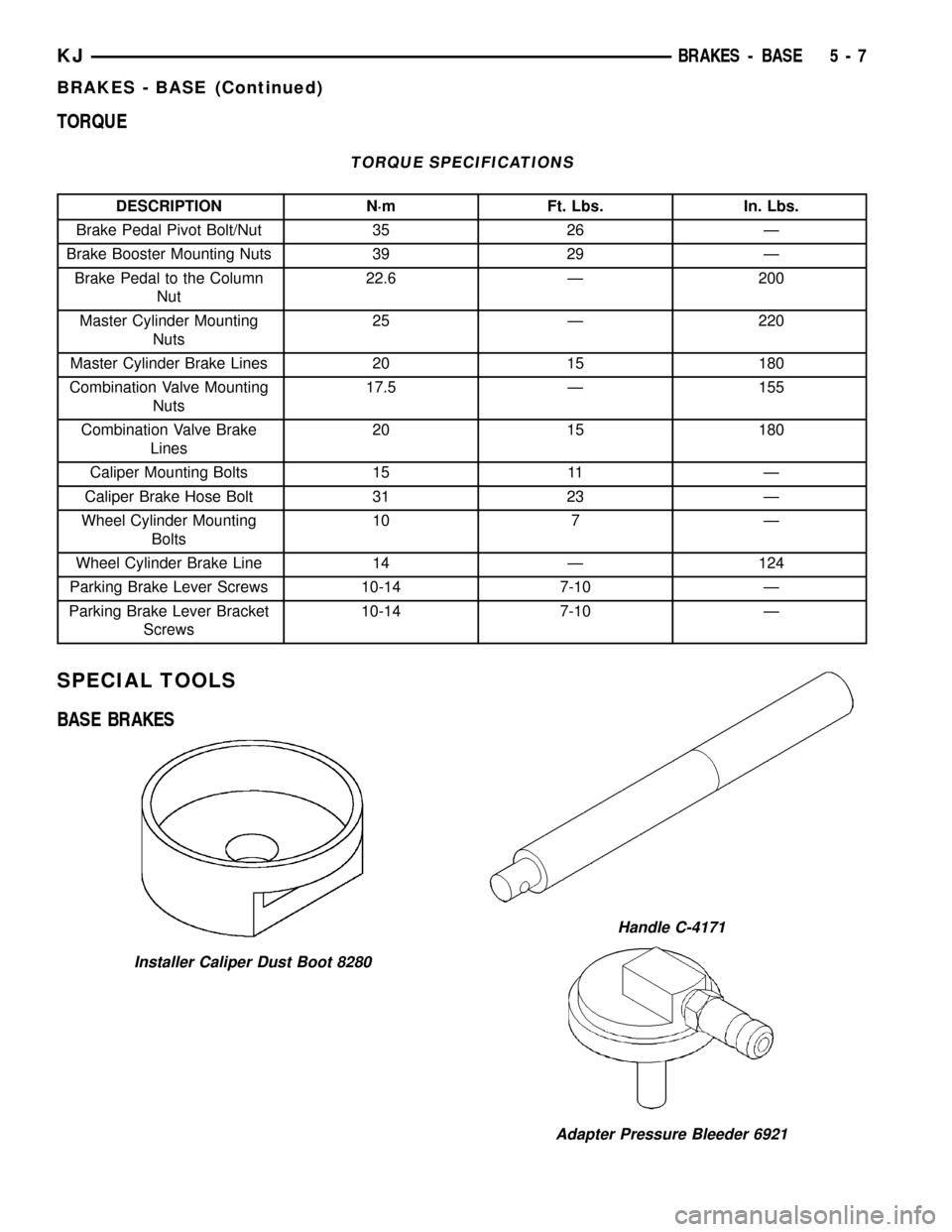
TORQUE
TORQUE SPECIFICATIONS
DESCRIPTION N´m Ft. Lbs. In. Lbs.
Brake Pedal Pivot Bolt/Nut 35 26 Ð
Brake Booster Mounting Nuts 39 29 Ð
Brake Pedal to the Column
Nut22.6 Ð 200
Master Cylinder Mounting
Nuts25 Ð 220
Master Cylinder Brake Lines 20 15 180
Combination Valve Mounting
Nuts17.5 Ð 155
Combination Valve Brake
Lines20 15 180
Caliper Mounting Bolts 15 11 Ð
Caliper Brake Hose Bolt 31 23 Ð
Wheel Cylinder Mounting
Bolts10 7 Ð
Wheel Cylinder Brake Line 14 Ð 124
Parking Brake Lever Screws 10-14 7-10 Ð
Parking Brake Lever Bracket
Screws10-14 7-10 Ð
SPECIAL TOOLS
BASE BRAKES
Installer Caliper Dust Boot 8280
Handle C-4171
Adapter Pressure Bleeder 6921
KJBRAKES - BASE 5 - 7
BRAKES - BASE (Continued)
Page 178 of 1803

OPERATION
When the brakes are applied fluid pressure is
exerted against the caliper piston. The fluid pressure
is exerted equally and in all directions. This means
pressure exerted against the caliper piston and
within the caliper bore will be equal (Fig. 14).
Fluid pressure applied to the piston is transmitted
directly to the inboard brake shoe. This forces the
shoe lining against the inner surface of the disc
brake rotor. At the same time, fluid pressure within
the piston bore forces the caliper to slide inward on
the mounting bolts. This action brings the outboard
brake shoe lining into contact with the outer surface
of the disc brake rotor.
In summary, fluid pressure acting simultaneously
on both piston and caliper, produces a strong clamp-
ing action. When sufficient force is applied, friction
will attempt to stop the rotors from turning and
bring the vehicle to a stop.
Application and release of the brake pedal gener-
ates only a very slight movement of the caliper and
piston. Upon release of the pedal, the caliper and pis-
ton return to a rest position. The brake shoes do not
retract an appreciable distance from the rotor. In
fact, clearance is usually at, or close to zero. The rea-
sons for this are to keep road debris from gettingbetween the rotor and lining and in wiping the rotor
surface clear each revolution.
The caliper piston seal controls the amount of pis-
ton extension needed to compensate for normal lining
wear.
During brake application, the seal is deflected out-
ward by fluid pressure and piston movement (Fig.
15). When the brakes (and fluid pressure) are
released, the seal relaxes and retracts the piston.
The amount of piston retraction is determined by
the amount of seal deflection. Generally the amount
is just enough to maintain contact between the pis-
ton and inboard brake shoe.
REMOVAL
(1) Install prop rod on the brake pedal to keep
pressure on the brake system.
(2) Raise and support vehicle.
(3) Remove front wheel and tire assembly.
(4) Drain small amount of fluid from master cylin-
der brake reservoir with suction gun.
(5) Remove the brake hose banjo bolt if replacing
caliper (Fig. 16).
(6) Remove the caliper mounting slide pin bolts
(Fig. 16).
(7) Remove the caliper from vehicle.
DISASSEMBLY
(1) Remove brake shoes from caliper.
(2) Drain brake fluid out of caliper.
(3) Take a piece of wood and pad it with one-inch
thickness of shop towels. Place this piece in the out-
board shoe side of the caliper in front of the piston.
This will cushion and protect caliper piston during
removal (Fig. 17).
Fig. 14 Brake Caliper Operation
1 - CALIPER
2 - PISTON
3 - PISTON BORE
4 - SEAL
5 - INBOARD SHOE
6 - OUTBOARD SHOE
Fig. 15 Lining Wear Compensation By Piston Seal
1 - PISTON
2 - CYLINDER BORE
3 - PISTON SEAL BRAKE PRESSURE OFF
4 - CALIPER HOUSING
5 - DUST BOOT
6 - PISTON SEAL BRAKE PRESSURE ON
5 - 14 BRAKES - BASEKJ
DISC BRAKE CALIPERS (Continued)
Page 179 of 1803

(4) Remove caliper piston withshort burstsof
low pressure compressed air. Direct air through fluid
inlet port and ease piston out of bore (Fig. 18).
CAUTION: Do not blow the piston out of the bore
with sustained air pressure. This could result in a
cracked piston. Use only enough air pressure to
ease the piston out.
WARNING: NEVER ATTEMPT TO CATCH THE PIS-
TON AS IT LEAVES THE BORE. THIS MAY RESULT
IN PERSONAL INJURY.(5) Remove caliper piston dust boot with suitable
pry tool (Fig. 19).
(6) Remove caliper piston seal with wood or plastic
tool (Fig. 20). Do not use metal tools as they will
scratch piston bore.
(7) Remove caliper mounting bolt bushings and
boots (Fig. 21).
Fig. 16 DISC BRAKE CALIPER
1 - DISC BRAKE CALIPER
2 - CALIPER SLIDE MOUNTING BOLTS
3 - BRAKE HOSE
4 - BANJO BOLT
5 - CALIPER ADAPTER MOUNTING BOLT
Fig. 17 PADDING CALIPER INTERIOR - TYPICAL
1 - SHOP TOWELS OR CLOTHS
2 - CALIPER
Fig. 18 CALIPER PISTON REMOVAL - TYPICAL
1 - AIR GUN
2 - CALIPER PISTON
3 - PADDING MATERIAL
Fig. 19 CALIPER PISTON DUST BOOT REMOVAL -
TYPICAL
1 - COLLAPSE BOOT WITH PUNCH OR SCREWDRIVER
2 - PISTON DUST BOOT
KJBRAKES - BASE 5 - 15
DISC BRAKE CALIPERS (Continued)
Page 180 of 1803

CLEANING
Clean the caliper components with clean brake
fluid or brake clean only. Wipe the caliper and piston
dry with lint free towels or use low pressure com-
pressed air.
CAUTION: Do not use gasoline, kerosene, thinner,
or similar solvents. These products may leave a
residue that could damage the piston and seal.
INSPECTION
The piston is made from a phenolic resin (plastic
material) and should be smooth and clean.
The piston must be replaced if cracked or scored.
Do not attempt to restore a scored piston surface by
sanding or polishing.
CAUTION: If the caliper piston is replaced, install
the same type of piston in the caliper. Never inter-
change phenolic resin and steel caliper pistons.The pistons, seals, seal grooves, caliper bore and
piston tolerances are different.
The bore can belightlypolished with a brake
hone to remove very minor surface imperfections
(Fig. 22). The caliper should be replaced if the bore is
severely corroded, rusted, scored, or if polishing
would increase bore diameter more than 0.025 mm
(0.001 inch).
ASSEMBLY
CAUTION: Dirt, oil, and solvents can damage cali-
per seals. Insure assembly area is clean and dry.
(1) Lubricate caliper piston bore, new piston seal
and piston with clean brake fluid.
(2) Lubricate caliper bushings and interior of
bushing boots with silicone grease.
(3) Install bushing boots in caliper, then insert
bushing into boot and push bushing into place (Fig.
23).
(4) Install new piston seal into seal groove with
finger (Fig. 24).
(5) Install new dust boot on caliper piston and seat
boot in piston groove (Fig. 25).
(6) Press piston into caliper bore by hand, use a
turn and push motion to work piston into seal (Fig.
26).
(7) Press caliper piston to bottom of bore.
(8) Seat dust boot in caliper with Installer Tool
C-4842 and Tool Handle C-4171 (Fig. 27).
(9) Replace caliper bleed screw if removed.
Fig. 20 PISTON SEAL REMOVAL - TYPICAL
1 - REMOVE SEAL WITH WOOD PENCIL OR SIMILAR TOOL
2 - PISTON SEAL
Fig. 21 MOUNTING BOLT BUSHING AND BOOT -
TYPICAL
1 - CALIPER SLIDE BUSHING
2 - BOOT
Fig. 22 POLISHING PISTON BORE - TYPICAL
1 - SPECIAL HONE
2 - CALIPER
3 - PISTON BORE
5 - 16 BRAKES - BASEKJ
DISC BRAKE CALIPERS (Continued)
Page 181 of 1803

INSTALLATION
(1) Install caliper to the caliper adapter.
(2) Coat the caliper mounting slide pin bolts with
silicone grease. Begin with the bolt closet to the
bleeder screws (top), Then install and tighten the
bolts to 15 N´m (11 ft. lbs.).
(3) Install the brake hose banjo bolt if removed.
Fig. 23 BUSHINGS AND BOOTS INSTALLATION -
TYPICAL
1 - BUSHING
2 - BOOT
Fig. 24 PISTON SEAL INSTALLATION - TYPICAL
1 - SEAL GROOVE
2 - PISTON SEAL
Fig. 25 DUST BOOT ON PISTON - TYPICAL
1 - PISTON
2 - DUST BOOT
Fig. 26 CALIPER PISTON INSTALLATION - TYPICAL
1 - PISTON
2 - BOOT
Fig. 27 PISTON DUST BOOT INSTALLATION -
TYPICAL
1 - HANDLE C-4171
2 - INSTALLER C-4842
3 - DUST BOOT
KJBRAKES - BASE 5 - 17
DISC BRAKE CALIPERS (Continued)
Page 192 of 1803

(9) Remove the axle shaft, (Refer to 3 - DIFFER-
ENTIAL & DRIVELINE/REAR AXLE - 8 1/4/AXLE
SHAFTS - REMOVAL).
(10) Remove the bolts attaching the support plate
to the axle and remove the support plate (Fig. 43).
INSTALLATION
INSTALLATION - 198 RBI AXLE
(1) Install the support plate on the axle flange.
Tighten 75 N´m (55 ft. lbs.)
(2) Install the axle, bearing and seal into the hous-
ing and tighten the four attaching bolts to 61 N´m
(45 ft. lbs.).
(3) Install the wheel cylinder,(Refer to 5 -
BRAKES/HYDRAULIC/MECHANICAL/WHEEL
CYLINDERS - INSTALLATION).
(4) Install the brake line in the wheel cylinder.
(5) Install the parking brake cable in the support
plate.
(6) Connect parking brake cable to lever on sec-
ondary shoe and install brake shoes on support plate.
(7) Adjust the brake shoes to the drum with the
brake gauge.
(8) Install the brake drum and wheel and tire
assembly (Refer to 22 - TIRES/WHEELS/WHEELS -
STANDARD PROCEDURE).
(9) Bleed brake system,(Refer to 5 - BRAKES -
STANDARD PROCEDURE) OR (Refer to 5 -
BRAKES - STANDARD PROCEDURE).
INSTALLATION - 8 1/4 AXLE
(1) Install the support plate on the axle flange.
Tighten attaching bolts to 61 N´m (45 ft. lbs.) (Fig.
43).(2) Install the wheel cylinder,(Refer to 5 -
BRAKES/HYDRAULIC/MECHANICAL/WHEEL
CYLINDERS - INSTALLATION).
(3) Install the brake line in the wheel cylinder and
tighten the line to 14 N´m (124 in.lbs.)..
(4) Remove the brake pedal prop rod.
(5) Install the parking brake cable in the support
plate.
(6) Install the axle shaft, (Refer to 3 - DIFFEREN-
TIAL & DRIVELINE/REAR AXLE - 8 1/4/AXLE
SHAFTS - INSTALLATION).
(7) Connect the parking brake cable to the lever on
the primary shoe and install the brake shoes on the
support plate (Refer to 5 - BRAKES/HYDRAULIC/
MECHANICAL/BRAKE PADS/SHOES - INSTALLA-
TION).
(8) Adjust the brake shoes to the drum with the
brake gauge (Refer to 5 - BRAKES/HYDRAULIC/
MECHANICAL/BRAKE PADS/SHOES - ADJUST-
MENTS).
(9) Install the brake drum.
(10) Install the wheel and tire assembly (Refer to
22 - TIRES/WHEELS/WHEELS - STANDARD PRO-
CEDURE).
(11) Bleed the brake system,(Refer to 5 - BRAKES
- STANDARD PROCEDURE).
WHEEL CYLINDERS
REMOVAL
(1) Remove wheel and tire assembly.
(2) Remove brake drum.
(3) Install brake pedal prop rod.
(4) Disconnect wheel cylinder brake line.
(5) Remove brake shoe return springs and move
shoes out of engagement with cylinder push rods.
(6) Remove cylinder attaching bolts and remove
cylinder from support plate (Fig. 44).
DISASSEMBLY
(1) Remove push rods and boots (Fig. 45).
(2) Press pistons, cups and spring and expander
out of cylinder bore.
(3) Remove bleed screw.
CLEANING
Clean the cylinder and pistons with clean brake
fluid or brake cleaner only. Do not use any other
cleaning agents.
Dry the cylinder and pistons with compressed air.
Do not use rags or shop towels to dry the cylinder
components. Lint from cloth material will adhere to
the cylinder bores and pistons.
Fig. 43 SUPPORT PLATE 8 1/4
1 - SUPPORT PLATE
2 - MOUNTING NUTS
5 - 28 BRAKES - BASEKJ
SUPPORT PLATE (Continued)
Page 193 of 1803

INSPECTION
Inspect the cylinder bore. Light discoloration and
dark stains in the bore are normal and will not
impair cylinder operation.
The cylinder bore can be lightly polished but only
with crocus cloth. Replace the cylinder if the bore is
scored, pitted or heavily corroded. Honing the bore to
restore the surface is not recommended.
Inspect the cylinder pistons. The piston surfaces
should be smooth and free of scratches, scoring and
corrosion. Replace the pistons if worn, scored, or cor-
roded. Do not attempt to restore the surface by sand-
ing or polishing.Discard the old piston cups and the spring and
expander. These parts are not reusable. The original
dust boots may be reused but only if they are in good
condition.
ASSEMBLY
(1) Lubricate wheel cylinder bore, pistons, piston
cups and spring and expander with clean brake fluid.
(2) Install first piston in cylinder bore. Then
install first cup in bore and against piston.Be sure
lip of piston cup is facing inward (toward
spring and expander) and flat side is against
piston.
(3) Install spring and expander followed by
remaining piston cup and piston.
(4) Install boots on each end of cylinder and insert
push rods in boots.
(5) Install cylinder bleed screw.
INSTALLATION
(1) Install cylinder mounting bolts and tighten to
20 N´m (15 ft. lbs.) (Fig. 44).
(2) Connect brake line to cylinder and tighten to
14 N´m (124 in. lbs.).
(3) Install the brake shoe return springs.
(4) Remove the brake pedal prop rod.
(5) Install the brake drum.
(6) Install the wheel and tire assembly (Refer to 22
- TIRES/WHEELS/WHEELS - STANDARD PROCE-
DURE).
(7) Bleed base brake system (Refer to 5 - BRAKES
- STANDARD PROCEDURE).
PARKING BRAKE
DESCRIPTION
The parking brake is a hand lever and cable oper-
ated system used to apply the rear brakes.
OPERATION
A hand operated lever in the passenger compart-
ment is the main application device. The front cable
is connected between the hand lever and the rear
cables with an equalizer.
The rear cables are connected to the actuating
lever on each primary brake shoe. The levers are
attached to the brake shoes by a pin either pressed
into, or welded to the lever. A clip is used to secure
the pin in the brake shoe. The pin allows each lever
to pivot independently of the brake shoe.
To apply the parking brakes, the hand lever is
pulled upward. This pulls the rear brake shoe actu-
ating levers forward, by means tensioner and cables.
As the actuating lever is pulled forward, the parking
brake strut (which is connected to both shoes), exerts
Fig. 44 WHEEL CYLINDER
1 - WHEEL CYLINDER
2 - SUPPORT PLATE
Fig. 45 Wheel Cylinder Components±Typical
1 - SPRING
2 - CYLINDER
3 - PISTON CLIP
4 - BOOT
5 - PUSH ROD
6 - PISTON
7 - BLEED SCREW
8 - CUP EXPANDERS
KJBRAKES - BASE 5 - 29
WHEEL CYLINDERS (Continued)
Page 388 of 1803

IGNITION CONTROL
TABLE OF CONTENTS
page page
IGNITION CONTROL
DESCRIPTION..........................1
OPERATION............................1
SPECIFICATIONS
SPECIFICATIONS - IGNITION TIMING.......2
ENGINE FIRING ORDER - 2.4L 4-CYLINDER . 2
ENGINE FIRING ORDER - 3.7L V-6.........2
IGNITION COIL RESISTANCE - 2.4L........2
IGNITION COIL RESISTANCE - 3.7L V-6.....3
SPARK PLUGS........................3
SPARK PLUG CABLE RESISTANCE - 2.4L . . . 3
TORQUE - IGNITION SYSTEM............3
AUTO SHUT DOWN RELAY
DESCRIPTION - PCM OUTPUT.............4
OPERATION
OPERATION - ASD SENSE - PCM INPUT....4
OPERATION - PCM OUTPUT.............4
DIAGNOSIS AND TESTING - ASD AND FUEL
PUMP RELAYS........................4
REMOVAL.............................5
INSTALLATION..........................5
CAMSHAFT POSITION SENSOR
DESCRIPTION
DESCRIPTION - 2.4L....................5
DESCRIPTION-3.7L.....................6
OPERATION
OPERATION - 2.4L.....................6OPERATION - 3.7L.....................6
REMOVAL.............................7
INSTALLATION..........................8
IGNITION COIL
DESCRIPTION..........................9
OPERATION............................9
REMOVAL.............................10
INSTALLATION.........................10
KNOCK SENSOR
DESCRIPTION.........................11
OPERATION...........................11
REMOVAL.............................12
INSTALLATION.........................12
SPARK PLUG
DESCRIPTION.........................12
OPERATION...........................12
DIAGNOSIS AND TESTING - SPARK PLUG
CONDITIONS.........................13
REMOVAL.............................15
CLEANING SPARK PLUGS................15
INSTALLATION.........................15
IGNITION COIL CAPACITOR
DESCRIPTION.........................16
OPERATION...........................16
REMOVAL.............................16
INSTALLATION.........................16
IGNITION CONTROL
DESCRIPTION
The ignition system consists of:
²Spark Plugs
²Ignition Coil(s)
²Powertrain Control Module (PCM)
²Crankshaft Position Sensor
²2 Knock Sensors (3.7L only)
²Camshaft Position Sensor
²The MAP, TPS, IAC and ECT also have an effect
on the control of the ignition system.
OPERATION
2.4L
A common ignition coil divided into 2 halves is
used. Secondary, high-tension spark plug cables are
also used. One half of the coil fires two spark plugs
simultaneously (one plug is the cylinder under com-pression, and the other plug is the cylinder on the
exhaust stroke). Coil half number one fires cylinders
1 and 4. Coil half number two fires cylinders 2 and 3.
The PCM determines which of the coils to charge and
fire at the correct time.
The Auto Shutdown (ASD) relay provides battery
voltage to the ignition coil. The PCM provides a
ground contact (circuit) for energizing the coil. When
the PCM breaks the contact, the energy in the coil
primary transfers to the secondary causing a spark.
The PCM will de-energize the ASD relay if it does
not receive inputs from either the crankshaft or cam-
shaft position sensors.
A distributor is not used with the 2.4L engine.
3.7L
The 3.7L V6 engine uses a separate ignition coil for
each cylinder. The one-piece coil bolts directly to the
cylinder head. Rubber boots seal the secondary ter-
minal ends of the coils to the top of all 6 spark plugs.
A separate electrical connector is used for each coil.
KJIGNITION CONTROL 8I - 1
Page 397 of 1803

cylinders 1 and 4, and coil number two fires cylinders
2 and 3.
The Auto Shutdown (ASD) relay provides battery
voltage to the ignition coil. The PCM provides a
ground contact (circuit) for energizing the coil(s). The
PCM will de-energize the ASD relay if it does not
receive the crankshaft position sensor and camshaft
position sensor inputs.
Base ignition timing is not adjustable.By con-
trolling the coil ground circuit, the PCM is able to set
the base timing and adjust the ignition timing
advance. This is done to meet changing engine oper-
ating conditions.
The ignition coil is not oil filled. The windings are
embedded in an epoxy compound. This provides heat
and vibration resistance that allows the ignition coil
to be mounted on the engine.
Spark plug cables (secondary wires or cables) are
used with the 2.4L engine.
3.7L
Battery voltage is supplied to the 6 ignition coils
from the ASD relay. The Powertrain Control Module
(PCM) opens and closes each ignition coil ground cir-
cuit at a determined time for ignition coil operation.
Base ignition timing is not adjustable.By con-
trolling the coil ground circuit, the PCM is able to set
the base timing and adjust the ignition timing
advance. This is done to meet changing engine oper-
ating conditions.
The ignition coil is not oil filled. The windings are
embedded in an epoxy compound. This provides heat
and vibration resistance that allows the ignition coil
to be mounted on the engine.
Because of coil design, spark plug cables (second-
ary cables) are not used with the 3.7L engine.
REMOVAL
2.4L
(1) Disconnect electrical connector at rear of coil.
(2) Remove all secondary cables from coil.
(3) Remove 4 coil mounting bolts (Fig. 17).
(4) Remove coil from vehicle.
3.7L
An individual ignition coil is used for each spark
plug (Fig. 19). The coil fits into machined holes in the
cylinder head. A mounting stud/nut secures each coil
to the top of the intake manifold (Fig. 18). The bot-
tom of the coil is equipped with a rubber boot to seal
the spark plug to the coil. Inside each rubber boot is
a spring. The spring is used for a mechanical contact
between the coil and the top of the spark plug. These
rubber boots and springs are a permanent part of the
coil and are not serviced separately. An o-ring (Fig.19) is used to seal the coil at the opening into the cyl-
inder head.
(1) Depending on which coil is being removed, the
throttle body air intake tube or intake box may need
to be removed to gain access to coil.
(2) Disconnect electrical connector from coil by
pushing downward on release lock on top of connec-
tor and pull connector from coil.
(3) Clean area at base of coil with compressed air
before removal.
(4) Remove coil mounting nut from mounting stud
(Fig. 18).
(5) Carefully pull up coil from cylinder head open-
ing with a slight twisting action.
(6) Remove coil from vehicle.
INSTALLATION
2.4L
(1) Position coil to engine.
(2) Install 4 mounting bolts. Refer to torque speci-
fications.
(3) Install secondary cables.
(4) Install electrical connector at rear of coil.
(5) Install air cleaner tube and housing.
3.7L
(1) Using compressed air, blow out any dirt or con-
taminants from around top of spark plug.
(2) Check condition of coil o-ring and replace as
necessary. To aid in coil installation, apply silicone to
coil o-ring.
Fig. 17 IGNITION COIL - 2.4L
1 - IGNITION COIL
2 - MOUNTING BOLTS (4)
8I - 10 IGNITION CONTROLKJ
IGNITION COIL (Continued)