gear shift JEEP LIBERTY 2002 KJ / 1.G User Guide
[x] Cancel search | Manufacturer: JEEP, Model Year: 2002, Model line: LIBERTY, Model: JEEP LIBERTY 2002 KJ / 1.GPages: 1803, PDF Size: 62.3 MB
Page 358 of 1803

TESTING
COLD CRANKING TEST
For complete starter wiring circuit diagrams, refer
to 8, Wiring Diagrams. The battery must be fully-
charged and load-tested before proceeding. Refer to
Batteryin 8, Battery.
(1) Connect volt-ampere tester to battery terminals
(Fig. 1). See instructions provided by manufacturer of
volt-ampere tester being used.Note: Certain diesel
equipped models use dual batteries. If equipped
with dual battery system, tester should be con-
nected to battery on left side of vehicle only.
Also, tester current reading must be taken from
positive battery cable lead that connects to
starter motor.
(2) Fully engage parking brake.
(3) If equipped with manual transmission, place
gearshift selector lever in Neutral position and block
clutch pedal in fully depressed position. If equipped
with automatic transmission, place gearshift selector
lever in Park position.
(4) Verify that all lamps and accessories are
turned off.
(5) To prevent a gasoline engine from starting,
remove Automatic ShutDown (ASD) relay. To prevent
a diesel engine from starting, remove Fuel Pump
Relay. These relays are located in Power Distribution
Center (PDC). Refer to label on PDC cover for relay
location.
WARNING: IF EQUIPPED WITH DIESEL ENGINE,
ATTEMPT TO START ENGINE A FEW TIMES
BEFORE PROCEEDING WITH FOLLOWING STEP.(6) Rotate and hold ignition switch in Start posi-
tion. Note cranking voltage and current (amperage)
draw readings shown on volt-ampere tester.
(a) If voltage reads below 9.6 volts, refer to
Starter Motorin Diagnosis and Testing. If starter
motor is OK, refer toEngine Diagnosisin 9,
Engine for further testing of engine. If starter
motor is not OK, replace faulty starter motor.
(b) If voltage reads above 9.6 volts and current
(amperage) draw reads below specifications, refer
toFeed Circuit Testin this section.
(c) If voltage reads 12.5 volts or greater and
starter motor does not turn, refer toControl Cir-
cuit Testingin this section.
(d) If voltage reads 12.5 volts or greater and
starter motor turns very slowly, refer toFeed Cir-
cuit Testin this section.
NOTE: A cold engine will increase starter current
(amperage) draw reading, and reduce battery volt-
age reading.
FEED CIRCUIT TEST
The starter feed circuit test (voltage drop method)
will determine if there is excessive resistance in
high-amperage feed circuit. For complete starter wir-
ing circuit diagrams, refer 8, Wiring Diagrams.
When performing these tests, it is important to
remember that voltage drop is giving an indication of
resistance between two points at which voltmeter
probes are attached.
Example:When testing resistance of positive bat-
tery cable, touch voltmeter leads to positive battery
cable clamp and cable connector at starter solenoid.
If you probe positive battery terminal post and cable
connector at starter solenoid, you are reading com-
bined voltage drop in positive battery cable clamp-to-
terminal post connection and positive battery cable.
The following operation will require a voltmeter
accurate to 1/10 (0.10) volt. Before performing tests,
be certain that following procedures are accom-
plished:
²Battery is fully-charged and load-tested. Refer to
Batteryin 8, Battery.
²Fully engage parking brake.
²If equipped with manual transmission, place
gearshift selector lever in Neutral position and block
clutch pedal in fully depressed position. If equipped
with automatic transmission, place gearshift selector
lever in Park position.
²Verify that all lamps and accessories are turned
off.
²To prevent a gasoline engine from starting,
remove Automatic ShutDown (ASD) relay. To prevent
a diesel engine from starting, remove Fuel Pump
Relay. These relays are located in Power Distribution
Fig. 1 Volts-Amps Tester Connections - Typical
1 - POSITIVE CLAMP
2 - NEGATIVE CLAMP
3 - INDUCTION AMMETER CLAMP
KJSTARTING SYSTEM 8F - 35
STARTING SYSTEM (Continued)
Page 365 of 1803

OPERATION
The ISO relay consists of an electromagnetic coil, a
resistor or diode, and three (two fixed and one mov-
able) electrical contacts. The movable (common feed)
relay contact is held against one of the fixed contacts
(normally closed) by spring pressure. When electro-
magnetic coil is energized, it draws the movable con-
tact away from normally closed fixed contact, and
holds it against the other (normally open) fixed con-
tact.
When electromagnetic coil is de-energized, spring
pressure returns movable contact to normally closed
position. The resistor or diode is connected in parallel
with electromagnetic coil within relay, and helps to
dissipate voltage spikes produced when coil is de-en-
ergized.
DIAGNOSIS AND TESTING - STARTER RELAY
The starter relay is located in the Power Distribu-
tion Center (PDC) in engine compartment. Refer to
label on PDC cover for relay location.
RELAY TEST
(1) Remove starter relay (Fig. 13) from PDC.
(2) A relay in de-energized position should have
continuity between terminals 87A and 30, and no
continuity between terminals 87 and 30. If OK, go to
Step 3. If not OK, replace faulty relay.
(3) Resistance between terminals 85 and 86 (elec-
tromagnet) should be 75 5 ohms. If OK, go to Step
4. If not OK, replace faulty relay.
(4) Connect a battery to terminals 85 and 86.
There should now be continuity between terminals
30 and 87, and no continuity between terminals 87A
and 30. If OK, perform following Relay Circuit Test.
If not OK, replace faulty relay.
RELAY CIRCUIT TEST
(1) The relay common feed terminal cavity (30) is
connected to battery voltage and should be hot at all
times. If OK, go to Step 2. If not OK, repair open cir-
cuit to fused B(+) fuse in PDC as required.
(2) The relay normally closed terminal (87A) is
connected to terminal 30 in de-energized position,
but is not used for this application. Go to Step 3.
(3) The relay normally open terminal (87) is con-
nected to common feed terminal (30) in energized
position. This terminal supplies battery voltage to
starter solenoid field coil. There should be continuity
between cavity for relay terminal 87 and starter sole-
noid terminal at all times. If OK, go to Step 4. If not
OK, repair open engine starter motor relay output
circuit to starter solenoid as required.
(4) The coil battery terminal (86) is connected to
electromagnet in relay. It is energized when ignition
switch is held in Start position. On vehicles with amanual transmission, the clutch pedal must be
blocked in fully depressed position for this test.
Check for battery voltage at cavity for relay terminal
86 with ignition switch in Start position, and no volt-
age when ignition switch is released to On position.
If OK, go to Step 5. If not OK with a manual trans-
mission, disconnect clutch pedal position switch wire
harness connector and install a jumper wire between
two cavities in body half of connector and check for
battery voltage again at cavity for relay terminal 86.
If now OK, replace faulty clutch pedal position
switch. If still not OK with a manual transmission or
if not OK with an automatic transmission, check for
open or shorted fused ignition switch output (start)
circuit to ignition switch and repair as required. If
fused ignition switch output (start) circuit is OK,
refer toIgnition Switch and Key Lock Cylinder.
(5) The coil ground terminal (85) is connected to
electromagnet in relay. On vehicles with manual
transmission, it is grounded at all times. On vehicles
with automatic transmission, it is grounded through
park/neutral position switch only when gearshift
selector lever is in Park or Neutral positions. Check
for continuity to ground at cavity for relay terminal
85. If not OK with a manual transmission, repair
open park/neutral position switch sense circuit to
ground as required. If not OK with an automatic
transmission, check for open or shorted park/neutral
position switch sense circuit to park/neutral position
switch and repair, as required. If park/neutral posi-
tion switch sense circuit checks OK, refer toPark/
Neutral Position Switch.
Fig. 13 STARTER RELAY (ISO MICRO RELAY)
30 - COMMON FEED
85 - COIL GROUND
86 - COIL BATTERY
87 - NORMALLY OPEN
87A - NORMALLY CLOSED
8F - 42 STARTING SYSTEMKJ
STARTER MOTOR RELAY (Continued)
Page 446 of 1803

trols for both the exterior and interior lighting sys-
tems.
²Park Lamp Relay- A park lamp relay is
located in the Junction Block (JB) of all vehicles.
²Rear Fog Lamp Relay- Vehicles manufac-
tured for certain markets where rear fog lamps are
required equipment have a rear fog lamp relay
located in the Junction Block (JB).
²Trailer Tow Adapter- Vehicles equipped with
a factory-installed trailer towing package have an
adapter provided that adapts the factory-installed
heavy duty 7-way trailer tow connector to a conven-
tional 4-way light duty connector.
²Trailer Tow Connector- Vehicles equipped
with a factory-installed trailer towing package have a
heavy duty 7-way trailer tow connector installed in a
bracket on the trailer hitch receiver.
²Trailer Tow Relays- Vehicles equipped with a
factory-installed trailer towing package have a con-
nector bank containing four relays located behind the
right quarter trim panel and over the right rear
wheel housing. The four relays are used to supply
fused ignition switch output (run), brake lamps, right
turn signal, and left turn signal outputs to a trailer
through the trailer tow wiring and connectors.
Hard wired circuitry connects the exterior lighting
system components to the electrical system of the
vehicle. These hard wired circuits are integral to sev-
eral wire harnesses, which are routed throughout the
vehicle and retained by many different methods.
These circuits may be connected to each other, to the
vehicle electrical system and to the exterior lighting
system components through the use of a combination
of soldered splices, splice block connectors, and many
different types of wire harness terminal connectors
and insulators. Refer to the appropriate wiring infor-
mation. The wiring information includes wiring dia-
grams, proper wire and connector repair procedures,
further details on wire harness routing and reten-
tion, as well as pin-out and location views for the
various wire harness connectors, splices and grounds.
OPERATION
Following are paragraphs that briefly describe the
operation of each of the major exterior lighting sys-
tems. The hard wired circuits and components of the
exterior lighting systems may be diagnosed and
tested using conventional diagnostic tools and proce-
dures. However, conventional diagnostic methods
may not prove conclusive in the diagnosis of the Body
Control Module (BCM), the ElectroMechanical
Instrument Cluster (EMIC), the Powertrain Control
Module (PCM), or the Programmable Communica-
tions Interface (PCI) data bus network. The most
reliable, efficient, and accurate means to diagnose
the BCM, the EMIC, the PCM, and the PCI data busnetwork inputs and outputs related to the various
exterior lighting systems requires the use of a
DRBIIItscan tool. Refer to the appropriate diagnos-
tic information.
BACKUP LAMPS
The backup (or reverse) lamps have a path to
ground at all times through their connection to the
rear lighting wire harness from a take out of the rear
body wire harness with an eyelet terminal connector
that is secured by a ground screw to the base of the
right D-pillar behind the quarter trim panel. The
backup lamps receive battery current from a fused
ignition switch output (run) fuse in the Junction
Block (JB) on the back-up lamp feed circuit only
when the backup lamp switch (manual transmission),
or backup lamp switch circuit of the Transmission
Range Sensor (TRS - electronic automatic transmis-
sion) is closed by the gearshift mechanism within the
transmission.
BRAKE LAMPS
The brake (or stop) lamps have a path to ground at
all times through their connection to the rear light-
ing wire harness from a take out of the rear body
wire harness with an eyelet terminal connector that
is secured by a screw to the base of the right D-pillar
behind the quarter trim panel. The Center High
Mounted Stop Lamp (CHMSL) has a path to ground
at all times through its connection to the rear body
wire harness from a take out of the rear body wire
harness with an eyelet terminal connector that is
secured by a ground screw to the driver side D-pillar
(left side D-pillar for left-hand drive, right side D-pil-
lar for right-hand drive) behind the quarter trim
panel. The brake lamps and CHMSL receive battery
current from a fused B(+) fuse in the Junction Block
(JB) on the brake lamp switch output circuit only
when the brake lamp switch circuit of the brake
lamp switch is closed by the brake pedal arm.
DAYTIME RUNNING LAMPS
Vehicles manufactured for sale in Canada illumi-
nate the high beam filament at a reduced intensity
when the engine is running and the exterior lamps
are turned off. This feature is enabled by the Body
Control Module (BCM) and a solid state Daytime
Running Lamps (DRL) relay, which is installed in the
Junction Block (JB) and the high beam relay is omit-
ted. When the BCM monitors an engine speed signal
of greater than 450 RPM and the status of the exte-
rior lighting switch input from the multi-function
switch is Off, the BCM duty cycles the DRL relay to
produce illumination of the headlamp high beam fil-
aments at a reduced intensity. The BCM also pro-
vides normal headlamp high beam operation through
the DRL relay on vehicles so equipped. When the
KJLAMPS/LIGHTING - EXTERIOR 8L - 5
LAMPS/LIGHTING - EXTERIOR (Continued)
Page 456 of 1803
SPECIFICATIONS - LAMPS/LIGHTING -
EXTERIOR
BULB SPECIFICATIONS
LAMP BULB
Backup 3157 P27/7W
Brake 3157 P27/7W
Center High Mounted
Stop921/W16W
Front Fog 9145
Front Park 3157 P27/7W
Front Position W5W
Front Side Marker 168
Front Turn 3157 P27/7W
Headlamp (North
America)9007QL
Headlamp (Rest-Of-
World)H-4 W0W6
License Plate (North
America)168
License Plate (Rest-Of-
World)W5W
Rear Fog 3157 P27/7W
Rear Park/Tail 3157 P27/7W
Rear Turn 3157 P27/7W
Side Repeater W5W
BACKUP LAMP SWITCH
DESCRIPTION
Vehicles equipped with a manual transmission
have a normally open, spring-loaded plunger type
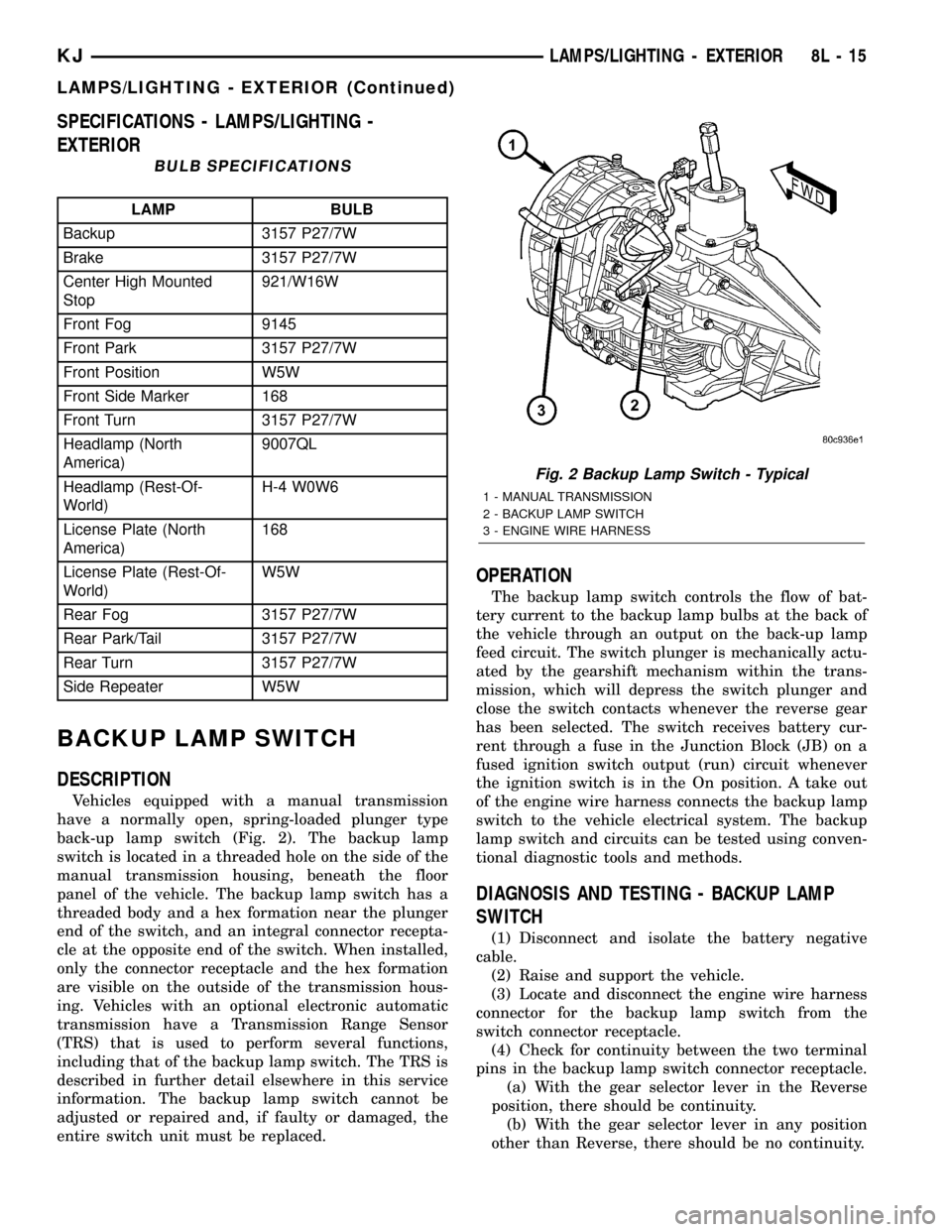
back-up lamp switch (Fig. 2). The backup lamp
switch is located in a threaded hole on the side of the
manual transmission housing, beneath the floor
panel of the vehicle. The backup lamp switch has a
threaded body and a hex formation near the plunger
end of the switch, and an integral connector recepta-
cle at the opposite end of the switch. When installed,
only the connector receptacle and the hex formation
are visible on the outside of the transmission hous-
ing. Vehicles with an optional electronic automatic
transmission have a Transmission Range Sensor
(TRS) that is used to perform several functions,
including that of the backup lamp switch. The TRS is
described in further detail elsewhere in this service
information. The backup lamp switch cannot be
adjusted or repaired and, if faulty or damaged, the
entire switch unit must be replaced.
OPERATION
The backup lamp switch controls the flow of bat-
tery current to the backup lamp bulbs at the back of
the vehicle through an output on the back-up lamp
feed circuit. The switch plunger is mechanically actu-
ated by the gearshift mechanism within the trans-
mission, which will depress the switch plunger and
close the switch contacts whenever the reverse gear
has been selected. The switch receives battery cur-
rent through a fuse in the Junction Block (JB) on a
fused ignition switch output (run) circuit whenever
the ignition switch is in the On position. A take out
of the engine wire harness connects the backup lamp
switch to the vehicle electrical system. The backup
lamp switch and circuits can be tested using conven-
tional diagnostic tools and methods.
DIAGNOSIS AND TESTING - BACKUP LAMP
SWITCH
(1) Disconnect and isolate the battery negative
cable.
(2) Raise and support the vehicle.
(3) Locate and disconnect the engine wire harness
connector for the backup lamp switch from the
switch connector receptacle.
(4) Check for continuity between the two terminal
pins in the backup lamp switch connector receptacle.
(a) With the gear selector lever in the Reverse
position, there should be continuity.
(b) With the gear selector lever in any position
other than Reverse, there should be no continuity.
Fig. 2 Backup Lamp Switch - Typical
1 - MANUAL TRANSMISSION
2 - BACKUP LAMP SWITCH
3 - ENGINE WIRE HARNESS
KJLAMPS/LIGHTING - EXTERIOR 8L - 15
LAMPS/LIGHTING - EXTERIOR (Continued)
Page 508 of 1803

mission have an illuminated transmission range indi-
cator integral to the console mounted gearshift
mechanism, and controlled by the panel lamps dim-
mer circuit.
²Vanity Lamps- Available single intensity van-
ity lamps are located on each side of a covered mirror
on both the right and left sun visors, and are con-
trolled by an integral vanity mirror cover-actuated
switch on the courtesy lamp circuit.
Other components of the interior lighting system
for this model include:
²Body Control Module- The Body Control
Module (BCM) is located on the Junction Block (JB)
under the driver side outboard end of the instrument
panel. (Refer to 8 - ELECTRICAL/ELECTRONIC
CONTROL MODULES/BODY CONTROL MODULE
- DESCRIPTION).
²Door Ajar Switches- A door ajar switch is
integral to the door latch mechanism of each front
and rear door.
²Flip-Up Glass Ajar Switch- A flip-up glass
ajar switch is integral to the flip-up glass latch mech-
anism on the top of the tailgate inner panel.
²Multi-Function Switch- The multi-function
switch is located on the top of the steering column,
just below the steering wheel. The multi-function
switch includes a left (lighting) control stalk and a
right (wiper) control stalk. The left control stalk is
dedicated to providing almost all of the driver con-
trols for both the exterior and interior lighting sys-
tems. (Refer to 8 - ELECTRICAL/LAMPS/LIGHTING
- EXTERIOR/MULTI-FUNCTION SWITCH -
DESCRIPTION).
²Tailgate Ajar Switch- A tailgate ajar switch is
integral to the latch mechanism of the tailgate.
Hard wired circuitry connects the interior lighting
system components to the electrical system of the
vehicle. These hard wired circuits are integral to sev-
eral wire harnesses, which are routed throughout the
vehicle and retained by many different methods.
These circuits may be connected to each other, to the
vehicle electrical system and to the interior lighting
system components through the use of a combination
of soldered splices, splice block connectors, and many
different types of wire harness terminal connectors
and insulators. Refer to the appropriate wiring infor-
mation. The wiring information includes wiring dia-
grams, proper wire and connector repair procedures,
further details on wire harness routing and reten-
tion, as well as pin-out and location views for the
various wire harness connectors, splices and grounds.
OPERATION
The interior lighting systems can be divided into
two general classifications based upon the circuit
that controls their operation: The courtesy lamp cir-cuit, or the panel lamps dimmer circuit. Following
are paragraphs that briefly describe the operation of
each of the major interior lighting systems. The hard
wired circuits and components of the interior lighting
systems may be diagnosed and tested using conven-
tional diagnostic tools and procedures. However, con-
ventional diagnostic methods may not prove
conclusive in the diagnosis of the Body Control Mod-
ule (BCM), the ElectroMechanical Instrument Clus-
ter (EMIC), or the Programmable Communications
Interface (PCI) data bus network. The most reliable,
efficient, and accurate means to diagnose the BCM,
the EMIC, and the PCI data bus network inputs and
outputs related to the various interior lighting sys-
tems requires the use of a DRBIIItscan tool. Refer
to the appropriate diagnostic information.
COURTESY LAMP CIRCUIT Depending upon the
selected vehicle options the courtesy lamp circuit
may include the courtesy lamps located below the
instrument panel, the dome or map/reading lamps
located in the headliner near the windshield, the
cargo lamp located in the headliner near the rear
roof header, and the vanity lamps located in the sun
visors. The lamps in the courtesy lamp circuit are
provided with battery current at all times from a
fused B(+) fuse in the Junction Block (JB) through a
fused B(+) circuit. The Body Control Module (BCM)
controls the ground path for these lamps using an
internal driver through the courtesy lamp driver cir-
cuit based upon hard wired inputs from the door ajar
switches, the flip-up glass ajar switch, and the tail-
gate ajar switch. After all of the ajar switch inputs to
the BCM transition to open, the BCM will keep the
lamps illuminated for about 27 seconds, then fade
the lamps to off (theater dimming) over about three
seconds.
The BCM also provides courtesy lamp operation
based upon a resistor multiplexed input from the
interior lighting control ring on the left (lighting)
control stalk of the multi-function switch through the
headlamp switch mux circuit, and in response to cer-
tain inputs from the optional Remote Keyless Entry
(RKE) system. A resistor multiplexed courtesy lamp
defeat input from the control ring on the left (light-
ing) control stalk of the multi-function switch will
cause the BCM to override normal courtesy lamp
operation based upon inputs from all of the ajar
switches. A hard wired input from the courtesy lamp
defeat switch in the optional cargo lamp through a
rear courtesy lamp control circuit will cause the BCM
to override normal courtesy lamp operation based
upon inputs from only the flip-up glass and tailgate
ajar switches.
For those lamps on the courtesy lamp circuit with
independent switching, such as the optional reading
lamps and vanity lamps, the BCM provides a ground
KJLAMPS/LIGHTING - INTERIOR 8L - 67
LAMPS/LIGHTING - INTERIOR (Continued)
Page 530 of 1803

²Trailer Tow Adapter- Vehicles equipped with
a factory-installed trailer towing package have an
adapter provided that adapts the factory-installed
heavy duty 7-way trailer tow connector to a conven-
tional 4-way light duty connector.
²Trailer Tow Connector- Vehicles equipped
with a factory-installed trailer towing package have a
heavy duty 7-way trailer tow connector installed in a
bracket on the trailer hitch receiver.
²Trailer Tow Relays- Vehicles equipped with a
factory-installed trailer towing package have a con-
nector bank containing four relays located behind the
right quarter trim panel and over the right rear
wheel housing. The four relays are used to supply
fused ignition switch output (run), brake lamps, right
turn signal, and left turn signal outputs to a trailer
through the trailer tow wiring and connectors.
Hard wired circuitry connects the exterior lighting
system components to the electrical system of the
vehicle. These hard wired circuits are integral to sev-
eral wire harnesses, which are routed throughout the
vehicle and retained by many different methods.
These circuits may be connected to each other, to the
vehicle electrical system and to the exterior lighting
system components through the use of a combination
of soldered splices, splice block connectors, and many
different types of wire harness terminal connectors
and insulators. Refer to the appropriate wiring infor-
mation. The wiring information includes wiring dia-
grams, proper wire and connector repair procedures,
further details on wire harness routing and reten-
tion, as well as pin-out and location views for the
various wire harness connectors, splices and grounds.
OPERATION
Following are paragraphs that briefly describe the
operation of each of the major exterior lighting sys-
tems. The hard wired circuits and components of the
exterior lighting systems may be diagnosed and
tested using conventional diagnostic tools and proce-
dures. However, conventional diagnostic methods
may not prove conclusive in the diagnosis of the Body
Control Module (BCM), the ElectroMechanical
Instrument Cluster (EMIC), the Powertrain Control
Module (PCM), or the Programmable Communica-
tions Interface (PCI) data bus network. The most
reliable, efficient, and accurate means to diagnose
the BCM, the EMIC, the PCM, and the PCI data bus
network inputs and outputs related to the various
exterior lighting systems requires the use of a
DRBIIItscan tool. Refer to the appropriate diagnos-
tic information.BACKUP LAMPS
The backup (or reverse) lamps have a path to
ground at all times through their connection to the
rear lighting wire harness from a take out of the rear
body wire harness with an eyelet terminal connector
that is secured by a ground screw to the base of the
right D-pillar behind the quarter trim panel. The
backup lamps receive battery current from a fused
ignition switch output (run) fuse in the Junction
Block (JB) on the back-up lamp feed circuit only
when the backup lamp switch (manual transmission),
or backup lamp switch circuit of the Transmission
Range Sensor (TRS - electronic automatic transmis-
sion) is closed by the gearshift mechanism within the
transmission.
BRAKE LAMPS
The brake (or stop) lamps have a path to ground at
all times through their connection to the rear light-
ing wire harness from a take out of the rear body
wire harness with an eyelet terminal connector that
is secured by a screw to the base of the right D-pillar
behind the quarter trim panel. The Center High
Mounted Stop Lamp (CHMSL) has a path to ground
at all times through its connection to the rear body
wire harness from a take out of the rear body wire
harness with an eyelet terminal connector that is
secured by a ground screw to the driver side D-pillar
(left side D-pillar for left-hand drive, right side D-pil-
lar for right-hand drive) behind the quarter trim
panel. The brake lamps and CHMSL receive battery
current from a fused B(+) fuse in the Junction Block
(JB) on the brake lamp switch output circuit only
when the brake lamp switch circuit of the brake
lamp switch is closed by the brake pedal arm.
DAYTIME RUNNING LAMPS
Vehicles manufactured for sale in Canada illumi-
nate the high beam filament at a reduced intensity
when the engine is running and the exterior lamps
are turned off. This feature is enabled by the Body
Control Module (BCM) and a solid state Daytime
Running Lamps (DRL) relay, which is installed in the
Junction Block (JB) and the high beam relay is omit-
ted. When the BCM monitors an engine speed signal
of greater than 450 RPM and the status of the exte-
rior lighting switch input from the multi-function
switch is Off, the BCM duty cycles the DRL relay to
produce illumination of the headlamp high beam fil-
aments at a reduced intensity. The BCM also pro-
vides normal headlamp high beam operation through
the DRL relay on vehicles so equipped. When the
DRL relay is energized, it provides battery current
from a fused B(+) fuse in the JB to the headlamp
high beam filament through the DRL relay output
circuit.
KJLAMPS8Ls-5
LAMPS/LIGHTING - EXTERIOR (Continued)
Page 540 of 1803
SPECIFICATIONS - LAMPS/LIGHTING -
EXTERIOR
BULB SPECIFICATIONS
LAMP BULB
Backup 3157 P27/7W
Brake 3157 P27/7W
Center High Mounted
Stop921/W16W
Front Fog 9145
Front Park 3157 P27/7W
Front Position W5W
Front Side Marker 168
Front Turn 3157 P27/7W
Headlamp (North
America)9007QL
Headlamp (Rest-Of-
World)H-4 W0W6
License Plate (North
America)168
License Plate (Rest-Of-
World)W5W
Rear Fog 3157 P27/7W
Rear Park/Tail 3157 P27/7W
Rear Turn 3157 P27/7W
Side Repeater W5W
BACKUP LAMP SWITCH
DESCRIPTION
Vehicles equipped with a manual transmission
have a normally open, spring-loaded plunger type
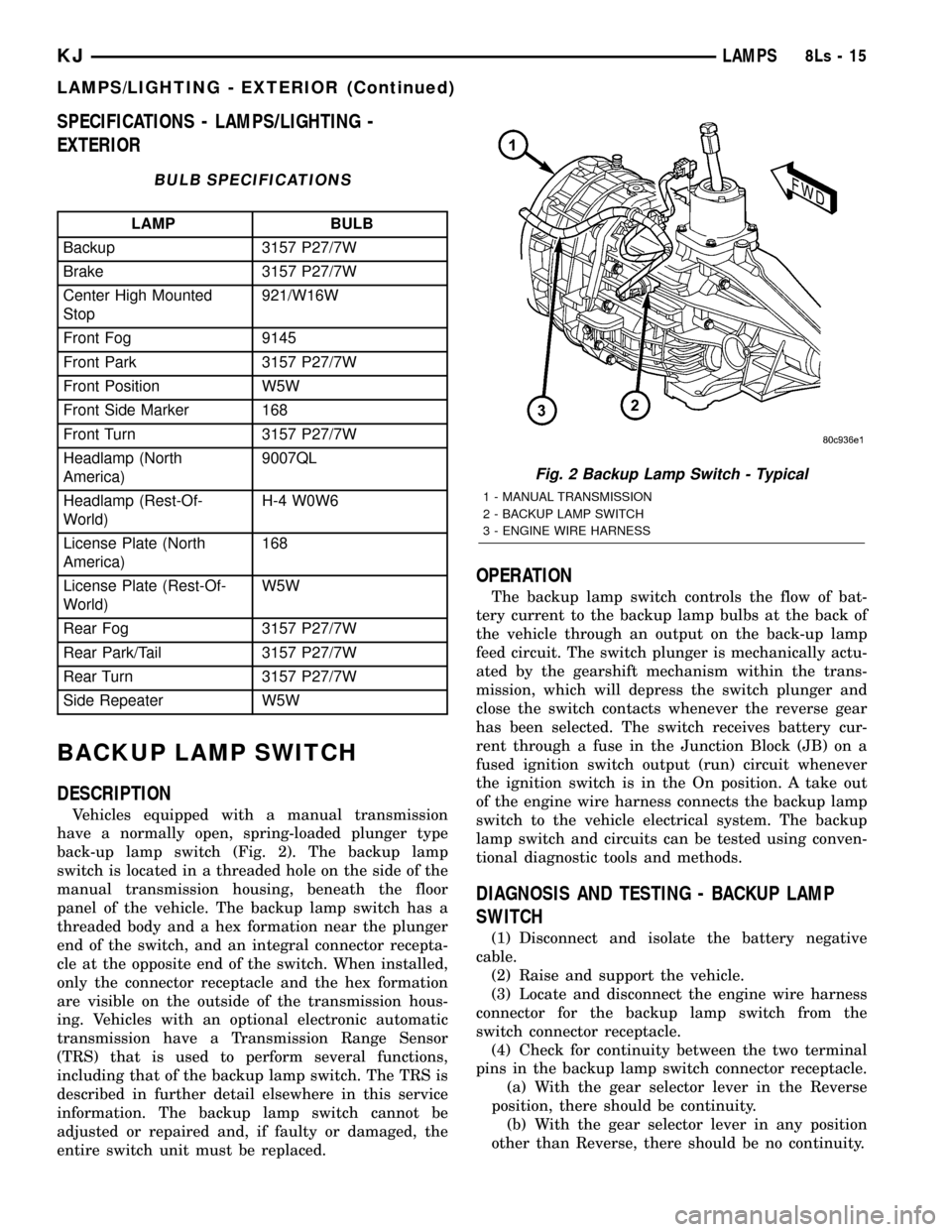
back-up lamp switch (Fig. 2). The backup lamp
switch is located in a threaded hole on the side of the
manual transmission housing, beneath the floor
panel of the vehicle. The backup lamp switch has a
threaded body and a hex formation near the plunger
end of the switch, and an integral connector recepta-
cle at the opposite end of the switch. When installed,
only the connector receptacle and the hex formation
are visible on the outside of the transmission hous-
ing. Vehicles with an optional electronic automatic
transmission have a Transmission Range Sensor
(TRS) that is used to perform several functions,
including that of the backup lamp switch. The TRS is
described in further detail elsewhere in this service
information. The backup lamp switch cannot be
adjusted or repaired and, if faulty or damaged, the
entire switch unit must be replaced.
OPERATION
The backup lamp switch controls the flow of bat-
tery current to the backup lamp bulbs at the back of
the vehicle through an output on the back-up lamp
feed circuit. The switch plunger is mechanically actu-
ated by the gearshift mechanism within the trans-
mission, which will depress the switch plunger and
close the switch contacts whenever the reverse gear
has been selected. The switch receives battery cur-
rent through a fuse in the Junction Block (JB) on a
fused ignition switch output (run) circuit whenever
the ignition switch is in the On position. A take out
of the engine wire harness connects the backup lamp
switch to the vehicle electrical system. The backup
lamp switch and circuits can be tested using conven-
tional diagnostic tools and methods.
DIAGNOSIS AND TESTING - BACKUP LAMP
SWITCH
(1) Disconnect and isolate the battery negative
cable.
(2) Raise and support the vehicle.
(3) Locate and disconnect the engine wire harness
connector for the backup lamp switch from the
switch connector receptacle.
(4) Check for continuity between the two terminal
pins in the backup lamp switch connector receptacle.
(a) With the gear selector lever in the Reverse
position, there should be continuity.
(b) With the gear selector lever in any position
other than Reverse, there should be no continuity.
Fig. 2 Backup Lamp Switch - Typical
1 - MANUAL TRANSMISSION
2 - BACKUP LAMP SWITCH
3 - ENGINE WIRE HARNESS
KJLAMPS8Ls-15
LAMPS/LIGHTING - EXTERIOR (Continued)
Page 1438 of 1803
SPECIFICATIONS
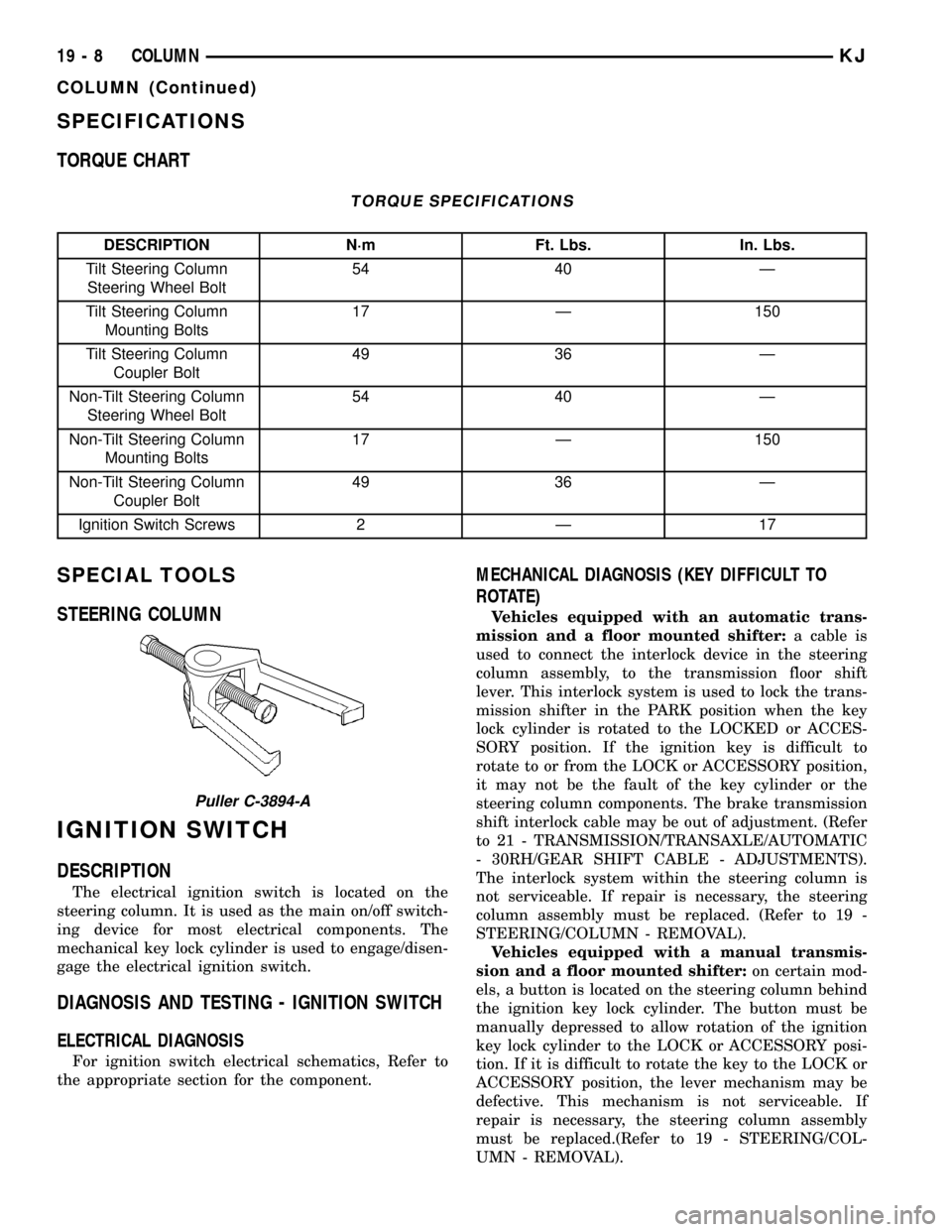
TORQUE CHART
TORQUE SPECIFICATIONS
DESCRIPTION N´m Ft. Lbs. In. Lbs.
Tilt Steering Column
Steering Wheel Bolt54 40 Ð
Tilt Steering Column
Mounting Bolts17 Ð 150
Tilt Steering Column
Coupler Bolt49 36 Ð
Non-Tilt Steering Column
Steering Wheel Bolt54 40 Ð
Non-Tilt Steering Column
Mounting Bolts17 Ð 150
Non-Tilt Steering Column
Coupler Bolt49 36 Ð
Ignition Switch Screws 2 Ð 17
SPECIAL TOOLS
STEERING COLUMN
IGNITION SWITCH
DESCRIPTION
The electrical ignition switch is located on the
steering column. It is used as the main on/off switch-
ing device for most electrical components. The
mechanical key lock cylinder is used to engage/disen-
gage the electrical ignition switch.
DIAGNOSIS AND TESTING - IGNITION SWITCH
ELECTRICAL DIAGNOSIS
For ignition switch electrical schematics, Refer to
the appropriate section for the component.
MECHANICAL DIAGNOSIS (KEY DIFFICULT TO
ROTATE)
Vehicles equipped with an automatic trans-
mission and a floor mounted shifter:a cable is
used to connect the interlock device in the steering
column assembly, to the transmission floor shift
lever. This interlock system is used to lock the trans-
mission shifter in the PARK position when the key
lock cylinder is rotated to the LOCKED or ACCES-
SORY position. If the ignition key is difficult to
rotate to or from the LOCK or ACCESSORY position,
it may not be the fault of the key cylinder or the
steering column components. The brake transmission
shift interlock cable may be out of adjustment. (Refer
to 21 - TRANSMISSION/TRANSAXLE/AUTOMATIC
- 30RH/GEAR SHIFT CABLE - ADJUSTMENTS).
The interlock system within the steering column is
not serviceable. If repair is necessary, the steering
column assembly must be replaced. (Refer to 19 -
STEERING/COLUMN - REMOVAL).
Vehicles equipped with a manual transmis-
sion and a floor mounted shifter:on certain mod-
els, a button is located on the steering column behind
the ignition key lock cylinder. The button must be
manually depressed to allow rotation of the ignition
key lock cylinder to the LOCK or ACCESSORY posi-
tion. If it is difficult to rotate the key to the LOCK or
ACCESSORY position, the lever mechanism may be
defective. This mechanism is not serviceable. If
repair is necessary, the steering column assembly
must be replaced.(Refer to 19 - STEERING/COL-
UMN - REMOVAL).
Puller C-3894-A
19 - 8 COLUMNKJ
COLUMN (Continued)
Page 1716 of 1803
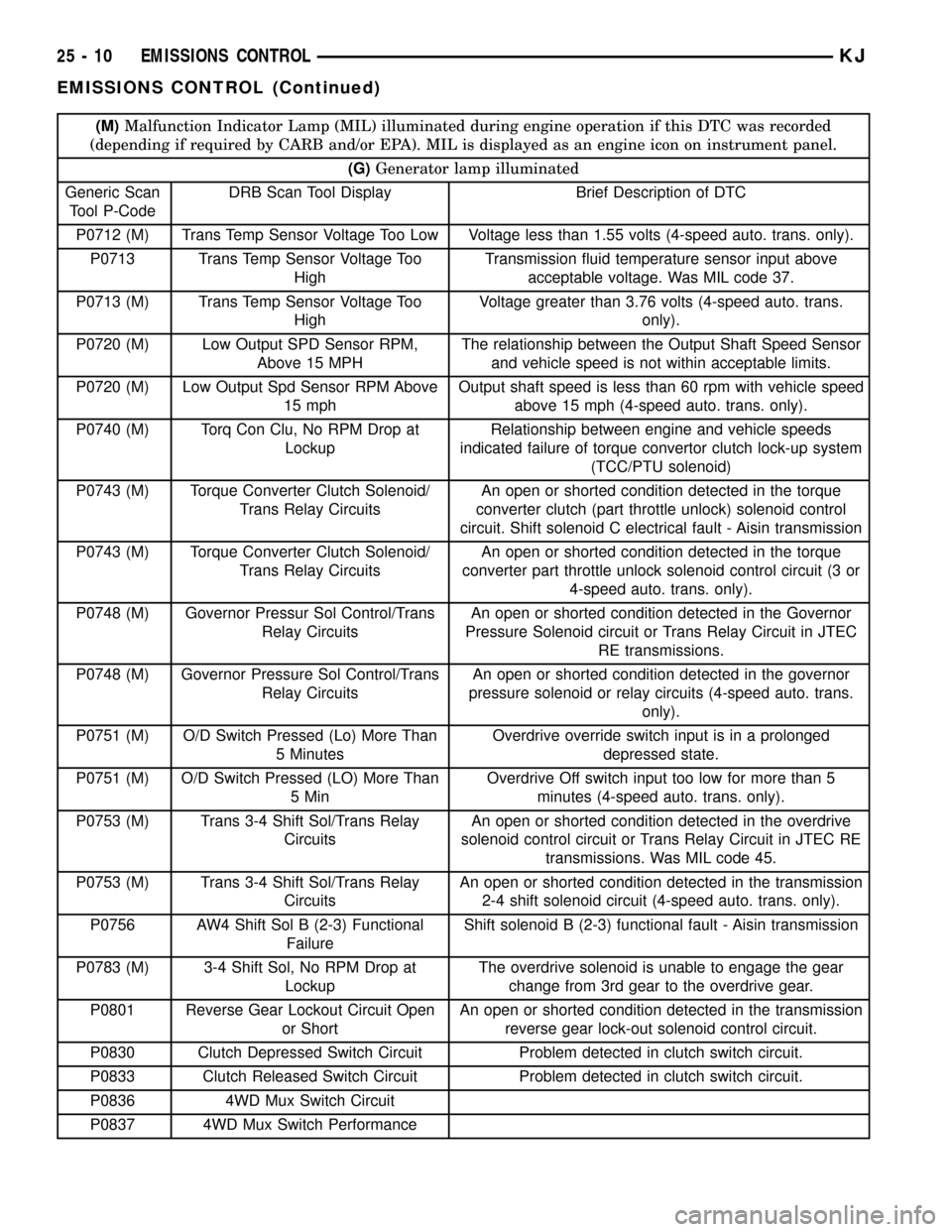
(M)Malfunction Indicator Lamp (MIL) illuminated during engine operation if this DTC was recorded
(depending if required by CARB and/or EPA). MIL is displayed as an engine icon on instrument panel.
(G)Generator lamp illuminated
Generic Scan
Tool P-CodeDRB Scan Tool Display Brief Description of DTC
P0712 (M) Trans Temp Sensor Voltage Too Low Voltage less than 1.55 volts (4-speed auto. trans. only).
P0713 Trans Temp Sensor Voltage Too
HighTransmission fluid temperature sensor input above
acceptable voltage. Was MIL code 37.
P0713 (M) Trans Temp Sensor Voltage Too
HighVoltage greater than 3.76 volts (4-speed auto. trans.
only).
P0720 (M) Low Output SPD Sensor RPM,
Above 15 MPHThe relationship between the Output Shaft Speed Sensor
and vehicle speed is not within acceptable limits.
P0720 (M) Low Output Spd Sensor RPM Above
15 mphOutput shaft speed is less than 60 rpm with vehicle speed
above 15 mph (4-speed auto. trans. only).
P0740 (M) Torq Con Clu, No RPM Drop at
LockupRelationship between engine and vehicle speeds
indicated failure of torque convertor clutch lock-up system
(TCC/PTU solenoid)
P0743 (M) Torque Converter Clutch Solenoid/
Trans Relay CircuitsAn open or shorted condition detected in the torque
converter clutch (part throttle unlock) solenoid control
circuit. Shift solenoid C electrical fault - Aisin transmission
P0743 (M) Torque Converter Clutch Solenoid/
Trans Relay CircuitsAn open or shorted condition detected in the torque
converter part throttle unlock solenoid control circuit (3 or
4-speed auto. trans. only).
P0748 (M) Governor Pressur Sol Control/Trans
Relay CircuitsAn open or shorted condition detected in the Governor
Pressure Solenoid circuit or Trans Relay Circuit in JTEC
RE transmissions.
P0748 (M) Governor Pressure Sol Control/Trans
Relay CircuitsAn open or shorted condition detected in the governor
pressure solenoid or relay circuits (4-speed auto. trans.
only).
P0751 (M) O/D Switch Pressed (Lo) More Than
5 MinutesOverdrive override switch input is in a prolonged
depressed state.
P0751 (M) O/D Switch Pressed (LO) More Than
5 MinOverdrive Off switch input too low for more than 5
minutes (4-speed auto. trans. only).
P0753 (M) Trans 3-4 Shift Sol/Trans Relay
CircuitsAn open or shorted condition detected in the overdrive
solenoid control circuit or Trans Relay Circuit in JTEC RE
transmissions. Was MIL code 45.
P0753 (M) Trans 3-4 Shift Sol/Trans Relay
CircuitsAn open or shorted condition detected in the transmission
2-4 shift solenoid circuit (4-speed auto. trans. only).
P0756 AW4 Shift Sol B (2-3) Functional
FailureShift solenoid B (2-3) functional fault - Aisin transmission
P0783 (M) 3-4 Shift Sol, No RPM Drop at
LockupThe overdrive solenoid is unable to engage the gear
change from 3rd gear to the overdrive gear.
P0801 Reverse Gear Lockout Circuit Open
or ShortAn open or shorted condition detected in the transmission
reverse gear lock-out solenoid control circuit.
P0830 Clutch Depressed Switch Circuit Problem detected in clutch switch circuit.
P0833 Clutch Released Switch Circuit Problem detected in clutch switch circuit.
P0836 4WD Mux Switch Circuit
P0837 4WD Mux Switch Performance
25 - 10 EMISSIONS CONTROLKJ
EMISSIONS CONTROL (Continued)
Page 1721 of 1803
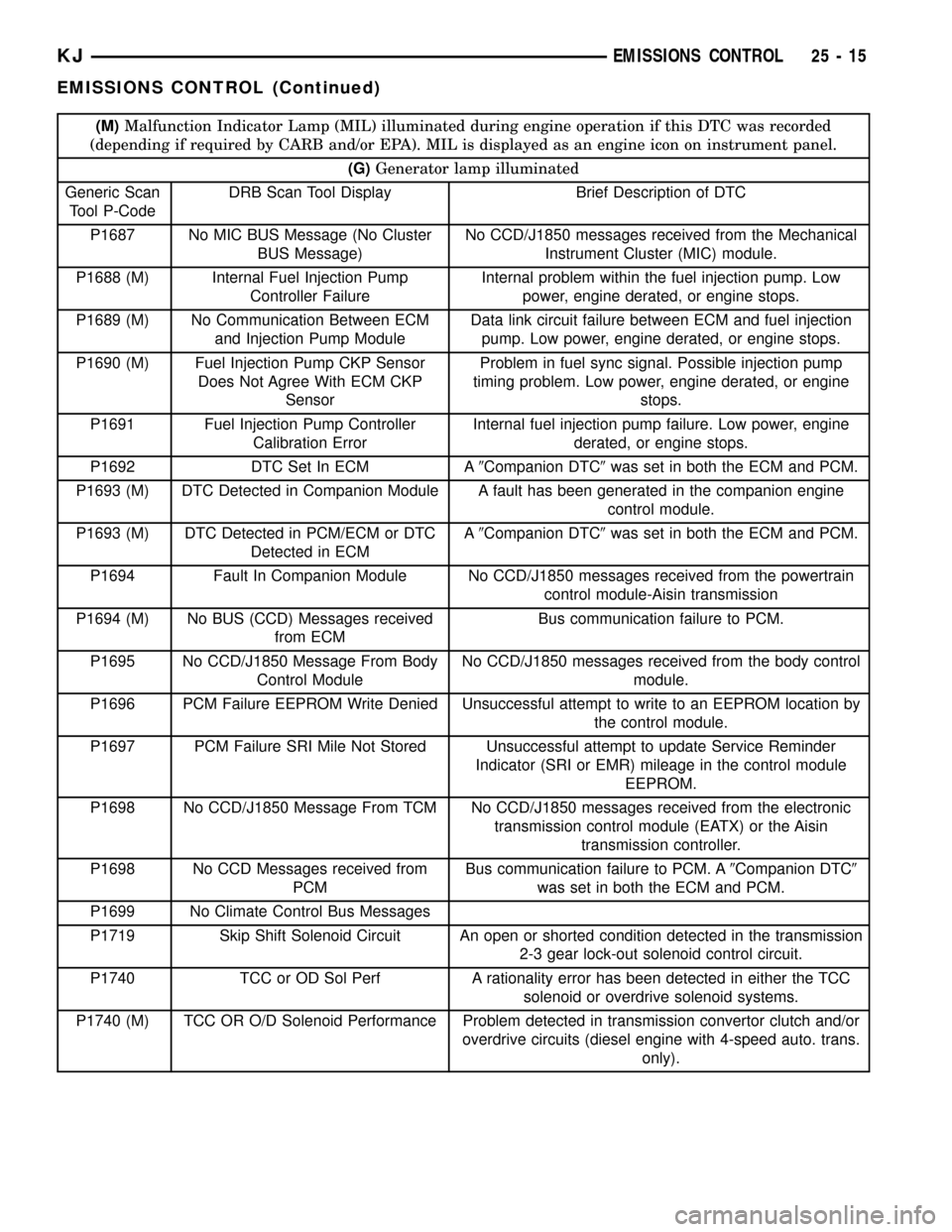
(M)Malfunction Indicator Lamp (MIL) illuminated during engine operation if this DTC was recorded
(depending if required by CARB and/or EPA). MIL is displayed as an engine icon on instrument panel.
(G)Generator lamp illuminated
Generic Scan
Tool P-CodeDRB Scan Tool Display Brief Description of DTC
P1687 No MIC BUS Message (No Cluster
BUS Message)No CCD/J1850 messages received from the Mechanical
Instrument Cluster (MIC) module.
P1688 (M) Internal Fuel Injection Pump
Controller FailureInternal problem within the fuel injection pump. Low
power, engine derated, or engine stops.
P1689 (M) No Communication Between ECM
and Injection Pump ModuleData link circuit failure between ECM and fuel injection
pump. Low power, engine derated, or engine stops.
P1690 (M) Fuel Injection Pump CKP Sensor
Does Not Agree With ECM CKP
SensorProblem in fuel sync signal. Possible injection pump
timing problem. Low power, engine derated, or engine
stops.
P1691 Fuel Injection Pump Controller
Calibration ErrorInternal fuel injection pump failure. Low power, engine
derated, or engine stops.
P1692 DTC Set In ECM A9Companion DTC9was set in both the ECM and PCM.
P1693 (M) DTC Detected in Companion Module A fault has been generated in the companion engine
control module.
P1693 (M) DTC Detected in PCM/ECM or DTC
Detected in ECMA9Companion DTC9was set in both the ECM and PCM.
P1694 Fault In Companion Module No CCD/J1850 messages received from the powertrain
control module-Aisin transmission
P1694 (M) No BUS (CCD) Messages received
from ECMBus communication failure to PCM.
P1695 No CCD/J1850 Message From Body
Control ModuleNo CCD/J1850 messages received from the body control
module.
P1696 PCM Failure EEPROM Write Denied Unsuccessful attempt to write to an EEPROM location by
the control module.
P1697 PCM Failure SRI Mile Not Stored Unsuccessful attempt to update Service Reminder
Indicator (SRI or EMR) mileage in the control module
EEPROM.
P1698 No CCD/J1850 Message From TCM No CCD/J1850 messages received from the electronic
transmission control module (EATX) or the Aisin
transmission controller.
P1698 No CCD Messages received from
PCMBus communication failure to PCM. A9Companion DTC9
was set in both the ECM and PCM.
P1699 No Climate Control Bus Messages
P1719 Skip Shift Solenoid Circuit An open or shorted condition detected in the transmission
2-3 gear lock-out solenoid control circuit.
P1740 TCC or OD Sol Perf A rationality error has been detected in either the TCC
solenoid or overdrive solenoid systems.
P1740 (M) TCC OR O/D Solenoid Performance Problem detected in transmission convertor clutch and/or
overdrive circuits (diesel engine with 4-speed auto. trans.
only).
KJEMISSIONS CONTROL 25 - 15
EMISSIONS CONTROL (Continued)