steering JEEP LIBERTY 2002 KJ / 1.G User Guide
[x] Cancel search | Manufacturer: JEEP, Model Year: 2002, Model line: LIBERTY, Model: JEEP LIBERTY 2002 KJ / 1.GPages: 1803, PDF Size: 62.3 MB
Page 32 of 1803

(11) Remove the clevis bracket at the shock. (Fig.
5)
(12) Remove the shock assembly from the vehicle.
(Fig. 5)
(13) Remove the spring from the shock (if needed).
(Refer to 2 - SUSPENSION/FRONT/SPRING -
REMOVAL).
INSTALLATION
INSTALLATION - LEFT SIDE
(1) Install the spring to the shock (if removed).
(2) Install the shock assembly to the vehicle.
(3) Install the four upper shock mounting nuts.
Tighten the nuts to 108 N´m (80 ft.lbs.).
(4) Install the clevis bracket at the shock. (Refer to
2 - SUSPENSION/FRONT/CLEVIS BRACKET -
INSTALLATION). Tighten the bolt to 88 N´m (65
ft.lbs.).
(5) Raise the lower control into place and recon-
nect the lower ball joint nut. Tighten the nut to 81
N´m (60 ft.lbs.).
(6) Install the clevis bracket at the lower control
arm. (Refer to 2 - SUSPENSION/FRONT/CLEVIS
BRACKET - INSTALLATION). Tighten the bolt to
150 N´m (110 ft.lbs.).(7) Install the lower stabilizer link at the lower
control arm. Tighten the bolt to 136 N´m (100 ft.lbs.)
(Refer to 2 - SUSPENSION/FRONT/STABILIZER
LINK - INSTALLATION).
(8) Install the left tire and wheel assembly. (Refer
to 22 - TIRES/WHEELS/WHEELS - STANDARD
PROCEDURE).
(9) Lower the vehicle.
(10) Reconnect the battery temperature sensor.
(11) Install the battery tray (Refer to 8 - ELEC-
TRICAL/BATTERY SYSTEM/TRAY - INSTALLA-
TION).
(12) Install the battery (Refer to 8 - ELECTRI-
CAL/BATTERY SYSTEM/BATTERY - INSTALLA-
TION).
(13) Reconnect the battery cables.
INSTALLATION - RIGHT SIDE
(1) Install the spring to the shock (if removed).
(Refer to 2 - SUSPENSION/FRONT/SPRING -
INSTALLATION).
(2) Install the shock assembly to the vehicle.
(3) Install the four upper shock mounting nuts.
Tighten the nuts to 108 N´m (80 ft.lbs.).
(4) Install the clevis bracket at the shock. (Refer to
2 - SUSPENSION/FRONT/CLEVIS BRACKET -
INSTALLATION). Tighten the bolt to 88 N´m (65
ft.lbs.).
(5) Raise the lower control into place and recon-
nect the lower ball joint nut. Tighten the nut to 81
N´m (60 ft.lbs.).
(6) Install the clevis bracket at the lower control
arm. (Refer to 2 - SUSPENSION/FRONT/CLEVIS
BRACKET - INSTALLATION). Tighten the bolt to
150 N´m (110 ft.lbs.).
(7) Install the lower stabilizer link at the lower
control arm. Tighten the bolt to 136 N´m (100 ft.lbs.)
(Refer to 2 - SUSPENSION/FRONT/STABILIZER
LINK - INSTALLATION).
(8) Install the right tire and wheel assembly.
(Refer to 22 - TIRES/WHEELS/WHEELS - STAN-
DARD PROCEDURE).
(9) Lower the vehicle.
(10) Install the cruise control servo mounting nuts.
(11) Install the airbox (Refer to 9 - ENGINE/AIR
INTAKE SYSTEM/AIR CLEANER ELEMENT -
INSTALLATION).
Fig. 5 SHOCK & CLEVIS ASSEMBLY
1 - FRONT CRADLE
2 - SPRING & SHOCK ASSEMBLY
3 - STEERING KNUCKLE
4 - CLEVIS BRACKET
5 - LOWER CONTROL ARM
2 - 12 FRONTKJ
SHOCK (Continued)
Page 34 of 1803

STABILIZER BAR
REMOVAL
(1) Raise and support the vehicle.
(2) Remove the tire and wheel assembly.
(3) Remove the upper stabilizer link bolts at the
stabilizer bar.
(4) Remove the stabilizer bar bushing clamps from
the frame (Fig. 8).
(5) Remove the stabilizer bar from the vehicle.
INSTALLATION
(1) Install the stabilizer bar to the vehicle.
(2) Install the stabilizer bar bushing clamps (Fig.
8). Tighten the nuts to 149 N´m (110 ft.lbs.).
(3) Install the upper stabilizer link bolts and
washer at the stabilizer bar. Tighten the bolt to 136
N´m (100 ft.lbs.).
(4) Install the tire and wheel assembly. (Refer to
22 - TIRES/WHEELS/WHEELS - STANDARD PRO-
CEDURE).
(5) Lower the vehicle.
STABILIZER LINK
REMOVAL
(1) Raise and support the vehicle.
(2) Remove the tire and wheel assembly.
(3) Remove the lower stabilizer link bolt at the
lower control arm.
(4) Remove the upper stabilizer link bolt at the
stabilizer bar.
(5) Remove the stabilizer link. (Fig. 9)
INSTALLATION
(1) Install the stabilizer link (Fig. 9).
(2) Install the upper stabilizer link bolt and
washer at the stabilizer bar. Tighten the bolt to 136
N´m (100 ft.lbs.).
(3) Install the lower stabilizer link bolt and
washer at the lower control arm. Tighten the nut to
115 N´m (85 ft.lbs.).
(4) Install the tire and wheel assembly. (Refer to
22 - TIRES/WHEELS/WHEELS - STANDARD PRO-
CEDURE).
UPPER CONTROL ARM
REMOVAL
REMOVAL - RIGHT SIDE
(1) Raise and support the vehicle.
(2) Remove the right side tire and wheel assembly.
(3) Remove the upper ball joint nut.
(4) Separate the upper ball joint from the steering
knuckle using tool C-4150A.
(5) Lower the vehicle.
(6) Remove the air box (Refer to 9 - ENGINE/AIR
INTAKE SYSTEM/AIR CLEANER ELEMENT -
REMOVAL).
(7) Remove the cruise control servo mounting nuts.
(8) Remove the upper control arm rear bolt.
(9) Remove the upper control arm front bolt.
(10) Remove the upper control arm from the vehi-
cle.
Fig. 8 SWAY BAR
1-SWAYBAR
2 - SWAY BAR BUSHINGS
Fig. 9 STABILIZER BAR LINK
1 - STABILIZER BAR
2 - STABILIZER BAR LINK
2 - 14 FRONTKJ
Page 35 of 1803

REMOVAL - LEFT SIDE
(1) Raise and support the vehicle.
(2) Remove the left side tire and wheel assembly.
(3) Remove the upper ball joint nut.
(4) Separate the upper ball joint from the steering
knuckle using tool C-4150A.
(5) Lower the vehicle.
(6) Remove the battery (Refer to 8 - ELECTRI-
CAL/BATTERY SYSTEM/BATTERY - REMOVAL).
(7) Unclip the power center and move it to the side
out of the way.
(8) Remove the battery tray (Refer to 8 - ELEC-
TRICAL/BATTERY SYSTEM/TRAY - REMOVAL).
(9) Disconnect the battery temperature sensor
from the battery tray.
(10) Remove the upper control arm rear bolt by
using a ratchet and extension under the steering
shaft and positioned by the power steering reservoir.
(Fig. 10)
(11) Remove the upper control arm front bolt.
(12) Remove the upper control arm from the vehi-
cle.
INSTALLATION
INSTALLATION - RIGHT SIDE
(1) Install the upper control arm to the vehicle.
(2) Install the upper control arm front bolt.
Tighten the bolt to 122 N´m (90 ft.lbs.).
(3) Install the upper control arm rear bolt. Tighten
the bolt to 122 N´m (90 ft.lbs.).
(4) Install the cruise control servo mounting nuts.(5) Install the air box (Refer to 9 - ENGINE/AIR
INTAKE SYSTEM/AIR CLEANER ELEMENT -
INSTALLATION).
(6) Install the upper ball joint nut. Tighten the nut
to 81 N´m (60 ft.lbs.).
(7) Install the right side tire and wheel assembly.
(Refer to 22 - TIRES/WHEELS/WHEELS - STAN-
DARD PROCEDURE).
(8) Lower the vehicle.
(9) Set the toe and center the steering wheel
(Refer to 2 - SUSPENSION/WHEEL ALIGNMENT -
STANDARD PROCEDURE).
INSTALLATION - LEFT SIDE
(1) Install the upper control arm to the vehicle.
(2) Install the upper control arm front bolt (Fig.
11). Tighten the bolt to 122 N´m (90 ft.lbs.).
(3) Install the upper control arm rear bolt (Fig.
11). Tighten the bolt to 122 N´m (90 ft.lbs.).
(4) Reconnect the battery temperature sensor to
the battery tray.
(5) Install the battery tray (Refer to 8 - ELECTRI-
CAL/BATTERY SYSTEM/TRAY - INSTALLATION).
(6) Install the battery (Refer to 8 - ELECTRICAL/
BATTERY SYSTEM/BATTERY - INSTALLATION).
(7) Reclip and mount the power center.
(8) Install the upper ball joint nut (Fig. 11).
Tighten the nut to 81 N´m (60 ft.lbs.).
(9) Install the left side tire and wheel assembly.
(Refer to 22 - TIRES/WHEELS/WHEELS - STAN-
DARD PROCEDURE).
(10) Lower the vehicle.
(11) Set the toe and center the steering wheel
(Refer to 2 - SUSPENSION/WHEEL ALIGNMENT -
STANDARD PROCEDURE).
Fig. 10 REAR BOLT
1 - STEERING SHAFT
2 - REAR BOLT
3 - RATCHET WITH AN EXTENSION
Fig. 11 UPPER CONTROL ARM
KJFRONT 2 - 15
UPPER CONTROL ARM (Continued)
Page 46 of 1803

LOWER BALL JOINT
REMOVAL
(1) Remove the tire and wheel assembly.
(2) Remove the brake caliper and rotor (Refer to 5
- BRAKES/HYDRAULIC/MECHANICAL/ROTORS -
REMOVAL).
(3) Disconnect the tie rod from the steering
knuckle (Refer to 19 - STEERING/LINKAGE/TIE
ROD END - REMOVAL).
(4) Remove the steering knuckle (Refer to 2 - SUS-
PENSION/FRONT/KNUCKLE - REMOVAL).
(5) Move the halfshaft to the side and support the
halfshaft out of the way (If Equipped).
NOTE: Extreme pressure lubrication must be used
on the threaded portions of the tool. This will
increase the longevity of the tool and insure proper
operation during the removal and installation pro-
cess.
(6) Secure the steering knuckle in a vise.
(7) Press the ball joint from the steering knuckle
using special tools C-4212±F (PRESS), 8859-2
(RECEIVER) and 8859-1 (DRIVER) (Fig. 7).
INSTALLATION
NOTE: Extreme pressure lubrication must be used
on the threaded portions of the tool. This will
increase the longevity of the tool and insure proper
operation during the removal and installation pro-
cess.(1) Install the ball joint into the steering knuckle
and press in using special tools C-4212±F (press),
8859-3 (driver) and 6761 (receiver) (Fig. 8).
(2) Install the ball joint boot.
(3) Remove the support for the halfshaft and
install into position (If Equipped).
(4) Install the steering knuckle (Refer to 2 - SUS-
PENSION/FRONT/KNUCKLE - INSTALLATION).
(5) Install the tie rod end into the steering knuckle
(Refer to 19 - STEERING/LINKAGE/TIE ROD END -
INSTALLATION).
(6) Install and tighten the halfshaft nut to 136
N´m (100 ft. lbs.).
(7) Install the brake caliper and rotor (Refer to 5 -
BRAKES/HYDRAULIC/MECHANICAL/ROTORS -
INSTALLATION).
(8) Install the tire and wheel assembly (Refer to 22
- TIRES/WHEELS/WHEELS - STANDARD PROCE-
DURE).
(9) Check the vehicle ride height (Refer to 2 - SUS-
PENSION/WHEEL ALIGNMENT - STANDARD
PROCEDURE).
(10) Perform a wheel alignment (Refer to 2 - SUS-
PENSION/WHEEL ALIGNMENT - STANDARD
PROCEDURE).
Fig. 7 LOWER BALL JOINT
1 - 8859-1 DRIVER
2 - C-4212F PRESS
3 - 8859-2 RECEIVER
Fig. 8 LOWER BALL JOINT
1 - 6761 RECEIVER
2 - 8859-3 DRIVER
3 - C-4212F PRESS
KJSUSPENSION 2s - 5
Page 60 of 1803
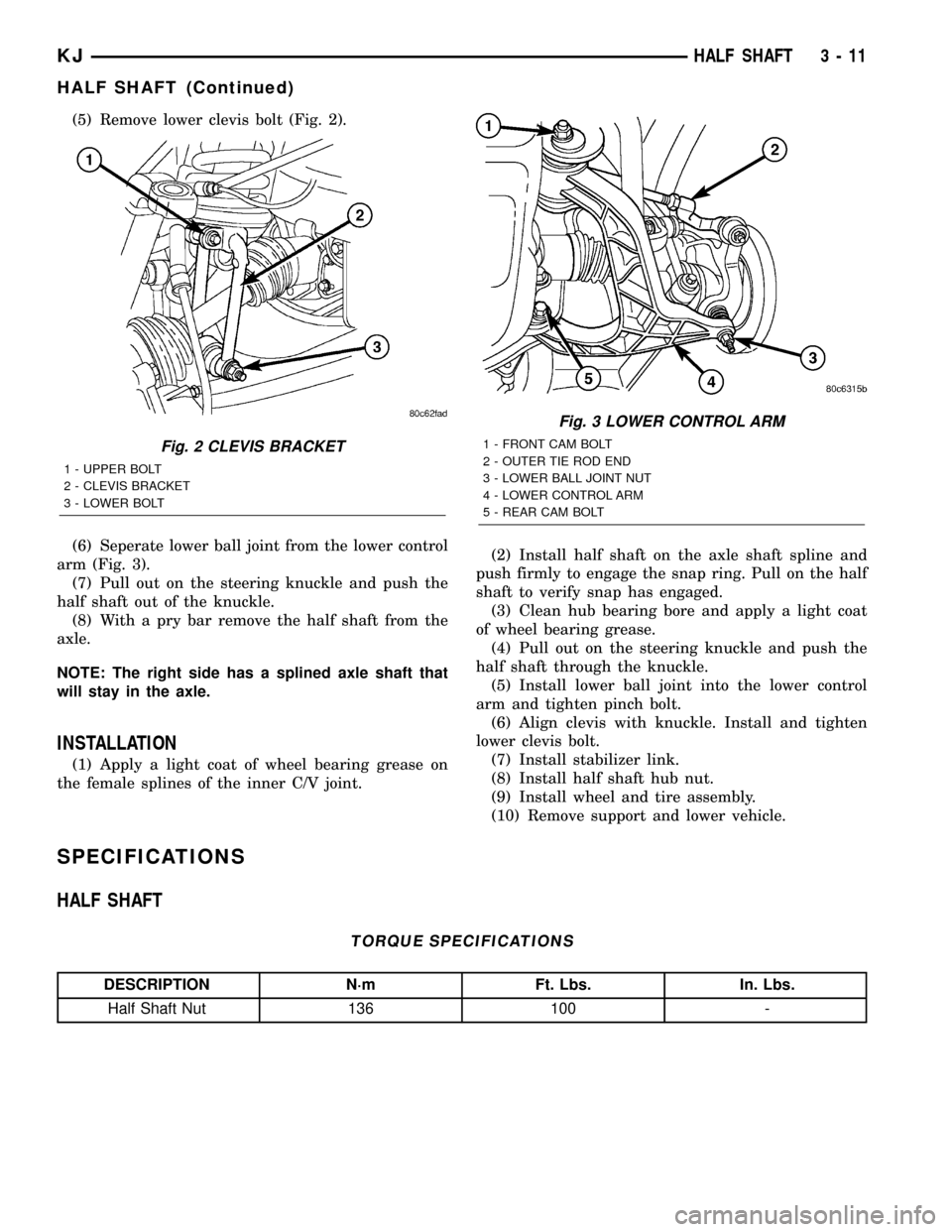
(5) Remove lower clevis bolt (Fig. 2).
(6) Seperate lower ball joint from the lower control
arm (Fig. 3).
(7) Pull out on the steering knuckle and push the
half shaft out of the knuckle.
(8) With a pry bar remove the half shaft from the
axle.
NOTE: The right side has a splined axle shaft that
will stay in the axle.
INSTALLATION
(1) Apply a light coat of wheel bearing grease on
the female splines of the inner C/V joint.(2) Install half shaft on the axle shaft spline and
push firmly to engage the snap ring. Pull on the half
shaft to verify snap has engaged.
(3) Clean hub bearing bore and apply a light coat
of wheel bearing grease.
(4) Pull out on the steering knuckle and push the
half shaft through the knuckle.
(5) Install lower ball joint into the lower control
arm and tighten pinch bolt.
(6) Align clevis with knuckle. Install and tighten
lower clevis bolt.
(7) Install stabilizer link.
(8) Install half shaft hub nut.
(9) Install wheel and tire assembly.
(10) Remove support and lower vehicle.
SPECIFICATIONS
HALF SHAFT
TORQUE SPECIFICATIONS
DESCRIPTION N´m Ft. Lbs. In. Lbs.
Half Shaft Nut 136 100 -
Fig. 3 LOWER CONTROL ARM
1 - FRONT CAM BOLT
2 - OUTER TIE ROD END
3 - LOWER BALL JOINT NUT
4 - LOWER CONTROL ARM
5 - REAR CAM BOLTFig. 2 CLEVIS BRACKET
1 - UPPER BOLT
2 - CLEVIS BRACKET
3 - LOWER BOLT
KJHALF SHAFT 3 - 11
HALF SHAFT (Continued)
Page 167 of 1803

CAUTION: Never use gasoline, kerosene, alcohol,
motor oil, transmission fluid, or any fluid containing
mineral oil to clean the system components. These
fluids damage rubber cups and seals. Use only
fresh brake fluid or Mopar brake cleaner to clean or
flush brake system components. These are the only
cleaning materials recommended. If system contam-
ination is suspected, check the fluid for dirt, discol-
oration, or separation into distinct layers. Also
check the reservoir cap seal for distortion. Drain
and flush the system with new brake fluid if con-
tamination is suspected.
CAUTION: Use Mopar brake fluid, or an equivalent
quality fluid meeting SAE/DOT standards J1703 and
DOT 3. Brake fluid must be clean and free of con-
taminants. Use fresh fluid from sealed containers
only to ensure proper antilock component opera-
tion.
CAUTION: Use Mopar multi-mileage or high temper-
ature grease to lubricate caliper slide surfaces,
drum brake pivot pins, and shoe contact points on
the backing plates. Use multi-mileage grease or GE
661 or Dow 111 silicone grease on caliper slide pins
to ensure proper operation.
DIAGNOSIS AND TESTING - BASE BRAKE
SYSTEM
Base brake components consist of the brake shoes,
calipers, wheel cylinders, brake drums, rotors, brake
lines, master cylinder, booster, and parking brake
components.
Brake diagnosis involves determining if the prob-
lem is related to a mechanical, hydraulic, or vacuum
operated component.
The first diagnosis step is the preliminary check.
PRELIMINARY BRAKE CHECK
(1) Check condition of tires and wheels. Damaged
wheels and worn, damaged, or underinflated tires
can cause pull, shudder, vibration, and a condition
similar to grab.
(2) If complaint was based on noise when braking,
check suspension components. Jounce front and rear
of vehicle and listen for noise that might be caused
by loose, worn or damaged suspension or steering
components.
(3) Inspect brake fluid level and condition. Note
that the brake reservoir fluid level will decrease in
proportion to normal lining wear.Also note that
brake fluid tends to darken over time. This is
normal and should not be mistaken for contam-
ination.(a) If fluid level is abnormally low, look for evi-
dence of leaks at calipers, wheel cylinders, brake
lines, and master cylinder.
(b) If fluid appears contaminated, drain out a
sample to examine. System will have to be flushed
if fluid is separated into layers, or contains a sub-
stance other than brake fluid. The system seals
and cups will also have to be replaced after flush-
ing. Use clean brake fluid to flush the system.
(4) Check parking brake operation. Verify free
movement and full release of cables and pedal. Also
note if vehicle was being operated with parking
brake partially applied.
(5) Check brake pedal operation. Verify that pedal
does not bind and has adequate free play. If pedal
lacks free play, check pedal and power booster for
being loose or for bind condition. Do not road test
until condition is corrected.
(6) Check booster vacuum check valve and hose.
(7) If components checked appear OK, road test
the vehicle.
ROAD TESTING
(1) If complaint involved low brake pedal, pump
pedal and note if it comes back up to normal height.
(2) Check brake pedal response with transmission
in Neutral and engine running. Pedal should remain
firm under constant foot pressure.
(3) During road test, make normal and firm brake
stops in 25-40 mph range. Note faulty brake opera-
tion such as low pedal, hard pedal, fade, pedal pulsa-
tion, pull, grab, drag, noise, etc.
(4) Attempt to stop the vehicle with the parking
brake only and note grab, drag, noise, etc.
PEDAL FALLS AWAY
A brake pedal that falls away under steady foot
pressure is generally the result of a system leak. The
leak point could be at a brake line, fitting, hose, or
caliper/wheel cylinder. If leakage is severe, fluid will
be evident at or around the leaking component.
Internal leakage (seal by-pass) in the master cylin-
der caused by worn or damaged piston cups, may
also be the problem cause.
An internal leak in the ABS or RWAL system may
also be the problem with no physical evidence.
LOW PEDAL
If a low pedal is experienced, pump the pedal sev-
eral times. If the pedal comes back up worn linings,
rotors, drums, or rear brakes out of adjustment are
the most likely causes. The proper course of action is
to inspect and replace all worn component and make
the proper adjustments.
KJBRAKES - BASE 5 - 3
BRAKES - BASE (Continued)
Page 169 of 1803

BRAKES DO NOT HOLD AFTER DRIVING THROUGH DEEP
WATER PUDDLES
This condition is generally caused by water soaked
lining. If the lining is only wet, it can be dried by
driving with the brakes very lightly applied for a
mile or two. However, if the lining is both soaked and
dirt contaminated, cleaning and/or replacement will
be necessary.
BRAKE LINING CONTAMINATION
Brake lining contamination is mostly a product of
leaking calipers or wheel cylinders, worn seals, driv-
ing through deep water puddles, or lining that has
become covered with grease and grit during repair.
Contaminated lining should be replaced to avoid fur-
ther brake problems.
WHEEL AND TIRE PROBLEMS
Some conditions attributed to brake components
may actually be caused by a wheel or tire problem.
A damaged wheel can cause shudder, vibration and
pull. A worn or damaged tire can also cause pull.
Severely worn tires with very little tread left can
produce a grab-like condition as the tire loses and
recovers traction. Flat-spotted tires can cause vibra-
tion and generate shudder during brake operation. A
tire with internal damage such as a severe bruise,
cut, or ply separation can cause pull and vibration.
BRAKE NOISES
Some brake noise is common with rear drum
brakes and on some disc brakes during the first few
stops after a vehicle has been parked overnight or
stored. This is primarily due to the formation of trace
corrosion (light rust) on metal surfaces. This light
corrosion is typically cleared from the metal surfaces
after a few brake applications causing the noise to
subside.
BRAKE SQUEAK/SQUEAL
Brake squeak or squeal may be due to linings that
are wet or contaminated with brake fluid, grease, or
oil. Glazed linings and rotors with hard spots can
also contribute to squeak. Dirt and foreign material
embedded in the brake lining will also cause squeak/
squeal.
A very loud squeak or squeal is frequently a sign of
severely worn brake lining. If the lining has worn
through to the brake shoes in spots, metal-to-metal
contact occurs. If the condition is allowed to continue,
rotors and drums can become so scored that replace-
ment is necessary.
BRAKE CHATTER
Brake chatter is usually caused by loose or worn
components, or glazed/burnt lining. Rotors with hard
spots can also contribute to chatter. Additional causesof chatter are out-of-tolerance rotors, brake lining not
securely attached to the shoes, loose wheel bearings
and contaminated brake lining.
THUMP/CLUNK NOISE
Thumping or clunk noises during braking are fre-
quentlynotcaused by brake components. In many
cases, such noises are caused by loose or damaged
steering, suspension, or engine components. However,
calipers that bind on the slide surfaces can generate
a thump or clunk noise. In addition, worn out,
improperly adjusted, or improperly assembled rear
brake shoes can also produce a thump noise.
STANDARD PROCEDURE
STANDARD PROCEDURE - PRESSURE
BLEEDING
Use Mopar brake fluid, or an equivalent quality
fluid meeting SAE J1703-F and DOT 3 standards
only. Use fresh, clean fluid from a sealed container at
all times.
Do not pump the brake pedal at any time while
bleeding. Air in the system will be compressed into
small bubbles that are distributed throughout the
hydraulic system. This will make additional bleeding
operations necessary.
Do not allow the master cylinder to run out of fluid
during bleed operations. An empty cylinder will allow
additional air to be drawn into the system. Check the
cylinder fluid level frequently and add fluid as
needed.
Bleed only one brake component at a time in the
following sequence:
²Master Cylinder
²Combination Valve
²Right Rear Wheel
²Left Rear Wheel
²Right Front Wheel
²Left Front Wheel
Follow the manufacturers instructions carefully
when using pressure equipment. Do not exceed the
tank manufacturers pressure recommendations. Gen-
erally, a tank pressure of 15-20 psi is sufficient for
bleeding.
Fill the bleeder tank with recommended fluid and
purge air from the tank lines before bleeding.
Do not pressure bleed without a proper master cyl-
inder adapter. The wrong adapter can lead to leak-
age, or drawing air back into the system. Use
adapter provided with the equipment or Adapter
6921.
KJBRAKES - BASE 5 - 5
BRAKES - BASE (Continued)
Page 184 of 1803

JUNCTION BLOCK
DESCRIPTION
The junction block and a rear brake proportioning
valve. The valve is not repairable and must be
replaced as an assembly if diagnosis indicates this is
necessary.
OPERATION
PROPORTIONING VALVE
The proportioning valve is used to balance front-
rear brake action at high decelerations. The valve
allows normal fluid flow during moderate braking.
The valve only controls fluid flow during high decel-
erations brake stops. If the primary brake hydraulic
circuit cannot build pressure a by-pass feature is
activated allowing full flow and pressure to the rear
brakes.
DIAGNOSIS AND TESTING - PROPORTIONING
VALVE
The valve controls fluid flow. If fluid enters the
valve and does not exit the valve the combination
valve must be replaced.
REMOVAL
(1) Install prop rod on the brake pedal to keep
pressure on the brake system.
(2) Remove the brake lines from the junction
block.
(3) Remove mounting nuts and bolt and remove
the junction block (Fig. 31).
INSTALLATION
(1) Install the junction block on the mounting
studs.
(2) Install mounting nuts and bolt. Tighten to 14
N´m (125 in. lbs.).
(3) Install brake lines to the junction block and
tighten to 20 N´m (180 in. lbs.).
(4) Bleed ABS brake system (Refer to 5 - BRAKES
- STANDARD PROCEDURE).
PEDAL
DESCRIPTION
A suspended-type brake pedal is used, the pedal
pivots on a shaft mounted in the steering coloumn
support bracket. The bracket is attached to the dash
panel. The unit is serviced as an assembly, except for
the pedal pad.
OPERATION
The brake pedal is attached to the booster push
rod. When the pedal is depressed, the primary
booster push rod is depressed which move the booster
secondary rod. The booster secondary rod depress the
master cylinder piston.
REMOVAL
(1) Remove the knee blocker under the steering
column,(Refer to 23 - BODY/INSTRUMENT PANEL/
KNEE BLOCKER - REMOVAL).
(2) Remove the retainer clip securing the booster
push rod to pedal (Fig. 32).
(3) Remove the brake lamp switch,(Refer to 8 -
ELECTRICAL/LAMPS/LIGHTING - EXTERIOR/
BRAKE LAMP SWITCH - REMOVAL).
(4) Remove the nuts securing the pedal to the col-
umn bracket.
(5) Remove the pedal from the vehicle.
INSTALLATION
(1) Install the pedal into the vehicle.
(2) Install the nuts securing the pedal to the col-
umn bracket.
(3) Tighten the nuts to 22.6 N´m (200 in. lbs.).
(4) Lubricate the brake pedal pin and bushings
with Mopar multi-mileage grease.
(5) Install the booster push rod on the pedal pin
and install a new retainer clip (Fig. 32).
(6) Install the brake lamp switch,(Refer to 8 -
ELECTRICAL/LAMPS/LIGHTING - EXTERIOR/
BRAKE LAMP SWITCH - INSTALLATION).
(7) Install the knee blocker,(Refer to 23 - BODY/
INSTRUMENT PANEL/KNEE BLOCKER - INSTAL-
LATION).
Fig. 31 JUNCTION BLOCK
1 - JUNCTION BLOCK
2 - MOUNTING NUT
5 - 20 BRAKES - BASEKJ
Page 187 of 1803

(6) Remove knee blocker under the steering colum-
n,(Refer to 23 - BODY/INSTRUMENT PANEL/KNEE
BLOCKER - REMOVAL).
(7) Remove retaining clip that secures booster
push rod to brake pedal (Fig. 36).(8) Remove nuts attaching booster to the dash
panel (Fig. 37).
(9) In engine compartment, slide booster studs out
of dash panel, tilt booster upward, and remove
booster from engine compartment.
INSTALLATION
(1) Align and position booster on the dash panel.
(2) Install booster mounting nuts. Tighten nuts
just enough to hold booster in place.
(3) Slide booster push rod onto the brake pedal.
Then secure push rod to pedal pin with retaining
clip.
NOTE: Lubricate the pedal pin and bushing with
Mopar multi-mileage grease before installation.
Fig. 34 Typical Booster Vacuum Test Connections
1 - TEE FITTING
2 - SHORT CONNECTING HOSE
3 - CHECK VALVE
4 - CHECK VALVE HOSE
5 - CLAMP TOOL
6 - INTAKE MANIFOLD
7 - VACUUM GAUGE
Fig. 35 TYPICAL - VACUUM CHECK VALVE AND
SEAL
1 - BOOSTER CHECK VALVE
2 - APPLY TEST VACUUM HERE
3 - VALVE SEAL
Fig. 36 BOOSTER PUSH ROD
1 - BRAKE PEDAL
2 - BOOSTER ROD
Fig. 37 BOOSTER MOUNTING
1 - BRAKE BOOSTER
KJBRAKES - BASE 5 - 23
POWER BRAKE BOOSTER (Continued)
Page 191 of 1803

SPECIFICATIONS
BRAKE FLUID
The brake fluid used in this vehicle must conform
to DOT 3 specifications and SAE J1703 standards.
No other type of brake fluid is recommended or
approved for usage in the vehicle brake system. Use
only Mopar brake fluid or an equivalent from a
tightly sealed container.
CAUTION: Never use reclaimed brake fluid or fluid
from an container which has been left open. An
open container will absorb moisture from the air
and contaminate the fluid.
CAUTION: Never use any type of a petroleum-based
fluid in the brake hydraulic system. Use of such
type fluids will result in seal damage of the vehicle
brake hydraulic system causing a failure of the
vehicle brake system. Petroleum based fluids would
be items such as engine oil, transmission fluid,
power steering fluid, etc.
DRUM
DIAGNOSIS AND TESTING - BRAKE DRUM
The maximum allowable diameter of the drum
braking surface is indicated on the drum outer edge.
Generally, a drum can be machined to a maximum of
1.52 mm (0.060 in.) oversize. Always replace the
drum if machining would cause drum diameter to
exceed the size limit indicated on the drum.
BRAKE DRUM RUNOUT
Measure drum diameter and runout with an accu-
rate gauge. The most accurate method of measure-
ment involves mounting the drum in a brake lathe
and checking variation and runout with a dial indi-
cator.
Variations in drum diameter should not exceed
0.076 mm (0.003 in.). Drum runout should not exceed
0.20 mm (0.008 in.) out of round. Machine the drum
if runout or variation exceed these values. Replace
the drum if machining causes the drum to exceed the
maximum allowable diameter.
STANDARD PROCEDURES - BRAKE DRUM
MACHINING
The brake drums can be machined on a drum lathe
when necessary. Initial machining cuts should be lim-
ited to 0.12 - 0.20 mm (0.005 - 0.008 in.) at a time as
heavier feed rates can produce taper and surface
variation. Final finish cuts of 0.025 to 0.038 mm(0.001 to 0.0015 in.) are recommended and will gen-
erally provide the best surface finish.
Be sure the drum is securely mounted in the lathe
before machining operations. A damper strap should
always be used around the drum to reduce vibration
and avoid chatter marks.
The maximum allowable diameter of the drum
braking surface is stamped or cast into the drum
outer edge.
CAUTION: Replace the drum if machining will cause
the drum to exceed the maximum allowable diame-
ter.
SUPPORT PLATE
REMOVAL
REMOVAL - 198 RBI AXLE
(1) Remove wheel and tire assembly.
(2) Remove the brake drum.
(3) Remove the brake shoes.
(4) Remove parking brake cable from parking
brake lever.
(5) Compress parking brake cable retainer tabs.
Then push retainer and cable through and out of
support plate.
(6) Disconnect brake line at wheel cylinder.
(7) Remove wheel cylinder from support plate,(Re-
fer to 5 - BRAKES/HYDRAULIC/MECHANICAL/
WHEEL CYLINDERS - REMOVAL).
(8) Remove the four bolts attaching the support
plate to axle and remove the support plate with the
axle, bearing and seal.
(9) Remove axle shaft,(Refer to 3 - DIFFEREN-
TIAL & DRIVELINE/REAR AXLE/AXLE SHAFTS -
REMOVAL).
REMOVAL - 8 1/4 AXLE
(1) Remove the wheel and tire assembly.
(2) Remove the brake drum.
(3) Install the brake pedal prop rod.
(4) Remove the brake shoes (Refer to 5 - BRAKES/
HYDRAULIC/MECHANICAL/BRAKE PADS/SHOES
- REMOVAL).
(5) Remove parking brake cable from parking
brake lever.
(6) Compress parking brake cable retainer tabs.
Then push retainer and cable through and out of
support plate.
(7) Disconnect the brake line at wheel cylinder.
(8) Remove the wheel cylinder from the support
plate,(Refer to 5 - BRAKES/HYDRAULIC/MECHAN-
ICAL/WHEEL CYLINDERS - REMOVAL).
KJBRAKES - BASE 5 - 27
FLUID (Continued)