Tab 9 JEEP LIBERTY 2002 KJ / 1.G Owner's Manual
[x] Cancel search | Manufacturer: JEEP, Model Year: 2002, Model line: LIBERTY, Model: JEEP LIBERTY 2002 KJ / 1.GPages: 1803, PDF Size: 62.3 MB
Page 37 of 1803
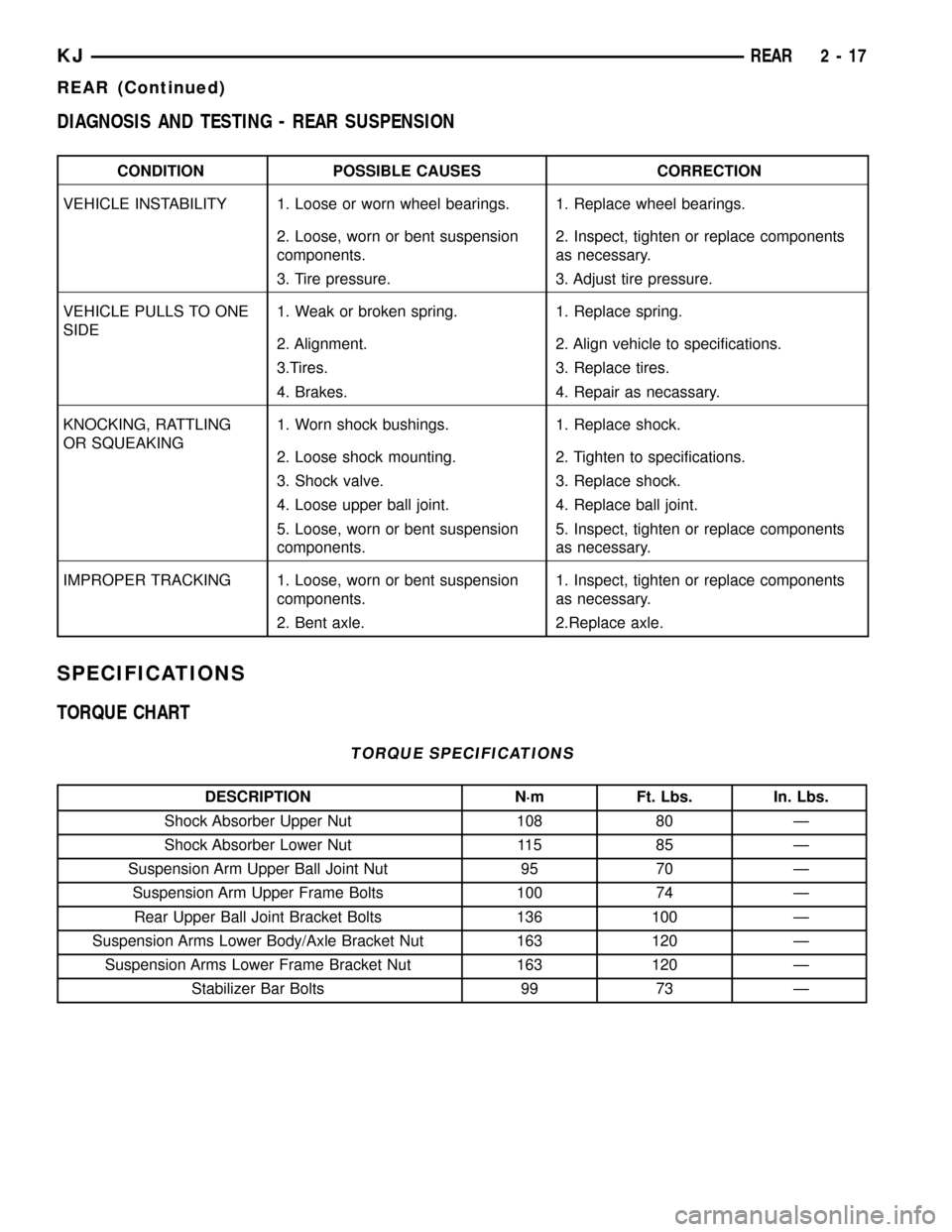
DIAGNOSIS AND TESTING - REAR SUSPENSION
CONDITION POSSIBLE CAUSES CORRECTION
VEHICLE INSTABILITY 1. Loose or worn wheel bearings. 1. Replace wheel bearings.
2. Loose, worn or bent suspension
components.2. Inspect, tighten or replace components
as necessary.
3. Tire pressure. 3. Adjust tire pressure.
VEHICLE PULLS TO ONE
SIDE1. Weak or broken spring. 1. Replace spring.
2. Alignment. 2. Align vehicle to specifications.
3.Tires. 3. Replace tires.
4. Brakes. 4. Repair as necassary.
KNOCKING, RATTLING
OR SQUEAKING1. Worn shock bushings. 1. Replace shock.
2. Loose shock mounting. 2. Tighten to specifications.
3. Shock valve. 3. Replace shock.
4. Loose upper ball joint. 4. Replace ball joint.
5. Loose, worn or bent suspension
components.5. Inspect, tighten or replace components
as necessary.
IMPROPER TRACKING 1. Loose, worn or bent suspension
components.1. Inspect, tighten or replace components
as necessary.
2. Bent axle. 2.Replace axle.
SPECIFICATIONS
TORQUE CHART
TORQUE SPECIFICATIONS
DESCRIPTION N´m Ft. Lbs. In. Lbs.
Shock Absorber Upper Nut 108 80 Ð
Shock Absorber Lower Nut 115 85 Ð
Suspension Arm Upper Ball Joint Nut 95 70 Ð
Suspension Arm Upper Frame Bolts 100 74 Ð
Rear Upper Ball Joint Bracket Bolts 136 100 Ð
Suspension Arms Lower Body/Axle Bracket Nut 163 120 Ð
Suspension Arms Lower Frame Bracket Nut 163 120 Ð
Stabilizer Bar Bolts 99 73 Ð
KJREAR 2 - 17
REAR (Continued)
Page 38 of 1803
SHOCK
REMOVAL
(1) Raise and support the vehicle. Position a
hydraulic jack under the axle to support the axle.
CAUTION: Do not allow the axle to hang from the
upper suspension arm ball joint.
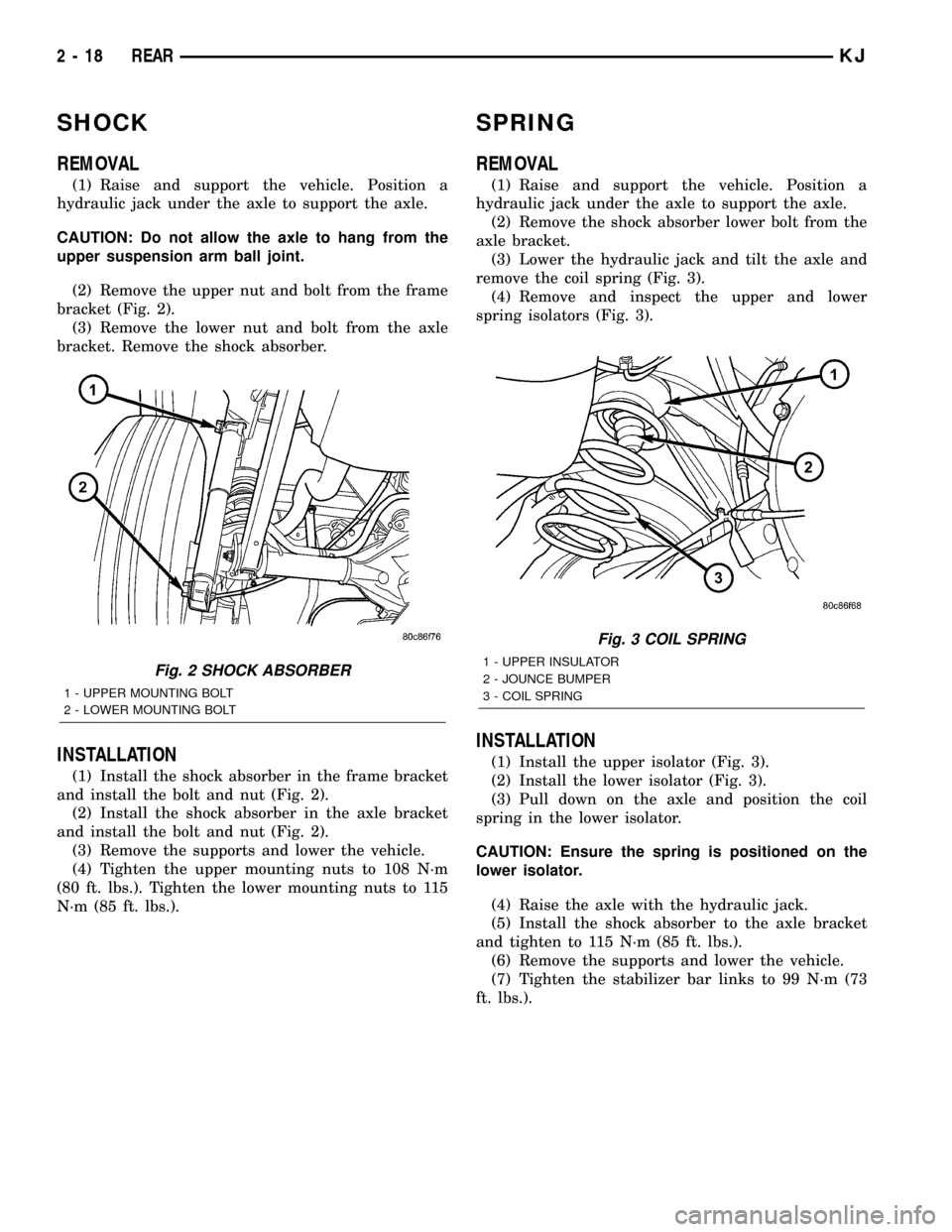
(2) Remove the upper nut and bolt from the frame
bracket (Fig. 2).
(3) Remove the lower nut and bolt from the axle
bracket. Remove the shock absorber.
INSTALLATION
(1) Install the shock absorber in the frame bracket
and install the bolt and nut (Fig. 2).
(2) Install the shock absorber in the axle bracket
and install the bolt and nut (Fig. 2).
(3) Remove the supports and lower the vehicle.
(4) Tighten the upper mounting nuts to 108 N´m
(80 ft. lbs.). Tighten the lower mounting nuts to 115
N´m (85 ft. lbs.).
SPRING
REMOVAL
(1) Raise and support the vehicle. Position a
hydraulic jack under the axle to support the axle.
(2) Remove the shock absorber lower bolt from the
axle bracket.
(3) Lower the hydraulic jack and tilt the axle and
remove the coil spring (Fig. 3).
(4) Remove and inspect the upper and lower
spring isolators (Fig. 3).
INSTALLATION
(1) Install the upper isolator (Fig. 3).
(2) Install the lower isolator (Fig. 3).
(3) Pull down on the axle and position the coil
spring in the lower isolator.
CAUTION: Ensure the spring is positioned on the
lower isolator.
(4) Raise the axle with the hydraulic jack.
(5) Install the shock absorber to the axle bracket
and tighten to 115 N´m (85 ft. lbs.).
(6) Remove the supports and lower the vehicle.
(7) Tighten the stabilizer bar links to 99 N´m (73
ft. lbs.).
Fig. 2 SHOCK ABSORBER
1 - UPPER MOUNTING BOLT
2 - LOWER MOUNTING BOLT
Fig. 3 COIL SPRING
1 - UPPER INSULATOR
2 - JOUNCE BUMPER
3 - COIL SPRING
2 - 18 REARKJ
Page 39 of 1803
JOUNCE BUMPER
REMOVAL
(1) Remove the shock (Refer to 2 - SUSPENSION/
REAR/SHOCK - REMOVAL).
(2) Remove the coil spring (Refer to 2 - SUSPEN-
SION/REAR/SPRING - REMOVAL).
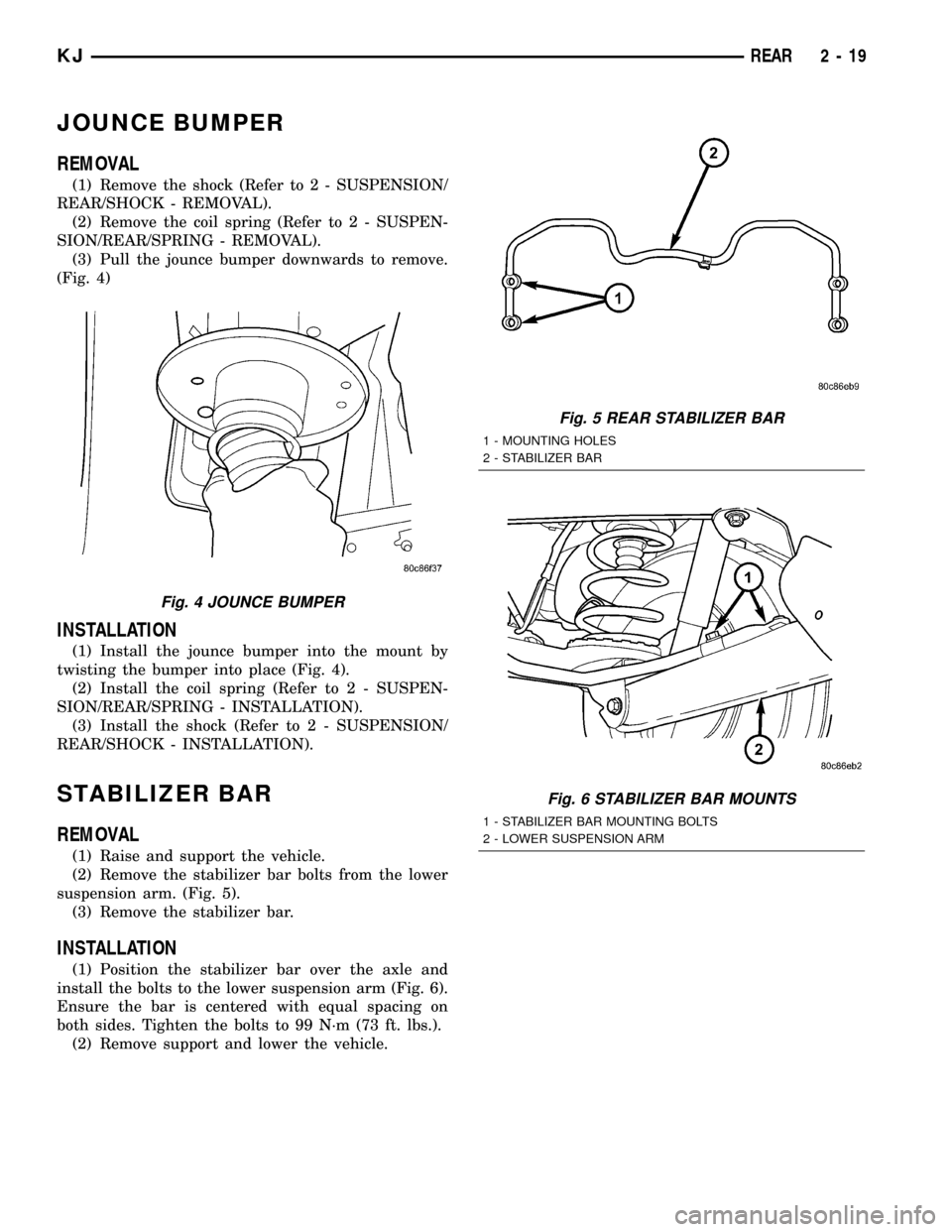
(3) Pull the jounce bumper downwards to remove.
(Fig. 4)
INSTALLATION
(1) Install the jounce bumper into the mount by
twisting the bumper into place (Fig. 4).
(2) Install the coil spring (Refer to 2 - SUSPEN-
SION/REAR/SPRING - INSTALLATION).
(3) Install the shock (Refer to 2 - SUSPENSION/
REAR/SHOCK - INSTALLATION).
STABILIZER BAR
REMOVAL
(1) Raise and support the vehicle.
(2) Remove the stabilizer bar bolts from the lower
suspension arm. (Fig. 5).
(3) Remove the stabilizer bar.
INSTALLATION
(1) Position the stabilizer bar over the axle and
install the bolts to the lower suspension arm (Fig. 6).
Ensure the bar is centered with equal spacing on
both sides. Tighten the bolts to 99 N´m (73 ft. lbs.).
(2) Remove support and lower the vehicle.
Fig. 4 JOUNCE BUMPER
Fig. 5 REAR STABILIZER BAR
1 - MOUNTING HOLES
2 - STABILIZER BAR
Fig. 6 STABILIZER BAR MOUNTS
1 - STABILIZER BAR MOUNTING BOLTS
2 - LOWER SUSPENSION ARM
KJREAR 2 - 19
Page 40 of 1803
UPPER BALL JOINT
REMOVAL
(1) Raise and support the vehicle.
(2) Support the rear axle with a hydraulic jack.
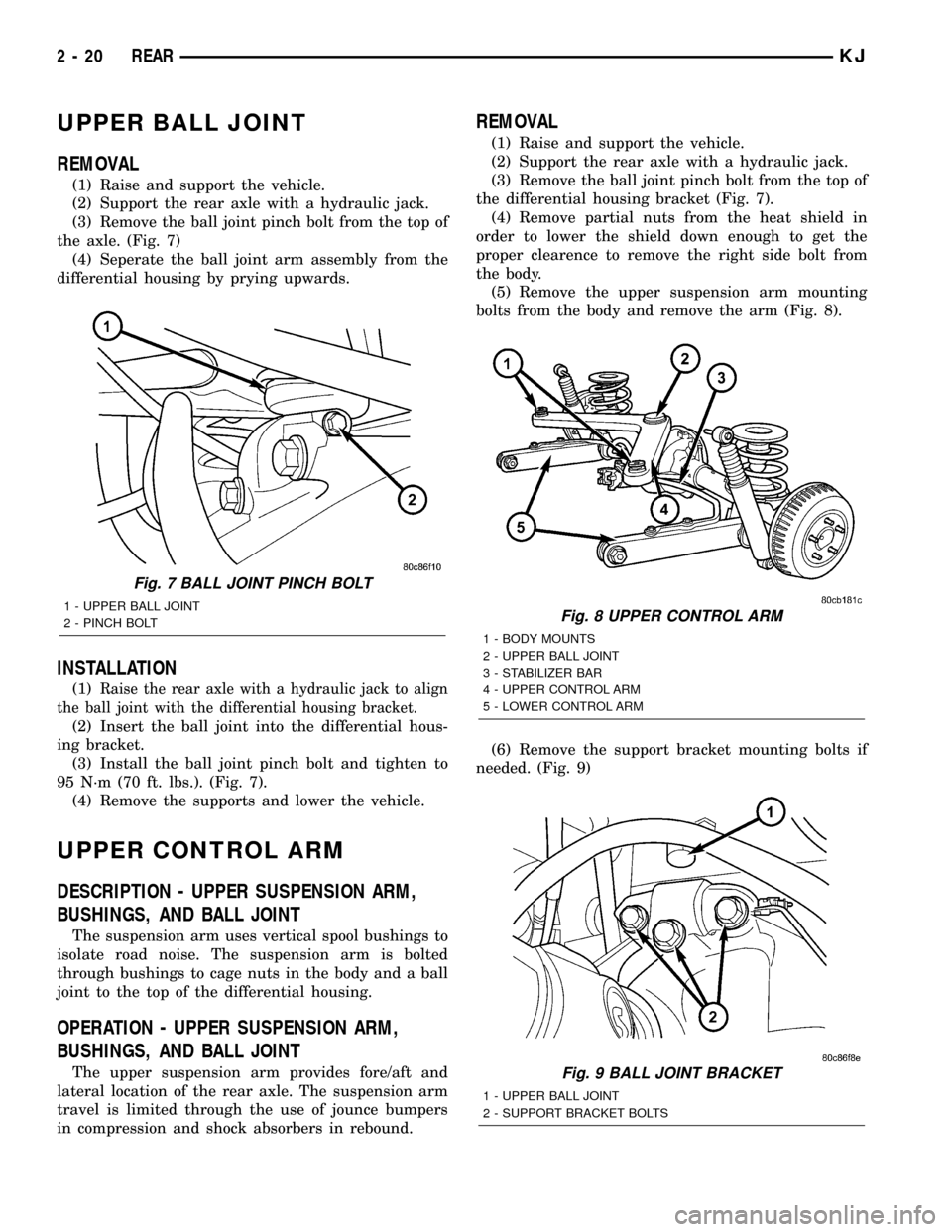
(3) Remove the ball joint pinch bolt from the top of
the axle. (Fig. 7)
(4) Seperate the ball joint arm assembly from the
differential housing by prying upwards.
INSTALLATION
(1)Raise the rear axle with a hydraulic jack to align
the ball joint with the differential housing bracket.
(2) Insert the ball joint into the differential hous-
ing bracket.
(3) Install the ball joint pinch bolt and tighten to
95 N´m (70 ft. lbs.). (Fig. 7).
(4) Remove the supports and lower the vehicle.
UPPER CONTROL ARM
DESCRIPTION - UPPER SUSPENSION ARM,
BUSHINGS, AND BALL JOINT
The suspension arm uses vertical spool bushings to
isolate road noise. The suspension arm is bolted
through bushings to cage nuts in the body and a ball
joint to the top of the differential housing.
OPERATION - UPPER SUSPENSION ARM,
BUSHINGS, AND BALL JOINT
The upper suspension arm provides fore/aft and
lateral location of the rear axle. The suspension arm
travel is limited through the use of jounce bumpers
in compression and shock absorbers in rebound.
REMOVAL
(1) Raise and support the vehicle.
(2) Support the rear axle with a hydraulic jack.
(3) Remove the ball joint pinch bolt from the top of
the differential housing bracket (Fig. 7).
(4) Remove partial nuts from the heat shield in
order to lower the shield down enough to get the
proper clearence to remove the right side bolt from
the body.
(5) Remove the upper suspension arm mounting
bolts from the body and remove the arm (Fig. 8).
(6) Remove the support bracket mounting bolts if
needed. (Fig. 9)
Fig. 7 BALL JOINT PINCH BOLT
1 - UPPER BALL JOINT
2 - PINCH BOLTFig. 8 UPPER CONTROL ARM
1 - BODY MOUNTS
2 - UPPER BALL JOINT
3 - STABILIZER BAR
4 - UPPER CONTROL ARM
5 - LOWER CONTROL ARM
Fig. 9 BALL JOINT BRACKET
1 - UPPER BALL JOINT
2 - SUPPORT BRACKET BOLTS
2 - 20 REARKJ
Page 41 of 1803
INSTALLATION
(1) Position the upper suspension arm in the
frame rail brackets (Fig. 8).
(2) Install the mounting bolts and tighten to 100
N´m (74 ft. lbs.).
(3) Retighten the heat shield back into place.
(4) Pull the arm down on the differential housing
bracket and install the pinch bolt and nut. Tighten
the nut to 95 N´m (70 ft. lbs.) (Fig. 7).
(5) Remove the supports and lower the vehicle.
LOWER CONTROL ARM
DESCRIPTION
The lower suspension arms are stamped steel and
welded and use voided round bushings at the axle
end and solid rubber at the body end of the arm.
OPERATION
The bushings provide isolation from the axle. The
arms mount to the unibody frame rail bracket and
the axle brackets. The arm and bushings provide
location and react to loads.
REMOVAL
(1) Raise the vehicle and support the rear axle.
(2) Remove the stabilizer bar retaining bolts from
the suspension arm.
(3) Remove the lower suspension arm nut and bolt
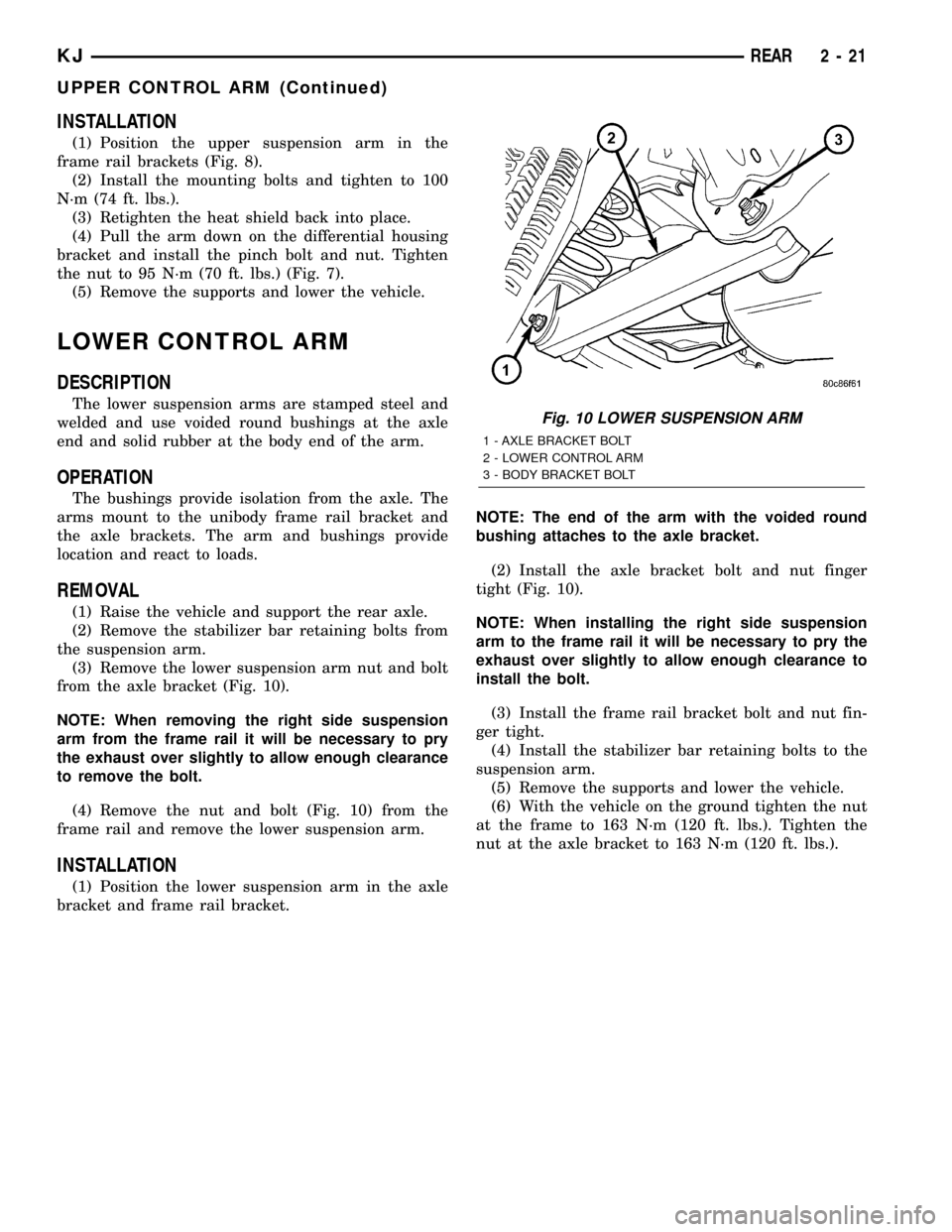
from the axle bracket (Fig. 10).
NOTE: When removing the right side suspension
arm from the frame rail it will be necessary to pry
the exhaust over slightly to allow enough clearance
to remove the bolt.
(4) Remove the nut and bolt (Fig. 10) from the
frame rail and remove the lower suspension arm.
INSTALLATION
(1) Position the lower suspension arm in the axle
bracket and frame rail bracket.NOTE: The end of the arm with the voided round
bushing attaches to the axle bracket.
(2) Install the axle bracket bolt and nut finger
tight (Fig. 10).
NOTE: When installing the right side suspension
arm to the frame rail it will be necessary to pry the
exhaust over slightly to allow enough clearance to
install the bolt.
(3) Install the frame rail bracket bolt and nut fin-
ger tight.
(4) Install the stabilizer bar retaining bolts to the
suspension arm.
(5) Remove the supports and lower the vehicle.
(6) With the vehicle on the ground tighten the nut
at the frame to 163 N´m (120 ft. lbs.). Tighten the
nut at the axle bracket to 163 N´m (120 ft. lbs.).
Fig. 10 LOWER SUSPENSION ARM
1 - AXLE BRACKET BOLT
2 - LOWER CONTROL ARM
3 - BODY BRACKET BOLT
KJREAR 2 - 21
UPPER CONTROL ARM (Continued)
Page 42 of 1803
SUSPENSION
TABLE OF CONTENTS
page page
FRONT
SPECIAL TOOLS
FRONT SUSPENSION...................1
BUSHINGS
REMOVAL
REMOVAL - LOWER CONTROL ARM
BUSHING............................2
REMOVAL - CLEVIS BRACKET BUSHING....2
REMOVAL - UPPER CONTROL ARM
BUSHINGS...........................3
INSTALLATION
INSTALLATION - LOWER CONTROL ARM
BUSHING............................3
INSTALLATION - CLEVIS BRACKET
BUSHING............................4
INSTALLATION - UPPER CONTROL ARM
BUSHINGS...........................4
LOWER BALL JOINT
REMOVAL.............................5INSTALLATION..........................5
REAR
SPECIAL TOOLS
REAR SUSPENSION....................6
UPPER BALL JOINT
REMOVAL.............................6
INSTALLATION..........................6
BUSHINGS
REMOVAL
REMOVAL - LOWER SUSPENSION ARM
BUSHING............................7
REMOVAL - UPPER SUSPENSION ARM
BUSHING............................7
INSTALLATION
INSTALLATION - LOWER SUSPENSION
ARM BUSHING........................8
INSTALLATION - UPPER SUSPENSION ARM
BUSHING............................8
FRONT
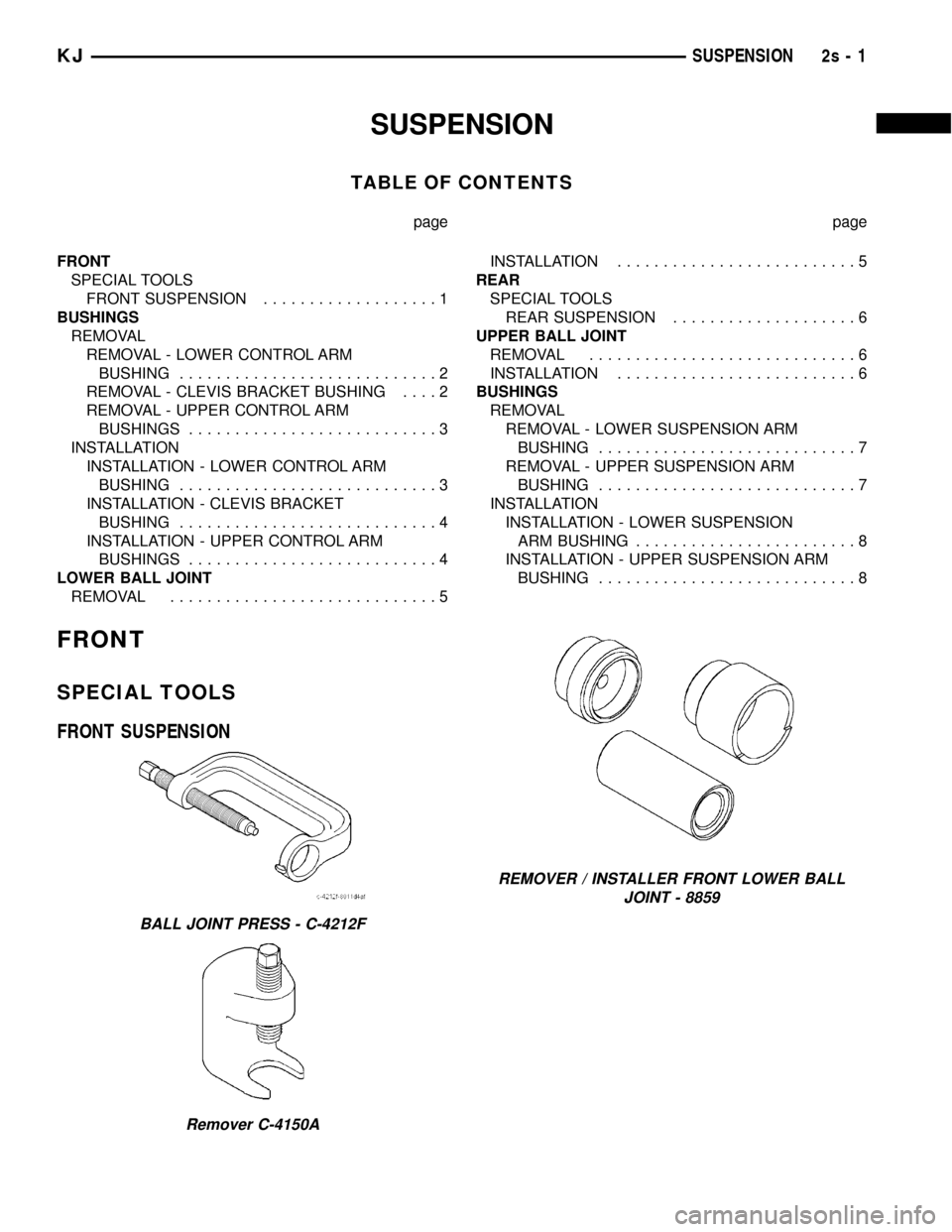
SPECIAL TOOLS
FRONT SUSPENSION
BALL JOINT PRESS - C-4212F
Remover C-4150A
REMOVER / INSTALLER FRONT LOWER BALL
JOINT - 8859
KJSUSPENSION 2s - 1
Page 50 of 1803
DIFFERENTIAL & DRIVELINE
TABLE OF CONTENTS
page page
PROPELLER SHAFT......................1
HALF SHAFT...........................10
FRONT AXLE - 186FIA....................19REAR AXLE - 198RBI.....................49
REAR AXLE-81/4.......................86
PROPELLER SHAFT
TABLE OF CONTENTS
page page
PROPELLER SHAFT
DIAGNOSIS AND TESTING - PROPELLER
SHAFT...............................1
STANDARD PROCEDURES - PROPELLER
SHAFT ANGLE........................3
SPECIFICATIONS
PROPELLER SHAFT....................6
SPECIAL TOOLS........................6
PROPELLER SHAFT - FRONT
REMOVAL.............................6INSTALLATION..........................6
PROPELLER SHAFT - REAR
REMOVAL.............................7
INSTALLATION..........................7
SINGLE CARDAN UNIVERSAL JOINTS
DISASSEMBLY..........................8
ASSEMBLY.............................9
PROPELLER SHAFT
DIAGNOSIS AND TESTING - PROPELLER
SHAFT
VIBRATION
Tires that are out-of-round, or wheels that are
unbalanced, will cause a low frequency vibration.
Brake rotors that are unbalanced will cause a
harsh, low frequency vibration.Driveline vibration can also result from loose or
damaged engine mounts.
Propeller shaft vibration increases as the vehicle
speed is increased. A vibration that occurs within a
specific speed range is not usually caused by a pro-
peller shaft being unbalanced. Defective joints or an
incorrect propeller shaft angle, are usually the cause
of such a vibration.
KJDIFFERENTIAL & DRIVELINE 3 - 1
Page 52 of 1803
(10) Start the engine and re-check for vibration. If
there is little or no change in vibration, move the
clamp to one of the other three positions. Repeat the
vibration test.
(11) If there is no difference in vibration at the
other positions, the source of the vibration may not
be propeller shaft.
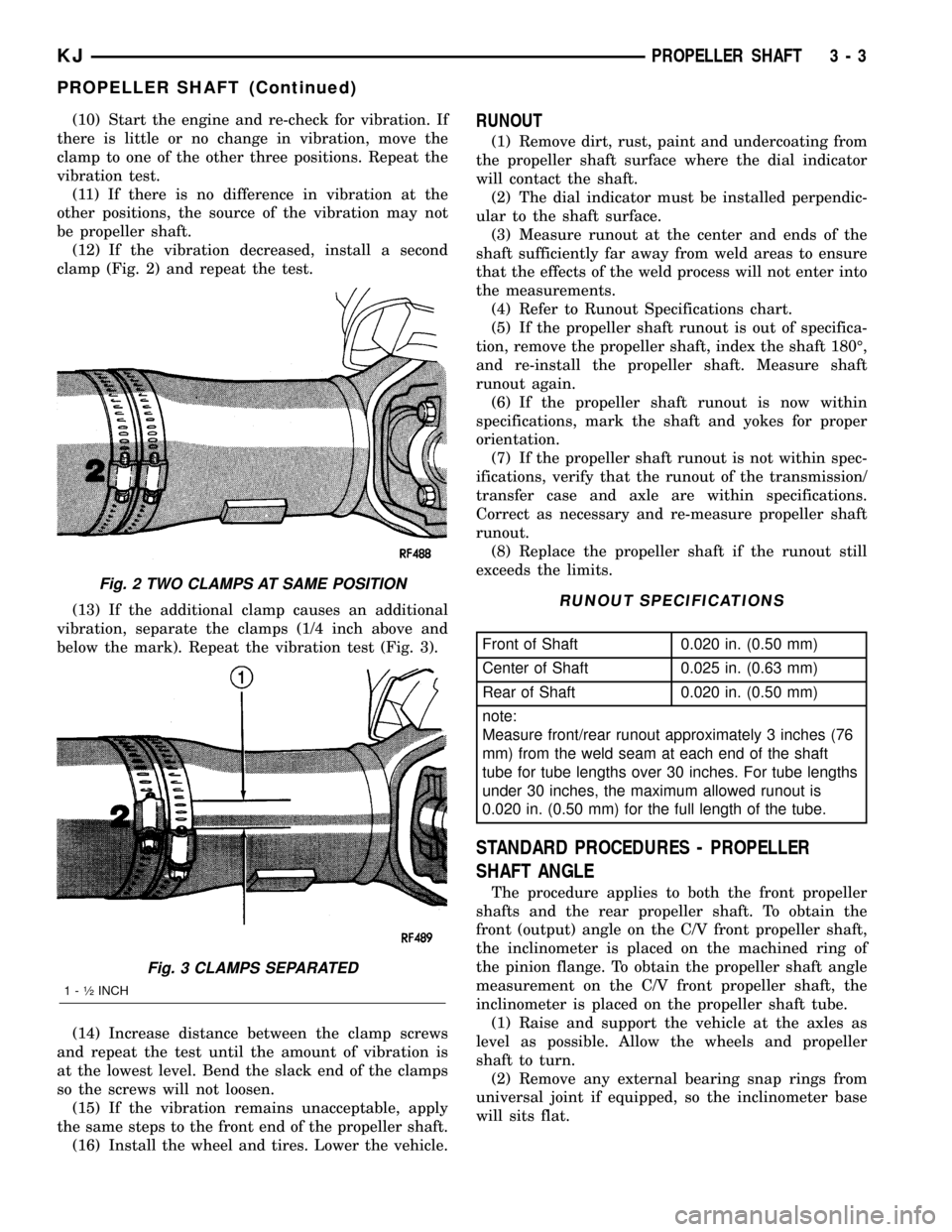
(12) If the vibration decreased, install a second
clamp (Fig. 2) and repeat the test.
(13) If the additional clamp causes an additional
vibration, separate the clamps (1/4 inch above and
below the mark). Repeat the vibration test (Fig. 3).
(14) Increase distance between the clamp screws
and repeat the test until the amount of vibration is
at the lowest level. Bend the slack end of the clamps
so the screws will not loosen.
(15) If the vibration remains unacceptable, apply
the same steps to the front end of the propeller shaft.
(16) Install the wheel and tires. Lower the vehicle.RUNOUT
(1) Remove dirt, rust, paint and undercoating from
the propeller shaft surface where the dial indicator
will contact the shaft.
(2) The dial indicator must be installed perpendic-
ular to the shaft surface.
(3) Measure runout at the center and ends of the
shaft sufficiently far away from weld areas to ensure
that the effects of the weld process will not enter into
the measurements.
(4) Refer to Runout Specifications chart.
(5) If the propeller shaft runout is out of specifica-
tion, remove the propeller shaft, index the shaft 180É,
and re-install the propeller shaft. Measure shaft
runout again.
(6) If the propeller shaft runout is now within
specifications, mark the shaft and yokes for proper
orientation.
(7) If the propeller shaft runout is not within spec-
ifications, verify that the runout of the transmission/
transfer case and axle are within specifications.
Correct as necessary and re-measure propeller shaft
runout.
(8) Replace the propeller shaft if the runout still
exceeds the limits.
RUNOUT SPECIFICATIONS
Front of Shaft 0.020 in. (0.50 mm)
Center of Shaft 0.025 in. (0.63 mm)
Rear of Shaft 0.020 in. (0.50 mm)
note:
Measure front/rear runout approximately 3 inches (76
mm) from the weld seam at each end of the shaft
tube for tube lengths over 30 inches. For tube lengths
under 30 inches, the maximum allowed runout is
0.020 in. (0.50 mm) for the full length of the tube.
STANDARD PROCEDURES - PROPELLER
SHAFT ANGLE
The procedure applies to both the front propeller
shafts and the rear propeller shaft. To obtain the
front (output) angle on the C/V front propeller shaft,
the inclinometer is placed on the machined ring of
the pinion flange. To obtain the propeller shaft angle
measurement on the C/V front propeller shaft, the
inclinometer is placed on the propeller shaft tube.
(1) Raise and support the vehicle at the axles as
level as possible. Allow the wheels and propeller
shaft to turn.
(2) Remove any external bearing snap rings from
universal joint if equipped, so the inclinometer base
will sits flat.
Fig. 2 TWO CLAMPS AT SAME POSITION
Fig. 3 CLAMPS SEPARATED
1 - ó INCH
KJPROPELLER SHAFT 3 - 3
PROPELLER SHAFT (Continued)
Page 59 of 1803
HALF SHAFT
TABLE OF CONTENTS
page page
HALF SHAFT
CAUTION.............................10
DIAGNOSIS AND TESTING - HALF SHAFT....10
REMOVAL.............................10
INSTALLATION.........................11
SPECIFICATIONS
HALF SHAFT.........................11SPECIAL TOOLS.......................12
CV JOINT/BOOT-OUTER
REMOVAL.............................12
INSTALLATION.........................13
CV JOINT/BOOT-INNER
REMOVAL.............................15
INSTALLATION.........................17
HALF SHAFT
CAUTION
CAUTION:: Never grasp half shaft assembly by the
boots. This may cause the boot to pucker or crease
and reduce the service life of the boot.
Avoid over angulating or stroking the C/V joints
when handling the half shaft.
Half shafts exposed to battery acid, transmission
fluid, brake fluid, differential fluid or gasoline may
cause the boots to deteriorate.
DIAGNOSIS AND TESTING - HALF SHAFT
Check for grease at the inboard and outboard C/V
joint. This is a sign of boot or boot clamp damage.
NOISE AND/OR VIBRATION IN TURNS
A clicking noise or a vibration in turns could be
caused by a damaged outer C/V or inner tripod joint
seal boot or seal boot clamps. This will result in the
loss/contamination of the joint grease, resulting in
inadequate lubrication of the joint. Noise could also
be caused by another component of the vehicle com-
ing in contact with the half shafts.
CLUNKING NOISE DURING ACCELERATION
This noise may be a result of a damaged or worn
C/V joint. A torn boot or loose/missing clamp on the
inner/outer joint which has allowed the grease to be
lost will damage the C/V joint.
SHUDDER OR VIBRATION DURING ACCELERATION
This problem could be a result of a worn/damaged
inner tripod joint or a sticking tripod joint. Improper
wheel alignment may also cause a shudder or vibration.
VIBRATION AT HIGHWAY SPEEDS
This problem could be a result of out of balance
front tires or tire/wheel runout. Foreign material
(mud, etc.) packed on the backside of the wheel(s)
will also cause a vibration.
REMOVAL
(1) Raise and support vehicle.
(2) Remove wheel and tire assembly.
(3) Remove half shaft hub nut.
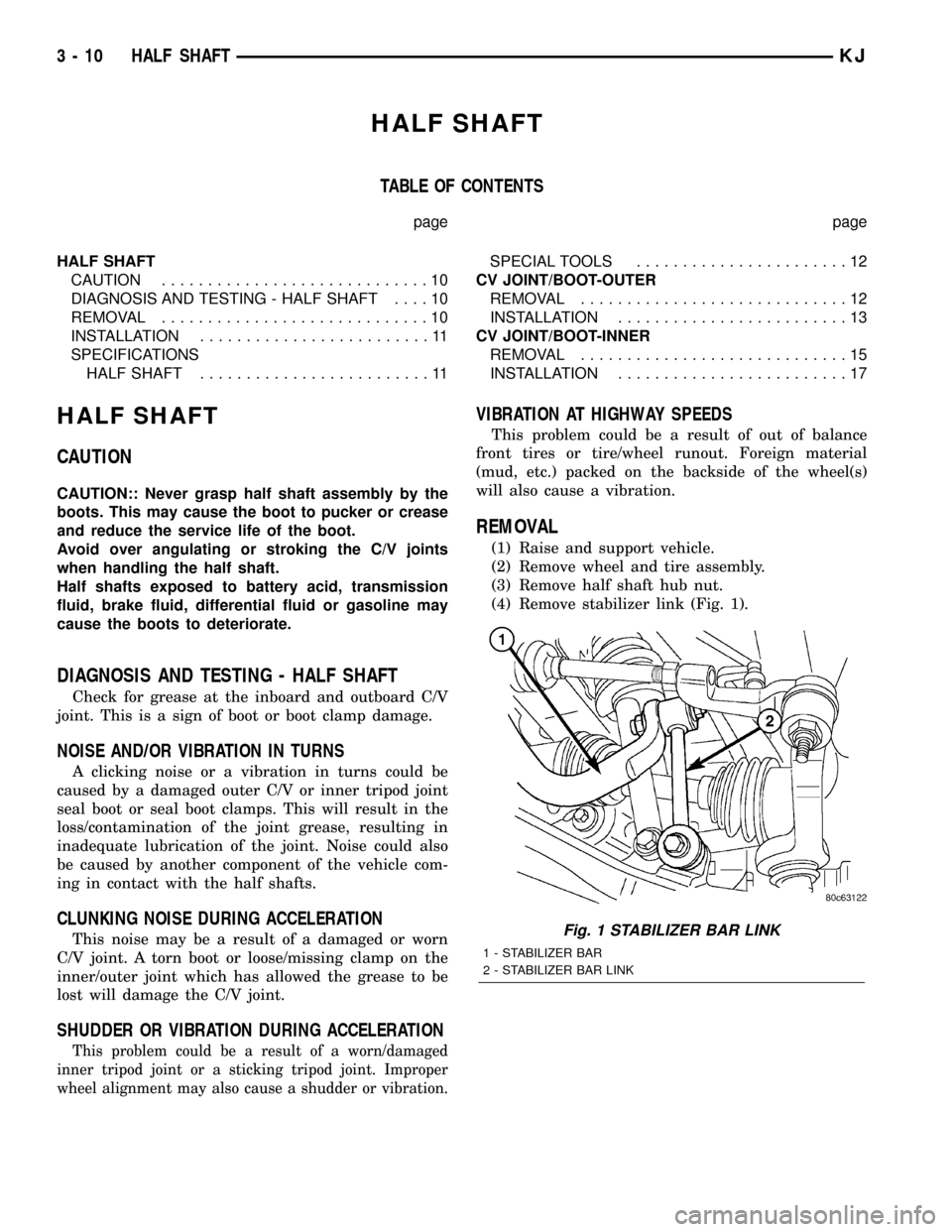
(4) Remove stabilizer link (Fig. 1).
Fig. 1 STABILIZER BAR LINK
1 - STABILIZER BAR
2 - STABILIZER BAR LINK
3 - 10 HALF SHAFTKJ
Page 60 of 1803
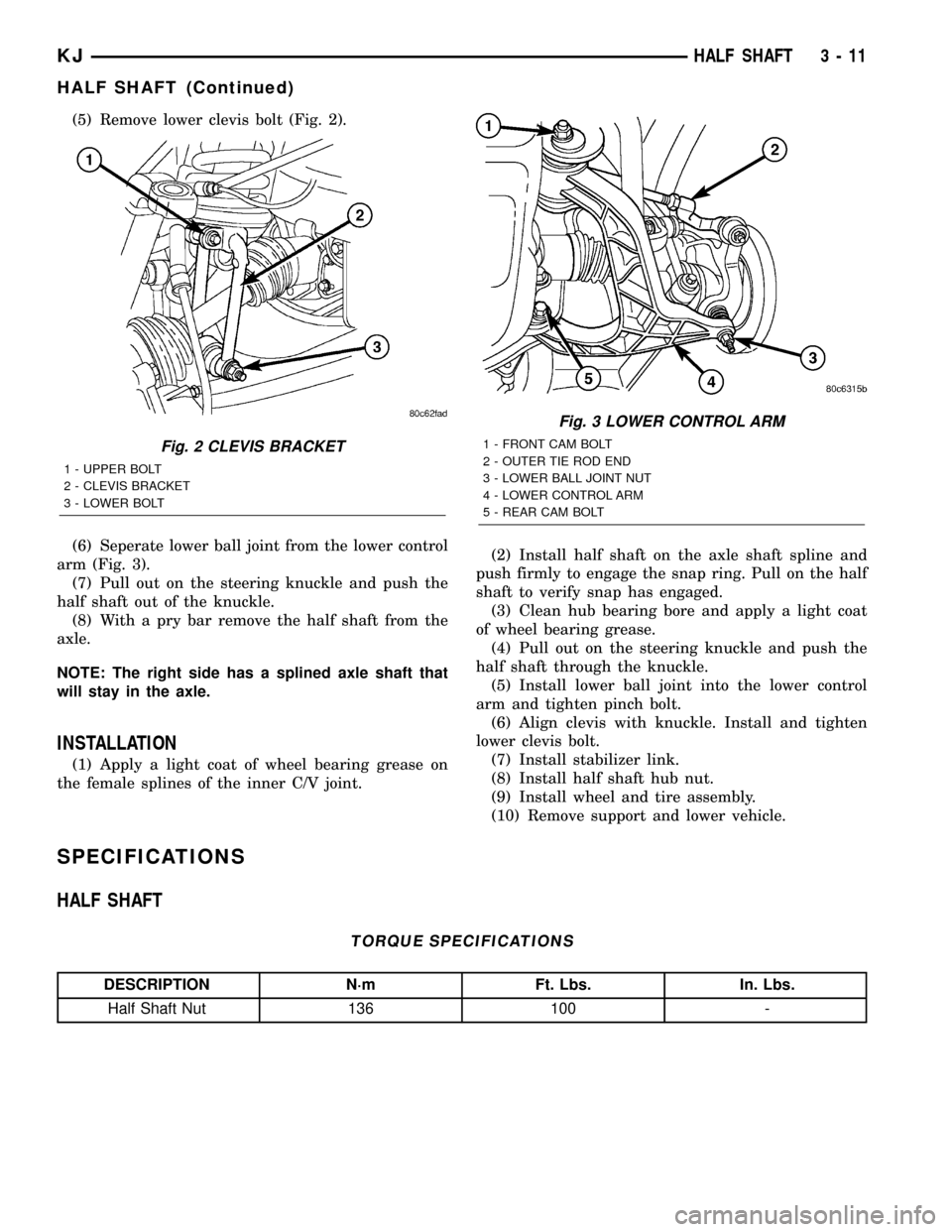
(5) Remove lower clevis bolt (Fig. 2).
(6) Seperate lower ball joint from the lower control
arm (Fig. 3).
(7) Pull out on the steering knuckle and push the
half shaft out of the knuckle.
(8) With a pry bar remove the half shaft from the
axle.
NOTE: The right side has a splined axle shaft that
will stay in the axle.
INSTALLATION
(1) Apply a light coat of wheel bearing grease on
the female splines of the inner C/V joint.(2) Install half shaft on the axle shaft spline and
push firmly to engage the snap ring. Pull on the half
shaft to verify snap has engaged.
(3) Clean hub bearing bore and apply a light coat
of wheel bearing grease.
(4) Pull out on the steering knuckle and push the
half shaft through the knuckle.
(5) Install lower ball joint into the lower control
arm and tighten pinch bolt.
(6) Align clevis with knuckle. Install and tighten
lower clevis bolt.
(7) Install stabilizer link.
(8) Install half shaft hub nut.
(9) Install wheel and tire assembly.
(10) Remove support and lower vehicle.
SPECIFICATIONS
HALF SHAFT
TORQUE SPECIFICATIONS
DESCRIPTION N´m Ft. Lbs. In. Lbs.
Half Shaft Nut 136 100 -
Fig. 3 LOWER CONTROL ARM
1 - FRONT CAM BOLT
2 - OUTER TIE ROD END
3 - LOWER BALL JOINT NUT
4 - LOWER CONTROL ARM
5 - REAR CAM BOLTFig. 2 CLEVIS BRACKET
1 - UPPER BOLT
2 - CLEVIS BRACKET
3 - LOWER BOLT
KJHALF SHAFT 3 - 11
HALF SHAFT (Continued)