transfer case JEEP LIBERTY 2002 KJ / 1.G Owner's Manual
[x] Cancel search | Manufacturer: JEEP, Model Year: 2002, Model line: LIBERTY, Model: JEEP LIBERTY 2002 KJ / 1.GPages: 1803, PDF Size: 62.3 MB
Page 267 of 1803

Propylene-glycol/ethylene-glycol Mixtures can
cause the destabilization of various corrosion inhibi-
tors, causing damage to the various cooling system
components. Also, once ethylene-glycol and propy-
lene-glycol based coolants are mixed in the vehicle,
conventional methods of determining freeze point will
not be accurate. Both the refractive index and spe-
cific gravity differ between ethylene glycol and propy-
lene glycol.
OPERATION
Coolant flows through the engine block absorbing
the heat from the engine, then flows to the radiator
where the cooling fins in the radiator transfers the
heat from the coolant to the atmosphere. During cold
weather the ethylene-glycol coolant prevents water
present in the cooling system from freezing within
temperatures indicated by mixture ratio of coolant to
water.
COOLANT RECOVERY PRESS
CONTAINER
DESCRIPTION
This system works along with the radiator pres-
sure cap. This is done by using thermal expansion
and contraction of the coolant to keep the coolant
free of trapped air. It provides:
²A volume for coolant expansion and contraction.
²A convenient and safe method for checking/ad-
justing coolant level at atmospheric pressure. This is
done without removing the radiator pressure cap.
²Some reserve coolant to the radiator to cover
minor leaks and evaporation or boiling losses.
As the engine cools, a vacuum is formed in the
cooling system of both the radiator and engine. Cool-
ant will then be drawn from the coolant tank and
returned to a proper level in the radiator.
The coolant reservoir/overflow system has a radia-
tor mounted pressurized cap, an overflow tube, and a
plastic coolant reservoir/overflow tank, mounted to
the right side of the cowl. It is mounted to the cowl
with two nuts on top, and a slide bracket on the bot-
tom.
OPERATION
The pressure chamber keeps the coolant free of
trapped air, provides a volume for expansion and con-
traction, and provides a convenient and safe method
for checking and adjusting coolant level at atmo-
spheric pressure. It also provides some reserve cool-
ant to cover minor leaks, evaporation or boiling
losses. The overflow chamber allows coolant recovery
in case of an overheat.
ENGINE BLOCK HEATER - 2.4L
DESCRIPTION
The block heater is operated by ordinary house
current (110 Volt A.C.) through a power cord and con-
nector located in the engine compartment. The
heater is mounted in a core hole (in place of a core
hole plug) in the engine block, with the heating ele-
ment immersed in coolant.
CAUTION: The power cord must be secured in its
retainer clips, and not positioned so it could con-
tact linkages or exhaust manifolds and become
damaged.
OPERATION
The block heater element is submerged in the cool-
ing system's coolant. When electrical power (110 volt
A.C.) is applied to the element, it creates heat. This
heat is transferred to the engine coolant. This pro-
vides easier engine starting and faster warm-up
when vehicle is operated in areas having extremely
low temperatures.
REMOVAL - 2.4L
(1) Drain cooling system (Refer to 7 - COOLING/
ENGINE - STANDARD PROCEDURE).
(2) Raise vehicle on hoist.
(3) Detach power cord plug from heater.
(4) Loosen screw in center of heater. Remove
heater assembly.
INSTALLATION - 2.4L
(1) Thoroughly clean core hole and heater seat.
(2) Insert heater assembly (Fig. 1) with element
loop positionedupward.
(3) With heater seated, tighten center screw
securely to assure a positive seal.
CAUTION: To prevent damage, the power cord must
be secured in it's retaining clips, and not positioned
so it could contact linkages or exhaust manifold.
(4) Connect power cord to heater.
(5) Lower vehicle.
(6) Fill cooling system (Refer to 7 - COOLING/EN-
GINE - STANDARD PROCEDURE).
7s - 20 ENGINEKJ
COOLANT (Continued)
Page 313 of 1803

²Fuel injectors
²Ignition coil(s)
²Certain relays/solenoids
²Certain sensors
DESCRIPTION - SENSOR RETURN
The Sensor Return circuits are internal to the Pow-
ertrain Control Module (PCM).
Sensor Return provides a low±noise ground refer-
ence for all engine control system sensors. Refer to
Power Grounds for more information.
OPERATION
OPERATION - PCM
The PCM operates the fuel system. The PCM is a
pre-programmed, triple microprocessor digital com-
puter. It regulates ignition timing, air-fuel ratio,
emission control devices, charging system, certain
transmission features, speed control, air conditioning
compressor clutch engagement and idle speed. The
PCM can adapt its programming to meet changing
operating conditions.
The PCM receives input signals from various
switches and sensors. Based on these inputs, the
PCM regulates various engine and vehicle operations
through different system components. These compo-
nents are referred to as Powertrain Control Module
(PCM) Outputs. The sensors and switches that pro-
vide inputs to the PCM are considered Powertrain
Control Module (PCM) Inputs.
The PCM adjusts ignition timing based upon
inputs it receives from sensors that react to: engine
rpm, manifold absolute pressure, engine coolant tem-
perature, throttle position, transmission gear selec-
tion (automatic transmission), vehicle speed, power
steering pump pressure, and the brake switch.
The PCM adjusts idle speed based on inputs it
receives from sensors that react to: throttle position,
vehicle speed, transmission gear selection, engine
coolant temperature and from inputs it receives from
the air conditioning clutch switch and brake switch.
Based on inputs that it receives, the PCM adjusts
ignition coil dwell. The PCM also adjusts the gener-
ator charge rate through control of the generator
field and provides speed control operation.
NOTE: PCM Inputs:
²A/C request (if equipped with factory A/C)
²A/C select (if equipped with factory A/C)
²A/C pressure transducer
²Auto shutdown (ASD) sense
²Battery temperature
²Battery voltage
²Brake switch²J1850 bus (+) circuits
²J1850 bus (-) circuits
²Camshaft position sensor signal
²Crankshaft position sensor
²Data link connection for DRB scan tool
²Engine coolant temperature sensor
²Fuel level (through J1850 circuitry)
²Generator (battery voltage) output
²Ignition circuit sense (ignition switch in on/off/
crank/run position)
²Intake manifold air temperature sensor
²Knock sensors (2 on 3.7L engine)
²Leak detection pump (switch) sense (if equipped)
²Manifold absolute pressure (MAP) sensor
²Oil pressure
²Oxygen sensors
²Park/neutral switch (auto. trans. only)
²Power ground
²Power steering pressure switch
²Sensor return
²Signal ground
²Speed control multiplexed single wire input
²Throttle position sensor
²Transfer case switch (4WD range position)
²Vehicle speed sensor
NOTE: PCM Outputs:
²A/C clutch relay
²Auto shutdown (ASD) relay
²J1850 bus (+/-) circuits for: speedometer, voltme-
ter, fuel gauge, oil pressure gauge/lamp, engine temp.
gauge and speed control warn. lamp
²Clutch pedal position switch override relay
²Data link connection for DRB scan tool
²EGR valve control solenoid (if equipped)
²EVAP canister purge solenoid
²Five volt sensor supply (primary)
²Five volt sensor supply (secondary)
²Fuel injectors
²Fuel pump relay
²Generator field driver (-)
²Generator field driver (+)
²Idle air control (IAC) motor
²Ignition coil(s)
²Leak detection pump (if equipped)
²Malfunction indicator lamp (Check engine lamp).
Driven through J1850 circuits.
²Oxygen sensor heater relays
²Oxygen sensors (pulse width modulated)
²Radiator cooling fan relay (pulse width modu-
lated)
²Speed control vacuum solenoid
²Speed control vent solenoid
²Tachometer (if equipped). Driven through J1850
circuits.
8E - 14 ELECTRONIC CONTROL MODULESKJ
POWERTRAIN CONTROL MODULE (Continued)
Page 404 of 1803

INSTRUMENT CLUSTER
TABLE OF CONTENTS
page page
INSTRUMENT CLUSTER
DESCRIPTION..........................2
OPERATION............................4
DIAGNOSIS AND TESTING - INSTRUMENT
CLUSTER............................7
REMOVAL.............................9
DISASSEMBLY..........................9
ASSEMBLY............................10
INSTALLATION.........................11
ABS INDICATOR
DESCRIPTION.........................11
OPERATION...........................11
AIRBAG INDICATOR
DESCRIPTION.........................12
OPERATION...........................12
BRAKE/PARK BRAKE INDICATOR
DESCRIPTION.........................13
OPERATION...........................13
DIAGNOSIS AND TESTING - BRAKE
INDICATOR..........................14
CHARGING INDICATOR
DESCRIPTION.........................15
OPERATION...........................15
COOLANT LOW INDICATOR
DESCRIPTION.........................15
OPERATION...........................16
CRUISE INDICATOR
DESCRIPTION.........................16
OPERATION...........................17
DOOR AJAR INDICATOR
DESCRIPTION.........................17
OPERATION...........................17
ENGINE TEMPERATURE GAUGE
DESCRIPTION.........................18
OPERATION...........................18
FRONT FOG LAMP INDICATOR
DESCRIPTION.........................19
OPERATION...........................19
FUEL GAUGE
DESCRIPTION.........................19
OPERATION...........................20
GATE AJAR INDICATOR
DESCRIPTION.........................20
OPERATION...........................20
GLASS AJAR INDICATOR
DESCRIPTION.........................21
OPERATION...........................21
HIGH BEAM INDICATOR
DESCRIPTION.........................22OPERATION...........................22
LOW FUEL INDICATOR
DESCRIPTION.........................22
OPERATION...........................22
LOW OIL PRESSURE INDICATOR
DESCRIPTION.........................23
OPERATION...........................23
MALFUNCTION INDICATOR LAMP (MIL)
DESCRIPTION.........................24
OPERATION...........................24
ODOMETER
DESCRIPTION.........................25
OPERATION...........................25
OVERDRIVE OFF INDICATOR
DESCRIPTION.........................26
OPERATION...........................26
REAR FOG LAMP INDICATOR
DESCRIPTION.........................27
OPERATION...........................27
SEATBELT INDICATOR
DESCRIPTION.........................27
OPERATION...........................28
SECURITY INDICATOR
DESCRIPTION.........................28
OPERATION...........................28
SHIFT INDICATOR (TRANSFER CASE)
DESCRIPTION
DESCRIPTION - PART TIME INDICATOR....29
DESCRIPTION - FULL TIME INDICATOR....29
DESCRIPTION - FOUR LOW MODE
INDICATOR..........................29
OPERATION
OPERATION - PART TIME INDICATOR.....29
OPERATION - FULL TIME INDICATOR.....30
OPERATION - FOUR LOW MODE
INDICATOR..........................30
SKIS INDICATOR
DESCRIPTION.........................31
OPERATION...........................31
SPEEDOMETER
DESCRIPTION.........................32
OPERATION...........................32
TACHOMETER
DESCRIPTION.........................33
OPERATION...........................33
TRANS TEMP INDICATOR
DESCRIPTION.........................33
OPERATION...........................34
KJINSTRUMENT CLUSTER 8J - 1
Page 406 of 1803

perform its many functions. The EMIC module incor-
porates a blue-green digital Vacuum Fluorescent Dis-
play (VFD) for displaying odometer and trip
odometer information, as well as several warning
messages and certain diagnostic information. In addi-
tion to instrumentation and indicators, the EMIC has
the hardware and software needed to provide the fol-
lowing features:
²Chime Warning Service- A chime tone gener-
ator on the EMIC electronic circuit board provides
audible alerts to the vehicle operator and eliminates
the need for a separate chime module. (Refer to 8 -
ELECTRICAL/CHIME WARNING SYSTEM -
DESCRIPTION).
²Panel Lamps Dimming Service- The EMIC
provides a hard wired 12-volt Pulse-Width Modulated
(PWM) output that synchronizes the dimming level
of the radio display, gear selector indicator, heater-air
conditioner control, and all other dimmable lighting
on the panel lamps dimmer circuit with that of the
cluster illumination lamps and VFD.
The EMIC houses four analog gauges and has pro-
visions for up to twenty-four indicators (Fig. 2). The
EMIC includes the following analog gauges:
²Coolant Temperature Gauge
²Fuel Gauge
²Speedometer
²Tachometer
Some of the EMIC indicators are automatically
configured when the EMIC is connected to the vehi-
cle electrical system for compatibility with certain
optional equipment or equipment required for regula-
tory purposes in certain markets. While each EMIC
may have provisions for indicators to support every
available option, the configurable indicators will not
be functional in a vehicle that does not have the
equipment that an indicator supports. The EMIC
includes provisions for the following indicators (Fig.
2):
²Airbag Indicator (with Airbag System only)
²Antilock Brake System (ABS) Indicator
(with ABS only)
²Brake Indicator
²Charging Indicator
²Coolant Low Indicator (with Diesel Engine
only)
²Cruise Indicator (with Speed Control Sys-
tem only)
²Four-Wheel Drive Full Time Indicator (with
Selec-Trac Transfer Case only)
²Four-Wheel Drive Low Mode Indicator
²Four-Wheel Drive Part Time Indicator
²Front Fog Lamp Indicator (with Front Fog
Lamps only)
²High Beam Indicator
²Low Fuel Indicator²Low Oil Pressure Indicator
²Malfunction Indicator Lamp (MIL)
²Overdrive-Off Indicator (with Automatic
Transmission only)
²Rear Fog Lamp Indicator (with Rear Fog
Lamps only)
²Seatbelt Indicator
²Security Indicator (with Vehicle Theft
Security System only)
²Sentry Key Immobilizer System (SKIS)
Indicator (with SKIS only)
²Transmission Overtemp Indicator (with
Automatic Transmission only)
²Turn Signal (Right and Left) Indicators
²Wait-To-Start Indicator (with Diesel Engine
only)
²Water-In-Fuel Indicator (with Diesel Engine
only)
Each indicator in the EMIC is illuminated by a
dedicated Light Emitting Diode (LED) that is sol-
dered onto the EMIC electronic circuit board. The
LEDs are not available for service replacement and,
if damaged or faulty, the entire EMIC must be
replaced. Cluster illumination is accomplished by
dimmable incandescent back lighting, which illumi-
nates the gauges for visibility when the exterior
lighting is turned on. Each of the incandescent bulbs
is secured by an integral bulb holder to the electronic
circuit board from the back of the cluster housing.
The incandescent bulb/bulb holder units are available
for service replacement.
Hard wired circuitry connects the EMIC to the
electrical system of the vehicle. These hard wired cir-
cuits are integral to several wire harnesses, which
are routed throughout the vehicle and retained by
many different methods. These circuits may be con-
nected to each other, to the vehicle electrical system
and to the EMIC through the use of a combination of
soldered splices, splice block connectors, and many
different types of wire harness terminal connectors
and insulators. Refer to the appropriate wiring infor-
mation. The wiring information includes wiring dia-
grams, proper wire and connector repair procedures,
further details on wire harness routing and reten-
tion, as well as pin-out and location views for the
various wire harness connectors, splices and grounds.
The EMIC modules for this model are serviced only
as complete units. The EMIC module cannot be
adjusted or repaired. If a gauge, an LED indicator,
the VFD, the electronic circuit board, the circuit
board hardware, the cluster overlay, or the EMIC
housing are damaged or faulty, the entire EMIC mod-
ule must be replaced. The cluster lens, hood and
mask unit and the individual incandescent lamp
bulbs with holders are available for service replace-
ment.
KJINSTRUMENT CLUSTER 8J - 3
INSTRUMENT CLUSTER (Continued)
Page 432 of 1803

indicator will be illuminated for the following rea-
sons:
²VTSS Indication- During the sixteen second
VTA pre-arming function, the BCM will flash the
security indicator on and off repeatedly at a steady,
fast rate to indicate that the VTA is in the process of
arming. Following successful VTA arming, the BCM
flashes the security indicator on and off continuously
at a slower rate to indicate that the VTA is armed.
The security indicator continues flashing at the
slower rate until the VTA is disarmed.
The BCM provides a hard wired ground input to
the instrument cluster circuitry through the VTSS
indicator driver circuit whenever the ignition switch
is in the Off position and the VTA is arming, armed,
or triggered. The VTSS indicator driver circuit
between the BCM and the instrument cluster can be
diagnosed using conventional diagnostic tools and
methods. However, for proper diagnosis of the VTA
and the BCM, or the hard wired inputs to the instru-
ment cluster that control the security indicator, a
DRBIIItscan tool is required. Refer to the appropri-
ate diagnostic information.
SHIFT INDICATOR (TRANSFER
CASE)
DESCRIPTION
DESCRIPTION - PART TIME INDICATOR
A part time indicator is standard equipment on all
instrument clusters. The part time indicator is
located near the lower edge of the tachometer dial
face in the instrument cluster. The part time indica-
tor consists of a stencil-like cutout of the words
ªPART TIMEº in the opaque layer of the instrument
cluster overlay. The dark outer layer of the overlay
prevents the indicator from being clearly visible
when it is not illuminated. An amber Light Emitting
Diode (LED) behind the cutout in the opaque layer of
the overlay causes the ªPART TIMEº text to appear
in amber through the translucent outer layer of the
overlay when it is illuminated from behind by the
LED, which is soldered onto the instrument cluster
electronic circuit board. When the exterior lighting is
turned On, the illumination intensity of the part
time indicator is dimmable, which is adjusted using
the panel lamps dimmer control ring on the left con-
trol stalk of the multi-function switch. The part time
indicator is serviced as a unit with the instrument
cluster.
DESCRIPTION - FULL TIME INDICATOR
A full time indicator is standard equipment on all
instrument clusters, but is only functional on vehi-
cles equipped with the optional Selec-Trac four-wheel
drive system. The full time indicator is located near
the lower edge of the tachometer dial face in the
instrument cluster. The full time indicator consists of
a stencil-like cutout of the words ªFULL TIMEº in
the opaque layer of the instrument cluster overlay.
The dark outer layer of the overlay prevents the indi-
cator from being clearly visible when it is not illumi-
nated. A green Light Emitting Diode (LED) behind
the cutout in the opaque layer of the cluster overlay
causes the ªFULL TIMEº text to appear in green
through the translucent outer layer of the overlay
when it is illuminated from behind by the LED,
which is soldered onto the instrument cluster elec-
tronic circuit board. When the exterior lighting is
turned On, the illumination intensity of the full time
indicator is dimmable, which is adjusted using the
panel lamps dimmer control ring on the left control
stalk of the multi-function switch. The full time indi-
cator is serviced as a unit with the instrument clus-
ter.
DESCRIPTION - FOUR LOW MODE INDICATOR
A four low mode indicator is standard equipment
on all instrument clusters. The four low mode indica-
tor is located above the coolant temperature gauge
and to the right of the speedometer in the instru-
ment cluster. The four low mode indicator consists of
a stencil-like cutout of the words ª4 LO MODEº in
the opaque layer of the instrument cluster overlay.
The dark outer layer of the overlay prevents the indi-
cator from being clearly visible when it is not illumi-
nated. An amber Light Emitting Diode (LED) behind
the cutout in the opaque layer of the overlay causes
the ª4 LO MODEº text to appear in amber through
the translucent outer layer of the overlay when it is
illuminated from behind by the LED, which is sol-
dered onto the instrument cluster electronic circuit
board. The four low mode indicator is serviced as a
unit with the instrument cluster.
OPERATION
OPERATION - PART TIME INDICATOR
The part time indicator gives an indication to the
vehicle operator that a four-wheel drive part time
operating mode of the transfer case is selected. On
vehicles equipped with the standard Command-Trac
four-wheel drive system, the part time indicator
lights when the transfer case is engaged in the 4H or
4L positions. On vehicles equipped with the optional
Selec-Trac four-wheel drive system, the part time
KJINSTRUMENT CLUSTER 8J - 29
SECURITY INDICATOR (Continued)
Page 433 of 1803

indicator lights when the transfer case is engaged in
the4X4Part Time position. This indicator is con-
trolled by a transistor on the instrument cluster elec-
tronic circuit board based upon the cluster
programming and electronic messages received by
the cluster from the Powertrain Control Module
(PCM) over the Programmable Communications
Interface (PCI) data bus. The instrument cluster
must be configured for the type of transfer case in
the vehicle using a DRBIIItscan tool in order to pro-
vide proper operation of the part time indicator. The
part time indicator Light Emitting Diode (LED) is
completely controlled by the instrument cluster logic
circuit, and that logic will only allow this indicator to
operate when the instrument cluster receives a bat-
tery current input on the fused ignition switch out-
put (run-start) circuit. Therefore, the LED will
always be off when the ignition switch is in any posi-
tion except On or Start. The LED only illuminates
when it is provided a path to ground by the instru-
ment cluster transistor. The instrument cluster will
turn on the part time indicator for the following rea-
sons:
²Part Time Lamp-On Message- Each time the
cluster receives a part time lamp-on message from
the PCM indicating that a four-wheel drive part time
position of the transfer case has been selected, the
part time indicator will be illuminated. The indicator
remains illuminated until the cluster receives a part
time lamp-off message from the PCM or until the
ignition switch is turned to the Off position, which-
ever occurs first.
²Actuator Test- Each time the cluster is put
through the actuator test, the part time indicator will
be turned on, then off again during the bulb check
portion of the test to confirm the functionality of the
LED and the cluster control circuitry.
The PCM continually monitors the transfer case
switch to determine the driveline operating mode.
The PCM then sends the proper part time lamp-on
and lamp-off messages to the instrument cluster. For
further diagnosis of the part time indicator or the
instrument cluster circuitry that controls the indica-
tor, (Refer to 8 - ELECTRICAL/INSTRUMENT
CLUSTER - DIAGNOSIS AND TESTING). For
proper diagnosis of the transfer case switch, the
PCM, the PCI data bus, or the electronic message
inputs to the instrument cluster that control the part
time indicator, a DRBIIItscan tool is required. Refer
to the appropriate diagnostic information.
OPERATION - FULL TIME INDICATOR
The full time indicator gives an indication to the
vehicle operator that a four-wheel drive full time
operating mode of the transfer case is selected. On
vehicles equipped with the optional Selec-Trac four-wheel drive system, the full time indicator lights
when the transfer case is engaged in the4X4Full
Time position. This indicator is controlled by a tran-
sistor on the instrument cluster electronic circuit
board based upon the cluster programming and elec-
tronic messages received by the cluster from the
Powertrain Control Module (PCM) over the Program-
mable Communications Interface (PCI) data bus. The
instrument cluster must be configured for the type of
transfer case in the vehicle using a DRBIIItscan
tool in order to provide proper operation of the full
time indicator. The full time indicator Light Emitting
Diode (LED) is completely controlled by the instru-
ment cluster logic circuit, and that logic will only
allow this indicator to operate when the instrument
cluster receives a battery current input on the fused
ignition switch output (run-start) circuit. Therefore,
the LED will always be off when the ignition switch
is in any position except On or Start. The LED only
illuminates when it is provided a path to ground by
the instrument cluster transistor. The instrument
cluster will turn on the full time indicator for the fol-
lowing reasons:
²Full Time Lamp-On Message- Each time the
cluster receives a full time lamp-on message from the
PCM indicating that a four-wheel drive full time
position of the transfer case has been selected, the
full time indicator will be illuminated. The indicator
remains illuminated until the cluster receives a full
time lamp-off message from the PCM or until the
ignition switch is turned to the Off position, which-
ever occurs first.
²Actuator Test- Each time the cluster is put
through the actuator test, the full time indicator will
be turned on, then off again during the bulb check
portion of the test to confirm the functionality of the
LED and the cluster control circuitry.
The PCM continually monitors the transfer case
switch to determine the driveline operating mode.
The PCM then sends the proper full time lamp-on
and lamp-off messages to the instrument cluster. For
further diagnosis of the full time indicator or the
instrument cluster circuitry that controls the indica-
tor, (Refer to 8 - ELECTRICAL/INSTRUMENT
CLUSTER - DIAGNOSIS AND TESTING). For
proper diagnosis of the transfer case switch, the
PCM, the PCI data bus, or the electronic message
inputs to the instrument cluster that control the full
time indicator, a DRBIIItscan tool is required. Refer
to the appropriate diagnostic information.
OPERATION - FOUR LOW MODE INDICATOR
The four low mode indicator gives an indication to
the vehicle operator that a four-wheel drive low oper-
ating mode of the transfer case is selected. On vehi-
cles equipped with the standard Command-Trac four-
8J - 30 INSTRUMENT CLUSTERKJ
SHIFT INDICATOR (TRANSFER CASE) (Continued)
Page 434 of 1803

wheel drive system, the four low mode indicator
lights when the transfer case is engaged in the 4L
position. On vehicles equipped with the optional
Selec-Trac four-wheel drive system, the four low
mode indicator lights when the transfer case is
engaged in the 4 Lo position. This indicator is con-
trolled by a transistor on the instrument cluster elec-
tronic circuit board based upon the cluster
programming and electronic messages received by
the cluster from the Powertrain Control Module
(PCM) over the Programmable Communications
Interface (PCI) data bus. The instrument cluster
must be configured for the type of transfer case in
the vehicle using a DRBIIItscan tool in order to pro-
vide proper operation of the four low mode indicator.
The four low mode indicator Light Emitting Diode
(LED) is completely controlled by the instrument
cluster logic circuit, and that logic will only allow
this indicator to operate when the instrument cluster
receives a battery current input on the fused ignition
switch output (run-start) circuit. Therefore, the LED
will always be off when the ignition switch is in any
position except On or Start. The LED only illumi-
nates when it is provided a path to ground by the
instrument cluster transistor. The instrument cluster
will turn on the four low mode indicator for the fol-
lowing reasons:
²Four Low Mode Lamp-On Message- Each
time the cluster receives a four low mode lamp-on
message from the PCM indicating that a four-wheel
drive low position of the transfer case has been
selected, the four low mode indicator will be illumi-
nated. The indicator remains illuminated until the
cluster receives a four low mode lamp-off message
from the PCM or until the ignition switch is turned
to the Off position, whichever occurs first.
²Actuator Test- Each time the cluster is put
through the actuator test, the four low mode indica-
tor will be turned on, then off again during the bulb
check portion of the test to confirm the functionality
of the LED and the cluster control circuitry.
The PCM continually monitors the transfer case
switch to determine the driveline operating mode.
The PCM then sends the proper four low mode
lamp-on and lamp-off messages to the instrument
cluster. For further diagnosis of the four low mode
indicator or the instrument cluster circuitry that con-
trols the indicator, (Refer to 8 - ELECTRICAL/IN-
STRUMENT CLUSTER - DIAGNOSIS AND
TESTING). For proper diagnosis of the transfer case
switch, the PCM, the PCI data bus, or the electronic
message inputs to the instrument cluster that control
the four low mode indicator, a DRBIIItscan tool is
required. Refer to the appropriate diagnostic infor-
mation.SKIS INDICATOR
DESCRIPTION
A Sentry Key Immobilizer System (SKIS) indicator
is standard equipment on all instrument clusters, but
is only operational on vehicles equipped with the
optional SKIS. The SKIS indicator is located above
the fuel gauge and to the left of the tachometer in
the instrument cluster. The SKIS indicator consists
of a stencil-like cutout of a graphical representation
or icon of a key that is circled and crossed-out in the
opaque layer of the instrument cluster overlay. The
dark outer layer of the overlay prevents the indicator
from being clearly visible when it is not illuminated.
An amber Light Emitting Diode (LED) behind the
cutout in the opaque layer of the overlay causes the
indicator to appear in amber through the translucent
outer layer of the overlay when it is illuminated from
behind by the LED, which is soldered onto the
instrument cluster electronic circuit board. The SKIS
indicator is serviced as a unit with the instrument
cluster.
OPERATION
The Sentry Key Immobilizer System (SKIS) indica-
tor gives an indication to the vehicle operator of the
status of the SKIS. This indicator is controlled by a
transistor on the instrument cluster electronic circuit
board based upon the cluster programming and elec-
tronic messages received by the cluster from the Sen-
try Key Immobilizer Module (SKIM) over the
Programmable Communications Interface (PCI) data
bus. The SKIS indicator Light Emitting Diode (LED)
is completely controlled by the instrument cluster
logic circuit, and that logic will only allow this indi-
cator to operate when the instrument cluster receives
a battery current input on the fused ignition switch
output (run-start) circuit. Therefore, the LED will
always be off when the ignition switch is in any posi-
tion except On or Start. The LED only illuminates
when it is switched to ground by the instrument clus-
ter transistor. The instrument cluster will turn on
the SKIS indicator for the following reasons:
²Bulb Test- Each time the ignition switch is
turned to the On position, the SKIM tells the cluster
to illuminate the SKIS indicator for about three sec-
onds as a bulb test.
²SKIS Lamp-On Message- Each time the clus-
ter receives a SKIS lamp-on message from the SKIM,
the SKIS indicator will be illuminated. The indicator
can be flashed on and off, or illuminated solid, as dic-
tated by the SKIM message. For more information on
the SKIS and the SKIS indicator control parameters,
(Refer to 8 - ELECTRICAL/VEHICLE THEFT SECU-
RITY - OPERATION). The indicator remains illumi-
nated until the cluster receives a SKIS lamp-off
KJINSTRUMENT CLUSTER 8J - 31
SHIFT INDICATOR (TRANSFER CASE) (Continued)
Page 689 of 1803

continuity. If OK, go to Step 6. If not OK, repair the
open ground circuit(s) to ground (G202) as required.
(6) Reconnect the battery negative cable. Check for
battery voltage at the fused B(+) circuit cavity of the
instrument panel wire harness connector for the
SKIM. If OK, go to Step 7. If not OK, repair the open
fused B(+) circuit between the SKIM and the JB as
required.
(7) Turn the ignition switch to the On position.
Check for battery voltage at the fused ignition switch
output (run-start) circuit cavity of the instrument
panel wire harness connector for the SKIM. If OK,
use a DRBIIItscan tool to complete the diagnosis of
the SKIS. Refer to the appropriate diagnostic infor-
mation. If not OK, repair the open fused ignition
switch output (run-start) circuit between the SKIM
and the JB as required.
SKIS INDICATOR FLASHES UPON IGNITION ªONº OR
LIGHTS SOLID FOLLOWING BULB TEST
A SKIS indicator that flashes following the ignition
switch being turned to the On position indicates that
an invalid key has been detected, or that a key-re-
lated fault has been set. A SKIS indicator that lights
solid following a successful bulb test indicates that
the SKIM has detected a system malfunction or that
the SKIS is inoperative. In either case, fault informa-
tion will be stored in the SKIM memory. For retrieval
of this fault information and further diagnosis of the
SKIS, the PCI data bus, the SKIM electronic mes-
sage outputs to the instrument cluster that control
the SKIS indicator and chime, or the electronic mes-
sage inputs and outputs between the SKIM and the
Powertrain Control Module (PCM) that control
engine operation, a DRBIIItscan tool is required.
Refer to the appropriate diagnostic information. Fol-
lowing are preliminary troubleshooting guidelines to
be followed during diagnosis using a DRBIIItscan
tool:
(1) Using the DRBIIItscan tool, read and record
the faults as they exist in the SKIM when you first
begin your diagnosis of the vehicle. It is important to
document these faults because the SKIM does not
differentiate between historical faults (those that
have occurred in the past) and active faults (those
that are currently present). If this problem turns out
to be an intermittent condition, this information may
become invaluable to your diagnosis.
(2) Using the DRBIIItscan tool, erase all of the
faults from the SKIM.
(3) Cycle the ignition switch to the Off position,
then back to the On position.
(4) Using the DRBIIItscan tool, read any faults
that are now present in the SKIM. These are the
active faults.(5) Using this active fault information, refer to the
proper procedure in the appropriate diagnostic infor-
mation for the specific additional diagnostic steps.
STANDARD PROCEDURE
STANDARD PROCEDURE - SKIS
INITIALIZATION
The Sentry Key Immobilizer System (SKIS) must
be initialized following a Sentry Key Immobilizer
Module (SKIM) replacement. SKIS initialization
requires the use of a DRBIIItscan tool. Initialization
will also require that you have access to the unique
four-digit PIN code that was assigned to the original
SKIM. The PIN codemustbe used to enter the
Secured Access Mode in the SKIM. This PIN number
may be obtained from the vehicle owner, from the
original vehicle invoice, or from the DaimlerChrysler
Customer Center. (Refer to 8 - ELECTRICAL/ELEC-
TRONIC CONTROL MODULES - STANDARD PRO-
CEDURE - PCM/SKIM PROGRAMMING).
NOTE: If a Powertrain Control Module (PCM) is
replaced on a vehicle equipped with the Sentry Key
Immobilizer System (SKIS), the unique Secret Key
data must be transferred from the Sentry Key
Immobilizer Module (SKIM) to the new PCM using
the PCM replacement procedure. This procedure
also requires the use of a DRBIIITscan tool and the
unique four-digit PIN code to enter the Secured
Access Mode in the SKIM. Refer to the appropriate
diagnostic information for the proper PCM replace-
ment procedures.
STANDARD PROCEDURE - SENTRY KEY
TRANSPONDER PROGRAMMING
All Sentry Keys included with the vehicle are pre-
programmed to work with the Sentry Key Immobi-
lizer System (SKIS) when it is shipped from the
factory. The Sentry Key Immobilizer Module (SKIM)
can be programmed to recognize up to a total of eight
Sentry Keys. When programming a blank Sentry Key
transponder, the key must first be cut to match the
ignition switch lock cylinder in the vehicle for which
it will be used. Once the additional or new key has
been cut, the SKIM must be programmed to recog-
nize it as a valid key. There are two possible methods
to program the SKIM to recognize a new or addi-
tional valid key, the Secured Access Method and the
Customer Learn Method. Following are the details of
these two programming methods.
8Q - 8 VEHICLE THEFT SECURITYKJ
VEHICLE THEFT SECURITY (Continued)
Page 752 of 1803
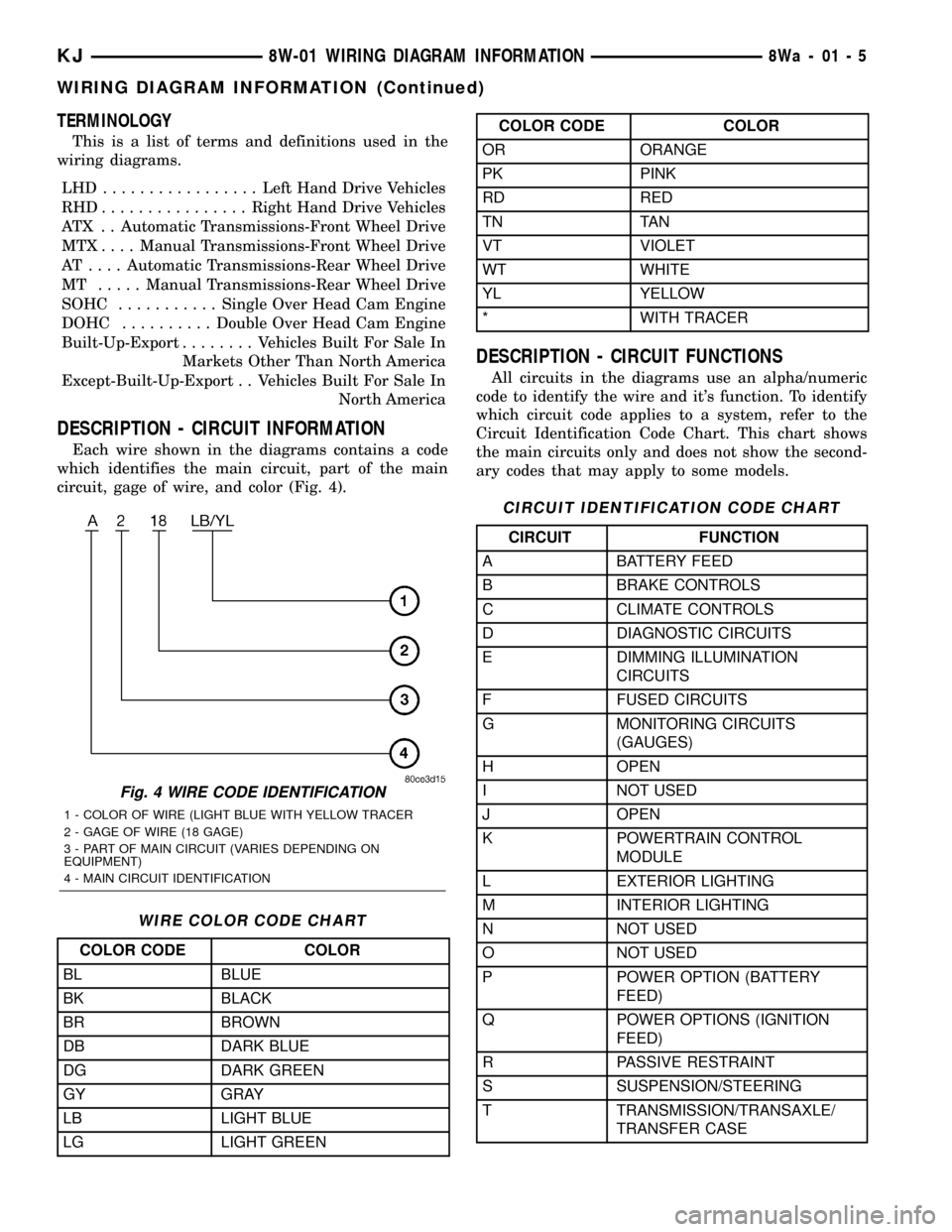
TERMINOLOGY
This is a list of terms and definitions used in the
wiring diagrams.
LHD .................Left Hand Drive Vehicles
RHD................Right Hand Drive Vehicles
ATX . . Automatic Transmissions-Front Wheel Drive
MTX....Manual Transmissions-Front Wheel Drive
AT ....Automatic Transmissions-Rear Wheel Drive
MT .....Manual Transmissions-Rear Wheel Drive
SOHC...........Single Over Head Cam Engine
DOHC..........Double Over Head Cam Engine
Built-Up-Export........ Vehicles Built For Sale In
Markets Other Than North America
Except-Built-Up-Export . . Vehicles Built For Sale In
North America
DESCRIPTION - CIRCUIT INFORMATION
Each wire shown in the diagrams contains a code
which identifies the main circuit, part of the main
circuit, gage of wire, and color (Fig. 4).
WIRE COLOR CODE CHART
COLOR CODE COLOR
BL BLUE
BK BLACK
BR BROWN
DB DARK BLUE
DG DARK GREEN
GY GRAY
LB LIGHT BLUE
LG LIGHT GREEN
COLOR CODE COLOR
OR ORANGE
PK PINK
RD RED
TN TAN
VT VIOLET
WT WHITE
YL YELLOW
* WITH TRACER
DESCRIPTION - CIRCUIT FUNCTIONS
All circuits in the diagrams use an alpha/numeric
code to identify the wire and it's function. To identify
which circuit code applies to a system, refer to the
Circuit Identification Code Chart. This chart shows
the main circuits only and does not show the second-
ary codes that may apply to some models.
CIRCUIT IDENTIFICATION CODE CHART
CIRCUIT FUNCTION
A BATTERY FEED
B BRAKE CONTROLS
C CLIMATE CONTROLS
D DIAGNOSTIC CIRCUITS
E DIMMING ILLUMINATION
CIRCUITS
F FUSED CIRCUITS
G MONITORING CIRCUITS
(GAUGES)
H OPEN
I NOT USED
J OPEN
K POWERTRAIN CONTROL
MODULE
L EXTERIOR LIGHTING
M INTERIOR LIGHTING
N NOT USED
O NOT USED
P POWER OPTION (BATTERY
FEED)
Q POWER OPTIONS (IGNITION
FEED)
R PASSIVE RESTRAINT
S SUSPENSION/STEERING
T TRANSMISSION/TRANSAXLE/
TRANSFER CASE
Fig. 4 WIRE CODE IDENTIFICATION
1 - COLOR OF WIRE (LIGHT BLUE WITH YELLOW TRACER
2 - GAGE OF WIRE (18 GAGE)
3 - PART OF MAIN CIRCUIT (VARIES DEPENDING ON
EQUIPMENT)
4 - MAIN CIRCUIT IDENTIFICATION
KJ8W-01 WIRING DIAGRAM INFORMATION8Wa-01-5
WIRING DIAGRAM INFORMATION (Continued)
Page 763 of 1803

Component Page
Low Beam Relay..................... 8Wa-50
Manifold Absolute Pressure Sensor....... 8Wa-30
Multi-Function Switch........... 8Wa-50, 52, 53
Output Speed Sensor.................. 8Wa-31
Overhead Map/Reading Lamp........... 8Wa-44
Oxygen Sensors...................... 8Wa-30
Oxygen Sensor Downstream Relay........ 8Wa-30
Park Brake Switch.................... 8Wa-40
Park Lamp Relay..................... 8Wa-50
Park/Turn Signal Lamps............ 8Wa-50, 52
Passenger Airbag..................... 8Wa-43
Passenger Door Unlock Relay........... 8Wa-61
Passenger Seat Belt Switch............. 8Wa-40
Position Lamps...................... 8Wa-50
Power Distribution Center.............. 8Wa-10
Power Mirrors....................... 8Wa-62
Power Outlet........................ 8Wa-41
Power Seats......................... 8Wa-63
Power Steering Pressure Switch......... 8Wa-30
Power Windows...................... 8Wa-60
Powertrain Control Module............. 8Wa-30
Radiator Fans....................... 8Wa-30
Radio Choke......................... 8Wa-47
Radio.............................. 8Wa-47
Rear Fog Lamp Relay................. 8Wa-51
Rear Power Outlet.................... 8Wa-41
Rear Power Window Switch............. 8Wa-60
Rear Wheel Speed Sensor.............. 8Wa-35
Rear Window Defogger................. 8Wa-48
Rear Wiper Motor.................... 8Wa-53
Red Brake Warning Indicator Switch...... 8Wa-40Component Page
Remote Keyless Entry Module........... 8Wa-45
Remote Radio Switches................ 8Wa-47
Splices............................. 8Wa-10
Sentry Key Immobilizer Module.......... 8Wa-39
Shifter Assembly..................... 8Wa-31
Side Impact Airbag Control Modules...... 8Wa-43
Side Marker Lamps................ 8Wa-50, 52
Side Repeater Lamps............... 8Wa-50, 52
Siren.............................. 8Wa-49
Speed Control Servo................... 8Wa-33
Speed Control Switches................ 8Wa-33
Starter Motor Relay................... 8Wa-21
Starter Motor........................ 8Wa-21
Sunroof............................ 8Wa-64
Tail/Stop Lamps...................... 8Wa-51
Tailgate Cylinder Lock Switch........... 8Wa-61
Tailgate Flip-Up Ajar Switch............ 8Wa-61
Tailgate Lock Motor/Ajar Switch......... 8Wa-61
Throttle Position Sensor................ 8Wa-30
Trailer Tow.......................... 8Wa-54
Transfer Case Position Sensor........ 8Wa-30, 31
Transmission Control Module........... 8Wa-31
Transmission Control Relay............. 8Wa-31
Transmission Solenoid/TRS Assembly..... 8Wa-31
Visor/Vanity Lamps................... 8Wa-44
Washer Fluid Level Switch............. 8Wa-53
Washer Pump........................ 8Wa-53
Water In Fuel Sensor.................. 8Wa-30
Wheel Speed Sensors.................. 8Wa-35
Wiper High/Low Relay................. 8Wa-53
KJ8W-02 COMPONENT INDEX8Wa-02-1