eco JEEP LIBERTY 2002 KJ / 1.G Workshop Manual
[x] Cancel search | Manufacturer: JEEP, Model Year: 2002, Model line: LIBERTY, Model: JEEP LIBERTY 2002 KJ / 1.GPages: 1803, PDF Size: 62.3 MB
Page 738 of 1803

INSTALLATION
NOTE: The rear washer nozzle latch feature is a one
time component, and will be damaged if the nozzle
is removed from its mounting hole for service. If
removed from its mounting hole for any reason, the
rear washer nozzle must be replaced with a new
unit.
(1) Position the new rear washer nozzle to the roof
panel (Fig. 7). Be certain that a new rubber gasket is
in position on the back of the nozzle.
(2) Reconnect the washer hose to the barbed nip-
ple on the back of the rear washer nozzle.
(3) Insert the rear washer nozzle supply hose and
nipple into the mounting hole in the roof panel and
align the nozzle with the hole.
(4) Engage the tab at the top of the nozzle behind
the sheet metal at the top of the roof panel mounting
hole.
(5) Using hand pressure, press firmly and evenly
on the hood of the rear washer nozzle until the lower
latch feature snaps into place behind the sheet metal
at the bottom of the roof panel mounting hole.
REAR WIPER ARM
DESCRIPTION
The rear wiper arm is the rigid member located
between the rear wiper motor output shaft that pro-
trudes from the outer tailgate panel near the base of
the rear flip-up glass opening and the rear wiper
blade (Fig. 8). This wiper arm features an over-center
hinge that allows easy access to the tailgate and rear
flip-up glass for cleaning, after the spare tire is
removed. The wiper arm has a die cast metal pivot
end with a large tapered mounting hole at one end. A
molded plastic pivot cover is secured loosely to and
pivots on the wiper arm hinge pin to conceal the
wiper arm retaining nut. The wide end of a tapered,
stamped steel channel is secured with a hinge pin to
the pivot end of the wiper arm. One end of a long,
rigid, stamped steel strap, with a small hole near its
pivot end, is riveted and crimped within the narrow
end of the stamped steel channel. The tip of the
wiper blade end of this strap is bent back under itself
to form a small hook. Concealed within the stamped
steel channel, one end of a long spring is engaged
with a wire hook on the underside of the die cast
pivot end, while the other end of the spring is hooked
through the small hole in the steel strap. A molded
plastic wiper arm support is snapped onto the wiper
arm strap where it exits the channel. The entire
wiper arm has a satin black finish applied to all of
its visible surfaces.
Fig. 7 Rear Washer Nozzle Remove/Install
1 - NOZZLE
2 - ROOF PANEL
3 - HEADLINER HOSEFig. 8 Rear Wiper Arm
1 - HOOK
2 - STRAP
3 - CHANNEL
4 - HINGE PIN
5 - COVER
6 - PIVOT END
7 - TENSION SPRING
8 - SUPPORT
KJREAR WIPERS/WASHERS 8R - 37
REAR WASHER NOZZLE (Continued)
Page 743 of 1803

REMOVAL
(1) Disconnect and isolate the battery negative
cable.
(2) Remove the rear wiper arm from the rear
wiper motor output shaft. (Refer to 8 - ELECTRI-
CAL/REAR WIPERS/WASHERS/REAR WIPER ARM
- REMOVAL).
(3) Using a small thin-bladed tool, gently pry at
the notch in the base of the rear wiper motor output
shaft bezel to unsnap the nut cover from the bezel
(Fig. 16).Be certain to take proper precautions
to protect the outer tailgate panel and its paint
finish from damage during this procedure.
(4) Remove the nut that secures the rear wiper
motor output shaft to the outer swing gate panel
(Fig. 16).
(5) Remove the bezel and gasket from the rear
wiper motor output shaft.
(6) Remove the trim panel from the tailgate inner
panel. (Refer to 23 - BODY/SWING GATE/TRIM
PANEL - REMOVAL).
(7) Disconnect the tailgate wire harness connector
for the flip-up glass ajar switch from the flip-up glass
latch connector receptacle.
(8) Disconnect the tailgate wire harness connector
for the rear wiper motor from the motor connector
receptacle (Fig. 17).
(9) Loosen the two screws that secure the rear
wiper motor mounting bracket to the top of the tail-
gate inner panel.
(10) Slide the rear wiper motor and mounting
bracket back far enough to disengage the two mount-ing screws from the keyed slots in the top of the tail-
gate inner panel.
(11) Remove the rear wiper motor and mounting
bracket from the tailgate as a unit.
INSTALLATION
(1) Position the rear wiper motor and bracket into
the tailgate as a unit (Fig. 17).
(2) Insert the rear wiper motor output shaft
through the hole in the tailgate outer panel and
engage the two mounting screws into the keyed slots
in the top of tailgate inner panel.
(3) From the outside of the tailgate, center the
rear wiper motor output shaft in the tailgate outer
panel clearance hole and install the gasket and bezel
over the centered shaft (Fig. 16).
(4) Install and tighten the nut that secures the
rear wiper motor output shaft to the outer tailgate
panel. Tighten the nut to 5 N´m (43 in. lbs.).
(5) From the inside of the tailgate, tighten the two
screws that secure the rear wiper motor mounting
bracket to the top of the tailgate inner panel. Tighten
the screws to 6 N´m (57 in. lbs.).
(6) Reconnect the tailgate wire harness connector
for the rear wiper motor to the motor connector
receptacle.
Fig. 16 Rear Wiper Motor Output Shaft Nut
Remove/Install
1 - BEZEL AND GASKET
2 - OUTPUT SHAFT
3 - TAILGATE OUTER PANEL
4 - NUT
5 - NUT COVER
Fig. 17 Rear Wiper Motor Remove/Install
1 - KEYED SLOT (2)
2 - SWING GATE INNER PANEL
3 - SCREW (2)
4 - REAR WIPER MOTOR ELECTRICAL CONNECTOR
5 - REAR WIPER MOTOR
8R - 42 REAR WIPERS/WASHERSKJ
REAR WIPER MOTOR (Continued)
Page 744 of 1803

(7) Reconnect the tailgate wire harness connector
for the flip-up glass ajar switch to the flip-up glass
latch connector receptacle.
(8) Reinstall the trim panel onto the tailgate inner
panel. (Refer to 23 - BODY/SWING GATE/TRIM
PANEL - INSTALLATION).
(9) From the outside of the tailgate, press the nut
cover firmly and evenly over the rear wiper motor
output shaft bezel using hand pressure until it snaps
into place.
(10) Reinstall the rear wiper arm onto the rear
wiper motor output shaft. (Refer to 8 - ELECTRI-
CAL/REAR WIPERS/WASHERS/REAR WIPER ARM
- INSTALLATION).
(11) Reconnect the battery negative cable.
REAR WIPER/WASHER
SWITCH
DESCRIPTION
The rear wiper and washer switches are integral to
the right (wiper) control stalk of the multi-function
switch. (Refer to 8 - ELECTRICAL/LAMPS/LIGHT-
ING - EXTERIOR/MULTI-FUNCTION SWITCH -
DESCRIPTION).
OPERATION
The rear wiper and washer switches are integral to
the right (wiper) control stalk of the multi-function
switch. (Refer to 8 - ELECTRICAL/LAMPS/LIGHT-
ING - EXTERIOR/MULTI-FUNCTION SWITCH -
OPERATION).
WIPER ARM PARK RAMP
REMOVAL
(1) Disengage the rear wiper arm support from the
wiper arm park ramp on the right side of the tailgate
just below the rear flip-up glass.(2) Lift the wiper arm and blade away from the
tailgate until the wiper arm hinge is in its over-cen-
ter position.
Remove the screw that secures the wiper arm park
ramp to the tailgate outer panel (Fig. 18).
(3) Remove the wiper arm park ramp from the
tailgate outer panel.
INSTALLATION
(1) Position the wiper arm park ramp onto the
tailgate outer panel (Fig. 18).
(2) Install and tighten the screw that secures the
wiper arm park ramp to the tailgate outer panel.
Tighten the screw to 5 N´m (45 in. lbs.).
(3) Lower the rear wiper arm and blade and place
the wiper arm support onto the wiper arm park
ramp.
Fig. 18 Wiper Arm Park Ramp Remove/Install
1 - SCREW (1)
2 - PARK RAMP
3 - RIVET NUT (1)
4 - TAILGATE OUTER PANEL
KJREAR WIPERS/WASHERS 8R - 43
REAR WIPER MOTOR (Continued)
Page 752 of 1803
TERMINOLOGY
This is a list of terms and definitions used in the
wiring diagrams.
LHD .................Left Hand Drive Vehicles
RHD................Right Hand Drive Vehicles
ATX . . Automatic Transmissions-Front Wheel Drive
MTX....Manual Transmissions-Front Wheel Drive
AT ....Automatic Transmissions-Rear Wheel Drive
MT .....Manual Transmissions-Rear Wheel Drive
SOHC...........Single Over Head Cam Engine
DOHC..........Double Over Head Cam Engine
Built-Up-Export........ Vehicles Built For Sale In
Markets Other Than North America
Except-Built-Up-Export . . Vehicles Built For Sale In
North America
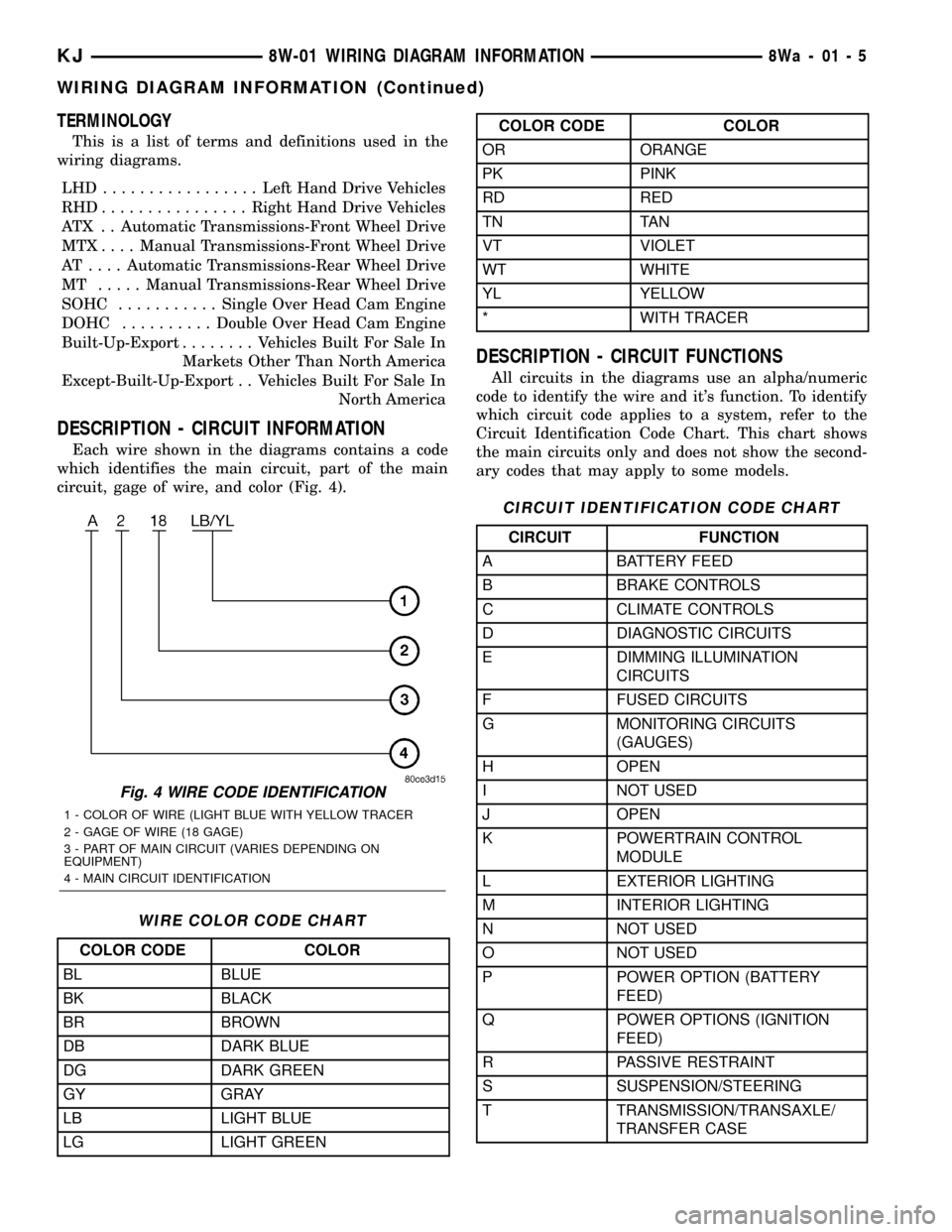
DESCRIPTION - CIRCUIT INFORMATION
Each wire shown in the diagrams contains a code
which identifies the main circuit, part of the main
circuit, gage of wire, and color (Fig. 4).
WIRE COLOR CODE CHART
COLOR CODE COLOR
BL BLUE
BK BLACK
BR BROWN
DB DARK BLUE
DG DARK GREEN
GY GRAY
LB LIGHT BLUE
LG LIGHT GREEN
COLOR CODE COLOR
OR ORANGE
PK PINK
RD RED
TN TAN
VT VIOLET
WT WHITE
YL YELLOW
* WITH TRACER
DESCRIPTION - CIRCUIT FUNCTIONS
All circuits in the diagrams use an alpha/numeric
code to identify the wire and it's function. To identify
which circuit code applies to a system, refer to the
Circuit Identification Code Chart. This chart shows
the main circuits only and does not show the second-
ary codes that may apply to some models.
CIRCUIT IDENTIFICATION CODE CHART
CIRCUIT FUNCTION
A BATTERY FEED
B BRAKE CONTROLS
C CLIMATE CONTROLS
D DIAGNOSTIC CIRCUITS
E DIMMING ILLUMINATION
CIRCUITS
F FUSED CIRCUITS
G MONITORING CIRCUITS
(GAUGES)
H OPEN
I NOT USED
J OPEN
K POWERTRAIN CONTROL
MODULE
L EXTERIOR LIGHTING
M INTERIOR LIGHTING
N NOT USED
O NOT USED
P POWER OPTION (BATTERY
FEED)
Q POWER OPTIONS (IGNITION
FEED)
R PASSIVE RESTRAINT
S SUSPENSION/STEERING
T TRANSMISSION/TRANSAXLE/
TRANSFER CASE
Fig. 4 WIRE CODE IDENTIFICATION
1 - COLOR OF WIRE (LIGHT BLUE WITH YELLOW TRACER
2 - GAGE OF WIRE (18 GAGE)
3 - PART OF MAIN CIRCUIT (VARIES DEPENDING ON
EQUIPMENT)
4 - MAIN CIRCUIT IDENTIFICATION
KJ8W-01 WIRING DIAGRAM INFORMATION8Wa-01-5
WIRING DIAGRAM INFORMATION (Continued)
Page 757 of 1803

SPECIAL TOOLS
WIRING/TERMINAL
CONNECTOR
REMOVAL
(1) Disconnect battery.
(2) Release Connector Lock (Fig. 10).
(3) Disconnect the connector being repaired from
its mating half/component.
(4) Remove the dress cover (if applicable) (Fig. 10).
(5) Release the Secondary Terminal Lock, if
required (Fig. 11).
(6) Position the connector locking finger away from
the terminal using the proper special tool. Pull on
the wire to remove the terminal from the connector
(Fig. 12).
PROBING TOOL PACKAGE 6807
TERMINAL PICK TOOL SET 6680
TERMINAL REMOVING TOOLS 6932 AND 8638
TERMINAL REMOVING TOOL 6934
Fig. 10 REMOVAL OF DRESS COVER
1 - DRESS COVER
2 - CONNECTOR LOCK
3 - CONNECTOR
8Wa - 01 - 10 8W-01 WIRING DIAGRAM INFORMATIONKJ
WIRING DIAGRAM INFORMATION (Continued)
Page 758 of 1803

1 - Secondary Terminal Lock
Fig. 11 EXAMPLES OF CONNECTOR SECONDARY TERMINAL LOCKS
KJ8W-01 WIRING DIAGRAM INFORMATION8Wa-01-11
CONNECTOR (Continued)
Page 760 of 1803

INSTALLATION
(1) Insert the removed terminal in the same cavity
on the repair connector.
(2) Repeat steps for each terminal in the connec-
tor, being sure that all wires are inserted into the
proper cavities. For additional connector pin-out
identification, refer to the wiring diagrams.
(3) When the connector is re-assembled, the sec-
ondary terminal lock must be placed in the locked
position to prevent terminal push out.
(4) Replace dress cover (if applicable).
(5) Connect connector to its mating half/compo-
nent.
(6) Connect battery and test all affected systems.
DIODE
REMOVAL
(1) Disconnect the battery.
(2) Locate the diode in the harness, and remove
the protective covering.
(3) Remove the diode from the harness, pay atten-
tion to the current flow direction (Fig. 13).
INSTALLATION
(1) Remove the insulation from the wires in the
harness. Only remove enough insulation to solder in
the new diode.(2) Install the new diode in the harness, making
sure current flow is correct. If necessary, refer to the
appropriate wiring diagram for current flow (Fig. 13).
(3) Solder the connection together using rosin core
type solder only.Do not use acid core solder.
(4) Tape the diode to the harness using electrical
tape. Make sure the diode is completely sealed from
the elements.
(5) Re-connect the battery and test affected sys-
tems.
TERMINAL
REMOVAL
(1) Follow steps for removing terminals described
in the connector removal section.
(2) Cut the wire 6 inches from the back of the con-
nector.
INSTALLATION
(1) Select a wire from the terminal repair kit that
best matches the color and gage of the wire being
repaired.
(2) Cut the repair wire to the proper length and
remove one±half (1/2) inch of insulation.
(3) Splice the repair wire to the wire harness (see
wire splicing procedure).
(4) Insert the repaired wire into the connector.
(5) Install the connector locking wedge, if required,
and reconnect the connector to its mating half/compo-
nent.
(6) Re-tape the wire harness starting at 1±1/2
inches behind the connector and 2 inches past the
repair.
(7) Connect battery and test all affected systems.
WIRE
STANDARD PROCEDURE - WIRE SPLICING
When splicing a wire, it is important that the cor-
rect gage be used as shown in the wiring diagrams.
(1) Remove one-half (1/2) inch of insulation from
each wire that needs to be spliced.
(2) Place a piece of adhesive lined heat shrink tub-
ing on one side of the wire. Make sure the tubing will
be long enough to cover and seal the entire repair
area.
Fig. 13 DIODE IDENTIFICATION
1 - CURRENT FLOW
2 - BAND AROUND DIODE INDICATES CURRENT FLOW
3 - DIODE AS SHOWN IN THE DIAGRAMS
KJ8W-01 WIRING DIAGRAM INFORMATION8Wa-01-13
CONNECTOR (Continued)
Page 1066 of 1803
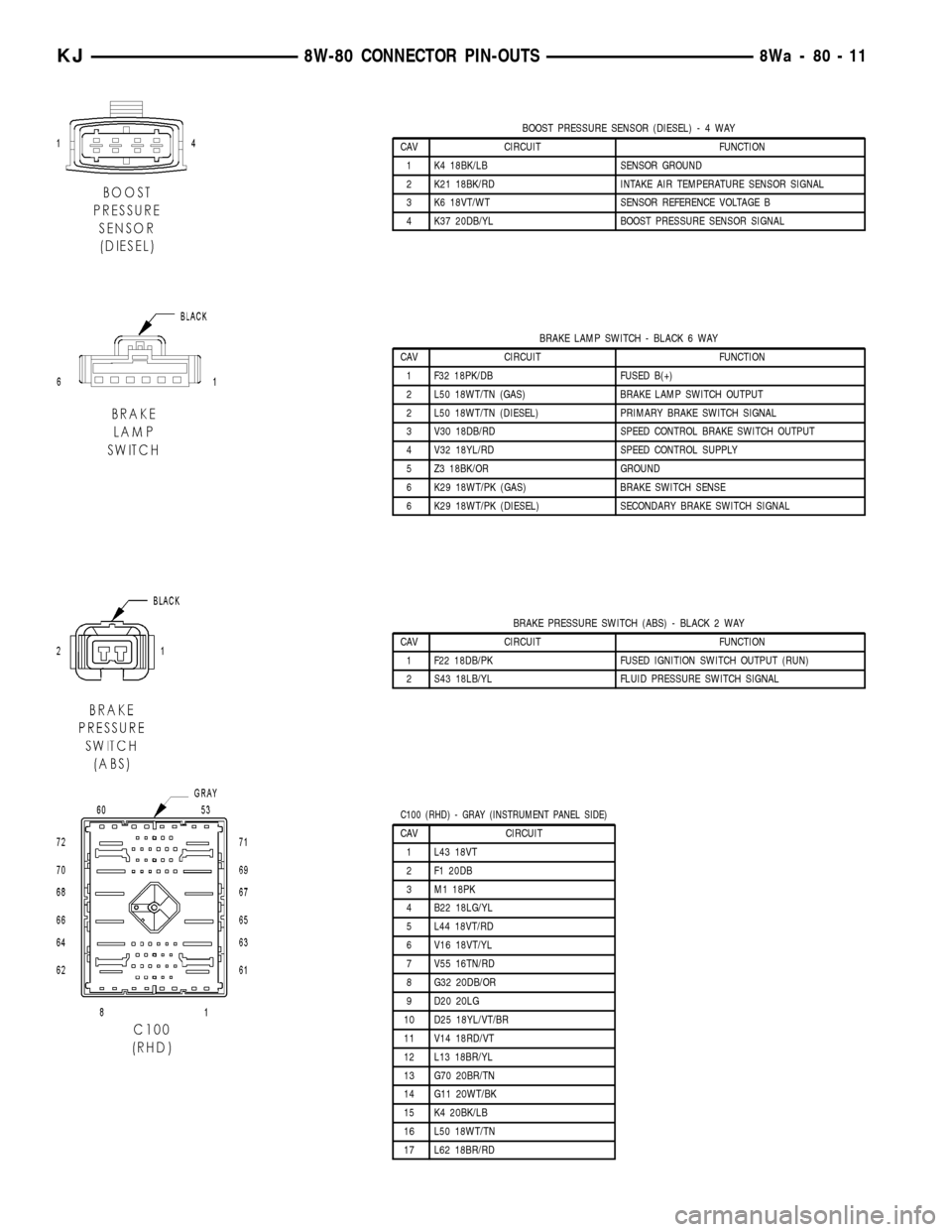
BOOST PRESSURE SENSOR (DIESEL)-4WAY
CAV CIRCUIT FUNCTION
1 K4 18BK/LB SENSOR GROUND
2 K21 18BK/RD INTAKE AIR TEMPERATURE SENSOR SIGNAL
3 K6 18VT/WT SENSOR REFERENCE VOLTAGE B
4 K37 20DB/YL BOOST PRESSURE SENSOR SIGNAL
BRAKE LAMP SWITCH - BLACK 6 WAY
CAV CIRCUIT FUNCTION
1 F32 18PK/DB FUSED B(+)
2 L50 18WT/TN (GAS) BRAKE LAMP SWITCH OUTPUT
2 L50 18WT/TN (DIESEL) PRIMARY BRAKE SWITCH SIGNAL
3 V30 18DB/RD SPEED CONTROL BRAKE SWITCH OUTPUT
4 V32 18YL/RD SPEED CONTROL SUPPLY
5 Z3 18BK/OR GROUND
6 K29 18WT/PK (GAS) BRAKE SWITCH SENSE
6 K29 18WT/PK (DIESEL) SECONDARY BRAKE SWITCH SIGNAL
BRAKE PRESSURE SWITCH (ABS) - BLACK 2 WAY
CAV CIRCUIT FUNCTION
1 F22 18DB/PK FUSED IGNITION SWITCH OUTPUT (RUN)
2 S43 18LB/YL FLUID PRESSURE SWITCH SIGNAL
C100 (RHD) - GRAY (INSTRUMENT PANEL SIDE)
CAV CIRCUIT
1 L43 18VT
2 F1 20DB
3 M1 18PK
4 B22 18LG/YL
5 L44 18VT/RD
6 V16 18VT/YL
7 V55 16TN/RD
8 G32 20DB/OR
9 D20 20LG
10 D25 18YL/VT/BR
11 V14 18RD/VT
12 L13 18BR/YL
13 G70 20BR/TN
14 G11 20WT/BK
15 K4 20BK/LB
16 L50 18WT/TN
17 L62 18BR/RD
KJ8W-80 CONNECTOR PIN-OUTS8Wa-80-11
Page 1218 of 1803

ENGINE - 3.7L
DESCRIPTION
The 3.7 liter (226 CID) six-cylinder engine is an
90É single overhead camshaft engine. The cast iron
cylinder block is made up of two different compo-
nents; the first component is the cylinder bore and
upper block, the second component is the bedplate
that comprises the lower portion of the cylinder block
and houses the lower half of the crankshaft mainbearings. The cylinders are numbered from front to
rear with the left bank being numbered 1,3,and 5
and the right bank being numbered 2,4, and 6. The
firing order is 1±6±5±4±3±2. The engine serial num-
ber is located at the right front side of the engine
block
3.7 L ENGINE
KJENGINE - 3.7L 9 - 3
Page 1223 of 1803
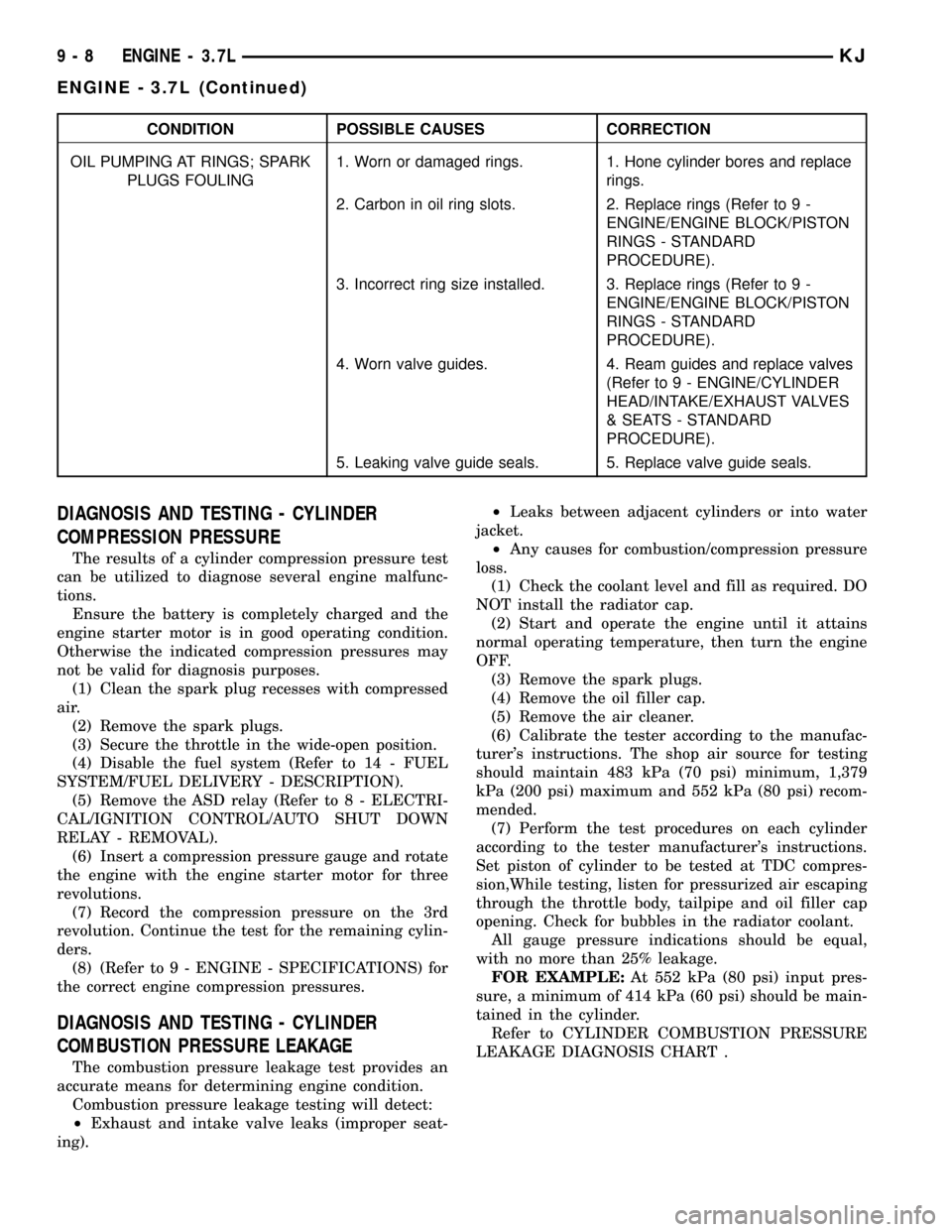
CONDITION POSSIBLE CAUSES CORRECTION
OIL PUMPING AT RINGS; SPARK
PLUGS FOULING1. Worn or damaged rings. 1. Hone cylinder bores and replace
rings.
2. Carbon in oil ring slots. 2. Replace rings (Refer to 9 -
ENGINE/ENGINE BLOCK/PISTON
RINGS - STANDARD
PROCEDURE).
3. Incorrect ring size installed. 3. Replace rings (Refer to 9 -
ENGINE/ENGINE BLOCK/PISTON
RINGS - STANDARD
PROCEDURE).
4. Worn valve guides. 4. Ream guides and replace valves
(Refer to 9 - ENGINE/CYLINDER
HEAD/INTAKE/EXHAUST VALVES
& SEATS - STANDARD
PROCEDURE).
5. Leaking valve guide seals. 5. Replace valve guide seals.
DIAGNOSIS AND TESTING - CYLINDER
COMPRESSION PRESSURE
The results of a cylinder compression pressure test
can be utilized to diagnose several engine malfunc-
tions.
Ensure the battery is completely charged and the
engine starter motor is in good operating condition.
Otherwise the indicated compression pressures may
not be valid for diagnosis purposes.
(1) Clean the spark plug recesses with compressed
air.
(2) Remove the spark plugs.
(3) Secure the throttle in the wide-open position.
(4) Disable the fuel system (Refer to 14 - FUEL
SYSTEM/FUEL DELIVERY - DESCRIPTION).
(5) Remove the ASD relay (Refer to 8 - ELECTRI-
CAL/IGNITION CONTROL/AUTO SHUT DOWN
RELAY - REMOVAL).
(6) Insert a compression pressure gauge and rotate
the engine with the engine starter motor for three
revolutions.
(7) Record the compression pressure on the 3rd
revolution. Continue the test for the remaining cylin-
ders.
(8) (Refer to 9 - ENGINE - SPECIFICATIONS) for
the correct engine compression pressures.
DIAGNOSIS AND TESTING - CYLINDER
COMBUSTION PRESSURE LEAKAGE
The combustion pressure leakage test provides an
accurate means for determining engine condition.
Combustion pressure leakage testing will detect:
²Exhaust and intake valve leaks (improper seat-
ing).²Leaks between adjacent cylinders or into water
jacket.
²Any causes for combustion/compression pressure
loss.
(1) Check the coolant level and fill as required. DO
NOT install the radiator cap.
(2) Start and operate the engine until it attains
normal operating temperature, then turn the engine
OFF.
(3) Remove the spark plugs.
(4) Remove the oil filler cap.
(5) Remove the air cleaner.
(6) Calibrate the tester according to the manufac-
turer's instructions. The shop air source for testing
should maintain 483 kPa (70 psi) minimum, 1,379
kPa (200 psi) maximum and 552 kPa (80 psi) recom-
mended.
(7) Perform the test procedures on each cylinder
according to the tester manufacturer's instructions.
Set piston of cylinder to be tested at TDC compres-
sion,While testing, listen for pressurized air escaping
through the throttle body, tailpipe and oil filler cap
opening. Check for bubbles in the radiator coolant.
All gauge pressure indications should be equal,
with no more than 25% leakage.
FOR EXAMPLE:At 552 kPa (80 psi) input pres-
sure, a minimum of 414 kPa (60 psi) should be main-
tained in the cylinder.
Refer to CYLINDER COMBUSTION PRESSURE
LEAKAGE DIAGNOSIS CHART .
9 - 8 ENGINE - 3.7LKJ
ENGINE - 3.7L (Continued)