wire JEEP LIBERTY 2002 KJ / 1.G Workshop Manual
[x] Cancel search | Manufacturer: JEEP, Model Year: 2002, Model line: LIBERTY, Model: JEEP LIBERTY 2002 KJ / 1.GPages: 1803, PDF Size: 62.3 MB
Page 1429 of 1803

THROTTLE POSITION SENSOR
DESCRIPTION
The 3±wire Throttle Position Sensor (TPS) is
mounted on the throttle body and is connected to the
throttle blade shaft.
OPERATION
The 3±wire TPS provides the Powertrain Control
Module (PCM) with an input signal (voltage) that
represents the throttle blade position of the throttle
body. The sensor is connected to the throttle blade
shaft. As the position of the throttle blade changes,
the output voltage of the TPS changes.
The PCM supplies approximately 5 volts to the
TPS. The TPS output voltage (input signal to the
PCM) represents the throttle blade position. The
PCM receives an input signal voltage from the TPS.
This will vary in an approximate range of from .26
volts at minimum throttle opening (idle), to 4.49 volts
at wide open throttle. Along with inputs from other
sensors, the PCM uses the TPS input to determine
current engine operating conditions. In response to
engine operating conditions, the PCM will adjust fuel
injector pulse width and ignition timing.
The PCM needs to identify the actions and position
of the throttle blade at all times. This information is
needed to assist in performing the following calcula-
tions:
²Ignition timing advance
²Fuel injection pulse-width
²Idle (learned value or minimum TPS)
²Off-idle (0.06 volt)
²Wide Open Throttle (WOT) open loop (2.608
volts above learned idle voltage)
²Deceleration fuel lean out
²Fuel cutoff during cranking at WOT (2.608 volts
above learned idle voltage)
²A/C WOT cutoff (certain automatic transmis-
sions only)
REMOVAL
2.4L
The Throttle Position Sensor (TPS) is mounted to
the throttle body (Fig. 31).
(1) Disconnect TPS electrical connector.
(2) Remove 2 TPS mounting screws.
(3) Remove TPS.
Fig. 31 TPS/IAC MOTOR - 2.4L
1 - THROTTLE POSITION SENSOR (TPS)
2 - MOUNTING SCREWS
3 - IDLE AIR CONTROL MOTOR (IAC)
4 - MOUNTING SCREWS
KJFUEL INJECTION 14 - 47
Page 1440 of 1803

KEY-IN IGNITION SWITCH
DESCRIPTION
The key-in ignition switch is integral to the igni-
tion switch, which is mounted on the left side of the
steering column, opposite the ignition lock cylinder.
It closes a path to ground for the instrument cluster
chime warning circuitry when the ignition key is
inserted in the ignition lock cylinder and the driver
door jamb switch is closed (driver door is open). The
key-in ignition switch opens the ground path when
the key is removed from the ignition lock cylinder.
The key-in ignition switch cannot be repaired and,
if faulty or damaged, the entire ignition switch must
be replaced. (Refer to 19 - STEERING/COLUMN/IG-
NITION SWITCH - REMOVAL).
DIAGNOSIS AND TESTING - KEY-IN IGNITION
SWITCH
For circuit descriptions and diagrams, Refer to the
appropriate sections on the individual components.
WARNING: ON VEHICLES EQUIPPED WITH AIR-
BAGS, REFER TO ELECTRICAL - PASSIVE
RESTRAINT SYSTEMS BEFORE ATTEMPTING ANY
STEERING WHEEL, STEERING COLUMN, OR
INSTRUMENT PANEL COMPONENT DIAGNOSIS OR
SERVICE. FAILURE TO TAKE THE PROPER PRE-
CAUTIONS COULD RESULT IN ACCIDENTAL AIR-
BAG DEPLOYMENT AND POSSIBLE PERSONAL
INJURY.
(1) Disconnect and isolate the battery negative
cable. Remove the steering column shrouds. Unplug
the key-in ignition switch wire harness connector
from the ignition switch.
(2) Check for continuity between the key-in switch
sense circuit and the left front door jamb switch
sense circuit terminals of the key-in ignition switch.
There should be continuity with the key in the igni-
tion lock cylinder, and no continuity with the key
removed from the ignition lock cylinder. If OK, go to
Step 3. If not OK, replace the faulty ignition switch
assembly.
(3) Check for continuity between the left front door
jamb switch sense circuit cavity of the key-in ignition
switch wire harness connector and a good ground.
There should be continuity with the driver door open,
and no continuity with the driver door closed. If OK,
see the diagnosis for Instrument Cluster in this
group. If not OK, repair the circuit to the driver door
jamb switch as required.
LOCK CYLINDER
REMOVAL
The ignition key must be in the key cylinder for
cylinder removal. The key cylinder must be removed
first before removing ignition switch.
(1) If equipped with an automatic transmission,
place shifter in PARK position.
(2) Remove the lower shroud cover.
(3) Remove the remote keyless entry (R.K.E.) mod-
ule.
(4) Remove the halo ring around the lock cylinder.
(5) Rotate key to ON position.
(6) A release tang is located on bottom of key cyl-
inder (Fig. 10).
(7) Position a small screwdriver or pin punch into
tang access hole on bottom of steering column (Fig.
11).
(8) Push the pin punch up while pulling key cylin-
der from steering column.
Fig. 10 LOCK CYLINDER RELEASE TANG
1 - Lock Cylinder
2 - Release Tang
19 - 10 COLUMNKJ
Page 1449 of 1803
(5) Remove the two nuts securing the wire loom
behind the pump bracket.
(6) Remove the three bolts securing the pump to
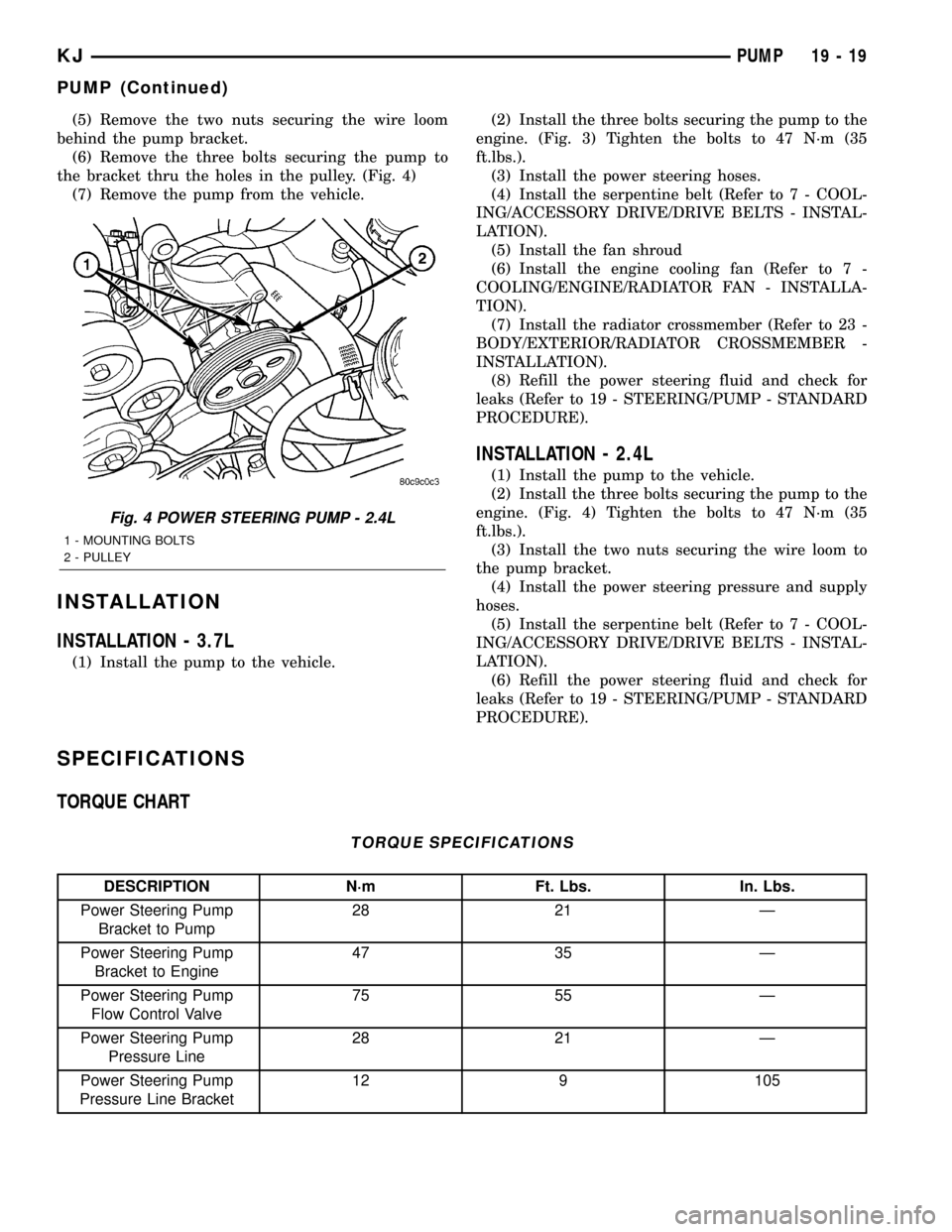
the bracket thru the holes in the pulley. (Fig. 4)
(7) Remove the pump from the vehicle.
INSTALLATION
INSTALLATION - 3.7L
(1) Install the pump to the vehicle.(2) Install the three bolts securing the pump to the
engine. (Fig. 3) Tighten the bolts to 47 N´m (35
ft.lbs.).
(3) Install the power steering hoses.
(4) Install the serpentine belt (Refer to 7 - COOL-
ING/ACCESSORY DRIVE/DRIVE BELTS - INSTAL-
LATION).
(5) Install the fan shroud
(6) Install the engine cooling fan (Refer to 7 -
COOLING/ENGINE/RADIATOR FAN - INSTALLA-
TION).
(7) Install the radiator crossmember (Refer to 23 -
BODY/EXTERIOR/RADIATOR CROSSMEMBER -
INSTALLATION).
(8) Refill the power steering fluid and check for
leaks (Refer to 19 - STEERING/PUMP - STANDARD
PROCEDURE).
INSTALLATION - 2.4L
(1) Install the pump to the vehicle.
(2) Install the three bolts securing the pump to the
engine. (Fig. 4) Tighten the bolts to 47 N´m (35
ft.lbs.).
(3) Install the two nuts securing the wire loom to
the pump bracket.
(4) Install the power steering pressure and supply
hoses.
(5) Install the serpentine belt (Refer to 7 - COOL-
ING/ACCESSORY DRIVE/DRIVE BELTS - INSTAL-
LATION).
(6) Refill the power steering fluid and check for
leaks (Refer to 19 - STEERING/PUMP - STANDARD
PROCEDURE).
SPECIFICATIONS
TORQUE CHART
TORQUE SPECIFICATIONS
DESCRIPTION N´m Ft. Lbs. In. Lbs.
Power Steering Pump
Bracket to Pump28 21 Ð
Power Steering Pump
Bracket to Engine47 35 Ð
Power Steering Pump
Flow Control Valve75 55 Ð
Power Steering Pump
Pressure Line28 21 Ð
Power Steering Pump
Pressure Line Bracket12 9 105
Fig. 4 POWER STEERING PUMP - 2.4L
1 - MOUNTING BOLTS
2 - PULLEY
KJPUMP 19 - 19
PUMP (Continued)
Page 1462 of 1803
DIAGNOSIS AND TESTING - TREAD WEAR
INDICATORS
Tread wear indicators are molded into the bottom
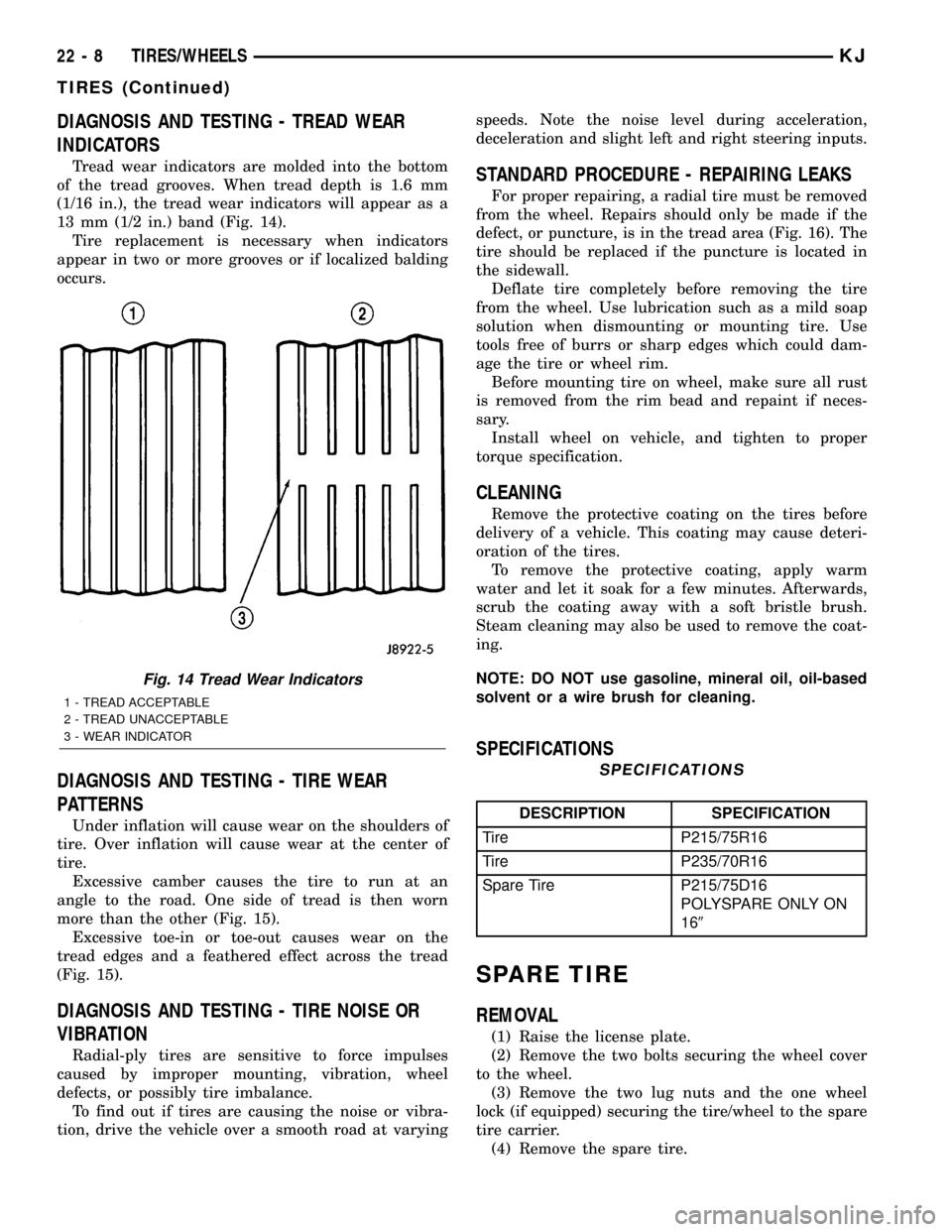
of the tread grooves. When tread depth is 1.6 mm
(1/16 in.), the tread wear indicators will appear as a
13 mm (1/2 in.) band (Fig. 14).
Tire replacement is necessary when indicators
appear in two or more grooves or if localized balding
occurs.
DIAGNOSIS AND TESTING - TIRE WEAR
PATTERNS
Under inflation will cause wear on the shoulders of
tire. Over inflation will cause wear at the center of
tire.
Excessive camber causes the tire to run at an
angle to the road. One side of tread is then worn
more than the other (Fig. 15).
Excessive toe-in or toe-out causes wear on the
tread edges and a feathered effect across the tread
(Fig. 15).
DIAGNOSIS AND TESTING - TIRE NOISE OR
VIBRATION
Radial-ply tires are sensitive to force impulses
caused by improper mounting, vibration, wheel
defects, or possibly tire imbalance.
To find out if tires are causing the noise or vibra-
tion, drive the vehicle over a smooth road at varyingspeeds. Note the noise level during acceleration,
deceleration and slight left and right steering inputs.
STANDARD PROCEDURE - REPAIRING LEAKS
For proper repairing, a radial tire must be removed
from the wheel. Repairs should only be made if the
defect, or puncture, is in the tread area (Fig. 16). The
tire should be replaced if the puncture is located in
the sidewall.
Deflate tire completely before removing the tire
from the wheel. Use lubrication such as a mild soap
solution when dismounting or mounting tire. Use
tools free of burrs or sharp edges which could dam-
age the tire or wheel rim.
Before mounting tire on wheel, make sure all rust
is removed from the rim bead and repaint if neces-
sary.
Install wheel on vehicle, and tighten to proper
torque specification.
CLEANING
Remove the protective coating on the tires before
delivery of a vehicle. This coating may cause deteri-
oration of the tires.
To remove the protective coating, apply warm
water and let it soak for a few minutes. Afterwards,
scrub the coating away with a soft bristle brush.
Steam cleaning may also be used to remove the coat-
ing.
NOTE: DO NOT use gasoline, mineral oil, oil-based
solvent or a wire brush for cleaning.
SPECIFICATIONS
SPECIFICATIONS
DESCRIPTION SPECIFICATION
Tire P215/75R16
Tire P235/70R16
Spare Tire P215/75D16
POLYSPARE ONLY ON
169
SPARE TIRE
REMOVAL
(1) Raise the license plate.
(2) Remove the two bolts securing the wheel cover
to the wheel.
(3) Remove the two lug nuts and the one wheel
lock (if equipped) securing the tire/wheel to the spare
tire carrier.
(4) Remove the spare tire.
Fig. 14 Tread Wear Indicators
1 - TREAD ACCEPTABLE
2 - TREAD UNACCEPTABLE
3 - WEAR INDICATOR
22 - 8 TIRES/WHEELSKJ
TIRES (Continued)
Page 1587 of 1803

DOOR
REMOVAL
(1) Disconnect the door wire harness electrical con-
nector at the A-pillar.
(2) Support the door with a suitable lifting device.
(3) Remove the bolts attaching the check strap to
the a-pillar.
NOTE: The epoxy washers should not be removed
from the hinge. If the washers are removed the door
may have to be re-adjusted.
(4) Remove the nuts attaching the door hinges to
the door. (Fig. 2)
INSTALLATION
(1) Support the door with a suitable lifting device
and install the door onto the hinges.
(2) Install the nuts and washers if they were
removed previously and tighten to 23 N´m (17 ft.
lbs.).
(3) Connect the door wire harness electrical con-
nector.
(4) Connect the check strap to the a-pillar and
install the bolts.
(5) Tighten the check strap bolts to 12 N´m (9 ft.
lbs.).(6) Adjust the door as necessary. (Refer to 23 -
BODY/BODY STRUCTURE/GAP AND FLUSH -
SPECIFICATIONS)
DOOR GLASS
REMOVAL
(1) Remove the outer belt molding. (Refer to 23 -
BODY/WEATHERSTRIP/SEALS/FRONT DOOR
OUTER BELT MOLDING - REMOVAL)
(2) Remove the waterdam. (Refer to 23 - BODY/
DOOR - FRONT/WATERDAM - REMOVAL)
(3) Raise the glass to the position shown and using
a long flat blade or hook type tool, disengage clips
attaching glass retainer to regulator lift plate. (Fig.
3)
(4) Disconnect the glass from the regulator lift
plate and re-install the clips.
(5) Rotate the top of the glass toward the front
and remove the glass from the window opening.
INSTALLATION
(1) Install the glass through the window opening
and align the mounting plate to the lift plate.
(2) Engage the glass to the regulator lift plate.
(3) Install the outer belt molding. (Refer to 23 -
BODY/WEATHERSTRIP/SEALS/FRONT DOOR
OUTER BELT MOLDING - INSTALLATION)
(4) Install the waterdam. (Refer to 23 - BODY/
DOOR - FRONT/WATERDAM - INSTALLATION)
Fig. 2 HINGES
1 - NUTS (4)
2 - EPOXY WASHERS (2) (NOT REMOVABLE)
3 - HINGES
4 - DOOR
Fig. 3 DOOR GLASS/REGULATOR
1 - DOOR GLASS ATTACHMENT CLIP (2)
2 - DOOR OPENING
3 - REGULATOR LIFT PLATE
4 - DOOR GLASS
23 - 122 DOOR - FRONTKJ
Page 1591 of 1803

INSTALLATION
(1) Connect the inside handle actuator rod and the
electrical connectors.
(2) Position the trim panel and seat the clips fully.
(3) Instal the screws and install the screw plug.
WATERDAM
REMOVAL
(1) Remove the trim panel. (Refer to 23 - BODY/
DOOR - FRONT/TRIM PANEL - REMOVAL)
(2) Remove the door speaker.
(3) Peal waterdam away from inner door panel
and off of the latch linkages (Fig. 12).
INSTALLATION
(1) Position the wire harness and actuator rods
through the holes in the waterdam.
(2) Place waterdam onto the door.
(3) Install the trim panel. (Refer to 23 - BODY/
DOOR - FRONT/TRIM PANEL - INSTALLATION)
WINDOW REGULATOR -
MANUAL
REMOVAL
(1) Remove the door glass. (Refer to 23 - BODY/
DOOR - FRONT/DOOR GLASS - REMOVAL)
(2) Loosen the bolts. (Fig. 13)
(3) Disconnect the runout tube clip and remove the
regulator.
INSTALLATION
(1) Install the regulator assembly.
(2) Tighten the bolts to 9 N´m (80 in. lbs.) using
the sequence shown. (Fig. 14)
(3) Install the door glass. (Refer to 23 - BODY/
DOOR - FRONT/DOOR GLASS - INSTALLATION)
WINDOW REGULATOR -
ELECTRIC
REMOVAL
(1) Remove the door glass. (Refer to 23 - BODY/
DOOR - FRONT/DOOR GLASS - REMOVAL)
(2) Loosen the bolts. (Fig. 15)
(3) Disconnect the runout tube clip.
(4) Disconnect the electrical connector and remove
the regulator.
INSTALLATION
(1) Install the regulator assembly.
(2) Connect the electrical connector.
Fig. 11 TRIM PANEL CONNECTIONS
1 - ELECTRICAL CONNECTORS
2 - ALIGNMENT PINS
3 - LATCH ACTUATOR ROD
4 - TRIM PANEL
Fig. 12 FRONT DOOR WATERDAM
1 - DOOR
2 - LOCK ACTUATOR ROD
3 - INSIDE HANDLE ACTUATOR ROD AND HOLE
4 - ELECTRICAL CONNECTOR
23 - 126 DOOR - FRONTKJ
TRIM PANEL (Continued)
Page 1594 of 1803

DOOR
REMOVAL
(1) Disconnect the door wire harness electrical con-
nector at the b-pillar.
(2) Disconnect the check strap from the b-pillar.
(Refer to 23 - BODY/DOORS - REAR/CHECK STRAP
- REMOVAL)
(3) Support the door with a suitable lifting device.
NOTE: The epoxy washers should not be removed
from the hinge. If the washers are removed the door
may have to be re-adjusted.
(4) Remove the nuts attaching the door hinges to
the door. (Fig. 2)
INSTALLATION
(1) Support the door with a suitable lifting device
and install the door onto the b-pillar.
(2) Install the nuts, washers and tighten to 23
N´m (17 ft. lbs.).
(3) Connect the door wire harness electrical con-
nector.
(4) Connect the check strap to the b-pillar. (Refer
to 23 - BODY/DOORS - REAR/CHECK STRAP -
INSTALLATION)(5) Adjust the door as necessary. (Refer to 23 -
BODY/BODY STRUCTURE/GAP AND FLUSH -
SPECIFICATIONS)
DOOR GLASS
REMOVAL
(1) Remove the waterdam. (Refer to 23 - BODY/
DOORS - REAR/WATERDAM - REMOVAL)
(2) Raise the glass and line up the lift plate clip
with the hole in the door panel shown. (Fig. 3)
(3) Using a long flat blade or hook type tool, dis-
engage the clip attaching glass retainer to regulator
lift plate.
(4) Disconnect the glass from the regulator lift
plate and re-install the clip.
(5) Position the glass into the bottom of the door.
(6) Remove the glass division bar bolt. (Fig. 4)
(7) Twist the division bar towards the inside of the
door and disengage the door glass.
(8) Remove the glass from the window opening.
INSTALLATION
(1) Install the glass through the window opening.
(2) Position the front of the glass into the glass
run channel.
Fig. 2 HINGES
1 - DOOR
2 - HINGES
3 - EPOXY WASHERS (2) (NOT REMOVABLE)
4 - NUTS
Fig. 3 DOOR GLASS POSITION
1 - GLASS DIVISION BAR
2 - DOOR PANEL SIGHT HOLE
3 - DOOR GLASS
KJDOORS - REAR 23 - 129
Page 1598 of 1803

WATERDAM
REMOVAL
(1) Remove the trim panel. (Refer to 23 - BODY/
DOORS - REAR/TRIM PANEL - REMOVAL)
(2) Remove the door speaker.
(3) Peal waterdam away from inner door panel
and off of the latch linkages (Fig. 12).
INSTALLATION
(1) Position the wire harness and actuator rods
through the holes in the waterdam.
(2) Place waterdam onto the door.
(3) Install the trim panel. (Refer to 23 - BODY/
DOORS - REAR/TRIM PANEL - INSTALLATION)
WINDOW REGULATOR -
MANUAL
REMOVAL
(1) Remove the door glass. (Refer to 23 - BODY/
DOORS - REAR/DOOR GLASS - REMOVAL)
(2) Remove the bolts. (Fig. 13)
(3) Disconnect the runout tube clip and remove the
regulator.
INSTALLATION
(1) Loosely install the bolts onto the regulator
assembly.
(2) Install the regulator assembly.
Fig. 11 A REAR DOOR TRIM PANEL CONNECTIONS
1 - TRIM PANEL
2 - INTERIOR LATCH HANDLE
3 - LATCH ACTUATOR ROD
Fig. 12 REAR DOOR WATERDAM
1 - WATERDAM
2 - LOCK ACTUATOR RODS
3 - LOCK ACTUATOR ROD AND HOLES
4 - DOOR
5 - INSIDE HANDLE ACTUATOR ROD AND HOLES
Fig. 13 WINDOW REGULATOR - MANUAL
1 - RUNOUT TUBE CLIP
2 - BOLTS (2)
3 - BOLTS (2)
4 - BOLT (1)
KJDOORS - REAR 23 - 133
TRIM PANEL (Continued)
Page 1601 of 1803

EXTERIOR HANDLE
REMOVAL
(1) Remove the trim panel and waterdam. (Refer
to 23 - BODY/SWING GATE/TRIM PANEL -
REMOVAL)
(2) Disconnect the lock switch and flip-up glass
release electrical connectors.
(3) Unclip the threaded clips and disconnect the
actuator rods. (Fig. 2)
(4) Remove the screws.
(5) Remove the nuts and remove the handle.
INSTALLATION
(1) Install the handle and hold tightly against the
gate and support bracket.
(2) Install the nuts and tighten to 6 N´m (55 in.
lbs.).
(3) Install the screws.
(4) Connect the actuator rods and electrical con-
nectors.
(5) Install the trim panel and waterdam. (Refer to
23 - BODY/SWING GATE/TRIM PANEL - INSTAL-
LATION)
FLIP-UP GLASS
REMOVAL
(1) Open the flip-up glass and disconnect the elec-
trical connectors.(2) Remove the support cylinders. (Refer to 23 -
BODY/SWING GATE/FLIP-UP GLASS SUPPORT
CYLINDER - REMOVAL)
(3) Open the glass to the full travel with the sup-
port cylinders off.
(4) Remove the bolts and remove the glass. (Fig. 3)
INSTALLATION
(1) Install the flip-up glass and install the hinge
bolts.
(2) Install the support cylinders. (Refer to 23 -
BODY/SWING GATE/FLIP-UP GLASS SUPPORT
CYLINDER - INSTALLATION)
(3) Connect the electrical connectors.
(4) Adjust flip-up glass fit if necessary and tighten
the hinge bolts to 7 N´m (60 in. lbs.). (Refer to 23 -
BODY/BODY STRUCTURE/GAP AND FLUSH -
SPECIFICATIONS)
FLIP-UP GLASS LATCH
REMOVAL
(1) Remove the trim panel. (Refer to 23 - BODY/
SWING GATE/TRIM PANEL - REMOVAL)
(2) Disconnect the electrical connectors. (Fig. 4)
(3) Using a trim stick C-4755 or equivalent, mark
the location of the latch assembly for installation.
(4) Remove the nuts and remove the latch assem-
bly.
INSTALLATION
(1) Install the latch assembly.
Fig. 2 EXTERIOR HANDLE
1 - LOCK CYLINDER SCREW
2 - LATCH ACTUATOR ROD CONNECTOR
3 - EXTERIOR HANDLE
4 - NUTS (2)
5 - SCREWS (2)
Fig. 3 FLIP-UP GLASS
1 - BOLTS (4)
2 - HINGE MOUNTING HOLES
3 - DEFROSTER WIRE HARNESS
4 - DEFROSTER ELECTRICAL CONNECTOR
5 - FLIPPER GLASS
23 - 136 SWING GATEKJ
Page 1603 of 1803

(2) Remove the clip and remove the lock cylinder
switch.
(3) Remove the screw and remove the lock cylin-
der. (Fig. 6)
INSTALLATION
(1) Install the lock cylinder.
(2) Install the screw and tighten to 6 N´m (50 in.
lbs.).
(3) Install the lock cylinder switch and retaining
clip.
(4) Install the exterior handle. (Refer to 23 -
BODY/SWING GATE/EXTERIOR HANDLE -
INSTALLATION)
SWING GATE
REMOVAL
(1) Remove the spare tire. (Refer to 22 - TIRES/
WHEELS/TIRES/SPARE TIRE - REMOVAL)
(2) Remove the quarter trim panel. (Refer to 23 -
BODY/INTERIOR/QUARTER TRIM PANEL -
REMOVAL)
(3) Support the swing gate with a suitable lifting
device.
(4) Disconnect the wire harness.(5) Disconnect the check strap from the d-pillar.
(Refer to 23 - BODY/SWING GATE/CHECK STRAP -
REMOVAL)
(6) Remove the bolts and remove the swing gate.
INSTALLATION
(1) Install the swing gate and install the bolts.
(2) Tighten the bolts to 31 N´m (23 ft. lbs.).
(3) Adjust the swing gate as needed adding 4 mm
on the right side to compensate for sag after the
spare tire is installed. (Refer to 23 - BODY/BODY
STRUCTURE/GAP AND FLUSH - SPECIFICA-
TIONS)
(4) Connect the wire harness electrical connector.
(5) Connect the check strap. (Refer to 23 - BODY/
SWING GATE/CHECK STRAP - INSTALLATION)
(6) Install the quarter trim panel. (Refer to 23 -
BODY/INTERIOR/QUARTER TRIM PANEL -
INSTALLATION)
(7) Install the spare tire. (Refer to 22 - TIRES/
WHEELS/TIRES/SPARE TIRE - INSTALLATION)
TRIM PANEL
REMOVAL
(1) Using a trim stick C-4755 or equivalent,
release the push pin fasteners. (Fig. 7)
(2) Lift trim panel up off of the upper trim panel
clips
INSTALLATION
(1) Position the trim panel and seat the upper
clips.
(2) Fully seat the lower trim panel clips
Fig. 6 LOCK CYLINDER
1 - SCREW
2 - LOCK CYLINDER
3 - EXTERIOR HANDLE
Fig. 7 SWING GATE TRIM PANEL
1 - TRIM PANEL
2 - UPPER TRIM PANEL CLIPS
3 - UPPER TRIM CLIP HOLES
4 - TRIM PANEL LOCATOR HOLES
5 - SWING GATE LOCATOR PINS
6 - PUSH IN FASTENERS
23 - 138 SWING GATEKJ
LOCK CYLINDER (Continued)