Fuse block JEEP LIBERTY 2002 KJ / 1.G Repair Manual
[x] Cancel search | Manufacturer: JEEP, Model Year: 2002, Model line: LIBERTY, Model: JEEP LIBERTY 2002 KJ / 1.GPages: 1803, PDF Size: 62.3 MB
Page 573 of 1803

²Parade Mode- The internal circuitry and hard-
ware of the multi-function switch left (lighting) con-
trol stalk provide detent switching for a parade mode
that maximizes the illumination intensity of all
instrument panel lighting for visibility when driving
in daylight with the exterior lamps turned on.
²Park Lamps- The internal circuitry and hard-
ware of the multi-function switch left (lighting) con-
trol stalk provide detent switching for the park
lamps.
²Rear Fog Lamps- For vehicles so equipped,
the internal circuitry and hardware of the multi-
function switch left (lighting) control stalk provide
detent switching for the optional rear fog lamps.
Rear fog lamps are optional only for vehicles manu-
factured for certain markets, where they are
required.
²Turn Signal Control- The internal circuitry
and hardware of the multi-function switch left (light-
ing) control stalk provide both momentary non-detent
switching and detent switching with automatic can-
cellation for both the left and right turn signal
lamps.
RIGHT CONTROL STALK The right (wiper) con-
trol stalk of the multi-function switch supports the
following functions and features:
²Continuous Front Wipe Modes- The internal
circuitry and hardware of the multi-function switch
right (wiper) control stalk provide two continuous
front wipe switch positions, low speed or high speed.
²Continuous Rear Wipe Mode- The internal
circuitry and hardware of the multi-function switch
right (wiper) control stalk provide one continuous
rear wipe switch position.
²Front Washer Mode- The internal circuitry
and hardware of the multi-function switch right
(wiper) control stalk switch provide front washer sys-
tem operation.
²Front Wipe-After-Wash Mode- The internal
circuitry and hardware of the multi-function switch
right (wiper) control stalk provide a wipe-after-wash
mode.
²Front Wiper Mist Mode- The internal cir-
cuitry and hardware of the multi-function switch
right (wiper) control stalk provide a front wiper sys-
tem mist mode.
²Intermittent Front Wipe Mode- The internal
circuitry and hardware of the multi-function switch
right (wiper) control stalk provide an intermittent
front wipe mode with five delay interval positions.
²Intermittent Rear Wipe Mode- The internal
circuitry and hardware of the multi-function switch
right (wiper) control stalk provide one fixed interval
intermittent rear wipe mode switch position.²Rear Washer Mode- The internal circuitry and
hardware of the multi-function switch right (wiper)
control stalk provide rear washer system operation.
OPERATION
The multi-function switch uses a combination of
resistor multiplexed and conventionally switched out-
puts to control the many functions and features it
provides. The switch receives battery current on a
fused ignition switch output (run-acc) circuit from a
fuse in the Junction Block (JB) whenever the ignition
switch is in the On or Accessory positions. The switch
receives a path to ground at all times through a
splice block located in the instrument panel wire har-
ness with an eyelet terminal connector that is
secured by a nut to a ground stud on the driver side
instrument panel end bracket near the Junction
Block (JB). Following are descriptions of how each of
the two multi-function switch control stalks operate
to control the functions and features they provide.
LEFT CONTROL STALK The left (lighting) control
stalk of the multi-function switch operates as follows:
²Front Fog Lamps- For vehicles so equipped,
the control knob on the end of the multi-function
switch left (lighting) control stalk is pulled outward
to activate the optional front fog lamps. The control
knob is mechanically keyed so that it cannot be
pulled outward unless it is first rotated to turn on
the exterior lighting. The multi-function switch pro-
vides a resistor multiplexed output to the Body Con-
trol Module (BCM) on a fog lamp switch sense
circuit, and the BCM responds by energizing or de-
energizing the front fog lamp relay in the Junction
Block (JB) as required.
²Headlamps-
The control knob on the end of the
multi-function switch left (lighting) control stalk is
rotated forward (counterclockwise) to its second detent
position to activate the headlamps. The multi-function
switch provides a resistor multiplexed output to the
Body Control Module (BCM) on a headlamp switch
sense circuit, and the BCM responds by energizing or
de-energizing the selected low or high beam relay
(Daytime Running Lamp relay in Canadian vehicles)
in the Junction Block (JB) as required.
²Headlamp Beam Selection-The left (lighting)
control stalk of the multi-function switch is pulled
towards the steering wheel past a detent to actuate
the integral beam select switch circuitry. Each time the
control stalk is activated in this manner, the opposite
headlamp beam from what is currently selected will be
energized. The multi-function switch provides a ground
output to the Body Control Module (BCM) on a high
beam switch sense circuit, and the BCM responds by
energizing or de-energizing the selected low or high
beam relay (Daytime Running Lamp relay in Canadian
vehicles) in the Junction Block (JB) as required.
8Ls - 48 LAMPSKJ
MULTI-FUNCTION SWITCH (Continued)
Page 574 of 1803

²Headlamp Optical Horn- The left (lighting)
control stalk of the multi-function switch is pulled
towards the steering wheel to just before a detent, to
momentarily activate the headlamp optical horn fea-
ture. The high beams will remain illuminated until
the control stalk is released. The multi-function
switch provides a ground output on a high beam
relay control circuit to energize the headlamp high
beam relay (Daytime Running Lamp relay in Cana-
dian vehicles) in the Junction Block (JB) as required.
²Interior Lamps Defeat- The control ring on
the multi-function switch left (lighting) control stalk
is rotated to a full rearward (clockwise) detent to
defeat the illumination of all interior courtesy lamps.
The multi-function switch provides a resistor multi-
plexed output to the Body Control Module (BCM) on
a panel lamps dimmer switch mux circuit, and the
BCM responds by de-energizing its internal courtesy
lamp driver circuit.
²Interior Lamps On- The control ring on the
multi-function switch left (lighting) control stalk is
rotated to a full forward (counterclockwise) detent to
illuminate all interior courtesy lamps. The multi-
function switch provides a resistor multiplexed out-
put to the Body Control Module (BCM) on a panel
lamps dimmer switch mux circuit, and the BCM
responds by energizing its internal courtesy lamp
driver circuit.
²Panel Lamps Dimming- The control ring on
the multi-function switch left (lighting) control stalk
is rotated to one of six minor intermediate detents to
simultaneously select the desired illumination inten-
sity of all adjustable instrument panel and instru-
ment cluster lighting. The control ring is rotated
rearward (clockwise) to dim, or forward (counter-
clockwise) to brighten. The multi-function switch pro-
vides a resistor multiplexed output to the Body
Control Module (BCM) on a panel lamps dimmer
switch mux circuit, and the BCM responds by send-
ing an electronic panel lamps dimming level message
to the ElectroMechanical Instrument Cluster (EMIC)
over the Programmable Communications Interface
(PCI) data bus. The EMIC electronic circuitry then
provides the proper PWM output to the cluster illu-
mination lamps and the VFD on the EMIC circuit
board, then provides a matching PWM output on the
hard wired fused panel lamps dimmer switch signal
circuit.
²Parade Mode- The control ring on the multi-
function switch left (lighting) control stalk is rotated
to an intermediate detent that is one detent rear-
ward (clockwise) from the full forward (counterclock-
wise) detent to select the Parade mode. The multi-
function switch provides a resistor multiplexed
output to the Body Control Module (BCM) on a panel
lamps dimmer switch mux circuit, and the BCMresponds by sending an electronic panel lamps dim-
ming level message to the ElectroMechanical Instru-
ment Cluster (EMIC) over the Programmable
Communications Interface (PCI) data bus. The EMIC
electronic circuitry then provides the proper PWM
output to the cluster illumination lamps and the
VFD on the EMIC circuit board, then provides a
matching PWM output on the hard wired fused panel
lamps dimmer switch signal circuit to illuminate all
lamps at full (daylight) intensity with the exterior
lamps turned On.
²Park Lamps- The control knob on the end of
the multi-function switch left (lighting) control stalk
is rotated forward (counterclockwise) to its first
detent from the Off position to activate the park
lamps. The multi-function switch provides a resistor
multiplexed output to the Body Control Module
(BCM) on a headlamp switch sense circuit, and the
BCM responds by energizing or de-energizing the
park lamp relay in the Junction Block (JB) as
required.
²Rear Fog Lamps- For vehicles so equipped,
the control knob on the end of the multi-function
switch left (lighting) control stalk is rotated forward
(counterclockwise) to its third detent position to acti-
vate the rear fog lamps. The multi-function switch
provides a resistor multiplexed output to the Body
Control Module (BCM) on a headlamp switch sense
circuit, and the BCM responds by energizing or de-
energizing the rear fog lamp relay in the Junction
Block (JB) as required. Rear fog lamps are optional
only for vehicles manufactured for certain markets,
where they are required.
²Turn Signal Control- The left (lighting) con-
trol stalk of the multi-function switch is moved
upward to activate the right turn signal circuitry,
and, downward to activate the left turn signal cir-
cuitry. The turn signal switch has a detent position
in each direction that provides turn signals with
automatic cancellation, and an intermediate, momen-
tary position in each direction that provides turn sig-
nals only until the left multi-function switch control
stalk is released. When the control stalk is moved to
a turn signal switch detent position, the cancel
actuator extends toward the center of the steering
column. A turn signal cancel cam that is integral to
the clockspring rotates with the steering wheel and
the cam lobes contact the cancel actuator when it is
extended from the left multi-function switch. When
the steering wheel is rotated during a turning
maneuver, one of the two turn signal cancel cam
lobes will contact the turn signal cancel actuator. The
cancel actuator latches against the cancel cam rota-
tion in the direction opposite that which is signaled.
In other words, if the left turn signal detent is
selected, the lobes of the cancel cam will ratchet past
KJLAMPS8Ls-49
MULTI-FUNCTION SWITCH (Continued)
Page 579 of 1803

(3) Position the multi-function switch onto the
steering column lock housing. Be certain that the
switch alignment posts and locator tabs are fully
seated on the lock housing.
(4) Position the upper and lower shrouds onto the
steering column.
(5) Align the snap features on the lower shroud
with the receptacles on the upper shroud and apply
hand pressure to snap them together.
(6) From below the steering column, install and
tighten the two screws that secure the lower shroud
to the upper shroud. Tighten the screws to 2 N´m (20
in. lbs.).
(7) If the vehicle is equipped with the optional tilt
steering column, move the tilt steering column back
to the fully raised position and move the tilt release
lever into the locked (up) position.
(8) Reconnect the battery negative cable.
PARK LAMP RELAY
DESCRIPTION
The park lamp relay is located in the Junction
Block (JB) below the driver side outboard end of the
instrument panel in the passenger compartment of
the vehicle. The park lamp relay is a conventional
International Standards Organization (ISO) micro
relay (Fig. 53). Relays conforming to the ISO specifi-
cations have common physical dimensions, current
capacities, terminal patterns, and terminal functions.
The relay is contained within a small, rectangular,
molded plastic housing and is connected to all of therequired inputs and outputs by five integral male
spade-type terminals that extend from the bottom of
the relay base.
The park lamp relay cannot be adjusted or
repaired and, if faulty or damaged, the unit must be
replaced.
OPERATION
The park lamp relay is an electromechanical
switch that uses a low current input from the Body
Control Module (BCM) to control a high current out-
put to the park lamps. The movable common feed
contact point is held against the fixed normally
closed contact point by spring pressure. When the
relay coil is energized, an electromagnetic field is
produced by the coil windings. This electromagnetic
field draws the movable relay contact point away
from the fixed normally closed contact point, and
holds it against the fixed normally open contact
point. When the relay coil is de-energized, spring
pressure returns the movable contact point back
against the fixed normally closed contact point. A
resistor is connected in parallel with the relay coil in
the relay, and helps to dissipate voltage spikes and
electromagnetic interference that can be generated as
the electromagnetic field of the relay coil collapses.
The park lamp relay terminals are connected to
the vehicle electrical system through a connector
receptacle in the Junction Block (JB). The inputs and
outputs of the park lamp relay include:
²Common Feed Terminal- The common feed
terminal (30) is connected to the park lamps through
the park lamp relay output circuit and provides
ground to the park lamps when the relay is de-ener-
gized, and battery current to the park lamps when-
ever the relay is energized.
²Coil Ground Terminal-
The coil ground termi-
nal (85) is connected to a control output of the Body
Control Module (BCM) through a park lamp relay con-
trol circuit. The BCM controls park lamp operation by
controlling a ground path through this circuit.
²Coil Battery Terminal- The coil battery ter-
minal (86) receives battery current at all times from
a fuse in the PDC through a fused B(+) circuit.
²Normally Open Terminal- The normally open
terminal (87) receives battery current at all times
from a fuse in the Power Distribution Center (PDC)
through a fused B(+) circuit.
²Normally Closed Terminal- The normally
closed terminal (87A) is connected to ground at all
times through a ground circuit that receives ground
through a splice block located in the instrument
panel wire harness with an eyelet terminal connector
that is secured by a nut to a ground stud on the
driver side instrument panel end bracket near the
Junction Block (JB).
Fig. 53 ISO Micro Relay
30 - COMMON FEED
85 - COIL GROUND
86 - COIL BATTERY
87 - NORMALLY OPEN
87A - NORMALLY CLOSED
8Ls - 54 LAMPSKJ
MULTI-FUNCTION SWITCH (Continued)
Page 582 of 1803

OPERATION
The rear fog lamp relay is an electromechanical
switch that uses a low current input from the Body
Control Module (BCM) to control a high current out-
put to the rear fog lamps. The movable common feed
contact point is held against the fixed normally
closed contact point by spring pressure. When the
relay coil is energized, an electromagnetic field is
produced by the coil windings. This electromagnetic
field draws the movable relay contact point away
from the fixed normally closed contact point, and
holds it against the fixed normally open contact
point. When the relay coil is de-energized, spring
pressure returns the movable contact point back
against the fixed normally closed contact point. A
resistor is connected in parallel with the relay coil in
the relay, and helps to dissipate voltage spikes and
electromagnetic interference that can be generated as
the electromagnetic field of the relay coil collapses.
The rear fog lamp relay terminals are connected to
the vehicle electrical system through a connector
receptacle in the Junction Block (JB). The inputs and
outputs of the rear fog lamp relay include:
²Common Feed Terminal- The common feed
terminal (30) receives battery current at all times
from a fuse in the JB through a fused B(+) circuit.
²Coil Ground Terminal- The coil ground termi-
nal (85) is connected to a control output of the pre-
mium Body Control Module (BCM) through a rear
fog lamp relay control circuit. The BCM controls rear
fog lamp operation by controlling a ground path
through this circuit.
²Coil Battery Terminal- The coil battery ter-
minal (86) receives battery current at all times from
a fuse in the JB through a fused B(+) circuit.
²Normally Open Terminal- The normally open
terminal (87) is connected to the rear fog lamps
through a rear fog lamp relay output circuit and pro-
vides battery current to the rear fog lamps whenever
the relay is energized.
²Normally Closed Terminal- The normally
closed terminal (87A) is not connected in this appli-
cation.
The rear fog lamp relay can be diagnosed using
conventional diagnostic tools and methods.
DIAGNOSIS AND TESTING - REAR FOG LAMP
RELAY
The rear fog lamp relay (Fig. 57) is located in the
Junction Block (JB) under the driver side outboard
end of the instrument panel. Refer to the appropriate
wiring information. The wiring information includes
wiring diagrams, proper wire and connector repair
procedures, details of wire harness routing and
retention, connector pin-out information and locationviews for the various wire harness connectors, splices
and grounds.
WARNING: ON VEHICLES EQUIPPED WITH AIR-
BAGS, DISABLE THE SUPPLEMENTAL RESTRAINT
SYSTEM BEFORE ATTEMPTING ANY STEERING
WHEEL, STEERING COLUMN, DRIVER AIRBAG,
PASSENGER AIRBAG, SEAT BELT TENSIONER,
FRONT IMPACT SENSORS, SIDE CURTAIN AIRBAG,
OR INSTRUMENT PANEL COMPONENT DIAGNOSIS
OR SERVICE. DISCONNECT AND ISOLATE THE
BATTERY NEGATIVE (GROUND) CABLE, THEN
WAIT TWO MINUTES FOR THE SYSTEM CAPACI-
TOR TO DISCHARGE BEFORE PERFORMING FUR-
THER DIAGNOSIS OR SERVICE. THIS IS THE ONLY
SURE WAY TO DISABLE THE SUPPLEMENTAL
RESTRAINT SYSTEM. FAILURE TO TAKE THE
PROPER PRECAUTIONS COULD RESULT IN ACCI-
DENTAL AIRBAG DEPLOYMENT AND POSSIBLE
PERSONAL INJURY.
(1) Remove the rear fog lamp relay from the JB.
(Refer to 8 - ELECTRICAL/LAMPS/LIGHTING -
EXTERIOR/REAR FOG LAMP RELAY - REMOVAL).
(2) A relay in the de-energized position should
have continuity between terminals 87A and 30, and
no continuity between terminals 87 and 30. If OK, go
to Step 3. If not OK, replace the faulty relay.
(3) Resistance between terminals 85 and 86 (elec-
tromagnet) should be 75 8 ohms. If OK, go to Step
4. If not OK, replace the faulty relay.
Fig. 57 ISO Micro Relay
30 - COMMON FEED
85 - COIL GROUND
86 - COIL BATTERY
87 - NORMALLY OPEN
87A - NORMALLY CLOSED
KJLAMPS8Ls-57
REAR FOG LAMP RELAY (Continued)
Page 604 of 1803

POWER SYSTEMS
TABLE OF CONTENTS
page page
POWER LOCKS............................ 1
POWER MIRRORS........................ 11POWER SEATS........................... 14
POWER WINDOWS........................ 21
POWER LOCKS
TABLE OF CONTENTS
page page
POWER LOCKS
DESCRIPTION..........................1
OPERATION............................3
DIAGNOSIS AND TESTING - POWER LOCKS . . 3
DOOR LOCK / UNLOCK SWITCH
DIAGNOSIS AND TESTING - DOOR LOCK/
UNLOCK SWITCH......................4
REMOVAL.............................4
INSTALLATION..........................5
DOOR LOCK MOTOR
DESCRIPTION..........................5
OPERATION............................5
DIAGNOSIS AND TESTING - DOOR LOCK
MOTOR ..............................5
FLIP-UP GLASS RELEASE SWITCH
DIAGNOSIS AND TESTING - FLIP-UP GLASS
RELEASE SWITCH.....................5
DOOR LOCK RELAY
DESCRIPTION..........................6
OPERATION............................6
DIAGNOSIS AND TESTING - DOOR LOCK
RELAY...............................6
REMOVAL.............................6
INSTALLATION..........................7
REMOTE KEYLESS ENTRY MODULE
DESCRIPTION..........................7OPERATION............................7
DIAGNOSIS AND TESTING - REMOTE
KEYLESS ENTRY MODULE...............7
REMOVAL.............................7
INSTALLATION..........................7
REMOTE KEYLESS ENTRY TRANSMITTER
DIAGNOSIS AND TESTING - REMOTE
KEYLESS ENTRY TRANSMITTER..........8
STANDARD PROCEDURE
STANDARD PROCEDURE - RKE
TRANSMITTER BATTERIES..............8
STANDARD PROCEDURE - RKE
TRANSMITTER CUSTOMER
PREFERENCES.......................8
STANDARD PROCEDURE - RKE
TRANSMITTER PROGRAMING............9
SPECIFICATIONS - REMOTE KEYLESS
ENTRY TRANSMITTER..................9
TAILGATE CYLINDER LOCK SWITCH
DESCRIPTION..........................9
OPERATION............................9
DIAGNOSIS AND TESTING - TAILGATE
CYLINDER LOCK SWITCH...............9
REMOVAL.............................10
INSTALLATION.........................10
POWER LOCKS
DESCRIPTION
POWER LOCKS
A power operated door and tailgate lock system is
available factory-installed equipment on this model.
The power lock system allows all of the doors and thetailgate to be locked or unlocked electrically by oper-
ating a switch on either front door trim panel. The
power lock system receives non-switched battery cur-
rent through a fuse in the Junction Block (JB), so
that the power locks remain operational, regardless
of the ignition switch position.
The Body Control Module (BCM) locks the doors
and tailgate automatically when the vehicle is driven
beyond the speed of 25.7 Km/h (15 mph), all doors
KJPOWER SYSTEMS 8N - 1
Page 605 of 1803

are closed and the accelerator pedal is depressed.
The rolling door lock feature can be disabled if
desired.
This vehicle also offers several customer program-
mable features, which allows the selection of several
optional electronic features to suit individual prefer-
ences.
The power lock system for this vehicle can also be
operated remotely using the available Remote Key-
less Entry (RKE) system radio frequency transmit-
ters, if equipped.
Certain functions and features of the power lock
system rely upon resources shared with other elec-
tronic modules in the vehicle over the Programmable
Communications Interface (PCI) data bus network.
For proper diagnosis of these electronic modules or of
the PCI data bus network, the use of a DRBIIItscan
tool and the appropriate diagnostic information are
required.
REMOTE KEYLESS ENTRY
A Radio Frequency (RF) type Remote Keyless
Entry (RKE) system is an available factory-installed
option on this model. The RKE system allows the use
of a remote battery-powered radio transmitter to sig-
nal the Body Control Module (BCM) to actuate the
power lock system. The RKE receiver operates on
non-switched battery current through a fuse in the
Junction Block (JB), so that the system remains
operational, regardless of the ignition switch position.
The RKE transmitters are also equipped with a
Panic button. If the Panic button on the RKE trans-
mitter is depressed, the horn will sound and the
exterior lights will flash on the vehicle for about
three minutes, or until the Panic button is depressed
a second time. A vehicle speed of about 25.7 kilome-
ters-per-hour (15 miles-per-hour) will also cancel the
panic event.
The RKE system can also perform other functions
on this vehicle. If the vehicle is equipped with the
optional Vehicle Theft Security System (VTSS), the
RKE transmitter will arm the VTSS when the Lock
button is depressed, and disarm the VTSS when the
Unlock button is depressed.
The RKE system includes two transmitters when
the vehicle is shipped from the factory, but the sys-
tem can retain the vehicle access codes of up to four
transmitters. The transmitter codes are retained in
the RKE receiver memory, even if the battery is dis-
connected. If an RKE transmitter is faulty or lost,
new transmitter vehicle access codes can be pro-
grammed into the system using a DRBIIItscan tool.
This vehicle also offers several customer program-
mable features, which allows the selection of several
optional electronic features to suit individual prefer-ences. Customer programmable feature options
affecting the RKE system include:
²Remote Unlock Sequence- Allows the option
of having only the driver side front door unlock when
the RKE transmitter Unlock button is depressed the
first time. The remaining doors and the tailgate
unlock when the button is depressed a second time
within 5 seconds of the first unlock press. Another
option is having all doors and the tailgate unlock
upon the first depression of the RKE transmitter
Unlock button.
²Sound Horn on Lock- Allows the option of
having the horn sound a short chirp as an audible
verification that the RKE system received a valid
Lock request from the RKE transmitter, or having no
audible verification.
²Flash Lights with Lock and Unlock- Allows
the option of having the lights flash as an optical ver-
ification that the RKE system received a valid Lock
request or Unlock request from the RKE transmitter,
or having no optical verification.
²Programming Additional Transmitters-
Allows up to four transmitter vehicle access codes to
be stored in the receiver memory.
Certain functions and features of the RKE system
rely upon resources shared with other electronic
modules in the vehicle over the Programmable Com-
munications Interface (PCI) data bus network. The
PCI data bus network allows the sharing of sensor
information. This helps to reduce wire harness com-
plexity, internal controller hardware, and component
sensor current loads. For diagnosis of these electronic
modules or of the PCI data bus network, the use of a
DRBIIItscan tool and the appropriate diagnostic
information are required.
TAILGATE / FLIP-UP GLASS POWER RELEASE
SYSTEM
A power operated tailgate / flip-up glass release
system is standard factory installed equipment on
this model. The entire system is controlled by the
Body Control Module (BCM). The tailgate / flip-up
glass power release system allows the flip-up glass
latch to be released electrically by actuating a switch
located integral to the outside tailgate handle. By
pulling the handle to the first detent or turning the
key cylinder to unlock, the flip-up glass will open.
Pulling the handle to the second detent will allow the
tailgate to open.
The tailgate / flip-up glass release system operates
on non-switched battery current supplied through a
fuse in the junction block so that the system remains
functional, regardless of the ignition switch position.
However, the BCM prevents the flip-up glass latch
from being actuated when the tailgate latch is
locked.
8N - 2 POWER LOCKSKJ
POWER LOCKS (Continued)
Page 607 of 1803
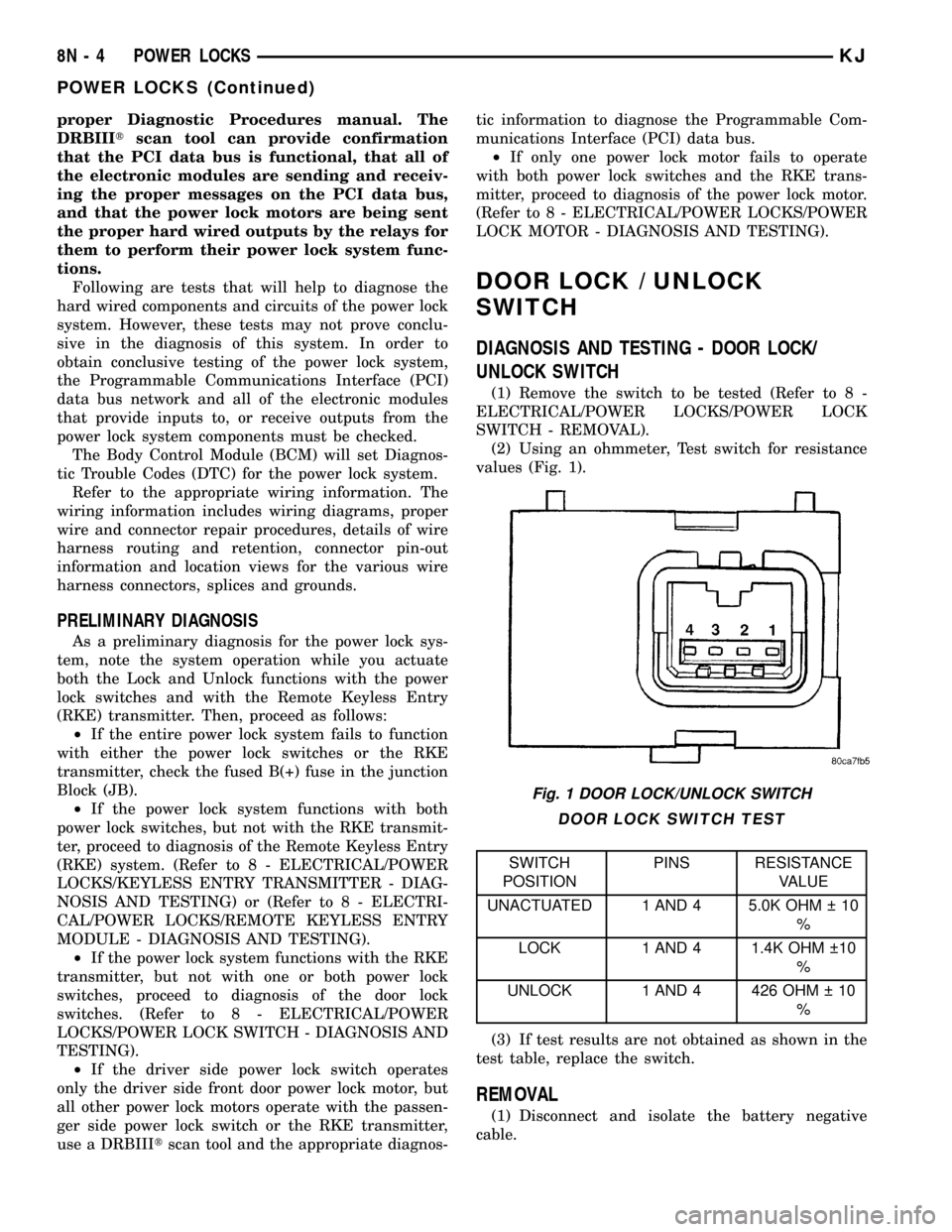
proper Diagnostic Procedures manual. The
DRBIIItscan tool can provide confirmation
that the PCI data bus is functional, that all of
the electronic modules are sending and receiv-
ing the proper messages on the PCI data bus,
and that the power lock motors are being sent
the proper hard wired outputs by the relays for
them to perform their power lock system func-
tions.
Following are tests that will help to diagnose the
hard wired components and circuits of the power lock
system. However, these tests may not prove conclu-
sive in the diagnosis of this system. In order to
obtain conclusive testing of the power lock system,
the Programmable Communications Interface (PCI)
data bus network and all of the electronic modules
that provide inputs to, or receive outputs from the
power lock system components must be checked.
The Body Control Module (BCM) will set Diagnos-
tic Trouble Codes (DTC) for the power lock system.
Refer to the appropriate wiring information. The
wiring information includes wiring diagrams, proper
wire and connector repair procedures, details of wire
harness routing and retention, connector pin-out
information and location views for the various wire
harness connectors, splices and grounds.
PRELIMINARY DIAGNOSIS
As a preliminary diagnosis for the power lock sys-
tem, note the system operation while you actuate
both the Lock and Unlock functions with the power
lock switches and with the Remote Keyless Entry
(RKE) transmitter. Then, proceed as follows:
²If the entire power lock system fails to function
with either the power lock switches or the RKE
transmitter, check the fused B(+) fuse in the junction
Block (JB).
²If the power lock system functions with both
power lock switches, but not with the RKE transmit-
ter, proceed to diagnosis of the Remote Keyless Entry
(RKE) system. (Refer to 8 - ELECTRICAL/POWER
LOCKS/KEYLESS ENTRY TRANSMITTER - DIAG-
NOSIS AND TESTING) or (Refer to 8 - ELECTRI-
CAL/POWER LOCKS/REMOTE KEYLESS ENTRY
MODULE - DIAGNOSIS AND TESTING).
²If the power lock system functions with the RKE
transmitter, but not with one or both power lock
switches, proceed to diagnosis of the door lock
switches. (Refer to 8 - ELECTRICAL/POWER
LOCKS/POWER LOCK SWITCH - DIAGNOSIS AND
TESTING).
²If the driver side power lock switch operates
only the driver side front door power lock motor, but
all other power lock motors operate with the passen-
ger side power lock switch or the RKE transmitter,
use a DRBIIItscan tool and the appropriate diagnos-tic information to diagnose the Programmable Com-
munications Interface (PCI) data bus.
²If only one power lock motor fails to operate
with both power lock switches and the RKE trans-
mitter, proceed to diagnosis of the power lock motor.
(Refer to 8 - ELECTRICAL/POWER LOCKS/POWER
LOCK MOTOR - DIAGNOSIS AND TESTING).
DOOR LOCK / UNLOCK
SWITCH
DIAGNOSIS AND TESTING - DOOR LOCK/
UNLOCK SWITCH
(1) Remove the switch to be tested (Refer to 8 -
ELECTRICAL/POWER LOCKS/POWER LOCK
SWITCH - REMOVAL).
(2) Using an ohmmeter, Test switch for resistance
values (Fig. 1).
DOOR LOCK SWITCH TEST
SWITCH
POSITIONPINS RESISTANCE
VALUE
UNACTUATED 1 AND 4 5.0K OHM 10
%
LOCK 1 AND 4 1.4K OHM 10
%
UNLOCK 1 AND 4 426 OHM 10
%
(3) If test results are not obtained as shown in the
test table, replace the switch.
REMOVAL
(1) Disconnect and isolate the battery negative
cable.
Fig. 1 DOOR LOCK/UNLOCK SWITCH
8N - 4 POWER LOCKSKJ
POWER LOCKS (Continued)
Page 614 of 1803

POWER MIRRORS
TABLE OF CONTENTS
page page
POWER MIRRORS
DESCRIPTION.........................11
OPERATION...........................11
DIAGNOSIS AND TESTING - POWER
MIRRORS...........................11
POWER MIRROR SWITCH
DIAGNOSIS AND TESTING - POWER MIRROR
SWITCH............................12REMOVAL.............................13
INSTALLATION.........................13
SIDEVIEW MIRROR
REMOVAL.............................13
POWER MIRRORS
DESCRIPTION
The available power operated sideview mirrors
allow the driver to adjust both outside mirrors elec-
trically from the drivers seat by operating a switch
on the driver side front door trim panel (Fig. 1).
OPERATION
The power mirrors receive ignition current through
a fuse in the junction block, and will only operate
when the ignition switch is in the Run position.
DIAGNOSIS AND TESTING - POWER MIRRORS
WIRING VOLTAGE TEST
The following wiring test determines whether or
not voltage is continuous through the body harness
to switch.
(1) Remove the power mirror switch (Refer to 8 -
ELECTRICAL/POWER MIRRORS/POWER MIRROR
SWITCH - REMOVAL).
(2) Disconnect wire connector from back of power
mirror switch.
(3) Switch ignition to the RUN position.
(4) Connect the clip end of a 12 volt test light to
Pin 5 in the harness connector at the mirror switch.
Touch the test light probe to Pin 3.
If the test light illuminates, the wiring circuit
between the battery and switch is OK.
If the lamp does not illuminate, first check fuse 25
in the Junction Block (JB). If fuse 25 is OK, then
check for a broken wire.
Refer to the appropriate wiring information. The
wiring information includes wiring diagrams, proper
wire and connector repair procedures, details of wire
harness routing and retention, connector pin-out
information and location views for the various wire
harness connectors, splices and grounds.
POWER MIRROR MOTOR TEST
If the power mirror switch is receiving proper cur-
rent and ground and mirrors do not operate, proceed
with power mirror motor test. Refer to the appropri-
ate wiring information. The wiring information
includes wiring diagrams, proper wire and connector
repair procedures, details of wire harness routing
and retention, connector pin-out information and
location views for the various wire harness connec-
tors, splices and grounds.
Fig. 1 POWER MIRROR SWITCH
1 - DOOR TRIM PANEL
2 - DOOR LOCK SWITCH
3 - POWER MIRROR SWITCH
KJPOWER MIRRORS 8N - 11
Page 618 of 1803

OPERATION
The power seat system receives battery current
through a fuse in the Power Distribution Center
(PDC) and a circuit breaker in the Junction Block,
regardless of the ignition switch position.
When a power seat switch control knob or knobs
are actuated, a battery feed and a ground path are
applied through the switch contacts to the appropri-
ate power seat track adjuster motor. The selected
adjuster motor operates to move the seat track
through its drive unit in the selected direction until
the switch is released, or until the travel limit of the
seat track is reached. When the switch is moved in
the opposite direction, the battery feed and ground
path to the motor are reversed through the switch
contacts. This causes the adjuster motor to run in the
opposite direction.
Refer to the owner's manual in the vehicle glove
box for more information on the features, use and
operation of the power seat system.
DIAGNOSIS AND TESTING - POWER SEATS
Before any testing of the power seat system is
attempted, the battery should be fully-charged and
all wire harness connections and pins cleaned and
tightened to ensure proper continuity and grounds.
Refer to the appropriate wiring information. The wir-
ing information includes wiring diagrams, proper
wire and connector repair procedures, further details
on wire harness routing and retention, as well as
pin-out and joint connector location views for the var-
ious wire harness connectors, splices and grounds.
(1) If all power seats are inoperative, check the
automatic resetting circuit breaker in the Junction
Block. (Refer to 8 - ELECTRICAL/POWER DISTRI-
BUTION/CIRCUIT BREAKER - DIAGNOSIS AND
TESTING).
(2) With the dome lamp on, apply the power seat
switch in the direction of the failure.
(3) If the dome lamp dims, the seat or the power
seat track may be jammed. Check under and behind
the seat for binding or obstructions.
(4) If the dome lamp does not dim, proceed with
testing of the individual power seat system compo-
nents and circuits.
SEAT TRACK
DESCRIPTION
The six-way power seat option includes a power
seat track assembly located under each front seat
(Fig. 2). The power seat track assembly replaces the
standard manually operated seat tracks. The lower
half of the power seat track is secured at the frontwith two bolts to the floor panel seat cross member,
and at the rear with one bolt and one nut to the floor
panel. Four bolts secure the bottom of the seat cush-
ion frame to the upper half of the power seat track
unit.
The power seat track assembly cannot be repaired,
and is serviced only as a complete assembly. If any
component in this assembly is faulty or damaged, the
entire power seat track must be replaced.
OPERATION
The power seat track unit includes three reversible
electric motors that are secured to the upper half of
the track unit. Each motor moves the seat adjuster
through a combination of worm-drive gearboxes and
screw-type drive units. Each of the three driver side
power seat track motors also has a position potenti-
ometer integral to the motor assembly, which elec-
tronically monitors the motor position.
The front and rear of the seat are operated by two
separate vertical adjustment motors. These motors
can be operated independently of each other, tilting
the entire seat assembly forward or rearward; or,
they can be operated in unison by selecting the
proper power seat switch functions, which will raise
or lower the entire seat assembly. The third motor is
the horizontal adjustment motor, which moves the
seat track in the forward and rearward directions.
Fig. 2 Power Seat Track - Typical
1 - POWER SEAT ADJUSTER AND MOTORS
2 - SEAT CUSHION FRAME
3 - POWER SEAT TRACK ASSEMBLY
KJPOWER SEATS 8N - 15
POWER SEATS (Continued)
Page 637 of 1803

The ACM housing also has an integral ground lug
with a tapped hole that protrudes from the lower left
rear corner of the unit. This lug provides a case
ground to the ACM when a ground screw is installed
through the left side of the mounting bracket. Two
molded plastic electrical connector receptacles exit
the right side of the ACM housing. The smaller of the
two receptacles contains twelve terminal pins, while
the larger one contains twenty-three. These terminal
pins connect the ACM to the vehicle electrical system
through two dedicated take outs and connectors of
the instrument panel wire harness.
A molded rubber protective cover is installed
loosely over the ACM to protect the unit from con-
densation or coolant leaking from a damaged or
faulty heater-air conditioner unit housing. An inte-
gral flange on the left side of the cover is secured to
the floor panel transmission tunnel with a short
piece of double-faced tape as an assembly aid during
the manufacturing process, but this tape does not
require replacement following service removal.
The impact sensor and safing sensor internal to
the ACM are calibrated for the specific vehicle, and
are only serviced as a unit with the ACM. The ACM
cannot be repaired or adjusted and, if damaged or
faulty, it must be replaced. The ACM cover is avail-
able for separate service replacement.
OPERATION
The microprocessor in the Airbag Control Module
(ACM) contains the front supplemental restraint sys-
tem logic circuits and controls all of the front supple-
mental restraint system components. The ACM uses
On-Board Diagnostics (OBD) and can communicate
with other electronic modules in the vehicle as well
as with the DRBIIItscan tool using the Programma-
ble Communications Interface (PCI) data bus net-
work. This method of communication is used for
control of the airbag indicator in the ElectroMechani-
cal Instrument Cluster (EMIC) and for supplemental
restraint system diagnosis and testing through the
16-way data link connector located on the driver side
lower edge of the instrument panel. (Refer to 8 -
ELECTRICAL/INSTRUMENT CLUSTER/AIRBAG
INDICATOR - OPERATION).
The ACM microprocessor continuously monitors all
of the front supplemental restraint system electrical
circuits to determine the system readiness. If the
ACM detects a monitored system fault, it sets an
active and stored Diagnostic Trouble Code (DTC) and
sends electronic messages to the EMIC over the PCI
data bus to turn on the airbag indicator. An active
fault only remains for the duration of the fault or in
some cases the duration of the current ignition
switch cycle, while a stored fault causes a DTC to be
stored in memory by the ACM. For some DTCs, if afault does not recur for a number of ignition cycles,
the ACM will automatically erase the stored DTC.
For other internal faults, the stored DTC is latched
forever.
On models equipped with optional side curtain air-
bags, the ACM communicates with both the left and
right Side Impact Airbag Control Modules (SIACM)
over the PCI data bus. The SIACM notifies the ACM
when it has detected a monitored system fault and
stored a DTC in memory for its respective side cur-
tain airbag system, and the ACM sets a DTC and
controls the airbag indicator operation accordingly.
The ACM also monitors a Hall effect-type seat belt
switch located in the buckle of each front seat belt to
determine whether the seatbelts are buckled, and
provides an input to the EMIC over the PCI data bus
to control the seatbelt indicator operation based upon
the status of the driver side front seat belt switch.
The ACM receives battery current through two cir-
cuits; a fused ignition switch output (run) circuit
through a fuse in the Junction Block (JB), and a
fused ignition switch output (run-start) circuit
through a second fuse in the JB. The ACM has a case
ground through a lug on the bottom of the ACM
housing that is secured with a ground screw to the
left side of the ACM mounting bracket. The ACM
also receives a power ground through a ground cir-
cuit and take out of the instrument panel wire har-
ness. This take out has a single eyelet terminal
connector that is secured by a second ground screw
to the left side of the ACM mounting bracket. These
connections allow the ACM to be operational when-
ever the ignition switch is in the Start or On posi-
tions. The ACM also contains an energy-storage
capacitor. When the ignition switch is in the Start or
On positions, this capacitor is continually being
charged with enough electrical energy to deploy the
airbags for up to one second following a battery dis-
connect or failure. The purpose of the capacitor is to
provide backup supplemental restraint system pro-
tection in case there is a loss of battery current sup-
ply to the ACM during an impact.
Two sensors are contained within the ACM, an
electronic impact sensor and a safing sensor. The
ACM also monitors inputs from two remote front
impact sensors located on the back of the right and
left vertical members of the radiator support near
the front of the vehicle. The electronic impact sensors
are accelerometers that sense the rate of vehicle
deceleration, which provides verification of the direc-
tion and severity of an impact. The safing sensor is
an electromechanical sensor within the ACM that
provides an additional logic input to the ACM micro-
processor. The safing sensor is a normally open
switch that is used to verify the need for an airbag
deployment by detecting impact energy of a lesser
8O - 10 RESTRAINTSKJ
AIRBAG CONTROL MODULE (Continued)