Low beam JEEP LIBERTY 2002 KJ / 1.G Repair Manual
[x] Cancel search | Manufacturer: JEEP, Model Year: 2002, Model line: LIBERTY, Model: JEEP LIBERTY 2002 KJ / 1.GPages: 1803, PDF Size: 62.3 MB
Page 568 of 1803

HEADLAMP ALIGNMENT SCREEN PREPARATION
Prepare an alignment screen as illustrated.
(1) Position the vehicle on a level surface perpen-
dicular to a flat wall 7.62 meters (25 feet) away from
the front of the headlamp lens for North American
vehicles, or 10.0 meters (32.81 feet) away from the
front of the headlamp lens for Rest-Of-World vehicles
(Fig. 43). If necessary, tape a line on the floor at the
appropriate distance away from and parallel to the
wall.
(2) Measure up on the wall 1.27 meters (5 feet)
from the floor and tape a vertical line on the align-
ment screen at the centerline of the vehicle. Sight
along the centerline of the vehicle (from the rear of
the vehicle forward) to verify the accuracy of the cen-
terline placement.
(3) Rock the vehicle from side-to-side three times
to allow the suspension to stabilize, then jounce the
front suspension three times by pushing downward
on the front bumper and releasing. Measure the dis-
tance from the center of the headlamp lens to the
floor. Transfer this measurement to the alignment
screen and tape a horizontal line on the wall at this
mark. This line will be used for up-and-down adjust-
ment reference.(4) Measure the distance from the centerline of the
vehicle to the center of each headlamp being aligned.
Transfer these measurements to the alignment
screen and tape a vertical line this distance to each
side of the vehicle centerline. These lines will be used
for left/right reference.
HEADLAMP ADJUSTMENT
A properly aligned headlamp will project a pattern
on the alignment screen from just below horizontal to
75 millimeters (3 inches) below the headlamp center-
line for vehicles in North America, or from just below
horizontal to 125 millimeters (5 inches) below the
headlamp horizontal centerline for vehicles in Rest-
Of-World.
(1) Vehicles for all markets except Japan should
have the headlamp low beams selected with the dim-
mer (multi-function) switch during the adjustment
procedure. Vehicles for the Japanese market should
have the headlamp high beams selected.
(2) Cover the lens of the headlamp that is not
being adjusted.
(3) Turn the adjusting screw (Fig. 44) until the top
edge of the beam intensity pattern is positioned from
just below horizontal to 75 millimeters (3 inches)
Fig. 43 Headlamp Alignment Screen - Typical
1 - CENTER OF VEHICLE TO CENTER OF HEADLAMP LENS
2 - FLOOR TO CENTER OF HEADLAMP LENS
3 - 7.62 METERS (25 FEET) NORTH AMERICA/10.0 METERS
(32.81 FEET) REST-OF-WORLD4 - FRONT OF HEADLAMP
5 - VEHICLE CENTERLINE
KJLAMPS8Ls-43
HEADLAMP UNIT (Continued)
Page 572 of 1803

knob on its end with a flattened face to allow it to be
easily rotated. On vehicles equipped with optional
front fog lamps, the knob on the end of left control
stalk can also be pulled outward to select those
lamps. Each control stalk also features a knurled
control ring located just below the control knob. The
left control stalk is dedicated to providing driver con-
trols for the interior and exterior lighting systems,
while the right control stalk is dedicated to providing
driver controls for the front and rear wiper systems.
Two integral connector receptacles on the forward
facing surface of the multi-function switch housing
connect the switch two the vehicle electrical system
through two take outs and connectors of the instru-
ment panel wire harness. The left connector recepta-
cle contains nine terminal pins for the lighting
control circuits of the switch, while the right connec-
tor receptacle contains six terminal pins for the
wiper control circuits of the switch. The multi-func-
tion switch cannot be adjusted or repaired and, if
faulty or damaged, it must be replaced.
LEFT CONTROL STALK The left (lighting) control
stalk of the multi-function switch supports the fol-
lowing functions and features:
²Front Fog Lamps- For vehicles so equipped,
the internal circuitry and hardware of the multi-
function switch left (lighting) control stalk provide
detent switching for the optional front fog lamps.
²Headlamps- The internal circuitry and hard-
ware of the multi-function switch left (lighting) con-trol stalk provide detent switching for the
headlamps.
²Headlamp Beam Selection- The internal cir-
cuitry and hardware of the multi-function switch left
(lighting) control stalk provide detent switching for
selection of the headlamp high or low beams.
²Headlamp Optical Horn- The internal cir-
cuitry and hardware of the multi-function switch left
(lighting) control stalk includes momentary switching
of the headlamp high beam circuits to provide an
optical horn feature (sometimes referred to as flash-
to-pass), which allows the vehicle operator to momen-
tarily flash the headlamp high beams as an optical
signalling device.
²Interior Lamps Defeat- The internal circuitry
and hardware of the multi-function switch left (light-
ing) control stalk provide detent switching to defeat
the illumination of all interior courtesy lamps when a
door, the rear flip-up glass, or the tailgate are
opened.
²Interior Lamps On- The internal circuitry and
hardware of the multi-function switch left (lighting)
control stalk provide detent switching to simulta-
neously illuminate all interior courtesy lamps.
²Panel Lamps Dimming- The internal cir-
cuitry and hardware of the multi-function switch left
(lighting) control stalk provide simultaneous adjust-
able control of the illumination intensity of all instru-
ment panel lighting at one of six available
illumination intensity levels.
Fig. 50 Multi-Function Switch
1 - MULTI-FUNCTION SWITCH
2 - RIGHT (WIPER) CONTROL STALK
3 - LEFT (LIGHTING) CONTROL STALK
4 - TURN SIGNAL CANCEL ACTUATOR5 - RIGHT (WIPER) CONTROL KNOB
6 - RIGHT (WIPER) CONTROL RING
7 - LEFT (LIGHTING) CONTROL RING
8 - LEFT (LIGHTING) CONTROL KNOB
KJLAMPS8Ls-47
MULTI-FUNCTION SWITCH (Continued)
Page 573 of 1803

²Parade Mode- The internal circuitry and hard-
ware of the multi-function switch left (lighting) con-
trol stalk provide detent switching for a parade mode
that maximizes the illumination intensity of all
instrument panel lighting for visibility when driving
in daylight with the exterior lamps turned on.
²Park Lamps- The internal circuitry and hard-
ware of the multi-function switch left (lighting) con-
trol stalk provide detent switching for the park
lamps.
²Rear Fog Lamps- For vehicles so equipped,
the internal circuitry and hardware of the multi-
function switch left (lighting) control stalk provide
detent switching for the optional rear fog lamps.
Rear fog lamps are optional only for vehicles manu-
factured for certain markets, where they are
required.
²Turn Signal Control- The internal circuitry
and hardware of the multi-function switch left (light-
ing) control stalk provide both momentary non-detent
switching and detent switching with automatic can-
cellation for both the left and right turn signal
lamps.
RIGHT CONTROL STALK The right (wiper) con-
trol stalk of the multi-function switch supports the
following functions and features:
²Continuous Front Wipe Modes- The internal
circuitry and hardware of the multi-function switch
right (wiper) control stalk provide two continuous
front wipe switch positions, low speed or high speed.
²Continuous Rear Wipe Mode- The internal
circuitry and hardware of the multi-function switch
right (wiper) control stalk provide one continuous
rear wipe switch position.
²Front Washer Mode- The internal circuitry
and hardware of the multi-function switch right
(wiper) control stalk switch provide front washer sys-
tem operation.
²Front Wipe-After-Wash Mode- The internal
circuitry and hardware of the multi-function switch
right (wiper) control stalk provide a wipe-after-wash
mode.
²Front Wiper Mist Mode- The internal cir-
cuitry and hardware of the multi-function switch
right (wiper) control stalk provide a front wiper sys-
tem mist mode.
²Intermittent Front Wipe Mode- The internal
circuitry and hardware of the multi-function switch
right (wiper) control stalk provide an intermittent
front wipe mode with five delay interval positions.
²Intermittent Rear Wipe Mode- The internal
circuitry and hardware of the multi-function switch
right (wiper) control stalk provide one fixed interval
intermittent rear wipe mode switch position.²Rear Washer Mode- The internal circuitry and
hardware of the multi-function switch right (wiper)
control stalk provide rear washer system operation.
OPERATION
The multi-function switch uses a combination of
resistor multiplexed and conventionally switched out-
puts to control the many functions and features it
provides. The switch receives battery current on a
fused ignition switch output (run-acc) circuit from a
fuse in the Junction Block (JB) whenever the ignition
switch is in the On or Accessory positions. The switch
receives a path to ground at all times through a
splice block located in the instrument panel wire har-
ness with an eyelet terminal connector that is
secured by a nut to a ground stud on the driver side
instrument panel end bracket near the Junction
Block (JB). Following are descriptions of how each of
the two multi-function switch control stalks operate
to control the functions and features they provide.
LEFT CONTROL STALK The left (lighting) control
stalk of the multi-function switch operates as follows:
²Front Fog Lamps- For vehicles so equipped,
the control knob on the end of the multi-function
switch left (lighting) control stalk is pulled outward
to activate the optional front fog lamps. The control
knob is mechanically keyed so that it cannot be
pulled outward unless it is first rotated to turn on
the exterior lighting. The multi-function switch pro-
vides a resistor multiplexed output to the Body Con-
trol Module (BCM) on a fog lamp switch sense
circuit, and the BCM responds by energizing or de-
energizing the front fog lamp relay in the Junction
Block (JB) as required.
²Headlamps-
The control knob on the end of the
multi-function switch left (lighting) control stalk is
rotated forward (counterclockwise) to its second detent
position to activate the headlamps. The multi-function
switch provides a resistor multiplexed output to the
Body Control Module (BCM) on a headlamp switch
sense circuit, and the BCM responds by energizing or
de-energizing the selected low or high beam relay
(Daytime Running Lamp relay in Canadian vehicles)
in the Junction Block (JB) as required.
²Headlamp Beam Selection-The left (lighting)
control stalk of the multi-function switch is pulled
towards the steering wheel past a detent to actuate
the integral beam select switch circuitry. Each time the
control stalk is activated in this manner, the opposite
headlamp beam from what is currently selected will be
energized. The multi-function switch provides a ground
output to the Body Control Module (BCM) on a high
beam switch sense circuit, and the BCM responds by
energizing or de-energizing the selected low or high
beam relay (Daytime Running Lamp relay in Canadian
vehicles) in the Junction Block (JB) as required.
8Ls - 48 LAMPSKJ
MULTI-FUNCTION SWITCH (Continued)
Page 577 of 1803
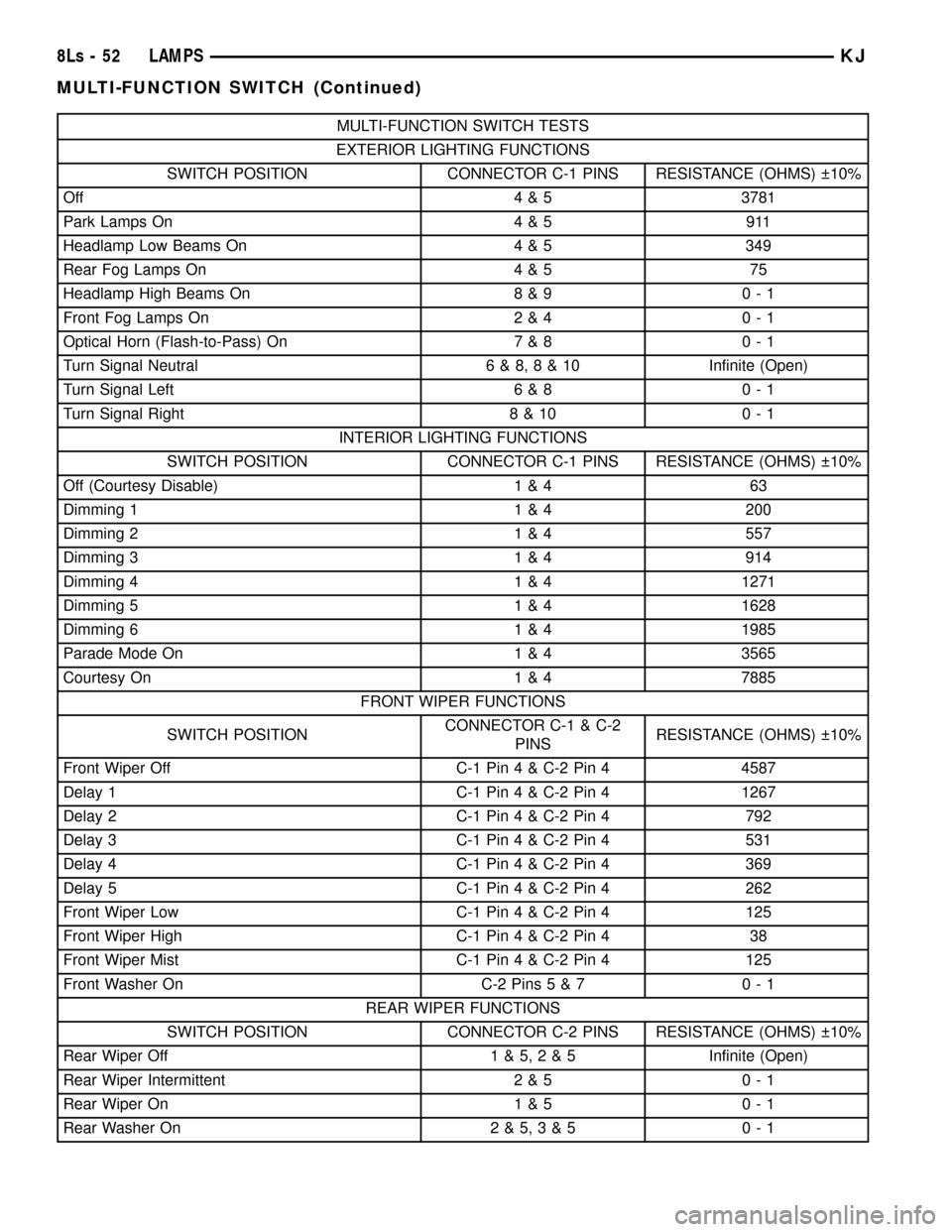
MULTI-FUNCTION SWITCH TESTS
EXTERIOR LIGHTING FUNCTIONS
SWITCH POSITION CONNECTOR C-1 PINS RESISTANCE (OHMS) 10%
Off 4 & 5 3781
Park Lamps On 4 & 5 911
Headlamp Low Beams On 4 & 5 349
Rear Fog Lamps On 4 & 5 75
Headlamp High Beams On 8 & 9 0 - 1
Front Fog Lamps On 2 & 4 0 - 1
Optical Horn (Flash-to-Pass) On 7 & 8 0 - 1
Turn Signal Neutral 6 & 8,8&10Infinite (Open)
Turn Signal Left 6 & 8 0 - 1
Turn Signal Right 8 & 10 0 - 1
INTERIOR LIGHTING FUNCTIONS
SWITCH POSITION CONNECTOR C-1 PINS RESISTANCE (OHMS) 10%
Off (Courtesy Disable) 1 & 4 63
Dimming 1 1 & 4 200
Dimming 2 1 & 4 557
Dimming 3 1 & 4 914
Dimming 4 1 & 4 1271
Dimming 5 1 & 4 1628
Dimming 6 1 & 4 1985
Parade Mode On 1 & 4 3565
Courtesy On 1 & 4 7885
FRONT WIPER FUNCTIONS
SWITCH POSITIONCONNECTOR C-1 & C-2
PINSRESISTANCE (OHMS) 10%
Front Wiper Off C-1 Pin 4 & C-2 Pin 4 4587
Delay 1 C-1 Pin 4 & C-2 Pin 4 1267
Delay 2 C-1 Pin 4 & C-2 Pin 4 792
Delay 3 C-1 Pin 4 & C-2 Pin 4 531
Delay 4 C-1 Pin 4 & C-2 Pin 4 369
Delay 5 C-1 Pin 4 & C-2 Pin 4 262
Front Wiper Low C-1 Pin 4 & C-2 Pin 4 125
Front Wiper High C-1 Pin 4 & C-2 Pin 4 38
Front Wiper Mist C-1 Pin 4 & C-2 Pin 4 125
Front Washer On C-2 Pins5&7 0-1
REAR WIPER FUNCTIONS
SWITCH POSITION CONNECTOR C-2 PINS RESISTANCE (OHMS) 10%
Rear Wiper Off 1 & 5,2&5Infinite (Open)
Rear Wiper Intermittent 2 & 5 0 - 1
Rear Wiper On 1 & 5 0 - 1
Rear Washer On 2 & 5,3&5 0-1
8Ls - 52 LAMPSKJ
MULTI-FUNCTION SWITCH (Continued)
Page 581 of 1803

INSTALLATION
WARNING: ON VEHICLES EQUIPPED WITH AIR-
BAGS, DISABLE THE SUPPLEMENTAL RESTRAINT
SYSTEM BEFORE ATTEMPTING ANY STEERING
WHEEL, STEERING COLUMN, DRIVER AIRBAG,
PASSENGER AIRBAG, SEAT BELT TENSIONER,
FRONT IMPACT SENSORS, SIDE CURTAIN AIRBAG,
OR INSTRUMENT PANEL COMPONENT DIAGNOSIS
OR SERVICE. DISCONNECT AND ISOLATE THE
BATTERY NEGATIVE (GROUND) CABLE, THEN
WAIT TWO MINUTES FOR THE SYSTEM CAPACI-
TOR TO DISCHARGE BEFORE PERFORMING FUR-
THER DIAGNOSIS OR SERVICE. THIS IS THE ONLY
SURE WAY TO DISABLE THE SUPPLEMENTAL
RESTRAINT SYSTEM. FAILURE TO TAKE THE
PROPER PRECAUTIONS COULD RESULT IN ACCI-
DENTAL AIRBAG DEPLOYMENT AND POSSIBLE
PERSONAL INJURY.(1) Position the park lamp relay to the proper
receptacle in the Junction Block (JB) (Fig. 55).
(2) Align the park lamp relay terminals with the
terminal cavities in the JB receptacle.
(3) Push firmly and evenly on the top of the park
lamp relay until the terminals are fully seated in the
terminal cavities in the JB receptacle.
(4) Reinstall the steering column opening cover
onto the instrument panel. (Refer to 23 - BODY/IN-
STRUMENT PANEL/STEERING COLUMN OPEN-
ING COVER - INSTALLATION).
(5) Reconnect the battery negative cable.
REAR FOG LAMP RELAY
DESCRIPTION
The rear fog lamp relay is located in the Junction
Block (JB) on the driver side outboard end of the
instrument panel in the passenger compartment of
the vehicle. The rear fog lamp relay is a conventional
International Standards Organization (ISO) micro
relay (Fig. 56). Relays conforming to the ISO specifi-
cations have common physical dimensions, current
capacities, terminal patterns, and terminal functions.
The relay is contained within a small, rectangular,
molded plastic housing and is connected to all of the
required inputs and outputs by five integral male
spade-type terminals that extend from the bottom of
the relay base.
The rear fog lamp relay cannot be adjusted or
repaired and, if faulty or damaged, the unit must be
replaced.
Fig. 55 Junction Block - Inboard Side (LHD Shown -
Rotate 180É for RHD)
1 - PASSENGER DOOR UNLOCK RELAY
2 - JB C3 CONNECTOR RECEPTACLE
3 - LOW BEAM RELAY
4 - CIRCUIT BREAKER #1
5 - CIRCUIT BREAKER #2
6 - CIRCUIT BREAKER #3
7 - DOOR LOCK RELAY
8 - DEFOGGER RELAY
9-SPARE
10 - FRONT FOG LAMP RELAY
11 - HORN RELAY
12 - SPARE
13 - SPARE
14 - REAR FOG LAMP RELAY
15 - PARK LAMP RELAY
16 - DRIVER DOOR UNLOCK RELAY
17 - JB C1 CONNECTOR RECEPTACLE
18 - JB C2 CONNECTOR RECEPTACLE
Fig. 56 ISO Micro Relay
30 - COMMON FEED
85 - COIL GROUND
86 - COIL BATTERY
87 - NORMALLY OPEN
87A - NORMALLY CLOSED
8Ls - 56 LAMPSKJ
PARK LAMP RELAY (Continued)
Page 583 of 1803

(4) Connect a battery to terminals 85 and 86.
There should now be continuity between terminals
30 and 87, and no continuity between terminals 87A
and 30. If OK, reinstall the relay and use a DRBIIIt
scan tool to perform further testing. Refer to the
appropriate diagnostic information.
REMOVAL
WARNING: ON VEHICLES EQUIPPED WITH AIR-
BAGS, DISABLE THE SUPPLEMENTAL RESTRAINT
SYSTEM BEFORE ATTEMPTING ANY STEERING
WHEEL, STEERING COLUMN, DRIVER AIRBAG,
PASSENGER AIRBAG, SEAT BELT TENSIONER,
FRONT IMPACT SENSORS, SIDE CURTAIN AIRBAG,
OR INSTRUMENT PANEL COMPONENT DIAGNOSIS
OR SERVICE. DISCONNECT AND ISOLATE THE
BATTERY NEGATIVE (GROUND) CABLE, THEN
WAIT TWO MINUTES FOR THE SYSTEM CAPACI-
TOR TO DISCHARGE BEFORE PERFORMING FUR-
THER DIAGNOSIS OR SERVICE. THIS IS THE ONLY
SURE WAY TO DISABLE THE SUPPLEMENTAL
RESTRAINT SYSTEM. FAILURE TO TAKE THE
PROPER PRECAUTIONS COULD RESULT IN ACCI-
DENTAL AIRBAG DEPLOYMENT AND POSSIBLE
PERSONAL INJURY.
(1) Disconnect and isolate the battery negative
cable.
(2) Remove the steering column opening cover
from the instrument panel. (Refer to 23 - BODY/IN-
STRUMENT PANEL/STEERING COLUMN OPEN-
ING COVER - REMOVAL).
(3) Remove the rear fog lamp relay by grasping it
firmly and pulling it straight out from the receptacle
in the Junction Block (JB) (Fig. 58).
INSTALLATION
WARNING: ON VEHICLES EQUIPPED WITH AIR-
BAGS, DISABLE THE SUPPLEMENTAL RESTRAINT
SYSTEM BEFORE ATTEMPTING ANY STEERING
WHEEL, STEERING COLUMN, DRIVER AIRBAG,
PASSENGER AIRBAG, SEAT BELT TENSIONER,
FRONT IMPACT SENSORS, SIDE CURTAIN AIRBAG,
OR INSTRUMENT PANEL COMPONENT DIAGNOSIS
OR SERVICE. DISCONNECT AND ISOLATE THE
BATTERY NEGATIVE (GROUND) CABLE, THEN
WAIT TWO MINUTES FOR THE SYSTEM CAPACI-
TOR TO DISCHARGE BEFORE PERFORMING FUR-
THER DIAGNOSIS OR SERVICE. THIS IS THE ONLY
SURE WAY TO DISABLE THE SUPPLEMENTAL
RESTRAINT SYSTEM. FAILURE TO TAKE THE
PROPER PRECAUTIONS COULD RESULT IN ACCI-
DENTAL AIRBAG DEPLOYMENT AND POSSIBLE
PERSONAL INJURY.(1) Position the rear fog lamp relay to the proper
receptacle in the Junction Block (JB) (Fig. 58).
(2) Align the rear fog lamp relay terminals with
the terminal cavities in the JB receptacle.
(3) Push firmly and evenly on the top of the rear
fog lamp relay until the terminals are fully seated in
the terminal cavities in the JB receptacle.
(4) Reinstall the steering column opening cover
onto the instrument panel. (Refer to 23 - BODY/IN-
STRUMENT PANEL/STEERING COLUMN OPEN-
ING COVER - INSTALLATION).
(5) Reconnect the battery negative cable.
Fig. 58 Junction Block - Inboard Side (LHD Shown -
Rotate 180É for RHD)
1 - PASSENGER DOOR UNLOCK RELAY
2 - JB C3 CONNECTOR RECEPTACLE
3 - LOW BEAM RELAY
4 - CIRCUIT BREAKER #1
5 - CIRCUIT BREAKER #2
6 - CIRCUIT BREAKER #3
7 - DOOR LOCK RELAY
8 - DEFOGGER RELAY
9-SPARE
10 - FRONT FOG LAMP RELAY
11 - HORN RELAY
12 - SPARE
13 - SPARE
14 - REAR FOG LAMP RELAY
15 - PARK LAMP RELAY
16 - DRIVER DOOR UNLOCK RELAY
17 - JB C1 CONNECTOR RECEPTACLE
18 - JB C2 CONNECTOR RECEPTACLE
8Ls - 58 LAMPSKJ
REAR FOG LAMP RELAY (Continued)
Page 606 of 1803

The tailgate will lock and can not be unlocked if
the rear wiper switch is activated. The tailgate will
also lock if battery power is lost and then restored.
The tailgate/flip-up glass will not function with the
battery discharged or disconnected.
COMBINATION FLASHER
This flasher can be energized by the BCM to flash
all of the park/turn signal lamps as a optical alert for
the RKE panic function and, if the Flash Lights with
Lock programmable feature is enabled, as an optical
verification for the RKE lock event.
HORN RELAY
This relay can be energized by the BCM to sound
the horns as an audible alert for the RKE panic func-
tion and, if the Sound Horn on Lock programmable
feature is enabled, as an audible verification for the
RKE lock event.
LOW BEAM HEADLAMP RELAY
This relay can be energized by the BCM to flash
the headlamp low beams as an optical alert for the
RKE panic function.
OPERATION
POWER LOCKS
The Body Control Module (BCM) locks or unlocks
the doors when an actuation input signal from a door
lock switch or Remote Keyless Entry Module (RKE)
is received. The BCM turns on the output drivers
and provides a voltage level to the door lock motor
for a specified time. All passenger doors can be
locked or unlocked using a mechanical button
mounted on the door trim panel. The front passenger
doors and tailgate can be locked or unlocked by using
the key cylinder (tailgate cylinder does not lock/un-
lock vehicle. It only unlocks the tailgate). The tail-
gate will lock and can not be unlocked if the rear
wiper switch is activated (this prevents the wiper
from operating when the tailgate is ajar). The tail-
gate will also lock if battery power is lost and then
restored.
AUTOMATIC DOOR LOCKS
When the automatic door locks are ENABLED the
door locks will lock when the vehicle is moving at
about 25.7 Km/h (15 mph), all doors are closed and
the accelerator pedal is depressed. This feature can
be switched ON or OFF as desired. When the system
is DISABLED the door locks will operate normally,
but will not lock automatically when the vehicle is
rolling. Once the automatic door locks have been
actuated, they will not try to lock the doors again
until a door is opened.
DOOR LOCK INHIBIT
If the key is in the ignition, in any position, and
either front door is ajar, the doors can not be locked,
but the unlock function still operates. Pressing the
RKE lock/unlock button under these conditions will
result in a normal lock/unlock activation.
After the key is removed from the Ignition Switch,
or the doors are closed, the power door locks will
operate normally.
DOOR LOCK CIRCUIT PROTECTION
The BCM controls the door lock relays. If the door
lock switch is actuated continuously for more than
five seconds the BCM will turn the output driver
OFF (the BCM would consider the switch stuck).
Each lock motor is protected with a Positive Temper-
ature Coefficient device that prevents motor burn
out.
REMOTE KEYLESS ENTRY
²LOCK: Pressing the LOCK button locks all
doors, sounds horn (chirp) if enabled, and arms the
Vehicle Theft Security System, if enabled. The chirp
verifies that the RKE receiver has sent a message to
the BCM for door lock operation. If a door has not
been closed before pressing the LOCK button, the
vehicle may not be secured and the VTSS (if
equipped) will not arm until the door is closed.
²UNLOCK: Pressing the UNLOCK button once
will unlock the driver's door and activate the illumi-
nated entry system and disarm Vehicle Theft Secu-
rity System, if equipped. Pressing the UNLOCK
button twice within five seconds will unlock all doors.
²TAILGATE: Pressing the TAILGATE BUTTON
unlocks the tailgate remotely and opens the flip-up
glass.
²PANIC: Pressing the PANIC button sounds the
horns at half second intervals, flashes the exterior
lamps, and turns ON the interior lamps. The panic
alarm will remain on for three minutes, or until the
PANIC button is actuated again or the ignition
switch is turned to the RUN position.
The Remote Keyless Entry Module is capable of
retaining the transmitter Vehicle Access Code(s) in
its memory even after vehicle power has been inter-
rupted.
DIAGNOSIS AND TESTING - POWER LOCKS
The Body Control Module (BCM) enters a
reduced power mode after the key is turned
OFF. All diagnosis and testing of the power lock
system must be done with the key in the ON
position unless otherwise stated.
The most reliable, efficient, and accurate
means to diagnose the power lock system
requires the use of a DRBIIItscan tool and the
KJPOWER LOCKS 8N - 3
POWER LOCKS (Continued)
Page 762 of 1803

8W-02 COMPONENT INDEX
Component Page
A/C Compressor Clutch Relay........... 8Wa-42
A/C Compressor Clutch................ 8Wa-42
A/C-Heater Control................... 8Wa-42
A/C High Pressure Switch.............. 8Wa-42
A/C Low Pressure Switch............... 8Wa-42
A/C Pressure Transducer............... 8Wa-42
Accelerator Pedal Position Sensor........ 8Wa-30
Airbag Control Module................. 8Wa-43
Ambient Temperature Sensor............ 8Wa-45
Antenna Module...................... 8Wa-47
Antenna............................ 8Wa-47
Ash Receiver Lamp................... 8Wa-44
Auto Shut Down Relay................. 8Wa-30
Back-Up Lamp Switch................. 8Wa-31
Battery Temperature Sensor......... 8Wa-20, 30
Battery............................. 8Wa-20
Blend Door Actuator................... 8Wa-42
Blower Motor Relay................... 8Wa-42
Blower Motor Resistor Block............ 8Wa-42
Blower Motor........................ 8Wa-42
Body Control Module.................. 8Wa-45
Boost Pressure Sensor................. 8Wa-30
Brake Lamp Switch................... 8Wa-33
Brake Pressure Switch................. 8Wa-35
Cabin Heater Relay................... 8Wa-42
Cabin Heater........................ 8Wa-42
Camshaft Position Sensor.............. 8Wa-30
Capacitor........................... 8Wa-30
Cargo Lamp......................... 8Wa-44
CD Changer......................... 8Wa-47
Center High Mounted Stop Lamp........ 8Wa-51
Cigar Lighter........................ 8Wa-41
Circuit Breakers...................... 8Wa-12
Clockspring................. 8Wa-33, 41, 43, 47
Clutch Interlock Switch................ 8Wa-21
Clutch Switch Override Relay........... 8Wa-21
Coil On Plugs........................ 8Wa-30
Coil Rail............................ 8Wa-30
Compass Mini-Trip Computer........... 8Wa-49
Controller Antilock Brake.............. 8Wa-35
Courtesy Lamps...................... 8Wa-44
Crankshaft Position Sensor............. 8Wa-30
Curtain Airbags...................... 8Wa-43
Cylinder Lock Switches................ 8Wa-61
Data Link Connector.................. 8Wa-18
Daytime Running Lamp Relay........... 8Wa-50
Defogger Relay....................... 8Wa-48
Diagnostic Junction Port............... 8Wa-18
Dome Lamp......................... 8Wa-44
Door Ajar Switches.................... 8Wa-45
Door Lock Motor/Ajar Switches.......... 8Wa-61
Door Lock Relay...................... 8Wa-61Component Page
Door Lock Switches................... 8Wa-61
Door Speakers....................... 8Wa-47
Driver Airbag Squib 1................. 8Wa-43
Driver Airbag Squib 2................. 8Wa-43
Driver Door Unlock Relay.............. 8Wa-61
Driver Seat Belt Switch................ 8Wa-40
Driver Seat Belt Tensioner.............. 8Wa-43
EGR Solenoid........................ 8Wa-30
Electric Brake Provision................ 8Wa-54
Engine Control Module................ 8Wa-30
Engine Coolant Level Sensor............ 8Wa-40
Engine Coolant Temperature Sensor...... 8Wa-30
Engine Oil Pressure Sensor............. 8Wa-30
EVAP/Purge Solenoid.................. 8Wa-30
Flip-Up Glass Release Motor............ 8Wa-61
Flip-Up Glass Release Switch........... 8Wa-61
Fog Lamps.......................... 8Wa-50
Front Fog Lamp Relay................. 8Wa-50
Front Wiper Motor.................... 8Wa-53
Fuel Heater Relay.................... 8Wa-30
Fuel Heater......................... 8Wa-30
Fuel Injectors........................ 8Wa-30
Fuel Pressure Sensor.................. 8Wa-30
Fuel Pressure Solenoid................. 8Wa-30
Fuel Pump Module.................... 8Wa-30
Fuel Pump Relay..................... 8Wa-30
Fuses........................... 8Wa-10, 12
Fusible Link......................... 8Wa-20
Grounds............................ 8Wa-15
Generator........................... 8Wa-20
Glow Plugs.......................... 8Wa-30
Hazard Switch/Combination Flasher...... 8Wa-52
Headlamp Leveling Switch.............. 8Wa-50
Headlamps.......................... 8Wa-50
Heated Seats........................ 8Wa-63
High Beam Relay..................... 8Wa-50
Horns.............................. 8Wa-41
Hood Ajar Switch..................... 8Wa-45
Idle Air Control Motor................. 8Wa-30
Ignition Switch....................... 8Wa-10
Impact Sensors....................... 8Wa-43
Input Speed Sensor................... 8Wa-31
Instrument Cluster................... 8Wa-40
Instrument Panel Speakers............. 8Wa-47
Intake Air Temperature Sensor.......... 8Wa-30
Intrusion Sensor..................... 8Wa-49
Junction Block....................... 8Wa-12
Knock Sensor........................ 8Wa-30
Leak Detection Pump.................. 8Wa-30
Leveling Motors...................... 8Wa-50
License Lamp........................ 8Wa-51
Line Pressure Sensor.................. 8Wa-31
KJ8W-02 COMPONENT INDEX8Wa-02-1
Page 763 of 1803

Component Page
Low Beam Relay..................... 8Wa-50
Manifold Absolute Pressure Sensor....... 8Wa-30
Multi-Function Switch........... 8Wa-50, 52, 53
Output Speed Sensor.................. 8Wa-31
Overhead Map/Reading Lamp........... 8Wa-44
Oxygen Sensors...................... 8Wa-30
Oxygen Sensor Downstream Relay........ 8Wa-30
Park Brake Switch.................... 8Wa-40
Park Lamp Relay..................... 8Wa-50
Park/Turn Signal Lamps............ 8Wa-50, 52
Passenger Airbag..................... 8Wa-43
Passenger Door Unlock Relay........... 8Wa-61
Passenger Seat Belt Switch............. 8Wa-40
Position Lamps...................... 8Wa-50
Power Distribution Center.............. 8Wa-10
Power Mirrors....................... 8Wa-62
Power Outlet........................ 8Wa-41
Power Seats......................... 8Wa-63
Power Steering Pressure Switch......... 8Wa-30
Power Windows...................... 8Wa-60
Powertrain Control Module............. 8Wa-30
Radiator Fans....................... 8Wa-30
Radio Choke......................... 8Wa-47
Radio.............................. 8Wa-47
Rear Fog Lamp Relay................. 8Wa-51
Rear Power Outlet.................... 8Wa-41
Rear Power Window Switch............. 8Wa-60
Rear Wheel Speed Sensor.............. 8Wa-35
Rear Window Defogger................. 8Wa-48
Rear Wiper Motor.................... 8Wa-53
Red Brake Warning Indicator Switch...... 8Wa-40Component Page
Remote Keyless Entry Module........... 8Wa-45
Remote Radio Switches................ 8Wa-47
Splices............................. 8Wa-10
Sentry Key Immobilizer Module.......... 8Wa-39
Shifter Assembly..................... 8Wa-31
Side Impact Airbag Control Modules...... 8Wa-43
Side Marker Lamps................ 8Wa-50, 52
Side Repeater Lamps............... 8Wa-50, 52
Siren.............................. 8Wa-49
Speed Control Servo................... 8Wa-33
Speed Control Switches................ 8Wa-33
Starter Motor Relay................... 8Wa-21
Starter Motor........................ 8Wa-21
Sunroof............................ 8Wa-64
Tail/Stop Lamps...................... 8Wa-51
Tailgate Cylinder Lock Switch........... 8Wa-61
Tailgate Flip-Up Ajar Switch............ 8Wa-61
Tailgate Lock Motor/Ajar Switch......... 8Wa-61
Throttle Position Sensor................ 8Wa-30
Trailer Tow.......................... 8Wa-54
Transfer Case Position Sensor........ 8Wa-30, 31
Transmission Control Module........... 8Wa-31
Transmission Control Relay............. 8Wa-31
Transmission Solenoid/TRS Assembly..... 8Wa-31
Visor/Vanity Lamps................... 8Wa-44
Washer Fluid Level Switch............. 8Wa-53
Washer Pump........................ 8Wa-53
Water In Fuel Sensor.................. 8Wa-30
Wheel Speed Sensors.................. 8Wa-35
Wiper High/Low Relay................. 8Wa-53
KJ8W-02 COMPONENT INDEX8Wa-02-1
Page 764 of 1803

8W-10 POWER DISTRIBUTION
Component Page
A/C Compressor Clutch Relay . . . 8Wa-10-11, 13, 22,
26
A/C Compressor Clutch.............. 8Wa-10-26
Auto Shut Down Relay...... 8Wa-10-10, 12, 19, 22
Battery....................... 8Wa-10-10, 12
Blower Motor Relay........... 8Wa-10-10, 12, 14
Blower Motor..................... 8Wa-10-14
Body Control Module................ 8Wa-10-23
Cabin Heater Relay........... 8Wa-10-13, 22, 26
Cabin Heater...................... 8Wa-10-26
Camshaft Position Sensor............ 8Wa-10-22
Capacitor...................... 8Wa-10-19, 21
Circuit Breaker No. 1............... 8Wa-10-16
Circuit Breaker No. 3 (JB)........... 8Wa-10-27
Clutch Interlock Switch.............. 8Wa-10-28
Clutch Switch Override Relay......... 8Wa-10-28
Coil On Plug No. 1................. 8Wa-10-21
Coil On Plug No. 2................. 8Wa-10-21
Coil On Plug No. 3................. 8Wa-10-21
Coil On Plug No. 4................. 8Wa-10-21
Coil On Plug No. 5................. 8Wa-10-21
Coil On Plug No. 6................. 8Wa-10-21
Coil Rail......................... 8Wa-10-19
Controller Antilock Brake . 8Wa-10-10, 11, 12, 13, 14
Daytime Running Lamp Relay........ 8Wa-10-16
Defogger Relay.................... 8Wa-10-24
EGR Solenoid..................... 8Wa-10-22
Engine Control Module.............. 8Wa-10-22
Fuel Heater Relay............... 8Wa-10-13, 18
Fuel Heater....................... 8Wa-10-18
Fuel Injector No. 1................. 8Wa-10-20
Fuel Injector No. 2................. 8Wa-10-20
Fuel Injector No. 3................. 8Wa-10-20
Fuel Injector No. 4................. 8Wa-10-20
Fuel Injector No. 5................. 8Wa-10-20
Fuel Injector No. 6................. 8Wa-10-20
Fuel Pressure Solenoid.............. 8Wa-10-22
Fuel Pump Module................. 8Wa-10-26
Fuel Pump Relay................ 8Wa-10-11, 26
Fuse 1.................. 8Wa-10-10, 12, 14, 25
Fuse 2.................. 8Wa-10-10, 12, 14, 15
Fuse 3.................. 8Wa-10-10, 12, 16, 25
Fuse 4..................... 8Wa-10-10, 12, 14
Fuse 5.................. 8Wa-10-10, 12, 17, 18
Fuse 6............... 8Wa-10-10, 12, 19, 22, 24
Fuse 7..................... 8Wa-10-10, 12, 15
Fuse 8..................... 8Wa-10-10, 12, 23
Fuse 9.................. 8Wa-10-10, 12, 13, 24
Fuse 10.............. 8Wa-10-10, 12, 13, 15, 18
Fuse 11.................... 8Wa-10-13, 15, 18
Fuse 12............ 8Wa-10-10, 11, 13, 15, 17, 18
Fuse 13............... 8Wa-10-10, 11, 13, 23, 27
Fuse 14.................... 8Wa-10-11, 13, 23
Fuse 15................. 8Wa-10-11, 13, 25, 27Component Page
Fuse 16................. 8Wa-10-19, 20, 22, 24
Fuse 17.......................... 8Wa-10-24
Fuse 18.......................... 8Wa-10-24
Fuse 19.................... 8Wa-10-11, 13, 24
Fuse 20.......................... 8Wa-10-27
Fuse 21.................... 8Wa-10-11, 13, 26
Fuse 22.......................... 8Wa-10-27
Fuse 24.................... 8Wa-10-11, 26, 29
Fuse 25................. 8Wa-10-11, 13, 14, 29
Fuse 26................. 8Wa-10-12, 19, 20, 22
Fuse 28.......................... 8Wa-10-28
Fuse 29.......................... 8Wa-10-15
Fuse 30.......................... 8Wa-10-24
Fuse 31.......................... 8Wa-10-27
Fuse 32.......................... 8Wa-10-27
Fuse 33.......................... 8Wa-10-16
Fuse 34.......................... 8Wa-10-15
Fuse 36.......................... 8Wa-10-27
Fuse 37.......................... 8Wa-10-29
Fuse 38.......................... 8Wa-10-29
Fuse 39.......................... 8Wa-10-29
Fusible Link................... 8Wa-10-10, 12
G202............................ 8Wa-10-23
Generator.................. 8Wa-10-10, 12, 22
Glow Plug Assembly................ 8Wa-10-18
Glow Plug Relay No. 1......... 8Wa-10-13, 18, 22
Glow Plug Relay No. 2......... 8Wa-10-13, 18, 22
High Beam Relay.................. 8Wa-10-16
Horn Relay....................... 8Wa-10-25
Ignition Switch . . . 8Wa-10-10, 11, 12, 13, 23, 27, 29
Junction Block . . . 8Wa-10-10, 11, 12, 13, 15, 16, 24,
25, 27, 29
Low Beam Relay................... 8Wa-10-25
Oxygen Sensor 1/1 Upstream......... 8Wa-10-19
Oxygen Sensor 1/2 Downstream.... 8Wa-10-19, 20
Oxygen Sensor 2/1 Upstream......... 8Wa-10-19
Oxygen Sensor 2/2 Downstream....... 8Wa-10-20
Oxygen Sensor Downstream Relay . . 8Wa-10-19, 20
Park Lamp Relay.................. 8Wa-10-16
Power Distribution Center . 8Wa-10-2, 3, 10, 11, 12,
13, 14, 15, 16, 17, 18, 19, 22, 23, 24, 25, 26, 27, 28
Power Window Master Switch......... 8Wa-10-29
Powertrain Control Module . . 8Wa-10-11, 19, 26, 28
Radiator Fan Relay.............. 8Wa-10-10, 14
Starter Motor Relay.............. 8Wa-10-23, 28
Starter Motor..................... 8Wa-10-23
Trailer Tow Circuit Breaker..... 8Wa-10-10, 12, 15
Trailer Tow Circuit Breaker.......... 8Wa-10-15
Trailer Tow Connector............... 8Wa-10-15
Trailer Tow Relay.................. 8Wa-10-15
Transmission Control Module . . . 8Wa-10-10, 17, 28
Transmission Control Relay........ 8Wa-10-10, 17
Transmission Solenoid/TRS Assembly . . . 8Wa-10-17
KJ8W-10 POWER DISTRIBUTION8Wa-10-1