Powertrain control JEEP LIBERTY 2002 KJ / 1.G Repair Manual
[x] Cancel search | Manufacturer: JEEP, Model Year: 2002, Model line: LIBERTY, Model: JEEP LIBERTY 2002 KJ / 1.GPages: 1803, PDF Size: 62.3 MB
Page 457 of 1803

BRAKE LAMP SWITCH
DESCRIPTION
The brake lamp switch is a three circuit, spring-
loaded plunger actuated switch that is secured to the
steering column support bracket under the driver
side of the instrument panel (Fig. 3). The brake lamp
switch is contained within a rectangular molded plas-
tic housing with an integral connector receptacle fea-
turing six terminal pins and a red plastic Connector
Position Assurance (CPA) lock. The switch is con-
nected to the vehicle electrical system through a ded-
icated take out and connector of the instrument
panel wire harness. The switch plunger extends
through a mounting collar on one end of the switch
housing. The plunger has a one time telescoping self-
adjustment feature that is achieved after the switch
is installed by moving an adjustment release lever on
the opposite end of the switch housing clockwise,
until it locks in a position that is parallel to the con-
nector receptacle. The brake lamp switch self-adjust-
ment is a one time feature. Once the feature has
been used, the switch cannot be readjusted. A ªDO
NOT RE-INSTALLº warning is molded into the
switch housing below the connector receptacle.
An installed brake lamp switch cannot be read-
justed or repaired. If the switch is damaged, faulty,
or removed from its mounting position for any rea-
son, it must be replaced with a new unit.
OPERATION
The brake lamp switch controls three different cir-
cuits, one normally open and two normally closed.
These circuits are described as follows:
²Brake Lamp Switch Circuit- A normally
open brake lamp switch circuit receives battery cur-
rent on a fused B(+) circuit from a fuse in the Junc-
tion Block (JB), and supplies battery current to the
brake lamps and the Controller Antilock Brake
(CAB) on a brake lamp switch output circuit when
the brake pedal is depressed (brake lamp switch
plunger released).
²Brake Lamp Switch Signal Circuit- A nor-
mally closed brake lamp switch signal circuit receives
a path to ground through a splice block located in the
instrument panel wire harness with an eyelet termi-
nal connector that is secured by a nut to a ground
stud on the driver side instrument panel end bracket
near the Junction Block (JB). This circuit supplies a
ground input to the Powertrain Control Module
(PCM) on a brake lamp switch sense circuit when the
brake pedal is released (brake lamp switch plunger is
depressed).
²Speed Control Circuit- A normally closed
speed control circuit receives battery current from
the Powertrain Control Module on a speed control
supply circuit, and supplies battery current to the
speed control servo solenoids (dump, vacuum, and
vent) on a speed control brake switch output circuit
when the speed control system is turned on and the
brake pedal is released (brake lamp switch plunger is
depressed).
Concealed within the brake lamp switch housing
the components of the self-adjusting brake switch
plunger consist of a two-piece telescoping plunger, a
split plunger locking collar, and a release wedge. The
release lever has an integral shaft with a wedge that
spreads the plunger locking collar to an open or
released position. After the switch is installed and
the brake pedal is released, the plunger telescopes to
the correct adjustment position. When the release
lever is moved to the release position, the wedge is
disengaged from the locking collar causing the collar
to apply a clamping pressure to the two plunger
halves fixing the plunger length.
The brake lamp switch can be diagnosed using con-
ventional diagnostic tools and methods.
Fig. 3 Brake Lamp Switch
1 - CONNECTOR RECEPTACLE
2 - BRAKE LAMP SWITCH
3 - PLUNGER
4 - COLLAR
5 - LEVER
8L - 16 LAMPS/LIGHTING - EXTERIORKJ
Page 530 of 1803

²Trailer Tow Adapter- Vehicles equipped with
a factory-installed trailer towing package have an
adapter provided that adapts the factory-installed
heavy duty 7-way trailer tow connector to a conven-
tional 4-way light duty connector.
²Trailer Tow Connector- Vehicles equipped
with a factory-installed trailer towing package have a
heavy duty 7-way trailer tow connector installed in a
bracket on the trailer hitch receiver.
²Trailer Tow Relays- Vehicles equipped with a
factory-installed trailer towing package have a con-
nector bank containing four relays located behind the
right quarter trim panel and over the right rear
wheel housing. The four relays are used to supply
fused ignition switch output (run), brake lamps, right
turn signal, and left turn signal outputs to a trailer
through the trailer tow wiring and connectors.
Hard wired circuitry connects the exterior lighting
system components to the electrical system of the
vehicle. These hard wired circuits are integral to sev-
eral wire harnesses, which are routed throughout the
vehicle and retained by many different methods.
These circuits may be connected to each other, to the
vehicle electrical system and to the exterior lighting
system components through the use of a combination
of soldered splices, splice block connectors, and many
different types of wire harness terminal connectors
and insulators. Refer to the appropriate wiring infor-
mation. The wiring information includes wiring dia-
grams, proper wire and connector repair procedures,
further details on wire harness routing and reten-
tion, as well as pin-out and location views for the
various wire harness connectors, splices and grounds.
OPERATION
Following are paragraphs that briefly describe the
operation of each of the major exterior lighting sys-
tems. The hard wired circuits and components of the
exterior lighting systems may be diagnosed and
tested using conventional diagnostic tools and proce-
dures. However, conventional diagnostic methods
may not prove conclusive in the diagnosis of the Body
Control Module (BCM), the ElectroMechanical
Instrument Cluster (EMIC), the Powertrain Control
Module (PCM), or the Programmable Communica-
tions Interface (PCI) data bus network. The most
reliable, efficient, and accurate means to diagnose
the BCM, the EMIC, the PCM, and the PCI data bus
network inputs and outputs related to the various
exterior lighting systems requires the use of a
DRBIIItscan tool. Refer to the appropriate diagnos-
tic information.BACKUP LAMPS
The backup (or reverse) lamps have a path to
ground at all times through their connection to the
rear lighting wire harness from a take out of the rear
body wire harness with an eyelet terminal connector
that is secured by a ground screw to the base of the
right D-pillar behind the quarter trim panel. The
backup lamps receive battery current from a fused
ignition switch output (run) fuse in the Junction
Block (JB) on the back-up lamp feed circuit only
when the backup lamp switch (manual transmission),
or backup lamp switch circuit of the Transmission
Range Sensor (TRS - electronic automatic transmis-
sion) is closed by the gearshift mechanism within the
transmission.
BRAKE LAMPS
The brake (or stop) lamps have a path to ground at
all times through their connection to the rear light-
ing wire harness from a take out of the rear body
wire harness with an eyelet terminal connector that
is secured by a screw to the base of the right D-pillar
behind the quarter trim panel. The Center High
Mounted Stop Lamp (CHMSL) has a path to ground
at all times through its connection to the rear body
wire harness from a take out of the rear body wire
harness with an eyelet terminal connector that is
secured by a ground screw to the driver side D-pillar
(left side D-pillar for left-hand drive, right side D-pil-
lar for right-hand drive) behind the quarter trim
panel. The brake lamps and CHMSL receive battery
current from a fused B(+) fuse in the Junction Block
(JB) on the brake lamp switch output circuit only
when the brake lamp switch circuit of the brake
lamp switch is closed by the brake pedal arm.
DAYTIME RUNNING LAMPS
Vehicles manufactured for sale in Canada illumi-
nate the high beam filament at a reduced intensity
when the engine is running and the exterior lamps
are turned off. This feature is enabled by the Body
Control Module (BCM) and a solid state Daytime
Running Lamps (DRL) relay, which is installed in the
Junction Block (JB) and the high beam relay is omit-
ted. When the BCM monitors an engine speed signal
of greater than 450 RPM and the status of the exte-
rior lighting switch input from the multi-function
switch is Off, the BCM duty cycles the DRL relay to
produce illumination of the headlamp high beam fil-
aments at a reduced intensity. The BCM also pro-
vides normal headlamp high beam operation through
the DRL relay on vehicles so equipped. When the
DRL relay is energized, it provides battery current
from a fused B(+) fuse in the JB to the headlamp
high beam filament through the DRL relay output
circuit.
KJLAMPS8Ls-5
LAMPS/LIGHTING - EXTERIOR (Continued)
Page 532 of 1803

move the headlamps to the selected position based
upon the voltage input received from the switch. The
headlamp leveling motors and switch have a path to
ground at all times. The headlamp leveling compo-
nents operate on battery current received through
the fused park lamp relay output circuit so that the
system will only operate when the exterior lighting is
turned on.
PARK LAMPS
The park lamps system includes the Body Control
Module (BCM), a park lamp relay installed in the
Junction Block (JB), and the exterior lighting switch
integral to the left (lighting) control stalk of the
multi-function switch. The front park lamp and side
marker or, if equipped, the front position lamp bulbs
each have a path to ground at all times through their
connections to the grille opening reinforcement wire
harness from two take outs of the headlamp and
dash wire harness with eyelet terminal connectors
that are secured by ground screws to the left inner
fender shield in the engine compartment. The rear
park lamp bulbs and license plate lamp have a path
to ground at all times through their connection to the
rear lighting wire harness from a take out of the rear
body wire harness with an eyelet terminal connector
that is secured by a ground screw to the base of the
right D-pillar behind the quarter trim panel. The
BCM controls the park lamp operation by monitoring
the exterior lighting switch inputs from the multi-
function switch, then energizing or de-energizing the
control coil of the park lamp relay. When the park
lamp relay is energized, it provides battery current
from a fused B(+) fuse in the Power Distribution
Center (PDC) through a park lamp relay output cir-
cuit and a separate fuse in the JB through a fused
park lamp relay output circuit to the appropriate
lamp bulb filaments. The BCM provides a battery
saver (load shedding) feature for the park lamps,
which will turn these lamps off if they are left on for
more than about eight minutes with the ignition
switch in the Off position.
REAR FOG LAMPS
Rear fog lamps are installed on vehicles manufac-
tured for certain markets where they are required.
The rear fog lamp system includes a premium Body
Control Module (BCM), a rear fog lamp relay
installed in the Junction Block (JB), and a rear fog
lamp switch integral to the left (lighting) control
stalk of the multi-function switch. The rear fog lamps
have a path to ground at all times through their con-
nection to the rear lighting wire harness from a take
out of the rear body wire harness with an eyelet ter-
minal connector that is secured by a ground screw to
the base of the right D-pillar behind the quarter trimpanel. The BCM controls rear fog lamp operation by
monitoring the exterior lighting switch input from
the multi-function switch, then energizing or de-ener-
gizing the rear fog lamp relay control coil; and, by
sending the appropriate electronic message to the
instrument cluster over the Programmable Commu-
nications Interface (PCI) data bus to turn the rear
fog lamp indicator on or off. When the rear fog lamp
relay is energized, it provides battery current from a
fused B(+) fuse in the JB to the rear fog lamps
through the rear fog lamp relay output circuit. The
BCM provides a battery saver (load shedding) feature
for the rear fog lamps, which will turn these lamps
off if they are left on for more than about eight min-
utes with the ignition switch in the Off position.
TURN SIGNAL LAMPS
When the left control stalk of the multi-function
switch is moved up (right turn) or down (left turn),
the turn signal system is activated causing the
selected right or left turn signal indicator, and right
or left turn signal lamps to flash on and off. When
the turn signal system is activated, the circuitry
within the turn signal switch and the hazard switch/
electronic combination flasher unit will repeatedly
energize and de-energize one of two internal relays
that switch battery current from a fused ignition
switch output (run) fuse in the Junction Block (JB) to
the right side or left side turn signal indicators and
turn signal lamps through the right or left turn sig-
nal circuits. The ElectroMechanical Instrument Clus-
ter (EMIC) chime tone generator will generate an
audible turn signal cancel warning each time the
vehicle is driven for a distance of about 3.2 kilome-
ters (about two miles) with a turn signal indicator
flashing. The EMIC uses Programmable Communica-
tions Interface (PCI) data bus distance messages
from the Powertrain Control Module (PCM) and a
hard wired input from the turn signal switch cir-
cuitry of the multi-function switch to determine when
to sound the turn signal cancel warning.
DIAGNOSIS AND TESTING - LAMPS/LIGHTING
- EXTERIOR
The hard wired circuits and components of the
exterior lighting systems may be diagnosed and
tested using conventional diagnostic tools and proce-
dures. However, conventional diagnostic methods
may not prove conclusive in the diagnosis of the Body
Control Module (BCM), the ElectroMechanical
Instrument Cluster (EMIC), the Powertrain Control
Module (PCM), or the Programmable Communica-
tions Interface (PCI) data bus network. The most
reliable, efficient, and accurate means to diagnose
the BCM, the EMIC, the PCM, and the PCI data bus
network inputs and outputs related to the various
KJLAMPS8Ls-7
LAMPS/LIGHTING - EXTERIOR (Continued)
Page 541 of 1803

BRAKE LAMP SWITCH
DESCRIPTION
The brake lamp switch is a three circuit, spring-
loaded plunger actuated switch that is secured to the
steering column support bracket under the driver
side of the instrument panel (Fig. 3). The brake lamp
switch is contained within a rectangular molded plas-
tic housing with an integral connector receptacle fea-
turing six terminal pins and a red plastic Connector
Position Assurance (CPA) lock. The switch is con-
nected to the vehicle electrical system through a ded-
icated take out and connector of the instrument
panel wire harness. The switch plunger extends
through a mounting collar on one end of the switch
housing. The plunger has a one time telescoping self-
adjustment feature that is achieved after the switch
is installed by moving an adjustment release lever on
the opposite end of the switch housing clockwise,
until it locks in a position that is parallel to the con-
nector receptacle. The brake lamp switch self-adjust-
ment is a one time feature. Once the feature has
been used, the switch cannot be readjusted. A ªDO
NOT RE-INSTALLº warning is molded into the
switch housing below the connector receptacle.
An installed brake lamp switch cannot be read-
justed or repaired. If the switch is damaged, faulty,
or removed from its mounting position for any rea-
son, it must be replaced with a new unit.
OPERATION
The brake lamp switch controls three different cir-
cuits, one normally open and two normally closed.
These circuits are described as follows:
²Brake Lamp Switch Circuit- A normally
open brake lamp switch circuit receives battery cur-
rent on a fused B(+) circuit from a fuse in the Junc-
tion Block (JB), and supplies battery current to the
brake lamps and the Controller Antilock Brake
(CAB) on a brake lamp switch output circuit when
the brake pedal is depressed (brake lamp switch
plunger released).
²Brake Lamp Switch Signal Circuit- A nor-
mally closed brake lamp switch signal circuit receives
a path to ground through a splice block located in the
instrument panel wire harness with an eyelet termi-
nal connector that is secured by a nut to a ground
stud on the driver side instrument panel end bracket
near the Junction Block (JB). This circuit supplies a
ground input to the Powertrain Control Module
(PCM) on a brake lamp switch sense circuit when the
brake pedal is released (brake lamp switch plunger is
depressed).
²Speed Control Circuit- A normally closed
speed control circuit receives battery current from
the Powertrain Control Module on a speed control
supply circuit, and supplies battery current to the
speed control servo solenoids (dump, vacuum, and
vent) on a speed control brake switch output circuit
when the speed control system is turned on and the
brake pedal is released (brake lamp switch plunger is
depressed).
Concealed within the brake lamp switch housing
the components of the self-adjusting brake switch
plunger consist of a two-piece telescoping plunger, a
split plunger locking collar, and a release wedge. The
release lever has an integral shaft with a wedge that
spreads the plunger locking collar to an open or
released position. After the switch is installed and
the brake pedal is released, the plunger telescopes to
the correct adjustment position. When the release
lever is moved to the release position, the wedge is
disengaged from the locking collar causing the collar
to apply a clamping pressure to the two plunger
halves fixing the plunger length.
The brake lamp switch can be diagnosed using con-
ventional diagnostic tools and methods.
Fig. 3 Brake Lamp Switch
1 - CONNECTOR RECEPTACLE
2 - BRAKE LAMP SWITCH
3 - PLUNGER
4 - COLLAR
5 - LEVER
8Ls - 16 LAMPSKJ
Page 675 of 1803
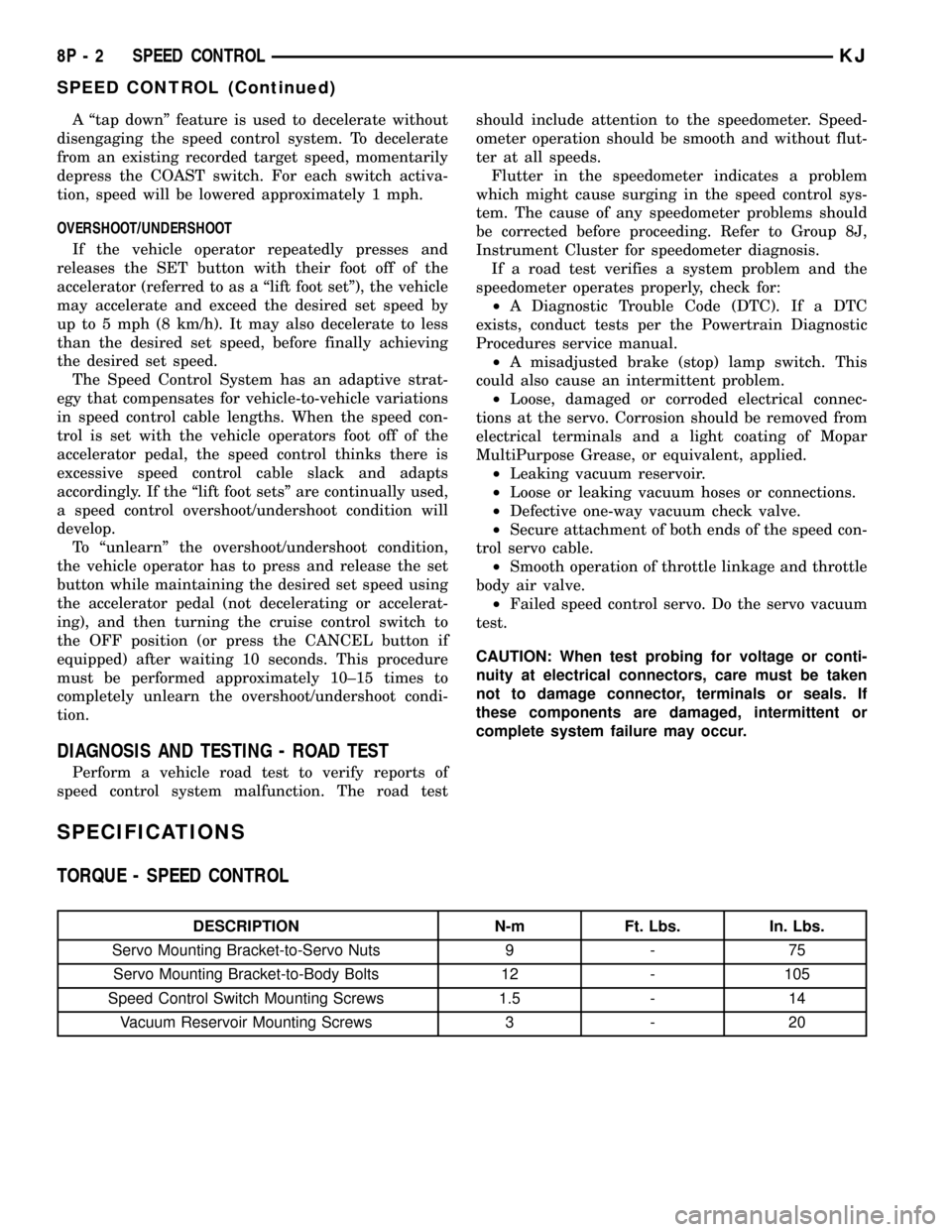
A ªtap downº feature is used to decelerate without
disengaging the speed control system. To decelerate
from an existing recorded target speed, momentarily
depress the COAST switch. For each switch activa-
tion, speed will be lowered approximately 1 mph.
OVERSHOOT/UNDERSHOOT
If the vehicle operator repeatedly presses and
releases the SET button with their foot off of the
accelerator (referred to as a ªlift foot setº), the vehicle
may accelerate and exceed the desired set speed by
up to 5 mph (8 km/h). It may also decelerate to less
than the desired set speed, before finally achieving
the desired set speed.
The Speed Control System has an adaptive strat-
egy that compensates for vehicle-to-vehicle variations
in speed control cable lengths. When the speed con-
trol is set with the vehicle operators foot off of the
accelerator pedal, the speed control thinks there is
excessive speed control cable slack and adapts
accordingly. If the ªlift foot setsº are continually used,
a speed control overshoot/undershoot condition will
develop.
To ªunlearnº the overshoot/undershoot condition,
the vehicle operator has to press and release the set
button while maintaining the desired set speed using
the accelerator pedal (not decelerating or accelerat-
ing), and then turning the cruise control switch to
the OFF position (or press the CANCEL button if
equipped) after waiting 10 seconds. This procedure
must be performed approximately 10±15 times to
completely unlearn the overshoot/undershoot condi-
tion.
DIAGNOSIS AND TESTING - ROAD TEST
Perform a vehicle road test to verify reports of
speed control system malfunction. The road testshould include attention to the speedometer. Speed-
ometer operation should be smooth and without flut-
ter at all speeds.
Flutter in the speedometer indicates a problem
which might cause surging in the speed control sys-
tem. The cause of any speedometer problems should
be corrected before proceeding. Refer to Group 8J,
Instrument Cluster for speedometer diagnosis.
If a road test verifies a system problem and the
speedometer operates properly, check for:
²A Diagnostic Trouble Code (DTC). If a DTC
exists, conduct tests per the Powertrain Diagnostic
Procedures service manual.
²A misadjusted brake (stop) lamp switch. This
could also cause an intermittent problem.
²Loose, damaged or corroded electrical connec-
tions at the servo. Corrosion should be removed from
electrical terminals and a light coating of Mopar
MultiPurpose Grease, or equivalent, applied.
²Leaking vacuum reservoir.
²Loose or leaking vacuum hoses or connections.
²Defective one-way vacuum check valve.
²Secure attachment of both ends of the speed con-
trol servo cable.
²Smooth operation of throttle linkage and throttle
body air valve.
²Failed speed control servo. Do the servo vacuum
test.
CAUTION: When test probing for voltage or conti-
nuity at electrical connectors, care must be taken
not to damage connector, terminals or seals. If
these components are damaged, intermittent or
complete system failure may occur.
SPECIFICATIONS
TORQUE - SPEED CONTROL
DESCRIPTION N-m Ft. Lbs. In. Lbs.
Servo Mounting Bracket-to-Servo Nuts 9 - 75
Servo Mounting Bracket-to-Body Bolts 12 - 105
Speed Control Switch Mounting Screws 1.5 - 14
Vacuum Reservoir Mounting Screws 3 - 20
8P - 2 SPEED CONTROLKJ
SPEED CONTROL (Continued)
Page 677 of 1803

(6) Slide speed control cable plastic mount towards
right of vehicle to remove cable from throttle body
bracket (Fig. 4).
(7) Remove servo cable from servo. Refer to Servo
Removal/Installation.
INSTALLATION - 3.7L
(1) Install end of cable to speed control servo.
Refer to Servo Removal/Installation.
(2) Slide speed control cable plastic mount into
throttle body bracket.
(3) Install speed control cable connector onto throt-
tle body bellcrank pin (push rearward to snap into
location).
(4) Slide throttle (accelerator) cable plastic mount
into throttle body bracket. Continue sliding until
cable release tab is aligned to hole in throttle body
mounting bracket.
(5) While holding throttle to wide open position,
place throttle cable pin into throttle body bellcrank.
(6) Install air filter resonator box to throttle body.
(7) Connect negative battery cable at battery.
(8) Before starting engine, operate accelerator
pedal to check for any binding.
SERVO
DESCRIPTION
The servo unit consists of a solenoid valve body,
and a vacuum chamber. The solenoid valve body con-
tains three solenoids:²Vacuum
²Vent
²Dump
The vacuum chamber contains a diaphragm with a
cable attached to control the throttle linkage.
OPERATION
The Powertrain Control Module (PCM) controls the
solenoid valve body. The solenoid valve body controls
the application and release of vacuum to the dia-
phragm of the vacuum servo. The servo unit cannot
be repaired and is serviced only as a complete assem-
bly.
Power is supplied to the servo's by the PCM
through the brake switch. The PCM controls the
ground path for the vacuum and vent solenoids.
The dump solenoid is energized anytime it receives
power. If power to the dump solenoid is interrupted,
the solenoid dumps vacuum in the servo. This pro-
vides a safety backup to the vent and vacuum sole-
noids.
The vacuum and vent solenoids must be grounded
at the PCM to operate. When the PCM grounds the
vacuum servo solenoid, the solenoid allows vacuum
to enter the servo and pull open the throttle plate
using the cable. When the PCM breaks the ground,
the solenoid closes and no more vacuum is allowed to
enter the servo. The PCM also operates the vent sole-
noid via ground. The vent solenoid opens and closes a
passage to bleed or hold vacuum in the servo as
required.
The PCM duty cycles the vacuum and vent sole-
noids to maintain the set speed, or to accelerate and
decelerate the vehicle. To increase throttle opening,
the PCM grounds the vacuum and vent solenoids. To
decrease throttle opening, the PCM removes the
grounds from the vacuum and vent solenoids. When
the brake is released, if vehicle speed exceeds 30
mph to resume, 35 mph to set, and the RES/ACCEL
switch has been depressed, ground for the vent and
vacuum circuits is restored.
REMOVAL
(1) Disconnect negative battery cable at battery.
(2) Disconnect vacuum line at servo (Fig. 5).
(3) Disconnect electrical connector at servo (Fig. 5).
(4) Remove coolant bottle nuts/bolts. Position bot-
tle forward a few inches.
(5) Disconnect servo cable at throttle body. Refer to
servo Cable Removal/Installation.
(6) Remove servo bracket mounting nuts (Fig. 5).
(7) Remove 2 mounting nuts holding servo cable
sleeve to bracket (Fig. 6).
(8) Pull speed control cable sleeve and servo away
from servo mounting bracket to expose cable retain-
ing clip (Fig. 6) and remove clip. Note: The servo
Fig. 4 SPEED CONTROL CABLE AT BRACKET
1 - THROTTLE CABLE BRACKET
2 - PLASTIC CABLE MOUNT
3 - SPEED CONTROL CABLE
8P - 4 SPEED CONTROLKJ
CABLE (Continued)
Page 684 of 1803

²Combination Flasher- An electronic combina-
tion flasher is integral to the hazard switch located
in the center of the instrument panel above the
radio. (Refer to 8 - ELECTRICAL/LAMPS/LIGHT-
ING - EXTERIOR/COMBINATION FLASHER -
DESCRIPTION).
²Door Ajar Switch- A door ajar switch is inte-
gral to the latch of each door in the vehicle. (Refer to
8 - ELECTRICAL/LAMPS/LIGHTING - INTERIOR/
DOOR AJAR SWITCH - DESCRIPTION).
²Door Cylinder Lock Switch- For North
American vehicles only, a door cylinder lock switch is
located on the back of the lock cylinder of each front
door. (Refer to 8 - ELECTRICAL/VEHICLE THEFT
SECURITY/DOOR CYLINDER LOCK SWITCH -
DESCRIPTION).
²Flip-Up Glass Ajar Switch- A flip-up glass
ajar switch is integral to the rear flip-up glass latch,
located on the top of the tailgate near the center.
(Refer to 8 - ELECTRICAL/LAMPS/LIGHTING -
INTERIOR/FLIP-UP GLASS AJAR SWITCH -
DESCRIPTION).
²Hood Ajar Switch- A hood ajar switch is
located beneath the hood panel on the right inner
fender side shield of vehicles built for sale in certain
markets where it is required equipment. (Refer to 8 -
ELECTRICAL/VEHICLE THEFT SECURITY/HOOD
AJAR SWITCH - DESCRIPTION).
²Horn Relay- A horn relay is located on the
Junction Block (JB) under the driver side outboard
end of the instrument panel. (Refer to 8 - ELECTRI-
CAL/HORN/HORN RELAY - DESCRIPTION).
²Intrusion Transceiver Module- An Intrusion
Transceiver Module (ITM) is located near the center
of the headliner in the passenger compartment of
vehicles built for sale in certain markets where it is
required equipment. (Refer to 8 - ELECTRICAL/VE-
HICLE THEFT SECURITY/UK SECURITY SYSTEM
MODULE - DESCRIPTION).
²Security Indicator- A security indicator is
located in the ElectroMechanical Instrument Cluster
(EMIC) on the instrument panel in front of the driver
side front seat. (Refer to 8 - ELECTRICAL/INSTRU-
MENT CLUSTER/SECURITY INDICATOR -
DESCRIPTION).
²Siren- An alarm siren is located on the front
extension of the right front wheel house panel in the
engine compartment of vehicles built for sale in cer-
tain markets where it is required equipment. (Refer
to 8 - ELECTRICAL/VEHICLE THEFT SECURITY/
SIREN - DESCRIPTION).
²Tailgate Ajar Switch- A tailgate ajar switch is
integral to the latch for the tailgate in the vehicle.
(Refer to 8 - ELECTRICAL/LAMPS/LIGHTING -
INTERIOR/TAILGATE AJAR SWITCH - DESCRIP-
TION).SENTRY KEY IMMOBILIZER SYSTEM The Sen-
try Key Immobilizer System (SKIS) is available as a
factory-installed option on this model. Vehicles
equipped with the Vehicle Theft Alarm (VTA) are also
equipped with SKIS. The SKIS provides passive vehi-
cle protection by preventing the engine from operat-
ing unless a valid electronically encoded key is
detected in the ignition lock cylinder. The SKIS
includes the following major components, which are
described in further detail elsewhere in this service
information:
²Powertrain Control Module- The Powertrain
Control Module (PCM) is located on the left inner
fender shield in the engine compartment near the
dash panel. (Refer to 8 - ELECTRICAL/ELEC-
TRONIC CONTROL MODULES/POWERTRAIN
CONTROL MODULE - DESCRIPTION).
²Sentry Key Immobilizer Module- The Sentry
Key Immobilizer Module (SKIM) is located beneath
the steering column shrouds on the right side of the
steering column near the ignition lock cylinder hous-
ing. (Refer to 8 - ELECTRICAL/ELECTRONIC CON-
TROL MODULES/SENTRY KEY IMMOBILIZER
MODULE - DESCRIPTION).
²Sentry Key Transponder- The Sentry Key
transponder is molded into the head of the ignition
key, and concealed by a gray molded rubber cap.
(Refer to 8 - ELECTRICAL/VEHICLE THEFT SECU-
RITY/TRANSPONDER KEY - DESCRIPTION).
²SKIS Indicator- The SKIS indicator is located
in the ElectroMechanical Instrument Cluster (EMIC)
on the instrument panel in front of the driver side
front seat. (Refer to 8 - ELECTRICAL/INSTRU-
MENT CLUSTER/SPEED CONTROL INDICATOR -
DESCRIPTION).
OPERATION
The Vehicle Theft Security System (VTSS) is
divided into two basic subsystems: Vehicle Theft
Alarm (VTA) and Sentry Key Immobilizer System
(SKIS). Following are paragraphs that briefly
describe the operation of each of these two sub-
systems.
VEHICLE THEFT ALARM The Body Control Mod-
ule (BCM) is used on this model to control and inte-
grate many of the electronic functions and features
included in the Vehicle Theft Alarm (VTA). The BCM
receives hard wired inputs indicating the status of
the door ajar switches, the door cylinder lock
switches, the ignition switch, the tailgate ajar switch,
the tailgate cylinder lock switch, the flip-up glass
ajar switch, the power lock switches and, in vehicles
built for certain markets where it is required, the
hood ajar switch. The programming in the BCM
allows it to process the information from all of these
inputs and send control outputs to energize or de-en-
KJVEHICLE THEFT SECURITY 8Q - 3
VEHICLE THEFT SECURITY (Continued)
Page 689 of 1803

continuity. If OK, go to Step 6. If not OK, repair the
open ground circuit(s) to ground (G202) as required.
(6) Reconnect the battery negative cable. Check for
battery voltage at the fused B(+) circuit cavity of the
instrument panel wire harness connector for the
SKIM. If OK, go to Step 7. If not OK, repair the open
fused B(+) circuit between the SKIM and the JB as
required.
(7) Turn the ignition switch to the On position.
Check for battery voltage at the fused ignition switch
output (run-start) circuit cavity of the instrument
panel wire harness connector for the SKIM. If OK,
use a DRBIIItscan tool to complete the diagnosis of
the SKIS. Refer to the appropriate diagnostic infor-
mation. If not OK, repair the open fused ignition
switch output (run-start) circuit between the SKIM
and the JB as required.
SKIS INDICATOR FLASHES UPON IGNITION ªONº OR
LIGHTS SOLID FOLLOWING BULB TEST
A SKIS indicator that flashes following the ignition
switch being turned to the On position indicates that
an invalid key has been detected, or that a key-re-
lated fault has been set. A SKIS indicator that lights
solid following a successful bulb test indicates that
the SKIM has detected a system malfunction or that
the SKIS is inoperative. In either case, fault informa-
tion will be stored in the SKIM memory. For retrieval
of this fault information and further diagnosis of the
SKIS, the PCI data bus, the SKIM electronic mes-
sage outputs to the instrument cluster that control
the SKIS indicator and chime, or the electronic mes-
sage inputs and outputs between the SKIM and the
Powertrain Control Module (PCM) that control
engine operation, a DRBIIItscan tool is required.
Refer to the appropriate diagnostic information. Fol-
lowing are preliminary troubleshooting guidelines to
be followed during diagnosis using a DRBIIItscan
tool:
(1) Using the DRBIIItscan tool, read and record
the faults as they exist in the SKIM when you first
begin your diagnosis of the vehicle. It is important to
document these faults because the SKIM does not
differentiate between historical faults (those that
have occurred in the past) and active faults (those
that are currently present). If this problem turns out
to be an intermittent condition, this information may
become invaluable to your diagnosis.
(2) Using the DRBIIItscan tool, erase all of the
faults from the SKIM.
(3) Cycle the ignition switch to the Off position,
then back to the On position.
(4) Using the DRBIIItscan tool, read any faults
that are now present in the SKIM. These are the
active faults.(5) Using this active fault information, refer to the
proper procedure in the appropriate diagnostic infor-
mation for the specific additional diagnostic steps.
STANDARD PROCEDURE
STANDARD PROCEDURE - SKIS
INITIALIZATION
The Sentry Key Immobilizer System (SKIS) must
be initialized following a Sentry Key Immobilizer
Module (SKIM) replacement. SKIS initialization
requires the use of a DRBIIItscan tool. Initialization
will also require that you have access to the unique
four-digit PIN code that was assigned to the original
SKIM. The PIN codemustbe used to enter the
Secured Access Mode in the SKIM. This PIN number
may be obtained from the vehicle owner, from the
original vehicle invoice, or from the DaimlerChrysler
Customer Center. (Refer to 8 - ELECTRICAL/ELEC-
TRONIC CONTROL MODULES - STANDARD PRO-
CEDURE - PCM/SKIM PROGRAMMING).
NOTE: If a Powertrain Control Module (PCM) is
replaced on a vehicle equipped with the Sentry Key
Immobilizer System (SKIS), the unique Secret Key
data must be transferred from the Sentry Key
Immobilizer Module (SKIM) to the new PCM using
the PCM replacement procedure. This procedure
also requires the use of a DRBIIITscan tool and the
unique four-digit PIN code to enter the Secured
Access Mode in the SKIM. Refer to the appropriate
diagnostic information for the proper PCM replace-
ment procedures.
STANDARD PROCEDURE - SENTRY KEY
TRANSPONDER PROGRAMMING
All Sentry Keys included with the vehicle are pre-
programmed to work with the Sentry Key Immobi-
lizer System (SKIS) when it is shipped from the
factory. The Sentry Key Immobilizer Module (SKIM)
can be programmed to recognize up to a total of eight
Sentry Keys. When programming a blank Sentry Key
transponder, the key must first be cut to match the
ignition switch lock cylinder in the vehicle for which
it will be used. Once the additional or new key has
been cut, the SKIM must be programmed to recog-
nize it as a valid key. There are two possible methods
to program the SKIM to recognize a new or addi-
tional valid key, the Secured Access Method and the
Customer Learn Method. Following are the details of
these two programming methods.
8Q - 8 VEHICLE THEFT SECURITYKJ
VEHICLE THEFT SECURITY (Continued)
Page 699 of 1803

(2) Install and tighten the two screws that secure
the alarm siren module to the front extension of the
right front wheel house panel. Tighten the screws to
6 N´m (50 in. lbs.).
(3) Reconnect the headlamp and dash wire harness
connector for the alarm siren module to the module
connector receptacle.
(4) Reconnect the battery negative cable.
NOTE: If the alarm siren module has been replaced
with a new unit, the new unit MUST be configured
in the Intrusion Transceiver Module (ITM) before the
Vehicle Theft Security System can operate as
designed. The use of a DRBIIITscan tool is required
to configure the alarm siren module settings in the
ITM. Refer to the appropriate diagnostic informa-
tion.
TRANSPONDER KEY
DESCRIPTION
Each ignition key used in the Sentry Key Immobi-
lizer System (SKIS) has an integral transponder chip
(Fig. 15). Ignition keys with this feature can be
readily identified by a gray rubber cap molded onto
the head of the key, while conventional ignition keys
have a black molded rubber cap. The transponderchip is concealed beneath the molded rubber cap,
where it is molded within a plastic mount into the
head of the metal key. In addition to being cut to
match the mechanical coding of the ignition lock cyl-
inder, each new Sentry Key has a unique transpon-
der identification code permanently programmed into
it by the manufacturer. The Sentry Key transponder
cannot be adjusted or repaired. If faulty or damaged,
the entire key must be replaced.
OPERATION
When the ignition switch is turned to the On posi-
tion, the Sentry Key Immobilizer Module (SKIM)
communicates through its antenna with the Sentry
Key transponder using a Radio Frequency (RF) sig-
nal. The SKIM then listens for a RF response from
the transponder through the same antenna. The Sen-
try Key transponder chip is within the range of the
SKIM transceiver antenna ring when it is inserted
into the ignition lock cylinder. The SKIM determines
whether a valid key is present in the ignition lock
cylinder based upon the response from the transpon-
der. If a valid key is detected, that fact is communi-
cated by the SKIM to the Powertrain Control Module
(PCM) over the Programmable Communications
Interface (PCI) data bus, and the PCM allows the
engine to continue running. If the PCM receives an
invalid key message, or receives no message from the
SKIM over the PCI data bus, the engine will be dis-
abled after about two seconds of operation. The Elec-
troMechanical Instrument Cluster (EMIC) will also
respond to the invalid key message on the PCI data
bus by flashing the SKIS indicator on and off.
Fig. 14 Siren Remove/Install
1 - SCREW (2)
2 - WIRE HARNESS CONNECTOR
3 - SIREN
Fig. 15 Sentry Key Immobilizer Transponder
1 - MOLDED CAP
2 - TRANSPONDER CHIP
3 - MOLDED CAP REMOVED
4 - TRANSPONDER KEY
8Q - 18 VEHICLE THEFT SECURITYKJ
SIREN (Continued)
Page 752 of 1803
TERMINOLOGY
This is a list of terms and definitions used in the
wiring diagrams.
LHD .................Left Hand Drive Vehicles
RHD................Right Hand Drive Vehicles
ATX . . Automatic Transmissions-Front Wheel Drive
MTX....Manual Transmissions-Front Wheel Drive
AT ....Automatic Transmissions-Rear Wheel Drive
MT .....Manual Transmissions-Rear Wheel Drive
SOHC...........Single Over Head Cam Engine
DOHC..........Double Over Head Cam Engine
Built-Up-Export........ Vehicles Built For Sale In
Markets Other Than North America
Except-Built-Up-Export . . Vehicles Built For Sale In
North America
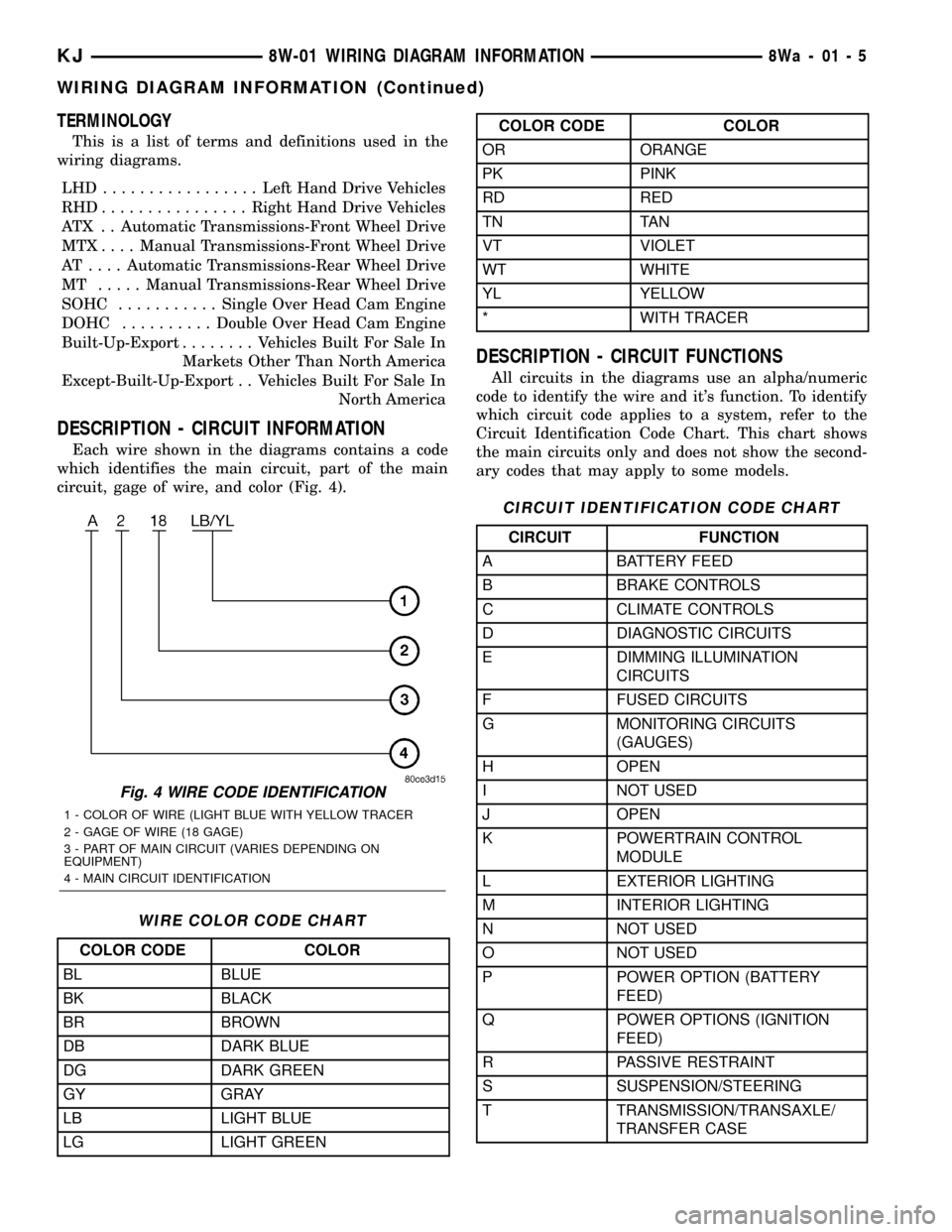
DESCRIPTION - CIRCUIT INFORMATION
Each wire shown in the diagrams contains a code
which identifies the main circuit, part of the main
circuit, gage of wire, and color (Fig. 4).
WIRE COLOR CODE CHART
COLOR CODE COLOR
BL BLUE
BK BLACK
BR BROWN
DB DARK BLUE
DG DARK GREEN
GY GRAY
LB LIGHT BLUE
LG LIGHT GREEN
COLOR CODE COLOR
OR ORANGE
PK PINK
RD RED
TN TAN
VT VIOLET
WT WHITE
YL YELLOW
* WITH TRACER
DESCRIPTION - CIRCUIT FUNCTIONS
All circuits in the diagrams use an alpha/numeric
code to identify the wire and it's function. To identify
which circuit code applies to a system, refer to the
Circuit Identification Code Chart. This chart shows
the main circuits only and does not show the second-
ary codes that may apply to some models.
CIRCUIT IDENTIFICATION CODE CHART
CIRCUIT FUNCTION
A BATTERY FEED
B BRAKE CONTROLS
C CLIMATE CONTROLS
D DIAGNOSTIC CIRCUITS
E DIMMING ILLUMINATION
CIRCUITS
F FUSED CIRCUITS
G MONITORING CIRCUITS
(GAUGES)
H OPEN
I NOT USED
J OPEN
K POWERTRAIN CONTROL
MODULE
L EXTERIOR LIGHTING
M INTERIOR LIGHTING
N NOT USED
O NOT USED
P POWER OPTION (BATTERY
FEED)
Q POWER OPTIONS (IGNITION
FEED)
R PASSIVE RESTRAINT
S SUSPENSION/STEERING
T TRANSMISSION/TRANSAXLE/
TRANSFER CASE
Fig. 4 WIRE CODE IDENTIFICATION
1 - COLOR OF WIRE (LIGHT BLUE WITH YELLOW TRACER
2 - GAGE OF WIRE (18 GAGE)
3 - PART OF MAIN CIRCUIT (VARIES DEPENDING ON
EQUIPMENT)
4 - MAIN CIRCUIT IDENTIFICATION
KJ8W-01 WIRING DIAGRAM INFORMATION8Wa-01-5
WIRING DIAGRAM INFORMATION (Continued)