motor JEEP LIBERTY 2002 KJ / 1.G Repair Manual
[x] Cancel search | Manufacturer: JEEP, Model Year: 2002, Model line: LIBERTY, Model: JEEP LIBERTY 2002 KJ / 1.GPages: 1803, PDF Size: 62.3 MB
Page 527 of 1803

LICENSE PLATE LAMP BULB
REMOVAL.............................44
INSTALLATION.........................45
LICENSE PLATE LAMP UNIT
REMOVAL.............................45
INSTALLATION.........................46
MULTI-FUNCTION SWITCH
DESCRIPTION.........................46
OPERATION...........................48
DIAGNOSIS AND TESTING - MULTI-
FUNCTION SWITCH...................50
REMOVAL.............................53
INSTALLATION.........................53
PARK LAMP RELAY
DESCRIPTION.........................54
OPERATION...........................54
DIAGNOSIS AND TESTING - PARK LAMP
RELAY..............................55
REMOVAL.............................55
INSTALLATION.........................56
REAR FOG LAMP RELAY
DESCRIPTION.........................56
OPERATION...........................57
DIAGNOSIS AND TESTING - REAR FOG
LAMP RELAY.........................57
REMOVAL.............................58
INSTALLATION.........................58
REAR LAMP BULB
REMOVAL.............................59
INSTALLATION.........................59
REAR LAMP UNIT
REMOVAL.............................59
INSTALLATION.........................60
REPEATER LAMP BULB
REMOVAL.............................60INSTALLATION.........................60
REPEATER LAMP UNIT
REMOVAL.............................61
INSTALLATION.........................61
TRAILER TOW CONNECTOR
REMOVAL.............................61
INSTALLATION.........................61
TRAILER TOW RELAY
DESCRIPTION.........................62
OPERATION...........................62
DIAGNOSIS AND TESTING - TRAILER TOW
RELAY..............................62
REMOVAL.............................63
INSTALLATION.........................63
TRAILER TOW WIRING
DESCRIPTION.........................64
LAMP BAR
DESCRIPTION.........................65
OPERATION...........................65
DIAGNOSIS AND TESTING - LAMP BAR.....65
STANDARD PROCEDURE - LAMP BAR
AIMING.............................65
REMOVAL
REMOVAL - LAMP BAR.................65
REMOVAL - LAMP.....................66
INSTALLATION
INSTALLATION - LAMP BAR.............66
INSTALLATION - LAMP.................66
LAMP BAR SWITCH
DESCRIPTION.........................67
REMOVAL.............................67
INSTALLATION.........................67
LAMPS/LIGHTING - EXTERIOR
DESCRIPTION
The exterior lighting system for this model
includes the following exterior lamps (Fig. 1):
²Backup Lamps- The backup (or reverse) lamps
are integral to the rear lamp units mounted to the
back of the quarter panel on each side of the tailgate
at the rear of the vehicle.
²Brake Lamps- The brake (or stop) lamps
include a lamp that is integral to the rear lamp units
mounted to the back of the quarter panel on each
side of the tailgate, and the Center High Mounted
Stop Lamp (CHMSL) that is centered on the rear
edge of the roof panel above the flip-up glass opening
at the rear of the vehicle.
²Daytime Running Lamps- Vehicles manufac-
tured for sale in Canada illuminate the high beam
filament in each headlamp bulb serves as the Day-
time Running Lamps (DRL).²Front Fog Lamps- Optional front fog lamps
include a single round front fog lamp unit with an
adjustable reflector and a removable bulb that is
secured behind a dedicated opening on each forward-
facing end of the front bumper fascia.
²Hazard Warning Lamps- The hazard warning
lamps include all of the right and left turn signal
lamps.
²Headlamps- A single round headlamp housing
with a fixed lens, an adjustable reflector, and a single
removable halogen bulb is secured to the grille open-
ing panel on each side of the grille opening at the
front of the vehicle. In certain markets where
required, a headlamp leveling actuator motor is
included on each headlamp.
²Park Lamps- The park lamps include the front
park lamps and front side marker lamps that are
integral to the front lamp units mounted at each end
of the bumper fascia at the front of the vehicle, as
well as the rear park lamps and rear side marker
lamps that are integral to the rear lamp units
8Ls - 2 LAMPSKJ
Page 529 of 1803

mounted to the back of the quarter panel on each
side of the tailgate at the rear of the vehicle. The
park lamps include a license plate lamp or lamps,
depending upon the requirements of the market for
which the vehicle is manufactured. Vehicles with a
license plate tub located near the left end of the rear
bumper fascia have a single lamp, while vehicles
with a license plate module located on the spare tire
carrier have two license plate lamps. In certain mar-
kets where required, a front position lamp that is
integral to each headlamp unit is illuminated instead
of the front park lamps and front side marker lamps
in the park lamps circuit; and, a rectangular, red
reflector is located on the rear bumper fascia just
inboard and below each rear lamp unit.
²Rear Fog Lamps- Rear fog lamps are avail-
able only in certain markets where they are required
equipment. The rear fog lamps are integral to the
rear lamp units mounted to the back of the quarter
panel on each side of the tailgate at the rear of the
vehicle.
²Turn Signal Lamps- The turn signal lamps
include the front turn signal and front side marker
lamps that are integral to the front lamp units
mounted at each end of the bumper fascia at the
front of the vehicle, as well as rear turn signal lamps
that are integral to the rear lamp units mounted to
the back of the quarter panel on each side of the tail-
gate at the rear of the vehicle. In certain markets
where required, a repeater lamp unit mounted to
each front fender just behind the front wheel opening
is illuminated instead of the front side marker lamp
in each turn signal lamp circuit.
Other components of the exterior lighting system
for this model include:
²Combination Flasher- An electronic combina-
tion flasher is integral to the hazard warning switch
in the center of the instrument panel.
²Backup Lamp Switch- Vehicles equipped with
a manual transmission have a plunger-type backup
lamp switch located on the transmission housing. A
Transmission Range Sensor (TRS) integral to the
solenoid pack on the valve body of the optional elec-
tronic automatic transmission performs the backup
lamp switch function on models that are so equipped.
²Brake Lamp Switch- A plunger-type brake
lamp switch is located on the steering column sup-
port bracket under the instrument panel and actu-
ated by the brake pedal arm.²Body Control Module- The Body Control
Module (BCM) is located on the Junction Block (JB)
under the driver side outboard end of the instrument
panel. (Refer to 8 - ELECTRICAL/ELECTRONIC
CONTROL MODULES/BODY CONTROL MODULE
- DESCRIPTION).
²Daytime Running Lamp Relay- Vehicles
manufactured for sale in Canada use a solid state
Daytime Running Lamps (DRL) relay installed in the
Junction Block (JB) instead of the conventional high
beam relay.
²Front Fog Lamp Relay- Vehicles equipped
with the optional front fog lamps have a front fog
lamp relay located in the Junction Block (JB).
²Hazard Switch- The hazard switch is located
near the center of the instrument panel and includes
the integral electronic combination flasher circuitry
for the hazard warning system and the turn signal
system.
²Headlamp Leveling Motor- A headlamp lev-
eling actuator motor is located on the back of each
headlamp housing of vehicles manufactured for cer-
tain markets where this equipment is required.
²Headlamp Leveling Switch- A thumbwheel
actuated headlamp leveling switch is mounted in the
driver side inboard instrument panel trim bezel of
vehicles manufactured for certain markets where this
equipment is required.
²High Beam Relay- A high beam relay is
located in the Junction Block (JB) of all vehicles
except those that are manufactured for sale in Can-
ada. Canadian vehicles have a solid state Daytime
Running Lamps (DRL) relay in the JB instead of the
high beam relay.
²Low Beam Relay- A low beam relay is located
in the Junction Block (JB) of all vehicles.
²Multi-Function Switch- The multi-function
switch is located on the top of the steering column,
just below the steering wheel. The multi-function
switch includes a left (lighting) control stalk and a
right (wiper) control stalk. The left control stalk is
dedicated to providing almost all of the driver con-
trols for both the exterior and interior lighting sys-
tems.
²Park Lamp Relay- A park lamp relay is
located in the Junction Block (JB) of all vehicles.
²Rear Fog Lamp Relay- Vehicles manufac-
tured for certain markets where rear fog lamps are
required equipment have a rear fog lamp relay
located in the Junction Block (JB).
1 - HEADLAMP UNIT (2)
2 - REPEATER LAMP UNIT (2)
3 - FRONT POSITION LAMP (2)
4 - FRONT LAMP UNIT (2)5 - FRONT FOG LAMP (2)
6 - CENTER HIGH MOUNTED STOP LAMP UNIT
7 - REAR LAMP UNIT
8 - LICENSE PLATE LAMP UNIT
8Ls - 4 LAMPSKJ
LAMPS/LIGHTING - EXTERIOR (Continued)
Page 531 of 1803

FRONT FOG LAMPS
Vehicles equipped with optional front fog lamps
have a premium Body Control Module (BCM), a front
fog lamp relay installed in the Junction Block (JB),
and a front fog lamp switch integral to the left (light-
ing) control stalk of the multi-function switch. The
front fog lamps have a path to ground at all times
through their connection to the front fascia wire har-
ness from two take outs of the headlamp and dash
wire harness with eyelet terminal connectors that
are secured by ground screws to the left inner fender
shield in the engine compartment. The BCM controls
front fog lamp operation by monitoring the exterior
lighting switch input from the multi-function switch,
then energizing or de-energizing the front fog lamp
relay control coil; and, by sending the appropriate
electronic message to the instrument cluster over the
Programmable Communications Interface (PCI) data
bus to turn the front fog lamp indicator on or off.
When the front fog lamp relay is energized, it pro-
vides battery current from a fused B(+) fuse in the
JB to the front fog lamps through the front fog lamp
relay output circuit. The BCM provides a battery
saver (load shedding) feature for the front fog lamps,
which will turn these lamps off if they are left on for
more than about eight minutes with the ignition
switch in the Off position. In certain markets where
required, the front fog lamps are also turned off by
the BCM whenever the headlamp high beams are
selected. Each front fog lamp includes an integral
adjustment screw to be used for static aiming the fog
lamp beams.
HAZARD WARNING LAMPS
With the hazard switch in the On position, the
hazard warning system is activated causing the haz-
ard switch button illumination lamp, the right and
left turn signal indicators, and the right and left turn
signal lamps to flash on and off. When the hazard
warning system is activated, the circuitry within the
hazard switch and electronic combination flasher
unit will repeatedly energize and de-energize two
internal relays that switch battery current from a
fused B(+) fuse in the Junction Block (JB) to the
right side and left side turn signal indicators, and
turn signal lamps through the right and left turn sig-
nal circuits. The flashing of the hazard switch button
illumination lamp is performed internally by the haz-
ard switch and combination flasher unit circuit
board. The hazard warning lamps can also be ener-
gized by the Body Control Module (BCM) through a
hazard lamp control circuit input to the hazard
switch and combination flasher unit.HEADLAMPS
The headlamp system includes the Body Control
Module (BCM), a low beam relay installed in the
Junction Block (JB), a high beam relay installed in
the JB (except Canada), a solid state Daytime Run-
ning Lamps (DRL) relay installed in the JB (Canada
only), and the exterior lighting (headlamp and dim-
mer) switches integral to the left (lighting) control
stalk of the multi-function switch. The headlamp
bulbs have a path to ground at all times through
their connection to the grille opening reinforcement
wire harness from two take outs of the headlamp and
dash wire harness with eyelet terminal connectors
that are secured by ground screws to the left inner
fender shield in the engine compartment. The BCM
controls the headlamp operation by monitoring the
exterior lighting switch inputs from the multi-func-
tion switch, then energizing or de-energizing the con-
trol coils of the low beam relay, the high beam relay,
or the solid state circuitry of the DRL relay; and, by
sending the appropriate electronic message to the
instrument cluster over the Programmable Commu-
nications Interface (PCI) data bus to turn the high
beam indicator on or off. When each respective relay
is energized, it provides battery current from a fused
B(+) fuse in the Power Distribution Center (PDC)
through a relay (low beam, high beam, or DRL) out-
put circuit and four separate fuses in the JB through
individual fused right and left, low and high beam
output circuits to the appropriate headlamp bulb fil-
aments. The BCM provides a battery saver (load
shedding) feature for the headlamps, which will turn
these lamps off if they are left on for more than
about eight minutes with the ignition switch in the
Off position; and, a headlamp delay feature with a
DRBIIItscan tool programmable delay interval.
Each headlamp includes an integral adjustment
screw to be used for static aiming of the headlamp
beams.
HEADLAMP LEVELING
In certain markets where required, a headlamp
leveling system is provided on the vehicle. The head-
lamp leveling system includes unique headlamp units
equipped with a headlamp leveling actuator motor,
and a rotary thumbwheel actuated headlamp leveling
switch on the instrument panel. The headlamp level-
ing system allows the headlamp beams to be
adjusted to one of four vertical positions to compen-
sate for changes in inclination caused by the loading
of the vehicle suspension. The actuator motors are
mechanically connected through an integral pushrod
to an adjustable headlamp reflector. The headlamp
leveling switch is a resistor multiplexed unit that
provides one of four voltage outputs to the headlamp
leveling motors. The headlamp leveling motors will
8Ls - 6 LAMPSKJ
LAMPS/LIGHTING - EXTERIOR (Continued)
Page 532 of 1803

move the headlamps to the selected position based
upon the voltage input received from the switch. The
headlamp leveling motors and switch have a path to
ground at all times. The headlamp leveling compo-
nents operate on battery current received through
the fused park lamp relay output circuit so that the
system will only operate when the exterior lighting is
turned on.
PARK LAMPS
The park lamps system includes the Body Control
Module (BCM), a park lamp relay installed in the
Junction Block (JB), and the exterior lighting switch
integral to the left (lighting) control stalk of the
multi-function switch. The front park lamp and side
marker or, if equipped, the front position lamp bulbs
each have a path to ground at all times through their
connections to the grille opening reinforcement wire
harness from two take outs of the headlamp and
dash wire harness with eyelet terminal connectors
that are secured by ground screws to the left inner
fender shield in the engine compartment. The rear
park lamp bulbs and license plate lamp have a path
to ground at all times through their connection to the
rear lighting wire harness from a take out of the rear
body wire harness with an eyelet terminal connector
that is secured by a ground screw to the base of the
right D-pillar behind the quarter trim panel. The
BCM controls the park lamp operation by monitoring
the exterior lighting switch inputs from the multi-
function switch, then energizing or de-energizing the
control coil of the park lamp relay. When the park
lamp relay is energized, it provides battery current
from a fused B(+) fuse in the Power Distribution
Center (PDC) through a park lamp relay output cir-
cuit and a separate fuse in the JB through a fused
park lamp relay output circuit to the appropriate
lamp bulb filaments. The BCM provides a battery
saver (load shedding) feature for the park lamps,
which will turn these lamps off if they are left on for
more than about eight minutes with the ignition
switch in the Off position.
REAR FOG LAMPS
Rear fog lamps are installed on vehicles manufac-
tured for certain markets where they are required.
The rear fog lamp system includes a premium Body
Control Module (BCM), a rear fog lamp relay
installed in the Junction Block (JB), and a rear fog
lamp switch integral to the left (lighting) control
stalk of the multi-function switch. The rear fog lamps
have a path to ground at all times through their con-
nection to the rear lighting wire harness from a take
out of the rear body wire harness with an eyelet ter-
minal connector that is secured by a ground screw to
the base of the right D-pillar behind the quarter trimpanel. The BCM controls rear fog lamp operation by
monitoring the exterior lighting switch input from
the multi-function switch, then energizing or de-ener-
gizing the rear fog lamp relay control coil; and, by
sending the appropriate electronic message to the
instrument cluster over the Programmable Commu-
nications Interface (PCI) data bus to turn the rear
fog lamp indicator on or off. When the rear fog lamp
relay is energized, it provides battery current from a
fused B(+) fuse in the JB to the rear fog lamps
through the rear fog lamp relay output circuit. The
BCM provides a battery saver (load shedding) feature
for the rear fog lamps, which will turn these lamps
off if they are left on for more than about eight min-
utes with the ignition switch in the Off position.
TURN SIGNAL LAMPS
When the left control stalk of the multi-function
switch is moved up (right turn) or down (left turn),
the turn signal system is activated causing the
selected right or left turn signal indicator, and right
or left turn signal lamps to flash on and off. When
the turn signal system is activated, the circuitry
within the turn signal switch and the hazard switch/
electronic combination flasher unit will repeatedly
energize and de-energize one of two internal relays
that switch battery current from a fused ignition
switch output (run) fuse in the Junction Block (JB) to
the right side or left side turn signal indicators and
turn signal lamps through the right or left turn sig-
nal circuits. The ElectroMechanical Instrument Clus-
ter (EMIC) chime tone generator will generate an
audible turn signal cancel warning each time the
vehicle is driven for a distance of about 3.2 kilome-
ters (about two miles) with a turn signal indicator
flashing. The EMIC uses Programmable Communica-
tions Interface (PCI) data bus distance messages
from the Powertrain Control Module (PCM) and a
hard wired input from the turn signal switch cir-
cuitry of the multi-function switch to determine when
to sound the turn signal cancel warning.
DIAGNOSIS AND TESTING - LAMPS/LIGHTING
- EXTERIOR
The hard wired circuits and components of the
exterior lighting systems may be diagnosed and
tested using conventional diagnostic tools and proce-
dures. However, conventional diagnostic methods
may not prove conclusive in the diagnosis of the Body
Control Module (BCM), the ElectroMechanical
Instrument Cluster (EMIC), the Powertrain Control
Module (PCM), or the Programmable Communica-
tions Interface (PCI) data bus network. The most
reliable, efficient, and accurate means to diagnose
the BCM, the EMIC, the PCM, and the PCI data bus
network inputs and outputs related to the various
KJLAMPS8Ls-7
LAMPS/LIGHTING - EXTERIOR (Continued)
Page 537 of 1803
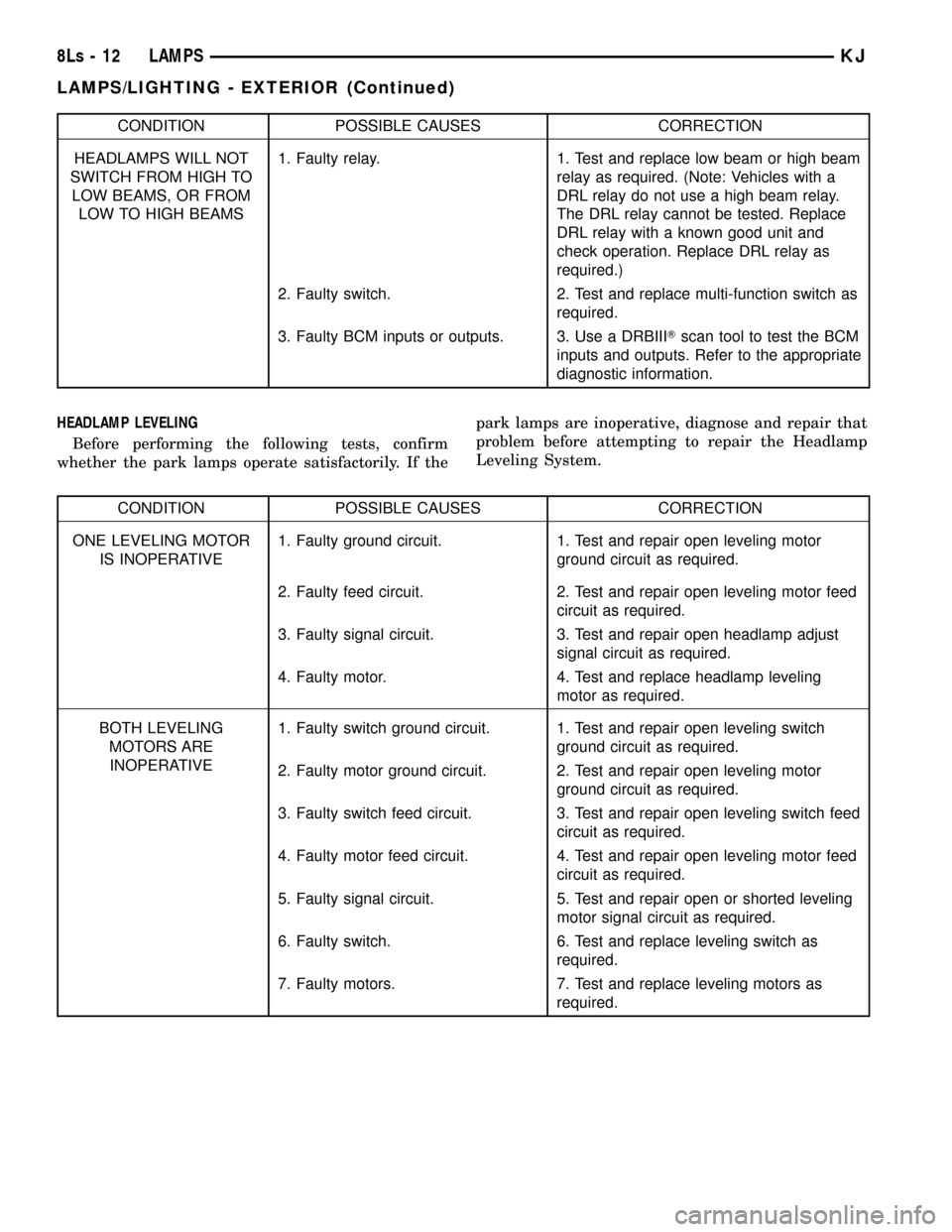
CONDITION POSSIBLE CAUSES CORRECTION
HEADLAMPS WILL NOT
SWITCH FROM HIGH TO
LOW BEAMS, OR FROM
LOW TO HIGH BEAMS1. Faulty relay. 1. Test and replace low beam or high beam
relay as required. (Note: Vehicles with a
DRL relay do not use a high beam relay.
The DRL relay cannot be tested. Replace
DRL relay with a known good unit and
check operation. Replace DRL relay as
required.)
2. Faulty switch. 2. Test and replace multi-function switch as
required.
3. Faulty BCM inputs or outputs. 3. Use a DRBIIITscan tool to test the BCM
inputs and outputs. Refer to the appropriate
diagnostic information.
HEADLAMP LEVELING
Before performing the following tests, confirm
whether the park lamps operate satisfactorily. If thepark lamps are inoperative, diagnose and repair that
problem before attempting to repair the Headlamp
Leveling System.
CONDITION POSSIBLE CAUSES CORRECTION
ONE LEVELING MOTOR
IS INOPERATIVE1. Faulty ground circuit. 1. Test and repair open leveling motor
ground circuit as required.
2. Faulty feed circuit. 2. Test and repair open leveling motor feed
circuit as required.
3. Faulty signal circuit. 3. Test and repair open headlamp adjust
signal circuit as required.
4. Faulty motor. 4. Test and replace headlamp leveling
motor as required.
BOTH LEVELING
MOTORS ARE
INOPERATIVE1. Faulty switch ground circuit. 1. Test and repair open leveling switch
ground circuit as required.
2. Faulty motor ground circuit. 2. Test and repair open leveling motor
ground circuit as required.
3. Faulty switch feed circuit. 3. Test and repair open leveling switch feed
circuit as required.
4. Faulty motor feed circuit. 4. Test and repair open leveling motor feed
circuit as required.
5. Faulty signal circuit. 5. Test and repair open or shorted leveling
motor signal circuit as required.
6. Faulty switch. 6. Test and replace leveling switch as
required.
7. Faulty motors. 7. Test and replace leveling motors as
required.
8Ls - 12 LAMPSKJ
LAMPS/LIGHTING - EXTERIOR (Continued)
Page 556 of 1803

(4) Rotate the lock ring on the back of the head-
lamp unit housing counterclockwise about 30
degrees.
CAUTION: Do not contaminate the bulb glass by
touching it with your fingers or by allowing it to
contact other oily surfaces. Shortened bulb life will
result.
(5) Pull the lock ring, socket, and bulb straight out
of the headlamp unit housing and up from behind
the upper radiator crossmember (Fig. 24).(6) Disconnect the grille opening reinforcement
wire harness connector for the headlamp bulb from
the connector receptacle on the bulb socket.
(7) Remove the bulb and bulb socket from the lock
ring as a unit.
REST-OF-WORLD
(1) Disconnect and isolate the battery negative
cable.
(2) Remove the headlamp unit from the grille
opening reinforcement. (Refer to 8 - ELECTRICAL/
LAMPS/LIGHTING - EXTERIOR/HEADLAMP UNIT
- REMOVAL).
(3) Firmly grasp the tab of the headlamp boot seal
on the back of the headlamp unit housing (Fig. 25).
(4) Pull the tab away from the back of the head-
lamp unit housing to remove the boot seal from the
housing and the bulb base.
(5) Pinch the two hooked ends of the wire head-
lamp bulb retainer clip together and disengage them
from the slots in the flange of the reflector (Fig. 26).
(6) Pivot the headlamp bulb retainer clip up off of
the bulb flange and out of the way.
CAUTION: Do not contaminate the bulb glass by
touching it with your fingers or by allowing it to
contact other oily surfaces. Shortened bulb life will
result.
Fig. 23 Headlamp Bulb Lock Ring
1 - HEADLAMP UNIT HOUSING
2 - LOCK RING
3 - SOCKET & BULB
Fig. 24 Headlamp Bulb Remove/Install
1 - HEADLAMP BULB
2 - SOCKET
3 - LOCK RING
Fig. 25 Headlamp Bulb Boot Seal Remove
1 - LEVELING MOTOR (IF EQUIPPED)
2 - BOOT SEAL
3 - FRONT POSITION LAMP
4 - ADJUSTING SCREW
5-TAB
6 - BULB BASE
KJLAMPS8Ls-31
HEADLAMP BULB (Continued)
Page 557 of 1803

(7) Pull the bulb straight out of the headlamp unit
reflector (Fig. 27).
INSTALLATION
NORTH AMERICA
CAUTION: Always use the correct bulb size and
type for replacement. An incorrect bulb size or type
may overheat and cause damage to the lamp, the
socket and/or the lamp wiring.
CAUTION: Do not contaminate the bulb glass by
touching it with your fingers or by allowing it to
contact other oily surfaces. Shortened bulb life will
result.
(1) Position the headlamp bulb and socket unit
into the lock ring (Fig. 24).
(2) Reconnect the grille opening reinforcement
wire harness connector for the headlamp bulb to the
connector receptacle on the bulb socket.
(3) Position the lock ring, socket, and bulb down
behind the upper radiator crossmember and align
them with the socket opening on the back of the
headlamp unit housing.
(4) Push the socket and bulb straight into the
headlamp unit housing until they are firmly seated.
(5) Position the lock ring over the socket and
engage it with the flange on the back of the head-
lamp unit housing (Fig. 23).
(6) Rotate the lock ring on the back of the head-
lamp unit housing clockwise about 30 degrees.
(7) Reconnect the battery negative cable.
REST-OF-WORLD
CAUTION: Always use the correct bulb size and
type for replacement. An incorrect bulb size or type
may overheat and cause damage to the lamp, the
socket and/or the lamp wiring.
CAUTION: Do not contaminate the bulb glass by
touching it with your fingers or by allowing it to
contact other oily surfaces. Shortened bulb life will
result.
(1) Position the bulb into the headlamp unit reflec-
tor (Fig. 27).
(2) Pivot the headlamp bulb retainer clip back over
the bulb flange.
(3) Pinch the two hooked ends of the wire head-
lamp bulb retainer clip together and engage them
into the slots in the flange of the reflector (Fig. 26).
(4) Position the center opening of the boot seal
over the base of the headlamp bulb and pull it down-
ward until the seal is fully engaged over the bulb
base (Fig. 25).
Fig. 26 Headlamp Bulb Retainer Clip Engage/
Disengage
1 - RETAINER CLIP
2 - BULB BASE
3 - HEADLAMP HOUSING
4 - REFLECTOR
5 - BULB FLANGE
6 - RETAINER SLOTS
Fig. 27 Headlamp Bulb Remove/Install
1 - BULB BASE
2 - RETAINER CLIP
3 - LEVELING MOTOR (IF EQUIPPED)
4 - REFLECTOR
5 - HEADLAMP HOUSING
6 - BULB FLANGE
8Ls - 32 LAMPSKJ
HEADLAMP BULB (Continued)
Page 560 of 1803

INSTALLATION
WARNING: ON VEHICLES EQUIPPED WITH AIR-
BAGS, DISABLE THE SUPPLEMENTAL RESTRAINT
SYSTEM BEFORE ATTEMPTING ANY STEERING
WHEEL, STEERING COLUMN, DRIVER AIRBAG,
PASSENGER AIRBAG, SEAT BELT TENSIONER,
FRONT IMPACT SENSORS, SIDE CURTAIN AIRBAG,
OR INSTRUMENT PANEL COMPONENT DIAGNOSIS
OR SERVICE. DISCONNECT AND ISOLATE THE
BATTERY NEGATIVE (GROUND) CABLE, THEN
WAIT TWO MINUTES FOR THE SYSTEM CAPACI-
TOR TO DISCHARGE BEFORE PERFORMING FUR-
THER DIAGNOSIS OR SERVICE. THIS IS THE ONLY
SURE WAY TO DISABLE THE SUPPLEMENTAL
RESTRAINT SYSTEM. FAILURE TO TAKE THE
PROPER PRECAUTIONS COULD RESULT IN ACCI-
DENTAL AIRBAG DEPLOYMENT AND POSSIBLE
PERSONAL INJURY.
(1) Position the headlamp high beam relay to the
proper receptacle in the Junction Block (JB) (Fig. 30).
(2) Align the headlamp high beam relay terminals
with the terminal cavities in the JB receptacle.
(3) Push firmly and evenly on the top of the head-
lamp high beam relay until the terminals are fully
seated in the terminal cavities in the JB receptacle.
(4) Reinstall the end cap onto the driver side out-
board end of the instrument panel. (Refer to 23 -
BODY/INSTRUMENT PANEL/INSTRUMENT
PANEL END CAP - INSTALLATION).
(5) Reconnect the battery negative cable.
HEADLAMP LEVELING MOTOR
DESCRIPTION
The headlamp leveling motor is located on the rear
inboard side of each headlamp unit on models
equipped with the headlamp leveling system, which
is available only in certain markets where required
(Fig. 31). The motor is encased within a molded plas-
tic housing and is secured by an integral wedge-type
mounting boss on its forward surface to a flanged
receptacle on the back of the headlamp unit housing.
A rubber seal around the circumference of the
mounting boss is compressed and seals the motor to
the headlamp unit when the boss is properly
installed in the flanged receptacle. The outside of the
motor housing features an integral molded connector
receptacle on its rearward surface, a hex-headed
adjusting screw extends from the top of the housing,
and a plastic pushrod with a ball formation on its
free end extends from the center of the mounting
boss at the front. Within the motor housing is a
12-volt Direct Current (DC) servo motor, an elec-
tronic controller board that includes the motor logic
circuits, and an integral screw-drive transmission.
The headlamp leveling motor is connected to the
vehicle electrical system through a dedicated take
out and connector of the front fascia wire harness.
The headlamp leveling motor cannot be repaired
and, if faulty or damaged, the unit must be replaced.
Fig. 30 Junction Block - Outboard Side (RHD Shown
- Rotate 180É for LHD)
1 - JB/BCM CONNECTOR
2 - HIGH BEAM RELAY
3 - DRL RELAY
Fig. 31 Headlamp Unit - With Leveling
1 - LEVELING MOTOR (IF EQUIPPED)
2 - BOOT SEAL
3 - ADJUSTING SCREW
4 - LOCATOR TAB
5 - HOUSING
6 - FRONT POSITION LAMP SOCKET & BULB
7 - HEADLAMP BULB
8 - MOUNTING TAB (2)
KJLAMPS8Ls-35
HEADLAMP HIGH BEAM RELAY (Continued)
Page 561 of 1803

OPERATION
The controller board and logic circuitry of the
headlamp leveling motor will energize the motor and
extend or retract the motor pushrod through the
integral screw-drive transmission based upon the
voltage signal input received from the resistor multi-
plexed headlamp leveling switch. The ball formation
on the end of the headlamp leveling motor pushrod is
snapped into a socket formation on the back of the
movable reflector within the headlamp unit housing.
The headlamp leveling motors and switch have a
path to ground at all times. The headlamp leveling
components operate on battery current received
through the fused park lamp relay output circuit so
that the system will only operate when the exterior
lighting is turned On.
Because of active electronic elements within the
headlamp leveling motor, it cannot be tested with
conventional automotive electrical test equipment. If
the headlamp leveling motor is believed to be faulty,
replace the motor with a known good unit to confirm
system operation.
REMOVAL
The headlamp leveling motors are integral to the
headlamp units on vehicles manufactured for certain
markets where headlamp leveling is required.
(1) Disconnect and isolate the battery negative
cable.
(2) Remove the headlamp bulb from the headlamp
unit housing. (Refer to 8 - ELECTRICAL/LAMPS/
LIGHTING - EXTERIOR/HEADLAMP BULB -
REMOVAL).
(3) Rotate the headlamp leveling motor on the
back of the headlamp unit housing counterclockwise
about 30 degrees (Fig. 32).
(4) Firmly grasp the motor with one hand while
stabilizing the headlamp unit housing with the other
hand.
(5) Firmly, steadily, and forcefully pull the head-
lamp leveling motor straight away from the back of
the headlamp unit housing to unsnap the ball forma-
tion on the end of the motor pushrod from the socket
on the headlamp unit reflector (Fig. 33).
(6) Remove the headlamp leveling motor and push-
rod from the back of the headlamp unit housing.
INSTALLATION
The headlamp leveling motors are integral to the
headlamp units on vehicles manufactured for certain
markets where headlamp leveling is required.
(1) Position the headlamp leveling motor and
pushrod from to the mounting hole on the back of the
headlamp unit housing.
(2) Insert two fingers through the bulb mounting
hole in the center of the headlamp reflector and pullthe reflector upwards toward the headlamp leveling
motor.
(3) Align the ball formation on the end of the lev-
eling motor pushrod with the socket on the headlamp
unit reflector (Fig. 33).
(4) While continuing to pulling the reflector
toward the motor, firmly, steadily, and forcefully push
the headlamp leveling motor straight into the back of
the headlamp unit housing to snap the ball formation
on the end of the motor pushrod into the socket on
the headlamp unit reflector.
(5) After the pushrod is engaged to the reflector,
remove your fingers from the bulb mounting hole in
Fig. 32 Headlamp Leveling Motor Remove/Install
1 - LEVELING MOTOR
2 - HEADLAMP HOUSING
3 - PUSHROD
Fig. 33 Leveling Motor Pushrod - Typical
1 - REFLECTOR PUSHROD SOCKET
2 - PUSHROD
3 - LEVELING MOTOR
4 - HEADLAMP HOUSING
8Ls - 36 LAMPSKJ
HEADLAMP LEVELING MOTOR (Continued)
Page 562 of 1803

the center of the headlamp reflector and thoroughly
clean any fingerprints from the reflector.
(6) Push the mounting flange of the headlamp lev-
eling motor into the mounting hole on the back of
headlamp unit housing unit the motor is firmly
seated (Fig. 32).
(7) Rotate the headlamp leveling motor on the
back of the headlamp unit housing clockwise about
30 degrees.
(8) Reinstall the headlamp bulb into the headlamp
unit housing. (Refer to 8 - ELECTRICAL/LAMPS/
LIGHTING - EXTERIOR/HEADLAMP BULB -
INSTALLATION).
(9) Reconnect the battery negative cable.
HEADLAMP LEVELING
SWITCH
DESCRIPTION
The headlamp leveling switch (Fig. 34) is used only
on vehicles manufactured for certain markets where
the headlamp leveling system is required. The head-
lamp leveling switch is mounted in the driver side
inboard trim bezel on the instrument panel, where it
is secured by molded latch features that are integral
to the switch housing. Only the switch bezel and
thumbwheel are visible on the outer surface of the
instrument panel trim bezel. The black plastic switch
thumbwheel is marked with white numbers ª0,º ª1,º
ª2,º and ª3,º each of which indicates one of the four
switch detent positions. Each higher number repre-sents a lower aiming position of the headlamp beam
relative to the road surface. The black, molded plas-
tic switch housing has an integral connector recepta-
cle on the back, a single latch feature on the top, and
two latch features (one on each side) on the bottom.
The switch is connected to the vehicle electrical sys-
tem through a dedicated take out and connector of
the instrument panel wire harness. Within the
switch housing is the leveling switch circuitry includ-
ing the switch contacts and a series resistor configu-
ration.
The headlamp leveling switch cannot be adjusted
or repaired and, if faulty or damaged, the unit must
be replaced.
OPERATION
The headlamp leveling switch receives battery cur-
rent on a fused park lamp relay output circuit from a
fuse in the Junction Block (JB) whenever the park
lamp relay is energized (park lamps are turned On).
The switch receives a path to ground through a splice
block located in the instrument panel wire harness
with an eyelet terminal connector that is secured by
a nut to a ground stud on the driver side instrument
panel end bracket near the JB. The only output from
the switch is a voltage signal that it provides to the
headlamp leveling motors on a headlamp adjust sig-
nal circuit. Each switch position selects a different
tap on a series resistor within the switch to provide a
different voltage signal to the leveling motors. The
higher the switch position number, the higher the
output voltage level.
The headlamp leveling switch can be tested using
conventional diagnostic tools and methods.
DIAGNOSIS AND TESTING - HEADLAMP
LEVELING SWITCH
WARNING: ON VEHICLES EQUIPPED WITH AIR-
BAGS, DISABLE THE SUPPLEMENTAL RESTRAINT
SYSTEM BEFORE ATTEMPTING ANY STEERING
WHEEL, STEERING COLUMN, DRIVER AIRBAG,
PASSENGER AIRBAG, SEAT BELT TENSIONER,
FRONT IMPACT SENSORS, SIDE CURTAIN AIRBAG,
OR INSTRUMENT PANEL COMPONENT DIAGNOSIS
OR SERVICE. DISCONNECT AND ISOLATE THE
BATTERY NEGATIVE (GROUND) CABLE, THEN
WAIT TWO MINUTES FOR THE SYSTEM CAPACI-
TOR TO DISCHARGE BEFORE PERFORMING FUR-
THER DIAGNOSIS OR SERVICE. THIS IS THE ONLY
SURE WAY TO DISABLE THE SUPPLEMENTAL
RESTRAINT SYSTEM. FAILURE TO TAKE THE
PROPER PRECAUTIONS COULD RESULT IN ACCI-
DENTAL AIRBAG DEPLOYMENT AND POSSIBLE
PERSONAL INJURY.
Fig. 34 Headlamp Leveling Switch
1 - SWITCH
2 - UPPER LATCH FEATURE (1)
3 - CONNECTOR RECEPTACLE
4 - LOWER LATCH FEATURE (2)
5 - THUMBWHEEL
KJLAMPS8Ls-37
HEADLAMP LEVELING MOTOR (Continued)