PCM JEEP LIBERTY 2002 KJ / 1.G Manual PDF
[x] Cancel search | Manufacturer: JEEP, Model Year: 2002, Model line: LIBERTY, Model: JEEP LIBERTY 2002 KJ / 1.GPages: 1803, PDF Size: 62.3 MB
Page 684 of 1803

²Combination Flasher- An electronic combina-
tion flasher is integral to the hazard switch located
in the center of the instrument panel above the
radio. (Refer to 8 - ELECTRICAL/LAMPS/LIGHT-
ING - EXTERIOR/COMBINATION FLASHER -
DESCRIPTION).
²Door Ajar Switch- A door ajar switch is inte-
gral to the latch of each door in the vehicle. (Refer to
8 - ELECTRICAL/LAMPS/LIGHTING - INTERIOR/
DOOR AJAR SWITCH - DESCRIPTION).
²Door Cylinder Lock Switch- For North
American vehicles only, a door cylinder lock switch is
located on the back of the lock cylinder of each front
door. (Refer to 8 - ELECTRICAL/VEHICLE THEFT
SECURITY/DOOR CYLINDER LOCK SWITCH -
DESCRIPTION).
²Flip-Up Glass Ajar Switch- A flip-up glass
ajar switch is integral to the rear flip-up glass latch,
located on the top of the tailgate near the center.
(Refer to 8 - ELECTRICAL/LAMPS/LIGHTING -
INTERIOR/FLIP-UP GLASS AJAR SWITCH -
DESCRIPTION).
²Hood Ajar Switch- A hood ajar switch is
located beneath the hood panel on the right inner
fender side shield of vehicles built for sale in certain
markets where it is required equipment. (Refer to 8 -
ELECTRICAL/VEHICLE THEFT SECURITY/HOOD
AJAR SWITCH - DESCRIPTION).
²Horn Relay- A horn relay is located on the
Junction Block (JB) under the driver side outboard
end of the instrument panel. (Refer to 8 - ELECTRI-
CAL/HORN/HORN RELAY - DESCRIPTION).
²Intrusion Transceiver Module- An Intrusion
Transceiver Module (ITM) is located near the center
of the headliner in the passenger compartment of
vehicles built for sale in certain markets where it is
required equipment. (Refer to 8 - ELECTRICAL/VE-
HICLE THEFT SECURITY/UK SECURITY SYSTEM
MODULE - DESCRIPTION).
²Security Indicator- A security indicator is
located in the ElectroMechanical Instrument Cluster
(EMIC) on the instrument panel in front of the driver
side front seat. (Refer to 8 - ELECTRICAL/INSTRU-
MENT CLUSTER/SECURITY INDICATOR -
DESCRIPTION).
²Siren- An alarm siren is located on the front
extension of the right front wheel house panel in the
engine compartment of vehicles built for sale in cer-
tain markets where it is required equipment. (Refer
to 8 - ELECTRICAL/VEHICLE THEFT SECURITY/
SIREN - DESCRIPTION).
²Tailgate Ajar Switch- A tailgate ajar switch is
integral to the latch for the tailgate in the vehicle.
(Refer to 8 - ELECTRICAL/LAMPS/LIGHTING -
INTERIOR/TAILGATE AJAR SWITCH - DESCRIP-
TION).SENTRY KEY IMMOBILIZER SYSTEM The Sen-
try Key Immobilizer System (SKIS) is available as a
factory-installed option on this model. Vehicles
equipped with the Vehicle Theft Alarm (VTA) are also
equipped with SKIS. The SKIS provides passive vehi-
cle protection by preventing the engine from operat-
ing unless a valid electronically encoded key is
detected in the ignition lock cylinder. The SKIS
includes the following major components, which are
described in further detail elsewhere in this service
information:
²Powertrain Control Module- The Powertrain
Control Module (PCM) is located on the left inner
fender shield in the engine compartment near the
dash panel. (Refer to 8 - ELECTRICAL/ELEC-
TRONIC CONTROL MODULES/POWERTRAIN
CONTROL MODULE - DESCRIPTION).
²Sentry Key Immobilizer Module- The Sentry
Key Immobilizer Module (SKIM) is located beneath
the steering column shrouds on the right side of the
steering column near the ignition lock cylinder hous-
ing. (Refer to 8 - ELECTRICAL/ELECTRONIC CON-
TROL MODULES/SENTRY KEY IMMOBILIZER
MODULE - DESCRIPTION).
²Sentry Key Transponder- The Sentry Key
transponder is molded into the head of the ignition
key, and concealed by a gray molded rubber cap.
(Refer to 8 - ELECTRICAL/VEHICLE THEFT SECU-
RITY/TRANSPONDER KEY - DESCRIPTION).
²SKIS Indicator- The SKIS indicator is located
in the ElectroMechanical Instrument Cluster (EMIC)
on the instrument panel in front of the driver side
front seat. (Refer to 8 - ELECTRICAL/INSTRU-
MENT CLUSTER/SPEED CONTROL INDICATOR -
DESCRIPTION).
OPERATION
The Vehicle Theft Security System (VTSS) is
divided into two basic subsystems: Vehicle Theft
Alarm (VTA) and Sentry Key Immobilizer System
(SKIS). Following are paragraphs that briefly
describe the operation of each of these two sub-
systems.
VEHICLE THEFT ALARM The Body Control Mod-
ule (BCM) is used on this model to control and inte-
grate many of the electronic functions and features
included in the Vehicle Theft Alarm (VTA). The BCM
receives hard wired inputs indicating the status of
the door ajar switches, the door cylinder lock
switches, the ignition switch, the tailgate ajar switch,
the tailgate cylinder lock switch, the flip-up glass
ajar switch, the power lock switches and, in vehicles
built for certain markets where it is required, the
hood ajar switch. The programming in the BCM
allows it to process the information from all of these
inputs and send control outputs to energize or de-en-
KJVEHICLE THEFT SECURITY 8Q - 3
VEHICLE THEFT SECURITY (Continued)
Page 689 of 1803

continuity. If OK, go to Step 6. If not OK, repair the
open ground circuit(s) to ground (G202) as required.
(6) Reconnect the battery negative cable. Check for
battery voltage at the fused B(+) circuit cavity of the
instrument panel wire harness connector for the
SKIM. If OK, go to Step 7. If not OK, repair the open
fused B(+) circuit between the SKIM and the JB as
required.
(7) Turn the ignition switch to the On position.
Check for battery voltage at the fused ignition switch
output (run-start) circuit cavity of the instrument
panel wire harness connector for the SKIM. If OK,
use a DRBIIItscan tool to complete the diagnosis of
the SKIS. Refer to the appropriate diagnostic infor-
mation. If not OK, repair the open fused ignition
switch output (run-start) circuit between the SKIM
and the JB as required.
SKIS INDICATOR FLASHES UPON IGNITION ªONº OR
LIGHTS SOLID FOLLOWING BULB TEST
A SKIS indicator that flashes following the ignition
switch being turned to the On position indicates that
an invalid key has been detected, or that a key-re-
lated fault has been set. A SKIS indicator that lights
solid following a successful bulb test indicates that
the SKIM has detected a system malfunction or that
the SKIS is inoperative. In either case, fault informa-
tion will be stored in the SKIM memory. For retrieval
of this fault information and further diagnosis of the
SKIS, the PCI data bus, the SKIM electronic mes-
sage outputs to the instrument cluster that control
the SKIS indicator and chime, or the electronic mes-
sage inputs and outputs between the SKIM and the
Powertrain Control Module (PCM) that control
engine operation, a DRBIIItscan tool is required.
Refer to the appropriate diagnostic information. Fol-
lowing are preliminary troubleshooting guidelines to
be followed during diagnosis using a DRBIIItscan
tool:
(1) Using the DRBIIItscan tool, read and record
the faults as they exist in the SKIM when you first
begin your diagnosis of the vehicle. It is important to
document these faults because the SKIM does not
differentiate between historical faults (those that
have occurred in the past) and active faults (those
that are currently present). If this problem turns out
to be an intermittent condition, this information may
become invaluable to your diagnosis.
(2) Using the DRBIIItscan tool, erase all of the
faults from the SKIM.
(3) Cycle the ignition switch to the Off position,
then back to the On position.
(4) Using the DRBIIItscan tool, read any faults
that are now present in the SKIM. These are the
active faults.(5) Using this active fault information, refer to the
proper procedure in the appropriate diagnostic infor-
mation for the specific additional diagnostic steps.
STANDARD PROCEDURE
STANDARD PROCEDURE - SKIS
INITIALIZATION
The Sentry Key Immobilizer System (SKIS) must
be initialized following a Sentry Key Immobilizer
Module (SKIM) replacement. SKIS initialization
requires the use of a DRBIIItscan tool. Initialization
will also require that you have access to the unique
four-digit PIN code that was assigned to the original
SKIM. The PIN codemustbe used to enter the
Secured Access Mode in the SKIM. This PIN number
may be obtained from the vehicle owner, from the
original vehicle invoice, or from the DaimlerChrysler
Customer Center. (Refer to 8 - ELECTRICAL/ELEC-
TRONIC CONTROL MODULES - STANDARD PRO-
CEDURE - PCM/SKIM PROGRAMMING).
NOTE: If a Powertrain Control Module (PCM) is
replaced on a vehicle equipped with the Sentry Key
Immobilizer System (SKIS), the unique Secret Key
data must be transferred from the Sentry Key
Immobilizer Module (SKIM) to the new PCM using
the PCM replacement procedure. This procedure
also requires the use of a DRBIIITscan tool and the
unique four-digit PIN code to enter the Secured
Access Mode in the SKIM. Refer to the appropriate
diagnostic information for the proper PCM replace-
ment procedures.
STANDARD PROCEDURE - SENTRY KEY
TRANSPONDER PROGRAMMING
All Sentry Keys included with the vehicle are pre-
programmed to work with the Sentry Key Immobi-
lizer System (SKIS) when it is shipped from the
factory. The Sentry Key Immobilizer Module (SKIM)
can be programmed to recognize up to a total of eight
Sentry Keys. When programming a blank Sentry Key
transponder, the key must first be cut to match the
ignition switch lock cylinder in the vehicle for which
it will be used. Once the additional or new key has
been cut, the SKIM must be programmed to recog-
nize it as a valid key. There are two possible methods
to program the SKIM to recognize a new or addi-
tional valid key, the Secured Access Method and the
Customer Learn Method. Following are the details of
these two programming methods.
8Q - 8 VEHICLE THEFT SECURITYKJ
VEHICLE THEFT SECURITY (Continued)
Page 699 of 1803

(2) Install and tighten the two screws that secure
the alarm siren module to the front extension of the
right front wheel house panel. Tighten the screws to
6 N´m (50 in. lbs.).
(3) Reconnect the headlamp and dash wire harness
connector for the alarm siren module to the module
connector receptacle.
(4) Reconnect the battery negative cable.
NOTE: If the alarm siren module has been replaced
with a new unit, the new unit MUST be configured
in the Intrusion Transceiver Module (ITM) before the
Vehicle Theft Security System can operate as
designed. The use of a DRBIIITscan tool is required
to configure the alarm siren module settings in the
ITM. Refer to the appropriate diagnostic informa-
tion.
TRANSPONDER KEY
DESCRIPTION
Each ignition key used in the Sentry Key Immobi-
lizer System (SKIS) has an integral transponder chip
(Fig. 15). Ignition keys with this feature can be
readily identified by a gray rubber cap molded onto
the head of the key, while conventional ignition keys
have a black molded rubber cap. The transponderchip is concealed beneath the molded rubber cap,
where it is molded within a plastic mount into the
head of the metal key. In addition to being cut to
match the mechanical coding of the ignition lock cyl-
inder, each new Sentry Key has a unique transpon-
der identification code permanently programmed into
it by the manufacturer. The Sentry Key transponder
cannot be adjusted or repaired. If faulty or damaged,
the entire key must be replaced.
OPERATION
When the ignition switch is turned to the On posi-
tion, the Sentry Key Immobilizer Module (SKIM)
communicates through its antenna with the Sentry
Key transponder using a Radio Frequency (RF) sig-
nal. The SKIM then listens for a RF response from
the transponder through the same antenna. The Sen-
try Key transponder chip is within the range of the
SKIM transceiver antenna ring when it is inserted
into the ignition lock cylinder. The SKIM determines
whether a valid key is present in the ignition lock
cylinder based upon the response from the transpon-
der. If a valid key is detected, that fact is communi-
cated by the SKIM to the Powertrain Control Module
(PCM) over the Programmable Communications
Interface (PCI) data bus, and the PCM allows the
engine to continue running. If the PCM receives an
invalid key message, or receives no message from the
SKIM over the PCI data bus, the engine will be dis-
abled after about two seconds of operation. The Elec-
troMechanical Instrument Cluster (EMIC) will also
respond to the invalid key message on the PCI data
bus by flashing the SKIS indicator on and off.
Fig. 14 Siren Remove/Install
1 - SCREW (2)
2 - WIRE HARNESS CONNECTOR
3 - SIREN
Fig. 15 Sentry Key Immobilizer Transponder
1 - MOLDED CAP
2 - TRANSPONDER CHIP
3 - MOLDED CAP REMOVED
4 - TRANSPONDER KEY
8Q - 18 VEHICLE THEFT SECURITYKJ
SIREN (Continued)
Page 1108 of 1803
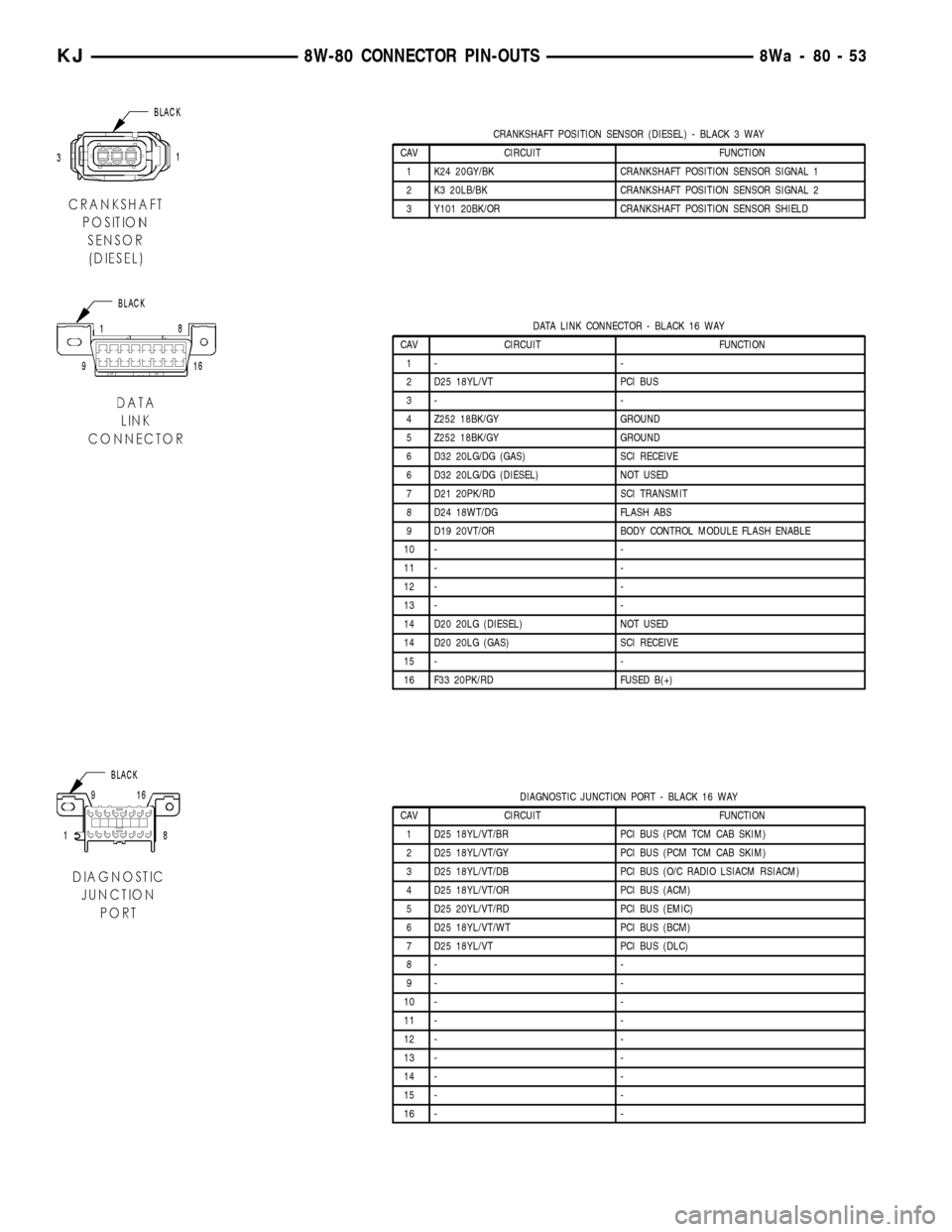
CRANKSHAFT POSITION SENSOR (DIESEL) - BLACK 3 WAY
CAV CIRCUIT FUNCTION
1 K24 20GY/BK CRANKSHAFT POSITION SENSOR SIGNAL 1
2 K3 20LB/BK CRANKSHAFT POSITION SENSOR SIGNAL 2
3 Y101 20BK/OR CRANKSHAFT POSITION SENSOR SHIELD
DATA LINK CONNECTOR - BLACK 16 WAY
CAV CIRCUIT FUNCTION
1- -
2 D25 18YL/VT PCI BUS
3- -
4 Z252 18BK/GY GROUND
5 Z252 18BK/GY GROUND
6 D32 20LG/DG (GAS) SCI RECEIVE
6 D32 20LG/DG (DIESEL) NOT USED
7 D21 20PK/RD SCI TRANSMIT
8 D24 18WT/DG FLASH ABS
9 D19 20VT/OR BODY CONTROL MODULE FLASH ENABLE
10 - -
11 - -
12 - -
13 - -
14 D20 20LG (DIESEL) NOT USED
14 D20 20LG (GAS) SCI RECEIVE
15 - -
16 F33 20PK/RD FUSED B(+)
DIAGNOSTIC JUNCTION PORT - BLACK 16 WAY
CAV CIRCUIT FUNCTION
1 D25 18YL/VT/BR PCI BUS (PCM TCM CAB SKIM)
2 D25 18YL/VT/GY PCI BUS (PCM TCM CAB SKIM)
3 D25 18YL/VT/DB PCI BUS (O/C RADIO LSIACM RSIACM)
4 D25 18YL/VT/OR PCI BUS (ACM)
5 D25 20YL/VT/RD PCI BUS (EMIC)
6 D25 18YL/VT/WT PCI BUS (BCM)
7 D25 18YL/VT PCI BUS (DLC)
8- -
9- -
10 - -
11 - -
12 - -
13 - -
14 - -
15 - -
16 - -
KJ8W-80 CONNECTOR PIN-OUTS8Wa-80-53
Page 1139 of 1803
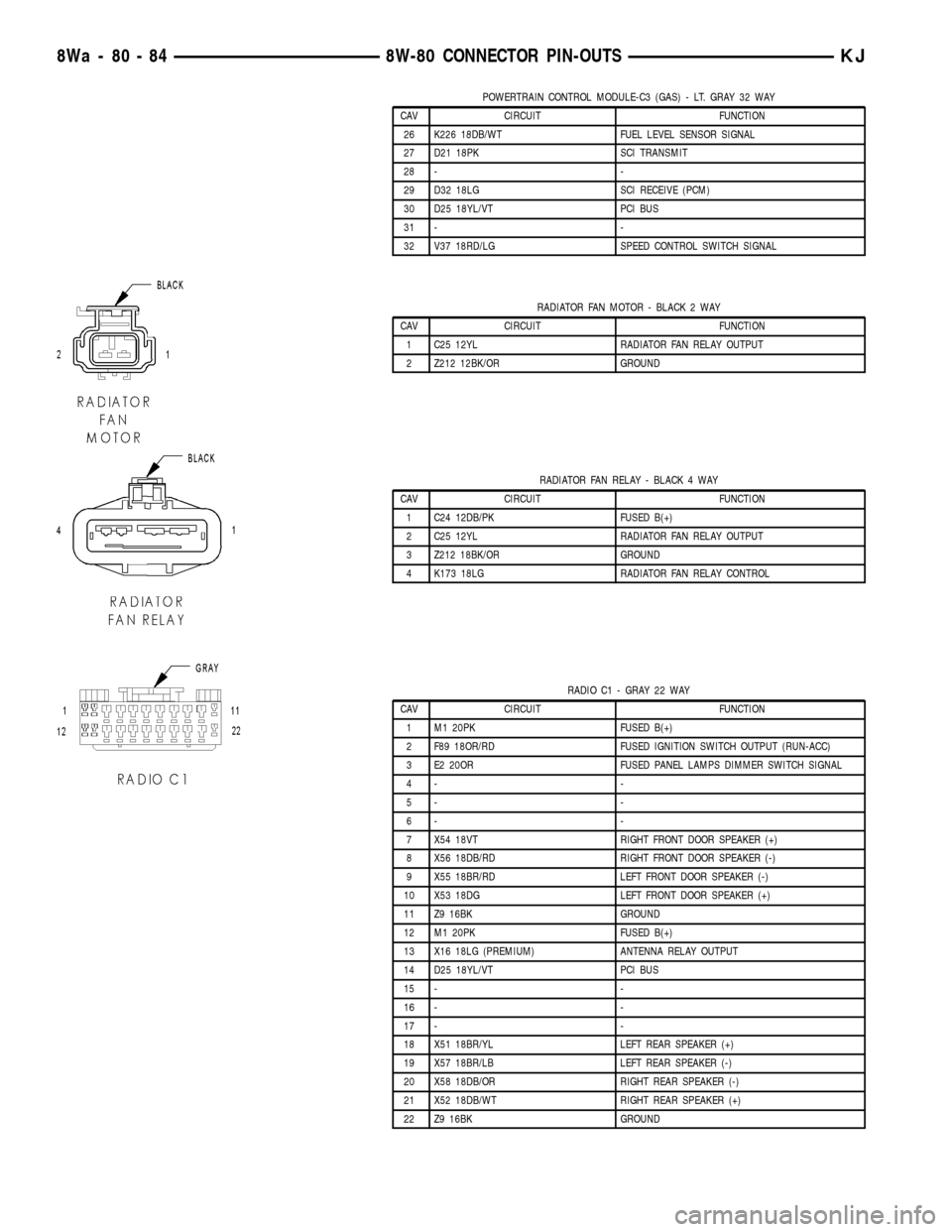
POWERTRAIN CONTROL MODULE-C3 (GAS) - LT. GRAY 32 WAY
CAV CIRCUIT FUNCTION
26 K226 18DB/WT FUEL LEVEL SENSOR SIGNAL
27 D21 18PK SCI TRANSMIT
28 - -
29 D32 18LG SCI RECEIVE (PCM)
30 D25 18YL/VT PCI BUS
31 - -
32 V37 18RD/LG SPEED CONTROL SWITCH SIGNAL
RADIATOR FAN MOTOR - BLACK 2 WAY
CAV CIRCUIT FUNCTION
1 C25 12YL RADIATOR FAN RELAY OUTPUT
2 Z212 12BK/OR GROUND
RADIATOR FAN RELAY - BLACK 4 WAY
CAV CIRCUIT FUNCTION
1 C24 12DB/PK FUSED B(+)
2 C25 12YL RADIATOR FAN RELAY OUTPUT
3 Z212 18BK/OR GROUND
4 K173 18LG RADIATOR FAN RELAY CONTROL
RADIO C1 - GRAY 22 WAY
CAV CIRCUIT FUNCTION
1 M1 20PK FUSED B(+)
2 F89 18OR/RD FUSED IGNITION SWITCH OUTPUT (RUN-ACC)
3 E2 20OR FUSED PANEL LAMPS DIMMER SWITCH SIGNAL
4- -
5- -
6- -
7 X54 18VT RIGHT FRONT DOOR SPEAKER (+)
8 X56 18DB/RD RIGHT FRONT DOOR SPEAKER (-)
9 X55 18BR/RD LEFT FRONT DOOR SPEAKER (-)
10 X53 18DG LEFT FRONT DOOR SPEAKER (+)
11 Z9 16BK GROUND
12 M1 20PK FUSED B(+)
13 X16 18LG (PREMIUM) ANTENNA RELAY OUTPUT
14 D25 18YL/VT PCI BUS
15 - -
16 - -
17 - -
18 X51 18BR/YL LEFT REAR SPEAKER (+)
19 X57 18BR/LB LEFT REAR SPEAKER (-)
20 X58 18DB/OR RIGHT REAR SPEAKER (-)
21 X52 18DB/WT RIGHT REAR SPEAKER (+)
22 Z9 16BK GROUND
8Wa - 80 - 84 8W-80 CONNECTOR PIN-OUTSKJ
Page 1280 of 1803

OIL PRESSURE SENSOR/
SWITCH
DESCRIPTION
The 3±wire, solid-state engine oil pressure sensor
(sending unit) is located in an engine oil pressure
gallery.
OPERATION
The oil pressure sensor uses three circuits. They
are:
²A 5±volt power supply from the Powertrain Con-
trol Module (PCM)
²A sensor ground through the PCM's sensor
return
²A signal to the PCM relating to engine oil pres-
sure
The oil pressure sensor has a 3±wire electrical
function very much like the Manifold Absolute Pres-
sure (MAP) sensor. Meaning different pressures
relate to different output voltages.
A 5±volt supply is sent to the sensor from the PCM
to power up the sensor. The sensor returns a voltage
signal back to the PCM relating to engine oil pres-
sure. This signal is then transferred (bussed) to the
instrument panel on either a CCD or PCI bus circuit
(depending on vehicle line) to operate the oil pressure
gauge and the check gauges lamp. Ground for the
sensor is provided by the PCM through a low-noise
sensor return.
REMOVAL
(1) Disconnect the negative cable from the battery.
(2) Raise vehicle on hoist.
(3) Remove front splash shield.
(4) Disconnect oil pressure sender wire (Fig. 78).
(5) Remove the pressure sender (Fig. 78).
INSTALLATION
(1) Install oil pressure sender.
(2) Connect oil pressure sender wire.
(3) Install front splash shield.
(4) Lower vehicle.
(5) Connect the negative battery cable.
OIL PUMP
REMOVAL
(1) Remove the oil pan and pick-up tube (Refer to
9 - ENGINE/LUBRICATION/OIL PAN - REMOVAL).
(2) Remove the timing chain cover (Refer to 9 -
ENGINE/VALVE TIMING/TIMING BELT / CHAIN
COVER(S) - REMOVAL).
(3) Remove the timing chains and tensioners
(Refer to 9 - ENGINE/VALVE TIMING/TIMING
BELT/CHAIN AND SPROCKETS - REMOVAL).
(4) Remove the four bolts, primary timing chain
tensioner and the oil pump.
DISASSEMBLY
(1) Remove oil pump cover screws and lift off cover
plate.
(2) Remove pump inner and outer rotors.
NOTE: Once the oil pressure relief valve, cup plug,
and pin are removed, the pump assembly must be
replaced.
(3) If it is necessary to remove the pressure relief
valve, drive the roll pin from pump housing and
remove cup plug, spring and valve.
Fig. 78 Oil Pressure Sending Unit
1 - BELT
2 - OIL PRESSURE SENSOR
3 - OIL FILTER
4 - ELEC. CONNECTOR
KJENGINE - 3.7L 9 - 65
Page 1345 of 1803

(3) Screw oil filter on until the gasket contacts
base. Tighten to 21 N´m (15 ft. lbs.).
OIL PAN
REMOVAL
(1) Remove air cleaner assembly.
(2) Raise vehicle on hoist and drain engine oil.
(3) Loosen the engine mount thru bolts.
(4) Disconnect exhaust pipe at manifold.
(5) Remove structural collar, if equipped.
(6) Remove front axle mounting bolts, and lower
axle as far possible, if equipped.
(7) Using suitable jack, raise engine as needed.
(8) Remove oil pan attaching bolts.
(9) Remove oil pan.
(10) Clean oil pan and all gasket surfaces.
INSTALLATION
(1) Install the oil pan gasket to the block.
(2) Apply a 3MM (1/8 inch) bead of MopartEngine
RTV at the oil pump to engine block parting line
(Fig. 80).
(3) Install pan and tighten the screws to 12 N´m
(105 in. lbs.).
(4) Lower engine, and remove jack.
(5) Tighten engine mount thru bolts.
(6) Raise the front axle into position, and reinstall
front axle mounting bolts. If equipped.
(7) Reconnect exhaust pipe to manifold.
(8) Install structural collar, if equipped.
(9) Lower vehicle.(10) Fill engine crankcase with proper oil to cor-
rect level.
(11) Reinstall air cleaner assembly.
OIL PRESSURE SENSOR/
SWITCH
DESCRIPTION
The 3±wire, electrical/mechanical engine oil pres-
sure sensor (sending unit) is located in an engine oil
pressure gallery.
OPERATION
The oil pressure sensor uses three circuits. They
are:
²A 5±volt power supply from the Powertrain Con-
trol Module (PCM)
²A sensor ground through the PCM's sensor
return
²A signal to the PCM relating to engine oil pres-
sure
The oil pressure sensor has a 3±wire electrical
function very much like the Manifold Absolute Pres-
sure (MAP) sensor. Meaning different pressures
relate to different output voltages.
A 5±volt supply is sent to the sensor from the PCM
to power up the sensor. The sensor returns a voltage
signal back to the PCM relating to engine oil pres-
sure. This signal is then transferred (bussed) to the
Fig. 79 2.4 OIL FILTERFig. 80 OIL PAN GASKET INSTALLATION
1 - SEALER LOCATION
9s - 48 ENGINEKJ
OIL FILTER (Continued)
Page 1346 of 1803

instrument panel on either a CCD or PCI bus circuit
(depending on vehicle line) to operate the oil pressure
gauge and the check gauges lamp. Ground for the
sensor is provided by the PCM through a low-noise
sensor return.
OIL PUMP
REMOVAL
(1) Disconnect negative cable from battery.
(2) Remove timing belt. (Refer to 9 - ENGINE/
VALVE TIMING/TIMING BELT/CHAIN AND
SPROCKETS - REMOVAL)
(3) Remove timing belt rear cover. (Refer to 9 -
ENGINE/VALVE TIMING/TIMING BELT / CHAIN
COVER(S) - REMOVAL)
(4) Remove oil pan. (Refer to 9 - ENGINE/LUBRI-
CATION/OIL PAN - REMOVAL)
(5) Remove crankshaft sprocket using Special
Tools 6793 and C-4685-C2 (Fig. 81).
(6) Remove crankshaft key (Fig. 82).
(7) Remove oil pick-up tube.
(8) Remove oil pump (Fig. 83) and front crankshaft
seal.
DISASSEMBLY
(1) To remove the relief valve, proceed as follows:
(a) Remove the threaded plug and gasket from
the oil pump.
(b) Remove spring and relief valve.
(2) Remove oil pump cover fasteners, and lift off
cover.
(3) Remove pump rotors.
(4) Wash all parts in a suitable solvent and
inspect carefully for damage or wear.
CLEANING
(1) Clean all parts thoroughly in a suitable sol-
vent.
Fig. 81 Crankshaft Sprocket - Removal
1 - SPECIAL TOOL 6793
2 - SPECIAL TOOL C-4685±C2
3 - CRANKSHAFT SPROCKET
Fig. 82 Crankshaft Key
1 - CRANKSHAFT KEY
Fig. 83 2.4L OIL PUMP
1 - BOLTS
2 - BOLTS
KJENGINE9s-49
OIL PRESSURE SENSOR/SWITCH (Continued)
Page 1386 of 1803

(8) Pressure should not fall below30 psi for five
minutes.
(9) If pressure falls below 30 psi, it must be deter-
mined if a fuel injector, the check valve within the
fuel pump module, or a fuel tube/line is leaking.
(10) Again, start engine and bring to normal oper-
ating temperature.
(11) Shut engine off.
(12)Testing for fuel injector or fuel rail leak-
age:Clamp off the rubber hose portion of Adaptor
Tool between the fuel rail and the test port ªTº on
Adapter Tool. If pressure now holds at or above 30
psi, a fuel injector or the fuel rail is leaking.
(13)Testing for fuel pump check valve, filter,
regulator check valve or fuel tube/line leakage:
Clamp off the rubber hose portion of Adaptor Tool
between the vehicle fuel line and test port ªTº on
Adapter Tool. If pressure now holds at or above 30
psi, a leak may be found at a fuel tube/line. If no
leaks are found at fuel tubes or lines, one of the
check valves in either the electric fuel pump, fuel fil-
ter or fuel pressure regulator may be leaking.
Note: A quick loss of pressure usually indicates a
defective check valve in the pressure regulator. A
slow loss of pressure usually indicates a defective
check valve in the bottom of the fuel pump module.
The check valves are not serviced separately. Also,
the electric fuel pump is not serviced separately.
STANDARD PROCEDURE - FUEL SYSTEM
PRESSURE RELEASE
Use following procedure if the fuel injector
rail is, or is not equipped with a fuel pressure
test port.
(1) Remove fuel fill cap.
(2) Remove fuel pump relay from Power Distribu-
tion Center (PDC). For location of relay, refer to label
on underside of PDC cover.(3) Start and run engine until it stalls.
(4) Attempt restarting engine until it will no
longer run.
(5) Turn ignition key to OFF position.
CAUTION: Steps 1, 2, 3 and 4 must be performed to
relieve high pressure fuel from within fuel rail. Do
not attempt to use following steps to relieve this
pressure as excessive fuel will be forced into a cyl-
inder chamber.
(6) Unplug connector from any fuel injector.
(7) Attach one end of a jumper wire with alligator
clips (18 gauge or smaller) to either injector terminal.
(8) Connect other end of jumper wire to positive
side of battery.
(9) Connect one end of a second jumper wire to
remaining injector terminal.
CAUTION: Powering an injector for more than a few
seconds will permanently damage the injector.
(10) Momentarily touch other end of jumper wire
to negative terminal of battery for no more than a
few seconds.
(11) Place a rag or towel below fuel line quick-con-
nect fitting at fuel rail.
(12) Disconnect quick-connect fitting at fuel rail.
Refer to Quick-Connect Fittings.
(13) Return fuel pump relay to PDC.
(14) One or more Diagnostic Trouble Codes (DTC's)
may have been stored in PCM memory due to fuel
pump relay removal. The DRBtscan tool must be
used to erase a DTC.
14 - 4 FUEL DELIVERYKJ
FUEL DELIVERY (Continued)
Page 1387 of 1803
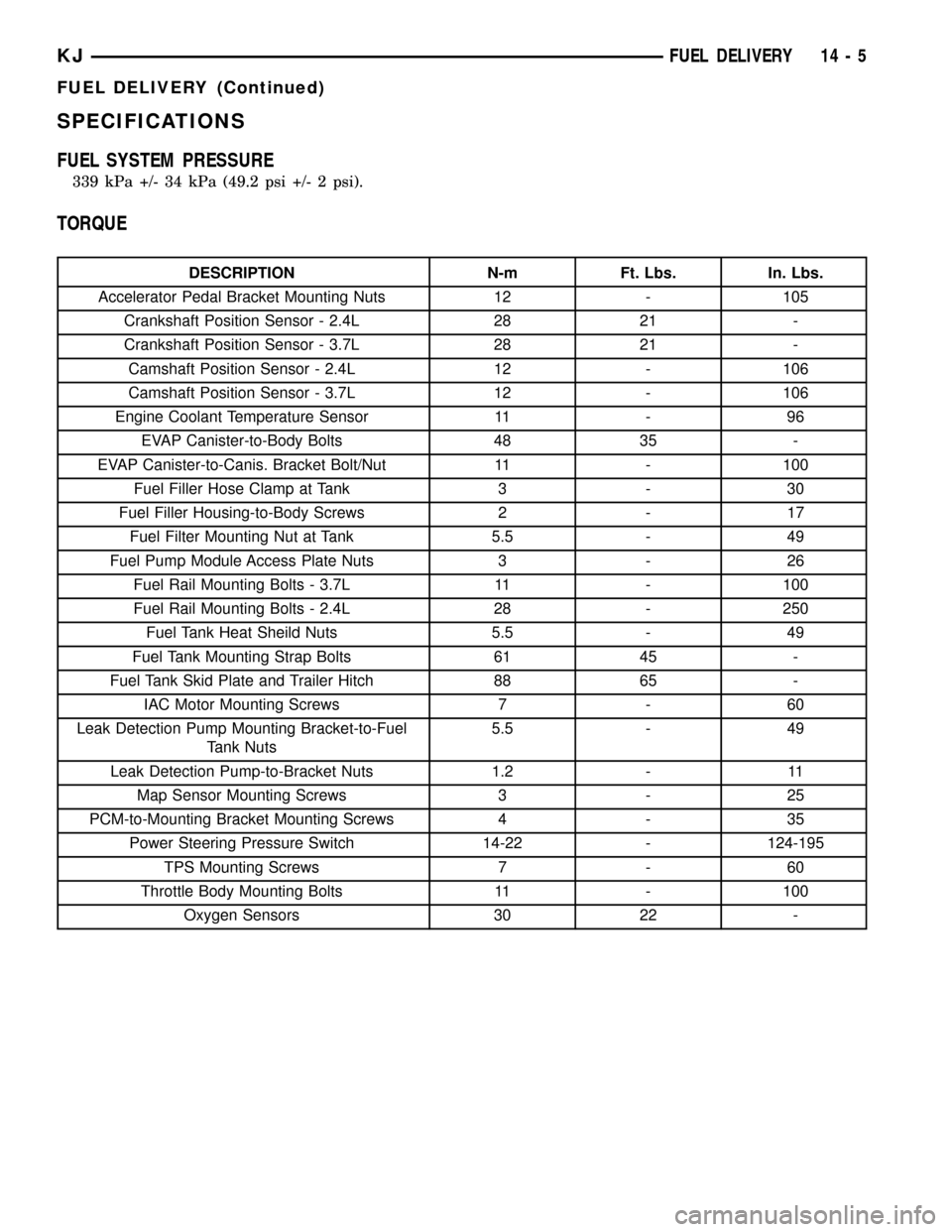
SPECIFICATIONS
FUEL SYSTEM PRESSURE
339 kPa +/- 34 kPa (49.2 psi +/- 2 psi).
TORQUE
DESCRIPTION N-m Ft. Lbs. In. Lbs.
Accelerator Pedal Bracket Mounting Nuts 12 - 105
Crankshaft Position Sensor - 2.4L 28 21 -
Crankshaft Position Sensor - 3.7L 28 21 -
Camshaft Position Sensor - 2.4L 12 - 106
Camshaft Position Sensor - 3.7L 12 - 106
Engine Coolant Temperature Sensor 11 - 96
EVAP Canister-to-Body Bolts 48 35 -
EVAP Canister-to-Canis. Bracket Bolt/Nut 11 - 100
Fuel Filler Hose Clamp at Tank 3 - 30
Fuel Filler Housing-to-Body Screws 2 - 17
Fuel Filter Mounting Nut at Tank 5.5 - 49
Fuel Pump Module Access Plate Nuts 3 - 26
Fuel Rail Mounting Bolts - 3.7L 11 - 100
Fuel Rail Mounting Bolts - 2.4L 28 - 250
Fuel Tank Heat Sheild Nuts 5.5 - 49
Fuel Tank Mounting Strap Bolts 61 45 -
Fuel Tank Skid Plate and Trailer Hitch 88 65 -
IAC Motor Mounting Screws 7 - 60
Leak Detection Pump Mounting Bracket-to-Fuel
Tank Nuts5.5 - 49
Leak Detection Pump-to-Bracket Nuts 1.2 - 11
Map Sensor Mounting Screws 3 - 25
PCM-to-Mounting Bracket Mounting Screws 4 - 35
Power Steering Pressure Switch 14-22 - 124-195
TPS Mounting Screws 7 - 60
Throttle Body Mounting Bolts 11 - 100
Oxygen Sensors 30 22 -
KJFUEL DELIVERY 14 - 5
FUEL DELIVERY (Continued)