Transmission JEEP LIBERTY 2002 KJ / 1.G Manual Online
[x] Cancel search | Manufacturer: JEEP, Model Year: 2002, Model line: LIBERTY, Model: JEEP LIBERTY 2002 KJ / 1.GPages: 1803, PDF Size: 62.3 MB
Page 477 of 1803

OPERATION
The controller board and logic circuitry of the
headlamp leveling motor will energize the motor and
extend or retract the motor pushrod through the
integral screw-drive transmission based upon the
voltage signal input received from the resistor multi-
plexed headlamp leveling switch. The ball formation
on the end of the headlamp leveling motor pushrod is
snapped into a socket formation on the back of the
movable reflector within the headlamp unit housing.
The headlamp leveling motors and switch have a
path to ground at all times. The headlamp leveling
components operate on battery current received
through the fused park lamp relay output circuit so
that the system will only operate when the exterior
lighting is turned On.
Because of active electronic elements within the
headlamp leveling motor, it cannot be tested with
conventional automotive electrical test equipment. If
the headlamp leveling motor is believed to be faulty,
replace the motor with a known good unit to confirm
system operation.
REMOVAL
The headlamp leveling motors are integral to the
headlamp units on vehicles manufactured for certain
markets where headlamp leveling is required.
(1) Disconnect and isolate the battery negative
cable.
(2) Remove the headlamp bulb from the headlamp
unit housing. (Refer to 8 - ELECTRICAL/LAMPS/
LIGHTING - EXTERIOR/HEADLAMP BULB -
REMOVAL).
(3) Rotate the headlamp leveling motor on the
back of the headlamp unit housing counterclockwise
about 30 degrees (Fig. 32).
(4) Firmly grasp the motor with one hand while
stabilizing the headlamp unit housing with the other
hand.
(5) Firmly, steadily, and forcefully pull the head-
lamp leveling motor straight away from the back of
the headlamp unit housing to unsnap the ball forma-
tion on the end of the motor pushrod from the socket
on the headlamp unit reflector (Fig. 33).
(6) Remove the headlamp leveling motor and push-
rod from the back of the headlamp unit housing.
INSTALLATION
The headlamp leveling motors are integral to the
headlamp units on vehicles manufactured for certain
markets where headlamp leveling is required.
(1) Position the headlamp leveling motor and
pushrod from to the mounting hole on the back of the
headlamp unit housing.
(2) Insert two fingers through the bulb mounting
hole in the center of the headlamp reflector and pullthe reflector upwards toward the headlamp leveling
motor.
(3) Align the ball formation on the end of the lev-
eling motor pushrod with the socket on the headlamp
unit reflector (Fig. 33).
(4) While continuing to pulling the reflector
toward the motor, firmly, steadily, and forcefully push
the headlamp leveling motor straight into the back of
the headlamp unit housing to snap the ball formation
on the end of the motor pushrod into the socket on
the headlamp unit reflector.
(5) After the pushrod is engaged to the reflector,
remove your fingers from the bulb mounting hole in
Fig. 32 Headlamp Leveling Motor Remove/Install
1 - LEVELING MOTOR
2 - HEADLAMP HOUSING
3 - PUSHROD
Fig. 33 Leveling Motor Pushrod - Typical
1 - REFLECTOR PUSHROD SOCKET
2 - PUSHROD
3 - LEVELING MOTOR
4 - HEADLAMP HOUSING
8L - 36 LAMPS/LIGHTING - EXTERIORKJ
HEADLAMP LEVELING MOTOR (Continued)
Page 506 of 1803

LAMPS/LIGHTING - INTERIOR
TABLE OF CONTENTS
page page
LAMPS/LIGHTING - INTERIOR
DESCRIPTION.........................65
OPERATION...........................67
DIAGNOSIS AND TESTING - LAMPS/
LIGHTING - INTERIOR..................68
SPECIFICATIONS - LAMPS/LIGHTING -
INTERIOR...........................71
ASH RECEIVER LAMP BULB
REMOVAL.............................71
INSTALLATION.........................71
ASH RECEIVER LAMP UNIT
REMOVAL.............................72
INSTALLATION.........................72
CARGO LAMP BULB
REMOVAL.............................72
INSTALLATION.........................73
CARGO LAMP SWITCH
REMOVAL.............................73
INSTALLATION.........................74
CARGO LAMP UNIT
REMOVAL.............................74
INSTALLATION.........................74
COMPASS MINI-TRIP ILLUMINATION BULB
REMOVAL.............................74
INSTALLATION.........................75
COURTESY LAMP BULB
REMOVAL.............................75
INSTALLATION.........................76
COURTESY LAMP UNIT
REMOVAL.............................76INSTALLATION.........................77
DOOR AJAR SWITCH
DESCRIPTION.........................77
OPERATION...........................77
FLIP-UP GLASS AJAR SWITCH
DESCRIPTION.........................77
OPERATION...........................77
HEATER-A/C CONTROL ILLUMINATION BULB
REMOVAL.............................78
INSTALLATION.........................78
READING LAMP BULB
REMOVAL.............................79
INSTALLATION.........................79
READING LAMP SWITCH
REMOVAL.............................80
INSTALLATION.........................80
READING LAMP UNIT
REMOVAL.............................81
INSTALLATION.........................81
TAILGATE AJAR SWITCH
DESCRIPTION.........................82
OPERATION...........................82
TRANSMISSION RANGE INDICATOR
ILLUMINATION BULB
REMOVAL.............................82
INSTALLATION.........................83
VANITY LAMP BULB
REMOVAL.............................83
INSTALLATION.........................84
LAMPS/LIGHTING - INTERIOR
DESCRIPTION
The interior lighting system (Fig. 1) for this model
includes the following incandescent interior lamps:
²Ash Receiver Lamp- An available ash receiver
lamp is located above the ash receiver housing
behind the instrument panel center bezel, and is con-
trolled by the panel lamps dimmer circuit.
²Cargo Lamp- An available cargo lamp with an
integral lens-actuated courtesy disable switch is
located in the headliner near the rear roof header,
and is controlled by the courtesy lamp circuit.
²Courtesy Lamps- Available courtesy lamps are
located below both the right and left side of the
instrument panel, and are controlled by the courtesy
lamp circuit.²Compass Mini-Trip Control Illumination
Lamps- The optional Compass Mini-Trip Computer
(CMTC) has three replaceable control illumination
bulb/bulb holder units on its circuit board that are
controlled by the panel lamps dimmer circuit.
²Dome Lamp- A standard front dome lamp that
does not include an on-off switch is located in the
headliner near the windshield header, and is con-
trolled by the courtesy lamp circuit.
²Hazard Switch Illumination/Indicator
Lamp- The hazard switch control button has a non-
replaceable illumination/indicator bulb soldered onto
its circuit board that is controlled by both the hazard
switch circuitry and the panel lamps dimmer circuit.
(Refer to 8 - ELECTRICAL/LAMPS/LIGHTING -
EXTERIOR/HAZARD SWITCH - DESCRIPTION).
²Heater-Air Conditioner Control Illumina-
tion Lamps- The heater-air conditioner control has
KJLAMPS/LIGHTING - INTERIOR 8L - 65
Page 507 of 1803

two replaceable control illumination bulb/bulb holder
units on its circuit board that are controlled by the
panel lamps dimmer circuit.
²Instrument Cluster Illumination Lamps-
The ElectroMechanical Instrument Cluster (EMIC)
has nine replaceable general illumination bulb/bulb
holder units on its circuit board that are controlled
by the panel lamps dimmer circuit. (Refer to 8 -ELECTRICAL/INSTRUMENT CLUSTER -
DESCRIPTION).
²Reading Lamps- Available front seat driver
side and passenger side reading lamps located in the
headliner near the windshield header are controlled
by both the courtesy lamp circuit and independent
lens-actuated switches.
²Transmission Range Indicator Illumination
Lamp- Vehicles equipped with an automatic trans-
Fig. 1 Courtesy Lamps
1 - COURTESY LAMP (2)
2 - DOME OR READING LAMP3 - VANITY LAMP (2)
4 - CARGO LAMP
8L - 66 LAMPS/LIGHTING - INTERIORKJ
LAMPS/LIGHTING - INTERIOR (Continued)
Page 508 of 1803

mission have an illuminated transmission range indi-
cator integral to the console mounted gearshift
mechanism, and controlled by the panel lamps dim-
mer circuit.
²Vanity Lamps- Available single intensity van-
ity lamps are located on each side of a covered mirror
on both the right and left sun visors, and are con-
trolled by an integral vanity mirror cover-actuated
switch on the courtesy lamp circuit.
Other components of the interior lighting system
for this model include:
²Body Control Module- The Body Control
Module (BCM) is located on the Junction Block (JB)
under the driver side outboard end of the instrument
panel. (Refer to 8 - ELECTRICAL/ELECTRONIC
CONTROL MODULES/BODY CONTROL MODULE
- DESCRIPTION).
²Door Ajar Switches- A door ajar switch is
integral to the door latch mechanism of each front
and rear door.
²Flip-Up Glass Ajar Switch- A flip-up glass
ajar switch is integral to the flip-up glass latch mech-
anism on the top of the tailgate inner panel.
²Multi-Function Switch- The multi-function
switch is located on the top of the steering column,
just below the steering wheel. The multi-function
switch includes a left (lighting) control stalk and a
right (wiper) control stalk. The left control stalk is
dedicated to providing almost all of the driver con-
trols for both the exterior and interior lighting sys-
tems. (Refer to 8 - ELECTRICAL/LAMPS/LIGHTING
- EXTERIOR/MULTI-FUNCTION SWITCH -
DESCRIPTION).
²Tailgate Ajar Switch- A tailgate ajar switch is
integral to the latch mechanism of the tailgate.
Hard wired circuitry connects the interior lighting
system components to the electrical system of the
vehicle. These hard wired circuits are integral to sev-
eral wire harnesses, which are routed throughout the
vehicle and retained by many different methods.
These circuits may be connected to each other, to the
vehicle electrical system and to the interior lighting
system components through the use of a combination
of soldered splices, splice block connectors, and many
different types of wire harness terminal connectors
and insulators. Refer to the appropriate wiring infor-
mation. The wiring information includes wiring dia-
grams, proper wire and connector repair procedures,
further details on wire harness routing and reten-
tion, as well as pin-out and location views for the
various wire harness connectors, splices and grounds.
OPERATION
The interior lighting systems can be divided into
two general classifications based upon the circuit
that controls their operation: The courtesy lamp cir-cuit, or the panel lamps dimmer circuit. Following
are paragraphs that briefly describe the operation of
each of the major interior lighting systems. The hard
wired circuits and components of the interior lighting
systems may be diagnosed and tested using conven-
tional diagnostic tools and procedures. However, con-
ventional diagnostic methods may not prove
conclusive in the diagnosis of the Body Control Mod-
ule (BCM), the ElectroMechanical Instrument Clus-
ter (EMIC), or the Programmable Communications
Interface (PCI) data bus network. The most reliable,
efficient, and accurate means to diagnose the BCM,
the EMIC, and the PCI data bus network inputs and
outputs related to the various interior lighting sys-
tems requires the use of a DRBIIItscan tool. Refer
to the appropriate diagnostic information.
COURTESY LAMP CIRCUIT Depending upon the
selected vehicle options the courtesy lamp circuit
may include the courtesy lamps located below the
instrument panel, the dome or map/reading lamps
located in the headliner near the windshield, the
cargo lamp located in the headliner near the rear
roof header, and the vanity lamps located in the sun
visors. The lamps in the courtesy lamp circuit are
provided with battery current at all times from a
fused B(+) fuse in the Junction Block (JB) through a
fused B(+) circuit. The Body Control Module (BCM)
controls the ground path for these lamps using an
internal driver through the courtesy lamp driver cir-
cuit based upon hard wired inputs from the door ajar
switches, the flip-up glass ajar switch, and the tail-
gate ajar switch. After all of the ajar switch inputs to
the BCM transition to open, the BCM will keep the
lamps illuminated for about 27 seconds, then fade
the lamps to off (theater dimming) over about three
seconds.
The BCM also provides courtesy lamp operation
based upon a resistor multiplexed input from the
interior lighting control ring on the left (lighting)
control stalk of the multi-function switch through the
headlamp switch mux circuit, and in response to cer-
tain inputs from the optional Remote Keyless Entry
(RKE) system. A resistor multiplexed courtesy lamp
defeat input from the control ring on the left (light-
ing) control stalk of the multi-function switch will
cause the BCM to override normal courtesy lamp
operation based upon inputs from all of the ajar
switches. A hard wired input from the courtesy lamp
defeat switch in the optional cargo lamp through a
rear courtesy lamp control circuit will cause the BCM
to override normal courtesy lamp operation based
upon inputs from only the flip-up glass and tailgate
ajar switches.
For those lamps on the courtesy lamp circuit with
independent switching, such as the optional reading
lamps and vanity lamps, the BCM provides a ground
KJLAMPS/LIGHTING - INTERIOR 8L - 67
LAMPS/LIGHTING - INTERIOR (Continued)
Page 509 of 1803

path to the switches using another internal driver
through the courtesy lamp load shed circuit. The
BCM provides a battery saver (load shedding) feature
for all courtesy lamps, which will automatically turn
these lamps off if they are left on for more than
about eight minutes with the ignition switch in the
Off position.
PANEL LAMPS DIMMER CIRCUIT The panel
lamps dimmer circuit includes the ElectroMechanical
Instrument Cluster (EMIC), heater-air conditioner
control, hazard switch and, depending upon the
selected vehicle options, ash receiver, and automatic
transmission range indicator illumination lamps. All
lamps in the panel lamps dimmer circuit are pro-
vided a path to ground at all times through a hard
wired ground circuit. These lamps illuminate based
upon inputs to the Body Control Module (BCM) from
the exterior lighting control knob and the interior
lighting control ring on the left (lighting) control
stalk of the multi-function switch. The control knob
on the left control stalk of the multi-function switch
selects the exterior lights, while the control ring
selects the panel lamps intensity (dimming) level.
When the exterior lighting is turned On, the BCM
energizes the park lamp relay and provides an elec-
tronic dimming level message to the ElectroMechani-
cal Instrument Cluster (EMIC), the radio, and the
Compass Mini-Trip Computer (CMTC) over the Pro-
grammable Communications Interface (PCI) data
bus. The energized park lamp relay provides a hard
wired battery current signal input to the EMIC on
the park lamp relay output circuit. The EMIC
responds to these inputs by supplying a 12-volt Pulse
Width Modulated (PWM) output to all of the incan-
descent lamps in the panel lamps dimmer circuit
over the fused panel lamps dimmer switch signal cir-
cuit. This shared PWM output synchronizes the
selected illumination intensity level of all of the
incandescent lamps in the panel lamps dimmer cir-
cuit.
The EMIC and the radio each use the electronic
dimming level message from the BCM to control and
synchronize the illumination intensity of their own
Vacuum Fluorescent Display (VFD), while the CMTC
uses the dimming level message to control the illumi-
nation intensity of both its VFD and its incandescent
lighting. In addition, when the control ring on the
left (lighting) control stalk of the multi-function
switch is moved to the Parade Mode detent position,
all of the VFDs are illuminated at their full intensity
levels for increased visibility when the vehicle is
driven during daylight hours with the exterior lights
turned On.DIAGNOSIS AND TESTING - LAMPS/LIGHTING
- INTERIOR
The hard wired circuits and components of the
interior lighting system may be diagnosed and tested
using conventional diagnostic tools and procedures.
However, conventional diagnostic methods may not
prove conclusive in the diagnosis of the Body Control
Module (BCM), the ElectroMechanical Instrument
Cluster (EMIC), or the Programmable Communica-
tions Interface (PCI) data bus network. The most
reliable, efficient, and accurate means to diagnose
the BCM, the EMIC, and the PCI data bus network
inputs and outputs related to the various interior
lighting systems requires the use of a DRBIIItscan
tool. Refer to the appropriate diagnostic information.
When diagnosing the interior lighting circuits,
remember that high generator output can burn out
bulbs rapidly and repeatedly; and, that dim or flick-
ering bulbs can be caused by low generator output or
poor battery condition. If one of these symptoms is a
problem on the vehicle being diagnosed, be certain to
diagnose and repair the battery and charging system
as required. Also keep in mind that a good ground is
necessary for proper lighting operation. If a lighting
problem is being diagnosed that involves multiple
symptoms, systems, or components the problem can
often be traced to a loose, corroded, or open ground.
For complete circuit diagrams, refer to the appropri-
ate wiring information. The wiring information
includes wiring diagrams, proper wire and connector
repair procedures, details of wire harness routing
and retention, connector pin-out information and
location views for the various wire harness connec-
tors, splices and grounds.
WARNING: ON VEHICLES EQUIPPED WITH AIR-
BAGS, DISABLE THE SUPPLEMENTAL RESTRAINT
SYSTEM BEFORE ATTEMPTING ANY STEERING
WHEEL, STEERING COLUMN, DRIVER AIRBAG,
PASSENGER AIRBAG, SEAT BELT TENSIONER,
FRONT IMPACT SENSORS, SIDE CURTAIN AIRBAG,
OR INSTRUMENT PANEL COMPONENT DIAGNOSIS
OR SERVICE. DISCONNECT AND ISOLATE THE
BATTERY NEGATIVE (GROUND) CABLE, THEN
WAIT TWO MINUTES FOR THE SYSTEM CAPACI-
TOR TO DISCHARGE BEFORE PERFORMING FUR-
THER DIAGNOSIS OR SERVICE. THIS IS THE ONLY
SURE WAY TO DISABLE THE SUPPLEMENTAL
RESTRAINT SYSTEM. FAILURE TO TAKE THE
PROPER PRECAUTIONS COULD RESULT IN ACCI-
DENTAL AIRBAG DEPLOYMENT AND POSSIBLE
PERSONAL INJURY.
8L - 68 LAMPS/LIGHTING - INTERIORKJ
LAMPS/LIGHTING - INTERIOR (Continued)
Page 512 of 1803
SPECIFICATIONS - LAMPS/LIGHTING -
INTERIOR
BULB SPECIFICATIONS
LAMP BULB
Ash Receiver 161
Cargo 214-2
Cluster Illumination 103
Compass Mini-Trip
IlluminationMOPAR 4437661
Courtesy 906
Heater-A/C Control
Illumination74
Map/Reading 192
Transmission Range
Indicator IlluminationS14V
Vanity Mirror MOPAR 6501966
ASH RECEIVER LAMP BULB
REMOVAL
WARNING: ON VEHICLES EQUIPPED WITH AIR-
BAGS, DISABLE THE SUPPLEMENTAL RESTRAINT
SYSTEM BEFORE ATTEMPTING ANY STEERING
WHEEL, STEERING COLUMN, DRIVER AIRBAG,
PASSENGER AIRBAG, SEAT BELT TENSIONER,
FRONT IMPACT SENSORS, SIDE CURTAIN AIRBAG,
OR INSTRUMENT PANEL COMPONENT DIAGNOSIS
OR SERVICE. DISCONNECT AND ISOLATE THE
BATTERY NEGATIVE (GROUND) CABLE, THEN
WAIT TWO MINUTES FOR THE SYSTEM CAPACI-
TOR TO DISCHARGE BEFORE PERFORMING FUR-
THER DIAGNOSIS OR SERVICE. THIS IS THE ONLY
SURE WAY TO DISABLE THE SUPPLEMENTAL
RESTRAINT SYSTEM. FAILURE TO TAKE THE
PROPER PRECAUTIONS COULD RESULT IN ACCI-
DENTAL AIRBAG DEPLOYMENT AND POSSIBLE
PERSONAL INJURY.
(1) Disconnect and isolate the battery negative
cable.
(2) Remove the ash receiver lamp unit from the
top of the ash receiver housing. (Refer to 8 - ELEC-
TRICAL/LAMPS/LIGHTING - INTERIOR/ASH
RECEIVER LAMP UNIT - REMOVAL).
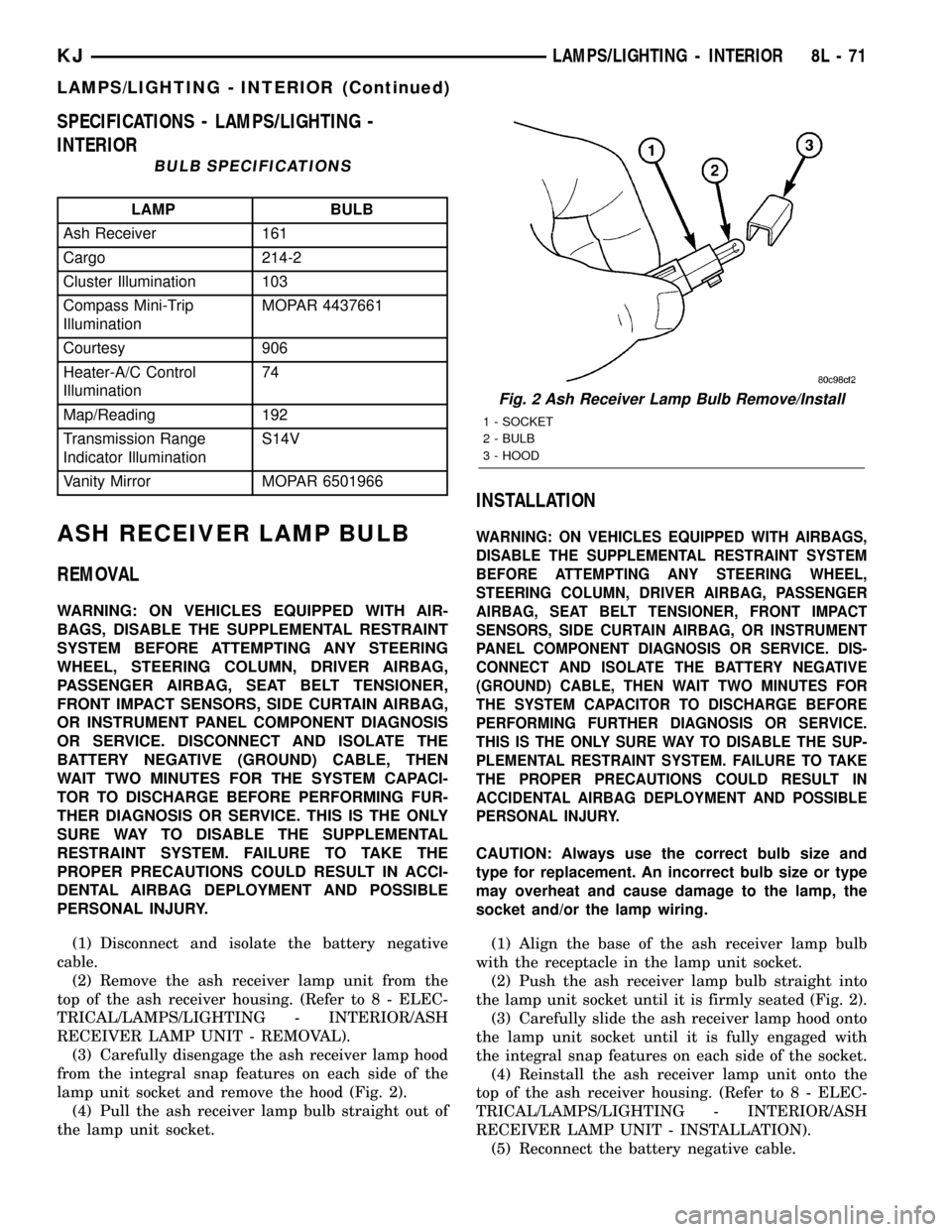
(3) Carefully disengage the ash receiver lamp hood
from the integral snap features on each side of the
lamp unit socket and remove the hood (Fig. 2).
(4) Pull the ash receiver lamp bulb straight out of
the lamp unit socket.
INSTALLATION
WARNING: ON VEHICLES EQUIPPED WITH AIRBAGS,
DISABLE THE SUPPLEMENTAL RESTRAINT SYSTEM
BEFORE ATTEMPTING ANY STEERING WHEEL,
STEERING COLUMN, DRIVER AIRBAG, PASSENGER
AIRBAG, SEAT BELT TENSIONER, FRONT IMPACT
SENSORS, SIDE CURTAIN AIRBAG, OR INSTRUMENT
PANEL COMPONENT DIAGNOSIS OR SERVICE. DIS-
CONNECT AND ISOLATE THE BATTERY NEGATIVE
(GROUND) CABLE, THEN WAIT TWO MINUTES FOR
THE SYSTEM CAPACITOR TO DISCHARGE BEFORE
PERFORMING FURTHER DIAGNOSIS OR SERVICE.
THIS IS THE ONLY SURE WAY TO DISABLE THE SUP-
PLEMENTAL RESTRAINT SYSTEM. FAILURE TO TAKE
THE PROPER PRECAUTIONS COULD RESULT IN
ACCIDENTAL AIRBAG DEPLOYMENT AND POSSIBLE
PERSONAL INJURY.
CAUTION: Always use the correct bulb size and
type for replacement. An incorrect bulb size or type
may overheat and cause damage to the lamp, the
socket and/or the lamp wiring.
(1) Align the base of the ash receiver lamp bulb
with the receptacle in the lamp unit socket.
(2) Push the ash receiver lamp bulb straight into
the lamp unit socket until it is firmly seated (Fig. 2).
(3) Carefully slide the ash receiver lamp hood onto
the lamp unit socket until it is fully engaged with
the integral snap features on each side of the socket.
(4) Reinstall the ash receiver lamp unit onto the
top of the ash receiver housing. (Refer to 8 - ELEC-
TRICAL/LAMPS/LIGHTING - INTERIOR/ASH
RECEIVER LAMP UNIT - INSTALLATION).
(5) Reconnect the battery negative cable.
Fig. 2 Ash Receiver Lamp Bulb Remove/Install
1 - SOCKET
2 - BULB
3 - HOOD
KJLAMPS/LIGHTING - INTERIOR 8L - 71
LAMPS/LIGHTING - INTERIOR (Continued)
Page 523 of 1803

TAILGATE AJAR SWITCH
DESCRIPTION
A tailgate ajar switch is standard equipment in
this vehicle. This switch is concealed within and inte-
gral to the tailgate latch unit. The switch is a
momentary leaf contact-type unit that is actuated by
the tailgate latch mechanism. A pigtail wire harness
and connector on the tailgate latch unit connects the
tailgate ajar switch to the vehicle electrical system
through the tailgate wire harness. The tailgate ajar
switch cannot be adjusted or repaired and, if faulty
or damaged, the tailgate latch unit must be replaced.
(Refer to 23 - BODY/SWING GATE/LATCH -
REMOVAL).
OPERATION
The tailgate switch is actuated by the tailgate
latch mechanism. When the tailgate is closed and
properly latched, the tailgate ajar switch is an open
circuit. When the tailgate is open or only partially
latched, the tailgate ajar switch is a closed circuit.
The tailgate ajar switch is hard wired between a
body ground and the Body Control Module (BCM).
The output of the switch is connected to the BCM
through a tailgate ajar switch sense circuit. The
BCM reads the tailgate ajar switch status through
an internal pull-up, then uses this input to control
many electronic functions and features of the vehicle.
The tailgate ajar switch can be diagnosed using con-
ventional diagnostic tools and methods; however, for
proper diagnosis of the BCM, and both the hard
wired and electronic BCM outputs affected by the
tailgate ajar switch input, a DRBIIItscan tool is
required. Refer to the appropriate diagnostic infor-
mation.
TRANSMISSION RANGE
INDICATOR ILLUMINATION
BULB
REMOVAL
WARNING: ON VEHICLES EQUIPPED WITH AIR-
BAGS, DISABLE THE SUPPLEMENTAL RESTRAINT
SYSTEM BEFORE ATTEMPTING ANY STEERING
WHEEL, STEERING COLUMN, DRIVER AIRBAG,
PASSENGER AIRBAG, SEAT BELT TENSIONER,
FRONT IMPACT SENSORS, SIDE CURTAIN AIRBAG,
OR INSTRUMENT PANEL COMPONENT DIAGNOSIS
OR SERVICE. DISCONNECT AND ISOLATE THE
BATTERY NEGATIVE (GROUND) CABLE, THEN
WAIT TWO MINUTES FOR THE SYSTEM CAPACI-
TOR TO DISCHARGE BEFORE PERFORMING FUR-
THER DIAGNOSIS OR SERVICE. THIS IS THE ONLY
SURE WAY TO DISABLE THE SUPPLEMENTAL
RESTRAINT SYSTEM. FAILURE TO TAKE THE
PROPER PRECAUTIONS COULD RESULT IN ACCI-
DENTAL AIRBAG DEPLOYMENT AND POSSIBLE
PERSONAL INJURY.
(1) Disconnect and isolate the battery negative
cable.
(2) Remove the center console from the floor panel
transmission tunnel. (Refer to 23 - BODY/INTERI-
OR/FLOOR CONSOLE - REMOVAL).
(3) From the left side of the vehicle, reach between
transmission range indicator and the floor panel
transmission tunnel to grasp the illumination lamp
socket (Fig. 15).
Fig. 15 Transmission Range Indicator Illumination
Bulb Remove/Install
1 - AUTOMATIC TRANSMISSION SHIFT MECHANISM
2 - ILLUMINATION LAMP SOCKET
8L - 82 LAMPS/LIGHTING - INTERIORKJ
Page 524 of 1803

(4) Rotate the transmission range indicator illumi-
nation lamp socket counterclockwise about 30
degrees on the bottom of the range indicator.
(5) Pull the transmission range indicator illumina-
tion lamp socket and bulb unit straight out of the
bulb mounting hole in the bottom of the indicator.
(6) Pull the transmission range indicator illumina-
tion lamp bulb straight out of the socket.
INSTALLATION
WARNING: ON VEHICLES EQUIPPED WITH AIR-
BAGS, DISABLE THE SUPPLEMENTAL RESTRAINT
SYSTEM BEFORE ATTEMPTING ANY STEERING
WHEEL, STEERING COLUMN, DRIVER AIRBAG,
PASSENGER AIRBAG, SEAT BELT TENSIONER,
FRONT IMPACT SENSORS, SIDE CURTAIN AIRBAG,
OR INSTRUMENT PANEL COMPONENT DIAGNOSIS
OR SERVICE. DISCONNECT AND ISOLATE THE
BATTERY NEGATIVE (GROUND) CABLE, THEN
WAIT TWO MINUTES FOR THE SYSTEM CAPACI-
TOR TO DISCHARGE BEFORE PERFORMING FUR-
THER DIAGNOSIS OR SERVICE. THIS IS THE ONLY
SURE WAY TO DISABLE THE SUPPLEMENTAL
RESTRAINT SYSTEM. FAILURE TO TAKE THE
PROPER PRECAUTIONS COULD RESULT IN ACCI-
DENTAL AIRBAG DEPLOYMENT AND POSSIBLE
PERSONAL INJURY.
CAUTION: Always use the correct bulb size and
type for replacement. An incorrect bulb size or type
may overheat and cause damage to the lamp, the
socket and/or the lamp wiring.
(1) Align the base of the transmission range indi-
cator illumination lamp bulb with the receptacle in
the lamp socket.
(2) Push the transmission range indicator illumi-
nation lamp bulb straight into the lamp socket until
it is firmly seated.
(3) Align the transmission range indicator illumi-
nation lamp socket and bulb unit with the mounting
hole on the bottom of the indicator (Fig. 15).
(4) Push the transmission range indicator illumi-
nation lamp socket and bulb unit straight into the
bottom of the indicator until it is firmly seated.
(5) Rotate the transmission range indicator illumi-
nation lamp socket clockwise about 30 degrees on the
bottom of the indicator.
(6) Reinstall the center console onto the floor panel
transmission tunnel. (Refer to 23 - BODY/INTERI-
OR/FLOOR CONSOLE - INSTALLATION).
(7) Reconnect the battery negative cable.
VANITY LAMP BULB
REMOVAL
WARNING: ON VEHICLES EQUIPPED WITH AIR-
BAGS, DISABLE THE SUPPLEMENTAL RESTRAINT
SYSTEM BEFORE ATTEMPTING ANY STEERING
WHEEL, STEERING COLUMN, DRIVER AIRBAG,
PASSENGER AIRBAG, SEAT BELT TENSIONER,
FRONT IMPACT SENSORS, SIDE CURTAIN AIRBAG,
OR INSTRUMENT PANEL COMPONENT DIAGNOSIS
OR SERVICE. DISCONNECT AND ISOLATE THE
BATTERY NEGATIVE (GROUND) CABLE, THEN
WAIT TWO MINUTES FOR THE SYSTEM CAPACI-
TOR TO DISCHARGE BEFORE PERFORMING FUR-
THER DIAGNOSIS OR SERVICE. THIS IS THE ONLY
SURE WAY TO DISABLE THE SUPPLEMENTAL
RESTRAINT SYSTEM. FAILURE TO TAKE THE
PROPER PRECAUTIONS COULD RESULT IN ACCI-
DENTAL AIRBAG DEPLOYMENT AND POSSIBLE
PERSONAL INJURY.
(1) Disconnect and isolate the battery negative
cable.
(2) Using a small thin-bladed tool, gently pry out-
ward on either side near the top or bottom of the
vanity lamp lens until the lens unsnaps from the
lamp unit housing (Fig. 16).
Fig. 16 Vanity Lamp Lens Remove
1 - LENS (2)
2 - MIRROR
3 - SUN VISOR
KJLAMPS/LIGHTING - INTERIOR 8L - 83
TRANSMISSION RANGE INDICATOR ILLUMINATION BULB (Continued)
Page 529 of 1803

mounted to the back of the quarter panel on each
side of the tailgate at the rear of the vehicle. The
park lamps include a license plate lamp or lamps,
depending upon the requirements of the market for
which the vehicle is manufactured. Vehicles with a
license plate tub located near the left end of the rear
bumper fascia have a single lamp, while vehicles
with a license plate module located on the spare tire
carrier have two license plate lamps. In certain mar-
kets where required, a front position lamp that is
integral to each headlamp unit is illuminated instead
of the front park lamps and front side marker lamps
in the park lamps circuit; and, a rectangular, red
reflector is located on the rear bumper fascia just
inboard and below each rear lamp unit.
²Rear Fog Lamps- Rear fog lamps are avail-
able only in certain markets where they are required
equipment. The rear fog lamps are integral to the
rear lamp units mounted to the back of the quarter
panel on each side of the tailgate at the rear of the
vehicle.
²Turn Signal Lamps- The turn signal lamps
include the front turn signal and front side marker
lamps that are integral to the front lamp units
mounted at each end of the bumper fascia at the
front of the vehicle, as well as rear turn signal lamps
that are integral to the rear lamp units mounted to
the back of the quarter panel on each side of the tail-
gate at the rear of the vehicle. In certain markets
where required, a repeater lamp unit mounted to
each front fender just behind the front wheel opening
is illuminated instead of the front side marker lamp
in each turn signal lamp circuit.
Other components of the exterior lighting system
for this model include:
²Combination Flasher- An electronic combina-
tion flasher is integral to the hazard warning switch
in the center of the instrument panel.
²Backup Lamp Switch- Vehicles equipped with
a manual transmission have a plunger-type backup
lamp switch located on the transmission housing. A
Transmission Range Sensor (TRS) integral to the
solenoid pack on the valve body of the optional elec-
tronic automatic transmission performs the backup
lamp switch function on models that are so equipped.
²Brake Lamp Switch- A plunger-type brake
lamp switch is located on the steering column sup-
port bracket under the instrument panel and actu-
ated by the brake pedal arm.²Body Control Module- The Body Control
Module (BCM) is located on the Junction Block (JB)
under the driver side outboard end of the instrument
panel. (Refer to 8 - ELECTRICAL/ELECTRONIC
CONTROL MODULES/BODY CONTROL MODULE
- DESCRIPTION).
²Daytime Running Lamp Relay- Vehicles
manufactured for sale in Canada use a solid state
Daytime Running Lamps (DRL) relay installed in the
Junction Block (JB) instead of the conventional high
beam relay.
²Front Fog Lamp Relay- Vehicles equipped
with the optional front fog lamps have a front fog
lamp relay located in the Junction Block (JB).
²Hazard Switch- The hazard switch is located
near the center of the instrument panel and includes
the integral electronic combination flasher circuitry
for the hazard warning system and the turn signal
system.
²Headlamp Leveling Motor- A headlamp lev-
eling actuator motor is located on the back of each
headlamp housing of vehicles manufactured for cer-
tain markets where this equipment is required.
²Headlamp Leveling Switch- A thumbwheel
actuated headlamp leveling switch is mounted in the
driver side inboard instrument panel trim bezel of
vehicles manufactured for certain markets where this
equipment is required.
²High Beam Relay- A high beam relay is
located in the Junction Block (JB) of all vehicles
except those that are manufactured for sale in Can-
ada. Canadian vehicles have a solid state Daytime
Running Lamps (DRL) relay in the JB instead of the
high beam relay.
²Low Beam Relay- A low beam relay is located
in the Junction Block (JB) of all vehicles.
²Multi-Function Switch- The multi-function
switch is located on the top of the steering column,
just below the steering wheel. The multi-function
switch includes a left (lighting) control stalk and a
right (wiper) control stalk. The left control stalk is
dedicated to providing almost all of the driver con-
trols for both the exterior and interior lighting sys-
tems.
²Park Lamp Relay- A park lamp relay is
located in the Junction Block (JB) of all vehicles.
²Rear Fog Lamp Relay- Vehicles manufac-
tured for certain markets where rear fog lamps are
required equipment have a rear fog lamp relay
located in the Junction Block (JB).
1 - HEADLAMP UNIT (2)
2 - REPEATER LAMP UNIT (2)
3 - FRONT POSITION LAMP (2)
4 - FRONT LAMP UNIT (2)5 - FRONT FOG LAMP (2)
6 - CENTER HIGH MOUNTED STOP LAMP UNIT
7 - REAR LAMP UNIT
8 - LICENSE PLATE LAMP UNIT
8Ls - 4 LAMPSKJ
LAMPS/LIGHTING - EXTERIOR (Continued)
Page 530 of 1803

²Trailer Tow Adapter- Vehicles equipped with
a factory-installed trailer towing package have an
adapter provided that adapts the factory-installed
heavy duty 7-way trailer tow connector to a conven-
tional 4-way light duty connector.
²Trailer Tow Connector- Vehicles equipped
with a factory-installed trailer towing package have a
heavy duty 7-way trailer tow connector installed in a
bracket on the trailer hitch receiver.
²Trailer Tow Relays- Vehicles equipped with a
factory-installed trailer towing package have a con-
nector bank containing four relays located behind the
right quarter trim panel and over the right rear
wheel housing. The four relays are used to supply
fused ignition switch output (run), brake lamps, right
turn signal, and left turn signal outputs to a trailer
through the trailer tow wiring and connectors.
Hard wired circuitry connects the exterior lighting
system components to the electrical system of the
vehicle. These hard wired circuits are integral to sev-
eral wire harnesses, which are routed throughout the
vehicle and retained by many different methods.
These circuits may be connected to each other, to the
vehicle electrical system and to the exterior lighting
system components through the use of a combination
of soldered splices, splice block connectors, and many
different types of wire harness terminal connectors
and insulators. Refer to the appropriate wiring infor-
mation. The wiring information includes wiring dia-
grams, proper wire and connector repair procedures,
further details on wire harness routing and reten-
tion, as well as pin-out and location views for the
various wire harness connectors, splices and grounds.
OPERATION
Following are paragraphs that briefly describe the
operation of each of the major exterior lighting sys-
tems. The hard wired circuits and components of the
exterior lighting systems may be diagnosed and
tested using conventional diagnostic tools and proce-
dures. However, conventional diagnostic methods
may not prove conclusive in the diagnosis of the Body
Control Module (BCM), the ElectroMechanical
Instrument Cluster (EMIC), the Powertrain Control
Module (PCM), or the Programmable Communica-
tions Interface (PCI) data bus network. The most
reliable, efficient, and accurate means to diagnose
the BCM, the EMIC, the PCM, and the PCI data bus
network inputs and outputs related to the various
exterior lighting systems requires the use of a
DRBIIItscan tool. Refer to the appropriate diagnos-
tic information.BACKUP LAMPS
The backup (or reverse) lamps have a path to
ground at all times through their connection to the
rear lighting wire harness from a take out of the rear
body wire harness with an eyelet terminal connector
that is secured by a ground screw to the base of the
right D-pillar behind the quarter trim panel. The
backup lamps receive battery current from a fused
ignition switch output (run) fuse in the Junction
Block (JB) on the back-up lamp feed circuit only
when the backup lamp switch (manual transmission),
or backup lamp switch circuit of the Transmission
Range Sensor (TRS - electronic automatic transmis-
sion) is closed by the gearshift mechanism within the
transmission.
BRAKE LAMPS
The brake (or stop) lamps have a path to ground at
all times through their connection to the rear light-
ing wire harness from a take out of the rear body
wire harness with an eyelet terminal connector that
is secured by a screw to the base of the right D-pillar
behind the quarter trim panel. The Center High
Mounted Stop Lamp (CHMSL) has a path to ground
at all times through its connection to the rear body
wire harness from a take out of the rear body wire
harness with an eyelet terminal connector that is
secured by a ground screw to the driver side D-pillar
(left side D-pillar for left-hand drive, right side D-pil-
lar for right-hand drive) behind the quarter trim
panel. The brake lamps and CHMSL receive battery
current from a fused B(+) fuse in the Junction Block
(JB) on the brake lamp switch output circuit only
when the brake lamp switch circuit of the brake
lamp switch is closed by the brake pedal arm.
DAYTIME RUNNING LAMPS
Vehicles manufactured for sale in Canada illumi-
nate the high beam filament at a reduced intensity
when the engine is running and the exterior lamps
are turned off. This feature is enabled by the Body
Control Module (BCM) and a solid state Daytime
Running Lamps (DRL) relay, which is installed in the
Junction Block (JB) and the high beam relay is omit-
ted. When the BCM monitors an engine speed signal
of greater than 450 RPM and the status of the exte-
rior lighting switch input from the multi-function
switch is Off, the BCM duty cycles the DRL relay to
produce illumination of the headlamp high beam fil-
aments at a reduced intensity. The BCM also pro-
vides normal headlamp high beam operation through
the DRL relay on vehicles so equipped. When the
DRL relay is energized, it provides battery current
from a fused B(+) fuse in the JB to the headlamp
high beam filament through the DRL relay output
circuit.
KJLAMPS8Ls-5
LAMPS/LIGHTING - EXTERIOR (Continued)