ENGINE ASSEMBLY JEEP LIBERTY 2002 KJ / 1.G Workshop Manual
[x] Cancel search | Manufacturer: JEEP, Model Year: 2002, Model line: LIBERTY, Model: JEEP LIBERTY 2002 KJ / 1.GPages: 1803, PDF Size: 62.3 MB
Page 2 of 1803

FOREWORD
This manual is designed as a supplement to be used along with the 2002 Liberty service manual,
81-370-02060. It includes information related to the 2.4L gas engine installed in this vehicle by
DaimlerChrysler Corporation. For diagnosis or service procedures relating to other components or systems,
refer to the 2002 Liberty Service Manual.
The information contained in this service manual has been prepared for the professional automotive tech-
nician involved in daily repair operations. Information describing the operation and use of standard and
optional equipment is included in the Owner's Manual provided with the vehicle.
Information in this manual is divided into groups. These groups contain description, operation, diagnosis,
testing, adjustments, removal, installation, disassembly, and assembly procedures for the systems and compo-
nents. To assist in locating a group title page, use the Group Tab Locator on the following page. The solid bar
after the group title is aligned to a solid tab on the first page of each group. The first page of the group has
a contents section that lists major topics within the group. If you are not sure which Group contains the infor-
mation you need, look up the Component/System in the alphabetical index located in the rear of this manual.
A Service Manual Comment form is included at the rear of this manual. Use the form to provide
DaimlerChrysler Corporation with your comments and suggestions.
Tightening torques are provided as a specific value throughout this manual. This value represents the
midpoint of the acceptable engineering torque range for a given fastener application. These torque values are
intended for use in service assembly and installation procedures using the correct OEM fasteners. When
replacing fasteners, always use the same type (part number) fastener as removed.
DaimlerChrysler Corporation reserves the right to change testing procedures, specifications, diagnosis,
repair methods, or vehicle wiring at any time without prior notice or incurring obligation.
Page 7 of 1803

FASTENER USAGE
DESCRIPTION
DESCRIPTION
WARNING: USE OF AN INCORRECT FASTENER
MAY RESULT IN COMPONENT DAMAGE OR PER-
SONAL INJURY.
Figure art, specifications and torque references in
this Service Manual are identified in metric and SAE
format.
During any maintenance or repair procedures, it is
important to salvage all fasteners (nuts, bolts, etc.)
for reassembly. If the fastener is not salvageable, a
fastener of equivalent specification must be used.
DESCRIPTION
Most stripped threaded holes can be repaired using
a Helicoilt. Follow the vehicle or Helicoiltrecommen-
dations for application and repair procedures.
THREADED HOLE REPAIR
DESCRIPTION
Most stripped threaded holes can be repaired using
a Helicoilt. Follow the vehicle or Helicoiltrecommen-
dations for application and repair procedures.
INTERNATIONAL SYMBOLS
DESCRIPTION
The graphic symbols illustrated in the following
International Control and Display Symbols Chart
(Fig. 3) are used to identify various instrument con-
trols. The symbols correspond to the controls and dis-
plays that are located on the instrument panel.
Fig. 3 INTERNATIONAL CONTROL AND DISPLAY SYMBOLS
1 High Beam 13 Rear Window Washer
2 Fog Lamps 14 Fuel
3 Headlamp, Parking Lamps, Panel Lamps 15 Engine Coolant Temperature
4 Turn Warning 16 Battery Charging Condition
5 Hazard Warning 17 Engine Oil
6 Windshield Washer 18 Seat Belt
7 Windshield Wiper 19 Brake Failure
8 Windshield Wiper and Washer 20 Parking Brake
9 Windscreen Demisting and Defrosting 21 Front Hood
10 Ventilating Fan 22 Rear hood (Decklid)
11 Rear Window Defogger 23 Horn
12 Rear Window Wiper 24 Lighter
4 INTRODUCTIONKJ
Page 12 of 1803
VEHICLE IDENTIFICATION NUMBER DECODING CHART
POSITION INTERPRETATION CODE = DESCRIPTION
1 Country of Origin 1 = United States
2 Make J = Jeep
3 Vehicle Type 4 = MPV W/O Side Airbags.
8 = MPV With Side Airbags.
4 Gross Vehicle Weight Rating F = 4001 - 5000 lbs.
G = 5001 - 6000 lbs.
5 Vehicle Line K = Liberty 4X2 (LHD)
L = Liberty 4X4 (LHD)
M = Cherokee 4X4 (RHD)
6 Series 3 = Liberty Renegade
4 = Liberty Sport/Cherokee Sport
5 = Liberty Limited/Cherokee Limited
7 Body Style 8 = Sport Utility - 4 Door
8 Engine K = 3.7L 6 cyl MPI Gasoline
1 = 2.4L 4 cyl MPI Gasoline
7 = 2.5L 4 cyl Diesel
9 Check Digit 0 through 9 or X
10 Model Year 2=2002
11 Assembly Plant W = Toledo North Assembly Plant
12 thru 17 Vehicle Build Sequence
VEHICLE SAFETY
CERTIFICATION LABEL
DESCRIPTION
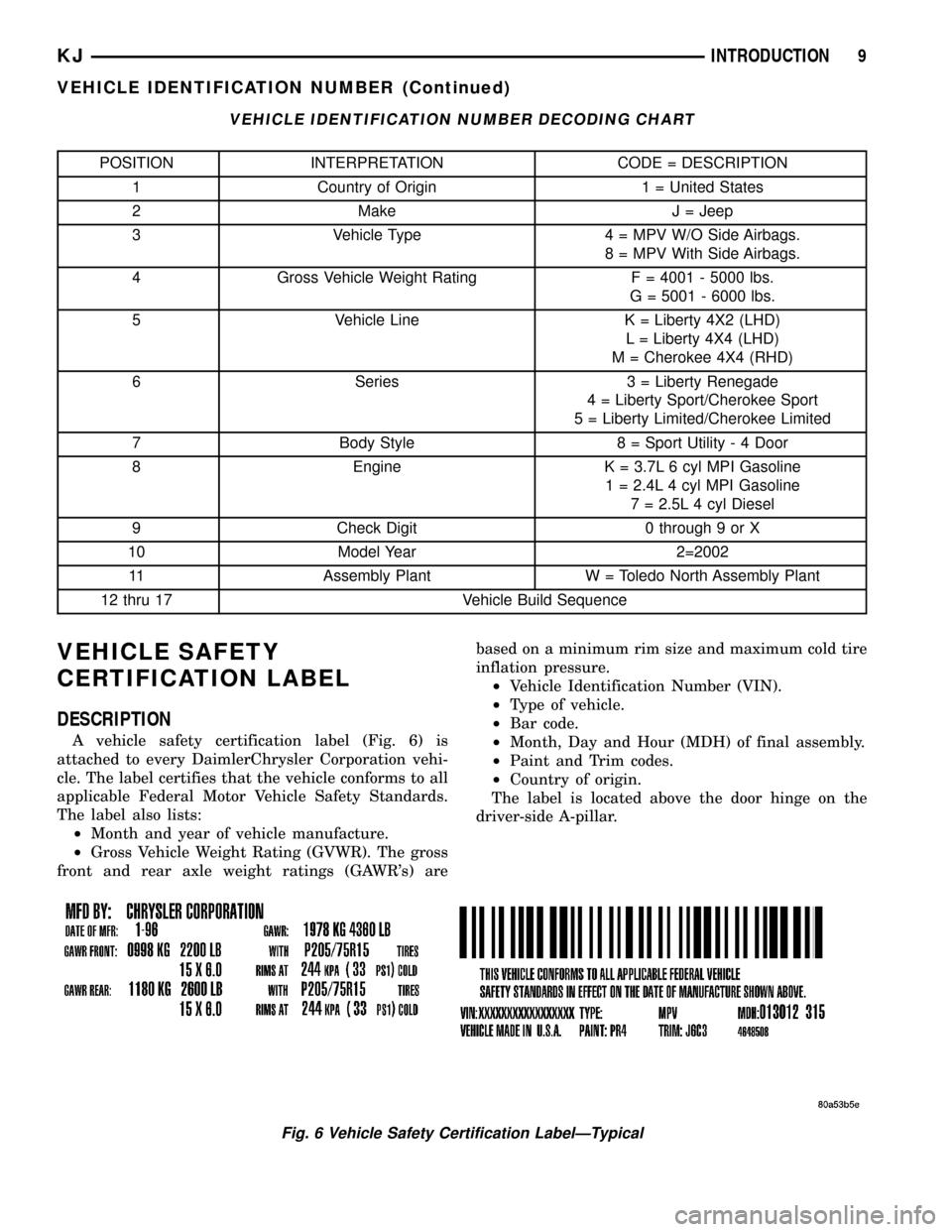
A vehicle safety certification label (Fig. 6) is
attached to every DaimlerChrysler Corporation vehi-
cle. The label certifies that the vehicle conforms to all
applicable Federal Motor Vehicle Safety Standards.
The label also lists:
²Month and year of vehicle manufacture.
²Gross Vehicle Weight Rating (GVWR). The gross
front and rear axle weight ratings (GAWR's) arebased on a minimum rim size and maximum cold tire
inflation pressure.
²Vehicle Identification Number (VIN).
²Type of vehicle.
²Bar code.
²Month, Day and Hour (MDH) of final assembly.
²Paint and Trim codes.
²Country of origin.
The label is located above the door hinge on the
driver-side A-pillar.
Fig. 6 Vehicle Safety Certification LabelÐTypical
KJINTRODUCTION 9
VEHICLE IDENTIFICATION NUMBER (Continued)
Page 31 of 1803
(5) Align the marks front and rear at the cam/
pivot bolts and tighten the bolts. Tighten the bolts to
170 N´m (125 ft.lbs.)
(6) Install the stabilizer link bolt at the lower con-
trol arm. Tighten the bolt to 136 N´m (100 ft.lbs.)
(7) Install the lower clevis bracket bolt at the
lower control arm. Tighten the bolt to 150 N´m (110
ft.lbs.)
(8) Install the tire and wheel assembly. (Refer to
22 - TIRES/WHEELS/WHEELS - STANDARD PRO-
CEDURE).
(9) Perform a full wheel alignment (Refer to 2 -
SUSPENSION/WHEEL ALIGNMENT - STANDARD
PROCEDURE).
SHOCK
REMOVAL
REMOVAL - LEFT SIDE
(1) Disconnect the battery.
(2) Remove the battery (Refer to 8 - ELECTRI-
CAL/BATTERY SYSTEM/BATTERY - REMOVAL).
(3) Unclip the power center and move it to the side
out of the way.
(4) Remove the battery tray (Refer to 8 - ELEC-
TRICAL/BATTERY SYSTEM/TRAY - REMOVAL).
(5) Disconnect the battery temperature sensor
from the battery tray.
(6) Remove the four upper shock mounting nuts.
(7) Raise and support the vehicle.(8) Remove the left tire and wheel assembly.
(9) Remove the lower bolt at the lower control
securing the clevis bracket.
(10) Remove the stabilizer link (Refer to 2 - SUS-
PENSION/FRONT/STABILIZER LINK - REMOVAL).
(11) Remove the lower ball joint nut.
(12) Seperate the lower ball joint from the lower
control arm using tool C-4150A.
(13) Rotate the lower control arm downward to
allow access.
(14) Remove the clevis bracket at the shock.
(15) Remove the shock assembly from the vehicle.
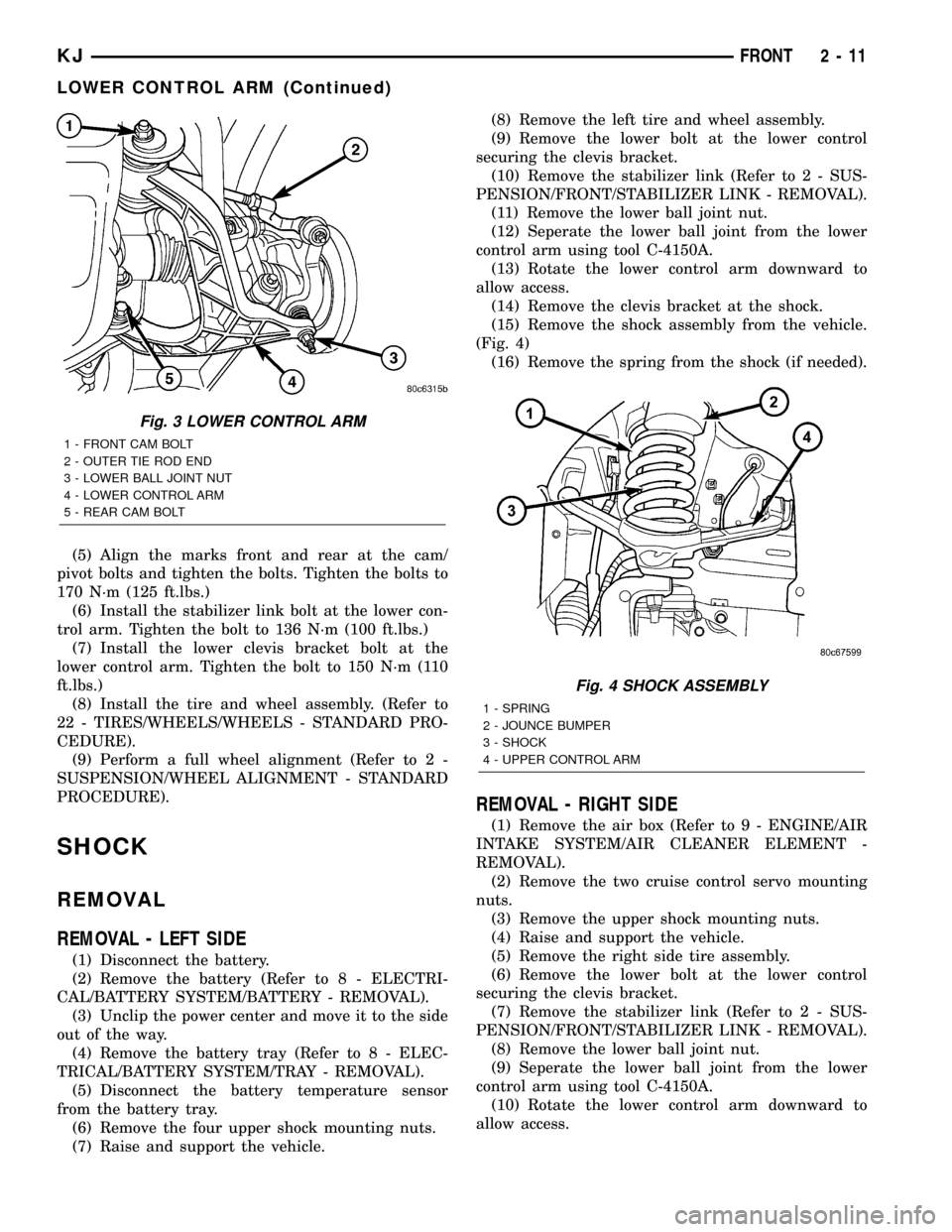
(Fig. 4)
(16) Remove the spring from the shock (if needed).
REMOVAL - RIGHT SIDE
(1) Remove the air box (Refer to 9 - ENGINE/AIR
INTAKE SYSTEM/AIR CLEANER ELEMENT -
REMOVAL).
(2) Remove the two cruise control servo mounting
nuts.
(3) Remove the upper shock mounting nuts.
(4) Raise and support the vehicle.
(5) Remove the right side tire assembly.
(6) Remove the lower bolt at the lower control
securing the clevis bracket.
(7) Remove the stabilizer link (Refer to 2 - SUS-
PENSION/FRONT/STABILIZER LINK - REMOVAL).
(8) Remove the lower ball joint nut.
(9) Seperate the lower ball joint from the lower
control arm using tool C-4150A.
(10) Rotate the lower control arm downward to
allow access.
Fig. 3 LOWER CONTROL ARM
1 - FRONT CAM BOLT
2 - OUTER TIE ROD END
3 - LOWER BALL JOINT NUT
4 - LOWER CONTROL ARM
5 - REAR CAM BOLT
Fig. 4 SHOCK ASSEMBLY
1 - SPRING
2 - JOUNCE BUMPER
3 - SHOCK
4 - UPPER CONTROL ARM
KJFRONT 2 - 11
LOWER CONTROL ARM (Continued)
Page 32 of 1803

(11) Remove the clevis bracket at the shock. (Fig.
5)
(12) Remove the shock assembly from the vehicle.
(Fig. 5)
(13) Remove the spring from the shock (if needed).
(Refer to 2 - SUSPENSION/FRONT/SPRING -
REMOVAL).
INSTALLATION
INSTALLATION - LEFT SIDE
(1) Install the spring to the shock (if removed).
(2) Install the shock assembly to the vehicle.
(3) Install the four upper shock mounting nuts.
Tighten the nuts to 108 N´m (80 ft.lbs.).
(4) Install the clevis bracket at the shock. (Refer to
2 - SUSPENSION/FRONT/CLEVIS BRACKET -
INSTALLATION). Tighten the bolt to 88 N´m (65
ft.lbs.).
(5) Raise the lower control into place and recon-
nect the lower ball joint nut. Tighten the nut to 81
N´m (60 ft.lbs.).
(6) Install the clevis bracket at the lower control
arm. (Refer to 2 - SUSPENSION/FRONT/CLEVIS
BRACKET - INSTALLATION). Tighten the bolt to
150 N´m (110 ft.lbs.).(7) Install the lower stabilizer link at the lower
control arm. Tighten the bolt to 136 N´m (100 ft.lbs.)
(Refer to 2 - SUSPENSION/FRONT/STABILIZER
LINK - INSTALLATION).
(8) Install the left tire and wheel assembly. (Refer
to 22 - TIRES/WHEELS/WHEELS - STANDARD
PROCEDURE).
(9) Lower the vehicle.
(10) Reconnect the battery temperature sensor.
(11) Install the battery tray (Refer to 8 - ELEC-
TRICAL/BATTERY SYSTEM/TRAY - INSTALLA-
TION).
(12) Install the battery (Refer to 8 - ELECTRI-
CAL/BATTERY SYSTEM/BATTERY - INSTALLA-
TION).
(13) Reconnect the battery cables.
INSTALLATION - RIGHT SIDE
(1) Install the spring to the shock (if removed).
(Refer to 2 - SUSPENSION/FRONT/SPRING -
INSTALLATION).
(2) Install the shock assembly to the vehicle.
(3) Install the four upper shock mounting nuts.
Tighten the nuts to 108 N´m (80 ft.lbs.).
(4) Install the clevis bracket at the shock. (Refer to
2 - SUSPENSION/FRONT/CLEVIS BRACKET -
INSTALLATION). Tighten the bolt to 88 N´m (65
ft.lbs.).
(5) Raise the lower control into place and recon-
nect the lower ball joint nut. Tighten the nut to 81
N´m (60 ft.lbs.).
(6) Install the clevis bracket at the lower control
arm. (Refer to 2 - SUSPENSION/FRONT/CLEVIS
BRACKET - INSTALLATION). Tighten the bolt to
150 N´m (110 ft.lbs.).
(7) Install the lower stabilizer link at the lower
control arm. Tighten the bolt to 136 N´m (100 ft.lbs.)
(Refer to 2 - SUSPENSION/FRONT/STABILIZER
LINK - INSTALLATION).
(8) Install the right tire and wheel assembly.
(Refer to 22 - TIRES/WHEELS/WHEELS - STAN-
DARD PROCEDURE).
(9) Lower the vehicle.
(10) Install the cruise control servo mounting nuts.
(11) Install the airbox (Refer to 9 - ENGINE/AIR
INTAKE SYSTEM/AIR CLEANER ELEMENT -
INSTALLATION).
Fig. 5 SHOCK & CLEVIS ASSEMBLY
1 - FRONT CRADLE
2 - SPRING & SHOCK ASSEMBLY
3 - STEERING KNUCKLE
4 - CLEVIS BRACKET
5 - LOWER CONTROL ARM
2 - 12 FRONTKJ
SHOCK (Continued)
Page 34 of 1803
STABILIZER BAR
REMOVAL
(1) Raise and support the vehicle.
(2) Remove the tire and wheel assembly.
(3) Remove the upper stabilizer link bolts at the
stabilizer bar.
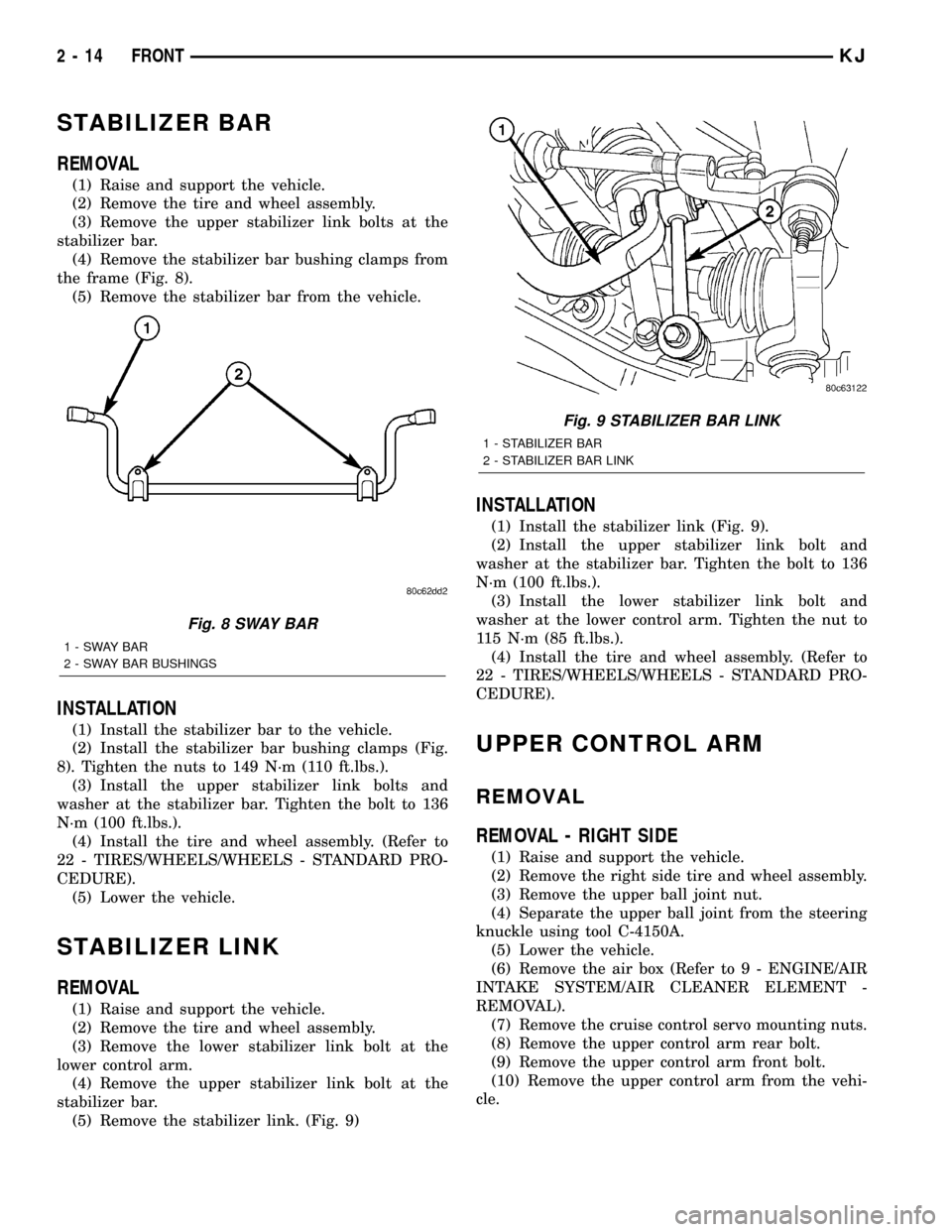
(4) Remove the stabilizer bar bushing clamps from
the frame (Fig. 8).
(5) Remove the stabilizer bar from the vehicle.
INSTALLATION
(1) Install the stabilizer bar to the vehicle.
(2) Install the stabilizer bar bushing clamps (Fig.
8). Tighten the nuts to 149 N´m (110 ft.lbs.).
(3) Install the upper stabilizer link bolts and
washer at the stabilizer bar. Tighten the bolt to 136
N´m (100 ft.lbs.).
(4) Install the tire and wheel assembly. (Refer to
22 - TIRES/WHEELS/WHEELS - STANDARD PRO-
CEDURE).
(5) Lower the vehicle.
STABILIZER LINK
REMOVAL
(1) Raise and support the vehicle.
(2) Remove the tire and wheel assembly.
(3) Remove the lower stabilizer link bolt at the
lower control arm.
(4) Remove the upper stabilizer link bolt at the
stabilizer bar.
(5) Remove the stabilizer link. (Fig. 9)
INSTALLATION
(1) Install the stabilizer link (Fig. 9).
(2) Install the upper stabilizer link bolt and
washer at the stabilizer bar. Tighten the bolt to 136
N´m (100 ft.lbs.).
(3) Install the lower stabilizer link bolt and
washer at the lower control arm. Tighten the nut to
115 N´m (85 ft.lbs.).
(4) Install the tire and wheel assembly. (Refer to
22 - TIRES/WHEELS/WHEELS - STANDARD PRO-
CEDURE).
UPPER CONTROL ARM
REMOVAL
REMOVAL - RIGHT SIDE
(1) Raise and support the vehicle.
(2) Remove the right side tire and wheel assembly.
(3) Remove the upper ball joint nut.
(4) Separate the upper ball joint from the steering
knuckle using tool C-4150A.
(5) Lower the vehicle.
(6) Remove the air box (Refer to 9 - ENGINE/AIR
INTAKE SYSTEM/AIR CLEANER ELEMENT -
REMOVAL).
(7) Remove the cruise control servo mounting nuts.
(8) Remove the upper control arm rear bolt.
(9) Remove the upper control arm front bolt.
(10) Remove the upper control arm from the vehi-
cle.
Fig. 8 SWAY BAR
1-SWAYBAR
2 - SWAY BAR BUSHINGS
Fig. 9 STABILIZER BAR LINK
1 - STABILIZER BAR
2 - STABILIZER BAR LINK
2 - 14 FRONTKJ
Page 35 of 1803
REMOVAL - LEFT SIDE
(1) Raise and support the vehicle.
(2) Remove the left side tire and wheel assembly.
(3) Remove the upper ball joint nut.
(4) Separate the upper ball joint from the steering
knuckle using tool C-4150A.
(5) Lower the vehicle.
(6) Remove the battery (Refer to 8 - ELECTRI-
CAL/BATTERY SYSTEM/BATTERY - REMOVAL).
(7) Unclip the power center and move it to the side
out of the way.
(8) Remove the battery tray (Refer to 8 - ELEC-
TRICAL/BATTERY SYSTEM/TRAY - REMOVAL).
(9) Disconnect the battery temperature sensor
from the battery tray.
(10) Remove the upper control arm rear bolt by
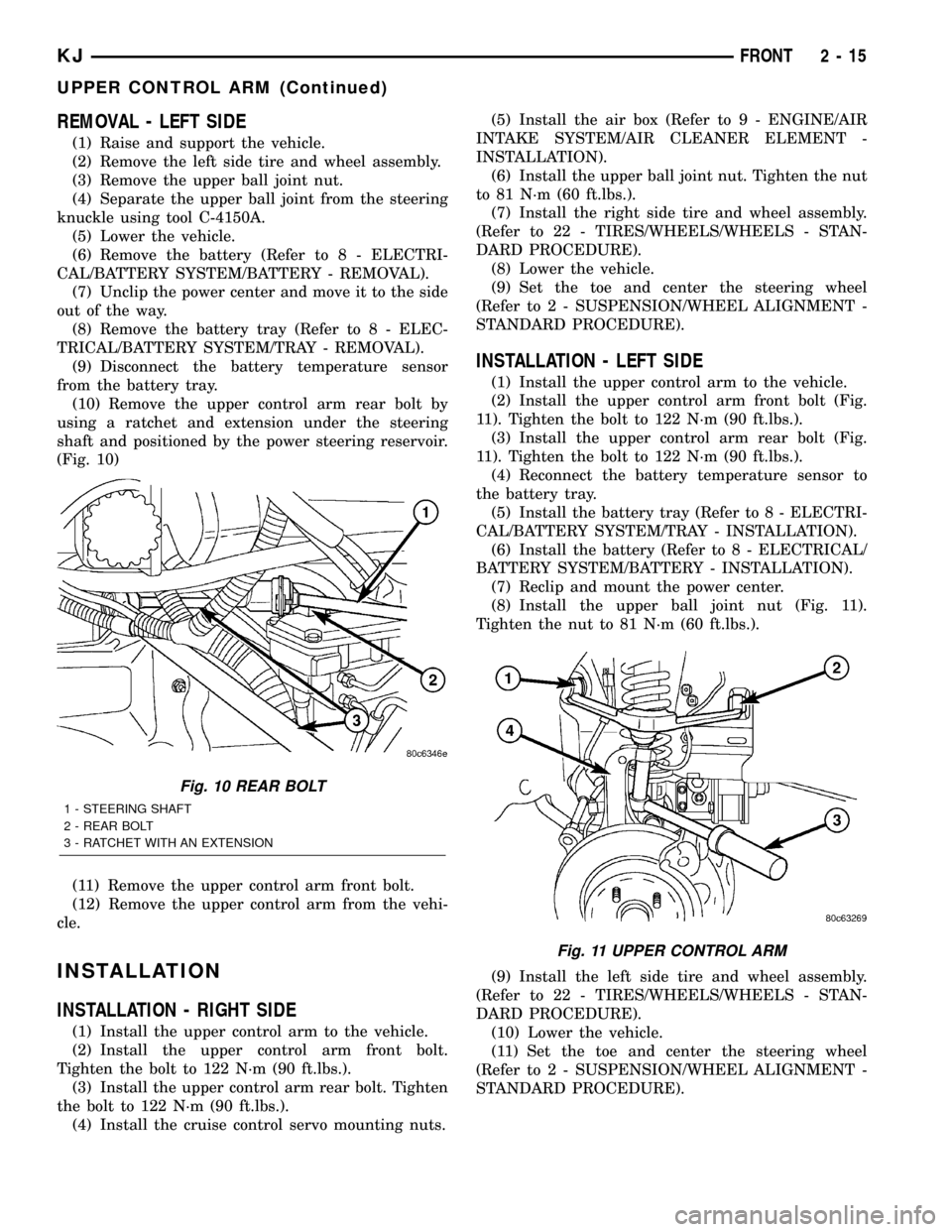
using a ratchet and extension under the steering
shaft and positioned by the power steering reservoir.
(Fig. 10)
(11) Remove the upper control arm front bolt.
(12) Remove the upper control arm from the vehi-
cle.
INSTALLATION
INSTALLATION - RIGHT SIDE
(1) Install the upper control arm to the vehicle.
(2) Install the upper control arm front bolt.
Tighten the bolt to 122 N´m (90 ft.lbs.).
(3) Install the upper control arm rear bolt. Tighten
the bolt to 122 N´m (90 ft.lbs.).
(4) Install the cruise control servo mounting nuts.(5) Install the air box (Refer to 9 - ENGINE/AIR
INTAKE SYSTEM/AIR CLEANER ELEMENT -
INSTALLATION).
(6) Install the upper ball joint nut. Tighten the nut
to 81 N´m (60 ft.lbs.).
(7) Install the right side tire and wheel assembly.
(Refer to 22 - TIRES/WHEELS/WHEELS - STAN-
DARD PROCEDURE).
(8) Lower the vehicle.
(9) Set the toe and center the steering wheel
(Refer to 2 - SUSPENSION/WHEEL ALIGNMENT -
STANDARD PROCEDURE).
INSTALLATION - LEFT SIDE
(1) Install the upper control arm to the vehicle.
(2) Install the upper control arm front bolt (Fig.
11). Tighten the bolt to 122 N´m (90 ft.lbs.).
(3) Install the upper control arm rear bolt (Fig.
11). Tighten the bolt to 122 N´m (90 ft.lbs.).
(4) Reconnect the battery temperature sensor to
the battery tray.
(5) Install the battery tray (Refer to 8 - ELECTRI-
CAL/BATTERY SYSTEM/TRAY - INSTALLATION).
(6) Install the battery (Refer to 8 - ELECTRICAL/
BATTERY SYSTEM/BATTERY - INSTALLATION).
(7) Reclip and mount the power center.
(8) Install the upper ball joint nut (Fig. 11).
Tighten the nut to 81 N´m (60 ft.lbs.).
(9) Install the left side tire and wheel assembly.
(Refer to 22 - TIRES/WHEELS/WHEELS - STAN-
DARD PROCEDURE).
(10) Lower the vehicle.
(11) Set the toe and center the steering wheel
(Refer to 2 - SUSPENSION/WHEEL ALIGNMENT -
STANDARD PROCEDURE).
Fig. 10 REAR BOLT
1 - STEERING SHAFT
2 - REAR BOLT
3 - RATCHET WITH AN EXTENSION
Fig. 11 UPPER CONTROL ARM
KJFRONT 2 - 15
UPPER CONTROL ARM (Continued)
Page 50 of 1803
DIFFERENTIAL & DRIVELINE
TABLE OF CONTENTS
page page
PROPELLER SHAFT......................1
HALF SHAFT...........................10
FRONT AXLE - 186FIA....................19REAR AXLE - 198RBI.....................49
REAR AXLE-81/4.......................86
PROPELLER SHAFT
TABLE OF CONTENTS
page page
PROPELLER SHAFT
DIAGNOSIS AND TESTING - PROPELLER
SHAFT...............................1
STANDARD PROCEDURES - PROPELLER
SHAFT ANGLE........................3
SPECIFICATIONS
PROPELLER SHAFT....................6
SPECIAL TOOLS........................6
PROPELLER SHAFT - FRONT
REMOVAL.............................6INSTALLATION..........................6
PROPELLER SHAFT - REAR
REMOVAL.............................7
INSTALLATION..........................7
SINGLE CARDAN UNIVERSAL JOINTS
DISASSEMBLY..........................8
ASSEMBLY.............................9
PROPELLER SHAFT
DIAGNOSIS AND TESTING - PROPELLER
SHAFT
VIBRATION
Tires that are out-of-round, or wheels that are
unbalanced, will cause a low frequency vibration.
Brake rotors that are unbalanced will cause a
harsh, low frequency vibration.Driveline vibration can also result from loose or
damaged engine mounts.
Propeller shaft vibration increases as the vehicle
speed is increased. A vibration that occurs within a
specific speed range is not usually caused by a pro-
peller shaft being unbalanced. Defective joints or an
incorrect propeller shaft angle, are usually the cause
of such a vibration.
KJDIFFERENTIAL & DRIVELINE 3 - 1
Page 68 of 1803

FRONT AXLE - 186FIA
TABLE OF CONTENTS
page page
FRONT AXLE - 186FIA
DESCRIPTION.........................19
OPERATION...........................19
DIAGNOSIS AND TESTING - AXLE..........20
REMOVAL.............................24
INSTALLATION.........................24
ADJUSTMENTS........................25
SPECIFICATIONS - FRONT AXLE...........33
SPECIAL TOOLS
FRONT AXLE........................34
AXLE SHAFTS
REMOVAL.............................37
INSTALLATION.........................37
AXLE SHAFT SEALS
REMOVAL.............................37
INSTALLATION.........................38
AXLE BEARINGS
REMOVAL.............................38INSTALLATION.........................38
PINION SEAL
REMOVAL.............................38
INSTALLATION.........................39
DIFFERENTIAL
REMOVAL.............................40
DISASSEMBLY.........................41
ASSEMBLY............................41
INSTALLATION.........................42
DIFFERENTIAL CASE BEARINGS
REMOVAL.............................43
INSTALLATION.........................44
PINION GEAR/RING GEAR
REMOVAL.............................44
INSTALLATION.........................46
FRONT AXLE - 186FIA
DESCRIPTION
The 186FIA (Model 30) axle consists of an alumu-
num center section with an axle tube extending from
one side. The tube is pressed into the differential
housing. The integral type housing, hypoid gear
design has the centerline of the pinion set below the
centerline of the ring gear.
The differential case is a one-piece design. The differ-
ential pinion mate shaft is retained with a roll-pin. Dif-
ferential bearing preload and ring gear backlash is
adjusted by the use of shims (select thickness). The
shims are located between the differential bearing cups
and the axle housing. Pinion bearing preload is set and
maintained by the use of a collapsible spacer.
The power is transferred from the axle through two
constant velocity (C/V) drive shafts to the wheel hubs.
The differential cover provides a means for inspec-
tion and service without removing the axle from the
vehicle. The cover has a vent tube used to relieve
internal pressure caused by vaporization and inter-
nal expansion.
OPERATION
The axle receives power from the transfer case through
the front propeller shaft. The front propeller shaft is con-
nected to the pinion gear which rotates the differential
through the gear mesh with the ring gear bolted to thedifferential case. The engine power is transmitted to the
axle shafts through the pinion mate and side gears. The
side gears are splined to the axle shafts.
During straight-ahead driving, the differential pin-
ion gears do not rotate on the pinion mate shaft. This
occurs because input torque applied to the gears is
divided and distributed equally between the two side
gears. As a result, the pinion gears revolve with the
pinion mate shaft but do not rotate around it (Fig. 1).
Fig. 1 DIFFERENTIAL-STRAIGHT AHEAD DRIVING
1 - STRAIGHT AHEAD DRIVING
2 - PINION GEAR
3 - SIDE GEAR
4 - PINION GEARS ROTATE WITH CASE
KJFRONT AXLE - 186FIA 3 - 19
Page 135 of 1803

REAR AXLE-81/4
TABLE OF CONTENTS
page page
REAR AXLE-81/4
DESCRIPTION.........................86
OPERATION...........................86
DIAGNOSIS AND TESTING - AXLE..........88
REMOVAL.............................91
INSTALLATION.........................91
ADJUSTMENTS........................92
SPECIFICATIONS
REAR AXLE..........................98
SPECIAL TOOLS
8 1/4 AXLE..........................98
AXLE SHAFTS
REMOVAL............................101
INSTALLATION........................101
AXLE SHAFT SEALS
REMOVAL............................101
INSTALLATION........................102
AXLE BEARINGS
REMOVAL............................102
INSTALLATION........................102PINION SEAL
REMOVAL............................102
INSTALLATION........................103
DIFFERENTIAL
REMOVAL............................104
DISASSEMBLY........................105
ASSEMBLY...........................105
INSTALLATION........................105
DIFFERENTIAL - TRAC-LOK
DIAGNOSIS AND TESTING - TRAC-LOKT....106
DISASSEMBLY........................107
CLEANING...........................109
INSPECTION.........................109
ASSEMBLY...........................109
DIFFERENTIAL CASE BEARINGS
REMOVAL............................110
INSTALLATION........................110
PINION GEAR/RING GEAR/TONE RING
REMOVAL............................110
INSTALLATION........................112
REAR AXLE-81/4
DESCRIPTION
The axle housings consist of a cast iron center sec-
tion with axle tubes extending from either side. The
tubes are pressed into and welded to the differential
housing to form a one-piece axle housing. The axles
are equipped with semi-floating axle shafts, meaning
vehicle loads are supported by the axle shaft and
bearings. The axle shafts are retained by C-locks in
the differential side gears.
The differential case is a one-piece design. The dif-
ferential pinion mate shaft is retained with a
threaded pin. Differential bearing preload and ring
gear backlash are set and maintained by threaded
adjusters at the outside of the differential housing.
Pinion bearing preload is set and maintained by the
use of a collapsible spacer.
The differential cover provides a means for inspec-
tion and service without removing the complete axlefrom the vehicle. A vent hose is used to relieve inter-
nal pressure caused by lubricant vaporization and
internal expansion.
Axles equipped with a Trac-Loktdifferential are
optional. A differential has a one-piece differential
case, and the same internal components as a stan-
dard differential, plus two clutch disc packs.
OPERATION
The axle receives power from the transmission/
transfer case through the rear propeller shaft. The
rear propeller shaft is connected to the pinion gear
which rotates the differential through the gear mesh
with the ring gear bolted to the differential case. The
engine power is transmitted to the axle shafts
through the pinion mate and side gears. The side
gears are splined to the axle shafts.
3 - 86 REAR AXLE-81/4KJ