warning JEEP LIBERTY 2008 KK / 2.G Repair Manual
[x] Cancel search | Manufacturer: JEEP, Model Year: 2008, Model line: LIBERTY, Model: JEEP LIBERTY 2008 KK / 2.GPages: 493
Page 175 of 493

2. Pull the loops upward and twist them1¤4turn so that
they are parallel to the slots in the storage bin cover.
3. Lift the cover upward over the loops.
4. When done, reinstall the cover with the handle recess
facing toward you.NOTE:You can install the cover with either side facing
upward.
5. With the cover seated in the floor, pull upward on
loops and twist them
1¤4turn so that they are no longer
parallel to the slots in the cover.
6. Flip the loops down.
WARNING!
A loose storage bin cover thrown forward in a colli-
sion or hard stop could endanger the occupants of the
vehicle. Always latch the storage bin cover to the
cargo load floor with the spring-loaded latches when
not accessing the storage bin.
UNDERSTANDING THE FEATURES OF YOUR VEHICLE 175
3
Page 177 of 493
WARNING!
²Cargo tie-downs are not safe anchors for a child
seat tether strap. In a sudden stop or collision, a
tie-down could pull loose and allow the child seat
to come loose. A child could be badly injured. Use
only the anchors provided for child seat tethers.
²The weight and position of cargo and passengers
can change the vehicle center of gravity and ve-
hicle handling. To avoid loss of control resulting
in personal injury, follow these guidelines for
loading your vehicle:
²Do not carry loads that exceed the load limits de-
scribed on the label attached to the left door or left
door center pillar.
²Always place cargo evenly on the cargo floor. Put
heavier objects as low and as far forward as possible.
²Place as much cargo as possible in front of the rear
axle. Too much weight or improperly placed weight
over or behind the rear axle can cause the vehicle to
sway.
²Do not pile luggage or cargo higher than the top of the
seatback. This could impair visibility or become a
dangerous projectile in a sudden stop or collision.
WARNING!
To help protect against personal injury, passengers
should not be seated in the rear cargo area. The rear
cargo space is intended for load carrying purposes
only, not for passengers, who should sit in seats and
use seat belts.
UNDERSTANDING THE FEATURES OF YOUR VEHICLE 177
3
Page 179 of 493
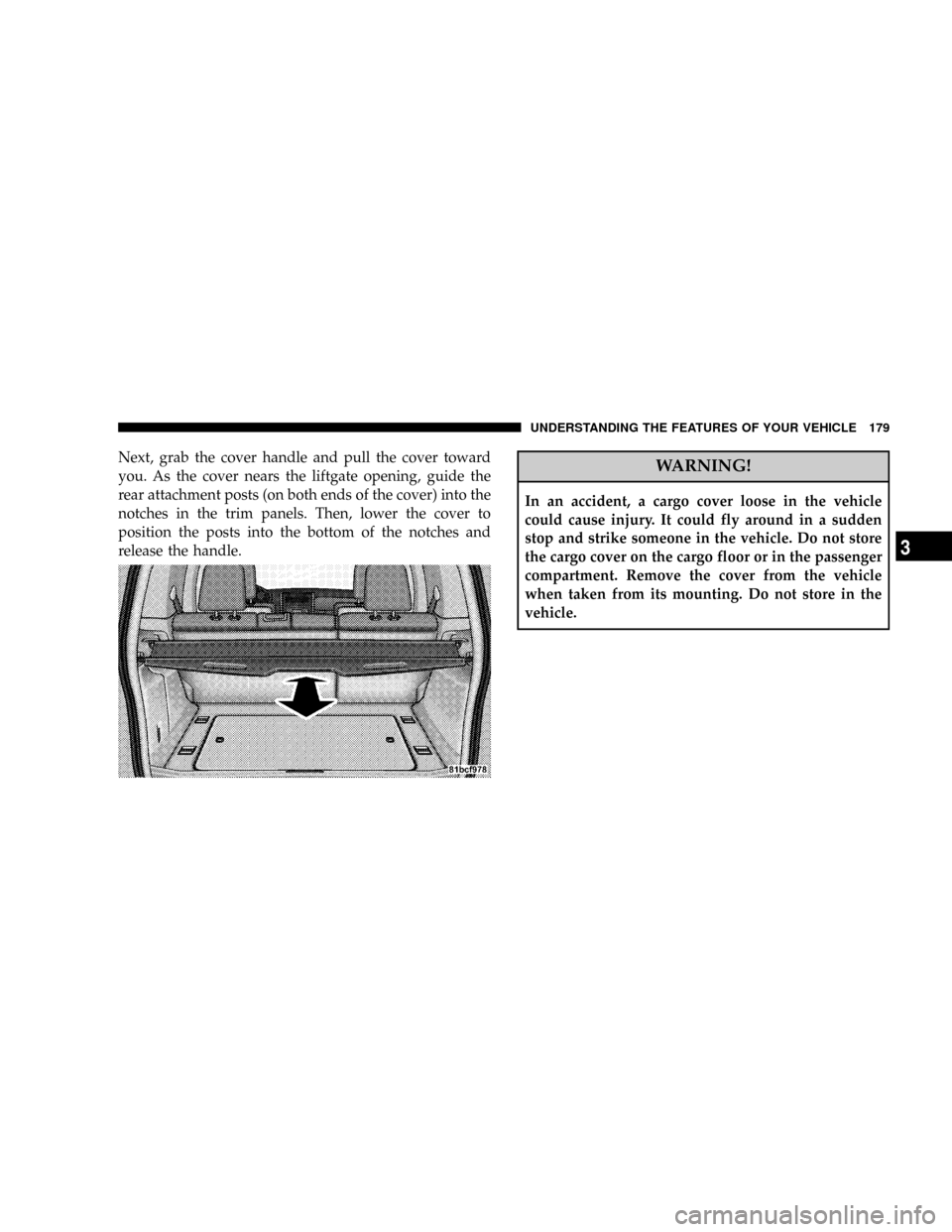
Next, grab the cover handle and pull the cover toward
you. As the cover nears the liftgate opening, guide the
rear attachment posts (on both ends of the cover) into the
notches in the trim panels. Then, lower the cover to
position the posts into the bottom of the notches and
release the handle.WARNING!
In an accident, a cargo cover loose in the vehicle
could cause injury. It could fly around in a sudden
stop and strike someone in the vehicle. Do not store
the cargo cover on the cargo floor or in the passenger
compartment. Remove the cover from the vehicle
when taken from its mounting. Do not store in the
vehicle.
UNDERSTANDING THE FEATURES OF YOUR VEHICLE 179
3
Page 183 of 493
CAUTION!
To avoid damage to the roof rack and vehicle, do not
exceed the maximum roof rack load capacity. Always
distribute heavy loads as evenly as possible and
secure the load appropriately.
Long loads, which extend over the windshield, such
as wood panels or surfboards, should be secured to
both the front and rear of the vehicle.
Place a blanket or other protection between the
surface of the roof and the load.
Travel at reduced speeds and turn corners carefully
when carrying large or heavy loads on the roof rack.
Wind forces, due to natural causes or nearby truck
traffic, can add sudden upward loads. This is espe-
cially true on large flat loads and may result in
damage to the cargo or your vehicle.
WARNING!
Cargo must be securely tied before driving your
vehicle. Improperly secured loads can fly off the
vehicle, particularly at high speeds, resulting in per-
sonal injury or property damage. Follow the roof rack
Cautions when carrying cargo on your roof rack.
UNDERSTANDING THE FEATURES OF YOUR VEHICLE 183
3
Page 190 of 493

INSTRUMENT CLUSTER DESCRIPTIONS
1. Fuel Gauge
The fuel gauge shows level of fuel in tank when
ignition switch is in the ON position. (See page 359
for more information.)
2. Fuel Cap Indicator
This symbol indicates the side of the vehicle
where the fuel cap is located.
3. Low Fuel Warning Light
This indicator lights when the fuel level drops to
approximately 1/8 tank. (See page 359 for more
information.)4. Tire Pressure Monitoring Telltale Light Ð If
Equipped
Each tire, including the spare (if provided),
should be checked monthly when cold and
inflated to the inflation pressure recommended
by the vehicle manufacturer on the vehicle
placard or tire inflation pressure label. (If your vehicle
has tires of a different size than the size indicated on the
vehicle placard or tire inflation pressure label, you should
determine the proper tire inflation pressure for those
tires.)
As an added safety feature, your vehicle has been
equipped with a tire pressure monitoring system (TPMS)
that illuminates a low tire pressure telltale when one or
more of your tires are significantly under-inflated. Ac-
cordingly, when the low tire pressure telltale illuminates,
you should stop and check your tires as soon as possible,
and inflate them to the proper pressure. Driving on a
190 INSTRUMENT PANEL AND CONTROLS
Page 192 of 493

CAUTION!
The TPMS has been optimized for the original
equipment tires and wheels. TPMS pressures and
warning have been established for the tire size
equipped on your vehicle. Undesirable system opera-
tion or sensor damage may result when using re-
placement equipment that is not of the same size,
type, and/or style. Aftermarket wheels can cause
sensor damage. Do not use aftermarket tire sealants
or balance beads if your vehicle is equipped with a
TPMS, as damage to the sensors may result. (Refer to
ªTire Inflation Pressuresº under ªTires Ð General
Informationº and to ªTire Pressure Monitor System
(TPMS)º in Section 5 of this manual for more
information).5. Electronic Throttle Control (ETC) Warning Light Ð
If Equipped
This light informs you of a problem with the
Electronic Throttle Control system. If a problem
is detected, the light will turn on while the
engine is running. If the light remains lit with
the engine running your vehicle will usually be drivable
and not need towing, however see your authorized
dealer for service as soon as possible.
If the light is flashing when the engine is running, you
may experience power loss, an elevated/rough idle, and
increased brake pedal effort, and your vehicle may
require towing. Immediate service is required.
The light will turn on when the ignition switch is first
turned ON, and remain on briefly as a bulb check. This is
normal. If the light does not turn on during starting, have
the system checked by an authorized dealer.
192 INSTRUMENT PANEL AND CONTROLS
Page 194 of 493

8. Front Fog Light Indicator Light Ð If Equipped
This light shows when the fog lights are ON. (See
page 133 for more information.)
9. Speedometer
Shows the vehicle speed.
10. Turn Signal Indicator Light
The left or right arrow will flash in unison with the
corresponding front and rear turn signal lights when
the turn signal switch is operated. (See page 133 for more
information.)
NOTE:A chime will sound if the vehicle is driven more
than 1 mile (1.6 km) with either turn signal on.
NOTE:Check for a defective outside light bulb if either
indicator flashes at a rapid rate.11. Electronic Stability Program (ESP) / Traction
Control System (TCS) Indicator Light
If this indicator light flashes during accelera-
tion, apply as little throttle as possible. While
driving, ease up on the accelerator. Be sure to
adapt your speed and driving to the prevailing
road conditions. (See page 314 for more infor-
mation.)
12. Charging System Warning Light
This light shows the status of the electrical charg-
ing system. The light should turn on when the
ignition switch is first turned ON and remain on briefly
as a bulb check. If the light stays on or turns on while
driving, turn off some of the vehicle's electrical devices,
such as the Fog Lights or Rear Defroster. If the light
remains on, it means that the charging system is experi-
encing a problem. See your local authorized dealer to
obtain SERVICE IMMEDIATELY.
194 INSTRUMENT PANEL AND CONTROLS
Page 195 of 493

13. Oil Pressure Warning Light
This light shows low engine oil pressure. The light
will turn on and remain on when the ignition
switch is turned from the LOCK or ACC position to the
ON position. The light will turn off after the engine is
started. If the light does not turn on during starting, have
the system checked by an authorized dealer.
If the light turns on and remains on while driving, safely
bring the vehicle to a stop and shut off the engine. DO
NOT OPERATE THE VEHICLE UNTIL THE CAUSE IS
CORRECTED.
This light does not show the quantity of oil in the engine.
The engine oil level must be checked using the proper
procedure. (See page 403 for more information.)
14. Anti-Lock Brake Warning Light
This light monitors the Anti-Lock Brake Sys-
tem. This light will turn on when the ignition
switch is turned to the ON position and it may
stay on for approximately 3 seconds.If the light remains on or turns on during driving, it
indicates that the Anti-Lock portion of the brake system
is not functioning and that service is required. However,
the conventional brake system will continue to operate
normally, provided the BRAKE warning light is not on.
If the ABS light is on, the brake system should be serviced as
soon as possible to restore the benefit of Anti-Lock Brakes.
The ABS Warning light should be checked frequently to
assure that it is operating properly. Turn the ignition
switch to the ON position, but do not start the vehicle.
The light should turn on. If the light does not turn on,
have the system checked by an authorized dealer. (See
page 310 for more information.)
15. Tachometer
This gauge measures engine revolutions-per-minute
(rpm x 1000). Before the pointer reaches the red area, ease
up on the accelerator to prevent engine damage.
INSTRUMENT PANEL AND CONTROLS 195
4
Page 196 of 493

16. 4 LOW Mode Indicator Light Ð If Equipped
This light alerts the driver that the vehicle is in
the 4WD LOW mode. In this mode, the front
driveshaft and rear driveshaft are mechanically
locked together forcing the front and rear
wheels to rotate at the same speed. (See page 292 for
more information.)
17. Hill Descent Control Indicator Light Ð If Equipped
The symbol indicates the status of the Hill
Decent Control (HDC) feature. The lamp will
be on solid when HDC is armed. HDC can only
be armed when the transfer case is in the ª4WD
Lowº position and the vehicle speed is less then 30 mph.
If these conditions are not met while attempting to use
the HDC feature, the HDC indicator lamp will flash
on/off.(See page 314 for more information.)18. TOW / HAUL Indicator Light Ð If Equipped
This light will illuminate when selecting
TOW/HAUL. The TOW/HAUL button is lo-
cated on the gearshift bezel. (See page 281 for
more information.)
19. 4WD Indicator Light Ð Vehicles Equipped with
Command-Tract
This light alerts the driver that the vehicle is in
the four-wheel drive mode. In this mode, the
front driveshaft and rear driveshaft are me-
chanically locked together forcing the front and
rear wheels to rotate at the same speed. (See page 292 for
more information.)
20.
Electronic Stability Program (ESP) / Brake Assist
System (BAS) Malfunction Indicator Light ± If Equipped
The malfunction indicator lamp for the ESP is
combined with the BAS indicator. The yellow
ªESP/BAS Warning Lampº in the instrument
196 INSTRUMENT PANEL AND CONTROLS
Page 197 of 493

cluster comes on when the ignition switch is turned to the
ªONº position. It should go out with the engine running.
If the ªESP/BAS Warning Lampº comes on continuously
with the engine running, a malfunction has been detected
in either the ESP or the BAS system, or both. If this light
remains on after the several ignition cycles, and the
vehicle has been driven several miles at speeds greater
than 30 mph (48 km/h), see your authorized dealer as
soon as possible to have the problem diagnosed and
corrected.(See page 314 for more information.)
NOTE:The ªESP/BAS Warning Lampº comes on mo-
mentarily each time the ignition switch is turned ON.
NOTE:Each time the ignition switch is turned ON, the
ESP System will be ON even if it was turned off previ-
ously.
NOTE:The ESP Control System will make buzzing or
clicking sounds when it is active. This is normal; thesound will stop when the ESP becomes inactive following
a maneuver that caused the ESP activation.
21. SERV (Service) 4WD Indicator Light Ð If Equipped
The ªSERV 4WD Indicator Lightº will turn on
when the ignition key is turned to the ON
position and it will stay on for 2 seconds. If the
light stays on or turns on during driving, it
means that the 4WD system is not functioning properly
and that service is required.
22. Coolant Temperature Warning Light
This light warns of an overheated engine condi-
tion. If the light turns on while driving, safely pull
over and stop the vehicle. If the air conditioner is
on, turn it off. Also, shift the transmission into ªNº
(Neutral) and idle the vehicle. If the temperature reading
does not return to normal, turn the engine off immedi-
ately and call for service. (See page 384 for more infor-
mation.)
INSTRUMENT PANEL AND CONTROLS 197
4