stop start JEEP LIBERTY 2009 KK / 2.G User Guide
[x] Cancel search | Manufacturer: JEEP, Model Year: 2009, Model line: LIBERTY, Model: JEEP LIBERTY 2009 KK / 2.GPages: 506
Page 300 of 506
WARNING! (Continued)
•It is dangerous to move the shift lever out of PARK
or NEUTRAL if the engine speed is higher than
idle speed. If your foot is not firmly on the brake
pedal, the vehicle could accelerate quickly forward
or in reverse. You could lose control of the vehicle
and hit someone or something. Only shift into
gear when the engine is idling normally and when
your right foot is firmly on the brake pedal.
REVERSE
This range is for moving the vehicle rearward. Use this
range only after the vehicle has come to a complete stop.
NEUTRAL
This range is used when the vehicle is standing for
prolonged periods with the engine running. The engine
may be started in this range. Set the parking brake if you
must leave the vehicle. NOTE:
Towing the vehicle, coasting, or driving for any
other reason with shift lever in NEUTRAL can result in
severe transmission damage. Refer to “Recreational Tow-
ing” in Section 5 and “Towing a Disabled Vehicle” in
Section 6 of this manual.
DRIVE
This range is used for most city and highway driving.
2 (Second)
This range is used for moderate grades and to assist
braking on dry pavement or in mud and snow. Begins at
a stop in low gear with automatic upshift to 2nd gear.
Will not shift to 3rd gear.
1 (First)
This range is used for hard pulling at low speeds in mud,
sand, snow, or on steep grades. Begins and stays in low
gear with no upshift. Provides engine compression brak-
ing at low speeds.
298 STARTING AND OPERATING
Page 303 of 506
Transmission Limp Home Mode
Transmission function is monitored for abnormal condi-
tions. If a condition is detected that could result in
transmission damage, the Transmission Limp Home
Mode will be engaged. In this mode, the transmission
will remain in second gear in any forward driving range.
To reset the transmission, use the following procedure:
1. Stop the vehicle.
2. Move the shift lever to the PARK position.
3. Turn OFF the engine and be sure to turn the key to the
LOCK position.
4. Wait approximately 10 seconds, then restart the en-
gine.
5. Move the shift lever to the desired gear range.If the problem is no longer detected, the transmission will
return to normal operation. If the problem persists,
PARK, REVERSE, and NEUTRAL will continue to oper-
ate. Only second gear range will operate in the DRIVE
position. Have the transmission checked at your autho-
rized dealer as soon as possible.
Torque Converter Clutch
A feature designed to improve fuel economy has been
added to the automatic transmission of this vehicle. A
clutch within the torque converter engages automatically
at calibrated speeds. This may result in a slightly differ-
ent feeling or response during normal operation in high
gear. When the vehicle speed drops or during accelera-
tion, the clutch automatically and smoothly disengages.
STARTING AND OPERATING 301
5
Page 306 of 506
WARNING! (Continued)
•Since four-wheel drive provides improved trac-
tion, there is a tendency to exceed safe turning and
stopping speeds. Do not go faster than road con-
ditions permit. You or others could be injured.
Shift Positions
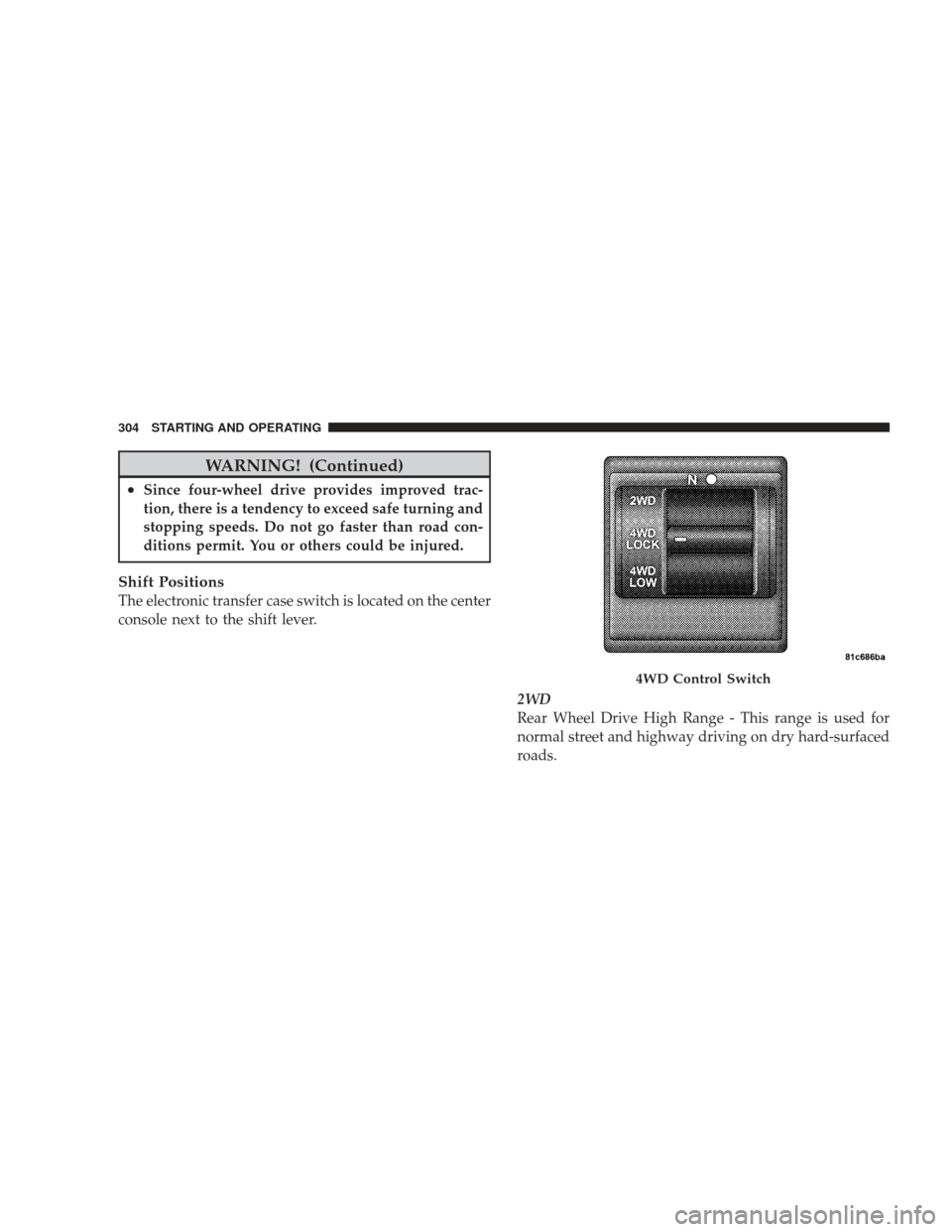
The electronic transfer case switch is located on the center
console next to the shift lever.2WD
Rear Wheel Drive High Range - This range is used for
normal street and highway driving on dry hard-surfaced
roads.
4WD Control Switch
304 STARTING AND OPERATING
Page 308 of 506
Shifting Procedures
NOTE:If any of the requirements to select a new
transfer case position have not been met, the transfer case
will not shift, the indicator light for the previous position
will remain on, and the newly selected position indicator
light will continue to flash until all the requirements for
the selected position have been met. To retry a shift, move
the 4WD Control Switch back to the original position,
make certain all shift requirements have been met, wait
five seconds, and try the shift again.
2WD to 4WD Lock
Move the 4WD Control Switch to the desired position.
Shifts between 2WD and 4WD LOCK can be done with
the vehicle stopped or in motion. With the vehicle in
motion, the transfer case will engage/disengage faster if
you momentarily release the accelerator pedal after mov-
ing the 4WD Control Switch. If the vehicle is stopped, the
ignition switch must be in the ON position with the engine either OFF or RUNNING. This shift cannot be
completed if the ignition switch is in the ACC position.
NOTE:
The four-wheel drive system will not allow
shifts between 2WD and 4WD LOCK if the rear wheels
are spinning (no traction). In this situation, the selected
position indicator light will flash and the original posi-
tion indicator light will remain ON. At this time, reduce
speed and stop spinning the wheels to complete the shift.
There may be a delay up to 10 seconds for the shift to
complete after the wheels have stopped spinning.
Delayed shifting out of 4WD LOCK may be experienced
due to uneven tire wear, low tire pressure, or excessive
loading.
4WD Lock to 4WD Low
When shifting into or out of 4WD LOW, some gear noise
may be heard. This noise is normal and is not detrimental
to the vehicle or its occupants
306 STARTING AND OPERATING
Page 309 of 506
Shifting can be performed with the vehicle rolling 2 to
3 mph (3 to 5 km/h) using the “Preferred Procedure” or
completely stopped using the “Alternate Procedure.”
Preferred Procedure
1. With the engine RUNNING, slow the vehicle speed to
2 to 3 mph (3 to 5 km/h).
2. Shift the transmission into NEUTRAL.
3. While still rolling, move the 4WD Control Switch to
the desired position.
4. After the desired position indicator light is ON (not
flashing), shift the transmission into gear.
Alternate Procedure
1. Bring the vehicle to a complete stop.2. With the ignition switch in the ON position, and the
engine OFF or RUNNING, shift the transmission into
NEUTRAL.
3. Move the 4WD Control Switch to the desired position.
4. After the desired position indicator light is on (not
flashing), shift the transmission into gear.
NOTE:
Steps 1 and 2 in the “Preferred Procedure” and
the “Alternate Procedure” are requirements for shifting
the transfer case. If these requirements are not met prior
to attempting the shift or while the shift attempt is in
process, then the indicator light will flash, and the
current transfer case position will be maintained. To retry
a shift, move the 4WD Control Switch back to the original
position, make certain all shift requirements have been
met, wait five seconds, and try the shift again.
The ignition switch must be in the ON position for a shift
to take place and for the position indicator lights to be
STARTING AND OPERATING 307
5
Page 312 of 506
WARNING! (Continued)
•Since four-wheel drive provides improved trac-
tion, there is a tendency to exceed safe turning and
stopping speeds. Do not go faster than road con-
ditions permit. You or others could be injured.
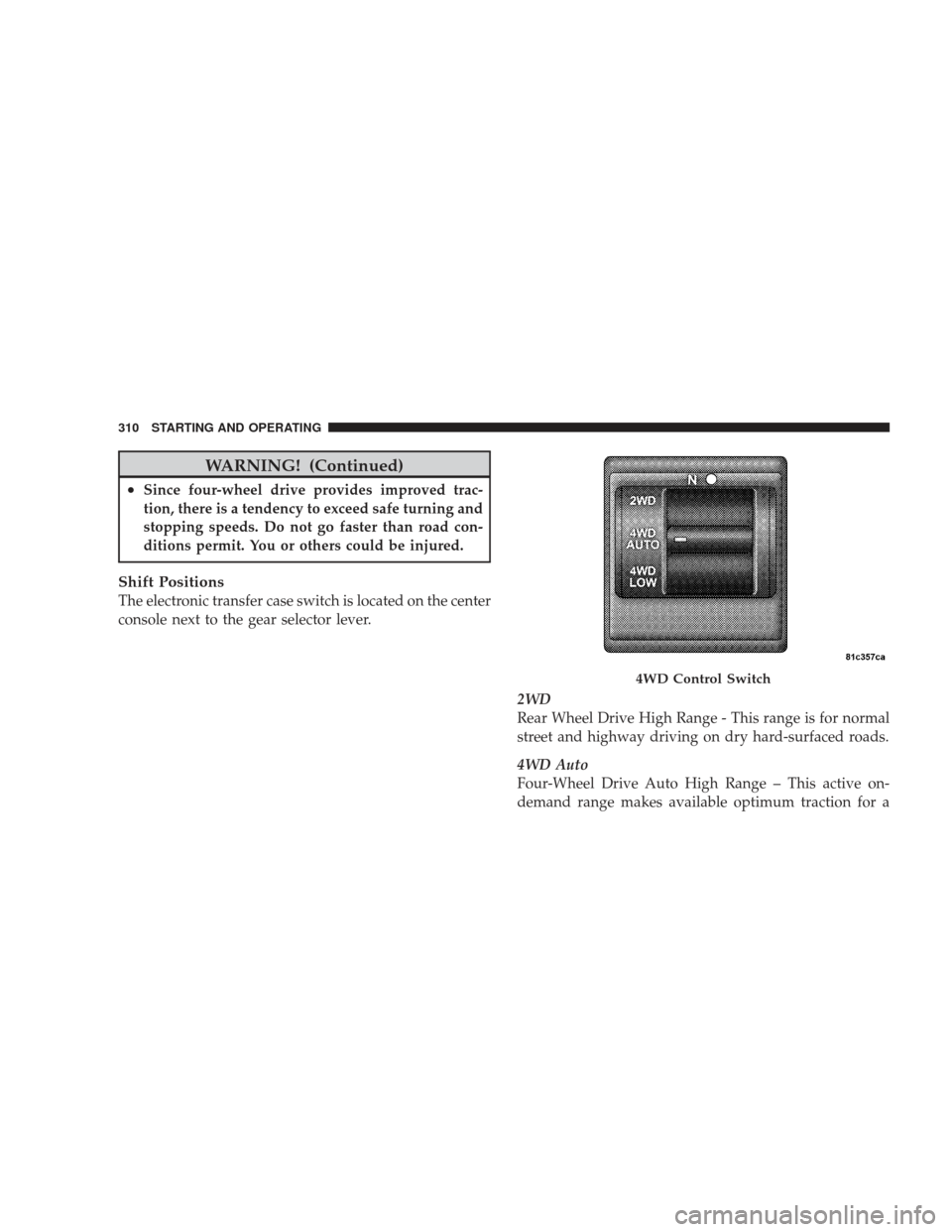
Shift Positions
The electronic transfer case switch is located on the center
console next to the gear selector lever.2WD
Rear Wheel Drive High Range - This range is for normal
street and highway driving on dry hard-surfaced roads.
4WD Auto
Four-Wheel Drive Auto High Range – This active on-
demand range makes available optimum traction for a
4WD Control Switch
310 STARTING AND OPERATING
Page 314 of 506
Shifting Procedures
NOTE:If any of the requirements to select a new
transfer case position have not been met, the transfer case
will not shift, the indicator light for the previous position
will remain on, and the newly selected position indicator
light will continue to flash until all the requirements for
the selected position have been met. To retry a shift, move
the 4WD Control Switch back to the original position,
make certain all shift requirements have been met, wait
five seconds, and try the shift again.
2WD to 4WD Auto
Move the 4WD Control Switch to the desired position.
Shifts between 2WD and 4WD Auto can be done with the
vehicle stopped or in motion. If the vehicle is stopped,
the ignition switch must be in the ON position with the
engine either OFF or RUNNING. This shift cannot be
completed if the ignition switch is in the ACC position. 2WD or 4WD Auto to 4WD Low
When shifting into or out of 4WD LOW, some gear noise
may be heard. This noise is normal and is not detrimental
to the vehicle or its occupants.
Shifting can be performed with the vehicle rolling 2 to
3 mph (3 to 5 km/h) using the “Preferred Procedure” or
completely stopped using the “Alternate Procedure.”
Preferred Procedure
1. With the engine RUNNING, slow the vehicle speed to
2 to 3 mph (3 to 5 km/h).
2. Shift the transmission into NEUTRAL.
3. While still rolling, move the 4WD Control Switch to
the desired position.
4. After the desired position indicator light is on (not
flashing), shift the transmission into gear.
312 STARTING AND OPERATING
Page 315 of 506
Alternate Procedure
1. Bring the vehicle to a complete stop.
2. With the ignition switch in the ON position and the
engine OFF or RUNNING, shift the transmission into
NEUTRAL.
3. Move the 4WD Control Switch to the desired position.
4. After the desired position indicator light is on (not
flashing), shift the transmission into gear.
NOTE:Steps 1 and 2 in the “Preferred Procedure” and
the “Alternate Procedure” are requirements for shifting
the transfer case. If these requirements are not met prior
to attempting the shift or while the shift attempt is in
process, then the indicator light will flash, and the
current transfer case position will be maintained. To retry
a shift, move the 4WD Control Switch back to the original
position, make certain all shift requirements have been
met, wait five seconds, and try the shift again. The ignition switch must be in the ON position for a shift
to take place and for the position indicator lights to be
operable. If the ignition switch is not in the ON position,
the shift will not take place, and no position indicator
lights will be on or flashing.
ON-ROAD DRIVING TIPS
Utility vehicles have higher ground clearance and a
narrower track to make them capable of performing in a
wide variety of off-road applications. Specific design
characteristics give them a higher center of gravity than
ordinary cars.
An advantage of the higher ground clearance is a better
view of the road, allowing you to anticipate problems.
They are not designed for cornering at the same speeds as
conventional two-wheel drive vehicles any more than
low-slung sports cars are designed to perform satisfacto-
rily in off-road conditions. If at all possible, avoid sharp
STARTING AND OPERATING 313
5
Page 318 of 506
Hill Climbing
NOTE:Before attempting to climb a hill, determine the
conditions at the crest and/or on the other side.
Before climbing a steep hill, shift the transmission to a
lower gear and shift the transfer case to 4WD LOW. Use
first gear and 4WD LOW for very steep hills.
If you stall or begin to lose headway while climbing a
steep hill, allow your vehicle to come to a stop and
immediately apply the brakes. Restart the engine and
shift to REVERSE. Back slowly down the hill allowing the
compression braking of the engine to help regulate your
speed. If the brakes are required to control vehicle speed,
apply them lightly and avoid locking or skidding the
tires.
WARNING!
If the engine stalls or you lose headway or cannot
make it to the top of a steep hill or grade, never
attempt to turn around. To do so may result in
tipping and rolling the vehicle. Always back straight
down a hill in REVERSE gear carefully. Never back
down a hill in NEUTRAL using only the brake.
Remember, never drive diagonally across a hill - drive
straight up or down.
If the wheels start to slip as you approach the crest of a
hill, ease off the accelerator and maintain headway by
turning the front wheels slowly left and right. This may
provide a fresh “bite” into the surface and will usually
provide traction to complete the climb.
316 STARTING AND OPERATING
Page 324 of 506
WARNING!
Significant over or under-inflation of tires or mixing
sizes of tires or wheels on the vehicle can lead to loss
of braking effectiveness.
The ABS conducts a low-speed self-test at about 12 mph
(20 km/h). If you have your foot lightly on the brake
while this test is occurring, you may feel slight pedal
movement. The movement can be more apparent on ice
and snow. This is normal.
The ABS pump motor runs during the self-test at 12 mph
(20 km/h) and during an ABS stop. The pump motor
makes a low humming noise during operation, which is
normal.
WARNING!
•Pumping of the Anti-Lock Brakes will diminish
their effectiveness and may lead to an accident.
Pumping makes the stopping distance longer. Just
press firmly on your brake pedal when you need
to slow down or stop.
•The ABS cannot prevent the natural laws of phys-
ics from acting on the vehicle, nor can it increase
braking or steering efficiency beyond that af-
forded by the condition of the vehicle brakes and
tires or the traction afforded.
•The ABS cannot prevent accidents, including
those resulting from excessive speed in turns,
following another vehicle too closely, or hydro-
planing. Only a safe, attentive, and skillful driver
can prevent accidents. (Continued)
322 STARTING AND OPERATING