seats JEEP LIBERTY 2012 KK / 2.G Owners Manual
[x] Cancel search | Manufacturer: JEEP, Model Year: 2012, Model line: LIBERTY, Model: JEEP LIBERTY 2012 KK / 2.GPages: 558, PDF Size: 3.12 MB
Page 35 of 558
•For vehicles not equipped with the EVIC, perform the
following procedure:
1. Close all doors and place the key in the ignition.
2. Cycle the ignition switch between OFF and ON/RUN
and then back to OFF five times, ending up in the
ON/RUN position.
3. Press the power door UNLOCK switch to unlock the
doors.
4. A single chime will indicate the completion of the
programming. Repeat these steps if you want to return this feature to its
previous setting.
NOTE:
Use the Automatic Unlock Doors On Exit feature
in accordance with local laws.
Child-Protection Door Lock System — Rear
Doors
To provide a safer environment for small children riding
in the rear seats, the rear doors are equipped with a
Child-Protection Door Lock system.
2
THINGS TO KNOW BEFORE STARTING YOUR VEHICLE 33
Page 44 of 558
OCCUPANT RESTRAINTS
Some of the most important safety features in your
vehicle are the restraint systems:
•Three-point lap and shoulder belts for all seating
positions
•Advanced Front Air Bags for driver and front passen-
ger
•Supplemental Active Head Restraints (AHR) located
on top of the front seats (integrated into the head
restraint)
•Supplemental Side Air Bag Inflatable Curtains
(SABIC) for the driver and passengers seated next to a
window
•An energy-absorbing steering column and steering
wheel
•Knee bolsters/blockers for front seat occupants
•Front seat belts incorporate pretensioners that may
enhance occupant protection by managing occupant
energy during an impact event
•All seat belt systems (except the driver’s and rear
center) include Automatic Locking Retractors (ALRs),
which lock the seat belt webbing into position by
extending the belt all the way out and then adjusting
the belt to the desired length to restrain a child seat or
secure a large item in a seat — if equipped
Please pay close attention to the information in this section.
It tells you how to use your restraint system properly, to
keep you and your passengers as safe as possible.
If you will be carrying children too small for adult-sized
seat belts, the seat belts or the Lower Anchors and Tether
for CHildren (LATCH) feature also can be used to hold
infant and child restraint systems. For more information
on LATCH, refer to Lower Anchors and Tether for
CHildren (LATCH).
42 THINGS TO KNOW BEFORE STARTING YOUR VEHICLE
Page 45 of 558
NOTE:The Advanced Front Air Bags have a multistage
inflator design. This allows the air bag to have different
rates of inflation based on the severity and type of
collision.
Here are some simple steps you can take to minimize the
risk of harm from a deploying air bag:
1. Children 12 years old and under should always ride
buckled up in a rear seat.
WARNING!
Infants in rear facing child restraints should never
ride in the front seat of a vehicle with a passenger
Advanced Front Air Bag. An air bag deployment can
cause severe injury or death to infants in that posi-
tion.
Children that are not big enough to wear the vehicle seat
belt properly (see section on Child Restraints) should be secured in the rear seat in child restraints or belt-
positioning booster seats. Older children who do not use
child restraints or belt-positioning booster seats should
ride properly buckled up in the rear seat. Never allow
children to slide the shoulder belt behind them or under
their arm.
If a child from 1 to 12 years old (not in a rear facing child
seat) must ride in the front passenger seat, move the seat
as far back as possible and use the proper child restraint.
(Refer to “Child Restraints”)
You should read the instructions provided with your
child restraint to make sure that you are using it properly.
2.
All occupants should always wear their lap and
shoulder belts properly.
3. The driver and front passenger seats should be
moved back as far as practical to allow the Advanced
Front Air Bags room to inflate.
2
THINGS TO KNOW BEFORE STARTING YOUR VEHICLE 43
Page 47 of 558
Buckle up even though you are an excellent driver, even
on short trips. Someone on the road may be a poor driver
and cause a collision that includes you. This can happen
far away from home or on your own street.
Research has shown that seat belts save lives, and they
can reduce the seriousness of injuries in a collision. Some
of the worst injuries happen when people are thrown
from the vehicle. Seat belts reduce the possibility of
ejection and the risk of injury caused by striking the
inside of the vehicle. Everyone in a motor vehicle should
be belted at all times.
Lap/Shoulder Belts
All seating positions in your vehicle are equipped with
lap/shoulder belts. The belt webbing retractor is de-
signed to lock during very sudden stops or accidents.
This feature allows the shoulder part of the belt to move
freely with you under normal conditions. However, in acollision, the belt will lock and reduce your risk of
striking the inside of the vehicle or being thrown out.
WARNING!
•It is dangerous to ride in a cargo area, inside or
outside of a vehicle. In a collision, people riding in
these areas are more likely to be seriously injured
or killed.
•Do not allow people to ride in any area of your
vehicle that is not equipped with seats and seat
belts.
•Be sure everyone in your vehicle is in a seat and
using a seat belt properly.
•Wearing a seat belt incorrectly is dangerous. Seat
belts are designed to go around the large bones of
your body. These are the strongest parts of your
body and can take the forces of a collision the best.
(Continued)
2
THINGS TO KNOW BEFORE STARTING YOUR VEHICLE 45
Page 71 of 558
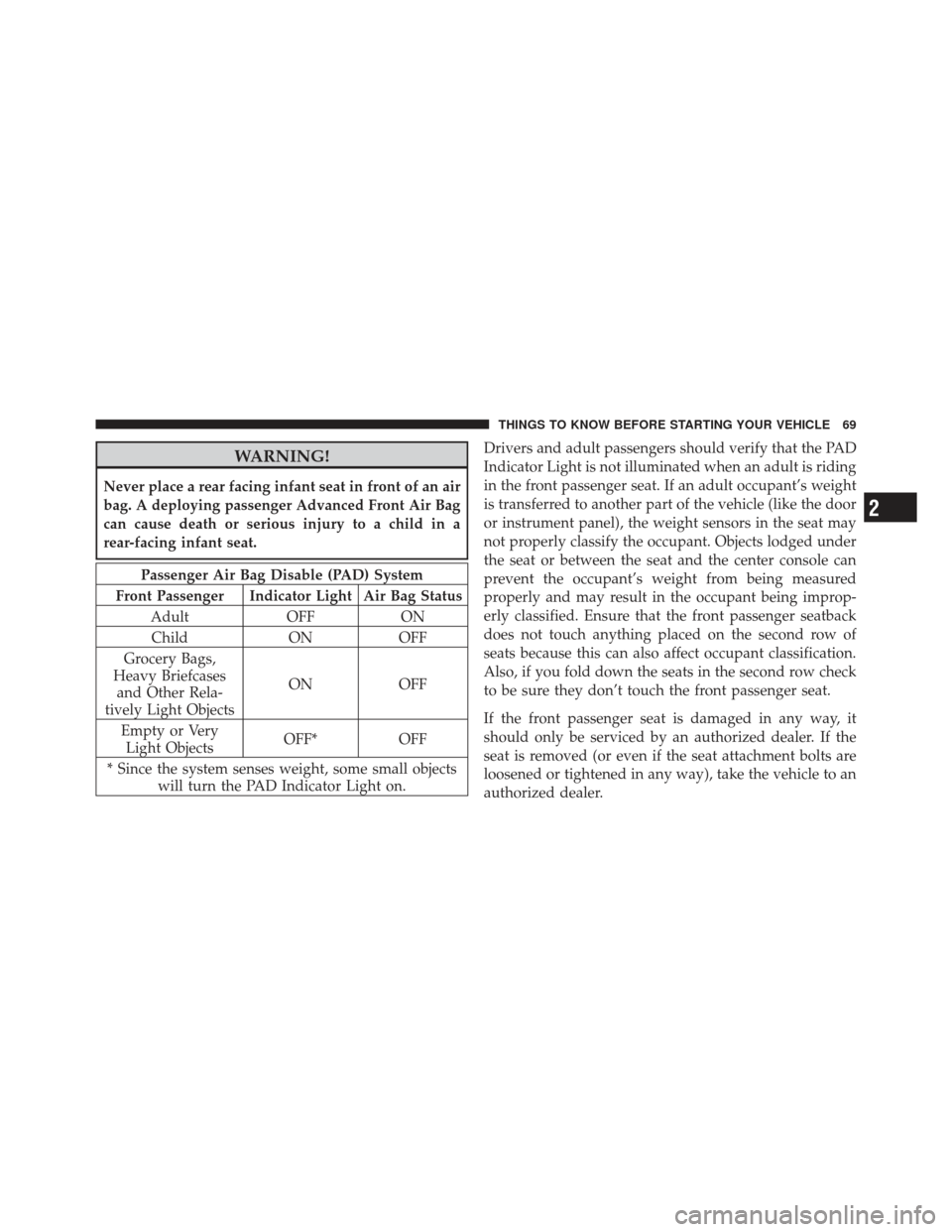
WARNING!
Never place a rear facing infant seat in front of an air
bag. A deploying passenger Advanced Front Air Bag
can cause death or serious injury to a child in a
rear-facing infant seat.
Passenger Air Bag Disable (PAD) System
Front Passenger Indicator Light Air Bag Status Adult OFFON
Child ONOFF
Grocery Bags,
Heavy Briefcases and Other Rela-
tively Light Objects ON
OFF
Empty or Very Light Objects OFF*
OFF
* Since the system senses weight, some small objects will turn the PAD Indicator Light on. Drivers and adult passengers should verify that the PAD
Indicator Light is not illuminated when an adult is riding
in the front passenger seat. If an adult occupant’s weight
is transferred to another part of the vehicle (like the door
or instrument panel), the weight sensors in the seat may
not properly classify the occupant. Objects lodged under
the seat or between the seat and the center console can
prevent the occupant’s weight from being measured
properly and may result in the occupant being improp-
erly classified. Ensure that the front passenger seatback
does not touch anything placed on the second row of
seats because this can also affect occupant classification.
Also, if you fold down the seats in the second row check
to be sure they don’t touch the front passenger seat.
If the front passenger seat is damaged in any way, it
should only be serviced by an authorized dealer. If the
seat is removed (or even if the seat attachment bolts are
loosened or tightened in any way), take the vehicle to an
authorized dealer.
2
THINGS TO KNOW BEFORE STARTING YOUR VEHICLE 69
Page 80 of 558
To read data recorded by an EDR, special equipment is
required, and access to the vehicle or the EDR is needed.
In addition to the vehicle manufacturer, other parties,
such as law enforcement, that have the special equip-
ment, can read the information if they have access to the
vehicle or the EDR.
Child Restraints
Everyone in your vehicle needs to be buckled up all the
time, including babies and children. Every state in the
United States and all Canadian provinces require that
small children ride in proper restraint systems. This is the
law, and you can be prosecuted for ignoring it.
Children 12 years or younger should ride properly
buckled up in a rear seat, if available. According to crash
statistics, children are safer when properly restrained in
the rear seats rather than in the front.
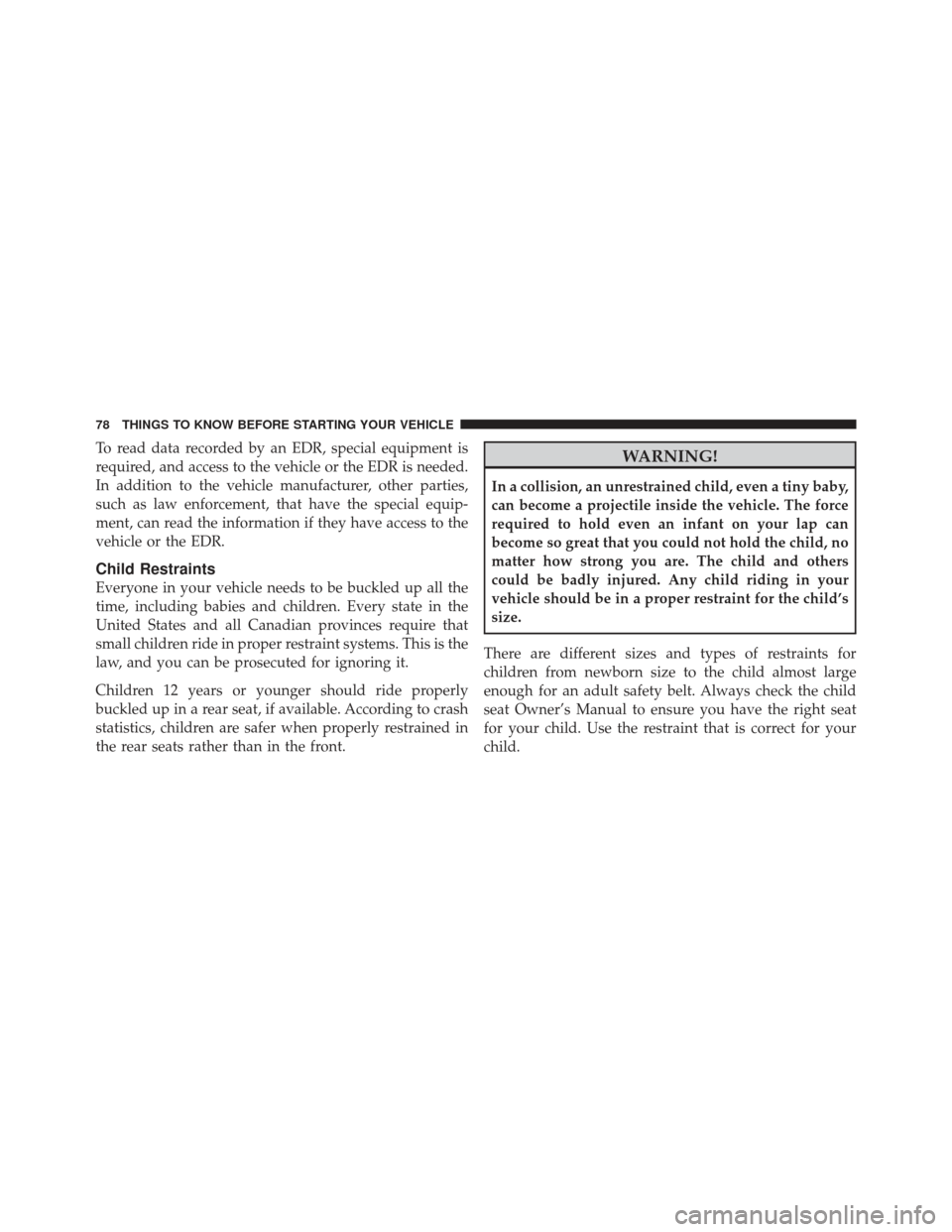
WARNING!
In a collision, an unrestrained child, even a tiny baby,
can become a projectile inside the vehicle. The force
required to hold even an infant on your lap can
become so great that you could not hold the child, no
matter how strong you are. The child and others
could be badly injured. Any child riding in your
vehicle should be in a proper restraint for the child’s
size.
There are different sizes and types of restraints for
children from newborn size to the child almost large
enough for an adult safety belt. Always check the child
seat Owner’s Manual to ensure you have the right seat
for your child. Use the restraint that is correct for your
child.
78 THINGS TO KNOW BEFORE STARTING YOUR VEHICLE
Page 81 of 558
Infants And Child Restraints
Safety experts recommend that children ride rearward-
facing in the vehicle until they are two years old or until
they reach either the height or weight limit of their rear
facing child safety seat. Two types of child restraints can
be used rearward-facing: infant carriers and convertible
child seats.
The infant carrier is only used rearward-facing in the
vehicle. It is recommended for children from birth until
they reach the weight or height limit of the infant carrier.
Convertible child seats can be used either rearward-
facing or forward-facing in the vehicle. Convertible child
seats often have a higher weight limit in the rearward-
facing direction than infant carriers do, so they can be
used rearward-facing by children who have outgrown
their infant carrier but are still less than at least two years
old. Children should remain rearward-facing until they
reach the highest weight or height allowed by their
convertible child seat. Both types of child restraints areheld in the vehicle by the lap/shoulder belt or the
LATCH child restraint anchor system. Refer to “Lower
Anchors and Tether for CHildren (LATCH)”.
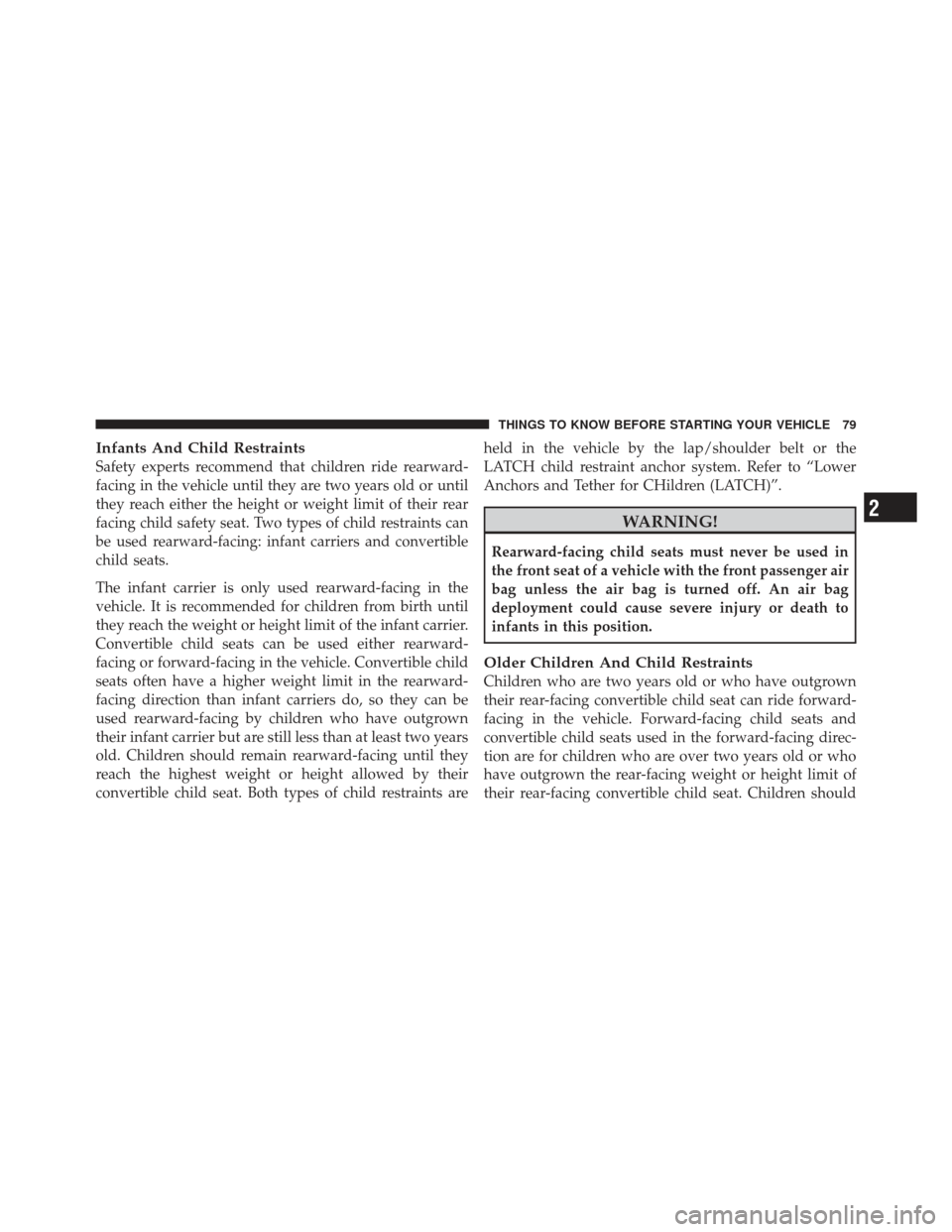
WARNING!
Rearward-facing child seats must never be used in
the front seat of a vehicle with the front passenger air
bag unless the air bag is turned off. An air bag
deployment could cause severe injury or death to
infants in this position.
Older Children And Child Restraints
Children who are two years old or who have outgrown
their rear-facing convertible child seat can ride forward-
facing in the vehicle. Forward-facing child seats and
convertible child seats used in the forward-facing direc-
tion are for children who are over two years old or who
have outgrown the rear-facing weight or height limit of
their rear-facing convertible child seat. Children should
2
THINGS TO KNOW BEFORE STARTING YOUR VEHICLE 79
Page 82 of 558
remain in a forward-facing child seat with a harness for
as long as possible, up to the highest weight or height
allowed by the child seat. These child seats are also held
in the vehicle by the lap/shoulder belt or the LATCH
child restraint anchorage system. Refer to “Lower An-
chors and Tether for CHildren (LATCH)”.
All children whose weight or height is above the
forward-facing limit for the child seat should use a
belt-positioning booster seat until the vehicle’s seat belts
fit properly. If the child cannot sit with knees bent over
the vehicle’s seat cushion while the child’s back is against
the seatback, they should use a belt-positioning booster
seat. The child and belt-positioning booster seat are held
in the vehicle by the lap/shoulder belt.
Children Too Large For Booster Seats
Children who are large enough to wear the shoulder belt
comfortably, and whose legs are long enough to bendover the front of the seat when their back is against the
seat back, should use the lap/shoulder belt in a rear seat.
•Make sure that the child is upright in the seat.
•The lap portion of the seat belt should be low on the
hips and as snug as possible.
•Check belt fit periodically. A child’s squirming or
slouching can move the belt out of position.
•If the shoulder belt contacts the face or neck, move the
child closer to the center of the vehicle. Never allow a
child to put the shoulder belt under an arm or behind
their back.
NOTE: For additional information, refer to
www.seatcheck.org or call 1–866–SEATCHECK. Cana-
dian residents should refer to Transport Canada’s web-
site for additional information: http://www.tc.gc.ca/
roadsafety/safedrivers/childsafety/index.htm
80 THINGS TO KNOW BEFORE STARTING YOUR VEHICLE
Page 83 of 558
WARNING!
•Improper installation can lead to failure of an
infant or child restraint. It could come loose in a
collision. The child could be badly injured or
killed. Follow the manufacturer’s directions ex-
actly when installing an infant or child restraint.
•A rearward- facing infant restraint should only be
used in a rear seat. A rearward-facing infant re-
straint in the front seat may be struck by a deploy-
ing passenger air bag, which may cause severe or
fatal injury to the infant.Here are some tips on getting the most out of your child
restraint:
•Before buying any restraint system, make sure that it
has a label certifying that it meets all applicable Safety
Standards. Chrysler Group LLC also recommends that
you try a child restraint in the vehicle seats where you
will use it before you buy it.
•The restraint must be appropriate for your child’s
weight and height. Check the label on the restraint for
weight and height limits.
•Carefully follow the instructions that come with the
restraint. If you install the restraint improperly, it may
not work when you need it.
•Buckle the child into the restraint exactly as the
manufacturer’s instructions tell you.
2
THINGS TO KNOW BEFORE STARTING YOUR VEHICLE 81
Page 84 of 558
WARNING!
When your child restraint is not in use, secure it in
the vehicle with the seat belt or remove it from the
vehicle. Do not leave it loose in the vehicle. In a
sudden stop or accident, it could strike the occupants
or seatbacks and cause serious personal injury.
Lower Anchors and Tether for CHildren (LATCH)
Your vehicle’s rear seat is equipped with the child re-
straint anchorage system called LATCH. The LATCH
system provides for the installation of the child restraint
without using the vehicle’s seat belts, instead securing the
child restraint using lower anchorages and upper tether
straps from the child restraint to the vehicle structure.
LATCH-compatible child restraint systems are now avail-
able. However, because the lower anchorages are to be
introduced over a period of years, child restraint systems
having attachments for those anchorages will continue tohave features for installation using the vehicle’s seat
belts. Child restraints having tether straps and hooks for
connection to the top tether anchorages have been avail-
able for some time. For some older child restraints, many
child restraint manufacturers offer add-on tether strap
kits or retrofit kits. You are urged to take advantage of all
the available attachments provided with your child re-
straint in any vehicle.
All three rear seating positions have lower anchorages
that are capable of accommodating LATCH-compatible
child seats having flexible webbing mounted attach-
ments. Child seats with fixed lower attachments must be
installed in the outboard seating positions only. The
center seating position will accommodate LATCH-
compatible lower anchorages with flexible webbing
mounted attachments only. Regardless of the specific
type of lower attachment. Never install LATCH-
compatible child seats such that two seats share a com-
mon lower anchorage.
82 THINGS TO KNOW BEFORE STARTING YOUR VEHICLE