brake JEEP LIBERTY 2012 KK / 2.G Owner's Manual
[x] Cancel search | Manufacturer: JEEP, Model Year: 2012, Model line: LIBERTY, Model: JEEP LIBERTY 2012 KK / 2.GPages: 124, PDF Size: 2.92 MB
Page 87 of 124
Preparations For Jacking
1. Park the vehicle on a firm level surface as far from the edge of theroadway as possible. Avoid icy or slippery areas.
2. Turn on the Hazard Warning flasher.
3. Set the parking brake.
4. Place the shift lever into PARK (automatic transmission) or REVERSE (manual transmission).
5. Turn the ignition to the LOCK position.
Block both the front and rear of the
wheel diagonally opposite of the
jacking position. For example, if
changing the right front tire, block the
left rear wheel.
NOTE:Passengers should not remain
in the vehicle when the vehicle is
being jacked.
Jacking Instructions
1. Remove spare tire.
2. Remove jack and tools from mounting bracket. Assemble the
tools by connecting the driver to
the extension, and then to the lug
wrench.
3. Loosen (but do not remove) the wheel lug nuts by turning them to
the left one turn while the wheel
is still on the ground.
WHAT TO DO IN EMERGENCIES
85
Page 90 of 124
WARNING!
• Do not attempt to change a tire on the side of the vehicle close tomoving traffic. Pull far enough off the road to avoid the danger of
being hit when operating the jack or changing the wheel.
• Being under a jacked-up vehicle is dangerous. The vehicle could slip off the jack and fall on you. You could be crushed. Never put any
part of your body under a vehicle that is on a jack. If you need to
get under a raised vehicle, take it to a service center where it can be
raised on a lift.
• Never start or run the engine while the vehicle is on a jack.
• The jack is designed to be used as a tool for changing tires only. The jack should not be used to lift the vehicle for service purposes. The
vehicle should be jacked on a firm level surface only. Avoid ice or
slippery areas.
• Do not attempt to change a tire on the side of the vehicle close to moving traffic, pull far enough off the road to avoid being hit when
operating the jack or changing the wheel.
• Carefully follow these tire changing warnings to help prevent personal injury or damage to your vehicle.
• Always park on a firm, level surface as far from the edge of the
roadway as possible before raising the vehicle.
• Turn on the Hazard Warning flasher.
• Block the wheel diagonally opposite the wheel to be raised.
• Set the parking brake firmly and set an automatic transmission in PARK; a manual transmission in REVERSE.
• Never start or run the engine with the vehicle on a jack.
• Do not let anyone sit in the vehicle when it is on a jack.
• Do not get under the vehicle when it is on a jack.
• Only use the jack in the positions indicated and for lifting this vehicle during a tire change.
• If working on or near a roadway, be extremely careful of motor traffic.
• Raising the vehicle higher than necessary can make the vehicle less stable and cause a collision. It could slip off the jack and hurt
someone near it. Raise the vehicle only enough to remove the tire.
• A loose tire or jack, thrown forward in a collision or hard stop, could endanger the occupants of the vehicle. Always stow the jack parts
and the spare tire in the places provided.
• To avoid the risk of forcing the vehicle off the jack, do not tighten the lug nuts fully until the vehicle is lowered to the ground.
WHAT TO DO IN EMERGENCIES
88
Page 91 of 124
JUMP-STARTING
• If your vehicle has a discharged battery it can be jump-started using aset of jumper cables and a battery in another vehicle or by using a
portable battery booster pack.
• Jump-starting can be dangerous if done improperly so please follow the procedures in this section carefully.
NOTE: When using a portable battery booster pack follow the
manufacturer’s operating instructions and precautions.
Preparations for Jump-Start
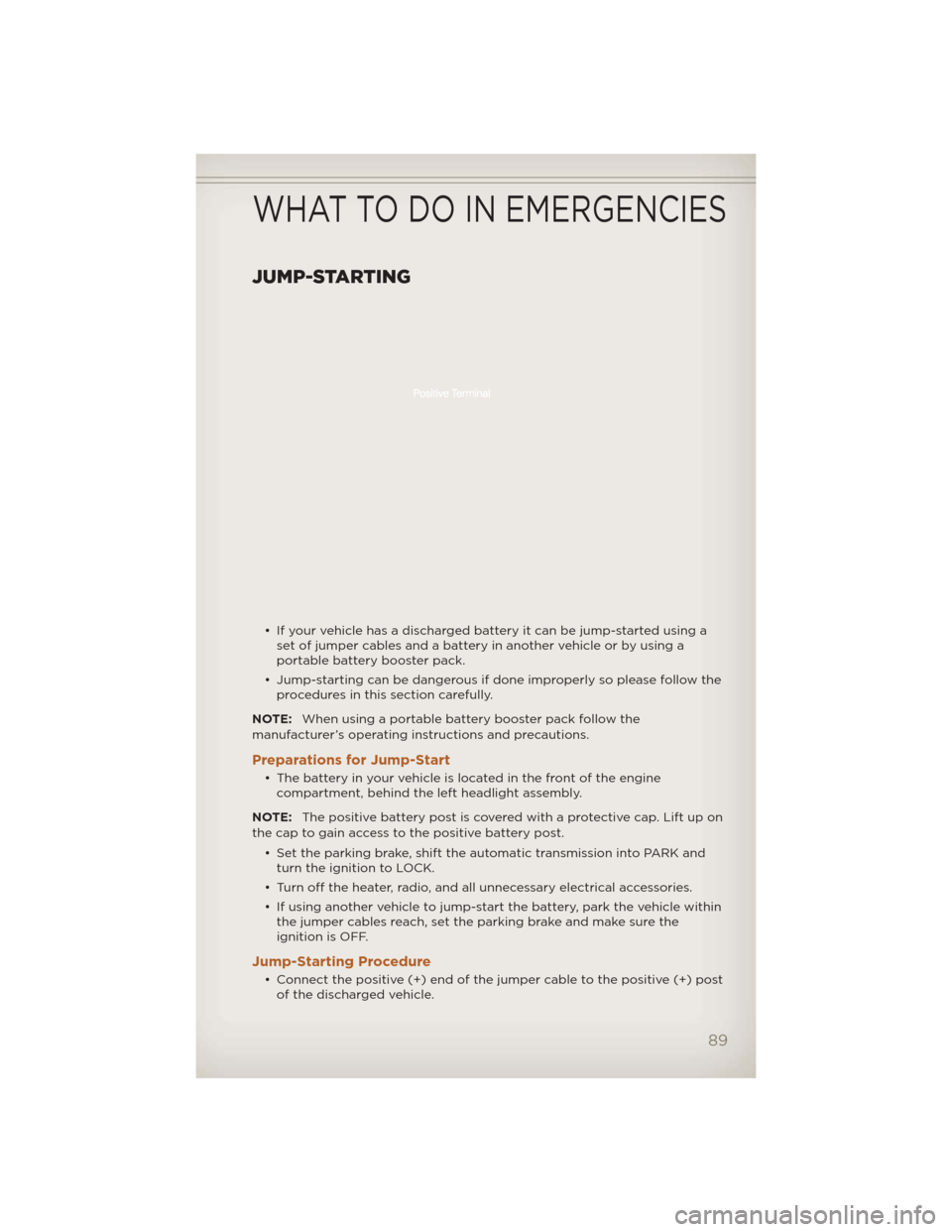
• The battery in your vehicle is located in the front of the engine compartment, behind the left headlight assembly.
NOTE: The positive battery post is covered with a protective cap. Lift up on
the cap to gain access to the positive battery post.
• Set the parking brake, shift the automatic transmission into PARK andturn the ignition to LOCK.
• Turn off the heater, radio, and all unnecessary electrical accessories.
• If using another vehicle to jump-start the battery, park the vehicle within the jumper cables reach, set the parking brake and make sure the
ignition is OFF.
Jump-Starting Procedure
• Connect the positive (+) end of the jumper cable to the positive (+) postof the discharged vehicle.
WHAT TO DO IN EMERGENCIES
89
Page 93 of 124
WARNING!(Continued)
• Take care to avoid the radiator cooling fan whenever the hood israised. It can start anytime the ignition switch is on. You can be
injured by moving fan blades.
• Remove any metal jewelry, such as watch bands or bracelets, that might make an inadvertent electrical contact. You could be severely
injured.
• Batteries contain sulfuric acid that can burn your skin or eyes and generate hydrogen gas which is flammable and explosive. Keep
open flames or sparks away from the battery.
• Do not allow vehicles to touch each other as this could establish a ground connection and personal injury could result.
• Failure to follow this procedure could result in personal injury or property damage due to battery explosion.
• Do not connect the cable to the negative post (-) of the discharged battery. The resulting electrical spark could cause the battery to
explode and could result in personal injury.
SHIFT LEVER OVERRIDE
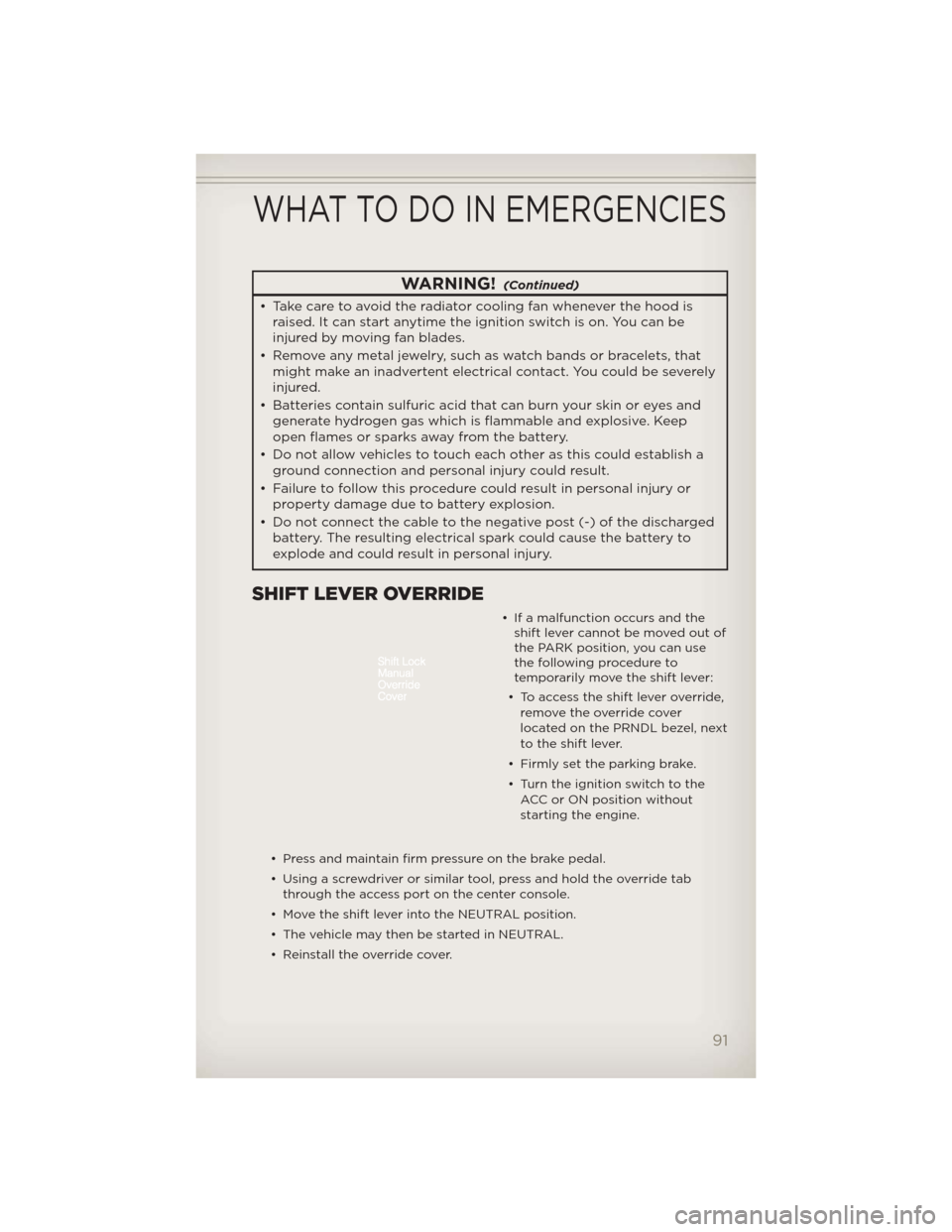
• If a malfunction occurs and theshift lever cannot be moved out of
the PARK position, you can use
the following procedure to
temporarily move the shift lever:
• To access the shift lever override, remove the override cover
located on the PRNDL bezel, next
to the shift lever.
• Firmly set the parking brake.
• Turn the ignition switch to the ACC or ON position without
starting the engine.
• Press and maintain firm pressure on the brake pedal.
• Using a screwdriver or similar tool, press and hold the override tab through the access port on the center console.
• Move the shift lever into the NEUTRAL position.
• The vehicle may then be started in NEUTRAL.
• Reinstall the override cover.
WHAT TO DO IN EMERGENCIES
91
Page 96 of 124
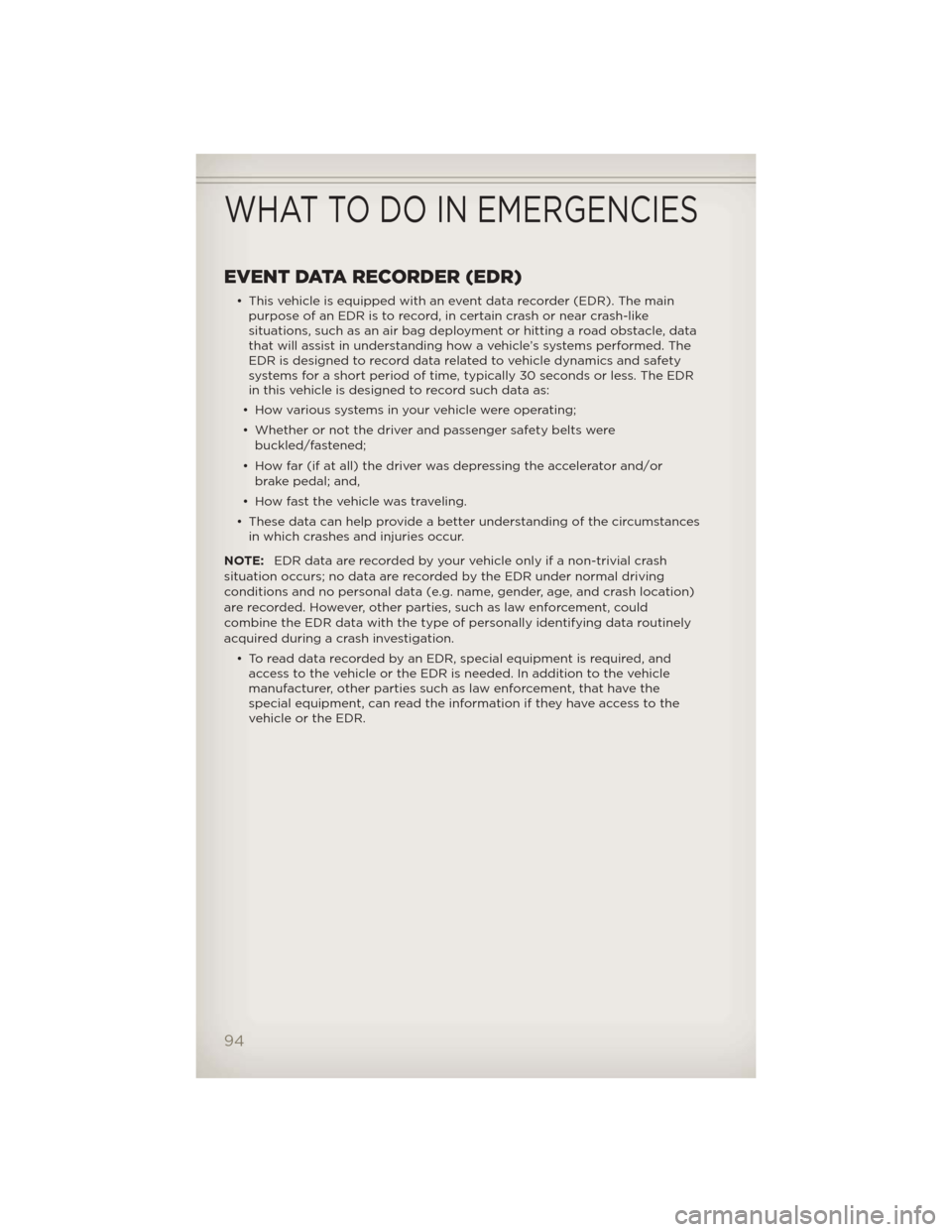
EVENT DATA RECORDER (EDR)
• This vehicle is equipped with an event data recorder (EDR). The mainpurpose of an EDR is to record, in certain crash or near crash-like
situations, such as an air bag deployment or hitting a road obstacle, data
that will assist in understanding how a vehicle’s systems performed. The
EDR is designed to record data related to vehicle dynamics and safety
systems for a short period of time, typically 30 seconds or less. The EDR
in this vehicle is designed to record such data as:
• How various systems in your vehicle were operating;
• Whether or not the driver and passenger safety belts were buckled/fastened;
• How far (if at all) the driver was depressing the accelerator and/or brake pedal; and,
• How fast the vehicle was traveling.
• These data can help provide a better understanding of the circumstances in which crashes and injuries occur.
NOTE: EDR data are recorded by your vehicle only if a non-trivial crash
situation occurs; no data are recorded by the EDR under normal driving
conditions and no personal data (e.g. name, gender, age, and crash location)
are recorded. However, other pa rties, such as law enforcement, could
combine the EDR data with the type of personally identifying data routinely
acquired during a crash investigation.
• To read data recorded by an EDR, special equipment is required, andaccess to the vehicle or the EDR is needed. In addition to the vehicle
manufacturer, other parties such as law enforcement, that have the
special equipment, can read the information if they have access to the
vehicle or the EDR.
WHAT TO DO IN EMERGENCIES
94
Page 100 of 124
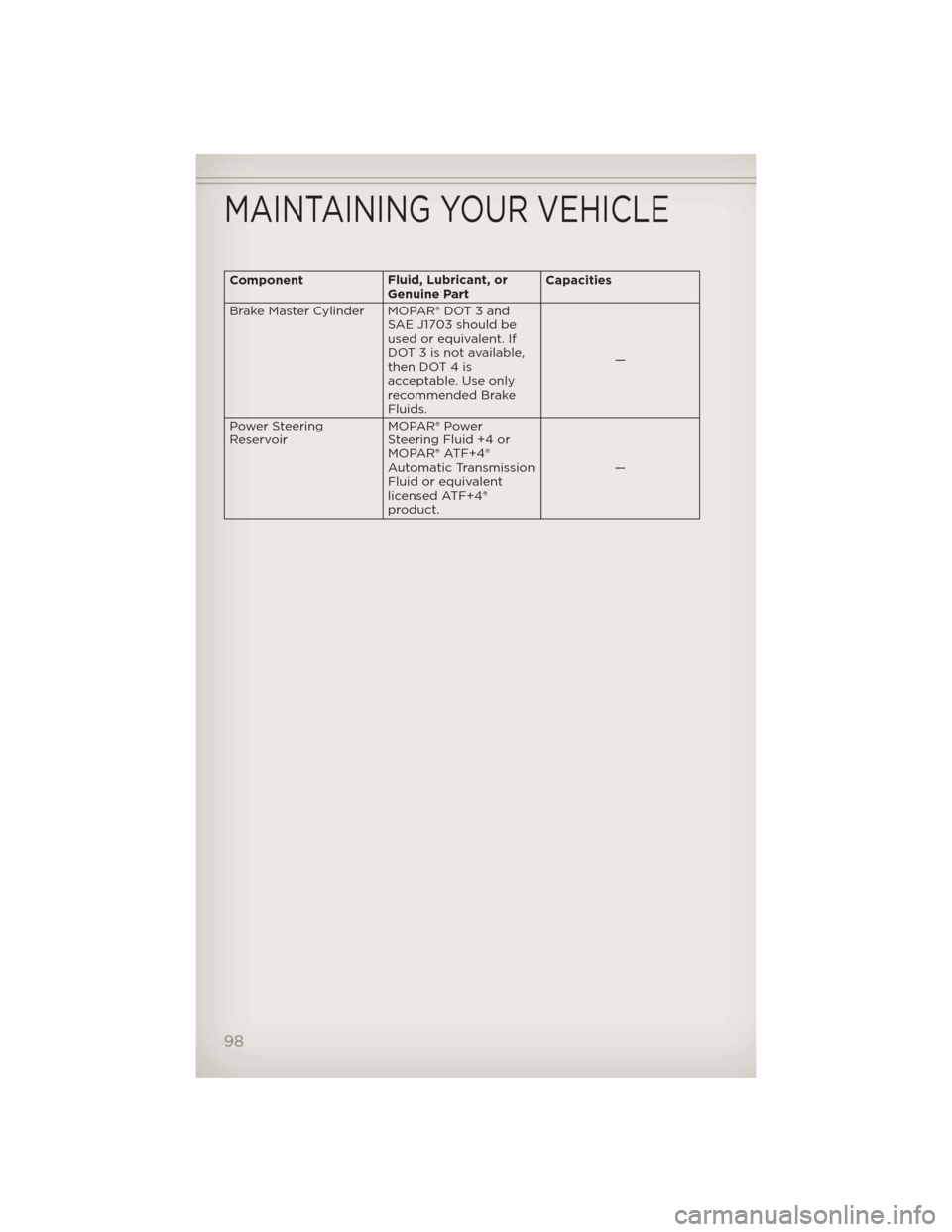
ComponentFluid, Lubricant, or
Genuine PartCapacities
Brake Master Cylinder MOPAR® DOT 3 and SAE J1703 should be
used or equivalent. If
DOT 3 is not available,
then DOT 4 is
acceptable. Use only
recommended Brake
Fluids. —
Power Steering
Reservoir MOPAR® Power
Steering Fluid +4 or
MOPAR® ATF+4®
Automatic Transmission
Fluid or equivalent
licensed ATF+4®
product. —
MAINTAINING YOUR VEHICLE
98
Page 101 of 124
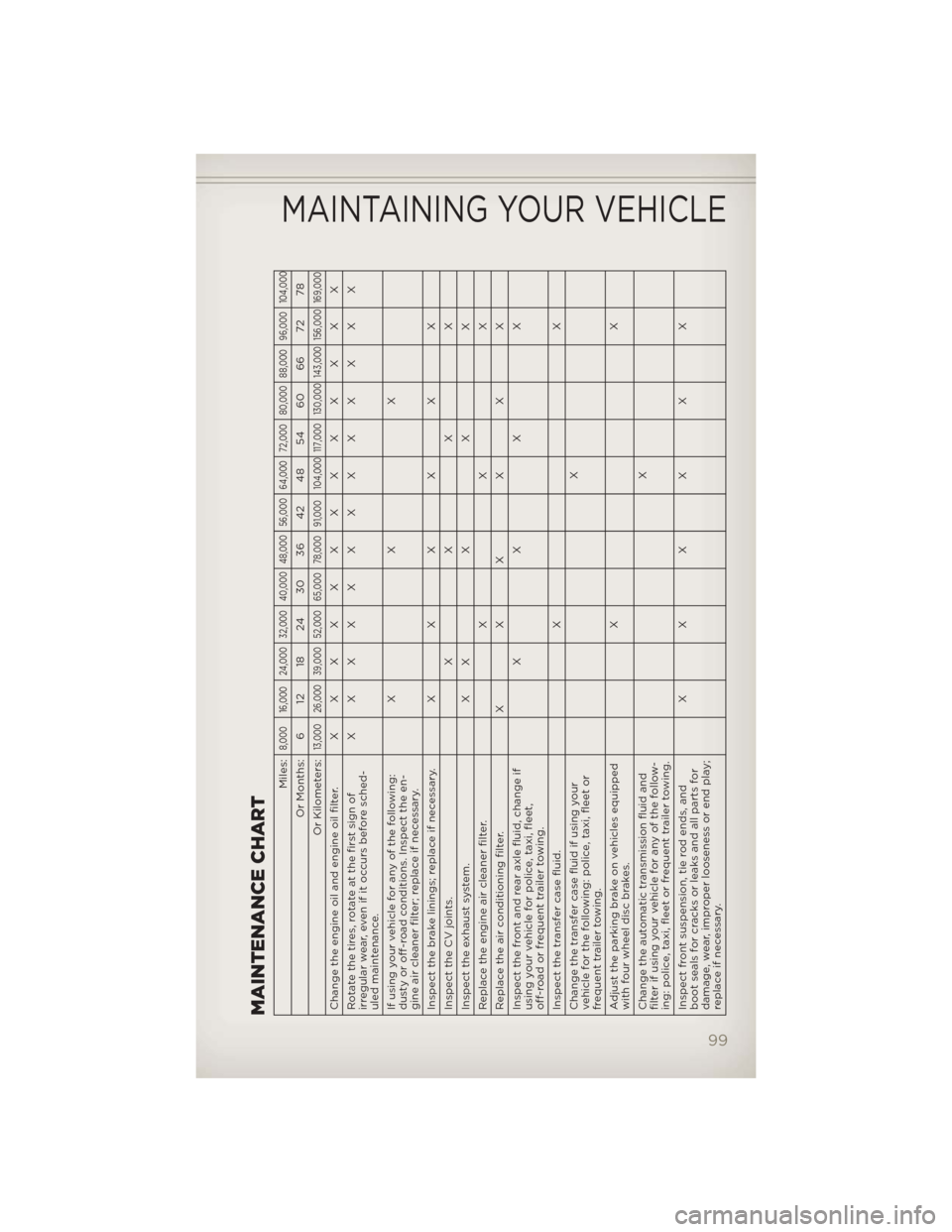
MAINTENANCE CHART
Miles:
8,000 16,000 24,000 32,000 40,000 48,000 56,000 64,000 72,000 80,000 88,000 96,000 104,000
Or Months: 6 12 18 24 30 36 42 48 54 60 66 72 78
Or Kilometers:
13,000 26,000 39,000 52,000 65,000 78,000 91,000 104,000 117,000 130,000 143,000 156,000 169,000
Change the engine oil and engine oil filter. XXXXXXXXXXXXX
Rotate the tires, rotate at the first sign of
irregular wear, even if it occurs before sched-
uled maintenance. XXXXXXXXXXXXX
If using your vehicle for any of the following:
dusty or off-road conditions. Inspect the en-
gine air cleaner filter; replace if necessary. XXX
Inspect the brake linings; replace if necessary. XXXXXX
InspecttheCVjoints. XXXX
Inspecttheexhaustsystem. XXXXX
Replace the engine air cleaner filter. X X X
Replace the air conditioning filter. X X X X X X
Inspect the front and rear axle fluid, change if
using your vehicle for police, taxi, fleet,
off-road or frequent trailer towing. XXXX
Inspect the transfer case fluid. X X
Change the transfer case fluid if using your
vehicle for the following: police, taxi, fleet or
frequent trailer towing. X
Adjust the parking brake on vehicles equipped
with four wheel disc brakes. XX
Change the automatic transmission fluid and
filter if using your vehicle for any of the follow-
ing: police, taxi, fleet or frequent trailer towing. X
Inspect front suspension, tie rod ends, and
boot seals for cracks or leaks and all parts for
damage, wear, improper looseness or end play;
replace if necessary. XXXXXX
MAINTAINING YOUR VEHICLE
99
Page 105 of 124
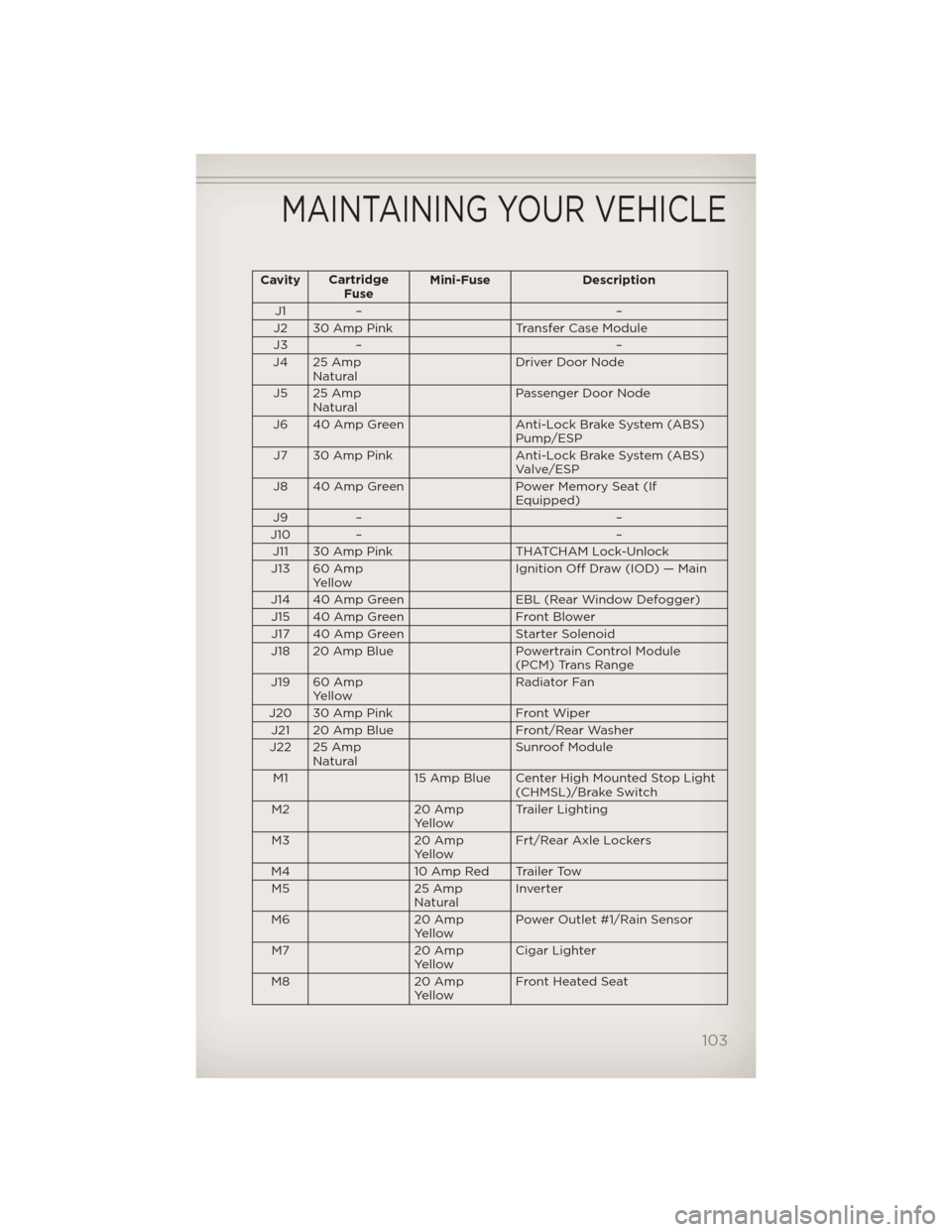
CavityCartridge
Fuse Mini-Fuse Description
J1 – –
J2 30 Amp Pink Transfer Case Module
J3 – –
J4 25 Amp Natural Driver Door Node
J5 25 Amp Natural Passenger Door Node
J6 40 Amp Green Anti-Lock Brake System (ABS)
Pump/ESP
J7 30 Amp Pink Anti-Lock Brake System (ABS)
Valve/ESP
J8 40 Amp Green Power Memory Seat (If
Equipped)
J9 – –
J10 – –
J11 30 Amp Pink THATCHAM Lock-Unlock
J13 60 Amp Yellow Ignition Off Draw (IOD) — Main
J14 40 Amp Green EBL (Rear Window Defogger)
J15 40 Amp Green Front Blower
J17 40 Amp Green Starter Solenoid
J18 20 Amp Blue Powertrain Control Module
(PCM) Trans Range
J19 60 Amp Yellow Radiator Fan
J20 30 Amp Pink Front Wiper
J21 20 Amp Blue Front/Rear Washer
J22 25 Amp Natural Sunroof Module
M1 15 Amp Blue Center High Mounted Stop Light
(CHMSL)/Brake Switch
M2 20 Amp
Yellow Trailer Lighting
M3 20 Amp
Yellow Frt/Rear Axle Lockers
M4 10 Amp Red Trailer Tow
M5 25 Amp
Natural Inverter
M6 20 Amp
Yellow Power Outlet #1/Rain Sensor
M7 20 Amp
Yellow Cigar Lighter
M8 20 Amp
Yellow Front Heated Seat
MAINTAINING YOUR VEHICLE
103
Page 107 of 124
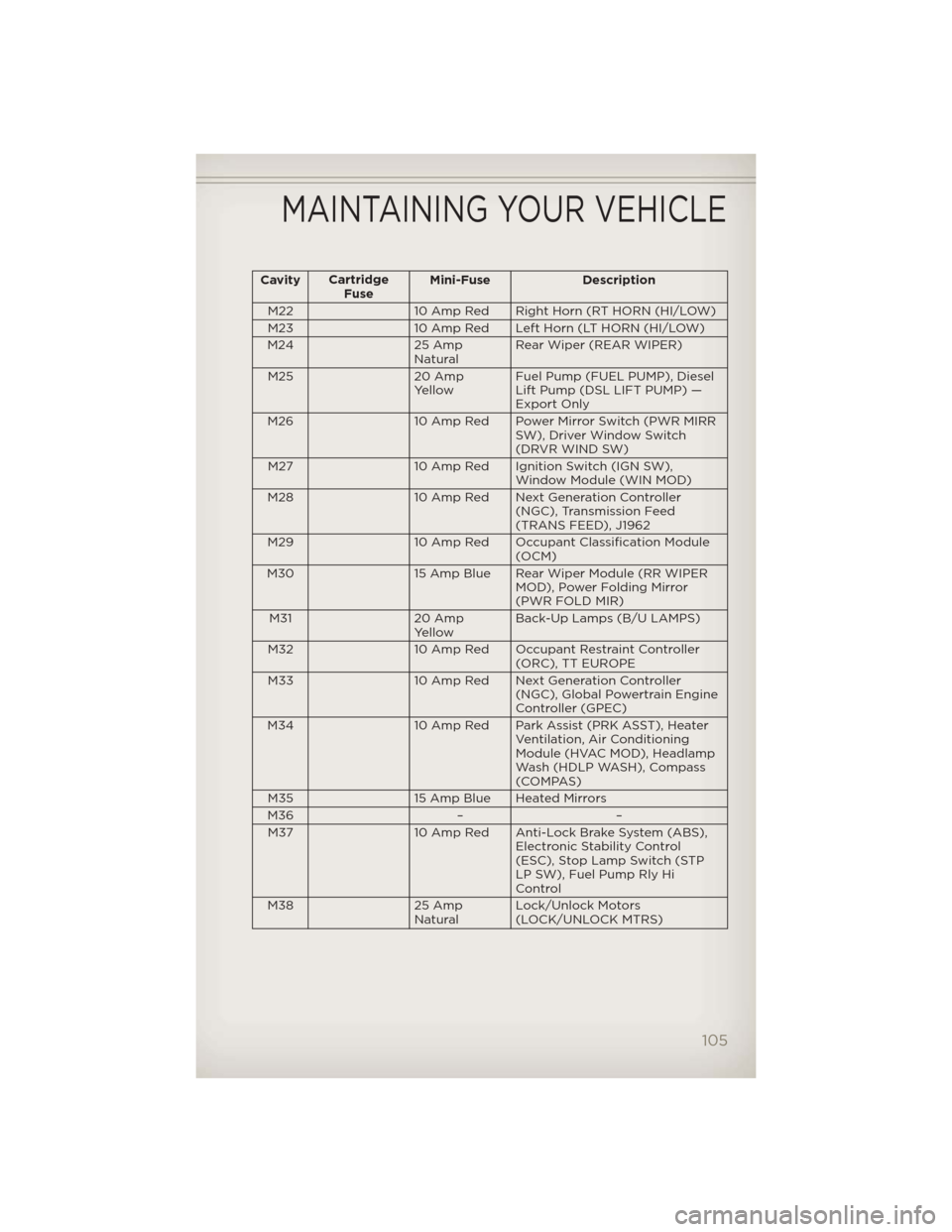
CavityCartridge
Fuse Mini-Fuse Description
M22 10 Amp Red Right Horn (RT HORN (HI/LOW)
M23 10 Amp Red Left Horn (LT HORN (HI/LOW)
M24 25 Amp
Natural Rear Wiper (REAR WIPER)
M25 20 Amp
Yellow Fuel Pump (FUEL PUMP), Diesel
Lift Pump (DSL LIFT PUMP) —
Export Only
M26 10 Amp Red Power Mirror Switch (PWR MIRR
SW), Driver Window Switch
(DRVR WIND SW)
M27 10 Amp Red Ignition Switch (IGN SW),
Window Module (WIN MOD)
M28 10 Amp Red Next Generation Controller
(NGC), Transmission Feed
(TRANS FEED), J1962
M29 10 Amp Red Occupant Classification Module
(OCM)
M30 15 Amp Blue Rear Wiper Module (RR WIPER
MOD), Power Folding Mirror
(PWR FOLD MIR)
M31 20 Amp
Yellow Back-Up Lamps (B/U LAMPS)
M32 10 Amp Red Occupant Restraint Controller
(ORC), TT EUROPE
M33 10 Amp Red Next Generation Controller
(NGC), Global Powertrain Engine
Controller (GPEC)
M34 10 Amp Red Park Assist (PRK ASST), Heater
Ventilation, Air Conditioning
Module (HVAC MOD), Headlamp
Wash (HDLP WASH), Compass
(COMPAS)
M35 15 Amp Blue Heated Mirrors
M36 ––
M37 10 Amp Red Anti-Lock Brake System (ABS),
Electronic Stability Control
(ESC), Stop Lamp Switch (STP
LP SW), Fuel Pump Rly Hi
Control
M38 25 Amp
Natural Lock/Unlock Motors
(LOCK/UNLOCK MTRS)
MAINTAINING YOUR VEHICLE
105
Page 109 of 124
WARNING!(Continued)
• Improperly inflated tires are dangerous and can cause collisions.Under-inflation is the leading cause of tire failure and may result in
severe cracking, component separation, or “blow out”. Over-
inflation reduces a tire’s ability to cushion shock. Objects on the
road and chuck holes can cause damage that results in tire failure.
Unequal tire pressures can cause steering problems. You could lose
control of your vehicle. Over-inflated or under-inflated tires can
affect vehicle handling and can fail suddenly, resulting in loss of
vehicle control.
WHEEL AND WHEEL TRIM CARE
• All wheels and wheel trim, especially aluminum and chrome platedwheels, should be cleaned regularly with a mild soap and water to
prevent corrosion.
• To remove heavy soil and/or excessive brake dust, use MOPAR® Wheel Cleaner or equivalent or select a non-abrasive, non-acidic cleaner.
CAUTION!
Do not use scouring pads, steel wool, a bristle brush, or metal
polishes. Do not use oven cleaner. These products may damage the
wheel's protective finish. Avoid automatic car washes that use acidic
solutions or harsh brushes that may damage the wheel's protective
finish. Only MOPAR® Wheel Cleaner or equivalent is recommended.
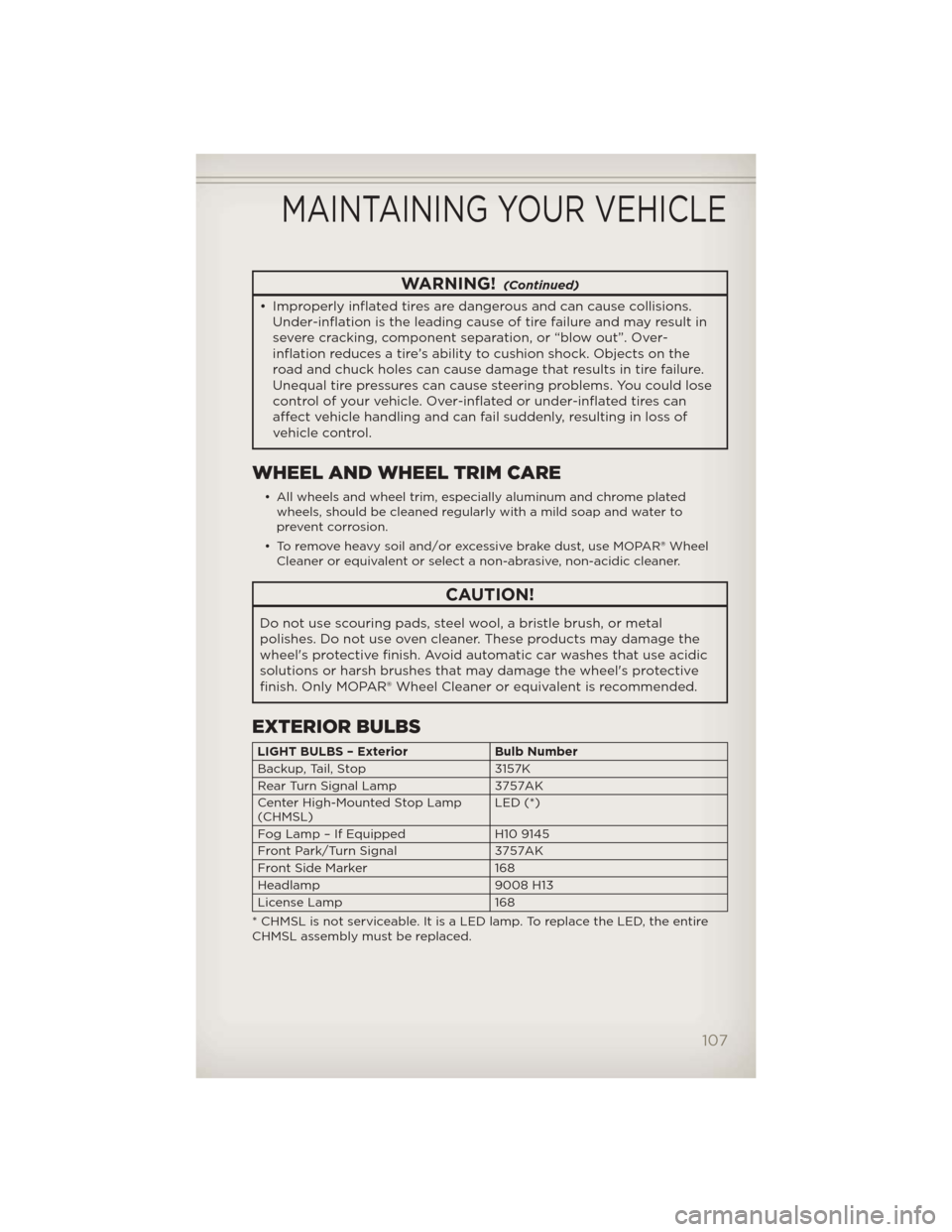
EXTERIOR BULBS
LIGHT BULBS – Exterior Bulb Number
Backup, Tail, Stop 3157K
Rear Turn Signal Lamp 3757AK
Center High-Mounted Stop Lamp
(CHMSL) LED (*)
Fog Lamp – If Equipped H10 9145
Front Park/Turn Signal 3757AK
Front Side Marker 168
Headlamp 9008 H13
License Lamp 168
* CHMSL is not serviceable. It is a LED lamp. To replace the LED, the entire
CHMSL assembly must be replaced.
MAINTAINING YOUR VEHICLE
107