ECU JEEP PATRIOT 2007 1.G User Guide
[x] Cancel search | Manufacturer: JEEP, Model Year: 2007, Model line: PATRIOT, Model: JEEP PATRIOT 2007 1.GPages: 440, PDF Size: 7.26 MB
Page 65 of 440
²If the belt still can't be tightened, or if by pulling and
pushing on the restraint loosens the belt, disconnect
the latch plate from the buckle, turn the latch plate
around, and insert the latch plate into the buckle
again. If you still can't make the child restraint secure,
try a different seating position.
²Buckle the child into the seat according to the child
restraint manufacturer's directions.
²When your child restraint is not in use, secure it in the
vehicle with the seat belt or remove it from the vehicle.
Don't leave it loose in the vehicle. In a sudden stop or
collision, it could strike the occupants or seat backs
and cause serious personal injury.
Automatic-Locking Retractor (ALR)
To operate the switchable retractor, pull the belt from the
retractor until there is enough to allow you to pass
through the child restraint and slide the latch plate into
the buckle. Then pull on the belt until it is all removedfrom the retractor. Allow the belt to return into the
retractor, pulling on the excess webbing to tighten the lap
portion about the child restraint. Follow the instructions
of the child restraint manufacture.
NOTE:To reset this feature you must let all of the belt
webbing return into the retractor. You will not be able to
pull out more webbing until all of the webbing has been
returned back into the retractor.
Lower Anchors and Tether for CHildren (LATCH)
Your vehicle is equipped with the child restraint anchor-
age system called LATCH, which stands for Lower
Anchors and Tether for CHildren. The LATCH system
provides for the installation of the child restraint without
using the vehicle seat belt. All three rear seating positions
have lower anchorages that are capable of accommodat-
ing LATCH-compatible child seats having flexible,
webbing-mounted lower attachments. Child seats with
64 THINGS TO KNOW BEFORE STARTING YOUR VEHICLE
Page 69 of 440
WARNING!
An incorrectly anchored tether strap could lead to
increased head motion and possible injury to the
child. Use only the anchor position directly behind
the child seat to secure a child restraint top tether
strap.
Children Too Large For Booster Seats
Children who are large enough to wear the shoulder belt
comfortably, and whose legs are long enough to bend
over the front of the seat when their back is against the
seat back, should use the lap/shoulder belt in a rear seat.
²Make sure that the child is upright in the seat.
²The lap portion should be low on the hips and as snug
as possible.
²Check belt fit periodically. A child's squirming or
slouching can move the belt out of position.
²If the shoulder belt contacts the face or neck, move the
child closer to the center of the vehicle. Never allow a
child to put the shoulder belt under an arm or behind
their back.
Transporting Pets
Airbags deploying in the front seat could harm your pet.
An unrestrained pet will be thrown about and possibly
injured, or injure a passenger during panic braking or in
a collision.
Pets should be restrained in the rear seat in pet harnesses
or pet carriers that are secured by seat belts.
68 THINGS TO KNOW BEFORE STARTING YOUR VEHICLE
Page 76 of 440
NWindshield Wiper Operation.............125
NIntermittent Wiper System...............125
NAdding Washer Fluid..................126
mTilt Steering Column....................126
mElectronic Speed Control Ð If Equipped......127
NTo Activate..........................127
NTo Set At A Desired Speed...............128
NTo Deactivate........................128
NTo Resume Speed.....................128
NTo Vary The Speed Setting...............128
NManual Transaxle.....................129
NTo Accelerate For Passing...............129
mGarage Door Opener Ð If Equipped.........130NProgramming The Universal Transceiver.....131
NªRolling Codeº Programming............133
NCanadian Programming/Gate Programming . . 135
NOperation...........................135
NReprogramming A Single Button..........135
NSecurity............................136
mAnti-Lock Brake System (ABS) ± If Equipped . . . 136
mElectronic Brake Control System ±
ABS/TCS/BAS/ERM/HDC/ESP...........137
NAnti-Lock Brake System ± ABS............137
NTraction Control System (TCS)............138
NBrake Assist System (BAS)...............138
NElectronic Roll Mitigation (ERM)..........139
UNDERSTANDING THE FEATURES OF YOUR VEHICLE 75
3
Page 118 of 440
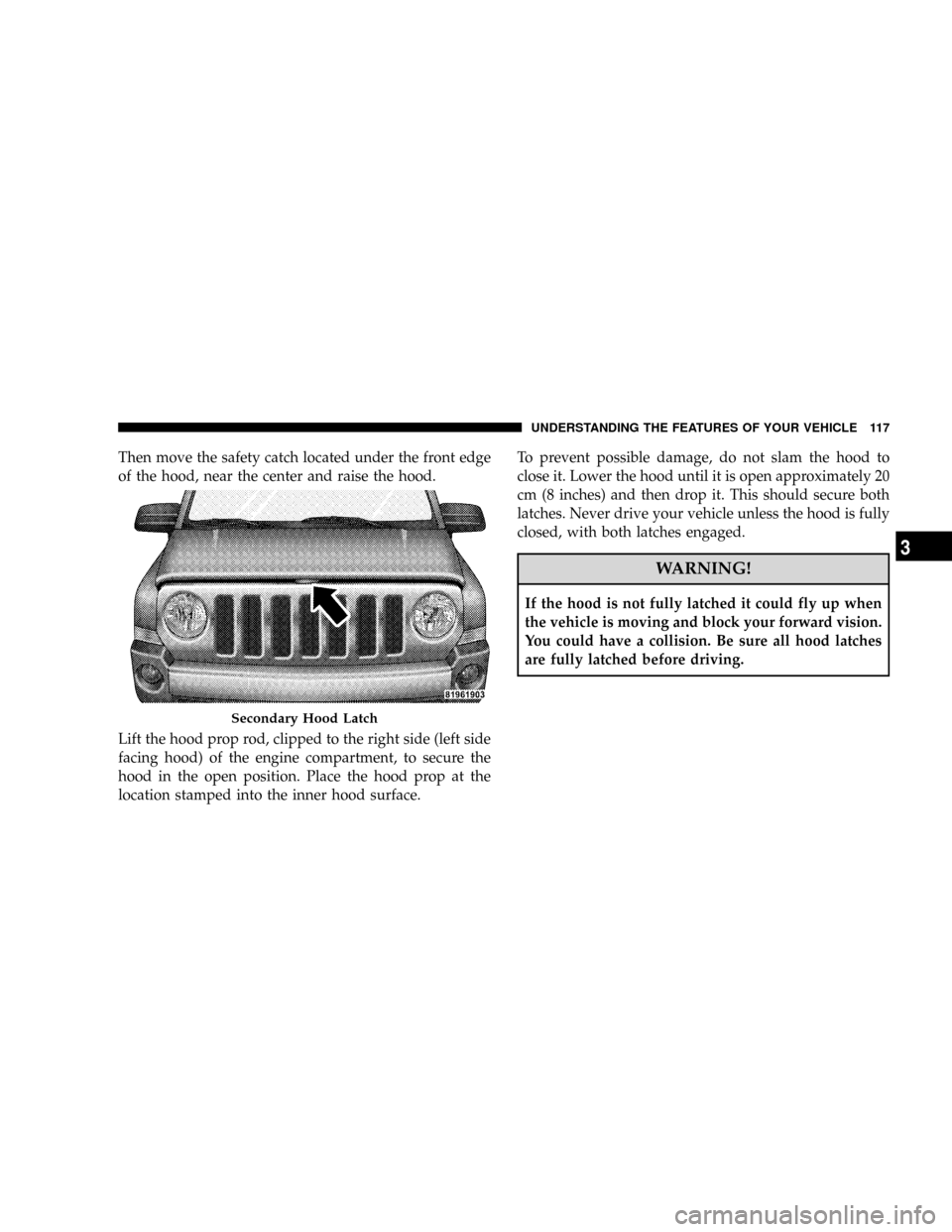
Then move the safety catch located under the front edge
of the hood, near the center and raise the hood.
Lift the hood prop rod, clipped to the right side (left side
facing hood) of the engine compartment, to secure the
hood in the open position. Place the hood prop at the
location stamped into the inner hood surface.To prevent possible damage, do not slam the hood to
close it. Lower the hood until it is open approximately 20
cm (8 inches) and then drop it. This should secure both
latches. Never drive your vehicle unless the hood is fully
closed, with both latches engaged.
WARNING!
If the hood is not fully latched it could fly up when
the vehicle is moving and block your forward vision.
You could have a collision. Be sure all hood latches
are fully latched before driving.
Secondary Hood Latch
UNDERSTANDING THE FEATURES OF YOUR VEHICLE 117
3
Page 137 of 440
Security
If you sell your vehicle, be sure to erase the frequencies.
To erase all of the previously trained frequencies, hold
down both outside buttons until the indicator light
begins to flash.
This device complies with part 15 of FCC rules and with
RS-210 of Industry Canada. Operation is subject to the
following conditions:
1. This device may not cause harmful interference.
2. This device must accept any interference that may be
received including interference that may cause undesired
operation.
NOTE:Changes or modifications not expressly ap-
proved by the party responsible for compliance could
void the user's authority to operate the equipment.HomeLinktis a trademark owned by Johnson Controls,
Inc.
ANTI-LOCK BRAKE SYSTEM (ABS) ± IF
EQUIPPED
This system aids the driver in maintaining vehicle control
under adverse braking conditions. The system controls
hydraulic brake pressure to prevent wheel lockup and
help avoid skidding on slippery surfaces during braking.
NOTE:ABS improves steering control of the vehicle
during hard braking maneuvers.
136 UNDERSTANDING THE FEATURES OF YOUR VEHICLE
Page 147 of 440
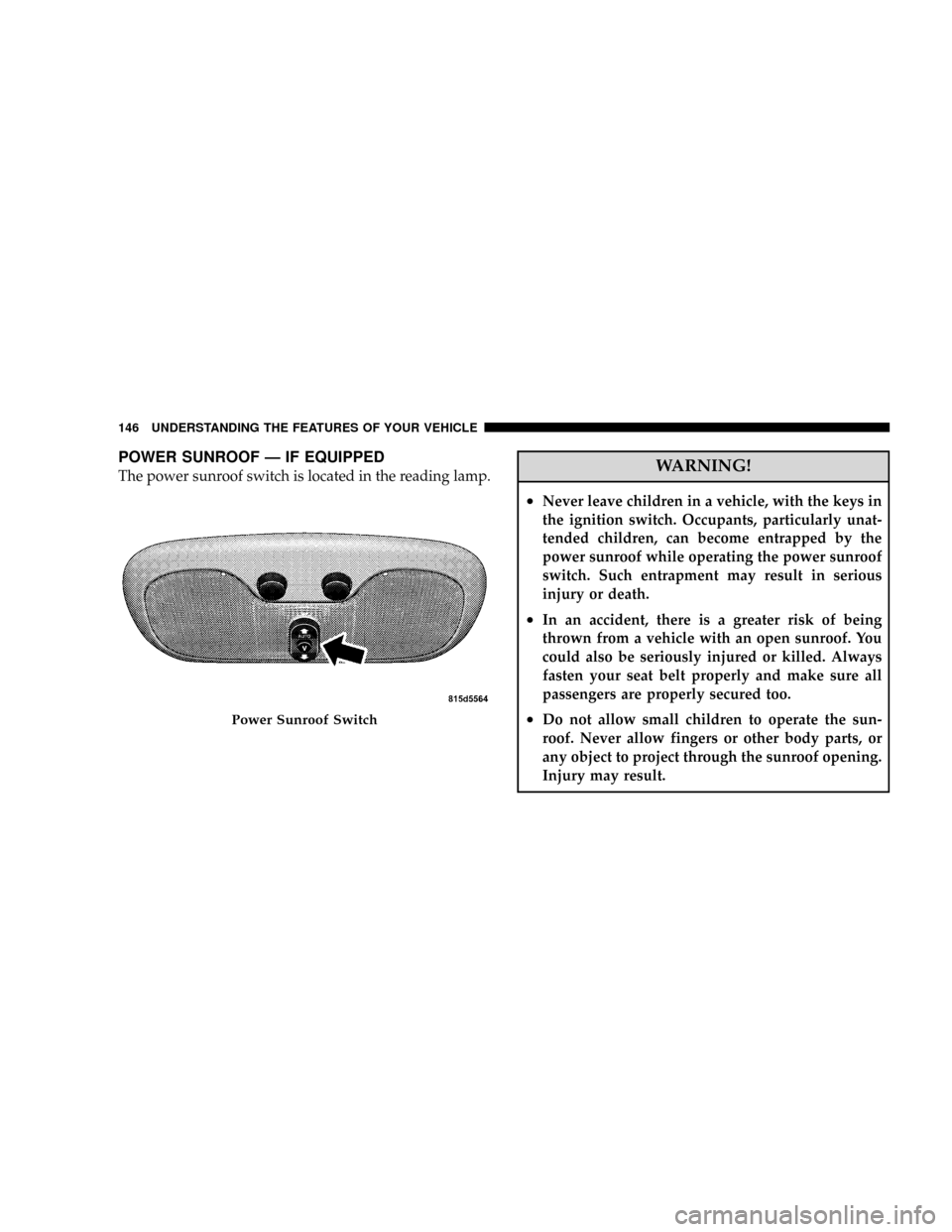
POWER SUNROOF Ð IF EQUIPPED
The power sunroof switch is located in the reading lamp.WARNING!
²Never leave children in a vehicle, with the keys in
the ignition switch. Occupants, particularly unat-
tended children, can become entrapped by the
power sunroof while operating the power sunroof
switch. Such entrapment may result in serious
injury or death.
²In an accident, there is a greater risk of being
thrown from a vehicle with an open sunroof. You
could also be seriously injured or killed. Always
fasten your seat belt properly and make sure all
passengers are properly secured too.
²Do not allow small children to operate the sun-
roof. Never allow fingers or other body parts, or
any object to project through the sunroof opening.
Injury may result.Power Sunroof Switch
146 UNDERSTANDING THE FEATURES OF YOUR VEHICLE
Page 153 of 440
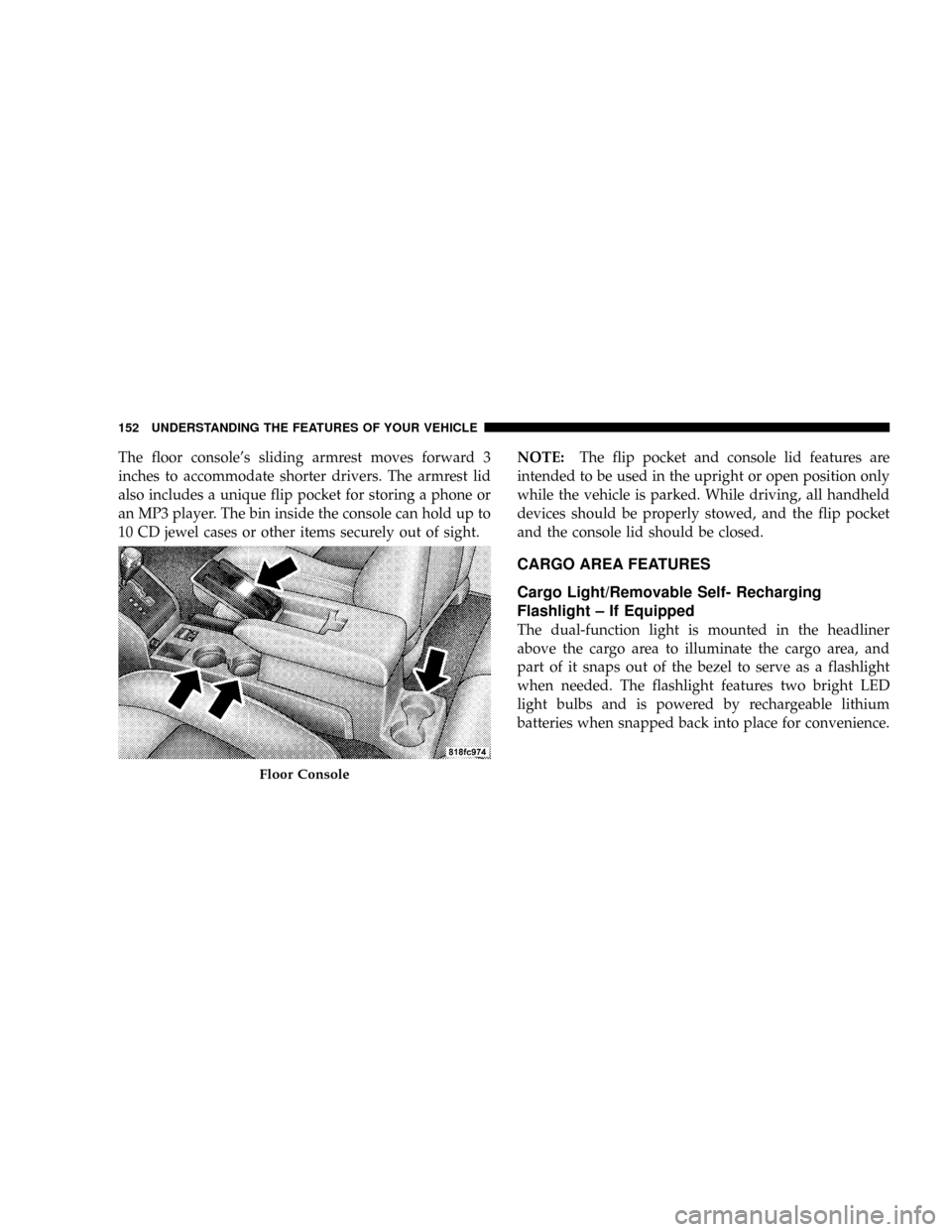
The floor console's sliding armrest moves forward 3
inches to accommodate shorter drivers. The armrest lid
also includes a unique flip pocket for storing a phone or
an MP3 player. The bin inside the console can hold up to
10 CD jewel cases or other items securely out of sight.NOTE:The flip pocket and console lid features are
intended to be used in the upright or open position only
while the vehicle is parked. While driving, all handheld
devices should be properly stowed, and the flip pocket
and the console lid should be closed.
CARGO AREA FEATURES
Cargo Light/Removable Self- Recharging
Flashlight ± If Equipped
The dual-function light is mounted in the headliner
above the cargo area to illuminate the cargo area, and
part of it snaps out of the bezel to serve as a flashlight
when needed. The flashlight features two bright LED
light bulbs and is powered by rechargeable lithium
batteries when snapped back into place for convenience.
Floor Console
152 UNDERSTANDING THE FEATURES OF YOUR VEHICLE
Page 157 of 440
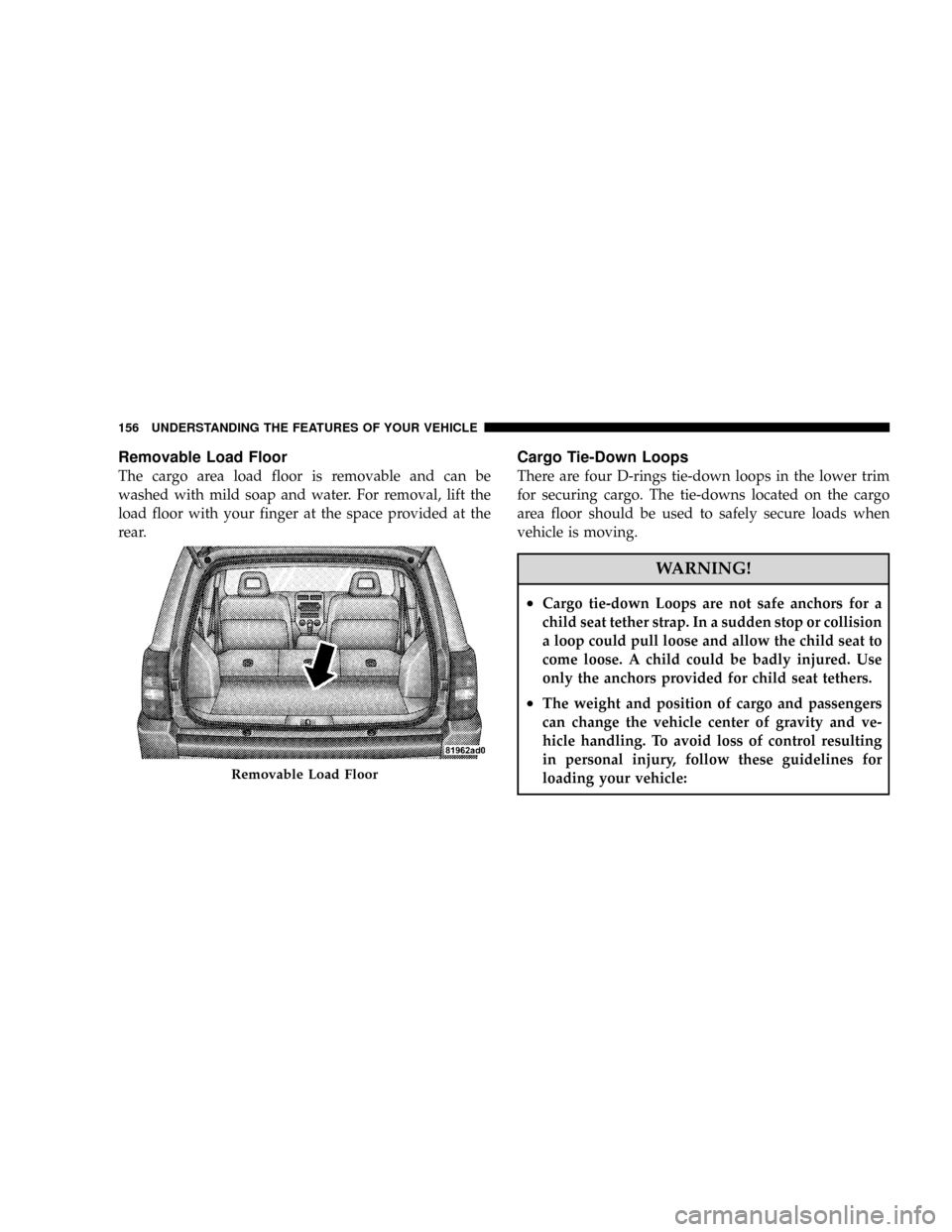
Removable Load Floor
The cargo area load floor is removable and can be
washed with mild soap and water. For removal, lift the
load floor with your finger at the space provided at the
rear.
Cargo Tie-Down Loops
There are four D-rings tie-down loops in the lower trim
for securing cargo. The tie-downs located on the cargo
area floor should be used to safely secure loads when
vehicle is moving.
WARNING!
²Cargo tie-down Loops are not safe anchors for a
child seat tether strap. In a sudden stop or collision
a loop could pull loose and allow the child seat to
come loose. A child could be badly injured. Use
only the anchors provided for child seat tethers.
²The weight and position of cargo and passengers
can change the vehicle center of gravity and ve-
hicle handling. To avoid loss of control resulting
in personal injury, follow these guidelines for
loading your vehicle:
Removable Load Floor
156 UNDERSTANDING THE FEATURES OF YOUR VEHICLE
Page 161 of 440
CAUTION!
Use care when washing the inside of the rear window
to prevent damage to heating elements. Use a soft
cloth and a mild washing solution, wiping parallel to
the heating elements. Also, keep all objects a safe
distance from the window to prevent damaging the
heating elements.
ROOF LUGGAGE RACK Ð IF EQUIPPED
External racks do not increase the total load carrying
capacity of the vehicle. Be sure that the total occupant
and luggage load inside the vehicle, plus the load on the
luggage rack, do not exceed the rated vehicle capacity.
This vehicle is not equipped with roof rack cross rails as
built, unless ordered as optional equipment. Cross rails
must be installed prior to carrying loads on the roof rack.
If not equipped, your authorized dealer can order andinstall Mopartcross rails built specifically for this roof
rack system or a number of after market rails that are
tailored to your lifestyle or activities.
NOTE:The optional cross rails have seven specific
locations identified by a feature on both the side rail and
the cross rail. Cross rails must be secured in one of the
seven detent locations on the side rail to prevent move-
ment with a sudden stop. For improved wind noise
performance when cross rails are not in use, place them
in detent positions #2 (second detent from the front of the
vehicle) and #7 (detent closest to the rear of the vehicle)
as indicated with a unique feature on the side rails.
160 UNDERSTANDING THE FEATURES OF YOUR VEHICLE
Page 162 of 440
CAUTION!
²To prevent damage to the roof of your vehicle, DO NOT
carry any loads on the roof rack without cross rails
installed. The load should be secured and placed on top of
the cross rails, not directly on the roof. If it is necessary to
place the load on the roof, place a blanket or some other
protection between the load and the roof surface.
²To avoid damage to the roof rack and vehicle, do not
exceed the rated load capacity of your cross rail system or
the roof rack system maximum load capacity of 150 lbs (68
kg). Always distribute heavy loads as evenly as possible
and secure the load appropriately.
²Long loads which extend over the windshield, such as
wood panels or surfboards, should be secured to both the
front and rear of the vehicle.
²Travel at reduced speeds and turn corners carefully when
carrying large or heavy loads on the roof rack. Wind forces,
due to natural causes or nearby truck traffic, can add
sudden upward loads. This is especially true on large flat
loads and may result in damage to the cargo or your
vehicle.
WARNING!
Cargo must be securely tied before driving your
vehicle. Improperly secured loads can fly off the
vehicle, particularly at high speeds, resulting in per-
sonal injury or property damage. Follow the roof rack
ªCautionsº when carrying cargo on your roof rack.
UNDERSTANDING THE FEATURES OF YOUR VEHICLE 161
3