airbag JEEP PATRIOT 2007 1.G User Guide
[x] Cancel search | Manufacturer: JEEP, Model Year: 2007, Model line: PATRIOT, Model: JEEP PATRIOT 2007 1.GPages: 440, PDF Size: 7.26 MB
Page 56 of 440
²TheDriver and Front Passenger Airbag/Inflator
Unitsare located in the center of the steering wheel
and the passenger side of the instrument panel. When
the ORC detects a collision requiring the airbags, it
signals the inflator units. A large quantity of nontoxic
gas is generated to inflate the front airbags. Different
airbag inflation rates may be possible based on colli-
sion severity. The steering wheel hub trim cover, and
the upper passenger side of the instrument panel
separate and fold out of the way, as the bags inflate to
their full size. The bags fully inflate in about 50 - 70
milliseconds. This is about half of the time that it takes
to blink your eyes. The bags then quickly deflate while
helping to restrain the driver and front passenger. The
driver's front airbag gas is vented through vent holes
in the sides of the airbag. The passenger's front airbag
gas is vented through vent holes in the sides of the
airbag. In this way, the airbags do not interfere with
your control of the vehicle.²TheSide Impact SRS Side Curtain Airbagare de-
signed to activate only in certain side collisions. When
the ORC (with side impact option) detects a collision
requiring the side curtain airbag to inflate, it signals
the inflators on the crash side of the vehicle. A quantity
of nontoxic gas is generated to inflate the side curtain
airbag. The inflating side curtain airbag pushes the
outside edge of the headliner out of the way and
covers the window. The airbag inflates in about 30
milliseconds (about one quarter of the time that it
takes to blink your eyes) with enough force to injure
you if you are not belted and seated properly, or if
items are positioned in the area where the side curtain
airbag inflates. This especially applies to children. The
side curtain airbag is only about 3-1/2 inches (9 cm)
thick when it is inflated.
²TheKnee Impact Bolstershelp protect the knees of
the driver and the front passenger, and position every-
one for the best interaction with the front airbag.
THINGS TO KNOW BEFORE STARTING YOUR VEHICLE 55
2
Page 57 of 440
If A Deployment Occurs
The airbag system is designed to deploy when the ORC
detects a moderate-to-severe collision, to help restrain the
driver and front passenger, and then to immediately
deflate.
NOTE:A frontal collision that is not severe enough to
need airbag protection will not activate the system. This
does not mean something is wrong with the airbag
system.
If you do have a collision, which deploys the airbags, any
or all of the following may occur:
²The nylon airbag material may sometimes cause abra-
sions and/or skin reddening to the driver and front
passenger as the airbags deploy and unfold. The
abrasions are similar to friction rope burns or those
you might get sliding along a carpet or gymnasium
floor. They are not caused by contact with chemicals.
They are not permanent and normally heal quickly.However, if you haven't healed significantly within a
few days, or if you have any blistering, see your doctor
immediately.
²As the airbags deflate, you may see some smoke-like
particles. The particles are a normal by-product of the
process that generates the nontoxic gas used for airbag
inflation. These airborne particles may irritate the skin,
eyes, nose, or throat. If you have skin or eye irritation,
rinse the area with cool water. For nose or throat
irritation, move to fresh air. If the irritation continues,
see your doctor. If these particles settle on your
clothing, follow the garment manufacturer's instruc-
tions for cleaning.
²It is not advisable to drive your vehicle after the
airbags have been deployed. If you are involved in
another collision, the airbags will not be in place to
protect you.
56 THINGS TO KNOW BEFORE STARTING YOUR VEHICLE
Page 58 of 440
WARNING!
Deployed airbags can't protect you in another colli-
sion. Have the airbags replaced by an authorized
dealer as soon as possible.
Enhanced Accident Response System
In the event of an impact that causes airbag deployment,
with the vehicle stopped, and the vehicle communication
network intact, and the power intact, the Enhanced Acci-
dent Response System performs the following functions:
²Cuts off fuel to the engine.
²Flashes hazard lights.
²Turns on the interior lamps which remain on as long as
the battery has power or until the ignition key is
removed.
²Unlocks the doors automatically
Maintaining Your Airbag System
WARNING!
²Modifications to any part of the airbag system
could cause it to fail when you need it. You could
be injured because the airbags are not there to
protect you. Do not modify the components or
wiring, including adding any kind of badges or
stickers to the steering wheel hub trim cover or the
upper passenger side of the instrument panel. Do
not modify the front bumper, vehicle body struc-
ture, or frame.
²You need proper knee impact protection in a
collision. Do not mount or locate any aftermarket
equipment on or behind the knee impact bolster.
²It is dangerous to try to repair any part of the
airbag system yourself. Be sure to tell anyone who
works on your vehicle that it has airbags.
THINGS TO KNOW BEFORE STARTING YOUR VEHICLE 57
2
Page 59 of 440
Airbag Warning Light
You will want to have the airbags ready to
inflate for your protection in an impact. While
the airbag system is designed to be mainte-
nance free, if any of the following occurs, have
an authorized dealer service the system promptly:
²The Airbag Warning Light does not come on or flickers
during the 6 to 8 seconds when the ignition switch is
first turned on.
²The light remains on or flickers after the 6 to 8 second
interval.
²The light flickers or comes on and remains on while
driving.
Event Data Recorder (EDR)
In the event of an accident, your vehicle is designed to
record up to 5 - seconds of specific vehicle data param-
eters (see list below) in an event data recorder prior to the
moment of airbag deployment, or near-deployment, and
up to a quarter second of high-speed deceleration data
during and/or after air bag deployment or near-
deployment. EDR data are ONLY recorded if an airbag
deploys, or nearly deploys, and are otherwise unavail-
able.
NOTE:
1. A near-deployment event occurs when the airbag
sensor detects severe vehicle deceleration usually indica-
tive of a crash, but not severe enough to warrant airbag
deployment.
2. Under certain circumstances, EDR data may not be
recorded (e.g., loss of battery power).
58 THINGS TO KNOW BEFORE STARTING YOUR VEHICLE
Page 61 of 440
Data Parameters that May Be Recorded:
²Diagnostic trouble code(s) and warning lamp status
for electronically-controlled safety systems, including
the airbag system
²Airbag disable lamp status (if equipped)
²9Time9of airbag deployment (in terms of ignition
cycles and vehicle mileage)
²Airbag deployment level (if applicable)
²Impact acceleration and angle
²Seatbelt status
²Brake status (service and parking brakes)
²Accelerator status (including vehicle speed)
²Engine control status (including engine speed)
²Transmission gear selection
²Cruise control status
²Traction/stability control status
²Tire pressure monitoring system status
Child Restraint
Everyone in your vehicle needs to be buckled up at all
times Ð babies and children, too. Every state in the
United States and all Canadian provinces require that
small children ride in proper restraint systems. This is the
law, and you can be prosecuted for ignoring it.
Children 12 years and under should ride properly buck-
led up in a rear seat, if available. According to crash
statistics, children are safer when properly restrained in
the rear seats, rather than in the front.
60 THINGS TO KNOW BEFORE STARTING YOUR VEHICLE
Page 63 of 440
²Rearward-facing child seats mustNEVERbe used in
the front seat of a vehicle with a front passenger
airbag. An airbag deployment could cause severe
injury or death to infants in this position.
²Children who weigh more than 20 lbs (9 kg) and who
are older than one year can ride forward-facing in the
vehicle. Forward-facing child seats and convertible
child seats used in the forward-facing direction are for
children who weigh 20 to 40 lbs (9 to 18 kg) and who
are older than one year. These child seats are also held
in the vehicle by the lap/shoulder belt or the LATCH
child restraint anchorage system.
²The belt-positioning booster seat is for children weigh-
ing more than 40 lbs (18 kg), but who are still too small
to fit the vehicle's seat belts properly. If the child cannot
sit with knees bent over the vehicle's cushion while the
child's back is against the seat back; they should use a
Belt Positioning Booster Seat. The child and boosterseat are held in the vehicle by the lap/shoulder belt.
(Some booster seats are equipped with a front shield
and are held in the vehicle by the lap portion.)
NOTE:For additional information refer to
www.seatcheck.org.
WARNING!
²Improper installation can lead to failure of an
infant or child restraint. It could come loose in a
collision. The child could be badly injured or
killed. Follow the manufacturer's directions ex-
actly when installing an infant or child restraint.
²A rearward facing child restraint should only be
used in a rear seat. A rearward facing child re-
straint in the front seat may be struck by a deploy-
ing passenger airbag which may cause severe or
fatal injury to the infant.
62 THINGS TO KNOW BEFORE STARTING YOUR VEHICLE
Page 69 of 440
WARNING!
An incorrectly anchored tether strap could lead to
increased head motion and possible injury to the
child. Use only the anchor position directly behind
the child seat to secure a child restraint top tether
strap.
Children Too Large For Booster Seats
Children who are large enough to wear the shoulder belt
comfortably, and whose legs are long enough to bend
over the front of the seat when their back is against the
seat back, should use the lap/shoulder belt in a rear seat.
²Make sure that the child is upright in the seat.
²The lap portion should be low on the hips and as snug
as possible.
²Check belt fit periodically. A child's squirming or
slouching can move the belt out of position.
²If the shoulder belt contacts the face or neck, move the
child closer to the center of the vehicle. Never allow a
child to put the shoulder belt under an arm or behind
their back.
Transporting Pets
Airbags deploying in the front seat could harm your pet.
An unrestrained pet will be thrown about and possibly
injured, or injure a passenger during panic braking or in
a collision.
Pets should be restrained in the rear seat in pet harnesses
or pet carriers that are secured by seat belts.
68 THINGS TO KNOW BEFORE STARTING YOUR VEHICLE
Page 71 of 440
Do not run the engine in a closed garage or in confined
areas any longer than needed to move your vehicle in or
out of the area.
If it is necessary to sit in a parked vehicle with the engine
running, adjust your heating or cooling controls to force
outside air into the vehicle. Set the blower at high speed.
WARNING!
If you are required to drive with the deck lid / liftgate
open, make sure that all windows are closed, and the
climate control blower switch is set at high speed.
DO NOT use the recirculation mode.
Safety Checks You Should Make Inside The
Vehicle
Seat Belts
Inspect the belt system periodically, checking for cuts,
frays and loose parts. Damaged parts must be replaced
immediately. Do not disassemble or modify the system.
Front seat belt assemblies must be replaced after a
collision. Rear seat belt assemblies must be replaced after
a collision if they have been damaged (bent retractor, torn
webbing, etc. If there is any question regarding belt or
retractor condition, replace the belt.
Airbag Light
The light should come on and remain on for 6 to 8
seconds as a bulb check when the ignition switch is first
turned ON. If the LED is not lit during starting, have it
checked. If the light stays on or comes on while driving,
have the system checked by an authorized dealer.
70 THINGS TO KNOW BEFORE STARTING YOUR VEHICLE
Page 171 of 440
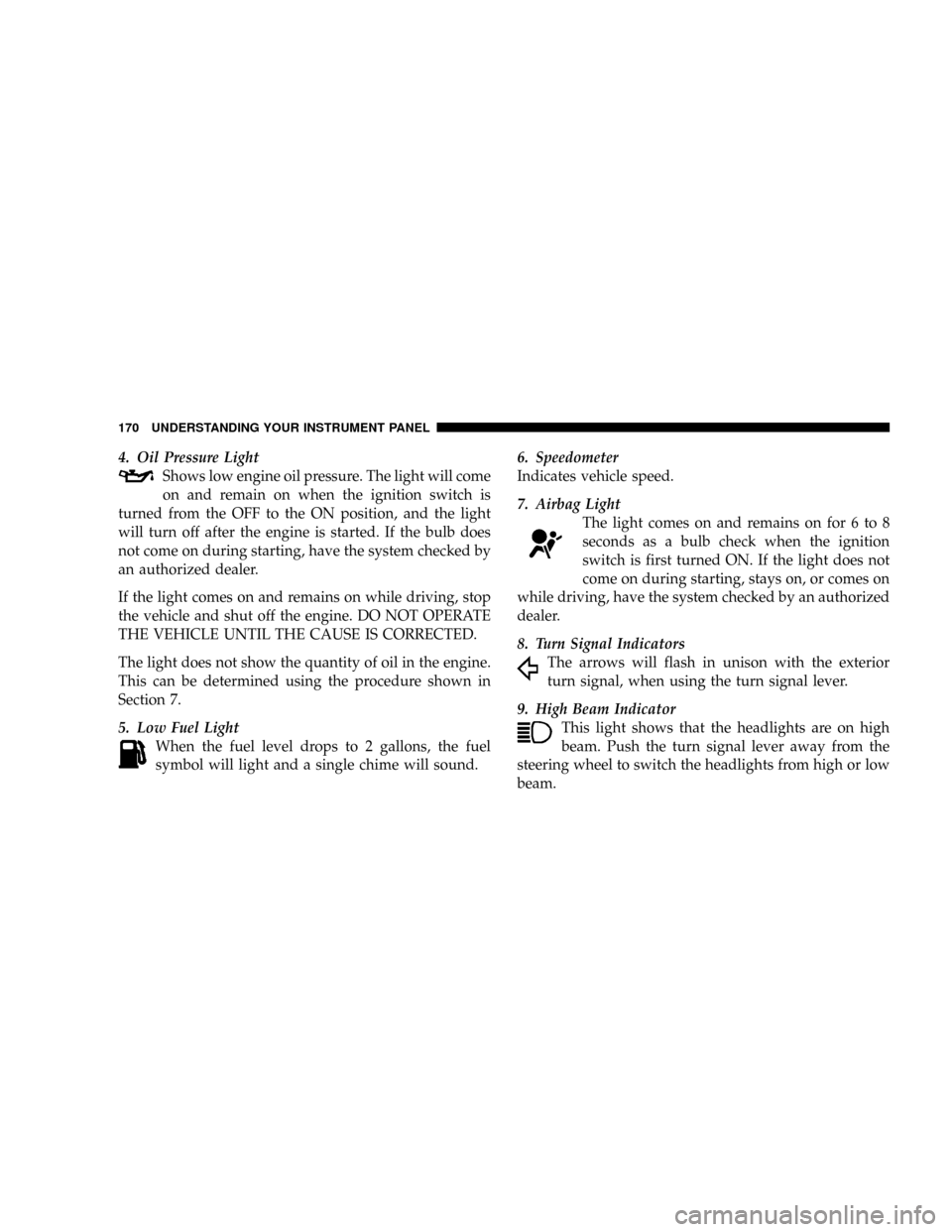
4. Oil Pressure Light
Shows low engine oil pressure. The light will come
on and remain on when the ignition switch is
turned from the OFF to the ON position, and the light
will turn off after the engine is started. If the bulb does
not come on during starting, have the system checked by
an authorized dealer.
If the light comes on and remains on while driving, stop
the vehicle and shut off the engine. DO NOT OPERATE
THE VEHICLE UNTIL THE CAUSE IS CORRECTED.
The light does not show the quantity of oil in the engine.
This can be determined using the procedure shown in
Section 7.
5. Low Fuel Light
When the fuel level drops to 2 gallons, the fuel
symbol will light and a single chime will sound.6. Speedometer
Indicates vehicle speed.
7. Airbag Light
The light comes on and remains on for 6 to 8
seconds as a bulb check when the ignition
switch is first turned ON. If the light does not
come on during starting, stays on, or comes on
while driving, have the system checked by an authorized
dealer.
8. Turn Signal Indicators
The arrows will flash in unison with the exterior
turn signal, when using the turn signal lever.
9. High Beam Indicator
This light shows that the headlights are on high
beam. Push the turn signal lever away from the
steering wheel to switch the headlights from high or low
beam.
170 UNDERSTANDING YOUR INSTRUMENT PANEL
Page 423 of 440
ABS (Anti-Lock Brake System).............. 273
Adding Engine Coolant (Antifreeze).......... 362
Adding Fuel........................... 307
Adding Washer Fluid..................126,159
Additives, Fuel......................... 305
Air Cleaner, Engine (Engine Air Cleaner Filter) . . . 353
Air Conditioner Maintenance............... 356
Air Conditioning Controls................. 223
Air Conditioning, Operating Tips............ 229
Air Conditioning Refrigerant.............356,357
Air Conditioning System................223,356
Air Pressure, Tires....................... 286
Airbag................................ 49
Airbag Deployment.....................54,56
Airbag Light.....................54,58,70,170
Airbag Maintenance....................... 57
Airbag, Side............................ 55
Airbag, Window (Side Curtain).............50,55
Alarm System (Security Alarm)............30,173Alignment and Balance................... 294
Alterations/Modifications, Vehicle............. 8
Antenna, Satellite Radio................... 220
Antifreeze (Engine Coolant)..............361,388
Capacities........................... 388
Disposal............................ 363
Anti-Lock Brake System (ABS)............136,273
Anti-Theft Security Alarm (Theft Alarm)........ 30
Appearance Care........................ 371
Automatic Door Locks...................20,21
Automatic Transaxle...........12,237,240,326,368
Fluid Level Check...................... 369
Interlock System.....................17,241
Overheating.......................... 326
Selection Of Lubricant................... 368
Shifting............................. 242
Special Additives...................... 369
Ball Joints............................. 357
422 INDEX