battery JEEP PATRIOT 2007 1.G User Guide
[x] Cancel search | Manufacturer: JEEP, Model Year: 2007, Model line: PATRIOT, Model: JEEP PATRIOT 2007 1.GPages: 440, PDF Size: 7.26 MB
Page 181 of 440
The Electronic Vehicle Information Center (EVIC) fea-
tures a driver-interactive display. It is located in the lower
left part of the cluster below the fuel and engine tem-
perature gauge. The EVIC consists of the following:
²System Status
²Vehicle information warning message displays
²Personal Settings (customer programmable features)
²Compass heading
²Outside temperature display
²Trip computer functions
²UConnectŸ hands-free communication system dis-
plays Ð If Equipped
²Audio mode display
²Tire Pressure Monitor (TPM)When the appropriate conditions exist, the Electronic
Vehicle Information Center (EVIC) displays the following
messages.
²Turn Signal On (with a continuous warning chime)
²Left Front Turn Signal Lamp Out (with a single chime)
²Left Rear Turn Signal Lamp Out (with a single chime)
²Right Front Turn Signal Lamp Out (with a single
chime)
²Right Rear Turn Signal Lamp Out (with a single
chime)
²RKE Battery Low (with a single chime)
²Personal Settings Not Available ± Vehicle Not in Park
(automatic transmissions) or vehicle is in motion
(manual transmissions).
180 UNDERSTANDING YOUR INSTRUMENT PANEL
Page 239 of 440
Manual Transaxle
Before starting the engine fully apply the parking brake,
press the clutch pedal to the floor and place the gear
selector in NEUTRAL.
NOTE:The engine will not start unless the clutch pedal
is pressed to the floor.
NOTE:If key won't turn and steering wheel is locked,
rotate the wheel in either direction to relieve pressure on
the locking mechanism and then turn the key.
Normal Starting
Normal Starting of either a cold or a warm engine does
not require pumping or depressing the accelerator pedal.
Simply turn the ignition switch to the ªSTART'º position
and release when the engine starts. If the engine fails to
start within 15 seconds, turn the ignition switch to the
ªOFFº position, wait 10 to 15 seconds, then repeat the
normal starting procedure.
WARNING!
Do not attempt to push or tow your vehicle to get it
started. Vehicles equipped with an automatic trans-
axle cannot be started this way. Unburned fuel could
enter the catalytic converter and once the engine has
started, ignite and damage the converter and vehicle.
If the vehicle has a discharged battery, booster cables
may be used to obtain a start from another vehicle.
This type of start can be dangerous if done improp-
erly, so follow the procedure carefully. See section 6
of this manual for jump starting instructions.
Extremely Cold Weather (below220ÉF or229ÉC)
To insure reliable starting at these temperatures, use of an
externally powered electric engine block heater (available
from your dealer) is recommended.
238 STARTING AND OPERATING
Page 242 of 440
WARNING!
It is dangerous to shift the selector lever out of ªPº or
ªNº if the engine speed is higher than idle speed. If
your foot is not firmly on the brake pedal, the vehicle
could accelerate quickly forward or in reverse. You
could lose control of the vehicle and hit someone or
something. Only shift into gear when the engine is
idling normally and when your right foot is firmly on
the brake pedal.
Brake/Transmission Interlock System
This system prevents you from moving the gear shift out
of Park and into any gear unless the brake pedal is
pressed. This system is active only while the ignition
switch is in the ON or ACC positions. Always depress the
brake pedal first,before moving the gear selector out of
PARK.NOTE:If a malfunction occurs, the transaxle will not
shift out of park. Battery power is required to release the
brake/transmission interlock system. There is a remov-
able plug in the right side of the shifter housing that
allows you to insert your finger to override the system.
The key must be in the ignition and in the on position to
use the override lever. If this occurs obtain service as
soon as possible.
Automatic Transaxle Ignition Interlock System
This system prevents the key from being removed unless
the shift lever is in PARK. It also prevents shifting out of
PARK unless the key is in the ACC or ON positions, and
the brake pedal is depressed.
NOTE:If a malfunction occurs, the system will trap the
key in the ignition cylinder to warn you that this safety
feature is inoperable. The engine can be started and
stopped but the key cannot be removed until you obtain
service.
STARTING AND OPERATING 241
5
Page 324 of 440
WHAT TO DO IN EMERGENCIES
CONTENTS
mHazard Warning Flasher..................324
mIf Your Engine Overheats.................324
mAutomatic Transaxle Overheating...........326
mJacking And Tire Changing................326
NJack Location........................327
NSpare Tire Stowage....................327
NPreparations For Jacking................327
NJacking Instructions....................328mJump-Starting Procedures Due To A Low
Battery..............................331
mDriving On Slippery Surfaces..............334
NAcceleration.........................334
NTraction............................334
mFreeing A Stuck Vehicle..................335
mTowing A Disabled Vehicle................336
NWith Ignition Key.....................336
NWithout The Ignition Key...............337
6
Page 325 of 440
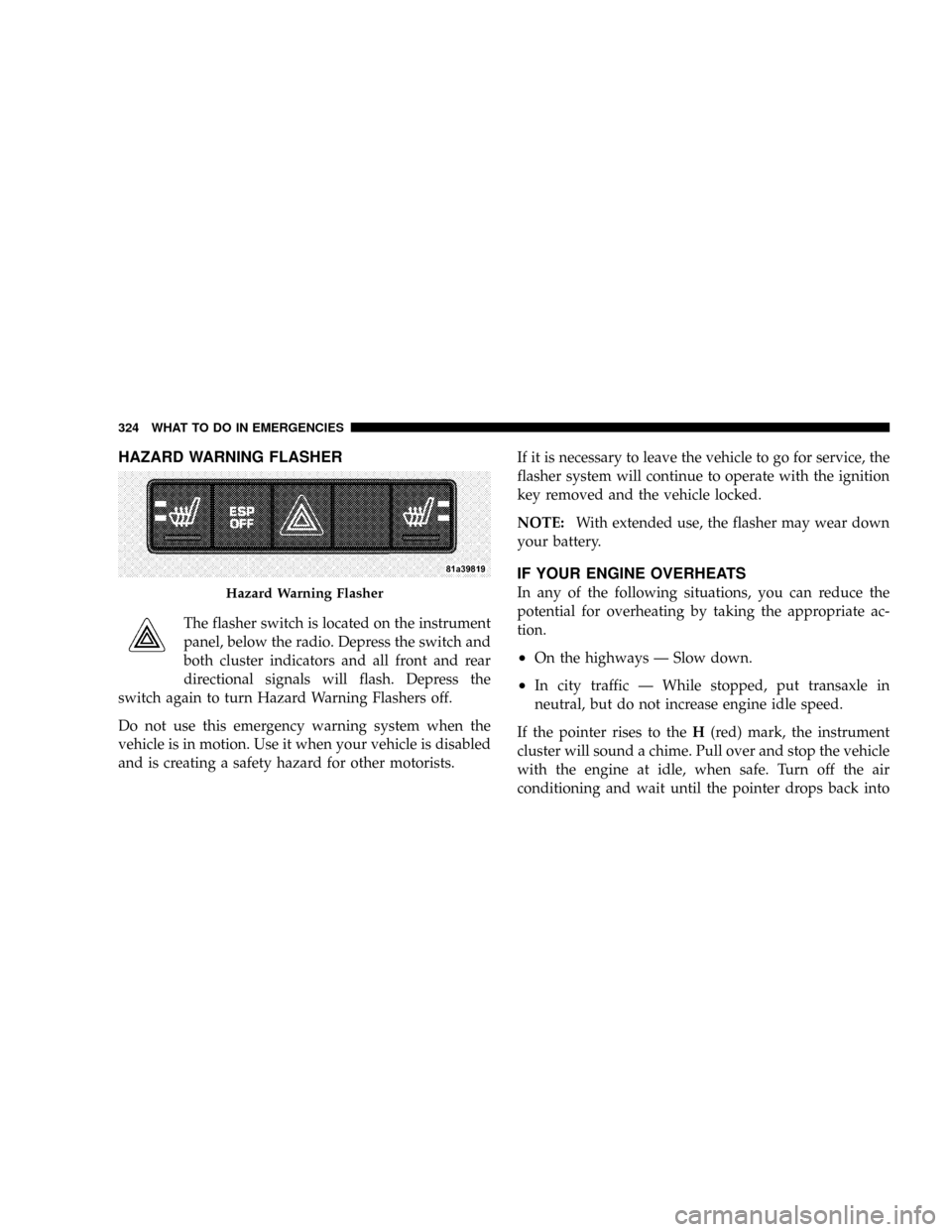
HAZARD WARNING FLASHER
The flasher switch is located on the instrument
panel, below the radio. Depress the switch and
both cluster indicators and all front and rear
directional signals will flash. Depress the
switch again to turn Hazard Warning Flashers off.
Do not use this emergency warning system when the
vehicle is in motion. Use it when your vehicle is disabled
and is creating a safety hazard for other motorists.If it is necessary to leave the vehicle to go for service, the
flasher system will continue to operate with the ignition
key removed and the vehicle locked.
NOTE:With extended use, the flasher may wear down
your battery.
IF YOUR ENGINE OVERHEATS
In any of the following situations, you can reduce the
potential for overheating by taking the appropriate ac-
tion.
²On the highways Ð Slow down.
²In city traffic Ð While stopped, put transaxle in
neutral, but do not increase engine idle speed.
If the pointer rises to theH(red) mark, the instrument
cluster will sound a chime. Pull over and stop the vehicle
with the engine at idle, when safe. Turn off the air
conditioning and wait until the pointer drops back into
Hazard Warning Flasher
324 WHAT TO DO IN EMERGENCIES
Page 332 of 440
JUMP-STARTING PROCEDURES DUE TO A LOW
BATTERY
WARNING!
Take care to avoid the radiator cooling fan whenever
the hood is raised. It can start anytime the ignition
switch is on. You can be hurt by the fan.
WARNING!
Do not attempt to push or tow your vehicle to get it
started. Vehicles equipped with an automatic trans-
axle cannot be started this way and may be damaged.
Unburned fuel could enter the catalytic converter and
once the engine has started, ignite and damage the
converter and vehicle. If the vehicle has a discharged
battery, booster cables may be used to obtain a start
from another vehicle. This type of start can be
dangerous if done improperly, so follow this proce-
dure carefully.
WHAT TO DO IN EMERGENCIES 331
6
Page 333 of 440
WARNING!
Wear eye protection and remove any metal jewelry
such as watch bands or bracelets that might make an
inadvertent electrical contact. You could be seriously
injured.NOTE: Disconnecting the battery with the ignition in
the On position will cause vehicles with an automatic
transaxle (CVT2) to go into ªdefault modeº and turn on
the malfunction indicator light. See your authorized
dealer to correct this condition.
1. Wear eye protection and remove any metal jewelry
such as watch bands or bracelets that might make an
inadvertent electrical contact.
2. When boosting from a battery in another vehicle, park
that vehicle within booster cable reach but without
letting the vehicles touch. Set parking brake, place auto-
matic transaxle in PARK (manual transaxle in NEU-
TRAL) and turn ignition to OFF for both vehicles.
3. Turn off the heater, radio and all unnecessary electrical
loads.
4. Remove the air intake duct covering the battery, using
the two finger screws on the cover.
332 WHAT TO DO IN EMERGENCIES
Page 334 of 440
5. Connect one end of a jumper cable to the positive
terminal of the booster battery. Connect the other end of
the jumper cable to the positive terminal of the dis-
charged battery.
WARNING!
Battery fluid is a corrosive acid solution; do not allow
battery fluid to contact eyes, skin or clothing. Don't
lean over battery when attaching clamps or allow the
clamps to touch each other. If acid splashes in eyes or
on skin, flush the contaminated area immediately
with large quantities of water.
A battery generates hydrogen gas which is flam-
mable and explosive. Keep flame or spark away from
the vent holes. Do not use a booster battery or any
other booster source with an output that exceeds 12
volts.6. Connect the other cable, first to the negative terminal
of the booster battery and then to the negative terminal of
the discharged battery. Make sure you have a good
contact.
7. If the vehicle is equipped with Sentry Key Immobi-
lizer, turn the ignition switch to the ON position for 3
seconds before moving the ignition switch to the START
position.
8. Start the engine in the vehicle that has the booster
battery, let the engine idle a few minutes, then start the
engine in the vehicle with the discharged battery.
9. When removing the jumper cables, reverse the se-
quence exactly. Be careful of the moving belts and fan.
WHAT TO DO IN EMERGENCIES 333
6
Page 338 of 440
Without The Ignition Key
Special care must be taken when the vehicle is towed
with the ignition in the LOCK position. A dolly should be
used under the front wheels if the rear wheels are raised.
Proper towing equipment is necessary to prevent dam-
age to the vehicle.
Battery power is required to release the brake/
transmission interlock system. There is a removable plug
in the right side of the shifter housing that allows you to
insert your finger to override the system. The ignition
key must be in the on position to use the override lever.
Towing This Vehicle Behind Another Vehicle (Flat
Towing With All Four Wheels On The Ground)
CAUTION!
DO NOT flat tow this vehicle. Damage to the driv-
etrain will result.
WHAT TO DO IN EMERGENCIES 337
6
Page 340 of 440
MAINTAINING YOUR VEHICLE
CONTENTS
mEngine Compartment Ð Gasoline Engines.....342
mOnboard Diagnostic System Ð OBD II........343
NLoose Fuel Filler Cap Message............344
mEmissions Inspection And Maintenance
Programs............................344
mReplacement Parts......................346
mDealer Service.........................346
mMaintenance Procedures..................347
NEngine Oil..........................347NDrive Belt ± Check Condition.............351
NSpark Plugs.........................351
NCatalytic Converter....................351
NCrankcase Emission Control System........353
NFuel Filter..........................353
NAir Cleaner Element (Filter)..............353
NMaintenance-Free Battery................354
NAir Conditioner Maintenance.............356
NPower Steering Ð Fluid Check............357
7