ECU JEEP PATRIOT 2009 1.G Owner's Guide
[x] Cancel search | Manufacturer: JEEP, Model Year: 2009, Model line: PATRIOT, Model: JEEP PATRIOT 2009 1.GPages: 457, PDF Size: 12.48 MB
Page 338 of 457
Curb Weight
The curb weight of a vehicle is defined as the total weight
of the vehicle with all fluids, including vehicle fuel, at full
capacity conditions, and with no occupants or cargo
loaded into the vehicle. The front and rear curb weight
values are determined by weighing your vehicle on a
commercial scale before any occupants or cargo are
added.
Overloading
The load carrying components (springs, tires, wheels,
etc.) of your vehicle will provide satisfactory service as
long as you do not exceed the GVWR.
The best way to figure out the total weight of your
vehicle is to weigh it when it is fully loaded and ready for
operation. Weigh it on a commercial scale to ensure that
it is not over the GVWR.Overloading can cause potential safety hazards and
shorten useful service life. Heavier suspension compo-
nents do not necessarily increase the vehicle’s GVWR.
Loading
To load your vehicle properly, first figure out its empty
weight. Store heavier items down low and be sure you
distribute their weight as evenly as possible. Stow all
loose items securely before driving. Improper weight
distribution can have an adverse effect on the way your
vehicle steers and handles, and the way the brakes
operate.
CAUTION!
Do not load your vehicle any heavier than the
GVWR. If you do, parts on your vehicle can break, or
it can change the way your vehicle handles. This
could cause you to lose control. Also, overloading can
shorten the life of your vehicle.
336 STARTING AND OPERATING
Page 344 of 457
NOTE:Remember that everything put into or on the
trailer adds to the load on your vehicle. Also, additional
factory-installed options, or authorized dealer-installed
options, must be considered as part of the total load on
your vehicle. Refer to the Tire and Loading Information
placard in the Tire Safety Information section of this
manual for the maximum combined weight of occupants
and cargo for your vehicle.
Towing Requirements
To promote proper break-in of your vehicle drivetrain
components, the following guidelines are recommended:
CAUTION!
•Avoid towing a trailer for the first 500 miles
(805 km) of vehicle operation. Doing so may dam-
age your vehicle.
•During the first 500 miles (805 km) of trailer
towing, limit your speed to 50 mph (80 km/h).
Perform the maintenance listed in the “Maintenance Sched-
ule.” Refer to Section 8 of this manual. When towing a
trailer, never exceed the GAWR, or GCWR, ratings.
WARNING!
Improper towing can lead to an injury accident.
Follow these guidelines to make your trailer towing
as safe as possible:
Make certain that the load is secured in the trailer
and will not shift during travel. When trailering
cargo that is not fully secured, dynamic load shifts
can occur that may be difficult for the driver to
control. You could lose control of your vehicle and
have an accident.
•When hauling cargo or towing a trailer, do not over-
load your vehicle or trailer. Overloading can cause a
loss of control, poor performance or damage to brakes,
axle, engine, transmission, steering, suspension, chas-
sis structure or tires.
342 STARTING AND OPERATING
Page 357 of 457
WARNING! (Continued)
•If working on or near a roadway, be extremely
careful of motor traffic.
•To assure that spare tires, flat or inflated are
securely stowed, spares must be stowed with the
valve stem facing the ground.
•Turn on the Hazard Warning flasher.
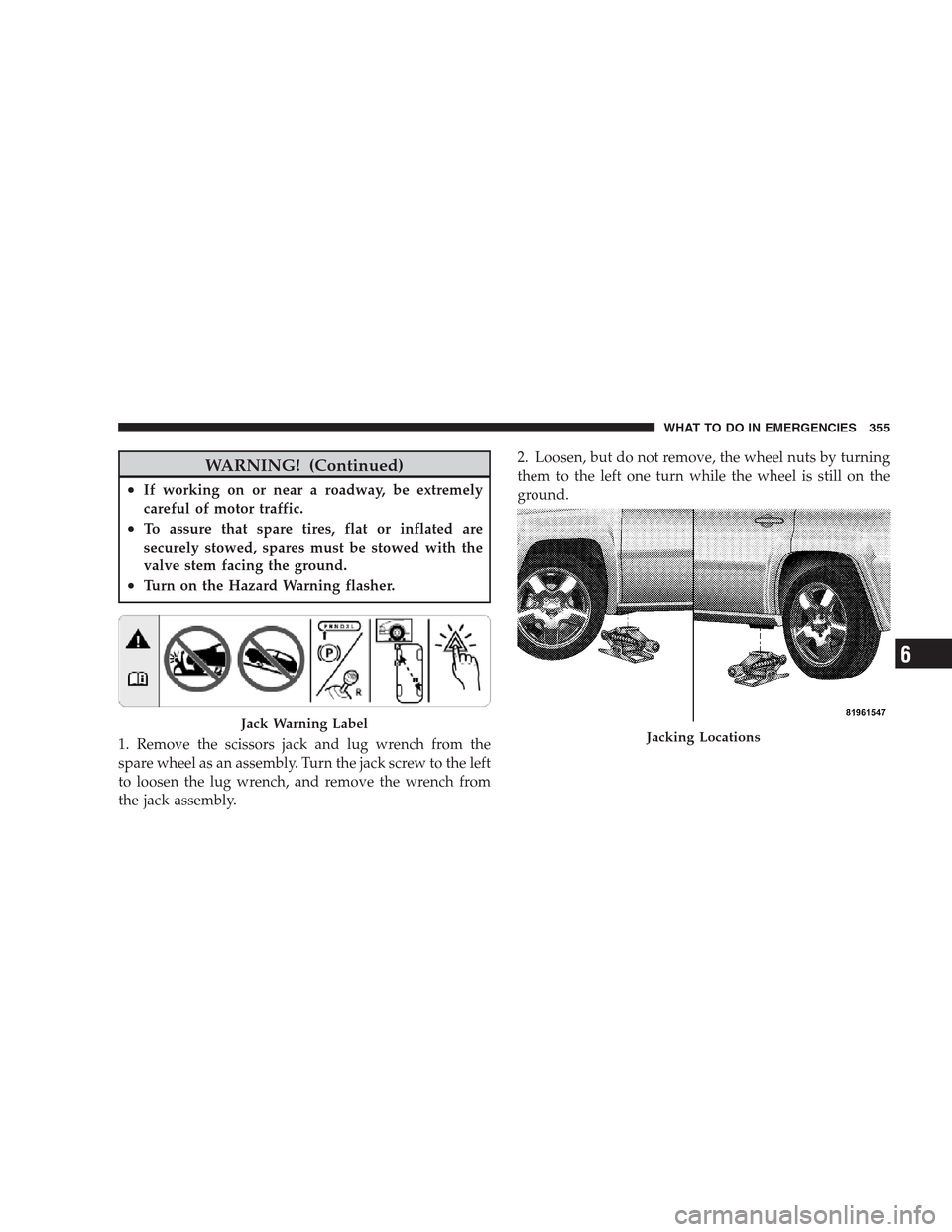
1. Remove the scissors jack and lug wrench from the
spare wheel as an assembly. Turn the jack screw to the left
to loosen the lug wrench, and remove the wrench from
the jack assembly.2. Loosen, but do not remove, the wheel nuts by turning
them to the left one turn while the wheel is still on the
ground.
Jack Warning LabelJacking Locations
WHAT TO DO IN EMERGENCIES 355
6
Page 358 of 457
CAUTION!
Do not attempt to raise the vehicle by jacking on
locations other than those indicated in Step 3.
3. There are two front jacking locations and two rear
jacking locations on each side of the body. The front
locations are outlined by two triangular cutouts, the rear
ones by two rectangular cutouts. For vehicles equipped
with plastic trim, the plastic has been cut away to expose
the jacking locations in the body.
Do not raise the vehicle until you are sure the jack is
securely engaged.
4. Turn the jack screw to the left until the jack can be
placed under the jacking location. Once the jack is
positioned, turn the jack screw to the right until the jackhead is properly engaged with the lift area closest to the
wheel to be changed. Do not raise the vehicle until you
are sure the jack is securely engaged.
WARNING!
Raising the vehicle higher than necessary can make
the vehicle less stable. It could slip off the jack and
hurt someone near it. Raise the vehicle only enough
to remove the tire.
5. Raise the vehicle by turning the jack screw to the right,
using the swivel wrench. Raise the vehicle only until the
tire just clears the surface and enough clearance is
obtained to install the spare tire. Minimum tire lift
provides maximum stability.
356 WHAT TO DO IN EMERGENCIES
Page 359 of 457
6. Remove the wheel nuts and pull the wheel (and
bolt-on center cap if equipped) off the hub. Install the
spare wheel and wheel nuts with the cone shaped end of
the nuts toward the wheel. Lightly tighten the nuts. To
avoid the risk of forcing the vehicle off the jack, do not
tighten the nuts fully until the vehicle has been lowered.
7. Lower the vehicle by turning the jack screw to the left.
8. Finish tightening the nuts. Push down on the wrench
while tightening the wheel nuts. Alternate nuts until each
nut has been tightened twice. Correct wheel nut torque is
100 ft lbs (135 N·m). If you doubt that you have tightened
the nuts correctly, have them checked with a torque
wrench by your authorized dealer or at a service station.
9. Remove the wheel blocks and lower the jack until it is
free. Reassemble the lug wrench to the jack assembly and
stow it in the spare tire area. Secure the assembly using
the means provided.WARNING!
A loose tire or jack thrown forward in a collision or
hard stop could endanger the occupants of the ve-
hicle. Always stow the jack parts and the spare tire in
the places provided.
10. Place the deflated (flat) tire in the cargo area.Have
the tire repaired or replaced as soon as possible.
WARNING!
A loose tire thrown forward in a collision or hard
stop could injure the occupants in the vehicle. Have
the deflated (flat) tire repaired or replaced immedi-
ately.
11. Check the tire pressure as soon as possible. Correct
pressure as required.
WHAT TO DO IN EMERGENCIES 357
6
Page 364 of 457
CAUTION!
•If the vehicle being towed requires steering, the
ignition switch must be in the ACC position, not
in the LOCK position.
•Do not attempt to use sling type equipment when
towing. When securing the vehicle to a flat bed
truck, do not attach to front or rear suspension
components. Damage to your vehicle may result
from improper towing.
Without The Ignition Key
Special care must be taken when the vehicle is towed
with the ignition in the LOCK position. A dolly should be
used under the front wheels if the rear wheels are raised.
Proper towing equipment is necessary to prevent dam-
age to the vehicle.
Battery power is required to release the brake/
transmission interlock system. There is a removable plug
in the right side of the shift lever housing that allows you
to insert your finger to override the system. The ignition
key must be in the ON position to use the override lever.
362 WHAT TO DO IN EMERGENCIES
Page 396 of 457
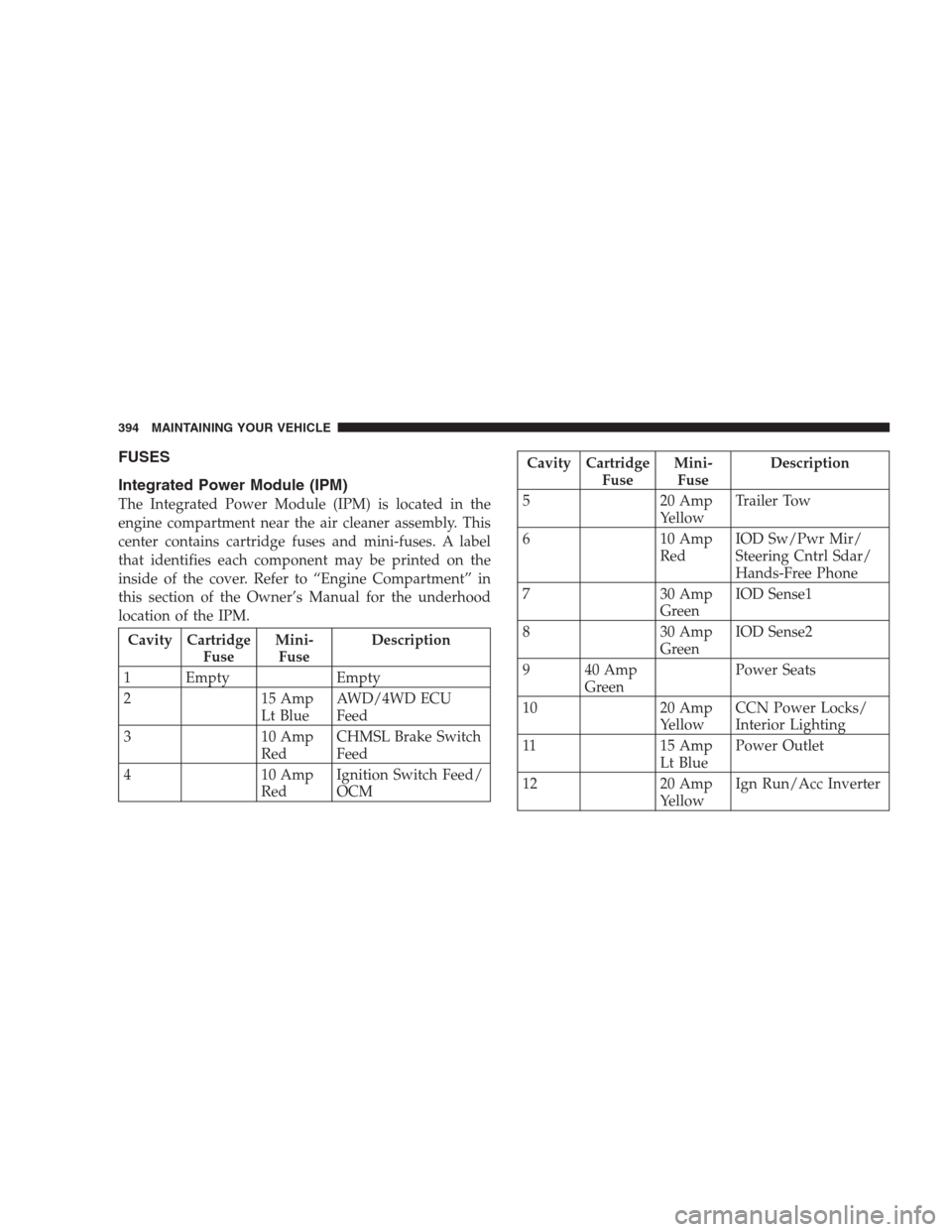
FUSES
Integrated Power Module (IPM)
The Integrated Power Module (IPM) is located in the
engine compartment near the air cleaner assembly. This
center contains cartridge fuses and mini-fuses. A label
that identifies each component may be printed on the
inside of the cover. Refer to “Engine Compartment” in
this section of the Owner’s Manual for the underhood
location of the IPM.
Cavity Cartridge
FuseMini-
FuseDescription
1 Empty Empty
2 15 Amp
Lt BlueAWD/4WD ECU
Feed
3 10 Amp
RedCHMSL Brake Switch
Feed
4 10 Amp
RedIgnition Switch Feed/
OCM
Cavity Cartridge
FuseMini-
FuseDescription
5 20 Amp
YellowTrailer Tow
6 10 Amp
RedIOD Sw/Pwr Mir/
Steering Cntrl Sdar/
Hands-Free Phone
7 30 Amp
GreenIOD Sense1
8 30 Amp
GreenIOD Sense2
9 40 Amp
GreenPower Seats
10 20 Amp
YellowCCN Power Locks/
Interior Lighting
11 15 Amp
Lt BluePower Outlet
12 20 Amp
YellowIgn Run/Acc Inverter
394 MAINTAINING YOUR VEHICLE
Page 405 of 457
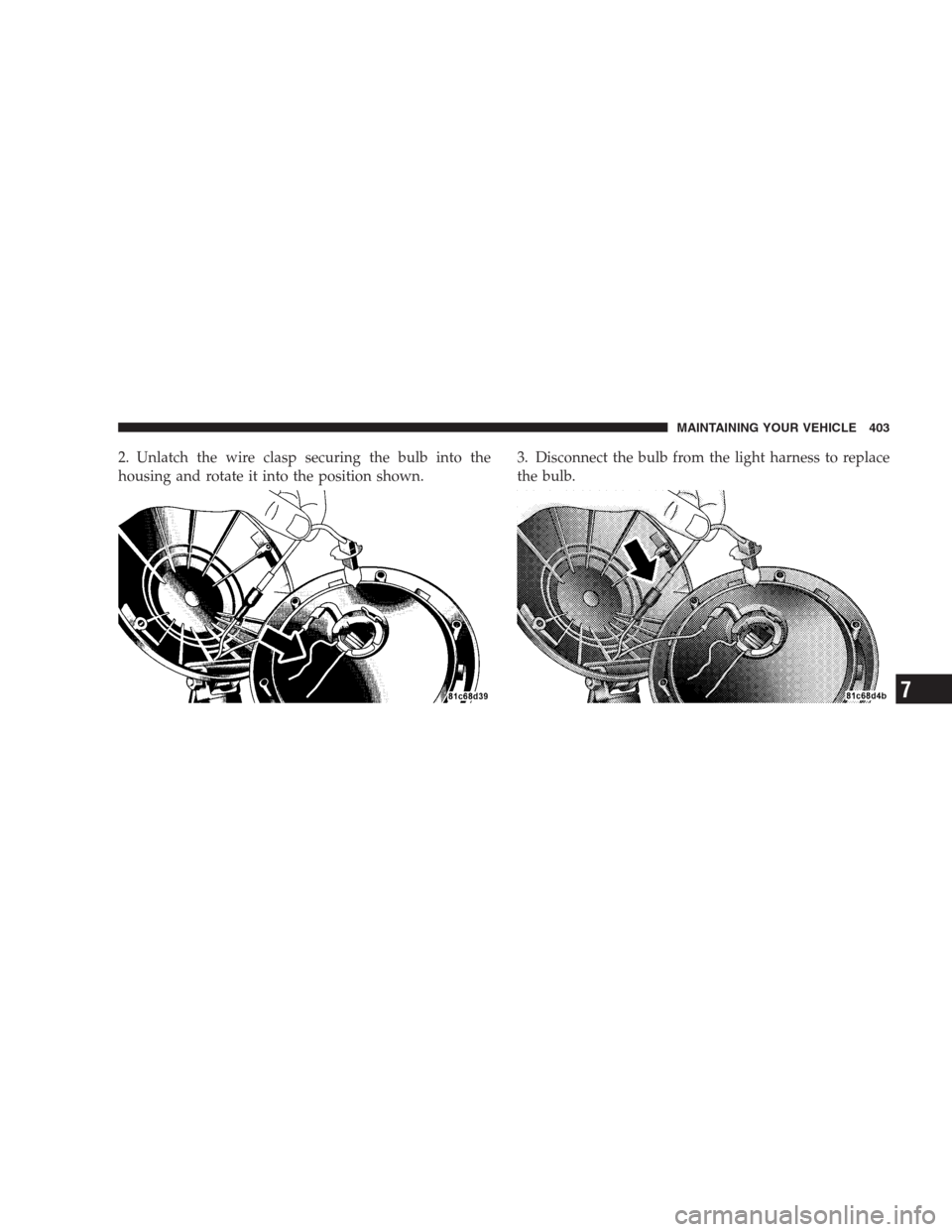
2. Unlatch the wire clasp securing the bulb into the
housing and rotate it into the position shown.3. Disconnect the bulb from the light harness to replace
the bulb.
MAINTAINING YOUR VEHICLE 403
7
Page 438 of 457
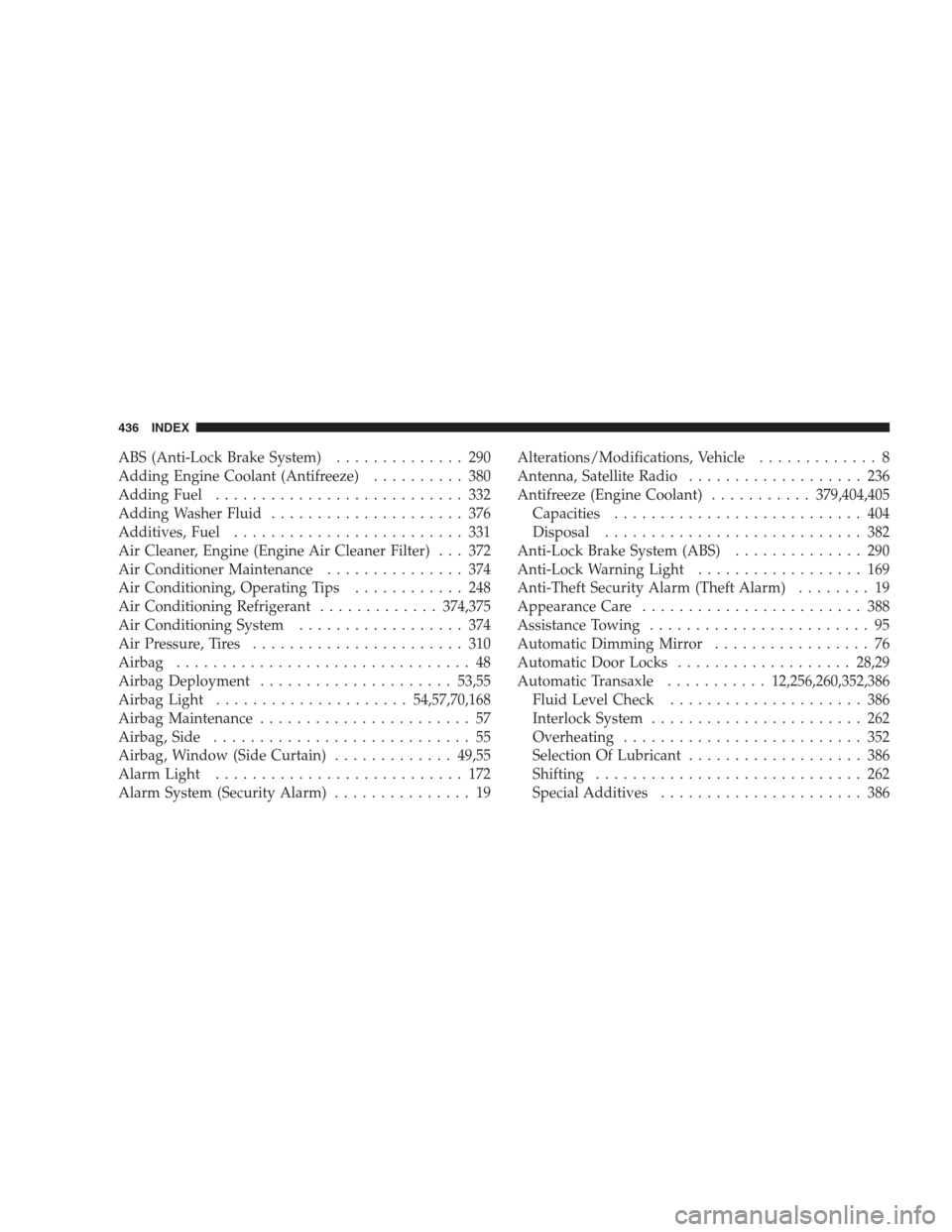
ABS (Anti-Lock Brake System).............. 290
Adding Engine Coolant (Antifreeze).......... 380
Adding Fuel........................... 332
Adding Washer Fluid..................... 376
Additives, Fuel......................... 331
Air Cleaner, Engine (Engine Air Cleaner Filter) . . . 372
Air Conditioner Maintenance............... 374
Air Conditioning, Operating Tips............ 248
Air Conditioning Refrigerant.............374,375
Air Conditioning System.................. 374
Air Pressure, Tires....................... 310
Airbag................................ 48
Airbag Deployment.....................53,55
Airbag Light.....................54,57,70,168
Airbag Maintenance....................... 57
Airbag, Side............................ 55
Airbag, Window (Side Curtain).............49,55
Alarm Light........................... 172
Alarm System (Security Alarm)............... 19Alterations/Modifications, Vehicle............. 8
Antenna, Satellite Radio................... 236
Antifreeze (Engine Coolant)...........379,404,405
Capacities........................... 404
Disposal............................ 382
Anti-Lock Brake System (ABS).............. 290
Anti-Lock Warning Light.................. 169
Anti-Theft Security Alarm (Theft Alarm)........ 19
Appearance Care........................ 388
Assistance Towing........................ 95
Automatic Dimming Mirror................. 76
Automatic Door Locks...................28,29
Automatic Transaxle...........12,256,260,352,386
Fluid Level Check..................... 386
Interlock System....................... 262
Overheating.......................... 352
Selection Of Lubricant................... 386
Shifting............................. 262
Special Additives...................... 386
436 INDEX
Page 446 of 457
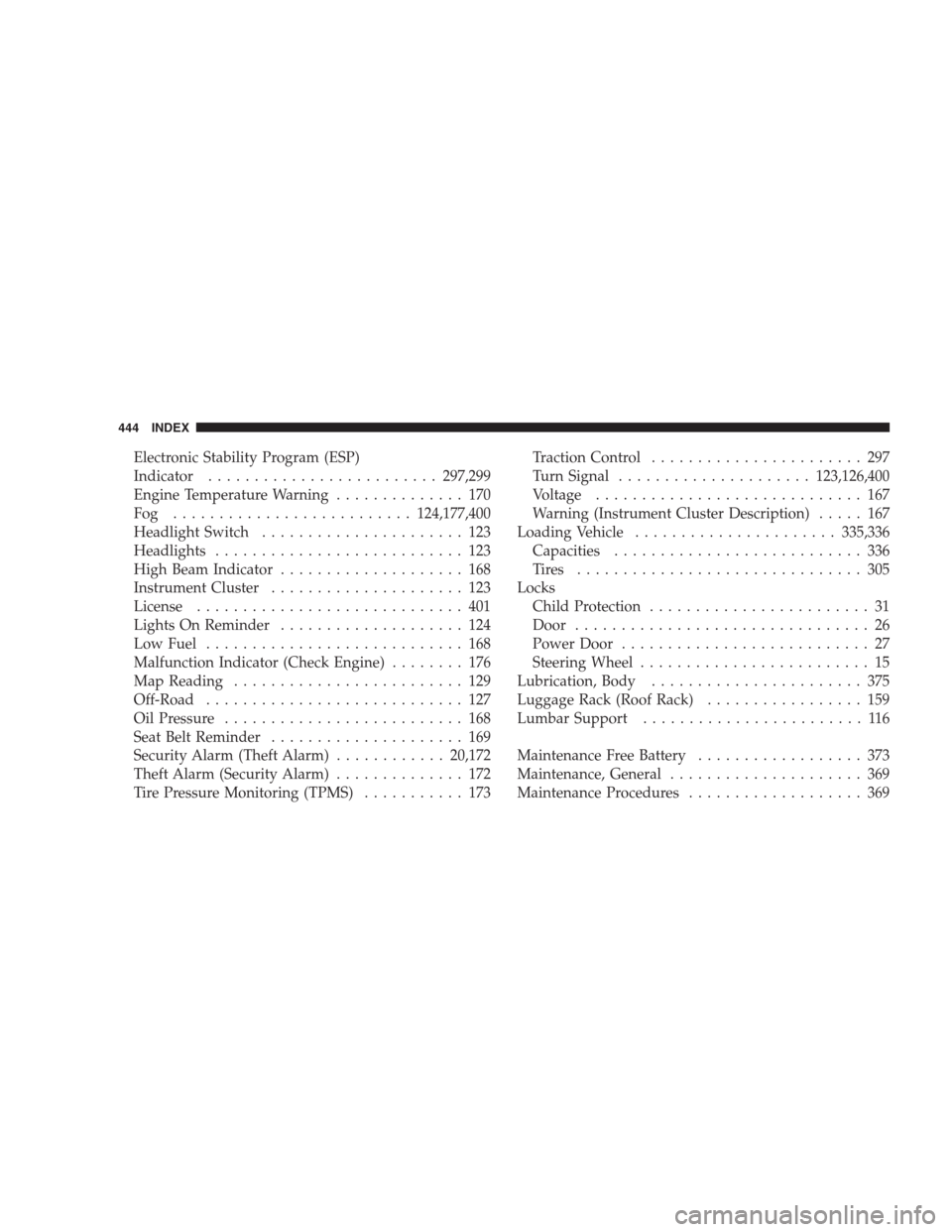
Electronic Stability Program (ESP)
Indicator.........................297,299
Engine Temperature Warning.............. 170
Fog ..........................124,177,400
Headlight Switch...................... 123
Headlights........................... 123
High Beam Indicator.................... 168
Instrument Cluster..................... 123
License............................. 401
Lights On Reminder.................... 124
Low Fuel............................ 168
Malfunction Indicator (Check Engine)........ 176
Map Reading......................... 129
Off-Road............................ 127
Oil Pressure.......................... 168
Seat Belt Reminder..................... 169
Security Alarm (Theft Alarm)............20,172
Theft Alarm (Security Alarm).............. 172
Tire Pressure Monitoring (TPMS)........... 173Traction Control....................... 297
Turn Signal.....................123,126,400
Voltage............................. 167
Warning (Instrument Cluster Description)..... 167
Loading Vehicle......................335,336
Capacities........................... 336
Tires ............................... 305
Locks
Child Protection........................ 31
Door................................ 26
Power Door........................... 27
Steering Wheel......................... 15
Lubrication, Body....................... 375
Luggage Rack (Roof Rack)................. 159
Lumbar Support........................ 116
Maintenance Free Battery.................. 373
Maintenance, General..................... 369
Maintenance Procedures................... 369
444 INDEX