ESP JEEP PATRIOT 2009 1.G Owner's Guide
[x] Cancel search | Manufacturer: JEEP, Model Year: 2009, Model line: PATRIOT, Model: JEEP PATRIOT 2009 1.GPages: 457, PDF Size: 12.48 MB
Page 281 of 457
designated and approved. You should tread lightly and
avoid damage to the environment. You should know
your vehicles abilities and be able to recover it if some-
thing goes wrong. You should never stop or shut a
vehicle off when crossing deep water unless you ingested
water into the engine air intake. If the engine stalls, do
not attempt to restart it. Determine if it has ingested
water first. The key to any crossing is low and slow. You
want to use low (L Off-Road) with the 4WD LOCK
engaged and proceed very slowly with a constant slow
speed {3-5 mph (5–8 km/h) maximum} and light throttle.
Keep the vehicle moving; do not try to accelerate through
the crossing. After crossing any water higher than the
bottom of the axle differentials, you should inspect all of
the vehicle fluids for signs of water ingestion.CAUTION!
Water ingestion into the transaxle, transfer case,
engine or vehicle interior can occur if you drive too
fast or through too deep of water. Water can cause
permanent damage to engine, driveline or other
vehicle components and your brakes will be less
effective once wet and/or muddy.
Before You Cross Any Type Of Water
As you approach any type of water you need to deter-
mine if you can cross it safely and responsibly. If neces-
sary, get out and walk through the water or probe it with
a stick. You need to be sure of its depth, approach angle,
current and bottom condition. Be careful of murky or
muddy waters, check for hidden obstacles. Make sure
you will not be intruding on any wildlife and you can
recover the vehicle if necessary. The key to a safe crossing
is the water depth, current and bottom conditions. On
STARTING AND OPERATING 279
5
Page 288 of 457
POWER STEERING
The standard power steering system will give you good
vehicle response and increased ease of maneuverability
in tight spaces. The system will provide mechanical
steering capability if power assist is lost.
If for some reason the power assist is interrupted, it will
still be possible to steer your vehicle. Under these condi-
tions, you will observe a substantial increase in steering
effort, especially at very low vehicle speeds and during
parking maneuvers.
NOTE:Increased noise levels at the end of the steering
wheel travel are considered normal and do not indicate
that there is a problem with the power steering system.
Upon initial start-up in cold weather, the power steering
pump may make noise for a short amount of time. This is
due to the cold, thick fluid in the steering system. This
noise should be considered normal, and it does not in any
way damage the steering system.WARNING!
Continued operation with reduced power steering
assist could pose a safety risk to yourself and others.
Service should be obtained as soon as possible.
CAUTION!
Prolonged operation of the steering system at the end
of the steering wheel travel will increase the steering
fluid temperature and it should be avoided when
possible. Damage to the power steering pump may
occur.
Power Steering Fluid Check
Checking the power steering fluid level at a defined
service interval is not required. The fluid should only be
checked if a leak is suspected, abnormal noises are
286 STARTING AND OPERATING
Page 294 of 457
WARNING!
The Anti-Lock Brake System (ABS) contains sophis-
ticated electronic equipment that may be susceptible
to interference caused by improperly installed or
high output radio transmitting equipment. This in-
terference can cause possible loss of Anti-Lock brak-
ing capability. Installation of such equipment should
be performed by qualified professionals.
All vehicle wheels and tires must be the same size and
type and tires must be properly inflated to produce
accurate signals for the computer.
ELECTRONIC BRAKE CONTROL SYSTEM
Your vehicle may be equipped with an optional ad-
vanced electronic brake control system that includes
Anti-Lock Brake System (ABS), Brake Assist System
(BAS), Traction Control System (TCS), Electronic Roll
Mitigation (ERM), Hill Decent Control (HDC) and Elec-
tronic Stability Program (ESP). All systems work together
to enhance vehicle stability and control in various driving
conditions and are commonly referred to as ESP.
Anti-Lock Brake System (ABS)
This system aids the driver in maintaining vehicle control
under adverse braking conditions. The system controls
hydraulic brake pressure to prevent wheel lockup and
help avoid skidding on slippery surfaces during braking.
Refer to “Anti-Lock Brake System” in this Section of the
manual for more information about ABS.
292 STARTING AND OPERATING
Page 296 of 457
Traction Control System (TCS)
This system monitors the amount of wheel spin of each of
the driven wheels. If wheel spin is detected, brake
pressure is applied to the slipping wheel(s) and engine
power is reduced to provide enhanced acceleration and
stability. A feature of the TCS system functions similar to
a limited slip differential and controls the wheel spin
across a driven axle. If one wheel on a driven axle is
spinning faster than the other, the system will apply the
brake of the spinning wheel. This will allow more engine
torque to be applied to the wheel that is not spinning.
This feature remains active even if TCS and ESP are in
either the “Partial Off” or “Full Off” modes. Refer to
“Electronic Stability Program (ESP)” in this Section of this
manual.
Electronic Roll Mitigation (ERM)
This system anticipates the potential for wheel lift by
monitoring the driver ’s steering wheel input and the
speed of the vehicle. When ERM determines that the rateof change of the steering wheel angle and vehicles speed
are sufficient to potentially cause wheel lift, it applies the
brake of the appropriate wheel and may also reduce
engine power to lessen the chance that wheel lift will
occur. ERM will only intervene during very severe or
evasive driving maneuvers.
ERM can only reduce the chance of wheel lift occurring
during severe or evasive driving maneuvers. It can not
prevent wheel lift due to other factors such as road
conditions, leaving the roadway or striking objects or
other vehicles.
NOTE:Anytime the ESP system is in the “Full Off”
mode, ERM is disabled. Refer to “Electronic Stability
Program (ESP)” for a complete explanation of the avail-
able ESP modes.
294 STARTING AND OPERATING
Page 297 of 457
WARNING!
Many factors, such as vehicle loading, road condi-
tions and driving conditions, influence the chance
that wheel lift or rollover may occur. ERM cannot
prevent all wheel lift or rollovers, especially those
that involve leaving the roadway or striking objects
or other vehicles. Only a safe, attentive, and skillful
driver can prevent accidents. The capabilities of an
ERM-equipped vehicle must never be exploited in a
reckless or dangerous manner which could jeopar-
dize the user’s safety or the safety of others.
Hill Descent Control (HDC) — If Equipped
This system maintains vehicle speed while descending
hills during off-road driving situations. HDC will auto-
matically apply the brakes to control downhill speed to
between 4 mph (7 km/h) and 6 mph (9 km/h) depending
on terrain. The system is activated by placing the vehiclein “Off-Road” mode and placing the shift lever in LOW
or REVERSE. Refer to “Safe Off-Road Driving” under
“Starting and Operating” in Section 5.
When HDC is properly enabled, the Hill De-
cent Control light in the instrument cluster will
be illuminated.
HDC has the capability to sense terrain and will only
activate when the vehicle is descending a hill. It will not
activate on level ground. If desired, HDC can be fully
deactivated by putting the vehicle into ESP “Full Off”
mode. This is done by pressing and holding the ESP OFF
button for five seconds. Refer to “Electronic Stability
Program (ESP)” in this section of the manual.
HDC operation can be overridden with brake application
to slow the vehicle down below the HDC control speed.
Conversely, if more speed is desired during HDC control,
the accelerator pedal will increase vehicle speed like
STARTING AND OPERATING 295
5
Page 298 of 457
normal. When either the brake or the accelerator is
released, HDC will control the vehicle back to the origi-
nal set speed.
HDC is only intended for low speed off-road driving. At
vehicle speeds above 31 mph (50 km/h) HDC will no
longer function. If the HDC indicator light begins to flash
this indicates that the brakes are getting too hot and the
vehicle should be stopped to allow the brakes to cool.
WARNING!
HDC is only intended to assist the driver in control-
ling vehicle speed when descending hills. The driver
must remain attentive to the driving conditions and
is responsible for maintaining a safe vehicle speed.
Electronic Stability Program (ESP)
This system enhances directional control and stability of
the vehicle under various driving conditions. ESP cor-
rects for over-steering or under-steering of the vehicle by
applying the brake of the appropriate wheel to assist in
counteracting the over-steering or under-steering condi-
tion. Engine power may also be reduced to help the
vehicle maintain the desired path. ESP uses sensors in the
vehicle to determine the vehicle path intended by the
driver and compares it to the actual path of the vehicle.
When the actual path does not match the intended path,
ESP applies the brake of the appropriate wheel to assist in
counteracting the over-steer or under-steer condition
•Over-steer - when the vehicle is turning more than
appropriate for the steering wheel position.
•Under-steer - when the vehicle is turning less than
appropriate for the steering wheel position.
296 STARTING AND OPERATING
Page 299 of 457
ESP Indicator Light
The “ESP Indicator Light” located in the instrument
cluster, starts to flash as soon as the tires lose traction and
the ESP system becomes active. If the “ESP Indicator
Light” begins to flash during acceleration, ease up on the
accelerator and apply as little throttle as possible. Be sure
to adapt your speed and driving to the prevailing road
conditions.
WARNING!
•Electronic Stability Program (ESP) cannot prevent
the natural laws of physics from acting on the
vehicle, nor can it increase the traction afforded by
prevailing road conditions.
(Continued)
WARNING! (Continued)
•ESP cannot prevent accidents, including those
resulting from excessive speed in turns, driving on
very slippery surfaces, or hydroplaning. Only a
safe, attentive, and skillful driver can prevent
accidents.
•The capabilities of an ESP-equipped vehicle must
never be exploited in a reckless or dangerous
manner which could jeopardize the user’s safety
or the safety of others.
ESP Operating Modes
The ESP system has three available operating modes for
4WD equipped vehicles and two available operating
modes for 2WD equipped vehicles.
STARTING AND OPERATING 297
5
Page 300 of 457
Full On (4WD Models) or On (2WD Models)
This is the normal operating mode for ESP. Whenever the
vehicle is started the ESP system will be in this “On”
mode. This mode should be used for most driving
situations. ESP should only be turned to “Partial Off” or
“ESP Off” for specific reasons as noted below.
Partial Off (4WD Models) or On (2WD Models)
This mode is entered by momentarily depressing the ESP
OFF switch. When in “Partial Off” mode the “ESP
Indicator Light” will be illuminated. This mode is in-
tended to be used if the vehicle is in deep snow, sand or
gravel conditions and more wheel spin than ESP would
normally allow is required to gain traction.
To turn ESP on again, momentarily depress the ESP OFF
switch. This will restore the normal “ESP On” mode of
operation.NOTE:To improve the vehicle’s traction when driving
with snow chains, or starting off in deep snow, sand or
gravel, it may be desirable to switch to the “Partial Off”
mode by pressing the ESP OFF switch. Once the situation
requiring ESP to be switched to the “Partial Off” mode is
overcome, turn ESP back on by momentarily depressing
the ESP OFF switch. This may be done while the vehicle
is in motion.
Full Off (4WD Models Only)
This mode is intended for off-highway or off-road use
when ESP stability features could inhibit vehicle maneu-
verability due to trail conditions. This mode is entered by
depressing and holding the ESP OFF switch for five
seconds when the vehicle is stopped and the engine is
running. After five seconds, the “ESP Indicator Light”
will illuminate and the “ESP Off” message will appear in
the odometer. Press and release the Trip Odometer button
located on the instrument cluster to clear this message.
298 STARTING AND OPERATING
Page 301 of 457
In this mode, ESP is turned off until the vehicle reaches a
speed of 35 mph (56 km/h). At 35 mph (56 km/h) the
system returns to “Partial Off” mode, as described above.
When the vehicle speed drops below 30 mph (48 km/h)
the ESP system shuts off. ESP is deactivated at low
vehicle speeds so that it will not interfere with off-road
driving however, ESP function returns to provide the
stability feature at speeds above 35 mph (56 km/h). The
“ESP Indicator Light” will always be illuminated when
ESP is off.
To turn ESP on again, momentarily depress the ESP OFF
switch. This will restore the “ESP On” mode of operation.
NOTE:The “ESP OFF” message will display and an
audible chime will sound when the shift lever is placed
into the PARK position from any other position, and then
moved out of the PARK position. This will occur even if
the message was previously cleared.WARNING!
With the ESP switched off, the enhanced vehicle
stability offered by ESP is unavailable. In an emer-
gency evasive maneuver, the ESP system will not
engage to assist in maintaining stability. “ESP Off”
mode is intended for off-highway or off-road use,
only.
ESP/BAS Warning Light and ESP Indicator Light
The malfunction indicator for the ESP is combined with
the BAS indicator. The yellow “ESP/BAS Warning Light”
and the yellow “ESP Indicator Light” in the instrument
cluster both come on when the ignition switch is turned
to the ON position. They should both go out with the
engine running. If the “ESP/BAS Warning Light” comes
on continuously with the engine running, a malfunction
has been detected in either the ESP or BAS system, or
both. If this light remains on after several ignition cycles,
STARTING AND OPERATING 299
5
Page 302 of 457
and the vehicle has been driven several miles/kilometers
at speeds greater than 30 mph (48 km/h), see your
authorized dealer as soon as possible to have the problem
diagnosed and corrected.
NOTE:
•The “ESP Indicator Light” and the “ESP/BAS Warning
Light” come onmomentarilyeach time the ignition
switch is turned ON.
•Each time the ignition is turned ON, the ESP System
will be ON even if it was turned off previously.
•The ESP Control System will make buzzing or clicking
sounds when it is active. This is normal; the sounds
will stop when ESP becomes inactive following the
maneuver that caused the ESP activation.
TIRE SAFETY INFORMATION
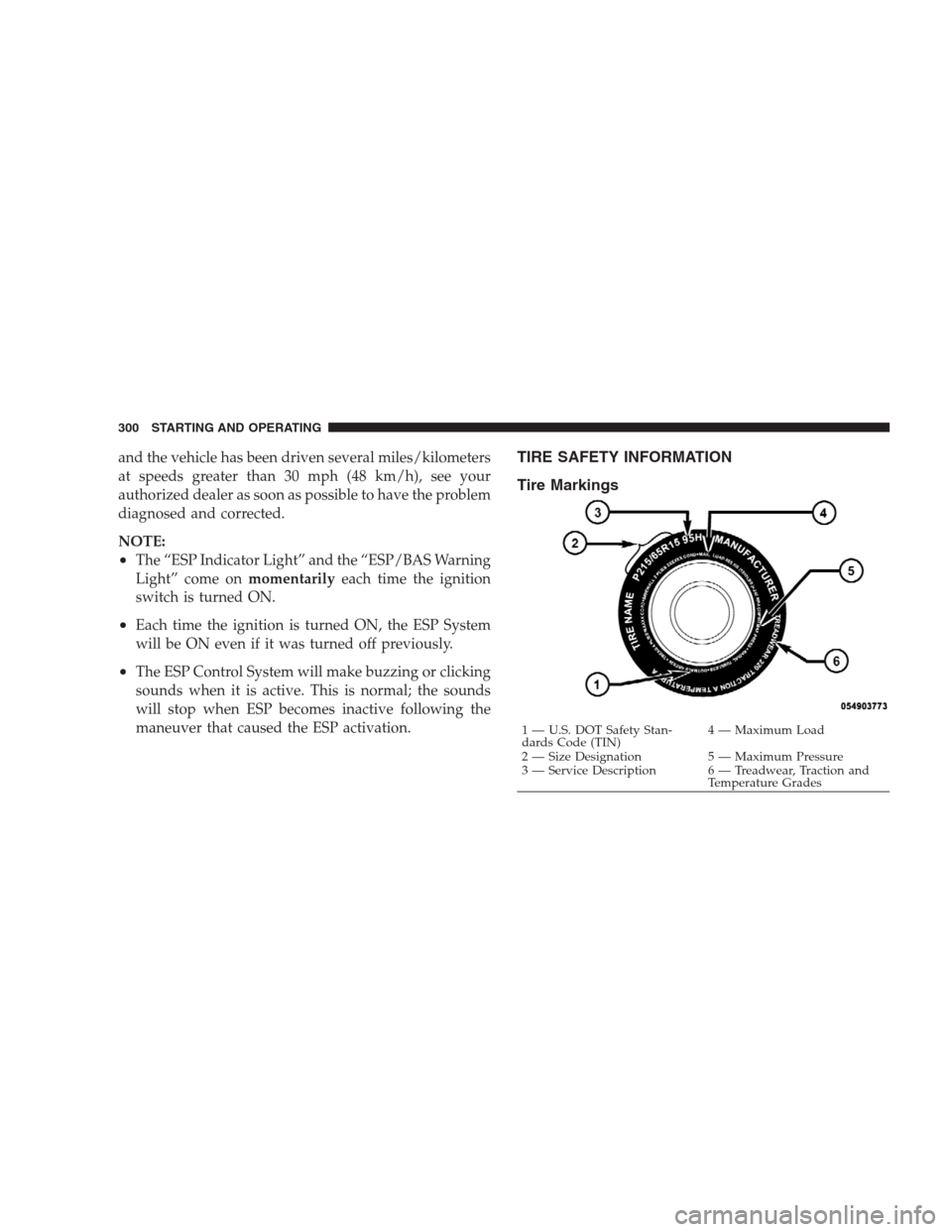
Tire Markings
1 — U.S. DOT Safety Stan-
dards Code (TIN)4 — Maximum Load
2 — Size Designation 5 — Maximum Pressure
3 — Service Description 6 — Treadwear, Traction and
Temperature Grades 300 STARTING AND OPERATING