ECU JEEP PATRIOT 2010 1.G User Guide
[x] Cancel search | Manufacturer: JEEP, Model Year: 2010, Model line: PATRIOT, Model: JEEP PATRIOT 2010 1.GPages: 496, PDF Size: 6.45 MB
Page 27 of 496
To Enter Remote Start
Press and release the REMOTE START button
on the RKE transmitter twice, within five sec-
onds. The parking lights will flash and the horn
will chirp twice (if programmed). Then, the
engine will start and the vehicle will remain in the
Remote Start mode for a 15-minute cycle.
NOTE:
•The park lamps will turn on and remain on during
Remote Start mode.
•For security, power window and power sunroof op-
eration (if equipped) are disabled when the vehicle is
in the Remote Start mode.
•The engine can be started two consecutive times (two
15-minute cycles) with the RKE transmitter. However,
the ignition switch must be cycled to the ON position
before you can repeat the start sequence for a third
cycle. Remote start will also cancel if any of the following occur:
•The engine stalls or RPM exceeds 2500
•Any engine warning lamps come on
•The hood is opened
•The hazard switch is pressed
•The transmission is moved out of PARK
•The brake pedal is pressed
To Exit Remote Start Mode without Driving the
Vehicle
Press and release the REMOTE START button one time,
or allow the engine to run for the entire 15-minute cycle.
NOTE:
To avoid unintentional shut downs, the system
will disable the one time press of the REMOTE START
button for two seconds after receiving a valid Remote
Start request.
26 THINGS TO KNOW BEFORE STARTING YOUR VEHICLE
Page 28 of 496
To Exit Remote Start Mode and Drive the Vehicle
Before the end of the 15-minute cycle, press and release
the UNLOCK button on the RKE transmitter to unlock
the doors and disarm the Vehicle Security Alarm (if
equipped). Then, insert the key into the ignition switch
and turn the switch to the ON position.
NOTE:The ignition switch must be in the ON position
in order to drive the vehicle.
DOOR LOCKS
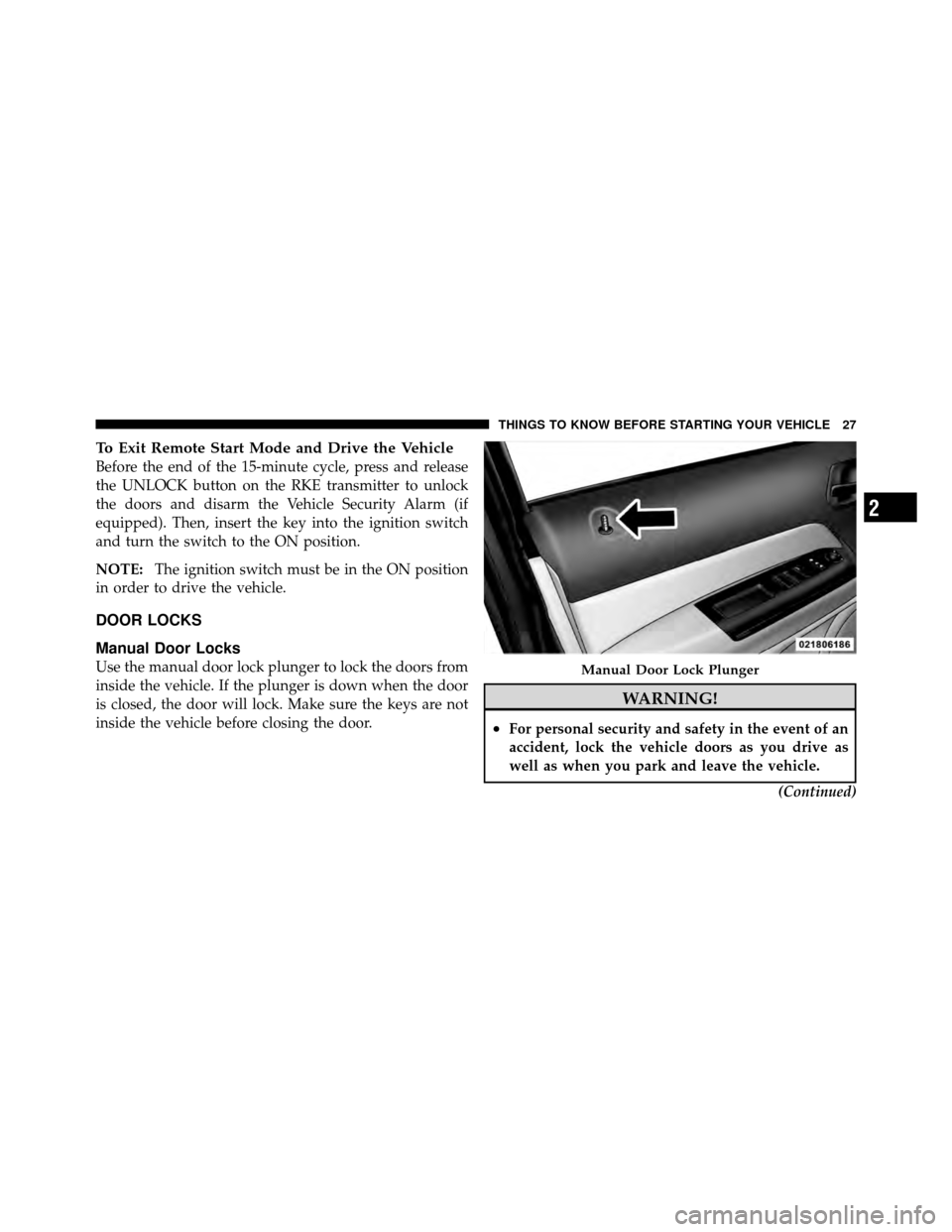
Manual Door Locks
Use the manual door lock plunger to lock the doors from
inside the vehicle. If the plunger is down when the door
is closed, the door will lock. Make sure the keys are not
inside the vehicle before closing the door.
WARNING!
•For personal security and safety in the event of an
accident, lock the vehicle doors as you drive as
well as when you park and leave the vehicle.
(Continued)
Manual Door Lock Plunger
2
THINGS TO KNOW BEFORE STARTING YOUR VEHICLE 27
Page 38 of 496

•Supplemental Side Airbag Inflatable Curtains (SABIC)
for the driver and passengers seated next to a window
•Supplemental Seat-Mounted Side Airbags — if
equipped
•An energy-absorbing steering column and steering
wheel
•Knee bolsters/blockers for front seat occupants
•Front seat belts incorporate pretensioners to enhance
occupant protection by managing occupant energy
during an impact event — if equipped
•All seat belt systems (except the driver’s) include
Automatic Locking Retractors (ALRs), which lock the
seat belt webbing into position by extending the belt
all the way out and then adjusting the belt to the
desired length to restrain a child seat or secure a large
item in a seat — if equippedIf you will be carrying children too small for adult-sized
seat belts, the seat belts or the Lower Anchors and Tether
for CHildren (LATCH) feature also can be used to hold
infant and child restraint systems. For more information
on LATCH, see Lower Anchors and Tether for CHildren
(LATCH).
NOTE:
The Advanced Front Airbags have a multistage
inflator design. This allows the airbag to have different
rates of inflation based on the severity and type of
collision.
Please pay close attention to the information in this
section. It tells you how to use your restraint system
properly, to keep you and your passengers as safe as
possible.
2
THINGS TO KNOW BEFORE STARTING YOUR VEHICLE 37
Page 63 of 496
WARNING!
Infants in rear facing child restraints should NEVER
ride in the front seat of a vehicle with a passenger
Advanced Front Airbag. An airbag deployment can
cause severe injury or death to infants in that posi-
tion.
Children that are not big enough to wear the vehicle seat
belt properly (see section on Child Restraints) should be
secured in the rear seat in child restraints or belt-
positioning booster seats. Older children who do not use
child restraints or belt-positioning booster seats should
ride properly buckled up in the rear seat. Never allow
children to slide the shoulder belt behind them or under
their arm. If a child from 1 to 12 years old (not in a rear facing child
seat) must ride in the front passenger seat, move the seat
as far back as possible and use the proper child restraint.
(Refer to “Child Restraints”)
You should read the instructions provided with your
child restraint to make sure that you are using it properly.
2.
All occupants should ALWAYS wear their lap and
shoulder belts properly.
3. The driver and front passenger seats should be
moved back as far as practical to allow the Advanced
Front Airbags room to inflate.
4. Do not lean against the door or window. If your
vehicle has side airbags, and deployment occurs, the
side airbags will inflate forcefully into the space be-
tween you and the door.
62 THINGS TO KNOW BEFORE STARTING YOUR VEHICLE
Page 74 of 496
•Pedal position
•And other parameters depending on vehicle
configuration
Child Restraints
Everyone in your vehicle needs to be buckled up at all
times, including babies and children. Every state in the
United States and all Canadian provinces require that
small children ride in proper restraint systems. This is the
law, and you can be prosecuted for ignoring it.
Children 12 years and younger should ride properly
buckled up in a rear seat, if available. According to crash
statistics, children are safer when properly restrained in
the rear seats, rather than in the front.
WARNING!
In a collision, an unrestrained child, even a tiny baby,
can become a projectile inside the vehicle. The force
required to hold even an infant on your lap could
become so great that you could not hold the child, no
matter how strong you are. The child and others
could be badly injured. Any child riding in your
vehicle should be in a proper restraint for the child’s
size.
Infants and Child Restraints
There are different sizes and types of restraints for
children from newborn size to the child almost large
enough for an adult safety belt. Always check the child
seat owner’s manual to ensure you have the correct seat
for your child. Use the restraint that is correct for your
child.
2
THINGS TO KNOW BEFORE STARTING YOUR VEHICLE 73
Page 77 of 496
•Carefully follow the instructions that come with the
restraint. If you install the restraint improperly, it may
not work when you need it.
Installing Child Restraints Using the Vehicle Seat
Belt
The seat belts in the passenger seating positions are
equipped with either an Automatic Locking Retractor
(ALR) or a cinching latch plate or both. Both types of
seatbelts are designed to keep the lap portion of the seat
belt tight around the child restraint so that it is not
necessary to use a locking clip. The ALR will make a
ratcheting noise if you extract the entire belt from the
retractor and then allow the belt to retract into the
retractor. For additional information on ALR, refer to
“Automatic Locking Mode”.
•Buckle the child into the seat according to the child
restraint manufacturer ’s directions.
•When your child restraint is not in use, secure it in the
vehicle with the seat belt or remove it from the vehicle.
Do not leave it loose in the vehicle. In a sudden stop or
collision, it could strike the occupants or seatbacks and
cause serious personal injury.
•To install a child restraint, first, pull enough of the seat
belt webbing from the retractor to route it through the
belt path of the child restraint and slide the latch plate
into the buckle. Next, extract all the seat belt webbing
out of the retractor and then allow the belt to retract
into the retractor. Finally, pull on any excess webbing
to tighten the lap portion around the child restraint.
Any seat belt system will loosen with time, so check
the belt occasionally, and pull it tight if necessary.
•In the rear seat, you may have trouble tightening the
lap/shoulder belt on the child restraint because the
buckle or latch plate is too close to the belt path
opening on the restraint. Disconnect the latch plate
76 THINGS TO KNOW BEFORE STARTING YOUR VEHICLE
Page 78 of 496
from the buckle and twist the short buckle end of the
belt several times to shorten it. Insert the latch plate
into the buckle with the release button facing out.
•If the belt still can’t be tightened, or if pulling and
pushing on the restraint loosens the belt, disconnect
the latch plate from the buckle, turn the latch plate
around, and insert the latch plate into the buckle
again. If you still can’t make the child restraint secure,
try a different seating position.
Children too Large for Booster Seats
Children who are large enough to wear the shoulder belt
comfortably and whose legs are long enough to bend
over the front of the seat when their back is against the
seatback should use the lap/shoulder belt in a rear seat.
•Make sure that the child is upright in the seat.
•The lap portion should be low on the hips and as snug
as possible.
•Check belt fit periodically. A child’s squirming or
slouching can move the belt out of position.
•If the shoulder belt contacts the face or neck, move the
child closer to the center of the vehicle. Never allow a
child to put the shoulder belt under an arm or behind
their back.
Lower Anchors and Tether for CHildren (LATCH)
Your vehicle is equipped with the child restraint anchor-
age system called LATCH, which stands for Lower
Anchors and Tether for CHildren. The LATCH system
provides for the installation of the child restraint without
using the vehicle seat belt. All three rear seating positions
have lower anchorages that are capable of accommodat-
ing LATCH-compatible child seats having flexible,
webbing-mounted lower attachments. Child seats with
fixed lower attachments must be installed in the out-
board positions only. Regardless of the specific type of
lower attachment,NEVERinstall LATCH-compatible
2
THINGS TO KNOW BEFORE STARTING YOUR VEHICLE 77
Page 81 of 496
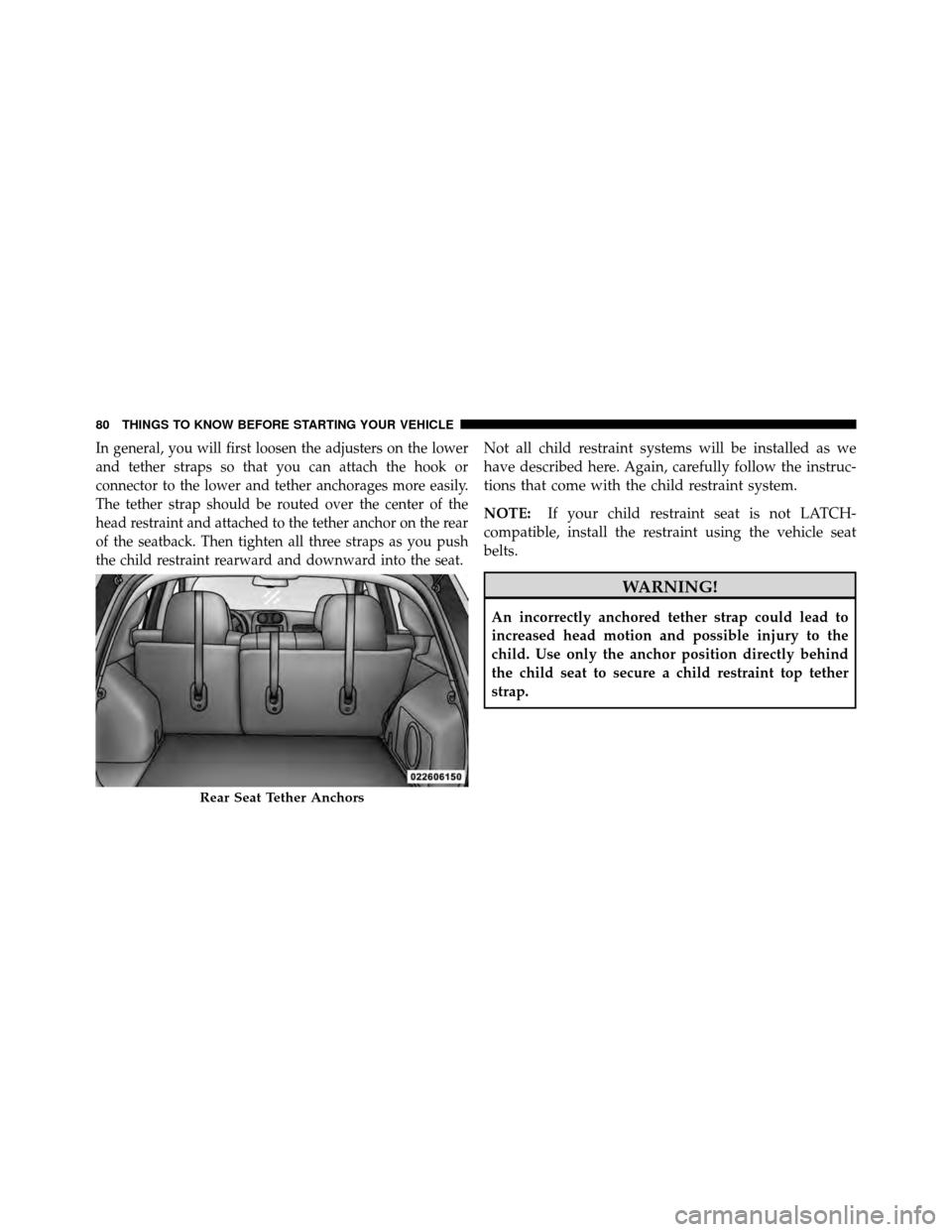
In general, you will first loosen the adjusters on the lower
and tether straps so that you can attach the hook or
connector to the lower and tether anchorages more easily.
The tether strap should be routed over the center of the
head restraint and attached to the tether anchor on the rear
of the seatback. Then tighten all three straps as you push
the child restraint rearward and downward into the seat.Not all child restraint systems will be installed as we
have described here. Again, carefully follow the instruc-
tions that come with the child restraint system.
NOTE:If your child restraint seat is not LATCH-
compatible, install the restraint using the vehicle seat
belts.
WARNING!
An incorrectly anchored tether strap could lead to
increased head motion and possible injury to the
child. Use only the anchor position directly behind
the child seat to secure a child restraint top tether
strap.
Rear Seat Tether Anchors
80 THINGS TO KNOW BEFORE STARTING YOUR VEHICLE
Page 82 of 496
Transporting Pets
Airbags deploying in the front seat could harm your pet.
An unrestrained pet will be thrown about and possibly
injured, or injure a passenger during panic braking or in
a collision.
Pets should be restrained in the rear seat in pet harnesses
or pet carriers that are secured by seat belts.
ENGINE BREAK-IN RECOMMENDATIONS
A long break-in period is not required for the engine and
drivetrain (transmission and axle) in your vehicle.
Drive moderately during the first 300 miles (500 km).
After the initial 60 miles (100 km), speeds up to 50 or
55 mph (80 or 90 km/h) are desirable.
While cruising, brief full-throttle acceleration within the
limits of local traffic laws, contributes to a good break-in.
Wide-open throttle acceleration in low gear can be detri-
mental and should be avoided.The engine oil installed in the engine at the factory is a
high-quality energy conserving type lubricant. Oil
changes should be consistent with anticipated climate
conditions under which vehicle operations will occur. For
the recommended viscosity and quality grades refer to
“Maintenance Procedures” in “Maintaining Your Ve-
hicle”. NON-DETERGENT OR STRAIGHT MINERAL
OILS MUST NEVER BE USED.
A new engine may consume some oil during its first few
thousand miles (kilometers) of operation. This should be
considered a normal part of the break-in and not inter-
preted as an indication of difficulty.
SAFETY TIPS
Transporting Passengers
NEVER TRANSPORT PASSENGERS IN THE CARGO
AREA.
2
THINGS TO KNOW BEFORE STARTING YOUR VEHICLE 81
Page 85 of 496
Defroster
Check operation by selecting the defrost mode and place
the blower control on high speed. You should be able to
feel the air directed against the windshield. See your
authorized dealer for service if your defroster is
inoperable.
Floor Mat Safety Information
Always use floor mats designed to fit the foot well of
your vehicle. Use only floor mats that leave the pedal
area unobstructed and that are firmly secured so that
they cannot slip out of position and interfere with the
pedals or impair safe operation of your vehicle in other
ways.
WARNING!
Pedals that cannot move freely can cause loss of
vehicle control and increase the risk of serious per-
sonal injury.
•Always make sure that floor mats are properly
attached to the floor mat fasteners.
•Never place or install floor mats or other floor
coverings in the vehicle that cannot be properly
secured to prevent them from moving and inter-
fering with the pedals or the ability to control the
vehicle.
•Never put floor mats or other floor coverings on
top of already installed floor mats. Additional
floor mats and other coverings will reduce the size
of the pedal area and interfere with the pedals.(Continued)
84 THINGS TO KNOW BEFORE STARTING YOUR VEHICLE