ignition JEEP PATRIOT 2012 1.G Owner's Manual
[x] Cancel search | Manufacturer: JEEP, Model Year: 2012, Model line: PATRIOT, Model: JEEP PATRIOT 2012 1.GPages: 108, PDF Size: 4.19 MB
Page 71 of 108
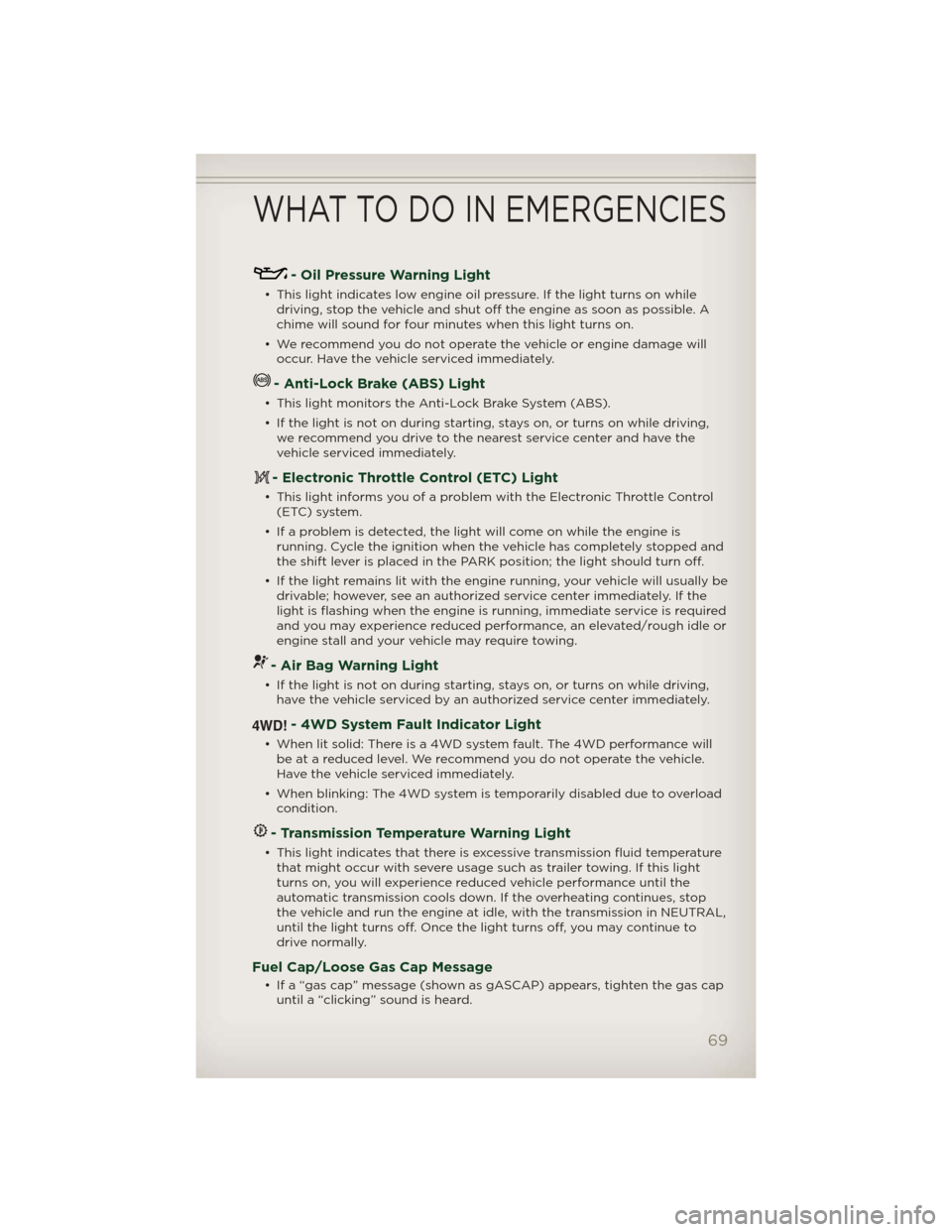
- Oil Pressure Warning Light
• This light indicates low engine oil pressure. If the light turns on while
driving, stop the vehicle and shut off the engine as soon as possible. A
chime will sound for four minutes when this light turns on.
• We recommend you do not operate the vehicle or engine damage will
occur. Have the vehicle serviced immediately.
- Anti-Lock Brake (ABS) Light
• This light monitors the Anti-Lock Brake System (ABS).
• If the light is not on during starting, stays on, or turns on while driving,
we recommend you drive to the nearest service center and have the
vehicle serviced immediately.
- Electronic Throttle Control (ETC) Light
• This light informs you of a problem with the Electronic Throttle Control
(ETC) system.
• If a problem is detected, the light will come on while the engine is
running. Cycle the ignition when the vehicle has completely stopped and
the shift lever is placed in the PARK position; the light should turn off.
• If the light remains lit with the engine running, your vehicle will usually be
drivable; however, see an authorized service center immediately. If the
light is flashing when the engine is running, immediate service is required
and you may experience reduced performance, an elevated/rough idle or
engine stall and your vehicle may require towing.
- Air Bag Warning Light
• If the light is not on during starting, stays on, or turns on while driving,
have the vehicle serviced by an authorized service center immediately.
4WD!- 4WD System Fault Indicator Light
• When lit solid: There is a 4WD system fault. The 4WD performance will
be at a reduced level. We recommend you do not operate the vehicle.
Have the vehicle serviced immediately.
• When blinking: The 4WD system is temporarily disabled due to overload
condition.
- Transmission Temperature Warning Light
• This light indicates that there is excessive transmission fluid temperature
that might occur with severe usage such as trailer towing. If this light
turns on, you will experience reduced vehicle performance until the
automatic transmission cools down. If the overheating continues, stop
the vehicle and run the engine at idle, with the transmission in NEUTRAL,
until the light turns off. Once the light turns off, you may continue to
drive normally.
Fuel Cap/Loose Gas Cap Message
• If a “gas cap” message (shown as gASCAP) appears, tighten the gas cap
until a “clicking” sound is heard.
WHAT TO DO IN EMERGENCIES
69
Page 72 of 108
• Press the odometer reset button, located below the tachometer, to turn
the message off.
• If the message continues to appear for more than three days after
tightening the gas cap, see your authorized service center.
Oil Change IndicatorMessage
• If an “oil change” message (shown as CHANgE OIL) appears and a single
chime sounds, it is time for your next required oil change.
Resetting The Light After Servicing
• Turn the ignition switch to the ON/RUN position (do not start engine).
• Fully depress the accelerator pedal three times within 10 seconds.
• Turn the ignition switch to the OFF/LOCK position.
IF YOUR ENGINE OVERHEATS
• In any of the following situations, you can reduce the potential for
overheating by taking the appropriate action.
• On the highways — slow down.
• In city traffic — while stopped, place the transmission in NEUTRAL, but
do not increase engine idle speed.
NOTE:There are steps that you can take to slow down an impending
overheat condition:
• If your air conditioner (A/C) is on, turn it off. The A/C system adds heat to
the engine cooling system and turning the A/C off can help remove this
heat.
• You can also turn the temperature control to maximum heat, the mode
control to floor and the blower control to high. This allows the heater core
to act as a supplement to the radiator and aids in removing heat from the
engine cooling system.
CAUTION!
Driving with a hot cooling system could damage your vehicle. If the
temperature gauge reads 240°F (116 °C) or greater pull over and stop
the vehicle. Idle the vehicle with the air conditioner turned off until the
pointer drops back into the normal range 200–230°F (93–110°C). If
the pointer remains at 240°F (116°C) or greater and you hear a chime,
turn the engine off immediately and call for service.
WHAT TO DO IN EMERGENCIES
70
Page 74 of 108
Preparations For Jacking
1. Park the vehicle on a firm level surface, avoiding ice or slippery areas.
2. Turn on the Hazard Warning flasher.
3. Set the parking brake.
4. Place the shift lever in PARK (automatic transmission) or REVERSE
(manual transmission).
5. Turn OFF the ignition.
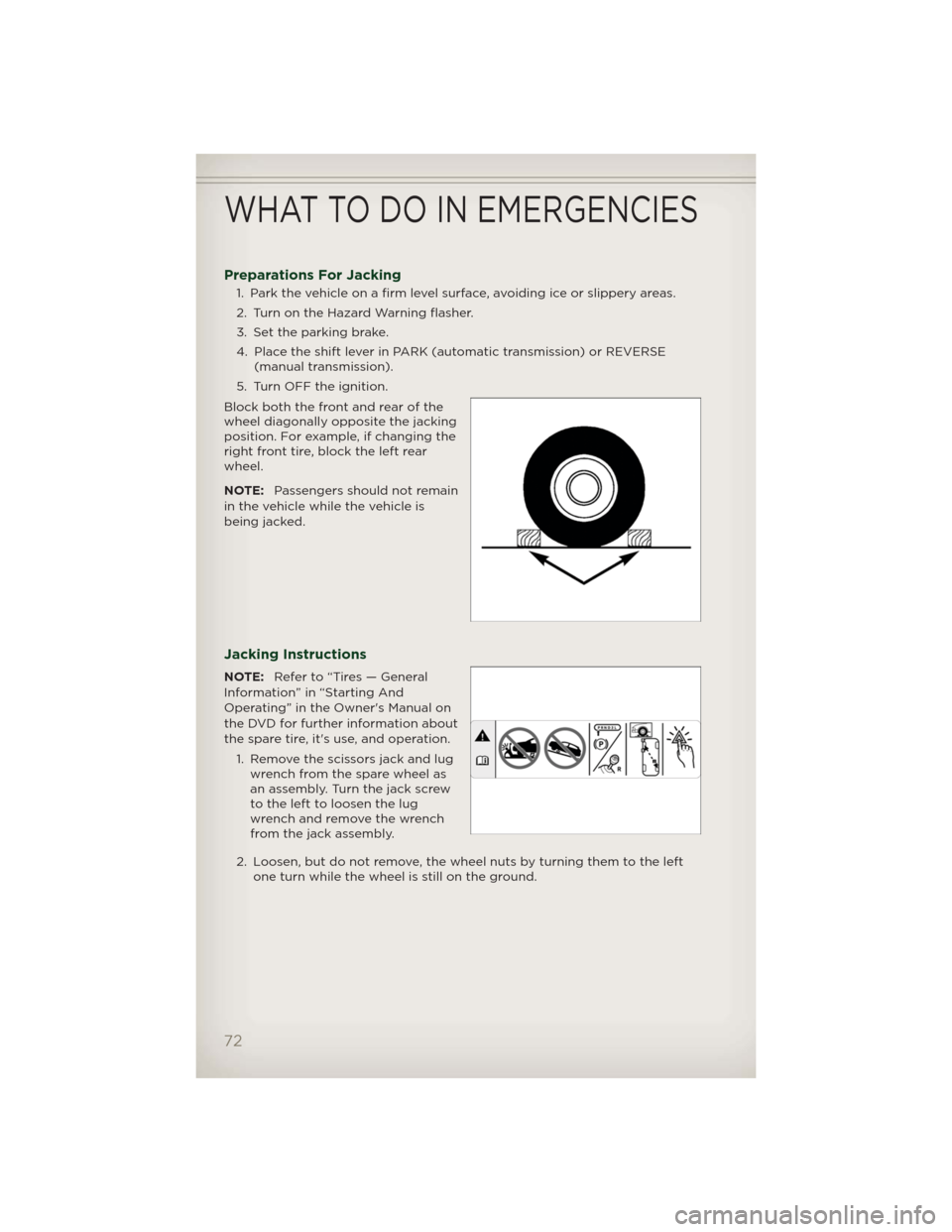
Block both the front and rear of the
wheel diagonally opposite the jacking
position. For example, if changing the
right front tire, block the left rear
wheel.
NOTE:Passengers should not remain
in the vehicle while the vehicle is
being jacked.
Jacking Instructions
NOTE:Refer to “Tires — General
Information” in “Starting And
Operating” in the Owner's Manual on
the DVD for further information about
the spare tire, it's use, and operation.
1. Remove the scissors jack and lug
wrench from the spare wheel as
an assembly. Turn the jack screw
to the left to loosen the lug
wrench and remove the wrench
from the jack assembly.
2. Loosen, but do not remove, the wheel nuts by turning them to the left
one turn while the wheel is still on the ground.
WHAT TO DO IN EMERGENCIES
72
Page 79 of 108
Preparations For Jump-Start
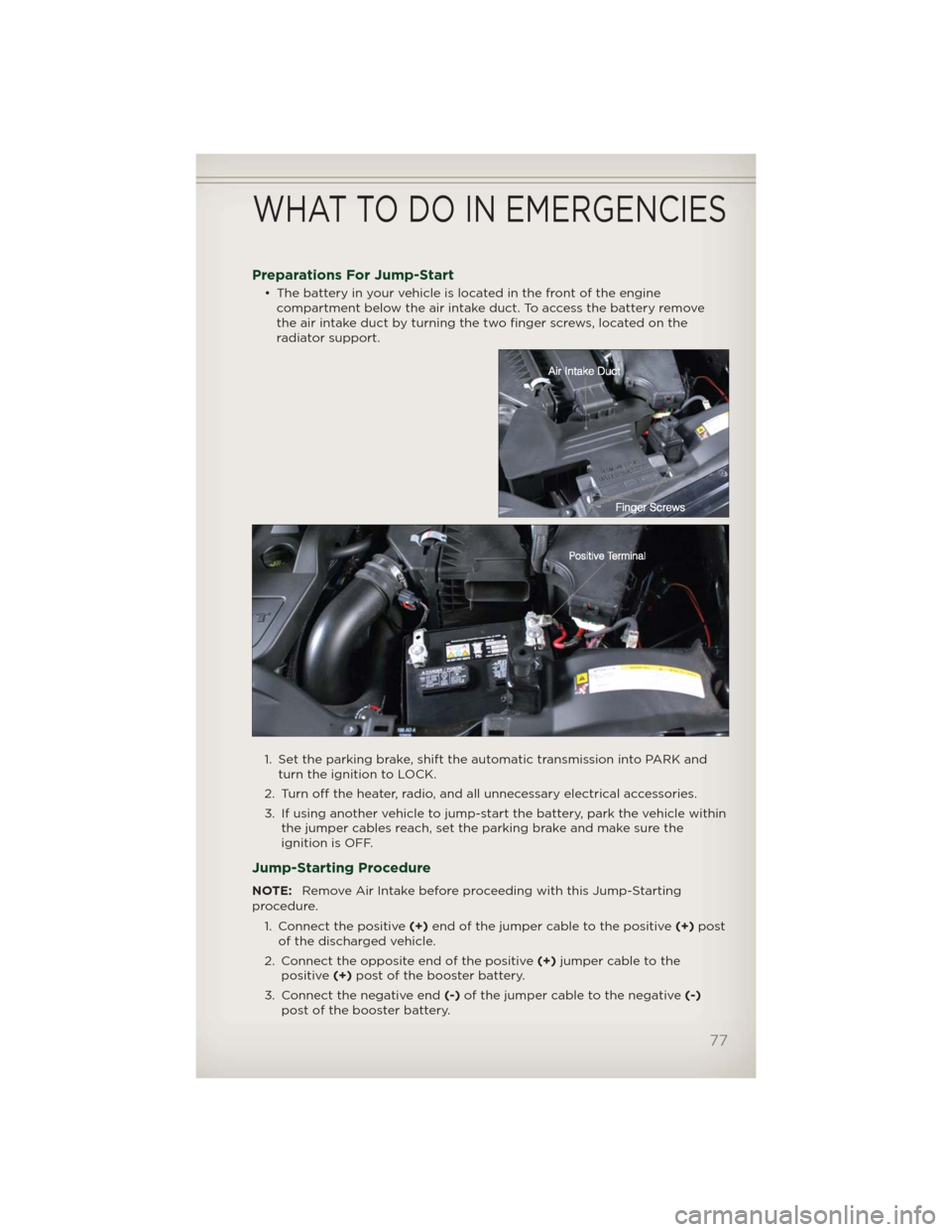
• The battery in your vehicle is located in the front of the engine
compartment below the air intake duct. To access the battery remove
the air intake duct by turning the two finger screws, located on the
radiator support.
1. Set the parking brake, shift the automatic transmission into PARK and
turn the ignition to LOCK.
2. Turn off the heater, radio, and all unnecessary electrical accessories.
3. If using another vehicle to jump-start the battery, park the vehicle within
the jumper cables reach, set the parking brake and make sure the
ignition is OFF.
Jump-Starting Procedure
NOTE:Remove Air Intake before proceeding with this Jump-Starting
procedure.
1. Connect the positive(+)end of the jumper cable to the positive(+)post
of the discharged vehicle.
2. Connect the opposite end of the positive(+)jumper cable to the
positive(+)post of the booster battery.
3. Connect the negative end(-)of the jumper cable to the negative(-)
post of the booster battery.
WHAT TO DO IN EMERGENCIES
77
Page 80 of 108
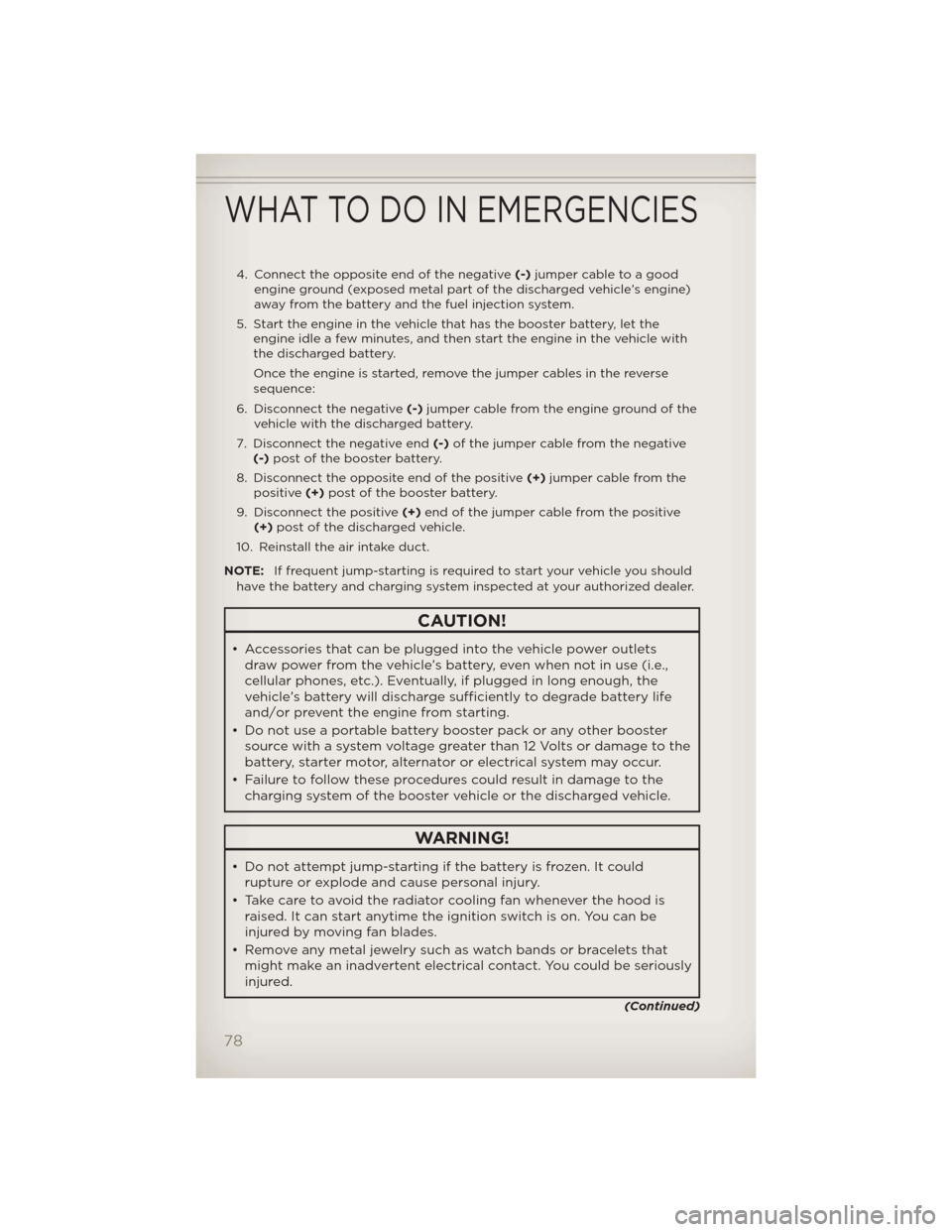
4. Connect the opposite end of the negative(-)jumper cable to a good
engine ground (exposed metal part of the discharged vehicle’s engine)
away from the battery and the fuel injection system.
5. Start the engine in the vehicle that has the booster battery, let the
engine idle a few minutes, and then start the engine in the vehicle with
the discharged battery.
Once the engine is started, remove the jumper cables in the reverse
sequence:
6. Disconnect the negative(-)jumper cable from the engine ground of the
vehicle with the discharged battery.
7. Disconnect the negative end(-)of the jumper cable from the negative
(-)post of the booster battery.
8. Disconnect the opposite end of the positive(+)jumper cable from the
positive(+)post of the booster battery.
9. Disconnect the positive(+)end of the jumper cable from the positive
(+)post of the discharged vehicle.
10. Reinstall the air intake duct.
NOTE:If frequent jump-starting is required to start your vehicle you should
have the battery and charging system inspected at your authorized dealer.
CAUTION!
• Accessories that can be plugged into the vehicle power outlets
draw power from the vehicle’s battery, even when not in use (i.e.,
cellular phones, etc.). Eventually, if plugged in long enough, the
vehicle’s battery will discharge sufficiently to degrade battery life
and/or prevent the engine from starting.
• Do not use a portable battery booster pack or any other booster
source with a system voltage greater than 12 Volts or damage to the
battery, starter motor, alternator or electrical system may occur.
• Failure to follow these procedures could result in damage to the
charging system of the booster vehicle or the discharged vehicle.
WARNING!
• Do not attempt jump-starting if the battery is frozen. It could
rupture or explode and cause personal injury.
• Take care to avoid the radiator cooling fan whenever the hood is
raised. It can start anytime the ignition switch is on. You can be
injured by moving fan blades.
• Remove any metal jewelry such as watch bands or bracelets that
might make an inadvertent electrical contact. You could be seriously
injured.
(Continued)
WHAT TO DO IN EMERGENCIES
78
Page 81 of 108
WARNING!(Continued)
• Batteries contain sulfuric acid that can burn your skin or eyes and
generate hydrogen gas which is flammable and explosive. Keep
open flames or sparksaway from the battery.
• Do not allow vehicles to touch each other as this could establish a
ground connection and personal injury could result.
• Failure to follow this procedure could result in personal injury or
property damage due to battery explosion.
• Do not connect the cable to the negative post(-)of the discharged
battery. The resulting electrical spark could cause the battery to
explode and could result in personal injury.
SHIFT LEVER OVERRIDE
• If a malfunction occurs and the shift lever cannot be moved out of the
PARK position, you can use the following procedure to temporarily move
the shift lever:
• To access the shift lever override, locate and remove the removable plug
in the right side of the shift lever housing.
• Firmly set the parking brake.
• Turn the ignition switch to the ACC or ON position without starting the
engine.
• Press and maintain firm pressure on the brake pedal.
• Using a screwdriver or similar tool, press and hold the override tab
through the access port on the center console.
• Move the shift lever into the NEUTRAL position.
• The vehicle may then be started in NEUTRAL.
• Reinstall the override cover.
WHAT TO DO IN EMERGENCIES
79
Page 93 of 108
FUSES
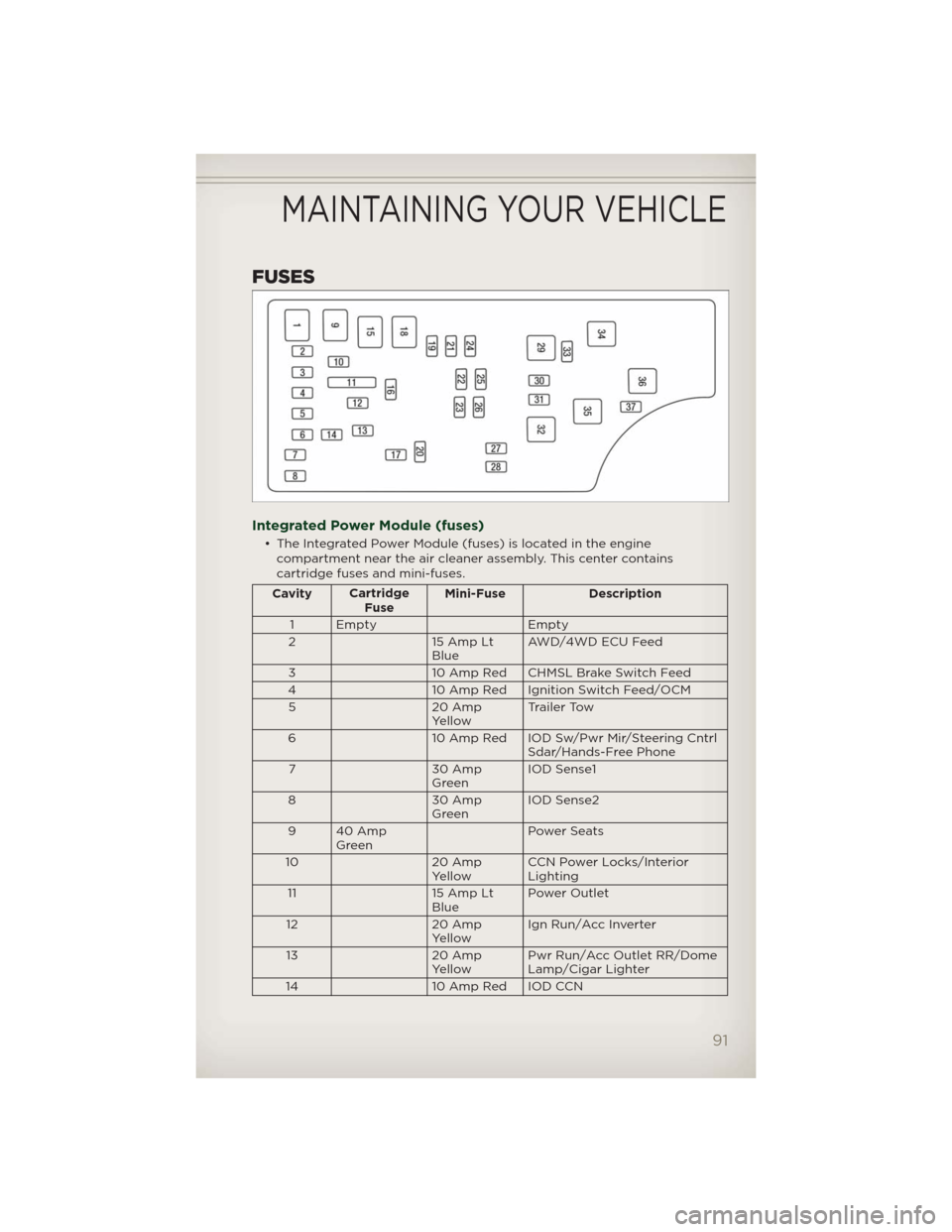
Integrated Power Module (fuses)
• The Integrated Power Module (fuses) is located in the engine
compartment near the air cleaner assembly. This center contains
cartridge fuses and mini-fuses.
CavityCartridge
FuseMini-Fuse Description
1 Empty Empty
2 15 Amp Lt
BlueAWD/4WD ECU Feed
3 10 Amp Red CHMSL Brake Switch Feed
4 10 Amp Red Ignition Switch Feed/OCM
5 20 Amp
YellowTrailer Tow
6 10 Amp Red IOD Sw/Pwr Mir/Steering Cntrl
Sdar/Hands-Free Phone
7 30 Amp
GreenIOD Sense1
8 30 Amp
GreenIOD Sense2
9 40 Amp
GreenPower Seats
10 20 Amp
YellowCCN Power Locks/Interior
Lighting
11 15 Amp Lt
BluePower Outlet
12 20 Amp
YellowIgn Run/Acc Inverter
13 20 Amp
YellowPwr Run/Acc Outlet RR/Dome
Lamp/Cigar Lighter
14 10 Amp Red IOD CCN
MAINTAINING YOUR VEHICLE
91