child seat JEEP PATRIOT 2013 1.G User Guide
[x] Cancel search | Manufacturer: JEEP, Model Year: 2013, Model line: PATRIOT, Model: JEEP PATRIOT 2013 1.GPages: 108, PDF Size: 3.17 MB
Page 3 of 108
INTRODUCTION/WELCOME
WELCOME FROM
CHRYSLER GROUP LLC.......... 2
CONTROLS AT A GLANCE
DRIVER COCKPIT............... 6
INSTRUMENT CLUSTER .......... 8
GETTING STARTED
KEYFOB ................... 10
REMOTE START............... 10
THEFT ALARM ................ 11
SEATBELT .................. 11
SUPPLEMENTAL RESTRAINT SYSTEM
(SRS) — AIR BAGS ............ 12
CHILD RESTRAINTS ............ 13
FRONT SEATS ................ 15
REAR SEATS ................ 17
HEATEDSEATS ............... 18
TILT STEERING COLUMN ......... 19
OPERATING YOUR VEHICLE
ENGINE BREAK-IN
RECOMMENDATIONS........... 20
TURN SIGNAL/LIGHTS LEVER ...... 20
WIPER/WASHER LEVER .......... 22
SPEED CONTROL .............. 23
CONTINUOUSLY VARIABLE AUTOMATIC
TRANSMISSION (CVT) ........... 24
MANUAL CLIMATE CONTROLS ...... 24
AUTOMATIC TEMPERATURE
CONTROLS (ATC) .............. 25
POWER SUNROOF ............. 26
WIND BUFFETING ............. 27
ELECTRONICS
YOUR VEHICLE'S SOUND SYSTEM . . . 28
Uconnect®130 ............... 30
Uconnect®130 WITH
SiriusXM SATELLITE RADIO ........ 32
Uconnect
®230 ............... 35
Uconnect®430/430N ........... 38
SiriusXM SATELLITE RADIO/TRAVEL
LINK ...................... 47
STEERING WHEEL AUDIO CONTROLS.. 50
iPod®/USB/MP3 CONTROL ........ 51
Uconnect®Phone .............. 51
Uconnect®VOICE COMMAND ....... 54
Bluetooth®STREAMING AUDIO ..... 57
ELECTRONIC VEHICLE INFORMATION
CENTER (EVIC) ............... 57
PROGRAMMABLE FEATURES ....... 58
UNIVERSAL GARAGE DOOR OPENER
(HomeLink
®) ................. 59
POWER INVERTER ............. 61
POWER OUTLET .............. 62
OFF-ROAD CAPABILITIES
FOUR-WHEEL DRIVE OPERATION . . . 63
UTILITY
TRAILER TOWING WEIGHTS
(MAXIMUM TRAILER WEIGHT
RATINGS).................. 65
RECREATIONAL TOWING
(BEHIND MOTORHOME, ETC.) ..... 65
WHATTODOIN
EMERGENCIES
ROADSIDE ASSISTANCE.......... 66
INSTRUMENT CLUSTER WARNING
LIGHTS .................... 66
IF YOUR ENGINE OVERHEATS ...... 70
AUTOMATIC TRANSMISSION
OVERHEATING ............... 71
JACKING AND TIRE CHANGING ..... 71
JUMP-STARTING PROCEDURES ..... 76
SHIFT LEVER OVERRIDE ......... 79
TOWING A DISABLED VEHICLE ..... 80
FREEING A STUCK VEHICLE ....... 81
EVENT DATA RECORDER (EDR) ..... 82
MAINTAINING YOUR VEHICLE
OPENING THE HOOD........... 83
ENGINE COMPARTMENT ......... 84
FLUIDS AND CAPACITIES ........ 86
MAINTENANCE SCHEDULE ....... 87
MAINTENANCE RECORD ......... 91
FUSES ..................... 92
TIRE PRESSURES ............. 94
WHEEL AND WHEEL TRIM CARE .... 95
EXTERIOR BULBS ............. 95
MOPAR ACCESSORIES
AUTHENTIC ACCESSORIES
BY MOPAR®................. 96
INDEX................... 97
FAQ(HowTo?)
FREQUENTLY ASKED QUESTIONS . . . 100
TABLE OF CONTENTS
Page 13 of 108
WARNING!
• Do not start or run an engine in a closed garage or confined area. Exhaust gascontains Carbon Monoxide (CO) which is odorless and colorless. Carbon
Monoxide is poisonous and can cause serious injury or death when inhaled.
• Keep Key Fob transmitters away from children. Operation of the Remote Start
System, windows, door locks or other controls could cause serious injury or
death.
THEFT ALARM
To Arm:
• Press the Key Fob LOCK button or the power door lock switch while the door isopen.
To Disarm:
• Press the Key Fob UNLOCK button or turn the ignition to the ON/RUN position.
SEAT BELT
• Be sure everyone in your vehicle is in a seat and using a seat belt properly.
• Position the lap belt across your thighs, below your abdomen. To remove slack inthe lap portion, pull up a bit on the shoulder belt. To loosen the lap belt if it is too
tight, tilt the latch plate and pull on the lap belt. A snug belt reduces the risk of
sliding under the belt in a collision.
• Position the shoulder belt on your chest so that it is comfortable and not resting on your neck. The retractor will withdraw any slack in the belt.
• A shoulder belt placed behind you will not protect you from injury during a collision. You are more likely to hit your head in a collision if you do not wear your
shoulder belt. The lap and shoulder belt are meant to be used together.
•
A belt that is too loose will not protect you properly. In a sudden stop you could move
too far forward, increasing the possibility of injury. Wear your seat belt snugly.
• A frayed or torn belt could rip apart in a collision and leave you with no protection. Inspect the belt system periodically, checking for cuts, frays, or loose parts.
Damaged parts must be replaced immediately. Do not disassemble or modify the
system. Seat belt assemblies must be replaced after a collision if they have been
damaged (bent retractor, torn webbing, etc.).
• The seat belts for both front seating positions are equipped with pretensioning devices that are designed to remove slack from the seat belt in the event of a
collision.
• A deployed pretensioner or a deployed air bag must be replaced immediately.
GETTING STARTED
11
Page 15 of 108
WARNING!
• Relying on the air bags alone could lead to more severe injuries in a collision.The air bags work with your seat belt to restrain you properly. In some
collisions, the air bags won’t deploy at all. Always wear your seat belts even
though you have air bags.
• Being too close to the steering wheel or instrument panel during Advanced
Front Air Bag deployment could cause serious injury, including death. Air bags
need room to inflate. Sit back, comfortably extending your arms to reach the
steering wheel or instrument panel.
• Being too close to the Supplemental Side Air Bag Inflation Curtain and/or
Seat-Mounted Side Air Bag during deployment could cause you to be severely
injured or killed.
• Supplemental Side Air bag Inflatable Curtains and Supplemental Seat-
Mounted Side Air Bags need room to inflate. Do not lean against the door or
window. Sit upright in the center of the seat.
• Do not drive your vehicle after the air bags have developed. If you are involved
in another collision, the air bags will not be in place to protect you.
• After any collision, the vehicle should be taken to an authorized dealer
immediately.
CHILD RESTRAINTS
• Children 12 years and under should ride properly buckled up in a rear seat, ifavailable. According to crash statistics, children are safer when properly restrained
in the rear seats rather than in the front.
•
Every state in the United States and all Canadian provinces require that small
children ride in proper restraint systems. This is the law, and you can be prosecuted
for ignoring it.
NOTE:
For additional information, refer to www.seatcheck.org or call 1–866–SEATCHECK.
Canadian residents, should refer to Transport Canada’s website for additional informa-
tion. http://www.tc.gc.ca/eng/roadsafety/safedrivers-childsafety-index-53.htm
Installing The LATCH - Compatible Child Restraint System
• Your vehicle's second row passenger seats are equipped with the child restraint anchorage system called LATCH, which stands for Lower Anchors and Tether for
CHildren. LATCH child restraint anchorage systems are installed at all three rear
seating positions.
• The rear outboard seating positions have lower anchors, and all three rear seating positions have top tether anchors.
GETTING STARTED
13
Page 16 of 108
• Child seats with fixed lower attachments must be installed in the outboardpositions only. Child seats with flexible lower attachments can be used in all three
seating positions.
• NEVER install LATCH-compatible child seats such that two seats share a common
lower anchorage.
• Loosen the child seat adjusters on the lower straps and tether straps so that
you can attach the hook or connector
to the lower and tether anchorages
more easily.
• Attach the lower hooks or connectors over the top of the seatcover material.
• The tether strap should be routed un- der the center of the head restraint and
attached to the tether anchor on the
rear of the seatback.
• Tighten all three straps as you push the child restraint rearward and down-
ward into the seat.
Installing The Child Restraint Using
The Vehicle Seat Belts
• To install a child restraint, first, pullenough of the seat belt webbing from
the retractor to route it through the belt
path of the child restraint and slide the
latch plate into the buckle.
• Next, extract all the seat belt webbing out of the retractor and then allow the belt to retract into the retractor. Finally, pull on any excess webbing to tighten the lap
portion around the child restraint. Any seat belt system will loosen with time, so
check the belt occasionally, and pull it tight if necessary.
• Once you have completed securing the child restraint with the seat belt, secure the top tether strap. The tether strap should be routed over the center top of the
head restraint.
GETTING STARTED
14
Page 17 of 108
WARNING!
• In a collision, an unrestrained child, even a tiny baby, can become a projectileinside the vehicle. The force required to hold even an infant on your lap could
become so great that you could not hold the child, no matter how strong you
are. The child and others could be severely injured or killed. Any child riding in
your vehicle should be in a proper restraint for the child's size.
• Rearward-facing child seats must never be used in the front seat of a vehicle
with a front passenger air bag. An air bag deployment could cause severe injury
or death to infants in this position.
• Improper installation of a child restraint to the LATCH anchorages can lead to
failure of an infant or child restraint. The child could be severely injured or
killed. Follow the manufacturer’s directions exactly when installing an infant or
child restraint.
• An incorrectly anchored tether strap could lead to increased head motion and
possible injury to the child. Use only the anchor positions directly behind the
child seat to secure a child restraint top tether strap.
FRONT SEATS
Power Seats
• The power seat switch is located onthe outboard side of the seat near the
floor. Use the switch to move the seat
up, down, forward, rearward, or to tilt
the seat.
GETTING STARTED
15
Page 19 of 108
CAUTION!
Do not place any article under a power seat or impede its ability to move as it may
cause damage to the seat controls. Seat travel may become limited if movement
is stopped by an obstruction in the seat’s path.
WARNING!
• Adjusting a seat while the vehicle is moving is dangerous. The suddenmovement of the seat could cause you to lose control. The seat belt might not
be properly adjusted, and you could be severely injured or killed. Only adjust a
seat while the vehicle is parked.
• Do not ride with the seatback reclined so that the seat belt is no longer resting
against your chest. In a collision, you could slide under the seat belt and be
severely injured or killed. Use the recliner only when the vehicle is parked.
REAR SEATS
Folding Rear Seatback
• To fold each rear seatback, pull thestrap forward to move the seatback
forward and flat.
Reclining Rear Seatback
•To recline each rear seatback, pull the
strap forward just enough to release the
seatback latch. Then push the seatback
to a reclined position, approximately
35 degrees maximum, and release the
strap.
WARNING!
Be certain that the seatback is securely locked into position. If the seatback is not
securely locked into position, the seat will not provide the proper stability for child
seats and/or passengers. An improperly latched seat could cause serious injury.
GETTING STARTED
17
Page 29 of 108
WARNING!
• Never leave children in a vehicle, and do not leave the key in the ignition switch(or leave the ignition of a vehicle equipped with Keyless Enter-N-Go™ in the
ACC or ON/Run position). Occupants, particularly unattended children, can
become entrapped by the power sunroof while operating the power sunroof
switch. Such entrapment may result in serious injury or death.
• In a collision, there is a greater risk of being thrown from a vehicle with an open
sunroof. You could also be severely injured or killed. Always fasten your seat
belt properly and make sure all passengers are properly secured.
• Do not allow small children to operate the sunroof. Never allow your fingers,
other body parts, or any object to project through the sunroof opening. Injury
may result.
WIND BUFFETING
• Wind buffeting can be described as a helicopter-type percussion sound. Ifbuffeting occurs with the rear windows open, adjust the front and rear windows
together.
• If buffeting occurs with the sunroof open, adjust the sunroof opening, or adjust any window. This will minimize buffeting.
OPERATING YOUR VEHICLE
27
Page 99 of 108
Airbag..................12
Air Conditioning............25
Alarm,Panic ..............10
Arming Theft System (Security Alarm) ...........11
Automatic Temperature Control (ATC).................25
Automatic Transmission FluidType .............86
Overheating ............71
AxleFluid................86
Belts, Seat ...............11
Brake Fluid ...............86
Break-In Recommendations, New Vehicle .............20
BulbReplacement...........95
Calibration,Compass .........57
ChangeOilIndicator..........70
ChangingAFlatTire..........71
Child Restraint .............13
Child Restraint Tether Anchors ....13
Compass Calibration ..........57
Cooling System Coolant Capacity .........86
Cruise Control (Speed Control) ....23
CruiseLight...............23
Dimmer Control .............21
Dimmer Switch, Headlight ......21
Disarming, Theft System .......11
Electronics
Your Vehicle's Sound System...28
Electronic Speed Control (Cruise Control) ...........23
Electronic Stability Control (ESC)...66
Electronic Vehicle Information Center(EVIC)..........57,58
Emergency, In Case of Brake Warning Light .......68
Jacking ...............71
Jump Starting ...........76
Overheating ............70 Engine
Break-In Recommendations . . .20
Compartment ...........84
Jump Starting ...........76
Oil Selection ............86
Overheating ............70
Event Data Recorder ..........82
Exterior Lights .............95
Flash-To-Pass ..............21
Fluid Capacities ............86
Fluids ..................86
FogLights................21
Folding Front Passenger Seat .....16
FoldingRearSeat ...........17
Four Wheel Drive Operation ......63
Freeing A Stuck Vehicle ........81
Front Heated Seats ...........18
Fuel Filler Cap (Gas Cap) .......69
Specifications ...........86
Garage Door Opener (HomeLink®)...59
Gas Cap (Fuel Filler Cap) .......69
Headlights ................20
Dimmer Switch ..........21
HighBeam .............21
Heated Seats ..............18
High Beam/Low Beam Select (Dimmer) Switch ..........21
HomeLink®(Garage Door Opener)...59
Hood Release ..............83
Instrument Cluster Indicators ..............9
Instrument Cluster Warning Lights . . .8
Intermittent Wipers (Delay Wipers)..22
Introduction ...............2
Inverter Outlet (115V) .........61
Inverter, Power .............61
iPod
®/USB/MP3 Control ........51
Bluetooth Streaming Audio . . .57
Jacking Instructions ..........72
Jack Location ..............71
INDEX
97
Page 100 of 108
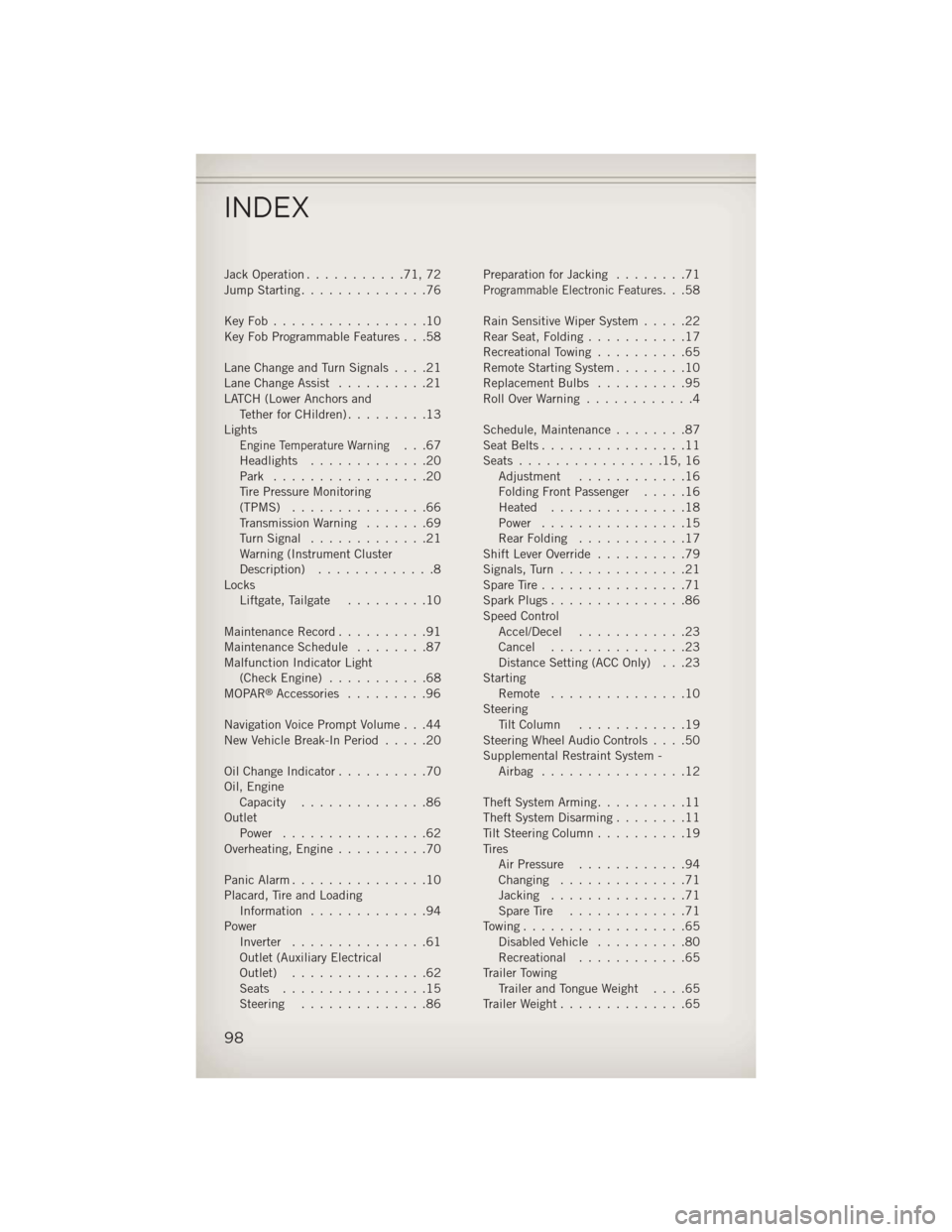
Jack Operation...........71,72
Jump Starting ..............76
KeyFob.................10
Key Fob Programmable Features . . .58
LaneChangeandTurnSignals....21
Lane Change Assist ..........21
LATCH (Lower Anchors and TetherforCHildren).........13
Lights
Engine Temperature Warning...67
Headlights .............20
Park .................20
Tire Pressure Monitoring
(TPMS) ...............66
Transmission Warning .......69
TurnSignal .............21
Warning (Instrument Cluster
Description) .............8
Locks Liftgate, Tailgate .........10
Maintenance Record ..........91
MaintenanceSchedule ........87
Malfunction Indicator Light (CheckEngine) ...........68
MOPAR
®Accessories .........96
Navigation Voice Prompt Volume . . .44
New Vehicle Break-In Period .....20
Oil Change Indicator ..........70
Oil, Engine Capacity ..............86
Outlet Power ................62
Overheating, Engine ..........70
Panic Alarm ...............10
Placard, Tire and Loading Information .............94
Power Inverter ...............61
Outlet (Auxiliary Electrical
Outlet) ...............62
Seats ................15
Steering ..............86 Preparation for Jacking
........71
Programmable Electronic Features...58
Rain Sensitive Wiper System .....22
RearSeat,Folding...........17
Recreational Towing ..........65
Remote Starting System ........10
Replacement Bulbs ..........95
RollOverWarning ............4
Schedule,Maintenance........87
Seat Belts ................11
Seats ................15,16
Adjustment ............16
Folding Front Passenger .....16
Heated ...............18
Power ................15
RearFolding ............17
Shift Lever Override ..........79
Signals, Turn ..............21
SpareTire................71
SparkPlugs...............86
Speed Control Accel/Decel ............23
Cancel ...............23
Distance Setting (ACC Only) . . .23
Starting Remote ...............10
Steering TiltColumn ............19
Steering Wheel Audio Controls ....50
Supplemental Restraint System - Airbag ................12
Theft System Arming ..........11
Theft System Disarming ........11
Tilt Steering Column ..........19
Tires Air Pressure ............94
Changing ..............71
Jacking ...............71
SpareTire .............71
Towing..................65 Disabled Vehicle ..........80
Recreational ............65
Trailer Towing Trailer and Tongue Weight ....65
Trailer Weight ..............65
INDEX
98
Page 102 of 108
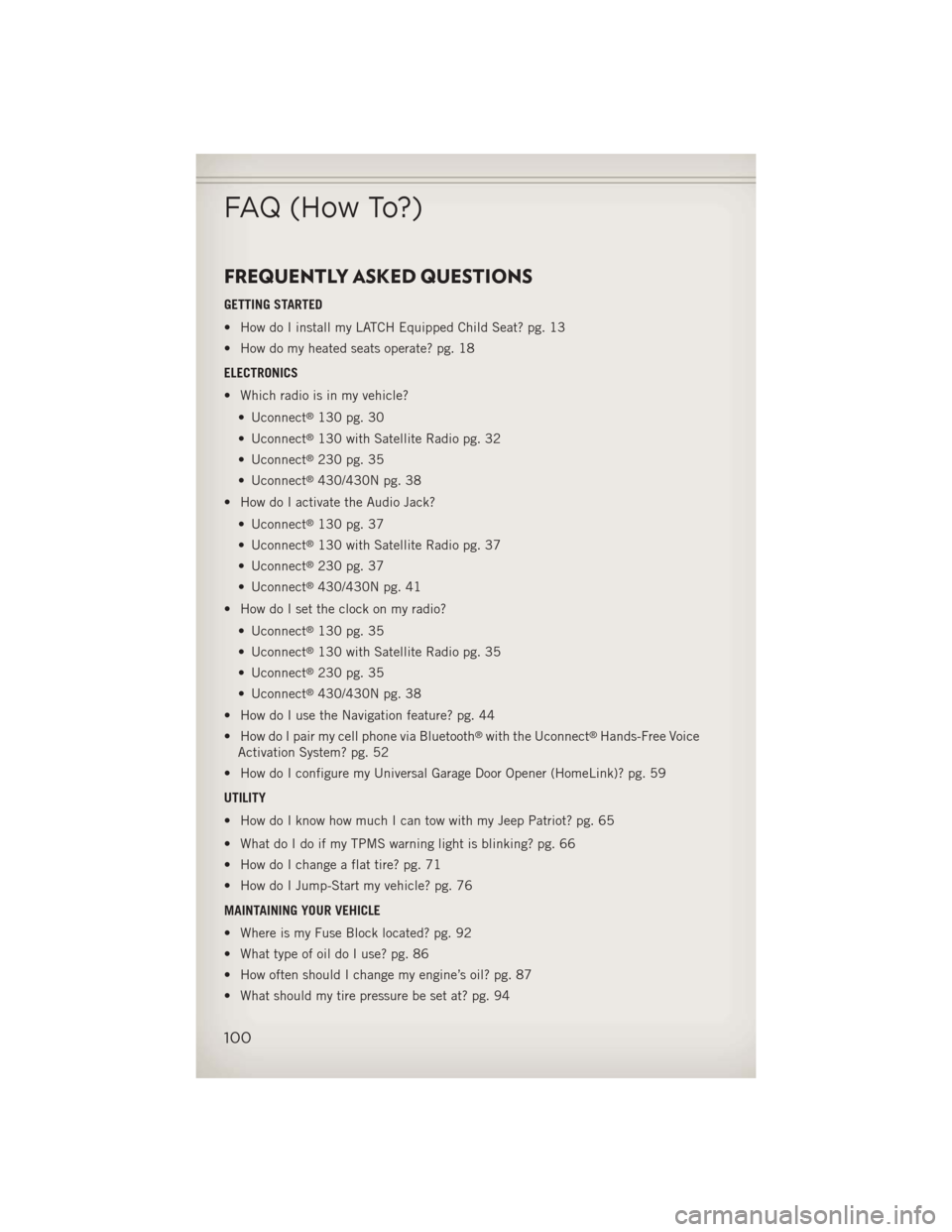
FREQUENTLY ASKED QUESTIONS
GETTING STARTED
• How do I install my LATCH Equipped Child Seat? pg. 13
• How do my heated seats operate? pg. 18
ELECTRONICS
• Which radio is in my vehicle?• Uconnect
®130 pg. 30
• Uconnect
®130 with Satellite Radio pg. 32
• Uconnect
®230 pg. 35
• Uconnect
®430/430N pg. 38
• How do I activate the Audio Jack?
• Uconnect
®130 pg. 37
• Uconnect
®130 with Satellite Radio pg. 37
• Uconnect
®230 pg. 37
• Uconnect
®430/430N pg. 41
• How do I set the clock on my radio?
• Uconnect
®130 pg. 35
• Uconnect
®130 with Satellite Radio pg. 35
• Uconnect
®230 pg. 35
• Uconnect
®430/430N pg. 38
• How do I use the Navigation feature? pg. 44
• How do I pair my cell phone via Bluetooth
®with the Uconnect®Hands-Free Voice
Activation System? pg. 52
• How do I configure my Universal Garage Door Opener (HomeLink)? pg. 59
UTILITY
• How do I know how much I can tow with my Jeep Patriot? pg. 65
• What do I do if my TPMS warning light is blinking? pg. 66
• How do I change a flat tire? pg. 71
• How do I Jump-Start my vehicle? pg. 76
MAINTAINING YOUR VEHICLE
• Where is my Fuse Block located? pg. 92
• What type of oil do I use? pg. 86
• How often should I change my engine’s oil? pg. 87
• What should my tire pressure be set at? pg. 94
FAQ (How To?)
100