radiator JEEP PATRIOT 2017 1.G User Guide
[x] Cancel search | Manufacturer: JEEP, Model Year: 2017, Model line: PATRIOT, Model: JEEP PATRIOT 2017 1.GPages: 421, PDF Size: 3.4 MB
Page 296 of 421
CAUTION!
•Mixing of engine coolant (antifreeze) other than
specified Organic Additive Technology (OAT) en-
gine coolant (antifreeze), may result in engine dam-
age and may decrease corrosion protection. Organic
Additive Technology (OAT) engine coolant is differ-
ent and should not be mixed with Hybrid Organic
Additive Technology (HOAT) engine coolant (anti-
freeze) or any “globally compatible” coolant (anti-
freeze). If a non-OAT engine coolant (antifreeze) is
introduced into the cooling system in an emergency,
the cooling system will need to be drained, flushed,
and refilled with fresh OAT coolant (conforming to
MS.90032), by an authorized dealer as soon as pos-
sible.
• Do not use water alone or alcohol-based engine
coolant (antifreeze) products. Do not use additional
rust inhibitors or antirust products, as they may not
be compatible with the radiator engine coolant and
may plug the radiator.
• This vehicle has not been designed for use with
propylene glycol-based engine coolant (antifreeze).
Use of propylene glycol-based engine coolant (anti-
freeze) is not recommended.
Adding Coolant
Your vehicle has been built with an improved engine
coolant (OAT coolant conforming to MS.90032) that allows
extended maintenance intervals. This engine coolant (anti-
freeze) can be used up to ten years or 150,000 miles
(240,000 km) before replacement. To prevent reducing this
extended maintenance period, it is important that you use
the same engine coolant (OAT coolant conforming to
MS.90032) throughout the life of your vehicle.
Please review these recommendations for using Organic
Additive Technology (OAT) engine coolant (antifreeze)
that meets the requirements of FCA Material Standard
MS.90032. When adding engine coolant (antifreeze):
• We recommend using MOPAR Antifreeze/Coolant 10
Year/150,000 Mile Formula OAT (Organic Additive
Technology) that meets the requirements of FCA Mate-
rial Standard MS.90032.
• Mix a minimum solution of 50% OAT engine coolant
that meets the requirements of FCA Material Standard
MS.90032 and distilled water. Use higher concentrations
(not to exceed 70%) if temperatures below 34°F (37°C)
are anticipated. Please contact your authorized dealer
for assistance.
294 SERVICING AND MAINTENANCE
Page 297 of 421
•Use only high purity water such as distilled or deionized
water when mixing the water/engine coolant (anti-
freeze) solution. The use of lower quality water will
reduce the amount of corrosion protection in the engine
cooling system.
NOTE:
• It is the owner’s responsibility to maintain the proper
level of protection against freezing according to the
temperatures occurring in the area where the vehicle is
operated.
• Some vehicles require special tools to add coolant prop-
erly. Failure to fill these systems properly could lead to
severe internal engine damage. If any coolant is needed
to be added to the system, please contact your local
authorized dealer.
• Mixing engine coolant (antifreeze) types is not recom-
mended and can result in cooling system damage. If
HOAT and OAT coolant are mixed in an emergency,
have a authorized dealer drain, flush, and refill with
OAT coolant (conforming to MS.90032) as soon as pos-
sible.Cooling System Pressure Cap
The cap must be fully tightened to prevent loss of engine
coolant (antifreeze), and to ensure that engine coolant
(antifreeze) will return to the radiator from the coolant
recovery tank.
The cap should be inspected and cleaned if there is any
accumulation of foreign material on the sealing surfaces.
WARNING!
• Do not open hot engine cooling system. Never add
engine coolant (antifreeze) when the engine is over-
heated. Do not loosen or remove the cap to cool an
overheated engine. Heat causes pressure to build up
in the cooling system. To prevent scalding or injury,
do not remove the pressure cap while the system is
hot or under pressure.
• Do not use a pressure cap other than the one speci-
fied for your vehicle. Personal injury or engine
damage may result.
8
SERVICING AND MAINTENANCE 295
Page 298 of 421
Disposal Of Used Engine Coolant
Used ethylene glycol-based engine coolant (antifreeze) is a
regulated substance requiring proper disposal. Check with
your local authorities to determine the disposal rules for
your community. To prevent ingestion by animals or
children, do not store ethylene glycol-based engine coolant
in open containers or allow it to remain in puddles on the
ground. If ingested by a child or pet, seek emergency
assistance immediately. Clean up any ground spills imme-
diately.
Coolant Level
The coolant expansion bottle provides a quick visual
method for determining that the coolant level is adequate.
With the engine off and cold, the level of the engine coolant
(antifreeze) in the bottle should be between the “MAX” and
“MIN” lines marked on the bottle.
As long as the engine operating temperature is satisfactory,
the coolant bottle need only be checked once a month.
When additional engine coolant (antifreeze) is needed to
maintain the proper level, it should be added to the coolant
bottle. Do not overfill.
Points To Remember
NOTE:When the vehicle is stopped after a few miles/
kilometers of operation, you may observe vapor coming
from the front of the engine compartment. This is normally
a result of moisture from rain, snow, or high humidity
accumulating on the radiator and being vaporized when
the thermostat opens, allowing hot engine coolant (anti-
freeze) to enter the radiator.
If an examination of your engine compartment shows no
evidence of radiator or hose leaks, the vehicle may be
safely driven. The vapor will soon dissipate.
• Do not overfill the coolant expansion bottle.
• Check the coolant freeze point in the radiator and in the
coolant expansion bottle. If engine coolant (antifreeze)
needs to be added, the contents of the coolant expansion
bottle must also be protected against freezing.
• If frequent engine coolant (antifreeze) additions are
required, the cooling system should be pressure tested
for leaks.
•
Maintain engine coolant (antifreeze) concentration at a
minimum of 50% OAT coolant (conforming to MS.90032)
and distilled water for proper corrosion protection of your
engine which contains aluminum components.
296 SERVICING AND MAINTENANCE
Page 299 of 421
•Keep the front of the radiator clean. If your vehicle is
equipped with air conditioning, keep the front of the
condenser clean.
• Do not change the thermostat for Summer or Winter
operation. If replacement is ever necessary, install ONLY
the correct type thermostat. Other designs may result in
unsatisfactory engine coolant (antifreeze) performance,
poor gas mileage, and increased emissions.
Brake System
In order to assure brake system performance, all brake
system components should be inspected periodically. Refer
to the “Maintenance Plan” for the proper maintenance
intervals.
WARNING!
Riding the brakes can lead to brake failure and possi-
bly a collision. Driving with your foot resting or riding
on the brake pedal can result in abnormally high brake
temperatures, excessive lining wear, and possible
brake damage. You would not have your full braking
capacity in an emergency.
Brake Master Cylinder
The fluid level in the master cylinder should be checked
when performing under hood services, or immediately if
the brake system warning light is on.
Be sure to clean the top of the master cylinder area before
removing the cap. If necessary, add fluid to bring the fluid
level up to the requirements described on the brake fluid
reservoir. Fluid level can be expected to fall as the brake
pads wear. The brake fluid level should be checked when
the pads are replaced. However, low fluid level may be
caused by a leak and a checkup may be needed.
NOTE: If your vehicle is equipped with a manual trans-
mission, the brake fluid reservoir supplies fluid to both the
brake system and the clutch release system. The two
systems are separated in the reservoir, and a leak in one
system will not affect the other system. The manual
transmission clutch release system should not require fluid
replacement during the life of the vehicle. If the brake fluid
reservoir is low and the brake system does not indicate any
leaks or other problems, it may be a result of a leak in the
hydraulic clutch release system. See your local authorized
dealer for service.
8
SERVICING AND MAINTENANCE 297
Page 339 of 421
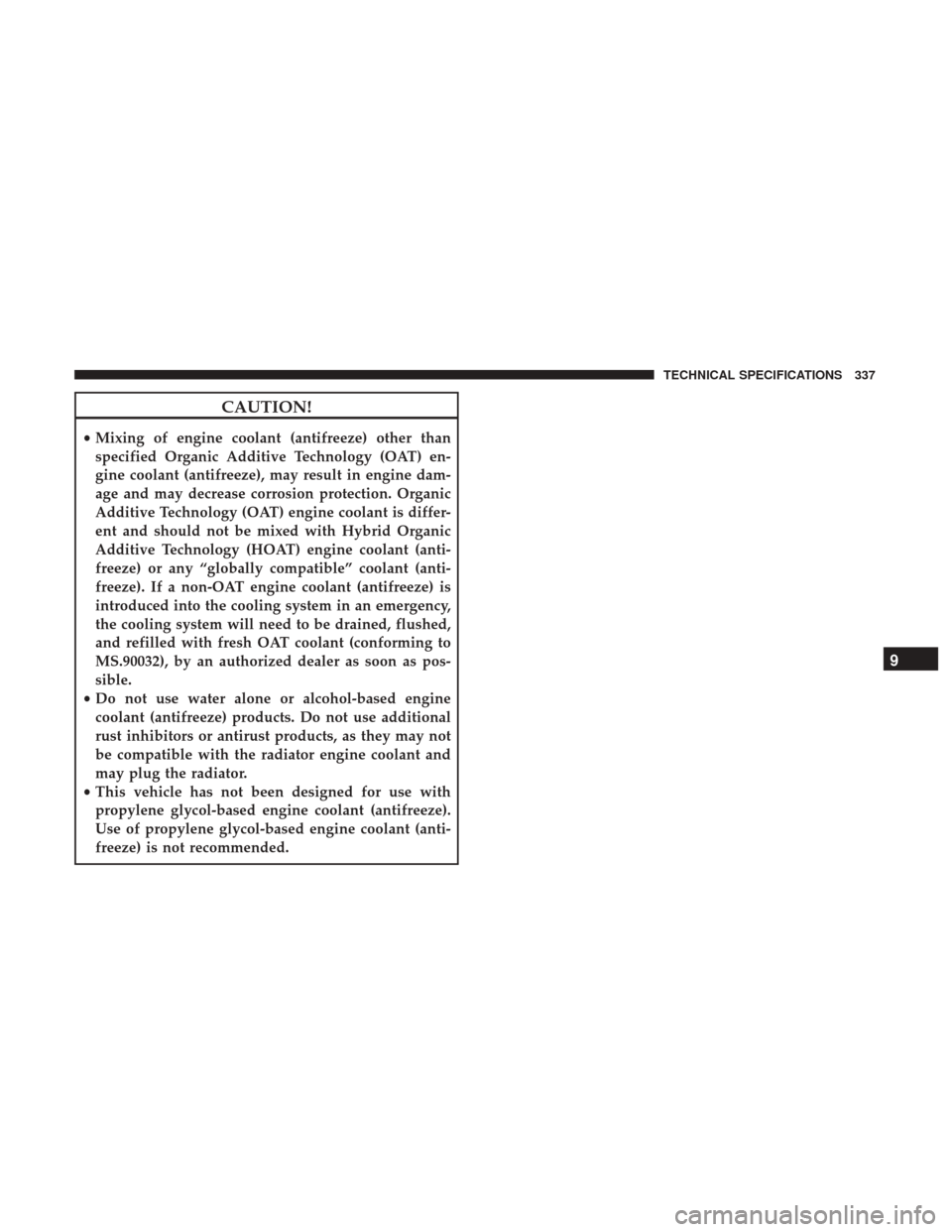
CAUTION!
•Mixing of engine coolant (antifreeze) other than
specified Organic Additive Technology (OAT) en-
gine coolant (antifreeze), may result in engine dam-
age and may decrease corrosion protection. Organic
Additive Technology (OAT) engine coolant is differ-
ent and should not be mixed with Hybrid Organic
Additive Technology (HOAT) engine coolant (anti-
freeze) or any “globally compatible” coolant (anti-
freeze). If a non-OAT engine coolant (antifreeze) is
introduced into the cooling system in an emergency,
the cooling system will need to be drained, flushed,
and refilled with fresh OAT coolant (conforming to
MS.90032), by an authorized dealer as soon as pos-
sible.
• Do not use water alone or alcohol-based engine
coolant (antifreeze) products. Do not use additional
rust inhibitors or antirust products, as they may not
be compatible with the radiator engine coolant and
may plug the radiator.
• This vehicle has not been designed for use with
propylene glycol-based engine coolant (antifreeze).
Use of propylene glycol-based engine coolant (anti-
freeze) is not recommended.
9
TECHNICAL SPECIFICATIONS 337
Page 407 of 421
Gear Ranges........................ .204, 209
Special Additives .....................299, 301
Axle Fluid .............................. .338
Battery ................................. .102
Charging System Light ....................102
Belts, Seat ............................... .190
Body Mechanism Lubrication ..................290
B-Pillar Location .......................... .306
Brake Assist System ........................ .132
Brake Fluid .............................. .338
Brake, Parking ............................ .198
Brakes ................................. .329
Brake System ......................... .297, 329
Master Cylinder ........................ .297
Parking .............................. .198
Warning Light .......................... .100
Brake/Transmission Interlock ..................203
Bulb Replacement ......................... .243
Bulbs, Light .......................... .192, 243
Calibration, Compass ....................... .124
Camera, Rear ............................ .217
Capacities, Antifreeze (Engine Coolant) ...........335
Capacities, Fluid .......................... .335Caps, Filler
Fuel ................................. .219
Oil (Engine) ..................... .282, 283, 286
Power Steering ......................... .213
Radiator (Coolant Pressure) .................295
Carbon Monoxide Warning ................189, 334
Cargo Area Cover ...........................74
Cargo Area Features .........................74
Cargo Compartment .........................74
Light ..................................74
Luggage Carrier ..........................91
Cargo Light ...............................74
Cargo Load Floor ...........................75
Cargo Tie-Downs ...........................76
Car Washes .............................. .324
Cellular
Phone........................ .367, 395
Center High Mounted Stop Light ...............245
Certification Label ......................... .220
Chains, Tire ............................. .320
Changing A Flat Tire .....................249, 302
Check Engine Light (Malfunction Indicator Light). . . .127
Checking Your Vehicle For Safety ...............189
Checks, Safety ............................ .189
Child Restraint ........................... .174
12
INDEX 405
Page 408 of 421
Child RestraintsBooster Seats ........................... .177
Child Restraints ........................ .174
Child Seat Installation .....................186
How To Stow An Unused ALR Seat Belt ........184
Infants And Child Restraints ................176
Lower Anchors And Tethers For Children .......179
Older Children And Child Restraints ...........176
Seating Positions ........................ .178
Child Safety Locks ..........................32
Clean Air Gasoline ........................ .331
Cleaning Wheels ............................... .319
Climate Control ............................55
Clock ............................... .341, 348
Clutch ................................. .297
Clutch Fluid ............................. .297
Coin Holder ...............................84
Cold Weather Operation ..................... .196
Compact Disc (CD) Maintenance ................396
Compact Spare Tire ........................ .317
Compass .................................115
Compass Calibration ....................... .124
Compass Variance ......................... .124Connector
UCI ................................. .362
Universal Consumer Interface (UCI) ...........362
Console ..................................84
Contract, Service .......................... .400
Coolant (Antifreeze) ........................ .335
Coolant Pressure Cap (Radiator Cap) .............295
Cooling System ........................ .284, 292
Adding Coolant (Antifreeze) .................294
Coolant Level ....................284, 293, 296
Disposal Of Used Coolant ..................296
Drain, Flush, And Refill ....................293
Inspection ............................. .296
Points To Remember ..................... .296
Pr
essure Cap ........................... .295
Radiator Cap .......................... .295
Selection Of Coolant (Antifreeze) ..........293, 336
Corrosion Protection ....................... .323
Cupholders ...............................84
Customer Assistance ....................... .398
Dealer Service ............................ .285
Defroster, Windshield ....................... .190
Delay (Intermittent) Wipers ....................52
Diagnostic System, Onboard ...................125
406 INDEX
Page 414 of 421
Oil Filter, Change......................... .287
Oil Filter, Selection ......................... .287
Oil Pressure Light ......................... .102
Onboard Diagnostic System ...................125
Opener, Garage Door (HomeLink) ...............77
Operating Precautions ...................... .125
Operator Manual (Owner’s Manual) ...............5
Overheating, Engine ....................... .268
Owner’s Manual (Operator Manual) ...........5,401
Paint Care ............................... .323
Parking Brake ............................ .198
Passing Light ..............................47
Personal Settings .......................... .121
Pets ................................... .188
Phone, Cellular ........................... .367
Phone, Hands-Free (Uconnect) .................367
Placard, Tire And Loading Information ...........306
Power Door Locks ..............................29
Mirrors ................................45
Outlet (Auxiliary Electrical Outlet) .............87
Steering .............................. .213
Sunroof ................................69
Transfer Unit ........................... .302Windows
...............................67
Power Seats Down .................................36
Forward ................................36
Rearward ...............................36
Tilt ...................................36
Up....................................36
Power Steering Fluid ....................... .338
Power Transfer Unit .....................302, 338
Pregnant Women And Seat Belts ................158
Preparation For Jacking ..................... .251
Pretensioners Seat Belts ............................. .158
Programmable Electronic Features ...............121
Radial Ply Tires ........................... .312
Radiator Cap (Coolant Pressure Cap) .............295
Radio 130 Operating Instructions Auxiliary Mode .........347
Operating Instructions Radio Mode ............341
Radio
130 With Satellite Radio
Multimedia Satellite Radio ..................356
Operating Instructions Radio Mode ............347
Radio Frequency General Information .....................21, 27
412 INDEX