trailer JEEP PATRIOT 2020 Owner handbook (in English)
[x] Cancel search | Manufacturer: JEEP, Model Year: 2020, Model line: PATRIOT, Model: JEEP PATRIOT 2020Pages: 332, PDF Size: 1.99 MB
Page 217 of 332
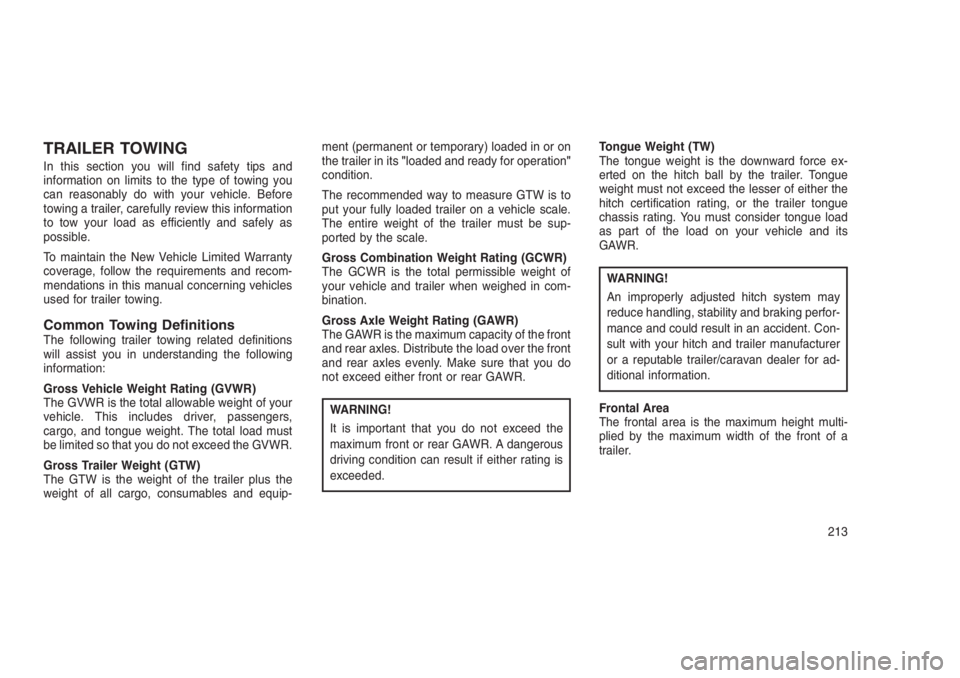
TRAILER TOWING
In this section you will find safety tips and
information on limits to the type of towing you
can reasonably do with your vehicle. Before
towing a trailer, carefully review this information
to tow your load as efficiently and safely as
possible.
To maintain the New Vehicle Limited Warranty
coverage, follow the requirements and recom-
mendations in this manual concerning vehicles
used for trailer towing.
Common Towing DefinitionsThe following trailer towing related definitions
will assist you in understanding the following
information:
Gross Vehicle Weight Rating (GVWR)
The GVWR is the total allowable weight of your
vehicle. This includes driver, passengers,
cargo, and tongue weight. The total load must
be limited so that you do not exceed the GVWR.
Gross Trailer Weight (GTW)
The GTW is the weight of the trailer plus the
weight of all cargo, consumables and equip-ment (permanent or temporary) loaded in or on
the trailer in its"loaded and ready for operation"
condition.
The recommended way to measure GTW is to
put your fully loaded trailer on a vehicle scale.
The entire weight of the trailer must be sup-
ported by the scale.
Gross Combination Weight Rating (GCWR)
The GCWR is the total permissible weight of
your vehicle and trailer when weighed in com-
bination.
Gross Axle Weight Rating (GAWR)
The GAWR is the maximum capacity of the front
and rear axles. Distribute the load over the front
and rear axles evenly. Make sure that you do
not exceed either front or rear GAWR.
WARNING!
It is important that you do not exceed the
maximum front or rear GAWR. A dangerous
driving condition can result if either rating is
exceeded.Tongue Weight (TW)
The tongue weight is the downward force ex-
erted on the hitch ball by the trailer. Tongue
weight must not exceed the lesser of either the
hitch certification rating, or the trailer tongue
chassis rating. You must consider tongue load
as part of the load on your vehicle and its
GAWR.
WARNING!
An improperly adjusted hitch system may
reduce handling, stability and braking perfor-
mance and could result in an accident. Con-
sult with your hitch and trailer manufacturer
or a reputable trailer/caravan dealer for ad-
ditional information.
Frontal Area
The frontal area is the maximum height multi-
plied by the maximum width of the front of a
trailer.
213
Page 218 of 332
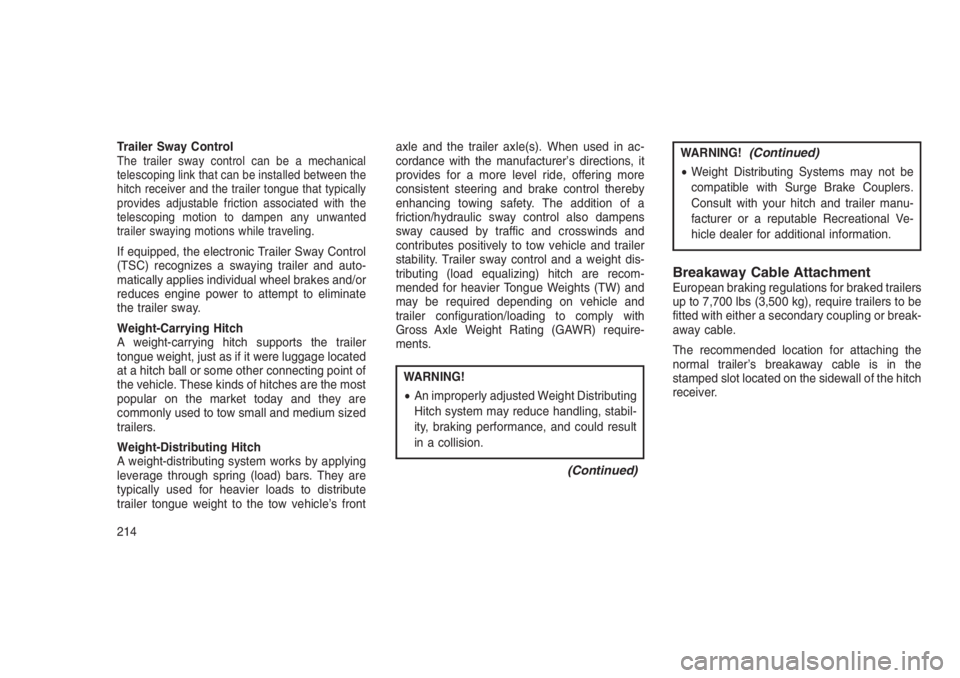
Trailer Sway ControlThe trailer sway control can be a mechanical
telescoping link that can be installed between the
hitch receiver and the trailer tongue that typically
provides adjustable friction associated with the
telescoping motion to dampen any unwanted
trailer swaying motions while traveling.
If equipped, the electronic Trailer Sway Control
(TSC) recognizes a swaying trailer and auto-
matically applies individual wheel brakes and/or
reduces engine power to attempt to eliminate
the trailer sway.
Weight-Carrying Hitch
A weight-carrying hitch supports the trailer
tongue weight, just as if it were luggage located
at a hitch ball or some other connecting point of
the vehicle. These kinds of hitches are the most
popular on the market today and they are
commonly used to tow small and medium sized
trailers.
Weight-Distributing Hitch
A weight-distributing system works by applying
leverage through spring (load) bars. They are
typically used for heavier loads to distribute
trailer tongue weight to the tow vehicle’s frontaxle and the trailer axle(s). When used in ac-
cordance with the manufacturer’s directions, it
provides for a more level ride, offering more
consistent steering and brake control thereby
enhancing towing safety. The addition of a
friction/hydraulic sway control also dampens
sway caused by traffic and crosswinds and
contributes positively to tow vehicle and trailer
stability. Trailer sway control and a weight dis-
tributing (load equalizing) hitch are recom-
mended for heavier Tongue Weights (TW) and
may be required depending on vehicle and
trailer configuration/loading to comply with
Gross Axle Weight Rating (GAWR) require-
ments.
WARNING!
•An improperly adjusted Weight Distributing
Hitch system may reduce handling, stabil-
ity, braking performance, and could result
in a collision.
(Continued)
WARNING!(Continued)
•Weight Distributing Systems may not be
compatible with Surge Brake Couplers.
Consult with your hitch and trailer manu-
facturer or a reputable Recreational Ve-
hicle dealer for additional information.
Breakaway Cable AttachmentEuropean braking regulations for braked trailers
up to 7,700 lbs (3,500 kg), require trailers to be
fitted with either a secondary coupling or break-
away cable.
The recommended location for attaching the
normal trailer’s breakaway cable is in the
stamped slot located on the sidewall of the hitch
receiver.
214
Page 219 of 332
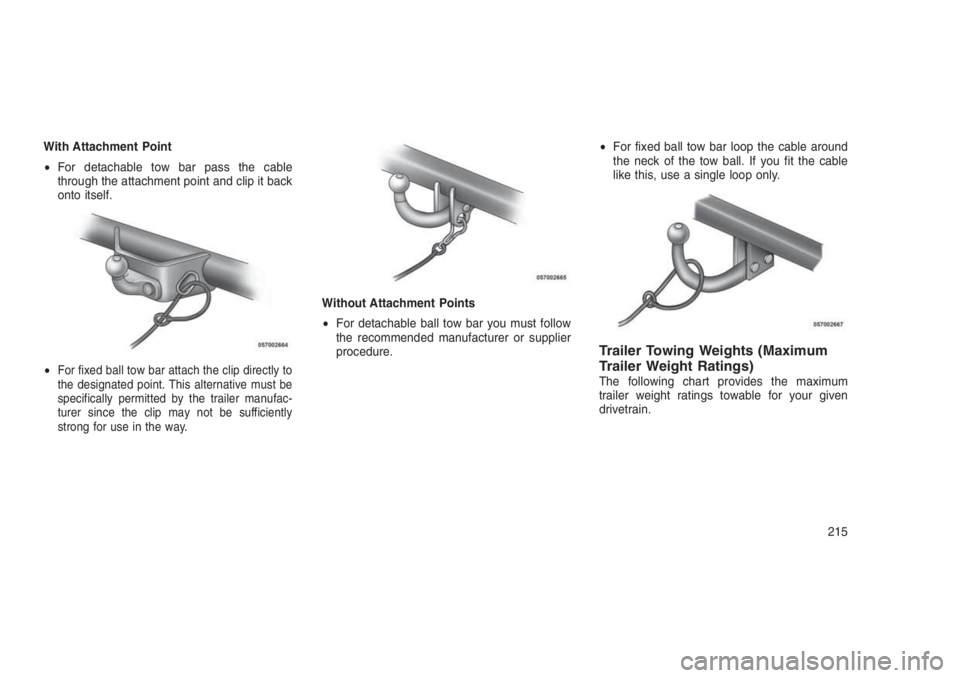
With Attachment Point
•For detachable tow bar pass the cable
through the attachment point and clip it back
onto itself.
•
For fixed ball tow bar attach the clip directly to
the designated point. This alternative must be
specifically permitted by the trailer manufac-
turer since the clip may not be sufficiently
strong for use in the way.
Without Attachment Points
•For detachable ball tow bar you must follow
the recommended manufacturer or supplier
procedure.•For fixed ball tow bar loop the cable around
the neck of the tow ball. If you fit the cable
like this, use a single loop only.
Trailer Towing Weights (Maximum
Trailer Weight Ratings)
The following chart provides the maximum
trailer weight ratings towable for your given
drivetrain.
215
Page 220 of 332
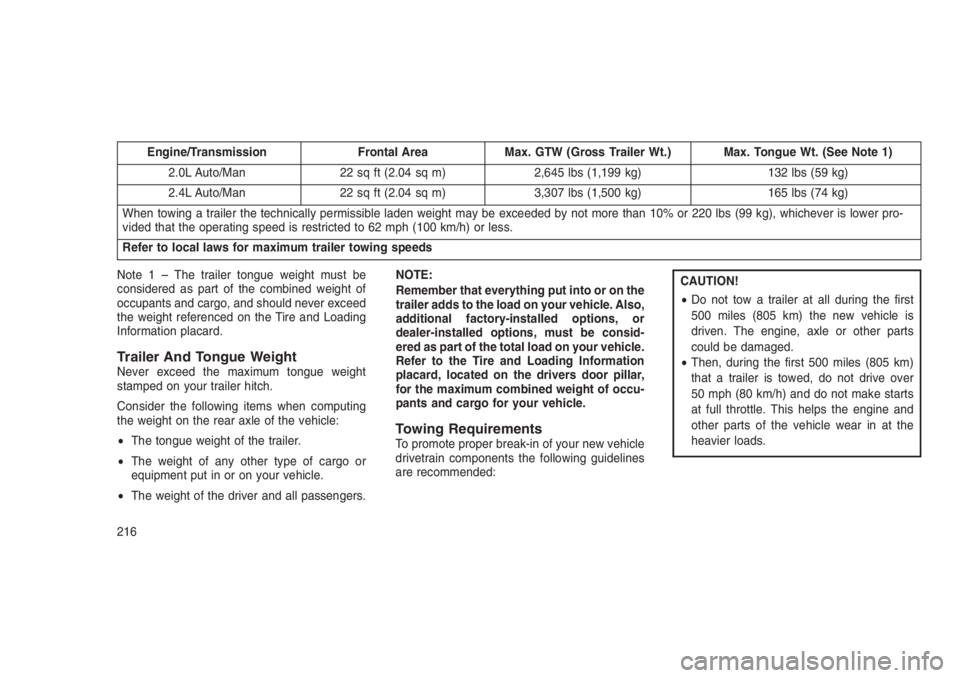
Engine/Transmission Frontal Area Max. GTW (Gross Trailer Wt.) Max. Tongue Wt. (See Note 1)
2.0L Auto/Man 22 sq ft (2.04 sq m) 2,645 lbs (1,199 kg) 132 lbs (59 kg)
2.4L Auto/Man 22 sq ft (2.04 sq m) 3,307 lbs (1,500 kg) 165 lbs (74 kg)
When towing a trailer the technically permissible laden weight may be exceeded by not more than 10% or 220 lbs (99 kg), whichever is lower pro-
vided that the operating speed is restricted to 62 mph (100 km/h) or less.
Refer to local laws for maximum trailer towing speeds
Note 1 – The trailer tongue weight must be
considered as part of the combined weight of
occupants and cargo, and should never exceed
the weight referenced on the Tire and Loading
Information placard.
Trailer And Tongue WeightNever exceed the maximum tongue weight
stamped on your trailer hitch.
Consider the following items when computing
the weight on the rear axle of the vehicle:
•The tongue weight of the trailer.
•The weight of any other type of cargo or
equipment put in or on your vehicle.
•The weight of the driver and all passengers.NOTE:
Remember that everything put into or on the
trailer adds to the load on your vehicle. Also,
additional factory-installed options, or
dealer-installed options, must be consid-
ered as part of the total load on your vehicle.
Refer to the Tire and Loading Information
placard, located on the drivers door pillar,
for the maximum combined weight of occu-
pants and cargo for your vehicle.
Towing RequirementsTo promote proper break-in of your new vehicle
drivetrain components the following guidelines
are recommended:
CAUTION!
•Do not tow a trailer at all during the first
500 miles (805 km) the new vehicle is
driven. The engine, axle or other parts
could be damaged.
•Then, during the first 500 miles (805 km)
that a trailer is towed, do not drive over
50 mph (80 km/h) and do not make starts
at full throttle. This helps the engine and
other parts of the vehicle wear in at the
heavier loads.
216
Page 221 of 332
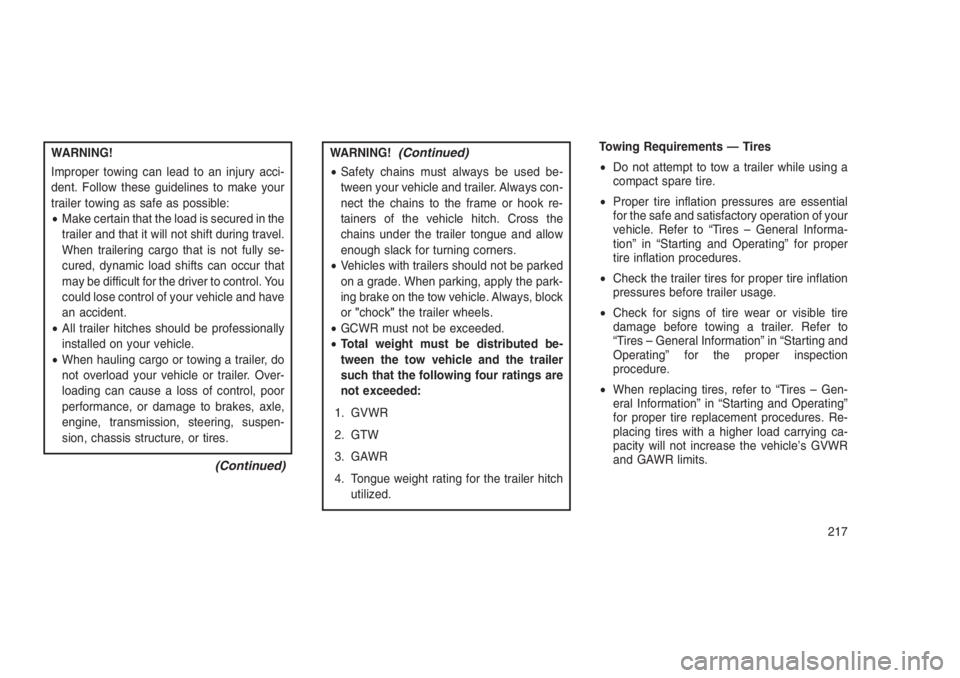
WARNING!
Improper towing can lead to an injury acci-
dent. Follow these guidelines to make your
trailer towing as safe as possible:
•Make certain that the load is secured in the
trailer and that it will not shift during travel.
When trailering cargo that is not fully se-
cured, dynamic load shifts can occur that
may be difficult for the driver to control. You
could lose control of your vehicle and have
an accident.
•All trailer hitches should be professionally
installed on your vehicle.
•When hauling cargo or towing a trailer, do
not overload your vehicle or trailer. Over-
loading can cause a loss of control, poor
performance, or damage to brakes, axle,
engine, transmission, steering, suspen-
sion, chassis structure, or tires.
(Continued)
WARNING!(Continued)
•Safety chains must always be used be-
tween your vehicle and trailer. Always con-
nect the chains to the frame or hook re-
tainers of the vehicle hitch. Cross the
chains under the trailer tongue and allow
enough slack for turning corners.
•Vehicles with trailers should not be parked
on a grade. When parking, apply the park-
ing brake on the tow vehicle. Always, block
or"chock"the trailer wheels.
•GCWR must not be exceeded.
•Total weight must be distributed be-
tween the tow vehicle and the trailer
such that the following four ratings are
not exceeded:
1. GVWR
2. GTW
3. GAWR
4. Tongue weight rating for the trailer hitch
utilized.Towing Requirements — Tires
•Do not attempt to tow a trailer while using a
compact spare tire.
•Proper tire inflation pressures are essential
for the safe and satisfactory operation of your
vehicle. Refer to “Tires – General Informa-
tion” in “Starting and Operating” for proper
tire inflation procedures.
•Check the trailer tires for proper tire inflation
pressures before trailer usage.
•Check for signs of tire wear or visible tire
damage before towing a trailer. Refer to
“Tires – General Information” in “Starting and
Operating” for the proper inspection
procedure.
•When replacing tires, refer to “Tires – Gen-
eral Information” in “Starting and Operating”
for proper tire replacement procedures. Re-
placing tires with a higher load carrying ca-
pacity will not increase the vehicle’s GVWR
and GAWR limits.
217
Page 222 of 332
Towing Requirements — Trailer Brakes
–Donotinterconnect the hydraulic brake sys-
tem or vacuum system of your vehicle with
that of the trailer. This could cause inad-
equate braking and possible personal injury.
– When towing a trailer equipped with a hy-
draulic surge actuated brake system, an
electronic brake controller is not required.
– Trailer brakes are recommended for trailers
over 1,000 lbs (453 kg) and required for
trailers in excess of 1,653 lbs (749 kg).
CAUTION!
If the trailer weighs more than 1,000 lbs
(453 kg) loaded, it should have its own
brakes and they should be of adequate
capacity. Failure to do this could lead to
accelerated brake lining wear, higher brake
pedal effort, and longer stopping distances.
WARNING!
•Do not connect trailer brakes to your vehi-
cle’s hydraulic brake lines. It can overload
your brake system and cause it to fail. You
might not have brakes when you need
them and could have an accident.
•Towing any trailer will increase your stop-
ping distance. When towing, you should
allow for additional space between your
vehicle and the vehicle in front of you.
Failure to do so could result in an accident.
Towing Requirements – Trailer Lights And
Wiring
Whenever you pull a trailer, regardless of the
trailer size, stop lights and turn signals on the
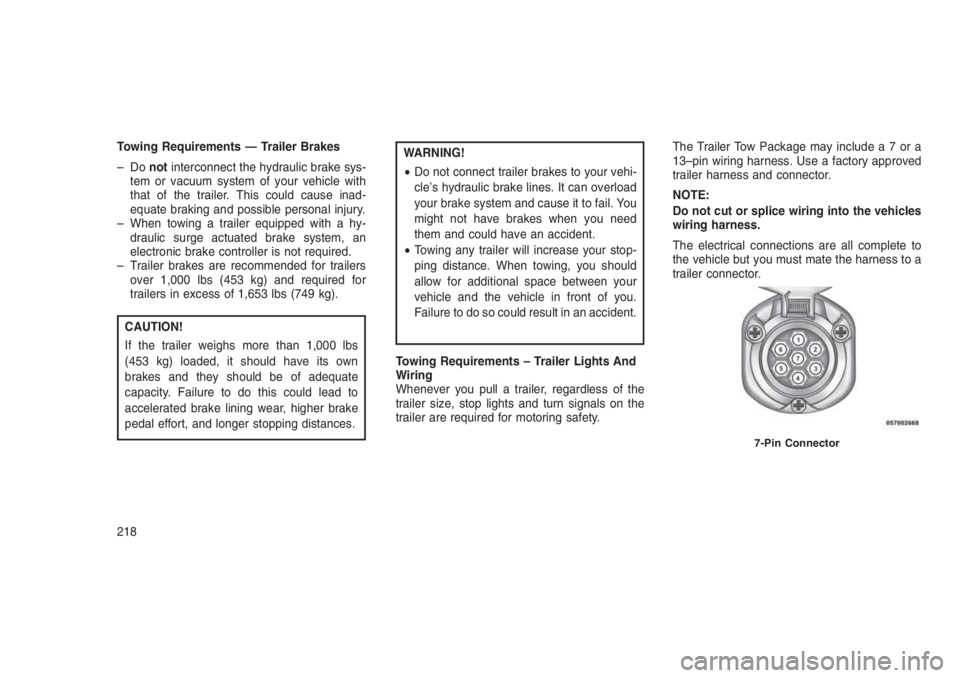
trailer are required for motoring safety.The Trailer Tow Package may includea7ora
13–pin wiring harness. Use a factory approved
trailer harness and connector.
NOTE:
Do not cut or splice wiring into the vehicles
wiring harness.
The electrical connections are all complete to
the vehicle but you must mate the harness to a
trailer connector.
7-Pin Connector
218
Page 225 of 332
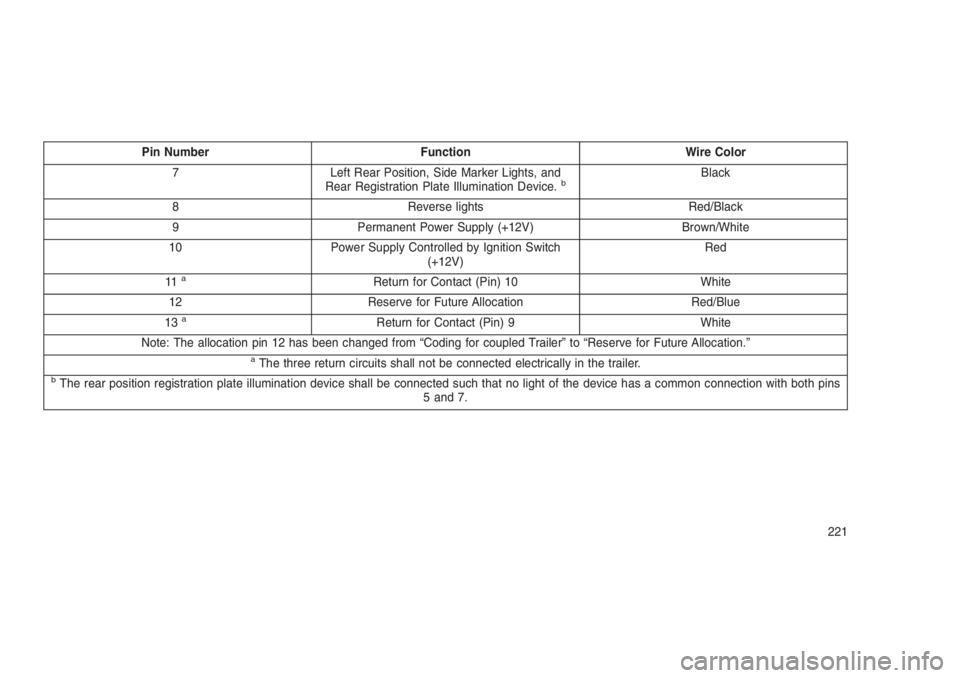
Pin Number Function Wire Color
7 Left Rear Position, Side Marker Lights, and
Rear Registration Plate Illumination Device.
bBlack
8 Reverse lights Red/Black
9 Permanent Power Supply (+12V) Brown/White
10 Power Supply Controlled by Ignition Switch
(+12V)Red
11
aReturn for Contact (Pin) 10 White
12 Reserve for Future Allocation Red/Blue
13
aReturn for Contact (Pin) 9 White
Note: The allocation pin 12 has been changed from “Coding for coupled Trailer” to “Reserve for Future Allocation.”
aThe three return circuits shall not be connected electrically in the trailer.bThe rear position registration plate illumination device shall be connected such that no light of the device has a common connection with both pins
5 and 7.
221
Page 226 of 332
Towing TipsBefore setting out on a trip, practice turning,
stopping and backing the trailer in an area away
from heavy traffic.
Manual Transmission — If Equipped
If using a manual transmission vehicle for trailer
towing, all starts must be in first gear to avoid
excessive clutch slippage.
Automatic Transmission — If Equipped
The DRIVE range can be selected when towing.
However, if frequent shifting or changes in
engine speed occur while in DRIVE, use the
AutoStick shift control to manually select a
lower gear ratio.
NOTE:
Using a lower gear ratio while operating the
vehicle under heavy loading conditions, will
improve performance and extend transmis-
sion life by reducing excessive shifting and
heat buildup. This action will also provide
better engine braking.
If you REGULARLY tow a trailer for more than
45 minutes of continuous operation, then
change the transmission fluid and filter asspecified for"police, taxi, fleet, or frequent
trailer towing."Refer to the “Maintenance
Schedule” for the proper maintenance intervals.
AutoStick
•When using the AutoStick shift control, select
the highest gear that allows for adequate
performance and avoids frequent downshifts.
For example, choose"4"if the desired speed
can be maintained. Choose"3"or"2"if
needed to maintain the desired speed.
•To prevent excess heat generation, avoid
continuous driving at high RPM. Reduce
vehicle speed as necessary to avoid ex-
tended driving at high RPM. Return to a
higher gear or vehicle speed when grade and
road conditions allow.
Electronic Speed Control — If Equipped
•Do not use in hilly terrain or with heavy loads.
•When using the speed control, if you experi-
ence speed drops greater than 10 mph
(16 km/h), disengage until you can get back
to cruising speed.•Use speed control in flat terrain and with light
loads to maximize fuel efficiency.
Cooling System
To reduce potential for engine and transmission
overheating, take the following actions:
City Driving
When stopped for short periods of time, shift the
transmission into NEUTRAL and increase en-
gine idle speed.
Highway Driving
Reduce speed.
Air Conditioning
Turn off temporarily.
222
Page 227 of 332
RECREATIONAL TOWING (BEHIND MOTORHOME, ETC.)
Towing This Vehicle Behind Another Vehicle
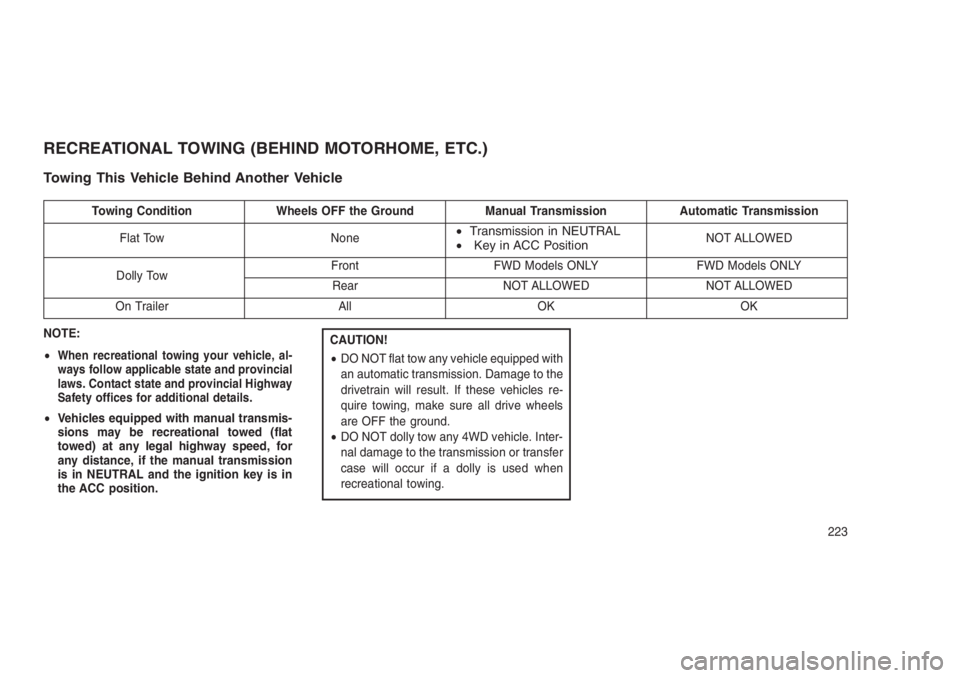
Towing Condition Wheels OFF the Ground Manual Transmission Automatic Transmission
Flat Tow None
•Transmission in NEUTRAL
•Key in ACC PositionNOT ALLOWED
Dolly TowFront FWD Models ONLY FWD Models ONLY
Rear NOT ALLOWED NOT ALLOWED
On Trailer All OK OK
NOTE:
•
When recreational towing your vehicle, al-
ways follow applicable state and provincial
laws. Contact state and provincial Highway
Safety offices for additional details.
•Vehicles equipped with manual transmis-
sions may be recreational towed (flat
towed) at any legal highway speed, for
any distance, if the manual transmission
is in NEUTRAL and the ignition key is in
the ACC position.
CAUTION!
•DO NOT flat tow any vehicle equipped with
an automatic transmission. Damage to the
drivetrain will result. If these vehicles re-
quire towing, make sure all drive wheels
are OFF the ground.
•DO NOT dolly tow any 4WD vehicle. Inter-
nal damage to the transmission or transfer
case will occur if a dolly is used when
recreational towing.
223
Page 272 of 332
Special Additives
The manufacturer strongly recommends
against using any special additives in the trans-
mission.
Automatic Transmission Fluid (ATF) is an engi-
neered product and its performance may be
impaired by supplemental additives. Therefore,
do not add any fluid additives to the transmis-
sion. The only exception to this policy is the use
of special dyes for diagnosing fluid leaks. Avoid
using transmission sealers as they may ad-
versely affect seals.
CAUTION!
Do not use chemical flushes in your trans-
mission as the chemicals can damage your
transmission components. Such damage is
not covered by the New Vehicle Limited
Warranty.
Fluid Level Check
The fluid level is preset at the factory and does
not require adjustment under normal operating
conditions.Routine fluid level checks are not required,
therefore the transmission filler tube is capped
and no dipstick is provided. Your authorized
dealer can check your transmission fluid level
using special service tools. If you notice fluid
leakage or transmission malfunction, visit your
authorized dealer immediately to have the
transmission fluid level checked. Operating the
vehicle with an improper fluid level can cause
severe transmission damage.
CAUTION!
If a transmission fluid leak occurs, visit your
authorized dealer immediately. Severe trans-
mission damage may occur. Your authorized
dealer has the proper tools to adjust the fluid
level accurately.
Fluid And Filter Changes
Under normal operating conditions, the fluid
installed at the factory will provide satisfactory
lubrication for the life of the vehicle. However, if
the vehicle is frequently driven on rough or
unpaved roads, on mountain roads, on short
trips, or in heavy city traffic during hot weather,or is used for frequent trailer towing, police,
fleet, taxi, etc., change the fluid as indicated in
the Maintenance Schedule. In addition, change
the fluid and filter if the fluid becomes contami-
nated (with water, etc.), or if the transmission is
disassembled for any reason.
Automatic Transmission (CVT) — If
Equipped
Selection Of Lubricant (CVT)
It is important to use the proper transmission
fluid to ensure optimum transmission perfor-
mance and life. Use only the manufacturer’s
specified transmission fluid which has the spe-
cial friction coefficient additives necessary for
proper steel belt traction on the drive and driven
pulleys. Refer to “Fluids, Lubricants, And Genu-
ine Parts” in this section for fluid specifications.
It is important to maintain the transmission fluid
at the correct level using the recommended
fluid.
No chemical flushes should be used in any
transmission; only the approved lubricant
should be used.
268