tow JEEP PATRIOT 2021 Owner handbook (in English)
[x] Cancel search | Manufacturer: JEEP, Model Year: 2021, Model line: PATRIOT, Model: JEEP PATRIOT 2021Pages: 332, PDF Size: 1.99 MB
Page 227 of 332
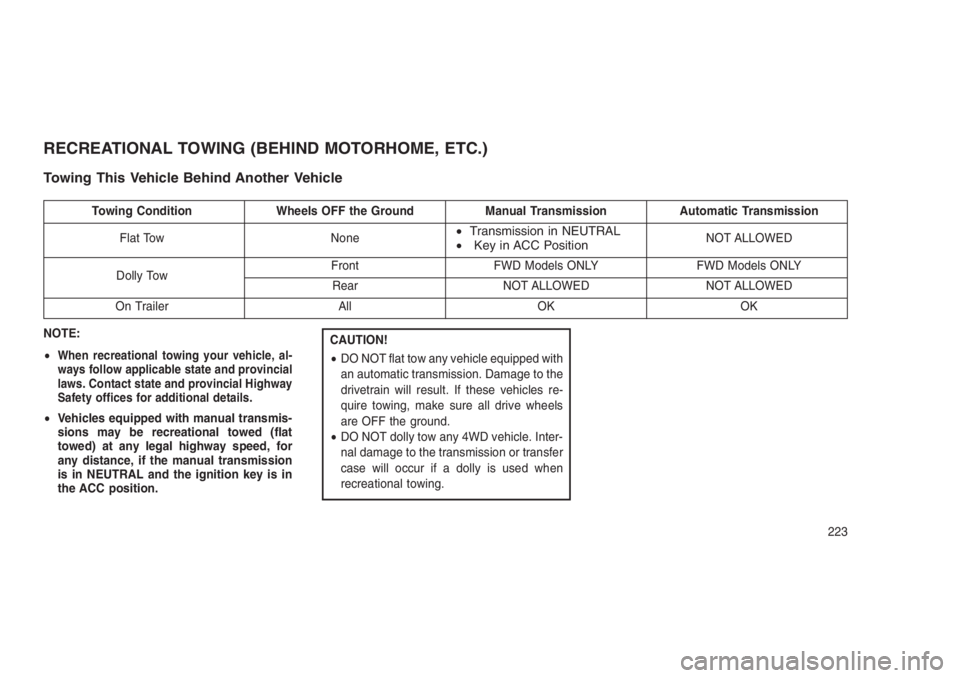
RECREATIONAL TOWING (BEHIND MOTORHOME, ETC.)
Towing This Vehicle Behind Another Vehicle
Towing Condition Wheels OFF the Ground Manual Transmission Automatic Transmission
Flat Tow None
•Transmission in NEUTRAL
•Key in ACC PositionNOT ALLOWED
Dolly TowFront FWD Models ONLY FWD Models ONLY
Rear NOT ALLOWED NOT ALLOWED
On Trailer All OK OK
NOTE:
•
When recreational towing your vehicle, al-
ways follow applicable state and provincial
laws. Contact state and provincial Highway
Safety offices for additional details.
•Vehicles equipped with manual transmis-
sions may be recreational towed (flat
towed) at any legal highway speed, for
any distance, if the manual transmission
is in NEUTRAL and the ignition key is in
the ACC position.
CAUTION!
•DO NOT flat tow any vehicle equipped with
an automatic transmission. Damage to the
drivetrain will result. If these vehicles re-
quire towing, make sure all drive wheels
are OFF the ground.
•DO NOT dolly tow any 4WD vehicle. Inter-
nal damage to the transmission or transfer
case will occur if a dolly is used when
recreational towing.
223
Page 229 of 332
6
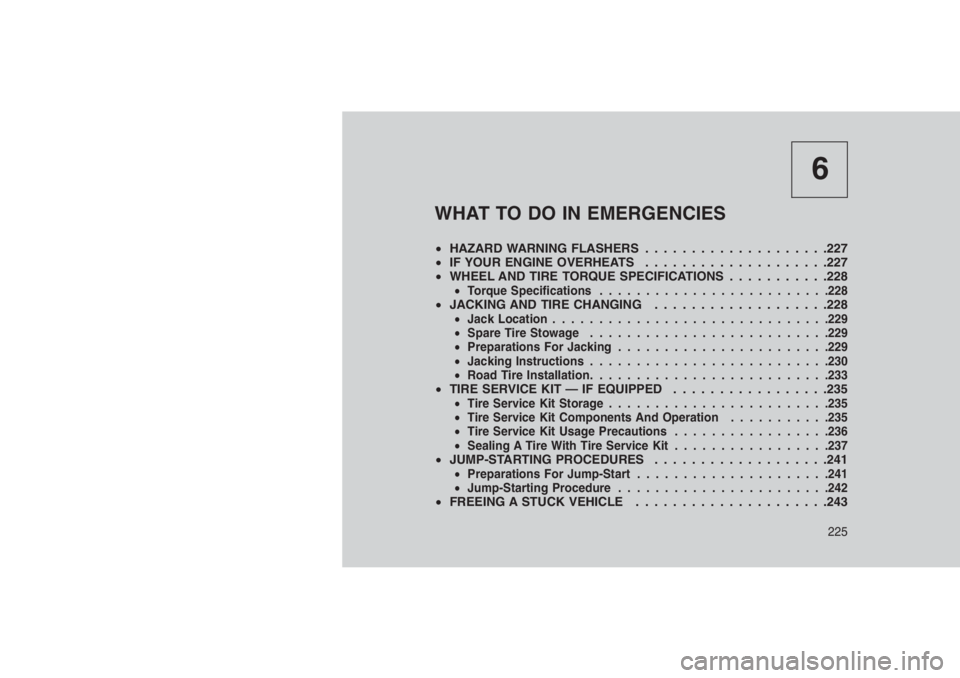
WHAT TO DO IN EMERGENCIES
•HAZARD WARNING FLASHERS . . . . . . . . ............227
•IF YOUR ENGINE OVERHEATS . . . . . . . . . . . . . . . . . . . .227
•WHEEL AND TIRE TORQUE SPECIFICATIONS . . . . . . . . . . .228
•Torque Specifications.........................228•JACKING AND TIRE CHANGING . . . . . . . . . . .........228•Jack Location..............................229
•Spare Tire Stowage..........................229
•Preparations For Jacking.......................229
•Jacking Instructions..........................230
•Road Tire Installation..........................233
•TIRE SERVICE KIT — IF EQUIPPED . . . . . . .. . . . . . . . . .235•Tire Service Kit Storage........................235
•Tire Service Kit Components And Operation...........235
•Tire Service Kit Usage Precautions.................236
•Sealing A Tire With Tire Service Kit.................237
•JUMP-STARTING PROCEDURES . . . . . . .. . . . . . . . . . . .241•Preparations For Jump-Start.....................241
•Jump-Starting Procedure.......................242
•FREEING A STUCK VEHICLE . . . . . . . ..............243
225
Page 230 of 332
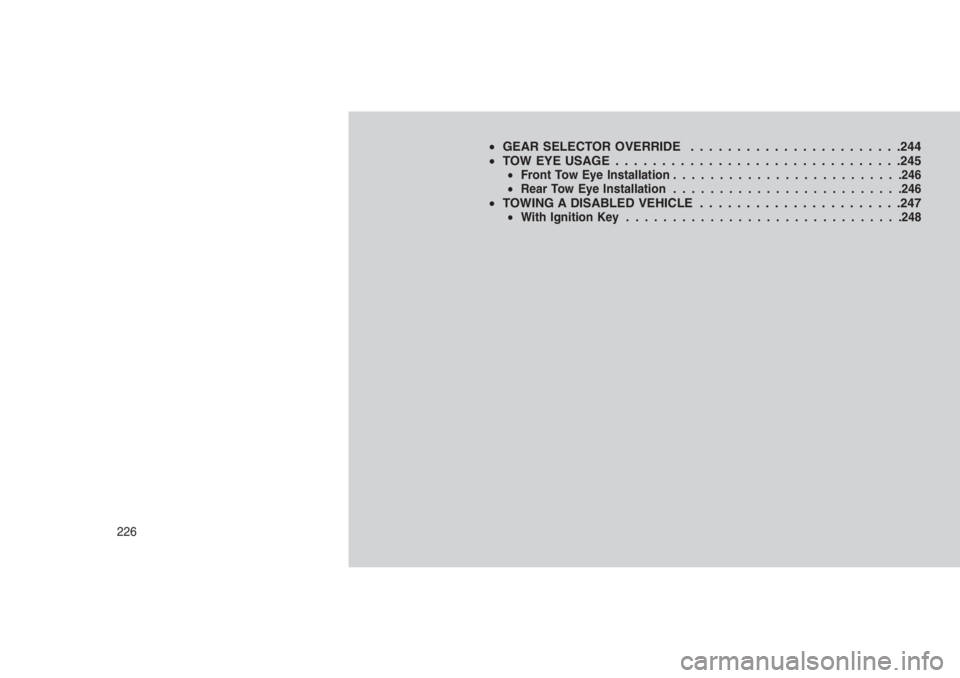
•GEAR SELECTOR OVERRIDE . . . . . . . .. . . . . . . . . . . . . . .244
•TOW EYE USAGE . . . . . . . . . .. . . . . . . . . . . . . . . . . . . . .245
•Front Tow Eye Installation.........................246
•Rear Tow Eye Installation.........................246
•TOWING A DISABLED VEHICLE......................247•With Ignition Key..............................248
226
Page 233 of 332
WARNING!(Continued)
•Being under a jacked-up vehicle is danger-
ous. The vehicle could slip off the jack and
fall on you. You could be crushed. Never
put any part of your body under a vehicle
that is on a jack. If you need to get under a
raised vehicle, take it to a service center
where it can be raised on a lift.
•Never start or run the engine while the
vehicle is on a jack.
•The jack is designed to be used as a tool
for changing tires only. The jack should not
be used to lift the vehicle for service pur-
poses. The vehicle should be jacked on a
firm level surface only. Avoid ice or slippery
areas.
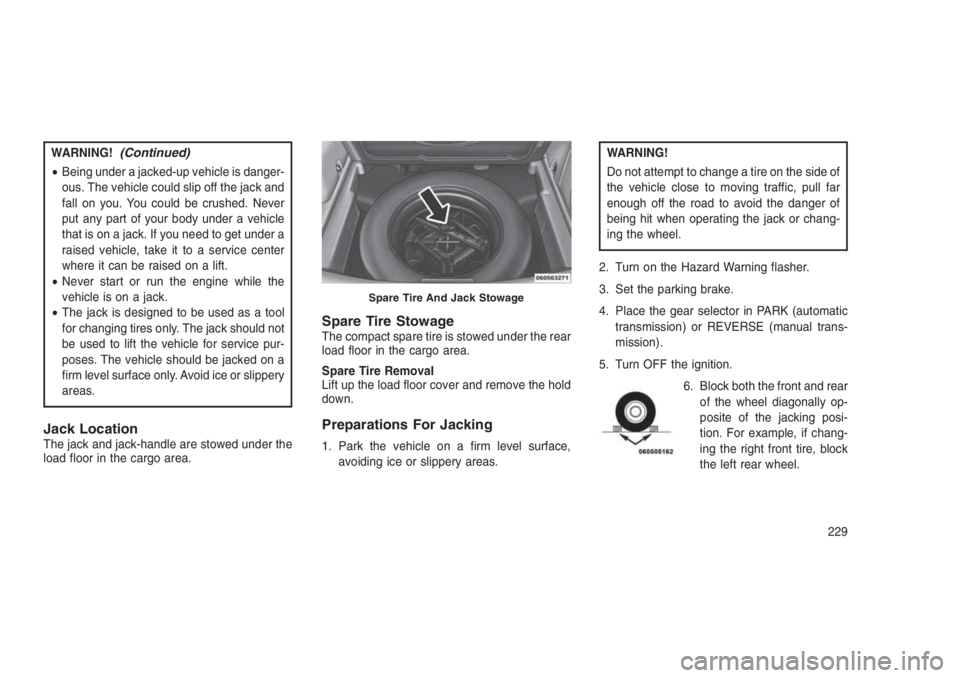
Jack LocationThe jack and jack-handle are stowed under the
load floor in the cargo area.
Spare Tire StowageThe compact spare tire is stowed under the rear
load floor in the cargo area.
Spare Tire Removal
Lift up the load floor cover and remove the hold
down.
Preparations For Jacking
1. Park the vehicle on a firm level surface,
avoiding ice or slippery areas.
WARNING!
Do not attempt to change a tire on the side of
the vehicle close to moving traffic, pull far
enough off the road to avoid the danger of
being hit when operating the jack or chang-
ing the wheel.
2. Turn on the Hazard Warning flasher.
3. Set the parking brake.
4. Place the gear selector in PARK (automatic
transmission) or REVERSE (manual trans-
mission).
5. Turn OFF the ignition.
6. Block both the front and rear
of the wheel diagonally op-
posite of the jacking posi-
tion. For example, if chang-
ing the right front tire, block
the left rear wheel.
Spare Tire And Jack Stowage
229
Page 234 of 332
NOTE:
Passengers should not remain in the vehicle
while the vehicle is being jacked.
Jacking Instructions
WARNING!
Carefully follow these tire changing warnings
to help prevent personal injury or damage to
your vehicle:
•Always park on a firm, level surface as far
from the edge of the roadway as possible
before raising the vehicle.
•Turn on the Hazard Warning flasher.
•Block the wheel diagonally opposite the
wheel to be raised.
•Set the parking brake firmly and set an
automatic transmission in PARK; a manual
transmission in REVERSE.
•Never start or run the engine with the
vehicle on a jack.
(Continued)
WARNING!(Continued)
•Do not let anyone sit in the vehicle when it
is on a jack.
•Do not get under the vehicle when it is on
a jack. If you need to get under a raised
vehicle, take it to a service center where it
can be raised on a lift.
•Only use the jack in the positions indicated
and for lifting this vehicle during a tire
change.
•If working on or near a roadway, be ex-
tremely careful of motor traffic.
•To assure that spare tires, flat or inflated,
are securely stowed, spares must be
stowed with the valve stem facing the
ground.NOTE:
Refer to “Tires — General Information” in
“Starting And Operating” for further infor-
mation about the spare tire, it’s use, and
operation.
1. Remove the scissors jack and lug wrench
from the spare wheel as an assembly. Turn
the jack screw to the left to loosen the lug
wrench and remove the wrench from the
jack assembly.
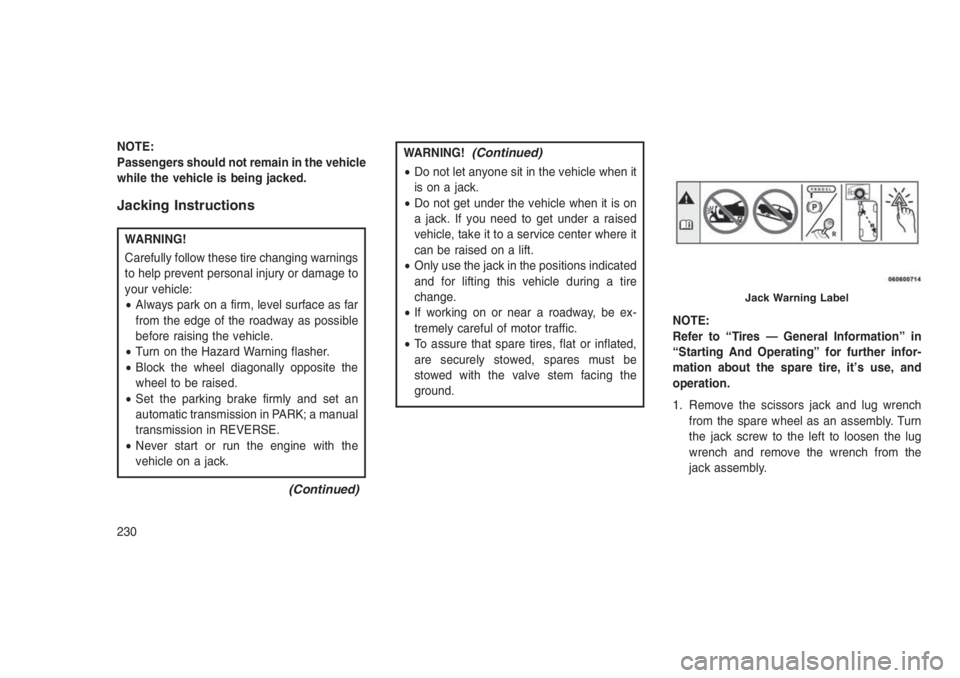
Jack Warning Label
230
Page 236 of 332
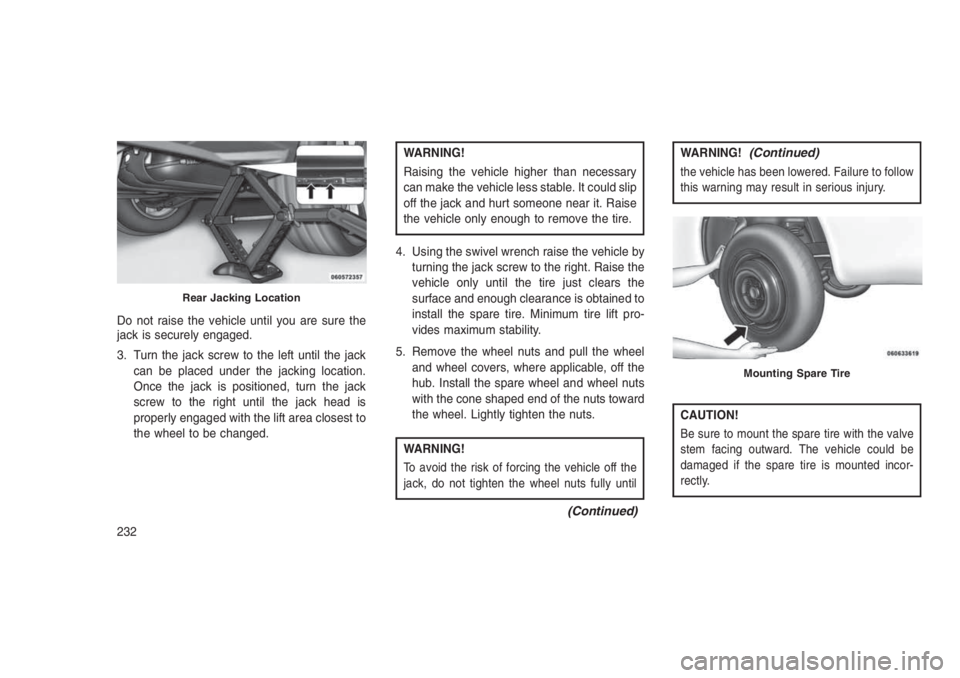
Do not raise the vehicle until you are sure the
jack is securely engaged.
3. Turn the jack screw to the left until the jack
can be placed under the jacking location.
Once the jack is positioned, turn the jack
screw to the right until the jack head is
properly engaged with the lift area closest to
the wheel to be changed.
WARNING!
Raising the vehicle higher than necessary
can make the vehicle less stable. It could slip
off the jack and hurt someone near it. Raise
the vehicle only enough to remove the tire.
4. Using the swivel wrench raise the vehicle by
turning the jack screw to the right. Raise the
vehicle only until the tire just clears the
surface and enough clearance is obtained to
install the spare tire. Minimum tire lift pro-
vides maximum stability.
5. Remove the wheel nuts and pull the wheel
and wheel covers, where applicable, off the
hub. Install the spare wheel and wheel nuts
with the cone shaped end of the nuts toward
the wheel. Lightly tighten the nuts.
WARNING!
To avoid the risk of forcing the vehicle off the
jack, do not tighten the wheel nuts fully until
(Continued)
WARNING!(Continued)
the vehicle has been lowered. Failure to follow
this warning may result in serious injury.
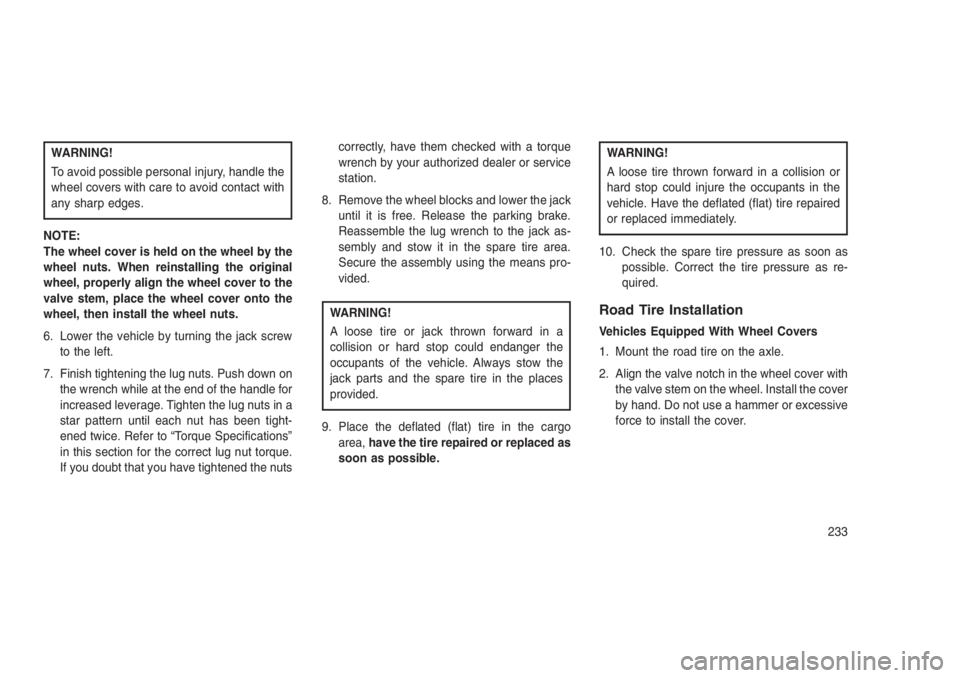
CAUTION!
Be sure to mount the spare tire with the valve
stem facing outward. The vehicle could be
damaged if the spare tire is mounted incor-
rectly.
Rear Jacking Location
Mounting Spare Tire
232
Page 237 of 332
WARNING!
To avoid possible personal injury, handle the
wheel covers with care to avoid contact with
any sharp edges.
NOTE:
The wheel cover is held on the wheel by the
wheel nuts. When reinstalling the original
wheel, properly align the wheel cover to the
valve stem, place the wheel cover onto the
wheel, then install the wheel nuts.
6. Lower the vehicle by turning the jack screw
to the left.
7. Finish tightening the lug nuts. Push down on
the wrench while at the end of the handle for
increased leverage. Tighten the lug nuts in a
star pattern until each nut has been tight-
ened twice. Refer to “Torque Specifications”
in this section for the correct lug nut torque.
If you doubt that you have tightened the nutscorrectly, have them checked with a torque
wrench by your authorized dealer or service
station.
8. Remove the wheel blocks and lower the jack
until it is free. Release the parking brake.
Reassemble the lug wrench to the jack as-
sembly and stow it in the spare tire area.
Secure the assembly using the means pro-
vided.
WARNING!
A loose tire or jack thrown forward in a
collision or hard stop could endanger the
occupants of the vehicle. Always stow the
jack parts and the spare tire in the places
provided.
9. Place the deflated (flat) tire in the cargo
area,have the tire repaired or replaced as
soon as possible.
WARNING!
A loose tire thrown forward in a collision or
hard stop could injure the occupants in the
vehicle. Have the deflated (flat) tire repaired
or replaced immediately.
10. Check the spare tire pressure as soon as
possible. Correct the tire pressure as re-
quired.
Road Tire Installation
Vehicles Equipped With Wheel Covers
1. Mount the road tire on the axle.
2. Align the valve notch in the wheel cover with
the valve stem on the wheel. Install the cover
by hand. Do not use a hammer or excessive
force to install the cover.
233
Page 238 of 332
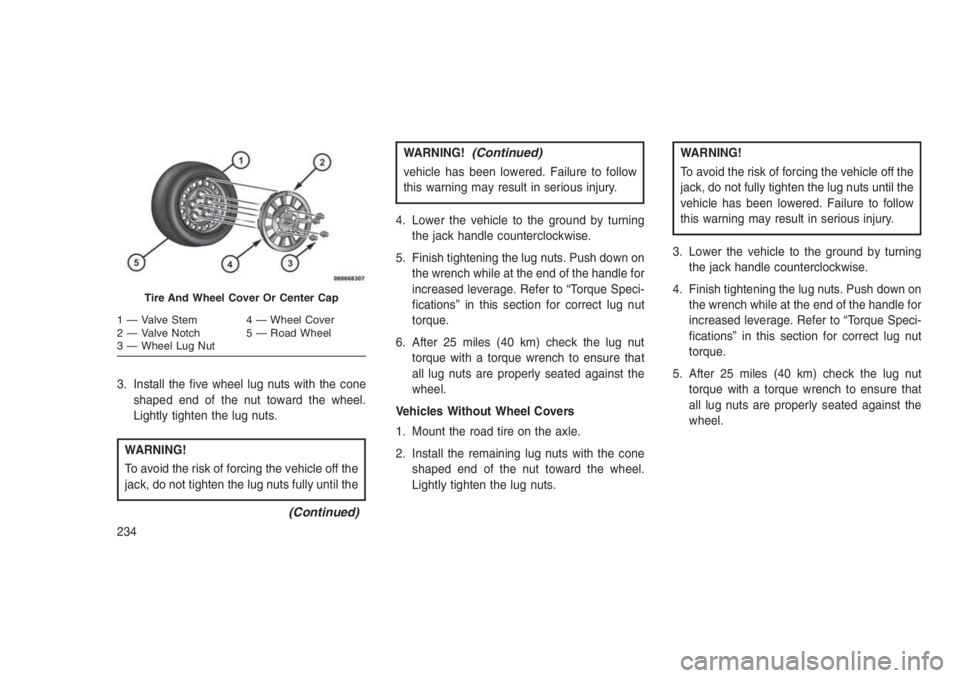
3. Install the five wheel lug nuts with the cone
shaped end of the nut toward the wheel.
Lightly tighten the lug nuts.
WARNING!
To avoid the risk of forcing the vehicle off the
jack, do not tighten the lug nuts fully until the
(Continued)
WARNING!(Continued)
vehicle has been lowered. Failure to follow
this warning may result in serious injury.
4. Lower the vehicle to the ground by turning
the jack handle counterclockwise.
5. Finish tightening the lug nuts. Push down on
the wrench while at the end of the handle for
increased leverage. Refer to “Torque Speci-
fications” in this section for correct lug nut
torque.
6. After 25 miles (40 km) check the lug nut
torque with a torque wrench to ensure that
all lug nuts are properly seated against the
wheel.
Vehicles Without Wheel Covers
1. Mount the road tire on the axle.
2. Install the remaining lug nuts with the cone
shaped end of the nut toward the wheel.
Lightly tighten the lug nuts.
WARNING!
To avoid the risk of forcing the vehicle off the
jack, do not fully tighten the lug nuts until the
vehicle has been lowered. Failure to follow
this warning may result in serious injury.
3. Lower the vehicle to the ground by turning
the jack handle counterclockwise.
4. Finish tightening the lug nuts. Push down on
the wrench while at the end of the handle for
increased leverage. Refer to “Torque Speci-
fications” in this section for correct lug nut
torque.
5. After 25 miles (40 km) check the lug nut
torque with a torque wrench to ensure that
all lug nuts are properly seated against the
wheel.
Tire And Wheel Cover Or Center Cap
1 — Valve Stem 4 — Wheel Cover
2 — Valve Notch 5 — Road Wheel
3 — Wheel Lug Nut
234
Page 241 of 332
WARNING!(Continued)
•Keep Tire Service Kit away from open
flames or heat source.
•A loose Tire Service Kit thrown forward in a
collision or hard stop could endanger the
occupants of the vehicle. Always stow the
Tire Service Kit in the place provided.
Failure to follow these warnings can result
in injuries that are serious or fatal to you,
your passengers, and others around you.
•Take care not to allow the contents of Tire
Service Kit to come in contact with hair,
eyes, or clothing. Tire Service Kit sealant is
harmful if inhaled, swallowed, or absorbed
through the skin. It causes skin, eye, and
respiratory irritation. Flush immediately
with plenty of water if there is any contact
with eyes or skin. Change clothing as soon
as possible, if there is any contact with
clothing.
(Continued)
WARNING!(Continued)
•Tire Service Kit Sealant solution contains
latex. In case of an allergic reaction or
rash, consult a physician immediately.
Keep Tire Service Kit out of reach of
children. If swallowed, rinse mouth imme-
diately with plenty of water and drink plenty
of water. Do not induce vomiting! Consult a
physician immediately.
Sealing A Tire With Tire Service Kit
(A) Whenever You Stop To Use Tire Service
Kit:
1. Pull over to a safe location and turn on the
vehicle’s Hazard Warning flashers.
2. Verify that the valve stem (on the wheel with
the deflated tire) is in a position that is near
to the ground. This will allow the Tire Service
Kit Hoses (6) and (7) to reach the valve stem
and keep the Tire Service Kit flat on the
ground. This will provide the best positioning
of the kit when injecting the sealant into thedeflated tire and running the air pump. Move
the vehicle as necessary to place the valve
stem in this position before proceeding.
3. Place the transmission in PARK (auto trans-
mission) or in Gear (manual transmission)
and place the ignition in the OFF position.
4. Set the parking brake.
(B) Setting Up To Use Tire Service Kit:
1. Push in the Mode Select Knob (5) and turn to
the Sealant Mode position.
2. Uncoil the Sealant Hose (6) and then re-
move the cap from the fitting at the end of the
hose.
3. Place the Tire Service Kit flat on the ground
next to the deflated tire.
4. Remove the cap from the valve stem and
then screw the fitting at the end of the
Sealant Hose (6) onto the valve stem.
5. Uncoil the Power Plug (8) and insert the plug
into the vehicle’s 12 Volt power outlet.
237
Page 249 of 332
7. Move the gear selector to the NEUTRAL
position.
8.
The vehicle may then be started in NEUTRAL.
9. Reinstall the gear selector override access
cover.
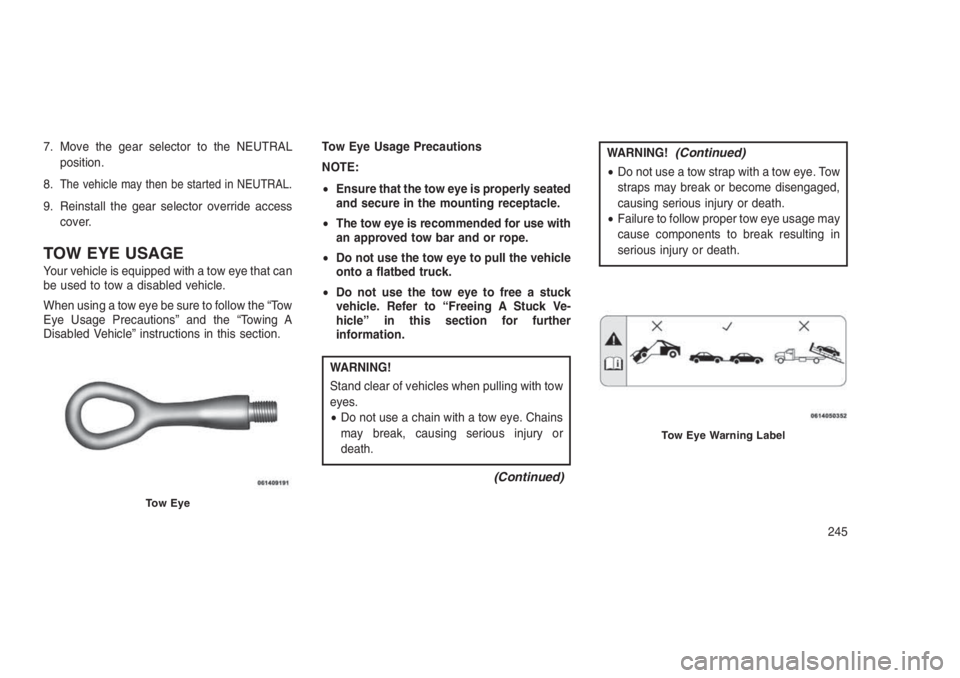
TOW EYE USAGE
Your vehicle is equipped with a tow eye that can
be used to tow a disabled vehicle.
When using a tow eye be sure to follow the “Tow
Eye Usage Precautions” and the “Towing A
Disabled Vehicle” instructions in this section.Tow Eye Usage Precautions
NOTE:
•Ensure that the tow eye is properly seated
and secure in the mounting receptacle.
•The tow eye is recommended for use with
an approved tow bar and or rope.
•Do not use the tow eye to pull the vehicle
onto a flatbed truck.
•Do not use the tow eye to free a stuck
vehicle. Refer to “Freeing A Stuck Ve-
hicle” in this section for further
information.
WARNING!
Stand clear of vehicles when pulling with tow
eyes.
•Do not use a chain with a tow eye. Chains
may break, causing serious injury or
death.
(Continued)
WARNING!(Continued)
•Do not use a tow strap with a tow eye. Tow
straps may break or become disengaged,
causing serious injury or death.
•Failure to follow proper tow eye usage may
cause components to break resulting in
serious injury or death.
Tow Eye
Tow Eye Warning Label
245