flat tire JEEP PATRIOT 2021 Owner handbook (in English)
[x] Cancel search | Manufacturer: JEEP, Model Year: 2021, Model line: PATRIOT, Model: JEEP PATRIOT 2021Pages: 332, PDF Size: 1.99 MB
Page 64 of 332
WARNING!(Continued)
•Always make sure that objects cannot fall
into the driver footwell while the vehicle is
moving. Objects can become trapped un-
der the brake pedal and accelerator pedal
causing a loss of vehicle control.
•If required, mounting posts must be prop-
erly installed, if not equipped from the
factory.
Failure to properly follow floor mat installa-
tion or mounting can cause interference with
the brake pedal and accelerator pedal opera-
tion causing loss of control of the vehicle.
Periodic Safety Checks You Should
Make Outside The Vehicle
Tires
Examine tires for excessive tread wear and
uneven wear patterns. Check for stones, nails,
glass, or other objects lodged in the tread or
sidewall. Inspect the tread for cuts and cracks.
Inspect sidewalls for cuts, cracks, and bulges.
Check the wheel nuts for tightness. Check the
tires (including spare) for proper cold inflation
pressure.
Lights
Have someone observe the operation of brake
lights and exterior lights while you work the
controls. Check turn signal and high beam
indicator lights on the instrument panel.Door Latches
Check for proper closing, latching, and locking.
Fluid Leaks
Check area under vehicle after overnight park-
ing for fuel, engine coolant, oil, or other fluid
leaks. Also, if gasoline fumes are detected or if
fuel, power steering fluid (if equipped), or brake
fluid leaks are suspected. The cause should be
located and corrected immediately.
60
Page 134 of 332
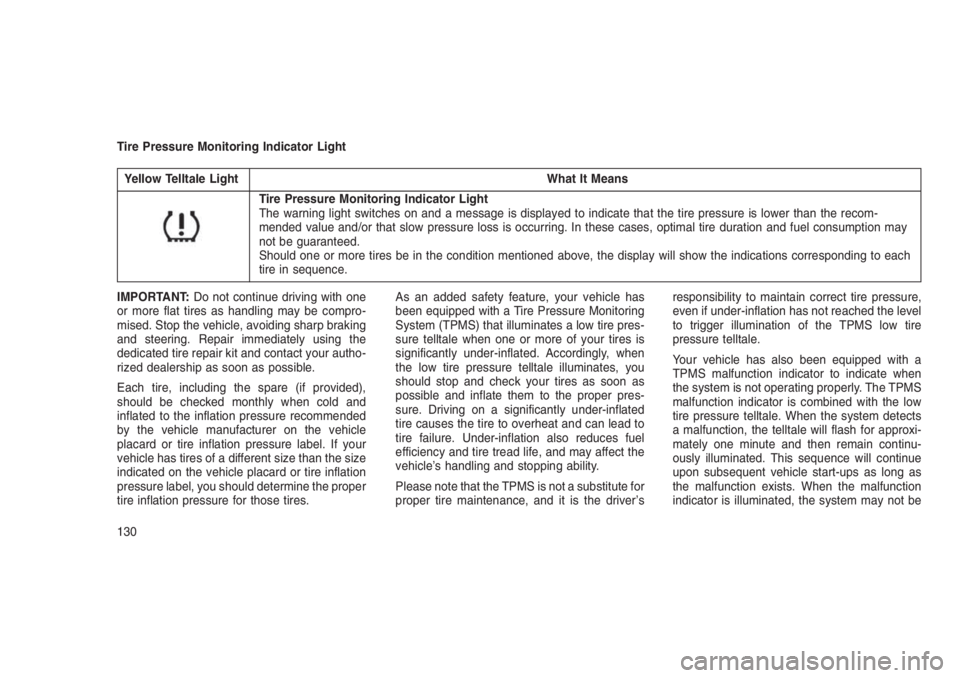
Tire Pressure Monitoring Indicator Light
Yellow Telltale Light What It Means
Tire Pressure Monitoring Indicator Light
The warning light switches on and a message is displayed to indicate that the tire pressure is lower than the recom-
mended value and/or that slow pressure loss is occurring. In these cases, optimal tire duration and fuel consumption may
not be guaranteed.
Should one or more tires be in the condition mentioned above, the display will show the indications corresponding to each
tire in sequence.
IMPORTANT:Do not continue driving with one
or more flat tires as handling may be compro-
mised. Stop the vehicle, avoiding sharp braking
and steering. Repair immediately using the
dedicated tire repair kit and contact your autho-
rized dealership as soon as possible.
Each tire, including the spare (if provided),
should be checked monthly when cold and
inflated to the inflation pressure recommended
by the vehicle manufacturer on the vehicle
placard or tire inflation pressure label. If your
vehicle has tires of a different size than the size
indicated on the vehicle placard or tire inflation
pressure label, you should determine the proper
tire inflation pressure for those tires.As an added safety feature, your vehicle has
been equipped with a Tire Pressure Monitoring
System (TPMS) that illuminates a low tire pres-
sure telltale when one or more of your tires is
significantly under-inflated. Accordingly, when
the low tire pressure telltale illuminates, you
should stop and check your tires as soon as
possible and inflate them to the proper pres-
sure. Driving on a significantly under-inflated
tire causes the tire to overheat and can lead to
tire failure. Under-inflation also reduces fuel
efficiency and tire tread life, and may affect the
vehicle’s handling and stopping ability.
Please note that the TPMS is not a substitute for
proper tire maintenance, and it is the driver’sresponsibility to maintain correct tire pressure,
even if under-inflation has not reached the level
to trigger illumination of the TPMS low tire
pressure telltale.
Your vehicle has also been equipped with a
TPMS malfunction indicator to indicate when
the system is not operating properly. The TPMS
malfunction indicator is combined with the low
tire pressure telltale. When the system detects
a malfunction, the telltale will flash for approxi-
mately one minute and then remain continu-
ously illuminated. This sequence will continue
upon subsequent vehicle start-ups as long as
the malfunction exists. When the malfunction
indicator is illuminated, the system may not be
130
Page 143 of 332
ELECTRONIC VEHICLE
INFORMATION CENTER (EVIC)
— IF EQUIPPED
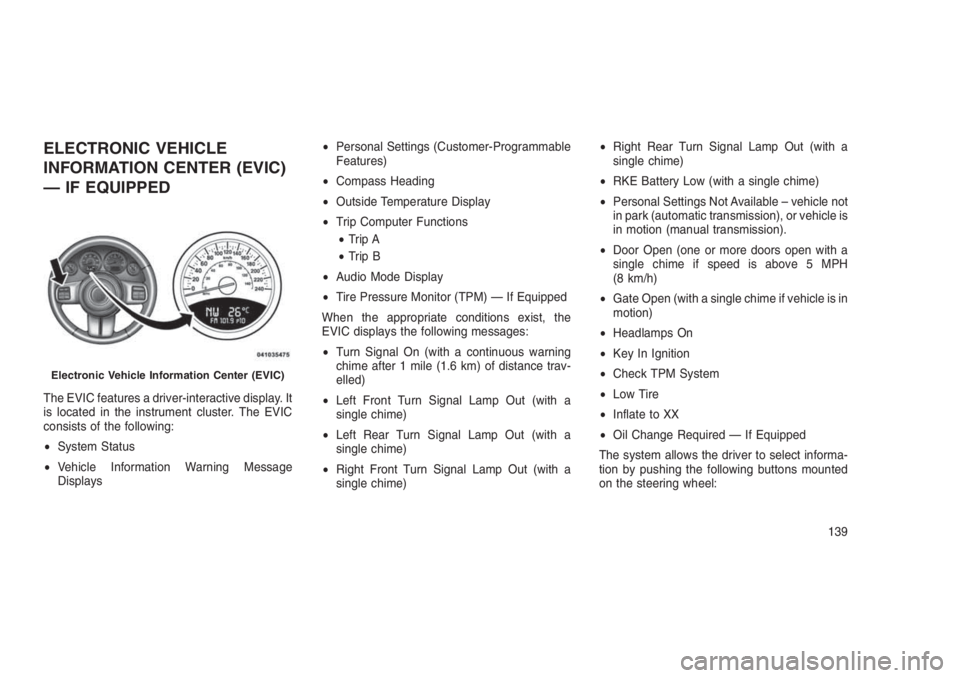
The EVIC features a driver-interactive display. It
is located in the instrument cluster. The EVIC
consists of the following:
•System Status
•Vehicle Information Warning Message
Displays•Personal Settings (Customer-Programmable
Features)
•Compass Heading
•Outside Temperature Display
•Trip Computer Functions
•Trip A
•Trip B
•Audio Mode Display
•Tire Pressure Monitor (TPM) — If Equipped
When the appropriate conditions exist, the
EVIC displays the following messages:
•Turn Signal On (with a continuous warning
chime after 1 mile (1.6 km) of distance trav-
elled)
•Left Front Turn Signal Lamp Out (with a
single chime)
•Left Rear Turn Signal Lamp Out (with a
single chime)
•Right Front Turn Signal Lamp Out (with a
single chime)•Right Rear Turn Signal Lamp Out (with a
single chime)
•RKE Battery Low (with a single chime)
•Personal Settings Not Available – vehicle not
in park (automatic transmission), or vehicle is
in motion (manual transmission).
•Door Open (one or more doors open with a
single chime if speed is above 5 MPH
(8 km/h)
•Gate Open (with a single chime if vehicle is in
motion)
•Headlamps On
•Key In Ignition
•Check TPM System
•Low Tire
•Inflate to XX
•Oil Change Required — If Equipped
The system allows the driver to select informa-
tion by pushing the following buttons mounted
on the steering wheel:
Electronic Vehicle Information Center (EVIC)
139
Page 167 of 332
•Tire Inflation Pressures........................196
•Tire Pressures For High Speed Operation.............197
•Radial Ply Tires.............................197
•Tire Types................................198
•Run Flat Tires — If Equipped.....................199
•Spare Tires — If Equipped.......................199
•Tire Spinning..............................200
•Tread Wear Indicators.........................200
•Life Of Tire...............................201
•Replacement Tires...........................201
•TIRE CHAINS (TRACTION DEVICES) . . . . . . . . . . . . .. . . .202
•TIRE ROTATION RECOMMENDATIONS . . . . . . .. . . . . . . .203
•TIRE PRESSURE MONITORING SYSTEM (TPMS) . . . . .. . . .204
•Base System...............................205
•Premium System — If Equipped...................207
•TPMS Deactivation — If Equipped..................209
•FUEL REQUIREMENTS — GASOLINE ENGINE . . . . . . . . . . .210•Methanol.................................210
•Ethanol..................................210
•Clean Air Gasoline...........................211
•MMT In Gasoline............................211
•Materials Added To Fuel.......................211
•ADDING FUEL...............................212•Locking Fuel Filler Cap (Gas Cap).................212
•Loose Fuel Filler Cap Message...................212
•TRAILER TOWING . . ..........................213•Common Towing Definitions.....................213
163
Page 184 of 332
This will allow you to cross over obstacles and
descend hills, with improved control and less
effort.
NOTE:
For maximum off-road performance, pre-
mium fuel is recommended. While the ve-
hicle will operate on regular fuel when in L
Off-Road mode (if equipped), the engine has
been calibrated for maximum performance
using premium fuel.
Driving In Snow, Mud And SandThere is a drastic reduction in traction when
driving in snow, mud or sand. The vehicle will be
less responsive to steering, acceleration and
braking inputs. Therefore, you should acceler-
ate slowly, leave greater stopping distances and
avoid abrupt vehicle maneuvers. You want to
keep a slow constant steady pace. The key is to
maintain the vehicle’s momentum.
Snow
In heavy snow or for additional control and
traction at slower speeds, activate the 4WD
LOCK and shift the transaxle to low (L Off-Road
[if equipped] ) if necessary. Do not shift to a
lower gear than necessary to maintain head-way. Over-revving the engine can spin the
wheels and traction will be lost. If you start to
slow to a stop, try turning your steering wheel no
more than a 1/4 turn quickly back and forth,
while still applying throttle. This will allow the
tires to get a fresh"bite"and help maintain your
momentum.
CAUTION!
On icy or slippery roads, do not downshift at
high engine RPM’s or vehicle speeds be-
cause engine braking may cause skidding
and loss of control.
Mud
Deep mud creates a great deal of suction
around the tires and is very difficult to get
through. You should use low (L Off-Road [if
equipped] ) with the 4WD LOCK engaged and
maintain your momentum. If you start to slow to
a stop, try turning your steering wheel no more
than a 1/4 turn quickly back and forth for
additional traction. Mud holes pose an in-
creased threat of vehicle damage and getting
stuck. They are normally full of debris fromprevious vehicles getting stuck. As a good prac-
tice before entering any mud hole, get out and
determine how deep it is, if there are any hidden
obstacles and if the vehicle can be safely recov-
ered if stuck.
Sand
Soft sand is very difficult to travel through with
full tire pressure. When crossing soft sandy
spots in a trail maintain your vehicle’s momen-
tum and do not stop. The key to driving in soft
sand is using the appropriate tire pressure,
accelerating slowly, avoiding abrupt maneuvers
and maintaining the vehicle’s momentum. If you
are going to be driving on large soft sandy areas
or dunes, reduce your tire pressure to a mini-
mum of 15 psi (103 kPa) to allow for a greater
tire surface area. You should use low (L Off-
Road [if equipped] ) with the 4WD LOCK en-
gaged and ESC turned off. Reduced tire pres-
sure will drastically improve your traction and
handling, while driving on the soft sand, but you
must return the tires to normal air pressure
before driving on pavement or other hard sur-
faces. Be sure you have a way to reinflate the
tires prior to reducing the pressure.
180
Page 196 of 332
WARNING!(Continued)
•The capabilities of an ESC-equipped ve-
hicle must never be exploited in a reckless
or dangerous manner, which could jeopar-
dize the user’s safety or the safety of
others
•Vehicle modifications, or failure to properly
maintain your vehicle, may change the
handling characteristics of your vehicle,
and may negatively affect the performance
of the ESC system. Changes to the steer-
ing system, suspension, braking system,
tire type and size or wheel size may ad-
versely affect ESC performance. Improp-
erly inflated and unevenly worn tires may
also degrade ESC performance. Any ve-
hicle modification or poor vehicle mainte-
nance that reduces the effectiveness of the
ESC system can increase the risk of loss
of vehicle control, vehicle rollover, per-
sonal injury and death.ESC Operating Modes
The ESC system has three available operating
modes for four–wheel drive equipped vehicles
and two available operating modes for two–
wheel drive equipped vehicles.
Full On (Four-Wheel Drive Models) Or On
(Two-Wheel Drive Models)
This is the normal operating mode for ESC.
Whenever the vehicle is started, the ESC sys-
tem will be in this “On” mode. This mode should
be used for most driving situations. ESC should
only be turned to “Partial Off” or “ESC Off” for
specific reasons as noted below.
Partial Off (Four-Wheel Drive Models) Or On
(Two-Wheel Drive Models)
This mode is entered by momentarily pushing
the “ESC Off” switch. When in “Partial Off”
mode, the TCS portion of ESC, except for the
“limited slip” feature described in the TCS sec-
tion, has been disabled, and the"ESC OFF
Indicator Light"will be illuminated. All other
stability features of ESC function normally. This
mode is intended to be used if the vehicle is in
deep snow, sand or gravel conditions, and morewheel spin than ESC would normally allow is
required to gain traction.
To turn ESC on again, momentarily push the
“ESC Off” switch. This will restore the normal
“ESC On” mode of operation.
NOTE:
To improve the vehicle’s traction when driv-
ing with snow chains, or starting off in deep
snow, sand or gravel, it may be desirable to
switch to the “Partial Off” mode by pushing
the “ESC Off” switch. Once the situation
requiring ESC to be switched to the “Partial
Off” mode is overcome, turn ESC back on by
momentarily pushing the “ESC Off” switch.
This may be done while the vehicle is in
motion.
WARNING!
When in “Partial Off” mode, the TCS func-
tionality of ESC (except for the limited slip
feature described in the TCS section) has
been disabled and the “ESC Off Indicator
(Continued)
192
Page 199 of 332
Hill Descent Control (HDC) — If
Equipped
This system maintains vehicle speed while de-
scending hills during off-road driving situations.
HDC will automatically apply the brakes to
control downhill speed to between 4 mph
(7 km/h) and 6 mph (9 km/h) depending on
terrain. The system is activated by placing the
vehicle in “Off-Road” mode and placing the gear
selector in LOW or REVERSE. Refer to “Off-
Road Driving Tips” in “Starting And Operating”
for further information.
When HDC is properly enabled,
the “Hill Decent Control Light” in
the instrument cluster will be
illuminated.
HDC has the capability to sense terrain and will
only activate when the vehicle is descending a
hill. It will not activate on level ground. If desired,
HDC can be fully deactivated by putting the
vehicle into ESC “Full Off” mode. This is done
by pushing and holding the “ESC Off” button for
five seconds. Refer to “Electronic Stability Con-
trol (ESC)” in this section of the manual.HDC operation can be overridden with brake
application to slow the vehicle down below the
HDC control speed. Conversely, if more speed
is desired during HDC control, the accelerator
pedal will increase vehicle speed like normal.
When either the brake or the accelerator is
released, HDC will control the vehicle back to
the original set speed.
HDC is only intended for low speed off-road
driving. At vehicle speeds above 31 mph (50
km/h), HDC will no longer function. If the “HDC
Indicator Light” begins to flash, this indicates
that the brakes are getting too hot and the
vehicle should be stopped to allow the brakes to
cool.
WARNING!
HDC is only intended to assist the driver in
controlling vehicle speed when descending
hills. The driver must remain attentive to the
driving conditions and is responsible for
maintaining a safe vehicle speed.
TIRES — GENERAL
INFORMATION
Tire PressureProper tire inflation pressure is essential to the
safe and satisfactory operation of your vehicle.
Four primary areas are affected by improper tire
pressure:
•Safety and Vehicle Stability
•Economy
•Tread Wear
•Ride Comfort
Safety
WARNING!
•Improperly inflated tires are dangerous
and can cause collisions.
•Underinflation increases tire flexing and
can result in overheating and tire failure.
(Continued)
195
Page 200 of 332
WARNING!(Continued)
•Overinflation reduces a tire’s ability to
cushion shock. Objects on the road and
chuckholes can cause damage that result
in tire failure.
•Overinflated or underinflated tires can af-
fect vehicle handling and can fail suddenly,
resulting in loss of vehicle control.
•Unequal tire pressures can cause steering
problems. You could lose control of your
vehicle.
•Unequal tire pressures from one side of
the vehicle to the other can cause the
vehicle to drift to the right or left.
•Always drive with each tire inflated to the
recommended cold tire inflation pressure.
Both under-inflation and over-inflation affect the
stability of the vehicle and can produce a feeling
of sluggish response or over responsiveness in
the steering.NOTE:
•Unequal tire pressures from side to side
may cause erratic and unpredictable
steering response.
•Unequal tire pressure from side to side
may cause the vehicle to drift left or right.
Fuel Economy
Underinflated tires will increase tire rolling resis-
tance resulting in higher fuel consumption.
Tread Wear
Improper cold tire inflation pressures can cause
abnormal wear patterns and reduced tread life,
resulting in the need for earlier tire replacement.
Ride Comfort And Vehicle Stability
Proper tire inflation contributes to a comfortable
ride. Over-inflation produces a jarring and un-
comfortable ride.
Tire Inflation PressuresThe proper cold tire inflation pressure is listed
on the driver’s side B-Pillar or rear edge of the
driver’s side door.At least once a month:
•Check and adjust tire pressure with a good
quality pocket-type pressure gauge. Do not
make a visual judgement when determining
proper inflation. Tires may look properly in-
flated even when they are under-inflated.
•Inspect tires for signs of tire wear or visible
damage.
CAUTION!
After inspecting or adjusting the tire pres-
sure, always reinstall the valve stem cap.
This will prevent moisture and dirt from en-
tering the valve stem, which could damage
the valve stem.
Inflation pressures specified on the placard are
always “cold tire inflation pressure”. Cold tire
inflation pressure is defined as the tire pressure
after the vehicle has not been driven for at least
three hours, or driven less than 1 mile (1.6 km)
after sitting for a minimum of three hours. The
196
Page 201 of 332
cold tire inflation pressure must not exceed the
maximum inflation pressure molded into the tire
sidewall.
Check tire pressures more often if subject to a
wide range of outdoor temperatures, as tire
pressures vary with temperature changes.
Tire pressures change by approximately 1 psi (7
kPa) per 12°F (7°C) of air temperature change.
Keep this in mind when checking tire pressure
inside a garage, especially in the Winter.
Example: If garage temperature = 68°F (20°C)
and the outside temperature = 32°F (0°C) then
the cold tire inflation pressure should be in-
creased by 3 psi (21 kPa), which equals 1 psi (7
kPa) for every 12°F (7°C) for this outside tem-
perature condition.
Tire pressure may increase from 2 to 6 psi (13
to 40 kPa) during operation. DO NOT reduce
this normal pressure build up or your tire pres-
sure will be too low.Tire Pressures For High Speed
Operation
The manufacturer advocates driving at safe
speeds and within posted speed limits. Where
speed limits or conditions are such that the
vehicle can be driven at high speeds, maintain-
ing correct tire inflation pressure is very impor-
tant. Increased tire pressure and reduced ve-
hicle loading may be required for high-speed
vehicle operation. Refer to your authorized tire
dealer or original equipment vehicle dealer for
recommended safe operating speeds, loading
and cold tire inflation pressures.
WARNING!
High speed driving with your vehicle under
maximum load is dangerous. The added
strain on your tires could cause them to fail.
You could have a serious collision. Do not
drive a vehicle loaded to the maximum ca-
pacity at continuous speeds above 75 mph
(120 km/h).
Radial Ply Tires
WARNING!
Combining radial ply tires with other types of
tires on your vehicle will cause your vehicle
to handle poorly. The instability could cause
a collision. Always use radial ply tires in sets
of four. Never combine them with other types
of tires.
Tire Repair
If your tire becomes damaged, it may be re-
paired if it meets the following criteria:
•The tire has not been driven on when flat.
•The damage is only on the tread section of
your tire (sidewall damage is not repairable).
•The puncture is no greater thana¼ofan
inch (6 mm).
Consult an authorized tire dealer for tire repairs
and additional information.
Damaged Run Flat tires, or Run Flat tires that
have experienced a loss of pressure should be
replaced immediately with another Run Flat tire
197
Page 202 of 332
of identical size and service description (Load
Index and Speed Symbol).
Tire Types
All Season Tires — If Equipped
All Season tires provide traction for all seasons
(Spring, Summer, Fall and Winter). Traction
levels may vary between different all season
tires. All season tires can be identified by the
M+S, M&S, M/S or MS designation on the tire
sidewall. Use all season tires only in sets of
four; failure to do so may adversely affect the
safety and handling of your vehicle.
Summer Or Three Season Tires — If
Equipped
Summer tires provide traction in both wet and
dry conditions, and are not intended to be
driven in snow or on ice. If your vehicle is
equipped with Summer tires, be aware these
tires are not designed for Winter or cold driving
conditions. Install Winter tires on your vehicle
when ambient temperatures are less than 40°F
(5°C) or if roads are covered with ice or snow.
For more information, contact an authorized
dealer.Summer tires do not contain the all season
designation or mountain/snowflake symbol on
the tire sidewall. Use Summer tires only in sets
of four; failure to do so may adversely affect the
safety and handling of your vehicle.
WARNING!
Do not use Summer tires in snow/ice condi-
tions. You could lose vehicle control, result-
ing in severe injury or death. Driving too fast
for conditions also creates the possibility of
loss of vehicle control.
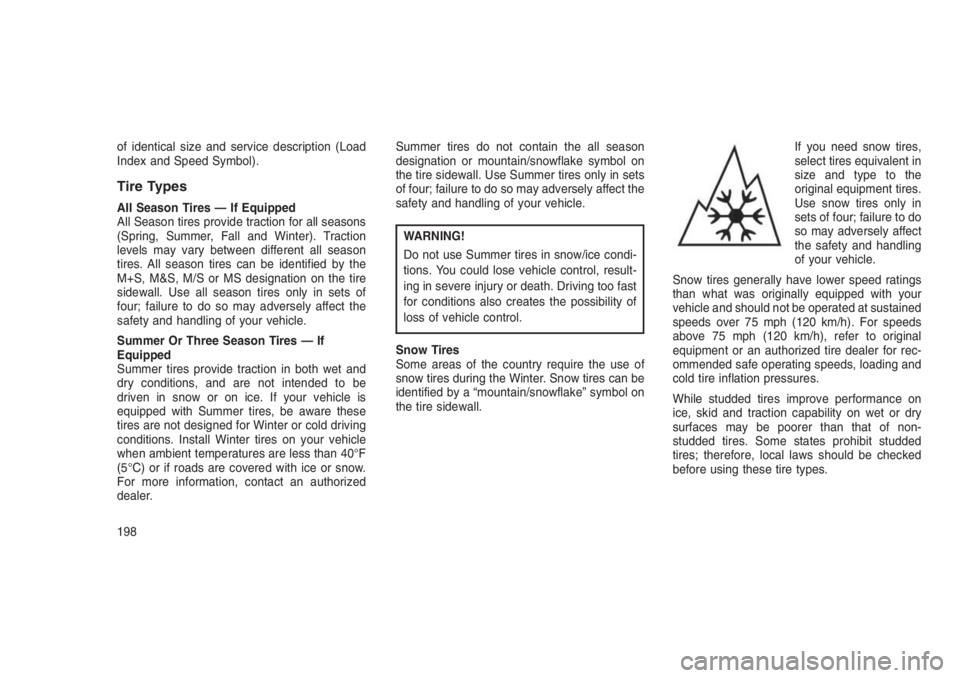
Snow Tires
Some areas of the country require the use of
snow tires during the Winter. Snow tires can be
identified by a “mountain/snowflake” symbol on
the tire sidewall.If you need snow tires,
select tires equivalent in
size and type to the
original equipment tires.
Use snow tires only in
sets of four; failure to do
so may adversely affect
the safety and handling
of your vehicle.
Snow tires generally have lower speed ratings
than what was originally equipped with your
vehicle and should not be operated at sustained
speeds over 75 mph (120 km/h). For speeds
above 75 mph (120 km/h), refer to original
equipment or an authorized tire dealer for rec-
ommended safe operating speeds, loading and
cold tire inflation pressures.
While studded tires improve performance on
ice, skid and traction capability on wet or dry
surfaces may be poorer than that of non-
studded tires. Some states prohibit studded
tires; therefore, local laws should be checked
before using these tire types.
198