transmission oil JEEP PATRIOT 2021 Owner handbook (in English)
[x] Cancel search | Manufacturer: JEEP, Model Year: 2021, Model line: PATRIOT, Model: JEEP PATRIOT 2021Pages: 332, PDF Size: 1.99 MB
Page 23 of 332
Skin oils may cause battery deterioration. If
you touch a battery, clean it with rubbing
alcohol.
3. To assemble the RKE Key Fob case, snap
the two halves together.
NOTE:
If the RKE Key Fob is equipped with a screw,
reinstall and tighten the screw until snug.
REMOTE STARTING SYSTEM
— IF EQUIPPED
This system uses the RKE Key Fob
to start the engine conveniently
from outside the vehicle while still
maintaining security. The system
has a range of approximately 300 ft
(91 m). Obstructions between the
vehicle and RKE Key Fob may reduce this
range.NOTE:
•The vehicle must be equipped with an
automatic transmission to be equipped
with Remote Start.
•Obstructions between the vehicle and the
RKE Key Fob may reduce this range.
How To Use Remote StartAll of the following conditions must be met
before the engine will remote start:
•Gear selector in PARK
•Doors closed
•Hood closed
•Hazard switch off
•Brake switch inactive (brake pedal not
pushed)
•Ignition RKE Key removed from ignition
•Battery at an acceptable charge level
•System not disabled from previous remote
start event
•Vehicle Security Alarm not active
WARNING!
•Do not start or run an engine in a closed
garage or confined area. Exhaust gas con-
tains Carbon Monoxide (CO) which is
odorless and colorless. Carbon Monoxide
is poisonous and can cause serious injury
or death when inhaled.
•Keep RKE Key Fobs away from children.
Operation of the Remote Start System,
windows, door locks or other controls
could cause serious injury or death.
Remote Start Abort Message On
Electronic Vehicle Information
Center (EVIC) — If Equipped
The following messages will display in the EVIC
if the vehicle fails to remote start or exits remote
start prematurely:
•Remote Start Aborted — Door Open
•Remote Start Aborted — Hood Open
•Remote Start Aborted — L/Gate Open
•Remote Start Aborted — Fuel Low
19
Page 61 of 332
room for the child seat. You may also move
the front seat forward to allow more room for
the child seat.
2. Pull enough of the seat belt webbing from
the retractor to pass it through the belt path
of the child restraint. Do not twist the belt
webbing in the belt path.
3. Slide the latch plate into the buckle until you
hear a “click.”
4. Pull on the webbing to make the lap portion
tight against the child seat.
5. To lock the seat belt, pull down on the
shoulder part of the belt until you have pulled
all the seat belt webbing out of the retractor.
Then, allow the webbing to retract back into
the retractor. As the webbing retracts, you
will hear a clicking sound. This means the
seat belt is now in the Automatic Locking
mode.6. Try to pull the webbing out of the retractor. If
it is locked, you should not be able to pull out
any webbing. If the retractor is not locked,
repeat step 5.
7.
Finally, pull up on any excess webbing to
tighten the lap portion around the child re-
straint while you push the child restraint rear-
ward and downward into the vehicle seat.
8. Test that the child restraint is installed tightly
by pulling back and forth on the child seat at
the belt path. It should not move more than
25 mm in any direction.
Any seat belt system will loosen with time, so
check the belt occasionally, and pull it tight if
necessary.
Transporting PetsAir Bags deploying in the front seat could harm
your pet. An unrestrained pet will be thrown
about and possibly injured, or injure a passen-
ger during panic braking or in a collision.
Pets should be restrained in the rear seat in pet
harnesses or pet carriers that are secured by
seat belts.
ENGINE BREAK-IN
RECOMMENDATIONS
A long break-in period is not required for the
engine and drivetrain (transmission and axle) in
your vehicle.
Drive moderately during the first 300 miles
(500 km). After the initial 60 miles (100 km),
speeds up to 50 or 55 mph (80 or 90 km/h) are
desirable.
While cruising, brief full-throttle acceleration
within the limits of local traffic laws contributes
to a good break-in. Wide-open throttle accelera-
tion in low gear can be detrimental and should
be avoided.
The engine oil installed in the engine at the
factory is a high-quality energy conserving type
lubricant. Oil changes should be consistent with
anticipated climate conditions under which ve-
hicle operations will occur. For the recom-
mended viscosity and quality grades, refer to
“Maintenance Procedures” in “Maintaining Your
Vehicle.”
57
Page 130 of 332
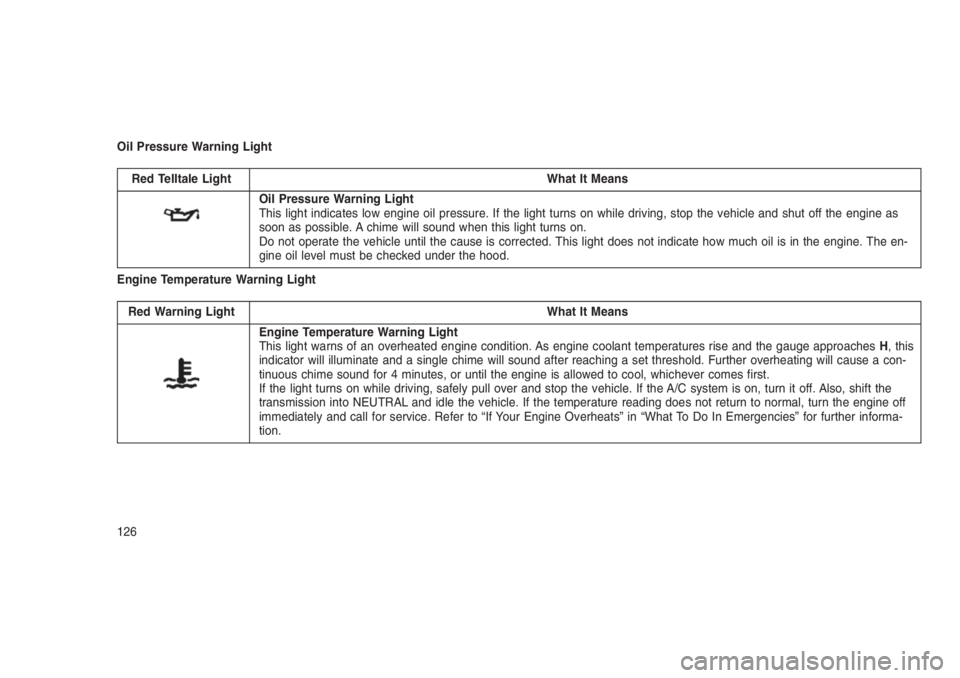
Oil Pressure Warning Light
Red Telltale Light What It Means
Oil Pressure Warning Light
This light indicates low engine oil pressure. If the light turns on while driving, stop the vehicle and shut off the engine as
soon as possible. A chime will sound when this light turns on.
Do not operate the vehicle until the cause is corrected. This light does not indicate how much oil is in the engine. The en-
gine oil level must be checked under the hood.
Engine Temperature Warning Light
Red Warning Light What It Means
Engine Temperature Warning Light
This light warns of an overheated engine condition. As engine coolant temperatures rise and the gauge approachesH, this
indicator will illuminate and a single chime will sound after reaching a set threshold. Further overheating will cause a con-
tinuous chime sound for 4 minutes, or until the engine is allowed to cool, whichever comes first.
If the light turns on while driving, safely pull over and stop the vehicle. If the A/C system is on, turn it off. Also, shift the
transmission into NEUTRAL and idle the vehicle. If the temperature reading does not return to normal, turn the engine off
immediately and call for service. Refer to “If Your Engine Overheats” in “What To Do In Emergencies” for further informa-
tion.
126
Page 139 of 332
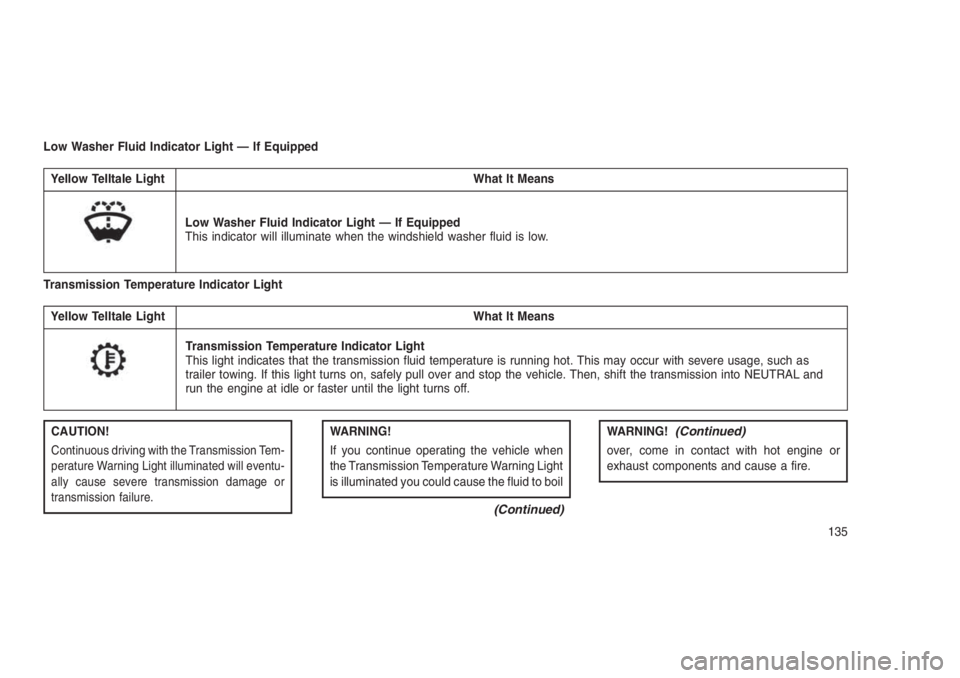
Low Washer Fluid Indicator Light — If Equipped
Yellow Telltale Light What It Means
Low Washer Fluid Indicator Light — If Equipped
This indicator will illuminate when the windshield washer fluid is low.
Transmission Temperature Indicator Light
Yellow Telltale Light What It Means
Transmission Temperature Indicator Light
This light indicates that the transmission fluid temperature is running hot. This may occur with severe usage, such as
trailer towing. If this light turns on, safely pull over and stop the vehicle. Then, shift the transmission into NEUTRAL and
run the engine at idle or faster until the light turns off.
CAUTION!
Continuous driving with the Transmission Tem-
perature Warning Light illuminated will eventu-
ally cause severe transmission damage or
transmission failure.
WARNING!
If you continue operating the vehicle when
the Transmission Temperature Warning Light
is illuminated you could cause the fluid to boil
(Continued)
WARNING!(Continued)
over, come in contact with hot engine or
exhaust components and cause a fire.
135
Page 143 of 332
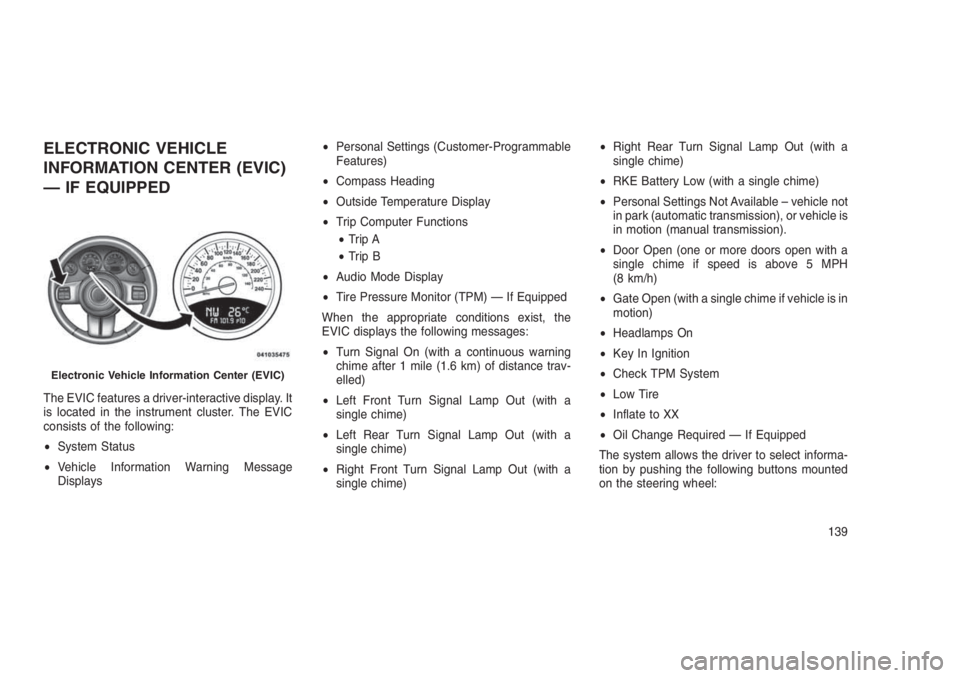
ELECTRONIC VEHICLE
INFORMATION CENTER (EVIC)
— IF EQUIPPED
The EVIC features a driver-interactive display. It
is located in the instrument cluster. The EVIC
consists of the following:
•System Status
•Vehicle Information Warning Message
Displays•Personal Settings (Customer-Programmable
Features)
•Compass Heading
•Outside Temperature Display
•Trip Computer Functions
•Trip A
•Trip B
•Audio Mode Display
•Tire Pressure Monitor (TPM) — If Equipped
When the appropriate conditions exist, the
EVIC displays the following messages:
•Turn Signal On (with a continuous warning
chime after 1 mile (1.6 km) of distance trav-
elled)
•Left Front Turn Signal Lamp Out (with a
single chime)
•Left Rear Turn Signal Lamp Out (with a
single chime)
•Right Front Turn Signal Lamp Out (with a
single chime)•Right Rear Turn Signal Lamp Out (with a
single chime)
•RKE Battery Low (with a single chime)
•Personal Settings Not Available – vehicle not
in park (automatic transmission), or vehicle is
in motion (manual transmission).
•Door Open (one or more doors open with a
single chime if speed is above 5 MPH
(8 km/h)
•Gate Open (with a single chime if vehicle is in
motion)
•Headlamps On
•Key In Ignition
•Check TPM System
•Low Tire
•Inflate to XX
•Oil Change Required — If Equipped
The system allows the driver to select informa-
tion by pushing the following buttons mounted
on the steering wheel:
Electronic Vehicle Information Center (EVIC)
139
Page 180 of 332
CAUTION!(Continued)
NEUTRAL can cause severe transmission
damage. Refer to “Recreational Towing” in
“Starting And Operating” and “Towing A Dis-
abled Vehicle” in “What To Do In Emergen-
cies” for further information.
DRIVE (D)
This range should be used for most city and
highway driving. It provides the best fuel
economy. The DRIVE position provides opti-
mum driving characteristics under all normal
operating conditions.
When frequent transmission shifting occurs
(such as when operating the vehicle under
heavy loading conditions, in hilly terrain, travel-
ing into strong head winds, or while towing
heavy trailers), use the AutoStick shift control (if
equipped, refer to"AutoStick (CVT)"in this
section for further information) to select a lower
gear ratio. Under these conditions, using a
lower gear ratio will improve performance and
extend transmission life by reducing excessive
shifting and heat buildup.During sustained high speed driv-
ing or trailer towing up long grades
on hot days, the automatic trans-
mission oil may become too hot. If
this happens, the transmission
overheat indicator light will come on, and the
vehicle will slow slightly until the transmission
cools down enough to allow a return to the
requested speed. This is done to prevent trans-
mission damage due to overheating. If the high
speed is maintained, the overheating may reoc-
cur, as before, in a cyclic fashion.
LOW (L) — If Equipped
Use this range for engine braking when de-
scending very steep grades. In this range, the
transmission will downshift for maximum engine
braking, and upshifts will occur only to prevent
engine overspeed.
AUTOSTICK
AutoStick (Six-Speed Automatic
Transmission) — If Equipped
AutoStick is a driver-interactive transmission
feature providing manual shift control, givingyou more control of the vehicle. AutoStick al-
lows you to maximize engine braking, eliminate
undesirable upshifts and downshifts, and im-
prove overall vehicle performance. This system
can also provide you with more control during
passing, city driving, cold slippery conditions,
mountain driving, trailer towing, and many other
situations.
Operation
When the gear selector is in the DRIVE position,
the transmission will operate automatically,
shifting between the six available gears. To
engage AutoStick, simply tap the gear selector
to the right or left (+/-) while in the DRIVE
position. Tapping (-) to enter AutoStick mode will
downshift the transmission to the next lower
gear, while using (+) to enter AutoStick mode
will retain the current gear. When AutoStick is
active, the current transmission gear is dis-
played in the instrument cluster.
In AutoStick mode, the transmission will shift up
or down when the driver moves the gear selec-
tor to the right (+) or left (-), unless an engine
lugging or overspeed condition would result. It
176
Page 241 of 332
WARNING!(Continued)
•Keep Tire Service Kit away from open
flames or heat source.
•A loose Tire Service Kit thrown forward in a
collision or hard stop could endanger the
occupants of the vehicle. Always stow the
Tire Service Kit in the place provided.
Failure to follow these warnings can result
in injuries that are serious or fatal to you,
your passengers, and others around you.
•Take care not to allow the contents of Tire
Service Kit to come in contact with hair,
eyes, or clothing. Tire Service Kit sealant is
harmful if inhaled, swallowed, or absorbed
through the skin. It causes skin, eye, and
respiratory irritation. Flush immediately
with plenty of water if there is any contact
with eyes or skin. Change clothing as soon
as possible, if there is any contact with
clothing.
(Continued)
WARNING!(Continued)
•Tire Service Kit Sealant solution contains
latex. In case of an allergic reaction or
rash, consult a physician immediately.
Keep Tire Service Kit out of reach of
children. If swallowed, rinse mouth imme-
diately with plenty of water and drink plenty
of water. Do not induce vomiting! Consult a
physician immediately.
Sealing A Tire With Tire Service Kit
(A) Whenever You Stop To Use Tire Service
Kit:
1. Pull over to a safe location and turn on the
vehicle’s Hazard Warning flashers.
2. Verify that the valve stem (on the wheel with
the deflated tire) is in a position that is near
to the ground. This will allow the Tire Service
Kit Hoses (6) and (7) to reach the valve stem
and keep the Tire Service Kit flat on the
ground. This will provide the best positioning
of the kit when injecting the sealant into thedeflated tire and running the air pump. Move
the vehicle as necessary to place the valve
stem in this position before proceeding.
3. Place the transmission in PARK (auto trans-
mission) or in Gear (manual transmission)
and place the ignition in the OFF position.
4. Set the parking brake.
(B) Setting Up To Use Tire Service Kit:
1. Push in the Mode Select Knob (5) and turn to
the Sealant Mode position.
2. Uncoil the Sealant Hose (6) and then re-
move the cap from the fitting at the end of the
hose.
3. Place the Tire Service Kit flat on the ground
next to the deflated tire.
4. Remove the cap from the valve stem and
then screw the fitting at the end of the
Sealant Hose (6) onto the valve stem.
5. Uncoil the Power Plug (8) and insert the plug
into the vehicle’s 12 Volt power outlet.
237
Page 255 of 332
7
MAINTAINING YOUR VEHICLE
•ENGINE COMPARTMENT — 2.0L . . . . . . . . . . . . .. . . . . .253
•ENGINE COMPARTMENT — 2.4L . . . . . . . . . . . . .. . . . . .254
•ONBOARD DIAGNOSTIC SYSTEM — OBD II . . ..........255
•Onboard Diagnostic System (OBD II) Cybersecurity.......255
•Loose Fuel Filler Cap Message...................256
•REPLACEMENT PARTS . . . . . . . . . . . . . . . . . . . . . . . . .256
•MAINTENANCE PROCEDURES . . . . . . . . . . . . . . ......256
•Engine Oil................................256
•Engine Oil Filter............................258
•Engine Air Cleaner Filter.......................258
•Maintenance-Free Battery.......................258
•Air Conditioner Maintenance.....................259
•Body Lubrication............................261
•Windshield Wiper Blades.......................261
•Adding Washer Fluid.........................261
•Exhaust System............................262
•Cooling System............................263
•Brake System..............................266
•Automatic Transmission (6-Speed) — If Equipped........267
251
Page 260 of 332
Loose Fuel Filler Cap MessageAfter fuel is added, the vehicle diagnostic sys-
tem can determine if the fuel filler cap is possi-
bly loose or improperly installed. A “gASCAP”
message will be displayed in the instrument
cluster. Tighten the gas cap until a “clicking”
sound is heard. This is an indication that the gas
cap is properly tightened. Push the trip odom-
eter RESET button to turn off the message. If
the problem persists, the message will appear
the next time the vehicle is started. This might
indicate a damaged cap. If the problem is
detected twice in a row, the system will turn on
the MIL. Resolving the problem will turn the MIL
light off.
REPLACEMENT PARTS
Use of genuine MOPAR parts for normal/
scheduled maintenance and repairs is highly
recommended to ensure the designed perfor-
mance. Damage or failures caused by the use
of non-MOPAR parts for maintenance and re-
pairs will not be covered by the New Vehicle
Limited Warranty.
MAINTENANCE PROCEDURES
The pages that follow contain therequired
maintenance services determined by the engi-
neers who designed your vehicle.
Besides those maintenance items specified in
the fixed “Maintenance Schedule”, there are
other components which may require servicing
or replacement in the future.
CAUTION!
•Failure to properly maintain your vehicle or
perform repairs and service when neces-
sary could result in more costly repairs,
damage to other components or negatively
impact vehicle performance. Immediately
have potential malfunctions examined by
an authorized dealer or qualified repair
center.
(Continued)
CAUTION!(Continued)
•Your vehicle has been built with improved
fluids that protect the performance and
durability of your vehicle and also allow
extended maintenance intervals. Do not
use chemical flushes in these components
as the chemicals can damage your engine,
transmission, or air conditioning. Such
damage is not covered by the New Vehicle
Limited Warranty. If a flush is needed
because of component malfunction, use
only the specified fluid for the flushing
procedure.
Engine Oil
Checking Oil Level
To assure proper engine lubrication, the engine
oil must be maintained at the correct level.
Check the oil level at regular intervals, such as
every fuel stop.
The best time to check the engine oil level is
about five minutes after a fully warmed engine is
shut off. Do not check oil level before starting
256
Page 271 of 332
WARNING!
•Use only manufacturer’s recommended
brake fluid. Refer to “Fluids, Lubricants,
And Genuine Parts” in “Maintaining Your
Vehicle” for further information. Using the
wrong type of brake fluid can severely
damage your brake system and/or impair
its performance. The proper type of brake
fluid for your vehicle is also identified on
the original factory installed hydraulic mas-
ter cylinder reservoir.
•To avoid contamination from foreign matter
or moisture, use only new brake fluid or
fluid that has been in a tightly closed
container. Keep the master cylinder reser-
voir cap secured at all times. Brake fluid in
a open container absorbs moisture from
the air resulting in a lower boiling point.
This may cause it to boil unexpectedly
during hard or prolonged braking, resulting
in sudden brake failure. This could result in
a collision.
(Continued)
WARNING!(Continued)
•Overfilling the brake fluid reservoir can
result in spilling brake fluid on hot engine
parts, causing the brake fluid to catch fire.
Brake fluid can also damage painted and
vinyl surfaces, care should be taken to
avoid its contact with these surfaces.
•Do not allow petroleum based fluid to
contaminate the brake fluid. Brake seal
components could be damaged, causing
partial or complete brake failure. This
could result in a collision.
CAUTION!
Use of improper brake fluids will affect over-
all clutch system performance. Improper
brake fluids may damage the clutch system
resulting in loss of clutch function and the
ability to shift the transmission.
Automatic Transmission (6-Speed)
— If Equipped
Selection Of Lubricant — 6-Speed
Transmission
It is important to use the proper transmission
fluid to ensure optimum transmission perfor-
mance and life. Use only the manufacturer’s
specified transmission fluid. Refer to “Fluids,
Lubricants, and Genuine Parts” in this section
for fluid specifications. It is important to maintain
the transmission fluid at the correct level using
the recommended fluid.
No chemical flushes should be used in any
transmission; only the approved lubricant
should be used.
CAUTION!
Using a transmission fluid other than the
manufacturer’s recommended fluid may
cause deterioration in transmission shift
quality and/or torque converter shudder. Re-
fer to “Fluids, Lubricants, And Genuine
Parts” in this section for fluid specifications.
267