ABS JEEP RENEGADE 2014 1.G User Guide
[x] Cancel search | Manufacturer: JEEP, Model Year: 2014, Model line: RENEGADE, Model: JEEP RENEGADE 2014 1.GPages: 212, PDF Size: 17.48 MB
Page 117 of 212
WARNING
44)The camera may have limited or absent
operation due to weather conditions such
as: heavy rain, hail, thick fog, heavy snow,
formation of ice layers on the windscreen.
45)Camera operation may also be
compromised by the presence of dust,
condensation, dirt or ice on the
windscreen, by traffic conditions (e.g.
vehicles that are driving not aligned with
yours, vehicle driving in a transverse or
opposite way on the same lane, bend with
a small radius of curvature), by road
surface conditions and by driving
conditions (e.g. off-road driving). Make sure
the windscreen is always clean. Use
specific detergents and clean cloths to
avoid scratching the windscreen. The
camera operation may also be limited or
absent in some driving, traffic and road
surface conditions.
46)Projecting loads on the roof of the
vehicle may interfere with the correct
operation of the camera. Before starting
make sure the load is correctly positioned,
in order not to cover the camera operating
range.
47)If the windscreen must be replaced
due to scratches, chipping or breakage,
contact exclusively a Jeep Dealership. Do
not replace the windscreen on your own,
risk of malfunction! It is advisable to replace
the windscreen if it is damaged in the area
of the camera.48)Do not tamper nor operate on the
camera. Do not close the openings in the
aesthetic cover located under the interior
rear view mirror. In the event of a failure
of the camera, contact a Jeep Dealership.
49)Do not cover the operating range of the
camera with stickers or other objects.
Also pay attention to other objects on the
bonnet (e.g. a layer of snow) and make
sure they do not interfere with the camera.
REAR CAMERA
(PARKVIEW® REAR
BACKUP CAMERA)
DESCRIPTION
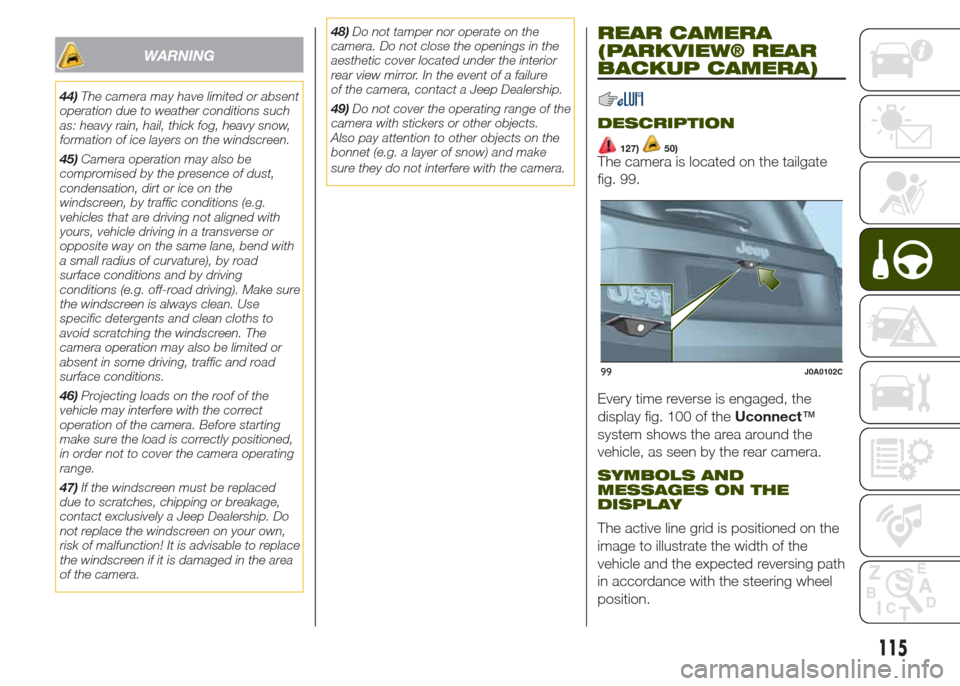
127)50)The camera is located on the tailgate
fig. 99.
Every time reverse is engaged, the
display fig. 100 of theUconnect™
system shows the area around the
vehicle, as seen by the rear camera.
SYMBOLS AND
MESSAGES ON THE
DISPLAY
The active line grid is positioned on the
image to illustrate the width of the
vehicle and the expected reversing path
in accordance with the steering wheel
position.
99J0A0102C
115
Page 121 of 212
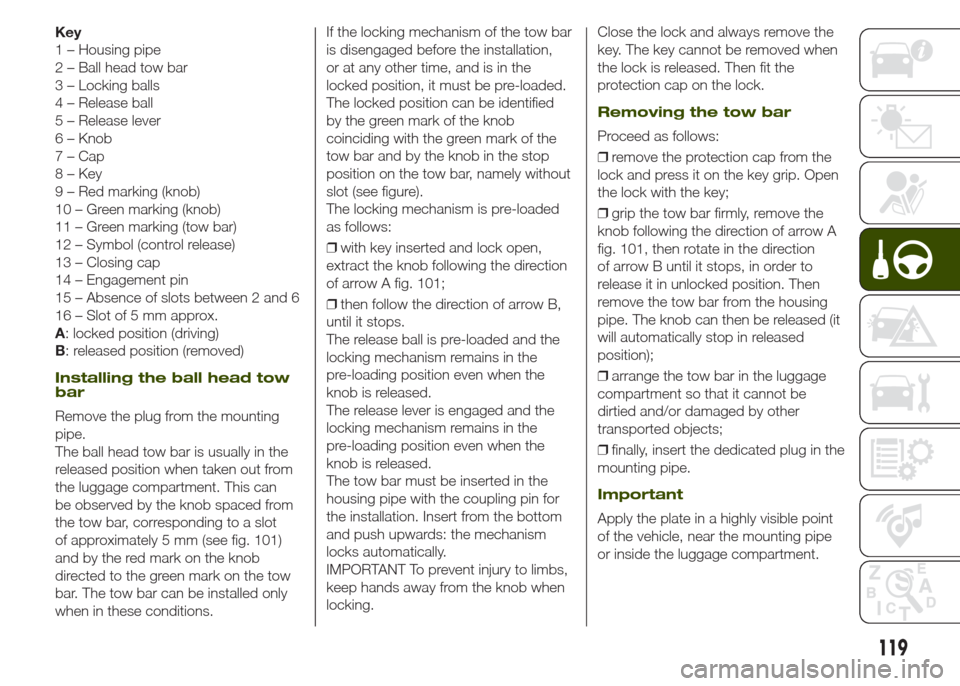
Key
1 – Housing pipe
2 – Ball head tow bar
3 – Locking balls
4 – Release ball
5 – Release lever
6 – Knob
7 – Cap
8 – Key
9 – Red marking (knob)
10 – Green marking (knob)
11 – Green marking (tow bar)
12 – Symbol (control release)
13 – Closing cap
14 – Engagement pin
15 – Absence of slots between 2 and 6
16 – Slot of 5 mm approx.
A: locked position (driving)
B: released position (removed)
Installing the ball head tow
bar
Remove the plug from the mounting
pipe.
The ball head tow bar is usually in the
released position when taken out from
the luggage compartment. This can
be observed by the knob spaced from
the tow bar, corresponding to a slot
of approximately 5 mm (see fig. 101)
and by the red mark on the knob
directed to the green mark on the tow
bar. The tow bar can be installed only
when in these conditions.If the locking mechanism of the tow bar
is disengaged before the installation,
or at any other time, and is in the
locked position, it must be pre-loaded.
The locked position can be identified
by the green mark of the knob
coinciding with the green mark of the
tow bar and by the knob in the stop
position on the tow bar, namely without
slot (see figure).
The locking mechanism is pre-loaded
as follows:
❒with key inserted and lock open,
extract the knob following the direction
of arrow A fig. 101;
❒then follow the direction of arrow B,
until it stops.
The release ball is pre-loaded and the
locking mechanism remains in the
pre-loading position even when the
knob is released.
The release lever is engaged and the
locking mechanism remains in the
pre-loading position even when the
knob is released.
The tow bar must be inserted in the
housing pipe with the coupling pin for
the installation. Insert from the bottom
and push upwards: the mechanism
locks automatically.
IMPORTANT To prevent injury to limbs,
keep hands away from the knob when
locking.Close the lock and always remove the
key. The key cannot be removed when
the lock is released. Then fit the
protection cap on the lock.
Removing the tow bar
Proceed as follows:
❒remove the protection cap from the
lock and press it on the key grip. Open
the lock with the key;
❒grip the tow bar firmly, remove the
knob following the direction of arrow A
fig. 101, then rotate in the direction
of arrow B until it stops, in order to
release it in unlocked position. Then
remove the tow bar from the housing
pipe. The knob can then be released (it
will automatically stop in released
position);
❒arrange the tow bar in the luggage
compartment so that it cannot be
dirtied and/or damaged by other
transported objects;
❒finally, insert the dedicated plug in the
mounting pipe.
Important
Apply the plate in a highly visible point
of the vehicle, near the mounting pipe
or inside the luggage compartment.
119
Page 122 of 212
To ensure correct operation of the
system, periodically remove all deposits
of dirt which may have accumulated
on the ball head bar and from the
mounting pipe. The lock must only be
treated with graphite.
Periodically lubricate the joints, the
sliding surfaces and the balls with
grease without resin or oil. Lubrication
is also a further corrosion protection.
if the vehicle is washed with high-
pressure jets, the ball head bar must be
removed and the dedicated plug fitted.
The ball head bar must never be
treated with high-pressure jets.
Two keys are supplied together with the
removable ball tow bar. Note down
the four-digit key number and keep it in
a safe place. This number is to be
used for ordering any duplicate keys
that may be required.
IMPORTANT To install a tow hook
contact a Jeep Dealership.
WARNING
128)The ABS with which the vehicle is
equipped will not control the braking
system of the trailer. Particular caution is
therefore required on slippery surfaces.
129)Never modify the braking system of
the vehicle to control the trailer brake. The
trailer braking system must be fully
independent of the vehicle’s hydraulic
system.
REFUELLING THE
VEHICLE
Always stop the engine before
refuelling.
130) 131) 132)
PETROL ENGINES
Only use unleaded petrol with a number
of octanes (R.O.N.) not lower than 95
(EN228 specification).
DIESEL ENGINES
51)Only use Diesel for motor vehicles
(EN590 specification).
When using or parking the vehicle for a
long time in the mountains or cold
areas, it is advisable to refuel using
locally available diesel. In this case, it is
also advisable to keep the tank over
50% full.
REFUELLING
PROCEDURE
The fuel flap is unlocked when the
central door locking system is released,
while it is automatically locked when
the central locking system is applied.
Opening the flap
To refuel proceed as follows:
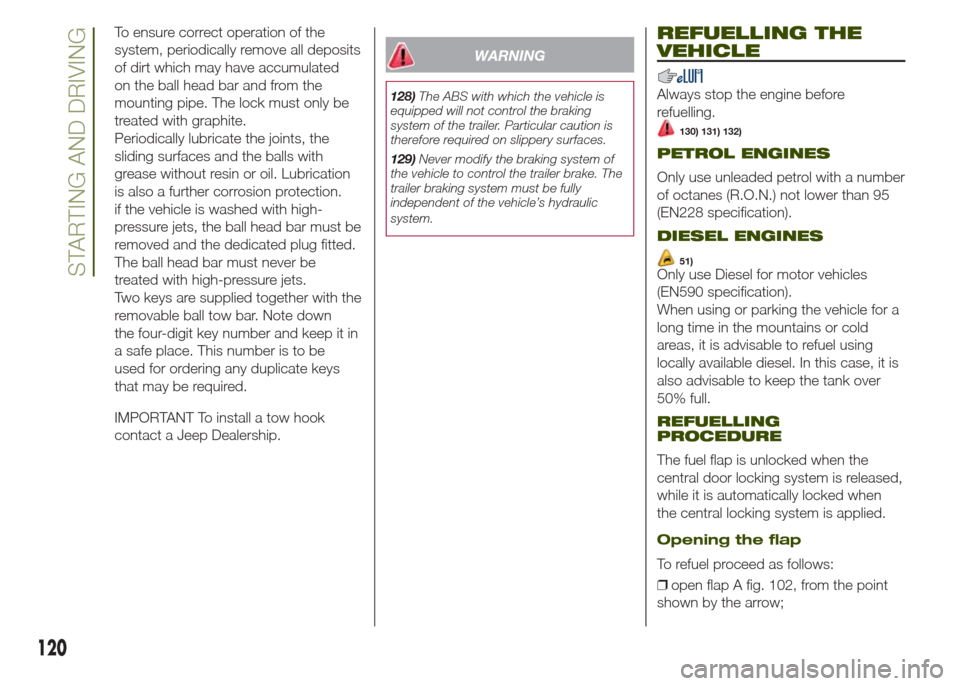
❒open flap A fig. 102, from the point
shown by the arrow;
120
STARTING AND DRIVING
Page 139 of 212
❒before raising the vehicle, loosen –
without removing – the bolts on the
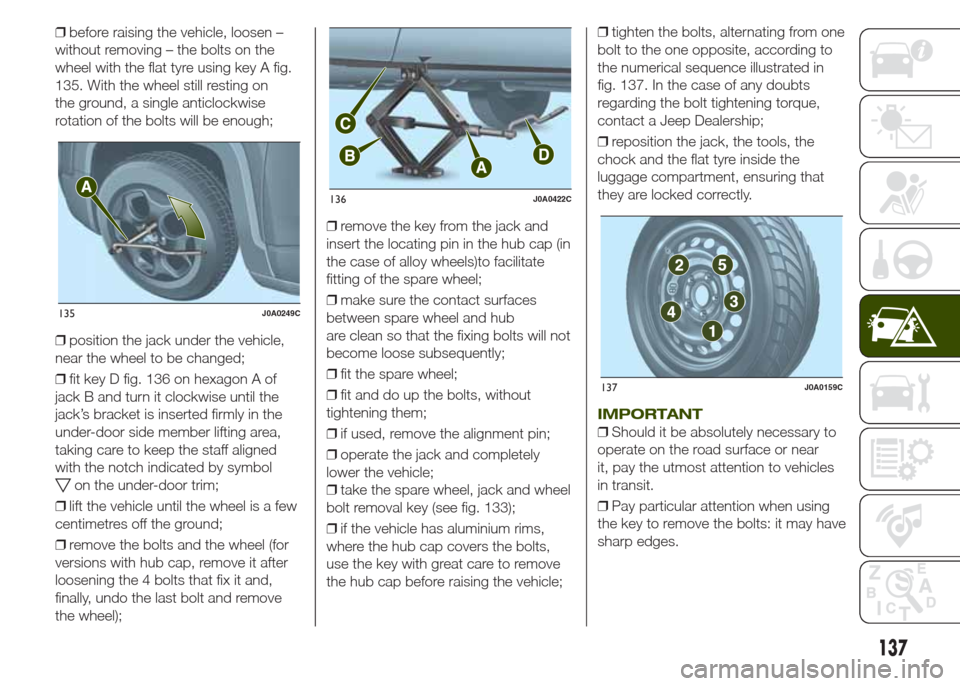
wheel with the flat tyre using key A fig.
135. With the wheel still resting on
the ground, a single anticlockwise
rotation of the bolts will be enough;
❒position the jack under the vehicle,
near the wheel to be changed;
❒fit key D fig. 136 on hexagon A of
jack B and turn it clockwise until the
jack’s bracket is inserted firmly in the
under-door side member lifting area,
taking care to keep the staff aligned
with the notch indicated by symbol
on the under-door trim;
❒lift the vehicle until the wheel is a few
centimetres off the ground;
❒remove the bolts and the wheel (for
versions with hub cap, remove it after
loosening the 4 bolts that fix it and,
finally, undo the last bolt and remove
the wheel);❒remove the key from the jack and
insert the locating pin in the hub cap (in
the case of alloy wheels)to facilitate
fitting of the spare wheel;
❒make sure the contact surfaces
between spare wheel and hub
are clean so that the fixing bolts will not
become loose subsequently;
❒fit the spare wheel;
❒fit and do up the bolts, without
tightening them;
❒if used, remove the alignment pin;
❒operate the jack and completely
lower the vehicle;
❒take the spare wheel, jack and wheel
bolt removal key (see fig. 133);
❒if the vehicle has aluminium rims,
where the hub cap covers the bolts,
use the key with great care to remove
the hub cap before raising the vehicle;❒tighten the bolts, alternating from one
bolt to the one opposite, according to
the numerical sequence illustrated in
fig. 137. In the case of any doubts
regarding the bolt tightening torque,
contact a Jeep Dealership;
❒reposition the jack, the tools, the
chock and the flat tyre inside the
luggage compartment, ensuring that
they are locked correctly.
IMPORTANT
❒Should it be absolutely necessary to
operate on the road surface or near
it, pay the utmost attention to vehicles
in transit.
❒Pay particular attention when using
the key to remove the bolts: it may have
sharp edges.
135J0A0249C
136J0A0422C
137J0A0159C
137
Page 209 of 212
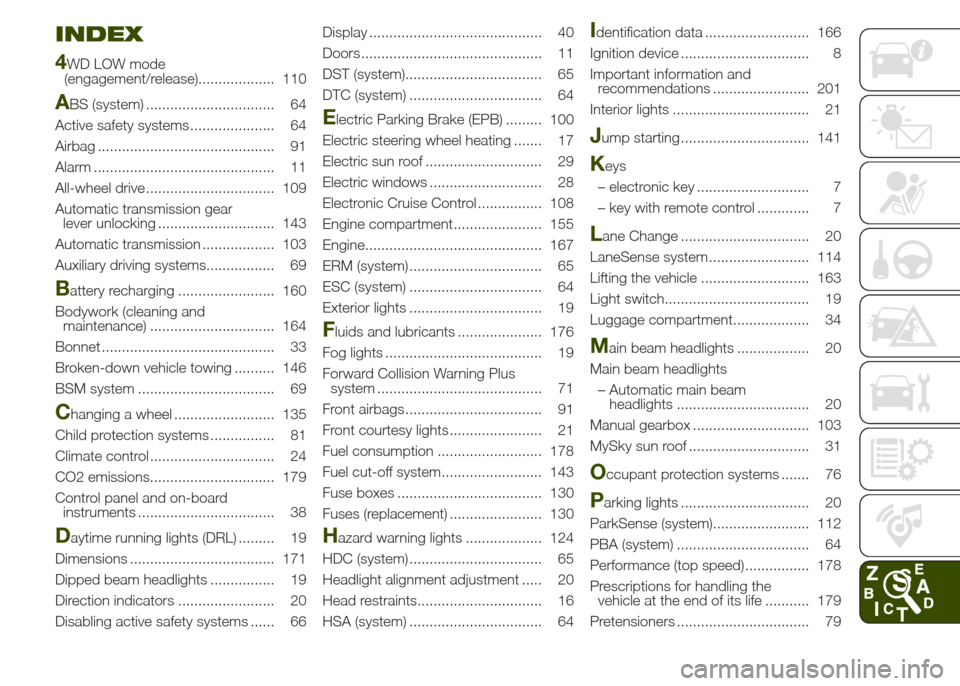
INDEX
4
WD LOW mode
(engagement/release)................... 110
ABS (system) ................................ 64
Active safety systems ..................... 64
Airbag ............................................ 91
Alarm ............................................. 11
All-wheel drive ................................ 109
Automatic transmission gear
lever unlocking ............................. 143
Automatic transmission .................. 103
Auxiliary driving systems................. 69
Battery recharging ........................ 160
Bodywork (cleaning and
maintenance) ............................... 164
Bonnet ........................................... 33
Broken-down vehicle towing .......... 146
BSM system .................................. 69
Changing a wheel ......................... 135
Child protection systems ................ 81
Climate control ............................... 24
CO2 emissions............................... 179
Control panel and on-board
instruments .................................. 38
Daytime running lights (DRL) ......... 19
Dimensions .................................... 171
Dipped beam headlights ................ 19
Direction indicators ........................ 20
Disabling active safety systems ...... 66Display ........................................... 40
Doors ............................................. 11
DST (system).................................. 65
DTC (system) ................................. 64
Electric Parking Brake (EPB) ......... 100
Electric steering wheel heating ....... 17
Electric sun roof ............................. 29
Electric windows ............................ 28
Electronic Cruise Control ................ 108
Engine compartment...................... 155
Engine............................................ 167
ERM (system) ................................. 65
ESC (system) ................................. 64
Exterior lights ................................. 19
Fluids and lubricants ..................... 176
Fog lights ....................................... 19
Forward Collision Warning Plus
system ......................................... 71
Front airbags .................................. 91
Front courtesy lights ....................... 21
Fuel consumption .......................... 178
Fuel cut-off system......................... 143
Fuse boxes .................................... 130
Fuses (replacement) ....................... 130
Hazard warning lights ................... 124
HDC (system) ................................. 65
Headlight alignment adjustment ..... 20
Head restraints............................... 16
HSA (system) ................................. 64
Identification data .......................... 166
Ignition device ................................ 8
Important information and
recommendations ........................ 201
Interior lights .................................. 21
Jump starting ................................ 141
Keys
– electronic key ............................ 7
– key with remote control ............. 7
Lane Change ................................ 20
LaneSense system ......................... 114
Lifting the vehicle ........................... 163
Light switch.................................... 19
Luggage compartment................... 34
Main beam headlights .................. 20
Main beam headlights
– Automatic main beam
headlights ................................. 20
Manual gearbox ............................. 103
MySky sun roof .............................. 31
Occupant protection systems ....... 76
Parking lights ................................ 20
ParkSense (system)........................ 112
PBA (system) ................................. 64
Performance (top speed) ................ 178
Prescriptions for handling the
vehicle at the end of its life ........... 179
Pretensioners ................................. 79