towing JEEP RENEGADE 2014 1.G Owners Manual
[x] Cancel search | Manufacturer: JEEP, Model Year: 2014, Model line: RENEGADE, Model: JEEP RENEGADE 2014 1.GPages: 212, PDF Size: 17.48 MB
Page 70 of 212
42)ESC performance features must not
induce the driver to take unnecessary
or unfounded risks. Your driving style must
always be suited to the road conditions,
visibility and traffic. The driver is, in any
case, responsible for safe driving.
43)For the correct operation of the TC
system, the tyres must of necessity be the
same make and type on all wheels, in
perfect condition and, above all, of the
prescribed type and size.
44)TC performance features must not
induce the driver to take unnecessary or
unfounded risks. Your driving style must
always be suited to the road conditions,
visibility and traffic. The driver is, in any
case, responsible for safe driving.
45)The TC system can’t overrule the
natural laws of physics, and can’t increase
the grip available according to the
condition of the road.
46)The TC system cannot prevent
accidents, including those due to excessive
speed on corners, driving on low-grip
surfaces or aquaplaning.
47)The capability of the TC must never be
tested irresponsibly and dangerously, in
such a way as to compromise personal
safety and the safety of others.
48)The PBA system can’t overrule the
natural laws of physics, and can’t increase
the grip available according to the
condition of the road.
49)The PBA system cannot prevent
accidents, including those due to excessive
speed on corners, driving on low-grip
surfaces or aquaplaning.50)The capability of the PBA system must
never be tested irresponsibly and
dangerously, in such a way as to
compromise the safety of the driver, the
other occupants of the vehicle or any other
road user.
51)The Hill Start Assist system is not a
parking brake; therefore, never leave the
vehicle without having engaged the electric
parking brake, turned the engine off and
engaged first gear, so that it is parked
in safe conditions (for further information
read the "Parking" paragraph in the
"Starting and driving" chapter).
52)There may be situations on small
gradients (less than 8%), with vehicle
laden, in which the Hill Start Assist system
may not activate, causing a slight reversing
motion and increasing the risk of collision
with another vehicle or object. The driver is,
in any case, responsible for safe driving.
53)DST is an aid for driving and does not
relieve the driver of responsibility for driving
the vehicle.
54)The performance of a vehicle with ERM
must never be tested in imprudent or
dangerous ways, with the possibility of
putting the safety of the driver or other
people at risk.
55)When towing trailers, the utmost
caution at the wheel is advised. Never
exceed the maximum permitted loads (see
the description in the "Weights" paragraph
in the "Technical Specifications" chapter).56)The TSC system cannot prevent
swerving for all trailers. If the system
activates during driving, reduce the speed,
stop the vehicle in a safe place and arrange
the load correctly to prevent the trailer
from swerving.
57)Prolonged use of the system may
overheat the braking system. If the brakes
overheat, the HDC system, when active,
will be gradually deactivated after suitably
informing the driver (LED on button off):
it can be reactivated only when the brakes
have cooled sufficiently. The distance
that can be covered depends on the
temperature of the brakes and therefore on
the gradient, load and speed of the
vehicle.
58)The performance of a vehicle with HDC
must never be tested in imprudent or
dangerous ways, with the possibility of
putting the safety of the driver or other
people at risk.
59)When "Systems partially disabled"
mode is selected, the intervention of the
TC function is limited to braking action on
the individual drive wheels and the
warning lights switches on in the
instrument panel. In "systems partially
disabled" mode, the engine torque value
that the ESC system may require will
not be guaranteed and the stability of the
vehicle will therefore be reduced.
60)With "Systems partially disabled" mode
selected, the TSC (Trailer Sway Control)
system is disabled.
61)Your driving style must always be
suited to the road conditions, visibility and
traffic. The driver is, in any case,
responsible for safe driving.
68
SAFETY
Page 77 of 212
70)Should one or more wheels be fitted
without sensors (e.g. if the spare wheel
is fitted), the system will no longer be
available for the replaced wheel and a
warning message will be shown on the
display, until the wheels with sensors are
fitted again.
71)The TPMS cannot indicate sudden tyre
pressure drops (e.g. if a tyre bursts). In
this case, stop the vehicle, braking with
care and avoiding sharp steering actions.
72)Replacing the normal tyres with winter
tyres and vice versa requires an inspection
of the TPMS, which should be carried
out only by a Jeep Dealership.
73)Changes in outside temperature may
cause tyre pressures to vary. The system
may temporarily indicate insufficient
pressure. In this case check the tyre
inflation pressure with the tyres cold and, if
necessary top up the inflation pressure.
74)When a tyre is removed, it is advisable
to replace the rubber gasket for the valve:
go to a Jeep Dealership. The fitting/
removal of the tyres and/or rims require
special care. To avoid damaging or fitting
the sensors incorrectly, tyre and/or rim
fitting/removal operations should only be
carried out by specialised staff. Go to a
Jeep Dealership.
WARNING
23)The system may have limited or absent
operation due to weather conditions such
as: heavy rain, hail, thick fog, heavy snow.
24)The section of the bumper before
the sensor must not be covered with
adhesives, auxiliary headlights or any other
object.
25)System intervention might be
unexpected or delayed when other vehicles
transport loads projecting from the side,
above or from the rear, with respect to the
normal size of the vehicle.
26)Operation can be adversely affected by
any structural change made to the vehicle,
such as a modification to the front
geometry, tyre change, or a heavier load
than the standard load of the vehicle.
27)Incorrect repairs made on the front part
of the vehicle (e.g. bumper, chassis) may
alter the position of the radar sensor,
and adversely affect its operation. Go to a
Jeep Dealership for any operation of this
type.
28)Do not tamper nor carry out any
intervention on the radar sensor or on the
camera on the windscreen. In the event
of a sensor failure, contact a Jeep
Dealership.
29)When towing a trailer (with modules
installed after purchasing the vehicle),
a vehicle or during loading manoeuvres on
a vehicle transporter (or in vehicle for
transport), the system must be deactivated
via theUconnect™system.30)Do not wash with high-pressure jets in
the bumper lower area: in particular do
not operate on the system's electrical
connector.
31)Be careful in the case of repairs and
new paintings in the area around the
sensor (panel covering the sensor on the
left side of the bumper). In the event of
a frontal impact the sensor may
automatically deactivate and display a
warning to indicate that the sensor needs
to be repaired. Even without a malfunction
warning, deactivate the system operation
if you think that the position of the radar
sensor has changed (e.g. due to
low-speed frontal impact as during parking
manoeuvres). In these cases, go to a
Jeep Dealership to have the radar sensor
realigned or replaced.
32)The tyre quick repair kit (TireKit),
provided with the vehicle, is compatible
with the TPMS sensors. Using sealants
different from that in the original kit may
compromise its operation. If sealants not
equivalent with the original one are used, it
is recommended to have the TPMS sensor
operation checked by a qualified repair
centre.
75
Page 100 of 212
STARTING AND DRIVING
Let’s get to the "heart" of the vehicle:
seeing how you can exploit all of its
potential to the full.
We’ll look at how to drive it safely in any
situation, so that it can be a welcome
companion, with our comfort and
our wallets in mind.STARTING THE ENGINE ................. 99
ELECTRIC PARKING BRAKE (EPB).100
MANUAL GEARBOX .......................103
AUTOMATIC TRANSMISSION.........103
STOP/START SYSTEM ...................106
SPEED LIMITER ..............................107
ELECTRONIC CRUISE CONTROL ..108
FOUR WHEEL DRIVE - JEEP
ACTIVE DRIVE (4WD) AND JEEP
ACTIVE DRIVE LOW (4WD LOW) ....109
SELEC-TERRAIN ............................111
PARKSENSE SYSTEM ....................112
LANESENSE SYSTEM (LANE
CROSSING WARNING) ...................114
REAR CAMERA (PARKVIEW®
REAR BACKUP CAMERA) ..............115
TOWING TRAILERS ........................117
REFUELLING THE VEHICLE ...........120
98
STARTING AND DRIVING
Page 102 of 212
111)Do not start the engine by pushing,
towing or driving downhill. These
manoeuvres may damage the catalytic
converter.
WARNING
34)In the first period of use, i.e. in the first
1,600 km (1,000 miles), we recommend
not to demand maximum performance
from the vehicle (for instance excessive
accelerations, extended travel at maximum
speed, sudden braking, etc.).
35)With the engine off, do not leave the
ignition device at MAR to prevent the
battery from draining.
36)A quick burst on the accelerator before
turning off the engine serves absolutely
no practical purpose; it wastes fuel and is
damaging for the engine.
37)Warning light
will flash after
starting or during prolonged cranking to
indicate a fault with the glow plug heating
system. If the engine starts, the vehicle can
be regularly used, but a Jeep Dealership
must be contacted as soon as possible.
ELECTRIC PARKING
BRAKE (EPB)
The electric parking brake (EPB)
guarantees better use and optimal
performance compared to a manually
operated parking brake.
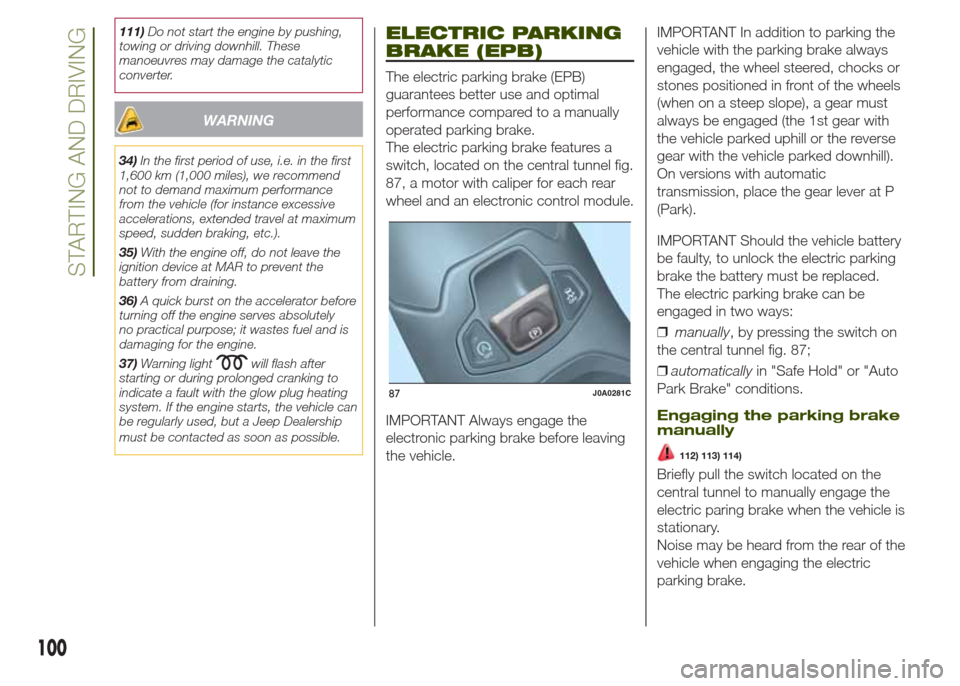
The electric parking brake features a
switch, located on the central tunnel fig.
87, a motor with caliper for each rear
wheel and an electronic control module.
IMPORTANT Always engage the
electronic parking brake before leaving
the vehicle.IMPORTANT In addition to parking the
vehicle with the parking brake always
engaged, the wheel steered, chocks or
stones positioned in front of the wheels
(when on a steep slope), a gear must
always be engaged (the 1st gear with
the vehicle parked uphill or the reverse
gear with the vehicle parked downhill).
On versions with automatic
transmission, place the gear lever at P
(Park).
IMPORTANT Should the vehicle battery
be faulty, to unlock the electric parking
brake the battery must be replaced.
The electric parking brake can be
engaged in two ways:
❒manually, by pressing the switch on
the central tunnel fig. 87;
❒automaticallyin "Safe Hold" or "Auto
Park Brake" conditions.
Engaging the parking brake
manually
112) 113) 114)
Briefly pull the switch located on the
central tunnel to manually engage the
electric paring brake when the vehicle is
stationary.
Noise may be heard from the rear of the
vehicle when engaging the electric
parking brake.
87J0A0281C
100
STARTING AND DRIVING
Page 106 of 212
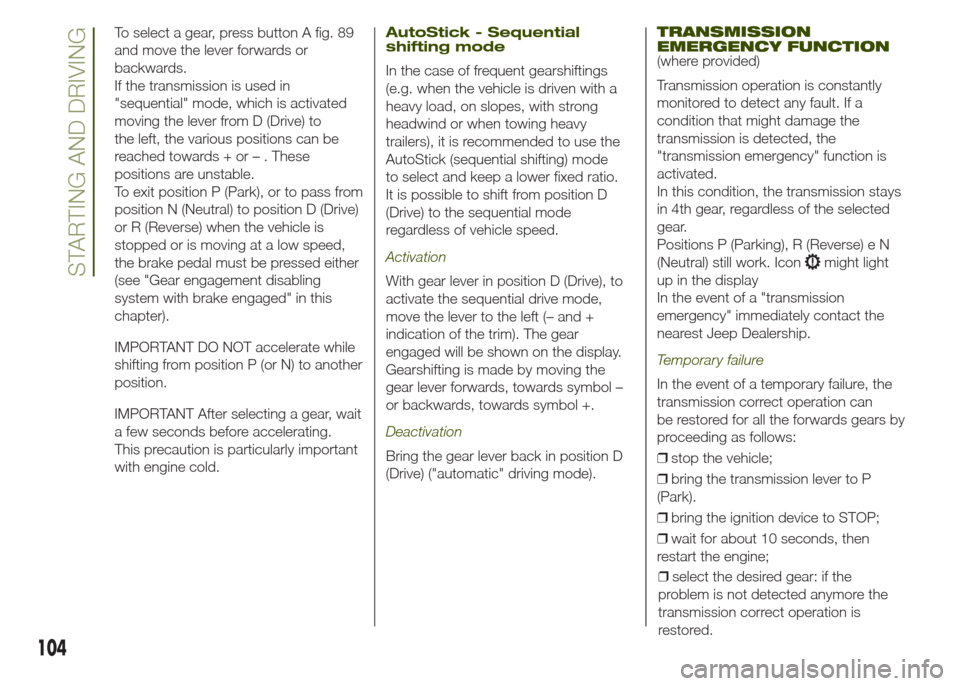
To select a gear, press button A fig. 89
and move the lever forwards or
backwards.
If the transmission is used in
"sequential" mode, which is activated
moving the lever from D (Drive) to
the left, the various positions can be
reached towards + or – . These
positions are unstable.
To exit position P (Park), or to pass from
position N (Neutral) to position D (Drive)
or R (Reverse) when the vehicle is
stopped or is moving at a low speed,
the brake pedal must be pressed either
(see "Gear engagement disabling
system with brake engaged" in this
chapter).
IMPORTANT DO NOT accelerate while
shifting from position P (or N) to another
position.
IMPORTANT After selecting a gear, wait
a few seconds before accelerating.
This precaution is particularly important
with engine cold.AutoStick - Sequential
shifting mode
In the case of frequent gearshiftings
(e.g. when the vehicle is driven with a
heavy load, on slopes, with strong
headwind or when towing heavy
trailers), it is recommended to use the
AutoStick (sequential shifting) mode
to select and keep a lower fixed ratio.
It is possible to shift from position D
(Drive) to the sequential mode
regardless of vehicle speed.
Activation
With gear lever in position D (Drive), to
activate the sequential drive mode,
move the lever to the left (– and +
indication of the trim). The gear
engaged will be shown on the display.
Gearshifting is made by moving the
gear lever forwards, towards symbol –
or backwards, towards symbol +.
Deactivation
Bring the gear lever back in position D
(Drive) ("automatic" driving mode).
TRANSMISSION
EMERGENCY FUNCTION
(where provided)
Transmission operation is constantly
monitored to detect any fault. If a
condition that might damage the
transmission is detected, the
"transmission emergency" function is
activated.
In this condition, the transmission stays
in 4th gear, regardless of the selected
gear.
Positions P (Parking), R (Reverse) e N
(Neutral) still work. Icon
might light
up in the display
In the event of a "transmission
emergency" immediately contact the
nearest Jeep Dealership.
Temporary failure
In the event of a temporary failure, the
transmission correct operation can
be restored for all the forwards gears by
proceeding as follows:
❒stop the vehicle;
❒bring the transmission lever to P
(Park).
❒bring the ignition device to STOP;
❒wait for about 10 seconds, then
restart the engine;
104
STARTING AND DRIVING
❒select the desired gear: if the
problem is not detected anymore the
transmission correct operation is
restored.
Page 119 of 212
TOWING TRAILERS
TOW HOOK SETUP
128) 129)
Instructions for using the
removable ball head tow
bar
IMPORTANT Before setting off,check
the correctlockingof the removable
ball head tow bar, as follows:
❒the green mark of the knob must
coincide with the green mark on the
tow bar;
❒the knob is in the stop position on
the tow bar (without slot);
❒locked lock and key removed. The
knob cannot be removed;
❒ball head bar firmly secured to the
housing pipe. Check by shaking with a
hand.
The fitting procedure must be repeated
if any of the requirements are not met.
If even only one of the requirements
is not met the tow hookmust notbe
used, since there is risk of causing
accidents. Contact a Jeep Dealership.
The ball head tow bar can be
fitted/removed manually, without
requiring specific equipment.
IMPORTANT Never use vehicles or
work tools: the mechanism may be
damaged.IMPORTANT Never unlock in the case
of trailer attached to the vehicle or
with rack fitted.
IMPORTANT When driving without
trailer (or without rack), the ball head
tow bar must be removed and the
closing plug must always be inserted in
the housing pipe. This applies
particularly if, due to the bar, the
visibility of the number plate or of the
lighting system is reduced.
117
Page 125 of 212
IN AN EMERGENCY
A punctured tyre or a burnt-out bulb?
At times, a problem may interfere
with our journey.
The pages on emergencies can help
you to deal with critical situations
independently and with calm.
In an emergency we recommend that
you call the freephone number found in
the Warranty Booklet.
It is also possible to call the national or
international universal freephone
number to search for the nearest
Dealership.HAZARD WARNING LIGHTS...........124
REPLACING A BULB ......................124
REPLACING FUSES........................130
CHANGING A WHEEL ...................135
TIREKIT ...........................................139
JUMP STARTING ............................141
FUEL CUT-OFF SYSTEM ................143
AUTOMATIC TRANSMISSION
GEAR LEVER UNLOCKING.............143
TOWING THE VEHICLE ..................145
BROKEN-DOWN VEHICLE
TOWING .........................................146
123
Page 147 of 212
TOWING THE
VEHICLE
ATTACHING THE TOW
HOOK
161) 162) 163)
The tow hook provided with the vehicle
is located in the tool box inside the
luggage compartment.
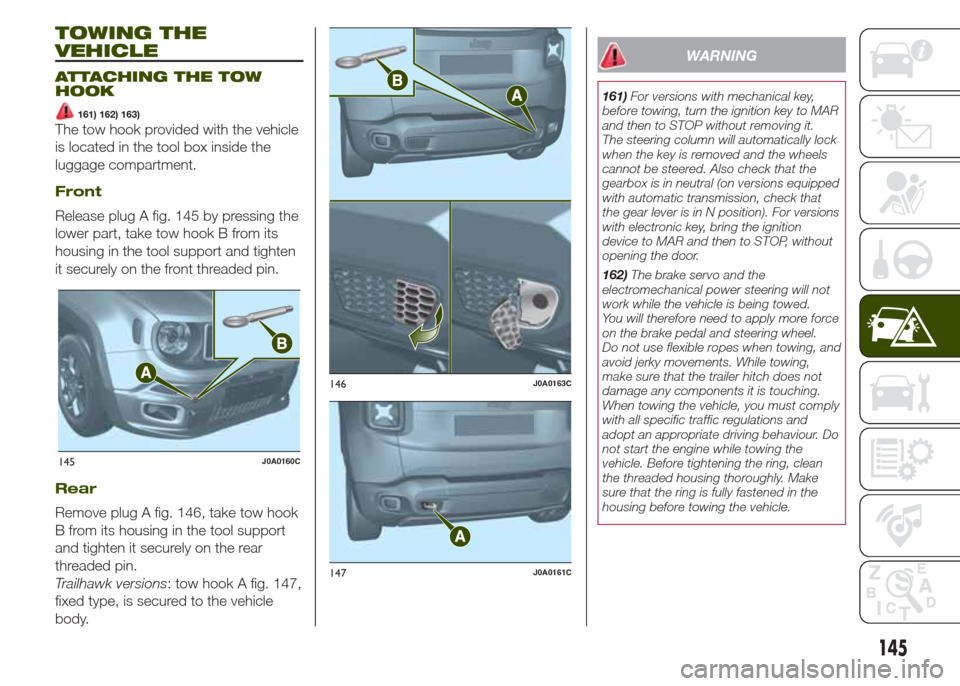
Front
Release plug A fig. 145 by pressing the
lower part, take tow hook B from its
housing in the tool support and tighten
it securely on the front threaded pin.
Rear
Remove plug A fig. 146, take tow hook
B from its housing in the tool support
and tighten it securely on the rear
threaded pin.
Trailhawk versions: tow hook A fig. 147,
fixed type, is secured to the vehicle
body.
WARNING
161)For versions with mechanical key,
before towing, turn the ignition key to MAR
and then to STOP without removing it.
The steering column will automatically lock
when the key is removed and the wheels
cannot be steered. Also check that the
gearbox is in neutral (on versions equipped
with automatic transmission, check that
the gear lever is in N position). For versions
with electronic key, bring the ignition
device to MAR and then to STOP, without
opening the door.
162)The brake servo and the
electromechanical power steering will not
work while the vehicle is being towed.
You will therefore need to apply more force
on the brake pedal and steering wheel.
Do not use flexible ropes when towing, and
avoid jerky movements. While towing,
make sure that the trailer hitch does not
damage any components it is touching.
When towing the vehicle, you must comply
with all specific traffic regulations and
adopt an appropriate driving behaviour. Do
not start the engine while towing the
vehicle. Before tightening the ring, clean
the threaded housing thoroughly. Make
sure that the ring is fully fastened in the
housing before towing the vehicle.
145J0A0160C
146J0A0163C
147J0A0161C
145
Page 148 of 212
163)The front and rear tow hooks should
be used only for emergencies on the road.
You are allowed to tow the vehicle for
short distances using an appropriate
device in accordance with the highway
code (a rigid bar), to move the vehicle on
the road in readiness for towing or
transport via a breakdown vehicle. Tow
hooks MUST NOT be used to tow vehicles
off the road or where there are obstacles
and/or for towing operations using ropes or
other non-rigid devices. Respecting the
above conditions, towing must take place
with two vehicles (one towing, the other
towed) aligned as much as possible along
the same centre line.BROKEN-DOWN
VEHICLE TOWING
It is recommended to tow the vehicle
with all four wheels lifted from the
ground on the platform of a rescue
vehicle.
VERSIONS WITH FOUR-WHEEL
DRIVE (4WD) AND AUTOMATIC
TRANSMISSION
IMPORTANT Avoid lifting the front (or
rear) wheels only. Lifting the front (or
rear) wheels only while towing might
damage the transmission or the transfer
unit.
IMPORTANT If a vehicle is towed
without complying with the above
requirements, the transmission and/or
the transfer unit might be seriously
damaged. Damage due to an incorrect
towing will not be covered by the
warranty.
146
IN AN EMERGENCY
Page 150 of 212
SCHEDULED
SERVICING
Correct servicing is crucial for
guaranteeing a long life for the vehicle
under the best conditions. For this
reason, Jeep has planned a series of
checks and services at fixed distance
intervals and, where provided, at fixed
time intervals, as described in the
Scheduled Servicing Plan.
Before each service, it is always
necessary to carefully follow the
instructions in the Scheduled Servicing
Plan (e.g. periodically check level of
fluids, tyre pressure, etc.).
Scheduled Servicing is offered by all
Jeep Dealerships according to a set
time schedule. If, during each
operation, in addition to the ones
scheduled, the need arises for further
replacements or repairs, these may
be carried out with your explicit
agreement only. If your vehicle is used
frequently for towing, the interval
between one service operation and the
next should be reduced.IMPORTANT Scheduled Servicing
Coupons are required by the
Manufacturer. Failure to have them
carried out may invalidate the warranty.
It is advisable to inform a Jeep
Dealership of any small operating
irregularities without waiting for the next
service.
PERIODIC CHECKS
Every1,000km or before long
journeys, check and if necessary, top
up: engine coolant level; brake fluid
level; screen washer fluid level; tyre
inflation pressure and condition; lighting
system operation (headlights, direction
indicators, hazard warning lights, etc.);
screen washer/wiper system operation
and positioning/wear of windscreen/
rear window wiper blades.
Every3,000km, check and top up if
required: engine oil level.
HEAVY-DUTY USE OF THE
VEHICLE
If the vehicle is used under one of the
following conditions: towing a trailer
or caravan; dusty roads; short (less
than 7-8 km), repeated journeys with
sub-zero outside temperatures; engine
often idling or driving long distances
at low speed or long periods of
inactivity, the following checks must be
carried out more often than indicated
in the Scheduled Servicing Plan:❒check front disc brake pad condition
and wear;
❒check cleanliness of bonnet and
luggage compartment locks,
cleanliness and lubrication of linkage;
❒visually inspect condition of: engine,
gearbox, transmission, pipes and hoses
(exhaust/fuel system/brakes) and
rubber elements (boots/sleeves/
bushes, etc.);
❒check battery charge and battery
fluid level (electrolyte);
❒visually inspect condition of the
accessory drive belts;
❒check and, if necessary, change
engine oil and replace oil filter;
❒check and, if necessary, replace
pollen filter;
❒check and, if necessary, replace air
cleaner.
On versions with automatic
transmission, change transmission oil
and replace oil filter every 60,000 km
(40,000) or every 4 years.
148
SERVICING AND MAINTENANCE