ECU JEEP RENEGADE 2014 1.G User Guide
[x] Cancel search | Manufacturer: JEEP, Model Year: 2014, Model line: RENEGADE, Model: JEEP RENEGADE 2014 1.GPages: 212, PDF Size: 17.48 MB
Page 119 of 212
TOWING TRAILERS
TOW HOOK SETUP
128) 129)
Instructions for using the
removable ball head tow
bar
IMPORTANT Before setting off,check
the correctlockingof the removable
ball head tow bar, as follows:
❒the green mark of the knob must
coincide with the green mark on the
tow bar;
❒the knob is in the stop position on
the tow bar (without slot);
❒locked lock and key removed. The
knob cannot be removed;
❒ball head bar firmly secured to the
housing pipe. Check by shaking with a
hand.
The fitting procedure must be repeated
if any of the requirements are not met.
If even only one of the requirements
is not met the tow hookmust notbe
used, since there is risk of causing
accidents. Contact a Jeep Dealership.
The ball head tow bar can be
fitted/removed manually, without
requiring specific equipment.
IMPORTANT Never use vehicles or
work tools: the mechanism may be
damaged.IMPORTANT Never unlock in the case
of trailer attached to the vehicle or
with rack fitted.
IMPORTANT When driving without
trailer (or without rack), the ball head
tow bar must be removed and the
closing plug must always be inserted in
the housing pipe. This applies
particularly if, due to the bar, the
visibility of the number plate or of the
lighting system is reduced.
117
Page 133 of 212
❒slowly rotate the screw anticlockwise,
until resistance is encountered (do not
overtighten);
❒slowly release the screw;
❒opening is indicated by the entire
screw head coming out of its housing;
❒remove cover B fig. 126, sliding it
completely upwards, as indicated in the
figure.
The number identifying the electrical
component corresponding to each fuse
is shown on the cover. After replacing
a fuse, make sure that you have closed
cover B correctly.
Fitting fuse box cover and
locking screw
Proceed as follows:
❒fix cover B fig. 126 to the box
correctly, sliding it down completely
from the top;❒fully tighten screw A fig. 126, using
the dedicated screwdriver provided;
❒slowly rotate the screw clockwise,
until resistance is encountered (do not
overtighten);
❒slowly release the screw;
❒closure is indicated by the securing
of the entire screw head in its housing.
DASHBOARD FUSE BOX
The fuse box fig. 127 is located near
the left side of the steering column and
the fuses can be accessed easily from
the lower part of the dashboard.
For fuse replacement, contact a Jeep
Dealership.
LUGGAGE
COMPARTMENT FUSE
BOXES
To access the fuses operate in the point
shown by the arrow and remove flap A
fig. 128.126J0A0116C
128J0A0113C
127J0A0114C
131
Page 138 of 212
❒remove the fixing device for the jack
and the spare wheel;
❒remove the wheel chock;
❒remove the jack unit and the key for
removing the bolts from the spare
wheel. Turn the screw of the jack to
loosen the key and separate it from the
jack assembly;
❒take the spare wheel out of the
luggage compartment.
Tool box (where provided)
On versions with spare wheel there
is also, inside the luggage compartment
(right side), a tool box secured to the
luggage compartment carpet with
dedicated fastenings.
Inside the tool box are fig. 133:
❒A: the jack;
❒B: the screwdriver;
❒C: the emergency refuelling adaptor;
❒D: the wheel locating pin (where
provided, to use during the spare wheel
fitting operation);
❒E: special anti-theft nut (where
provided, to use during the wheel bolt
fitting/removal operation);
❒F: a chock for locking the wheels;
❒G: the tow hook;
❒H: the key for removing/tightening the
wheel bolts and operating the jack;❒I: the Allen key for emergency sun
roof operation (where provided).
Important information about
the jack
Please note that:
❒the weight of the jack is 2.8 kg;
❒the jack requires no adjustment;
❒the jack cannot be repaired: in the
event of a fault it must be replaced by
another original one;❒no tool other than its cranking device
may be fitted on the jack.
Then proceed as follows:
❒should it be necessary to stop the
vehicle on a road with a gradient,
especially a very high one, or on an
unstable surface, take chock A and fold
it out, as shown in the diagram in fig.
134;
❒alert any bystander that the vehicle is
about to be raised: all persons should
be kept away from the vehicle and
nobody must touch it until it has been
lowered. Nor should any occupant
remain in the vehicle;
❒if the vehicle has alloy wheels, where
the hub cap covers the bolts, use the
key with great care to remove the
hub cap before raising the vehicle;
A
C
B
D
E
I
F
G
H
133J0A0226C
134J0A0157C
136
IN AN EMERGENCY
Page 142 of 212
❒make sure that the switch for the
compressor is in position0(off), start
the engine, insert the plug into the
luggage compartment power socket or
on central tunnel and switch on the
compressor by bringing the switch to
positionI(on);
❒inflate the tyre to the pressure
indicated in the “Wheels” paragraph
(see “Technical data” chapter). In order
to obtain a more precise reading, check
the pressure value on pressure gauge
B with the compressor off;
❒if after five minutes it is still impossible
to reach at least 1.8 bar, disengage
the compressor from the valve and
power socket, then move the vehicle
forwards by approx. ten metres in order
to distribute the sealing fluid inside the
tyre evenly, then repeat the inflation
operation;
❒if after this operation you still cannot
reach at least 1.8 bar after 5 minutes
from switching on the compressor,
do not resume driving but contact a
Jeep Dealership;
❒after having driven for about 10
minutes, stop and re-check the tyre
pressure; remember to engage the
electric parking brake;❒if a pressure value of at least 1.8 bar
is detected, restore the correct
pressure (with engine running and
electric parking brake), resume driving
immediately and drive with great care to
a Jeep Dealership.
WARNING
149)Punctures on the sides of the tyre
may not be repaired. Do not use the TireKit
if the tyre is damaged due to travelling
when flat.
150)Wear the protective gloves provided
with the TireKit.
151)Apply the adhesive label where it can
be easily seen by the driver as a reminder
that the tyre has been treated with the
TireKit. Drive carefully, particularly on
bends. Do not exceed 80 km/h. Do not
accelerate or brake suddenly.
152)If the pressure has fallen below 1.8
bar, do not drive any further: the TireKit
cannot guarantee proper hold because the
tyre is too damaged. Contact a Jeep
Dealership.
153)You must always indicate that the tyre
was repaired using the TireKit. Give the
leaflet to the technicians who will be
handling the tyre that was treated using the
TireKit.
154)Repair is not possible if the wheel rim
is damaged (groove is deformed, causing
air to escape). Do not remove foreign
bodies (screws or nails) from the tyre.155)Do not operate the compressor for
longer than 20 minutes consecutively. Risk
of overheating. The TireKit is not suitable
for definitive repairs, so the repaired tyres
may only be used temporarily.
156)The bottle contains ethylene glycol
and latex: it may cause an allergic reaction.
It is harmful if swallowed. It is irritant for
the eyes. It may cause sensitisation if
inhaled or on contact. Avoid contact with
eyes, skin and clothes. In the case of
contact, wash immediately with plenty of
water. In the event that it is swallowed, do
not induce vomiting. Rinse out your mouth,
drink large quantities of water and seek
immediate medical attention. Keep out of
the reach of children. The product must
not be used by asthmatics. Do not inhale
the vapours during insertion and suction.
Call a doctor immediately if allergic
reactions are noted. Store the bottle in its
proper compartment, away from sources
of heat. The sealant fluid has an expiry
date. Replace the bottle containing
out-of-date sealant fluid.
WARNING
55)In the event of a puncture caused by
foreign bodies, the kit may be used to
repair tyres showing damages on the tread
or shoulder up to max. 4 mm diameter.
140
IN AN EMERGENCY
Page 147 of 212
TOWING THE
VEHICLE
ATTACHING THE TOW
HOOK
161) 162) 163)
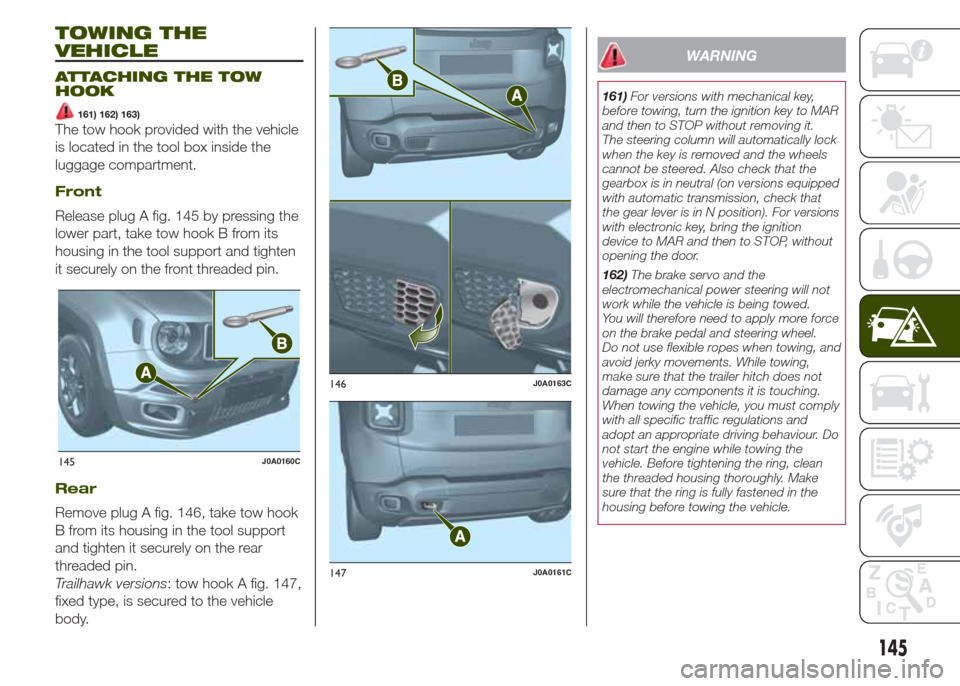
The tow hook provided with the vehicle
is located in the tool box inside the
luggage compartment.
Front
Release plug A fig. 145 by pressing the
lower part, take tow hook B from its
housing in the tool support and tighten
it securely on the front threaded pin.
Rear
Remove plug A fig. 146, take tow hook
B from its housing in the tool support
and tighten it securely on the rear
threaded pin.
Trailhawk versions: tow hook A fig. 147,
fixed type, is secured to the vehicle
body.
WARNING
161)For versions with mechanical key,
before towing, turn the ignition key to MAR
and then to STOP without removing it.
The steering column will automatically lock
when the key is removed and the wheels
cannot be steered. Also check that the
gearbox is in neutral (on versions equipped
with automatic transmission, check that
the gear lever is in N position). For versions
with electronic key, bring the ignition
device to MAR and then to STOP, without
opening the door.
162)The brake servo and the
electromechanical power steering will not
work while the vehicle is being towed.
You will therefore need to apply more force
on the brake pedal and steering wheel.
Do not use flexible ropes when towing, and
avoid jerky movements. While towing,
make sure that the trailer hitch does not
damage any components it is touching.
When towing the vehicle, you must comply
with all specific traffic regulations and
adopt an appropriate driving behaviour. Do
not start the engine while towing the
vehicle. Before tightening the ring, clean
the threaded housing thoroughly. Make
sure that the ring is fully fastened in the
housing before towing the vehicle.
145J0A0160C
146J0A0163C
147J0A0161C
145
Page 162 of 212
BATTERY
RECHARGING
IMPORTANT
IMPORTANT After placing the ignition
device to STOP and having closed
the driver side door, wait at least one
minute before disconnecting the
electrical supply from the battery. When
reconnecting the electrical supply to
the battery, make sure that the ignition
device is in the STOP position and
the driver side door is closed.
IMPORTANT Charging should be slow
at a low ampere rating for
approximately 24 hours. Charging for a
longer time may damage the battery.IMPORTANT The cables of the
electrical system must be correctly
reconnected to the battery, i.e. the
positive cable (+) to the positive
terminal and the negative cable (–) to
the negative terminal. The battery
terminals are marked with the positive
(+) and negative (–) symbols, and are
shown on the battery cover. The battery
terminals must also be corrosion-free
and firmly secured to the terminals. If a
"quick-type" battery charger is used
with the battery fitted on the vehicle,
before connecting it disconnect both
cables of the battery itself. Do not use a
"quick-type" battery charger to provide
the starting voltage.
VERSIONS WITHOUT
STOP/START SYSTEM
To recharge, proceed as follows:
❒disconnect the terminal from the
negative battery pole;
❒connect the charger cables to the
battery terminals, observing the polarity;
❒turn on the charger;
❒when it is recharged, turn the charger
off before disconnecting it from the
battery;
❒reconnect the negative battery
terminal.
VERSIONS WITH
STOP/START SYSTEM
To recharge, proceed as follows:
❒disconnect the connector A fig. 151
(pressing the button B) from the sensor
C monitoring the battery conditions,
on the negative pole (–) D of the
battery;
❒connect the positive cable (+) of the
battery charger to the positive battery
terminal E and the negative cable (–) to
sensor terminal D as shown;
❒turn on the battery charger. At the
end of the charging process, switch the
battery charger off;
❒after having disconnected the
charger, reconnect connector A to the
sensor C as in fig. 151.
160
SERVICING AND MAINTENANCE