phone JEEP RENEGADE 2014 1.G Owners Manual
[x] Cancel search | Manufacturer: JEEP, Model Year: 2014, Model line: RENEGADE, Model: JEEP RENEGADE 2014 1.GPages: 212, PDF Size: 17.48 MB
Page 16 of 212
WARNING
8)NEVER leave children unattended inside
the vehicle, let alone leave the vehicle
with the doors unlocked in a place that
children can access easily. Children may
seriously, or even fatally, injure themselves.
Also ensure that children do not
inadvertently operate the electric parking
brake, the brake pedal or the automatic
transmission lever.
9)Always use this device when carrying
children. After engaging the device on both
rear doors, check for proper engagement
by trying to open a rear door with the
internal handle.
10)Once the Dead Lock device has been
actuated, doors cannot be opened from
inside; for this reason, make sure there are
no persons left inside the vehicle.
WARNING
2)Make sure to take the key with you once
a door or the tailgate is locked, to prevent
locking the same key inside the vehicle.
Once it has been left inside, the key can be
collected only using the second key
supplied with the vehicle.3)The operation of the recognition system
depends on various factors, such as, for
example, any electromagnetic wave
interference from external sources (e.g.
mobile phones), the charge of the battery
in the electronic key and the presence
of metal objects near the key or the vehicle.
In these cases it is still possible to unlock
the doors by using the metal insert in
the electronic key (see description on the
following pages).
SEATS
FRONT SEATS WITH
MANUAL ADJUSTMENT
11)4)
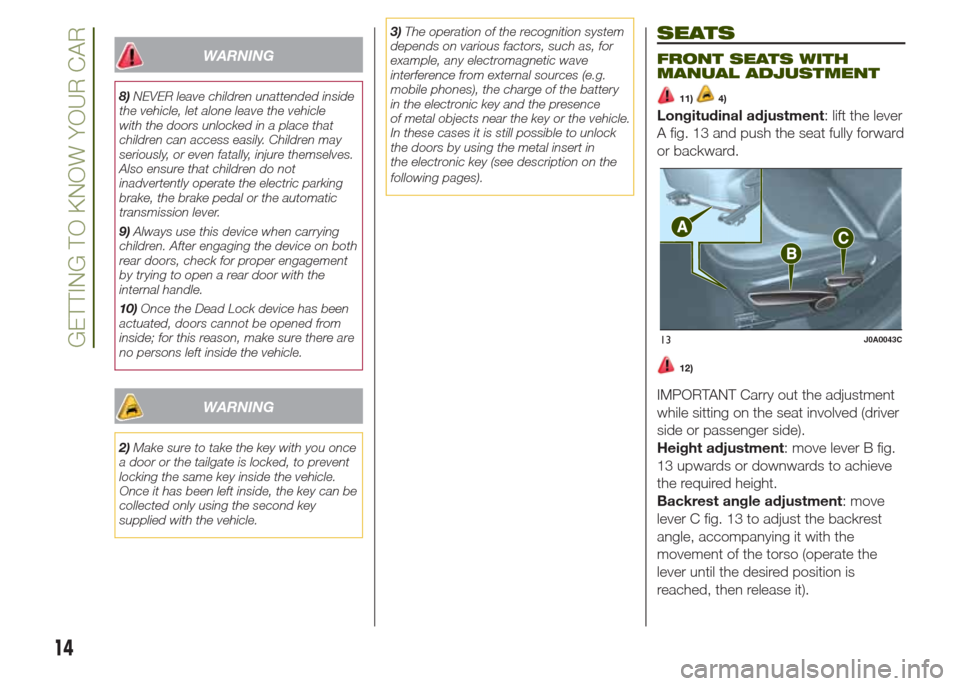
Longitudinal adjustment: lift the lever
A fig. 13 and push the seat fully forward
or backward.
12)
IMPORTANT Carry out the adjustment
while sitting on the seat involved (driver
side or passenger side).
Height adjustment: move lever B fig.
13 upwards or downwards to achieve
the required height.
Backrest angle adjustment: move
lever C fig. 13 to adjust the backrest
angle, accompanying it with the
movement of the torso (operate the
lever until the desired position is
reached, then release it).
13J0A0043C
14
GETTING TO KNOW YOUR CAR
Page 43 of 212
CONTROL BUTTONS
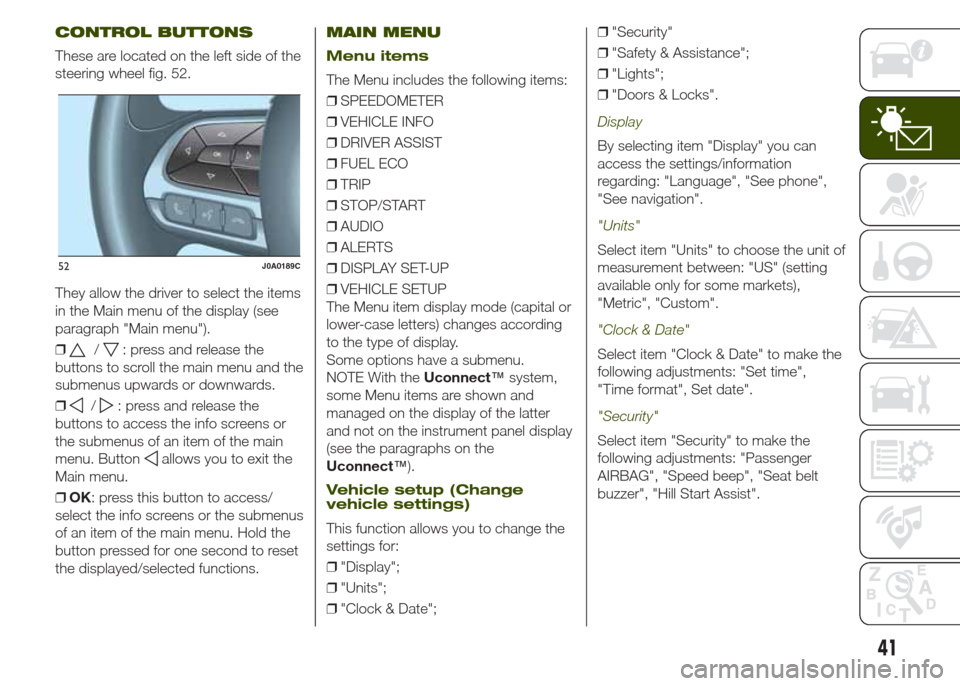
These are located on the left side of the
steering wheel fig. 52.
They allow the driver to select the items
in the Main menu of the display (see
paragraph "Main menu").
❒
/: press and release the
buttons to scroll the main menu and the
submenus upwards or downwards.
❒
/: press and release the
buttons to access the info screens or
the submenus of an item of the main
menu. Button
allows you to exit the
Main menu.
❒OK: press this button to access/
select the info screens or the submenus
of an item of the main menu. Hold the
button pressed for one second to reset
the displayed/selected functions.
MAIN MENU
Menu items
The Menu includes the following items:
❒SPEEDOMETER
❒VEHICLE INFO
❒DRIVER ASSIST
❒FUEL ECO
❒TRIP
❒STOP/START
❒AUDIO
❒ALERTS
❒DISPLAY SET-UP
❒VEHICLE SETUP
The Menu item display mode (capital or
lower-case letters) changes according
to the type of display.
Some options have a submenu.
NOTE With theUconnect™system,
some Menu items are shown and
managed on the display of the latter
and not on the instrument panel display
(see the paragraphs on the
Uconnect™).
Vehicle setup (Change
vehicle settings)
This function allows you to change the
settings for:
❒"Display";
❒"Units";
❒"Clock & Date";❒"Security"
❒"Safety & Assistance";
❒"Lights";
❒"Doors & Locks".
Display
By selecting item "Display" you can
access the settings/information
regarding: "Language", "See phone",
"See navigation".
"Units"
Select item "Units" to choose the unit of
measurement between: "US" (setting
available only for some markets),
"Metric", "Custom".
"Clock & Date"
Select item "Clock & Date" to make the
following adjustments: "Set time",
"Time format", Set date".
"Security"
Select item "Security" to make the
following adjustments: "Passenger
AIRBAG", "Speed beep", "Seat belt
buzzer", "Hill Start Assist".
52J0A0189C
41
Page 44 of 212
The "Passenger AIRBAG" function is
used to activate/deactivate the front
passenger side airbag.Passenger's
protection active: the LED
ON
comes on constantly on the dashboard
located in the instrument panel.
Passenger's protection not active:
the LED
OFFon the dashboard
comes on constantly in the control
panel.
"Safety & Assistance"
For possible adjustments see
paragraphUconnect™in chapter
"Multimedia".
"Lights"
Select item "Lights" to make the
following adjustments: "Ambient
lighting", "Follow me", "Headlights while
opening", "Headlight sensor", "High
Beams Auto Dim", "Daytime Lights",
"Cornering lights".
"Doors & Locks"
Select item "Doors & Locks" to make
the following adjustments: "Autoclose",
"Auto unlock on exit", "Flash Lights
w/Lock", "Horn with Lock", "Horn
w/Remote Start", "Remote Unlock"
(versions without Passive Entry), "Door
Unlock" (versions with Passive Entry),
"Passive Entry".
Versions with
reconfigurable multifunction
display
On versions equipped with
reconfigurable multifunction display only
the following items are available:
"Display" (only items "See phone" and
"See navigation" can be selected),
"Security" and "Safety & Assistance"
(only item "Buzzer volume" can be
selected). All other items will be shown
and managed on theUconnect™
system display.
TRIP COMPUTER
The “Trip computer” is used to display
information on vehicle operation when
the ignition device is at MAR.
This function is characterised by two
separate memories, called "Trip A" and
"Trip B", where the vehicle's "complete
missions" (journeys) are recorded in a
reciprocally independent manner.
“Trip A”allows the following values to
be displayed: "Distance travelled A",
"Average consumption A", "Journey
time (driving time) A".
“Trip B”allows the following values to
be displayed: "Distance travelled B",
"Average consumption B", "Journey
time (driving time) B". The “Trip B”
function may be excluded.
Both memories can be reset: (reset -
start of a new journey).
To reset the values of "Trip A" and "Trip
B" press and hold theOKbutton on
the steering wheel controls.
NOTE “Range” and “Instantaneous fuel
consumption" parameters cannot be
reset.
42
KNOWING THE INSTRUMENT PANEL
Page 98 of 212
WARNING
94)Do not apply stickers or other objects
on the steering wheel, on the dashboard in
the passenger side airbag area, on side
upholstery on the roof or on the seats.
Never put objects (e.g. mobile phones) on
the passenger's side dashboard since
they could interfere with correct inflation of
the airbag and also cause serious injury
to the passengers.
95)Always drive keeping your hands on
the steering wheel rim so that the airbag
can inflate freely if necessary. Do not drive
with your body bent forward. Keep your
back straight against the backrest.
96)When an active passenger airbag is
fitted, DO NOT install rearward facing child
restraint systems on the front passenger
seat. Deployment of the airbag in an
accident could cause fatal injuries to the
child regardless of the severity of the
impact. Therefore, always deactivate the
passenger side airbag when a rearward
facing child restraint system is installed on
the front passenger seat. The front
passenger seat must also be positioned
back as far as possible in order to prevent
the child restraint system from coming
into contact with the dashboard.
Immediately reactivate the passenger
airbag as soon as the child restraint system
has been removed.
97)Do not hook rigid objects to the coat
hooks and to the support handles.100)If the
warning light does not
switch on when the ignition device is
moved to MAR or if it stays on when
driving, there might be a fault in the
restraint systems; in this case, the airbags
or pretensioners may not deploy in the
event of an accident or, in a lower number
of cases, they could deploy erroneously.
Before proceeding, contact a Jeep
Dealership immediately to have the system
checked.
101)On some versions, if the
OFFLED
(located on the dashboard panel) is faulty,
warning light
lights up in the instrument
panel.
102)If a side bag is present, do not cover
the front seat backrests with extra covers.
103)Do not travel carrying objects in
your lap, in front of your chest or between
your lips (pipe, pencils, etc.). They could
cause severe injury if the airbag is
deployed.
104)If the has been subject to theft,
attempted theft, vandalism, or flooding,
have the airbag system inspected at a
Jeep Dealership.105)If the ignition device is at MAR, even if
the engine is switched off, airbags may
be deployed when the vehicle is stationary
and hit by another vehicle. Therefore,
even if the vehicle is stationary, when an
active front passenger airbag is fitted, DO
NOT install rearward facing child restraint
systems on the front passenger seat.
Deployment of the airbag following an
impact could cause fatal injuries to the
child. Therefore, always deactivate the
passenger side airbag when a rearward
facing child restraint system is installed on
the front passenger seat. The front
passenger seat must also be positioned
back as far as possible in order to prevent
the child restraint system from coming
into contact with the dashboard.
Immediately reactivate the passenger
airbag as soon as the child restraint system
has been removed. Finally, remember that
if the ignition device is at STOP, no safety
device (airbags or pretensioners) will
activate following an impact; therefore if
these devices do not activate this cannot
be considered as signal of the system
malfunction.
106)If the airbag failure warning light is
faulty this will be signalled by an airbag
failure icon lighting up in the instrument
panel display with a dedicated message.
The pyrotechnic charges are not disabled.
Before proceeding, contact a Jeep
Dealership immediately to have the system
checked.
107)The front airbag deployment threshold
is higher than that of the pretensioners.
When the impact is between the two
deployment thresholds, it is normal that
pretensioners only are engaged.
96
SAFETY
98)Do not rest your head, arms or elbows
on the door, windows or the area in which
the window bag is located to avoid
possible injury during inflation.
99)
elbows out of the windowNever lean head, arms and
Page 123 of 212
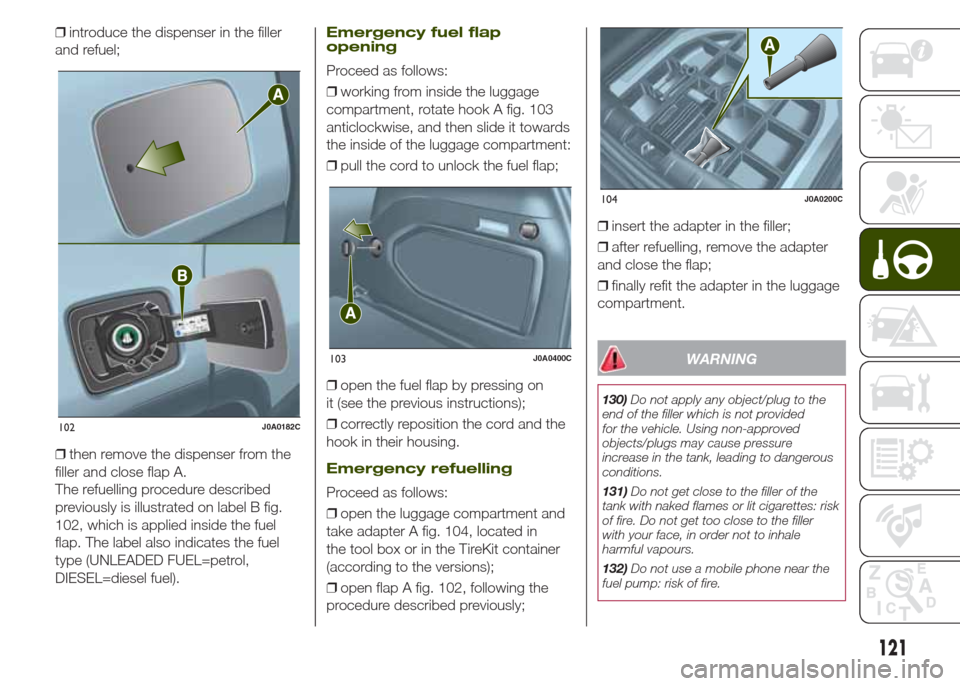
❒introduce the dispenser in the filler
and refuel;
❒then remove the dispenser from the
filler and close flap A.
The refuelling procedure described
previously is illustrated on label B fig.
102, which is applied inside the fuel
flap. The label also indicates the fuel
type (UNLEADED FUEL=petrol,
DIESEL=diesel fuel).Emergency fuel flap
opening
Proceed as follows:
❒working from inside the luggage
compartment, rotate hook A fig. 103
anticlockwise, and then slide it towards
the inside of the luggage compartment:
❒pull the cord to unlock the fuel flap;
❒open the fuel flap by pressing on
it (see the previous instructions);
❒correctly reposition the cord and the
hook in their housing.
Emergency refuelling
Proceed as follows:
❒open the luggage compartment and
take adapter A fig. 104, located in
the tool box or in the TireKit container
(according to the versions);
❒open flap A fig. 102, following the
procedure described previously;❒insert the adapter in the filler;
❒after refuelling, remove the adapter
and close the flap;
❒finally refit the adapter in the luggage
compartment.
WARNING
130)Do not apply any object/plug to the
end of the filler which is not provided
for the vehicle. Using non-approved
objects/plugs may cause pressure
increase in the tank, leading to dangerous
conditions.
131)Do not get close to the filler of the
tank with naked flames or lit cigarettes: risk
of fire. Do not get too close to the filler
with your face, in order not to inhale
harmful vapours.
132)Do not use a mobile phone near the
fuel pump: risk of fire.
102J0A0182C
103J0A0400C
104J0A0200C
121
Page 125 of 212
IN AN EMERGENCY
A punctured tyre or a burnt-out bulb?
At times, a problem may interfere
with our journey.
The pages on emergencies can help
you to deal with critical situations
independently and with calm.
In an emergency we recommend that
you call the freephone number found in
the Warranty Booklet.
It is also possible to call the national or
international universal freephone
number to search for the nearest
Dealership.HAZARD WARNING LIGHTS...........124
REPLACING A BULB ......................124
REPLACING FUSES........................130
CHANGING A WHEEL ...................135
TIREKIT ...........................................139
JUMP STARTING ............................141
FUEL CUT-OFF SYSTEM ................143
AUTOMATIC TRANSMISSION
GEAR LEVER UNLOCKING.............143
TOWING THE VEHICLE ..................145
BROKEN-DOWN VEHICLE
TOWING .........................................146
123
Page 144 of 212
❒connect the other end of the cable
used for positive (+) to the positive
terminal (+) of the auxiliary battery;
❒connect one end of the cable used
for negative (–) to the negative terminal
(–) of the auxiliary battery;
❒Connect the other end of the cable
used for negative (–) to an engine earth
(the visible metal part of the vehicle
engine with flat battery) away from the
battery and the fuel injection system;
❒start the vehicle engine with the
auxiliary battery, let it run for a
few minutes at idling. Start the engine
of the vehicle with flat battery.
Cable disconnection.
Once the engine has been started,
remove the cables proceeding as
follows:
❒disconnect the end of the cable used
for negative (–) from the engine earth
of the vehicle with flat battery;
❒disconnect the other end of the cable
used for negative (–) to the negative
terminal (–) of the auxiliary battery;
❒disconnect the end of the cable used
for positive (+) to the positive terminal
(+) of the auxiliary battery;
❒disconnect one end of the cable
used for positive (+) from the positive
terminal (+) of the vehicle with flat
battery;If it is often necessary to perform an
emergency starting, have the vehicle
battery and the recharging system
checked by a Jeep Dealership.
IMPORTANT Any accessories (e.g.
mobile phones, etc.) connected to the
vehicle current sockets, draw current
even if they are not used. These
devices, if left connected too much time
with engine off, may cause the battery
to drain with following reduction of
its life and/or failure to start the engine.
WARNING
157)Do not get too close to the radiator
cooling fan: the electric fan may start;
danger of injury. Pay attention to scarves,
ties and other loose clothing which might
be pulled by moving parts.
158)Remove any metal objects (e.g. rings,
watches, bracelets), that might cause an
accidental electrical contact and cause
serious injury.
159)Batteries contain acid which may burn
skin and eyes. Batteries produce
hydrogen, which is easily flammable and
explosive. Thus keep away flames or
devices which may cause sparks.
WARNING
56)Do not connect the cable to the
negative terminal (–) of the flat battery. The
following spark could lead to battery
explosion and cause serious harm. Only
use the specific earth point; do not use any
other exposed metallic part.
142
IN AN EMERGENCY
Page 161 of 212
WARNING
164)Never smoke when performing
operations in the engine compartment.
Flammable gases and fumes may be
present and risk igniting.
165)Be very careful when working in the
engine compartment when the engine
is hot: you may get burned.
166)If the engine oil is being topped up,
wait for the engine to cool down before
loosening the filler plug, particularly for
vehicles with aluminium plug (where
provided). CAUTION: risk of burns!
167)The cooling system is pressurised. If
necessary, only replace the cap with
another original one or the operation of the
system may be adversely affected. Do
not remove the reservoir cap when the
engine is hot: risk of burns.
168)Do not travel with the windscreen
washer reservoir empty: the windscreen
washer is essential for improving visibility.
Repeated operation of the system without
fluid could damage or cause rapid
deterioration of some system components.
169)Certain commercial additives for
windscreen washer fluids are inflammable.
The engine compartment contains hot
components which may set it on fire.
170)Brake fluid is poisonous and highly
corrosive. In the event of accidental
contact, immediately wash the affected
parts with water and mild soap. Then rinse
thoroughly. Call a doctor immediately if
swallowed.171)The
symbol on the container
indicates a synthetic brake fluid, which is
different from a mineral fluid. Using a
mineral fluid will damage the special rubber
seals of the braking system beyond repair.
172)Battery fluid is poisonous and
corrosive. Avoid contact with the skin and
eyes. Keep open flames away from the
battery and do not use objects that might
create sparks: risk of explosion and fire.
173)Using the battery with insufficient
fluid irreparably damages the battery and
may cause an explosion.
174)If the vehicle must remain unused for
a long time at a very low temperature,
remove the battery and take it to a warm
place, to avoid freezing.
175)When performing any operation on
the battery or near it, always protect your
eyes with special goggles.
WARNING
58)Be careful not to confuse the various
types of fluids while topping up: they
are not compatible with each other!
Topping up with an unsuitable fluid could
severely damage your vehicle.
59)The oil level should never exceed the
MAX mark.
60)Do not add oil with specifications other
than those of the oil already in the engine.61)PARAFLU
UPanti-freeze fluid is used in
the engine cooling system; use the same
fluid type as that already in the cooling
system when topping up. PARAFLU
UP
may not be mixed with other types of
anti-freeze fluids. In the event of topping up
with an unsuitable product, under no
circumstances start the engine and contact
a Jeep Dealership.
62)Avoid allowing brake fluid, which is
extremely corrosive, to come into contact
with painted areas. Should it happen, wash
immediately with water.
63)Incorrect assembly of electrical and
electronic accessories may cause severe
damage to your vehicle. Go to a Jeep
Dealership if you want to install accessories
(e.g. anti-theft, radio phone, etc.): they will
suggest the most suitable devices and
advise you whether a higher capacity
battery needs to be installed.
WARNING
4)Used engine oil and oil filters contain
substances which are harmful to the
environment. You are advised to contact a
Jeep Dealership to have the oil and filters
changed.
5)Used transmission fluid contains
substances that are harmful to the
environment. It is advisable to contact a
Jeep Dealership for oil changes.
6)Batteries contain substances which are
very dangerous for the environment. For
battery replacement, contact a Jeep
Dealership.
159
Page 181 of 212
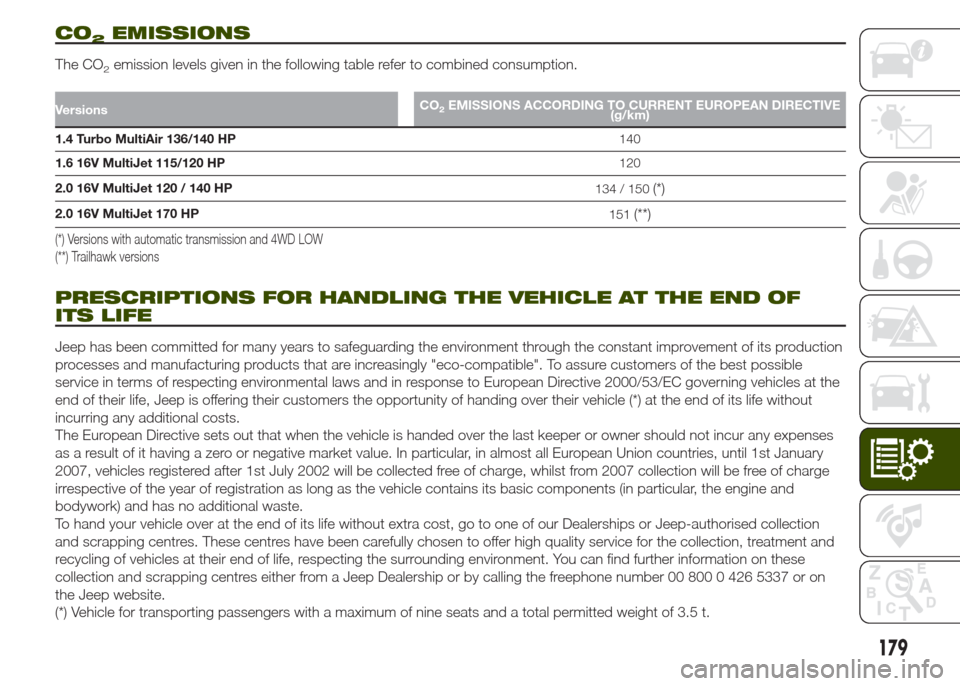
CO2EMISSIONS
The CO2emission levels given in the following table refer to combined consumption.
VersionsCO2EMISSIONS ACCORDING TO CURRENT EUROPEAN DIRECTIVE
(g/km)
1.4 Turbo MultiAir 136/140 HP140
1.6 16V MultiJet 115/120 HP120
2.0 16V MultiJet 120 / 140 HP
134 / 150
(*)
2.0 16V MultiJet 170 HP
151(**)
(*) Versions with automatic transmission and 4WD LOW
(**) Trailhawk versions
PRESCRIPTIONS FOR HANDLING THE VEHICLE AT THE END OF
ITS LIFE
Jeep has been committed for many years to safeguarding the environment through the constant improvement of its production
processes and manufacturing products that are increasingly "eco-compatible". To assure customers of the best possible
service in terms of respecting environmental laws and in response to European Directive 2000/53/EC governing vehicles at the
end of their life, Jeep is offering their customers the opportunity of handing over their vehicle (*) at the end of its life without
incurring any additional costs.
The European Directive sets out that when the vehicle is handed over the last keeper or owner should not incur any expenses
as a result of it having a zero or negative market value. In particular, in almost all European Union countries, until 1st January
2007, vehicles registered after 1st July 2002 will be collected free of charge, whilst from 2007 collection will be free of charge
irrespective of the year of registration as long as the vehicle contains its basic components (in particular, the engine and
bodywork) and has no additional waste.
To hand your vehicle over at the end of its life without extra cost, go to one of our Dealerships or Jeep-authorised collection
and scrapping centres. These centres have been carefully chosen to offer high quality service for the collection, treatment and
recycling of vehicles at their end of life, respecting the surrounding environment. You can find further information on these
collection and scrapping centres either from a Jeep Dealership or by calling the freephone number 00 800 0 426 5337 or on
the Jeep website.
(*) Vehicle for transporting passengers with a maximum of nine seats and a total permitted weight of 3.5 t.
179
Page 184 of 212
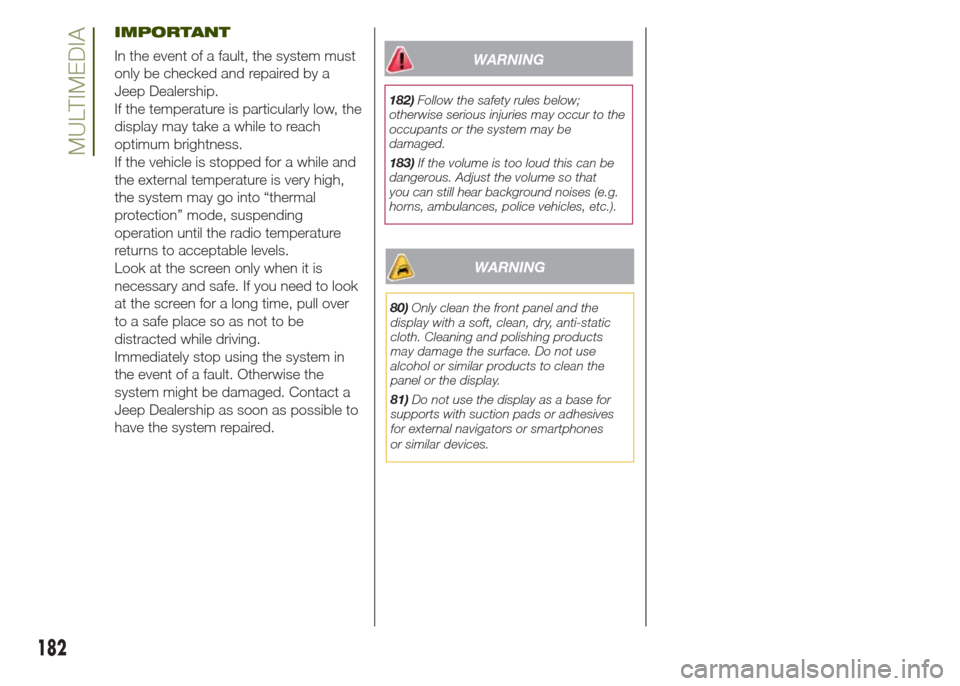
IMPORTANT
In the event of a fault, the system must
only be checked and repaired by a
Jeep Dealership.
If the temperature is particularly low, the
display may take a while to reach
optimum brightness.
If the vehicle is stopped for a while and
the external temperature is very high,
the system may go into “thermal
protection” mode, suspending
operation until the radio temperature
returns to acceptable levels.
Look at the screen only when it is
necessary and safe. If you need to look
at the screen for a long time, pull over
to a safe place so as not to be
distracted while driving.
Immediately stop using the system in
the event of a fault. Otherwise the
system might be damaged. Contact a
Jeep Dealership as soon as possible to
have the system repaired.WARNING
182)Follow the safety rules below;
otherwise serious injuries may occur to the
occupants or the system may be
damaged.
183)If the volume is too loud this can be
dangerous. Adjust the volume so that
you can still hear background noises (e.g.
horns, ambulances, police vehicles, etc.).
WARNING
80)Only clean the front panel and the
display with a soft, clean, dry, anti-static
cloth. Cleaning and polishing products
may damage the surface. Do not use
alcohol or similar products to clean the
panel or the display.
81)Do not use the display as a base for
supports with suction pads or adhesives
for external navigators or smartphones
or similar devices.
182
MULTIMEDIA