dashboard JEEP RENEGADE 2014 1.G User Guide
[x] Cancel search | Manufacturer: JEEP, Model Year: 2014, Model line: RENEGADE, Model: JEEP RENEGADE 2014 1.GPages: 212, PDF Size: 17.48 MB
Page 94 of 212
In the event of impact, those not
wearing a seat belt are projected
forwards and may come into contact
with the bag which is still inflating. The
protection offered by the bag is
compromised in these circumstances.
The front airbags may not activate in
the case of a frontal impact against
highly deformable objects not involving
the front surface of the vehicle (e.g.
wing collision against guard rail) or in
the case of the vehicle wedging under
other vehicles or protective barriers
(e.g. under trucks or guard rails).
Failure to activate in the conditions
described above is due to the fact that
they may not provide any additional
protection compared with seat belts, so
their activation would be inappropriate.
In these cases, non-deployment does
not indicate a system malfunction.
Driver's side front airbag
94) 95)
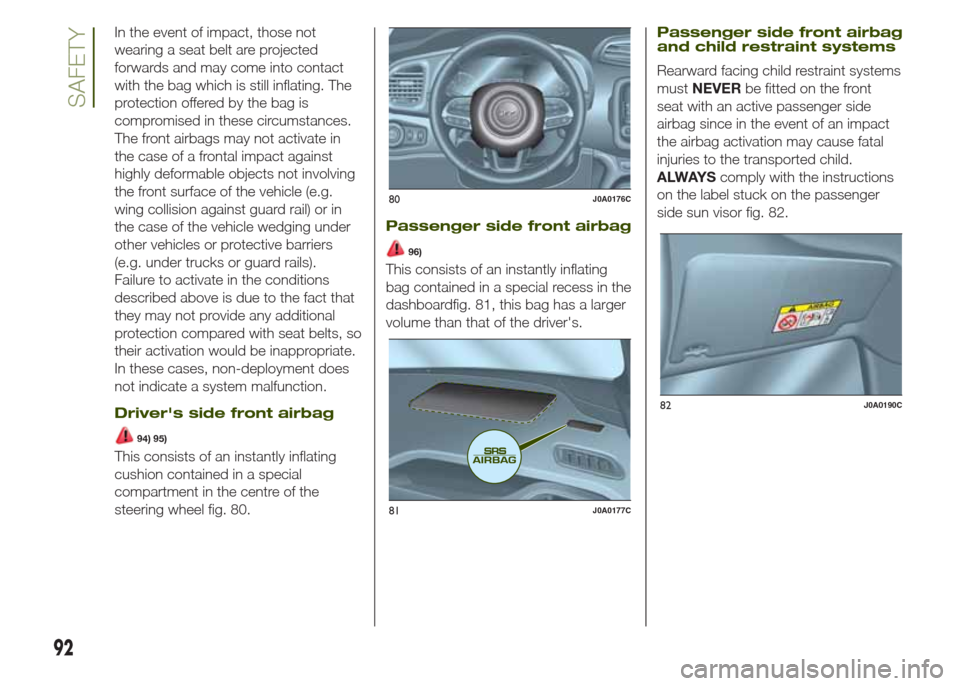
This consists of an instantly inflating
cushion contained in a special
compartment in the centre of the
steering wheel fig. 80.
Passenger side front airbag
96)
This consists of an instantly inflating
bag contained in a special recess in the
dashboardfig. 81, this bag has a larger
volume than that of the driver's.
Passenger side front airbag
and child restraint systems
Rearward facing child restraint systems
mustNEVERbe fitted on the front
seat with an active passenger side
airbag since in the event of an impact
the airbag activation may cause fatal
injuries to the transported child.
ALWAYScomply with the instructions
on the label stuck on the passenger
side sun visor fig. 82.
80J0A0176C
81J0A0177C
82J0A0190C
92
SAFETY
Page 95 of 212
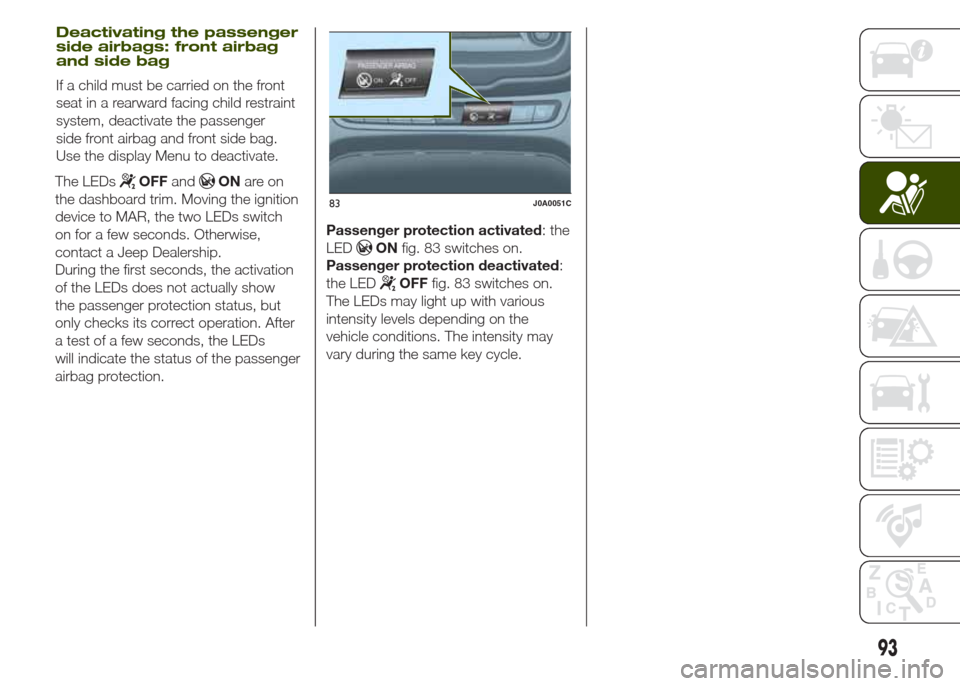
The LEDsOFFandONare on
the dashboard trim. Moving the ignition
device to MAR, the two LEDs switch
on for a few seconds. Otherwise,
contact a Jeep Dealership.
During the first seconds, the activation
of the LEDs does not actually show
the passenger protection status, but
only checks its correct operation. After
a test of a few seconds, the LEDs
will indicate the status of the passenger
airbag protection.Passenger protection activated: the
LED
ONfig. 83 switches on.
Passenger protection deactivated:
the LED
OFFfig. 83 switches on.
The LEDs may light up with various
intensity levels depending on the
vehicle conditions. The intensity may
vary during the same key cycle.
83J0A0051C
93
Deactivating the passenger
side airbags: front airbag
and side bag
If a child must be carried on the front
seat in a rearward facing child restraint
system, deactivate the passenger
side front airbag and front side bag.
Use the display Menu to deactivate.
Page 98 of 212
WARNING
94)Do not apply stickers or other objects
on the steering wheel, on the dashboard in
the passenger side airbag area, on side
upholstery on the roof or on the seats.
Never put objects (e.g. mobile phones) on
the passenger's side dashboard since
they could interfere with correct inflation of
the airbag and also cause serious injury
to the passengers.
95)Always drive keeping your hands on
the steering wheel rim so that the airbag
can inflate freely if necessary. Do not drive
with your body bent forward. Keep your
back straight against the backrest.
96)When an active passenger airbag is
fitted, DO NOT install rearward facing child
restraint systems on the front passenger
seat. Deployment of the airbag in an
accident could cause fatal injuries to the
child regardless of the severity of the
impact. Therefore, always deactivate the
passenger side airbag when a rearward
facing child restraint system is installed on
the front passenger seat. The front
passenger seat must also be positioned
back as far as possible in order to prevent
the child restraint system from coming
into contact with the dashboard.
Immediately reactivate the passenger
airbag as soon as the child restraint system
has been removed.
97)Do not hook rigid objects to the coat
hooks and to the support handles.100)If the
warning light does not
switch on when the ignition device is
moved to MAR or if it stays on when
driving, there might be a fault in the
restraint systems; in this case, the airbags
or pretensioners may not deploy in the
event of an accident or, in a lower number
of cases, they could deploy erroneously.
Before proceeding, contact a Jeep
Dealership immediately to have the system
checked.
101)On some versions, if the
OFFLED
(located on the dashboard panel) is faulty,
warning light
lights up in the instrument
panel.
102)If a side bag is present, do not cover
the front seat backrests with extra covers.
103)Do not travel carrying objects in
your lap, in front of your chest or between
your lips (pipe, pencils, etc.). They could
cause severe injury if the airbag is
deployed.
104)If the has been subject to theft,
attempted theft, vandalism, or flooding,
have the airbag system inspected at a
Jeep Dealership.105)If the ignition device is at MAR, even if
the engine is switched off, airbags may
be deployed when the vehicle is stationary
and hit by another vehicle. Therefore,
even if the vehicle is stationary, when an
active front passenger airbag is fitted, DO
NOT install rearward facing child restraint
systems on the front passenger seat.
Deployment of the airbag following an
impact could cause fatal injuries to the
child. Therefore, always deactivate the
passenger side airbag when a rearward
facing child restraint system is installed on
the front passenger seat. The front
passenger seat must also be positioned
back as far as possible in order to prevent
the child restraint system from coming
into contact with the dashboard.
Immediately reactivate the passenger
airbag as soon as the child restraint system
has been removed. Finally, remember that
if the ignition device is at STOP, no safety
device (airbags or pretensioners) will
activate following an impact; therefore if
these devices do not activate this cannot
be considered as signal of the system
malfunction.
106)If the airbag failure warning light is
faulty this will be signalled by an airbag
failure icon lighting up in the instrument
panel display with a dedicated message.
The pyrotechnic charges are not disabled.
Before proceeding, contact a Jeep
Dealership immediately to have the system
checked.
107)The front airbag deployment threshold
is higher than that of the pretensioners.
When the impact is between the two
deployment thresholds, it is normal that
pretensioners only are engaged.
96
SAFETY
98)Do not rest your head, arms or elbows
on the door, windows or the area in which
the window bag is located to avoid
possible injury during inflation.
99)
elbows out of the windowNever lean head, arms and
Page 132 of 212
WARNING
133)Before replacing the bulb, wait for the
exhaust ducts to cool down: RISK OF
BURNS!
134)Changes or repairs to the electrical
system carried out incorrectly and without
due consideration for the technical
specifications of the system may lead to
malfunctioning and generate a fire hazard.
135)Halogen bulbs contain pressurised
gas. If they break, glass fragments could fly
everywhere.
WARNING
52)Halogen bulbs must be handled by
holding the metallic part only. Touching the
transparent part of the bulb with your
fingers may reduce the intensity of the
emitted light and even reduce the lifespan
of the bulb. In the case of accidental
contact, rub the lamp with a cloth and
spirit and leave to dry.
REPLACING FUSES
INTRODUCTION
136) 137) 138) 139) 140)
53) 54)
Fuse extracting pliers
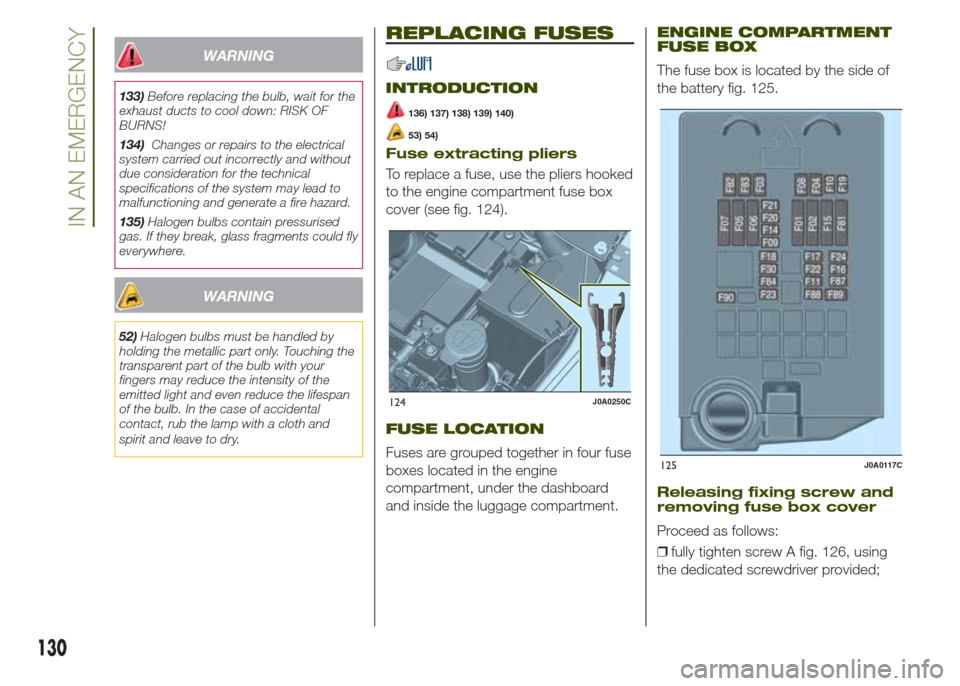
To replace a fuse, use the pliers hooked
to the engine compartment fuse box
cover (see fig. 124).
FUSE LOCATION
Fuses are grouped together in four fuse
boxes located in the engine
compartment, under the dashboard
and inside the luggage compartment.
ENGINE COMPARTMENT
FUSE BOX
The fuse box is located by the side of
the battery fig. 125.
Releasing fixing screw and
removing fuse box cover
Proceed as follows:
❒fully tighten screw A fig. 126, using
the dedicated screwdriver provided;
124J0A0250C
125J0A0117C
130
IN AN EMERGENCY
Page 133 of 212
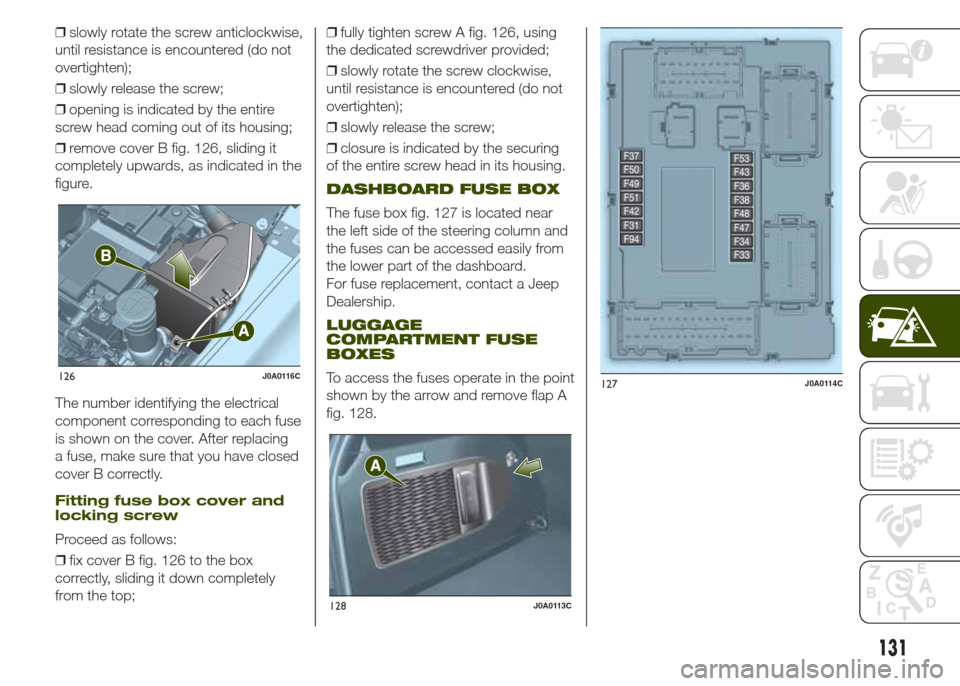
❒slowly rotate the screw anticlockwise,
until resistance is encountered (do not
overtighten);
❒slowly release the screw;
❒opening is indicated by the entire
screw head coming out of its housing;
❒remove cover B fig. 126, sliding it
completely upwards, as indicated in the
figure.
The number identifying the electrical
component corresponding to each fuse
is shown on the cover. After replacing
a fuse, make sure that you have closed
cover B correctly.
Fitting fuse box cover and
locking screw
Proceed as follows:
❒fix cover B fig. 126 to the box
correctly, sliding it down completely
from the top;❒fully tighten screw A fig. 126, using
the dedicated screwdriver provided;
❒slowly rotate the screw clockwise,
until resistance is encountered (do not
overtighten);
❒slowly release the screw;
❒closure is indicated by the securing
of the entire screw head in its housing.
DASHBOARD FUSE BOX
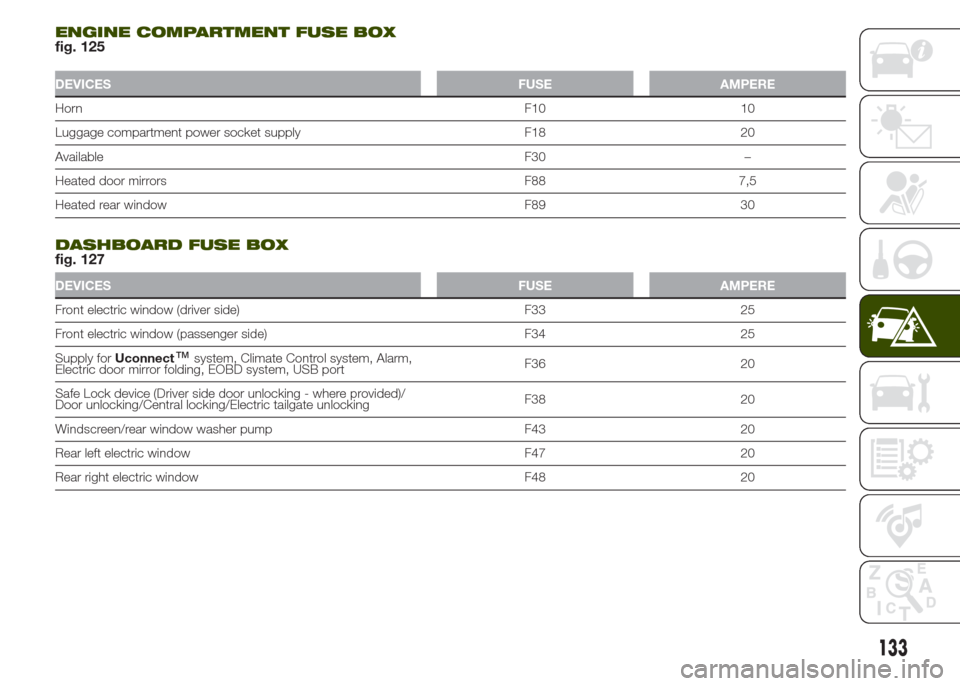
The fuse box fig. 127 is located near
the left side of the steering column and
the fuses can be accessed easily from
the lower part of the dashboard.
For fuse replacement, contact a Jeep
Dealership.
LUGGAGE
COMPARTMENT FUSE
BOXES
To access the fuses operate in the point
shown by the arrow and remove flap A
fig. 128.126J0A0116C
128J0A0113C
127J0A0114C
131
Page 135 of 212
ENGINE COMPARTMENT FUSE BOXfig. 125
DEVICES FUSE AMPERE
HornF10 10
Luggage compartment power socket supply F18 20
AvailableF30 –
Heated door mirrors F88 7,5
Heated rear window F89 30
.
DASHBOARD FUSE BOXfig. 127
DEVICES FUSE AMPERE
Front electric window (driver side) F33 25
Front electric window (passenger side) F34 25
Supply forUconnect
™system, Climate Control system, Alarm,
Electric door mirror folding, EOBD system, USB portF36 20
Safe Lock device (Driver side door unlocking - where provided)/
Door unlocking/Central locking/Electric tailgate unlockingF38 20
Windscreen/rear window washer pump F43 20
Rear left electric window F47 20
Rear right electric window F48 20
133
Page 141 of 212
146)The jack is a tool developed and
designed only for changing a wheel, if a
tyre gets punctured or damaged, on the
vehicle with which it is supplied or on other
vehicles of the same model. It must not
be used, for example, to jack other vehicle
models or objects. Never use the jack to
carry out maintenance or repairs under the
vehicle. Never position yourself under a
jacked vehicle. Should it be necessary to
work under the vehicle, contact a Jeep
Dealership. Incorrectly positioning the jack
may cause the vehicle to fall: use it only
in the positions indicated. Do not use the
jack for loads higher than the one shown
on its label.
147)The space-saver wheel cannot be
fitted with snow chains. If a front (drive) tyre
is punctured and chains are needed, use
a standard wheel from the rear axle and
install the space-saver wheel on the rear
axle. In this way, with two normal drive
wheels at the front axle, it is possible to use
snow chains.
148)Incorrect hub cap assembly, if
present, may cause it to come off when the
vehicle is moving. Never tamper with the
inflation valve. Never introduce tools of any
kind between the rim and the tyre. Check
tyre and space-saver wheel pressures
regularly, complying with the values given in
the "Technical specifications" chapter.TIREKIT
(where provided)
DESCRIPTION
The TireKit is located in the luggage
compartment inside a dedicated
container.
The container is also equipped with a
screwdriver, the tow hook and the
refuelling adaptor.
To access the TireKit, open the tailgate,
remove the reconfigurable load platform
and lift the carpet.
149) 151)55)3)The TireKit also contains:
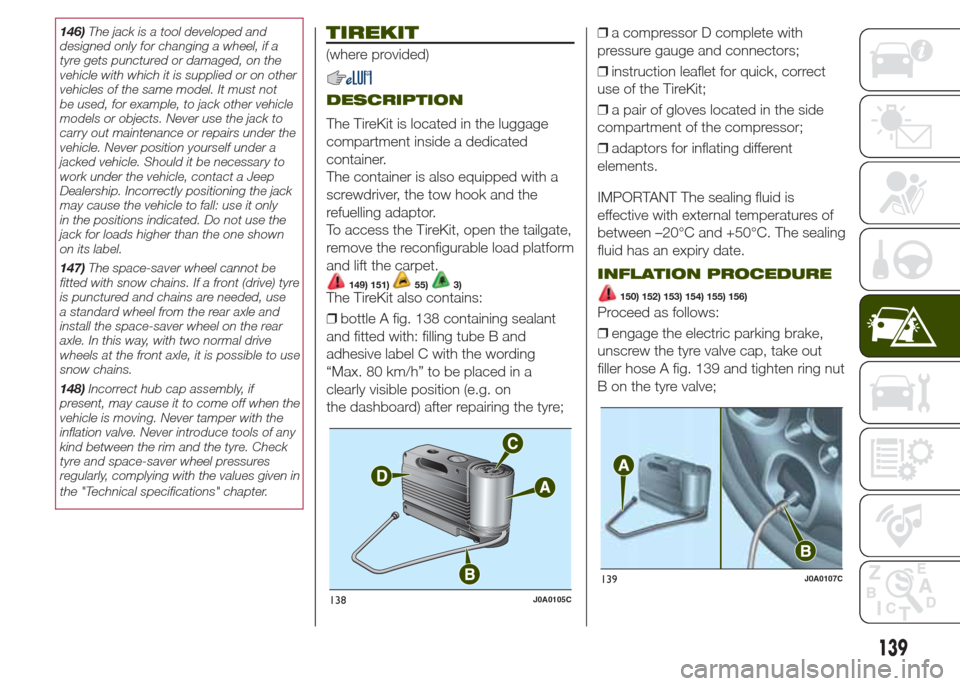
❒bottle A fig. 138 containing sealant
and fitted with: filling tube B and
adhesive label C with the wording
“Max. 80 km/h” to be placed in a
clearly visible position (e.g. on
the dashboard) after repairing the tyre;❒a compressor D complete with
pressure gauge and connectors;
❒instruction leaflet for quick, correct
use of the TireKit;
❒a pair of gloves located in the side
compartment of the compressor;
❒adaptors for inflating different
elements.
IMPORTANT The sealing fluid is
effective with external temperatures of
between –20°C and +50°C. The sealing
fluid has an expiry date.
INFLATION PROCEDURE
150) 152) 153) 154) 155) 156)
Proceed as follows:
❒engage the electric parking brake,
unscrew the tyre valve cap, take out
filler hose A fig. 139 and tighten ring nut
B on the tyre valve;
138J0A0105C
139J0A0107C
139
Page 145 of 212
FUEL CUT-OFF
SYSTEM
This intervenes in the case of an impact
causing:
❒the interruption of the fuel supply with
the engine consequently cutting out;
❒the automatic unlocking of the doors;
❒turning on of the lights inside the
vehicle;
❒deactivation of climate control system
ventilation;
❒switching on of the hazard warning
lights (to deactivate the lights press the
button on the dashboard).
On some versions, the intervention of
the system is indicated by a message
shown on the display. In the same way,
a dedicated message on the display
warns the driver if system operation is
compromised.
IMPORTANT Carefully check the vehicle
for fuel leaks, for instance in the engine
compartment, under the vehicle or
near the tank area. After a collision,
bring the ignition device to STOP to
prevent the battery from running down.
To restore correct operation of the
vehicle, carry out the following
procedure (this procedure must be
started and completed within less than
one minute):❒move the ignition device to MAR;
❒turn on the direction indicators on the
right, then on the left, then again on
the right and again on the left;
❒now deactivate the direction
indicators on the left;
❒bring the ignition device to STOP;
❒move the ignition device to MAR.
160)
WARNING
160)If, after an impact, you smell fuel or
notice leaks from the fuel system, do
not reactivate the system to avoid the risk
of fire.
AUTOMATIC
TRANSMISSION
GEAR LEVER
UNLOCKING
In the event of a fault, to move the gear
lever from P (Park), proceed as follows:
❒stop the engine and engage the
electric parking brake;
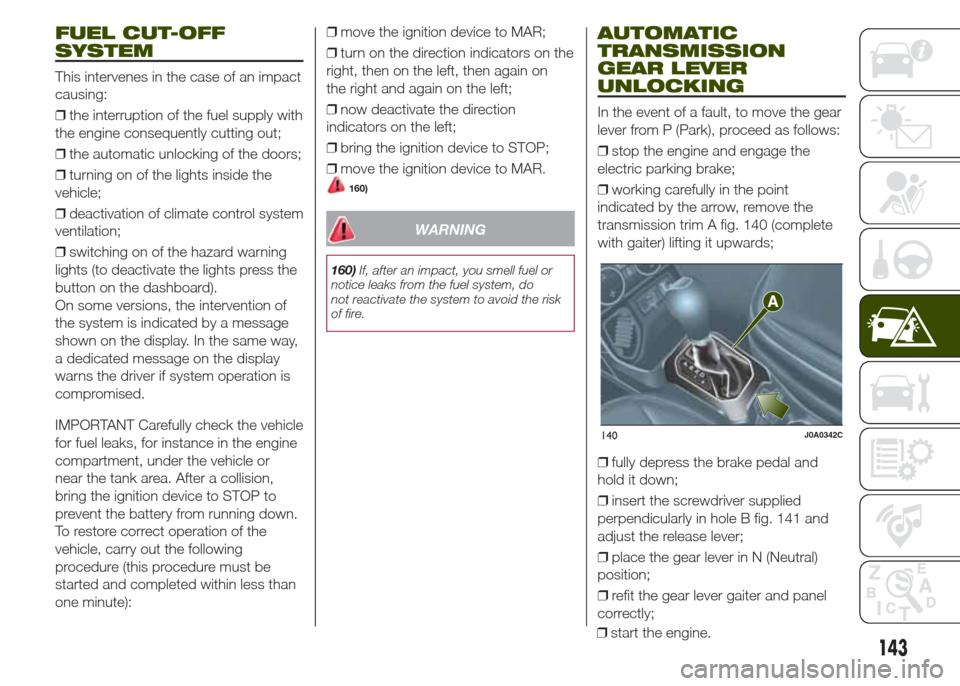
❒working carefully in the point
indicated by the arrow, remove the
transmission trim A fig. 140 (complete
with gaiter) lifting it upwards;
❒fully depress the brake pedal and
hold it down;
❒insert the screwdriver supplied
perpendicularly in hole B fig. 141 and
adjust the release lever;
❒place the gear lever in N (Neutral)
position;
❒refit the gear lever gaiter and panel
correctly;
140J0A0342C
143
❒start the engine.
Page 168 of 212
IDENTIFICATION
DATA
VEHICLE IDENTIFICATION
NUMBER
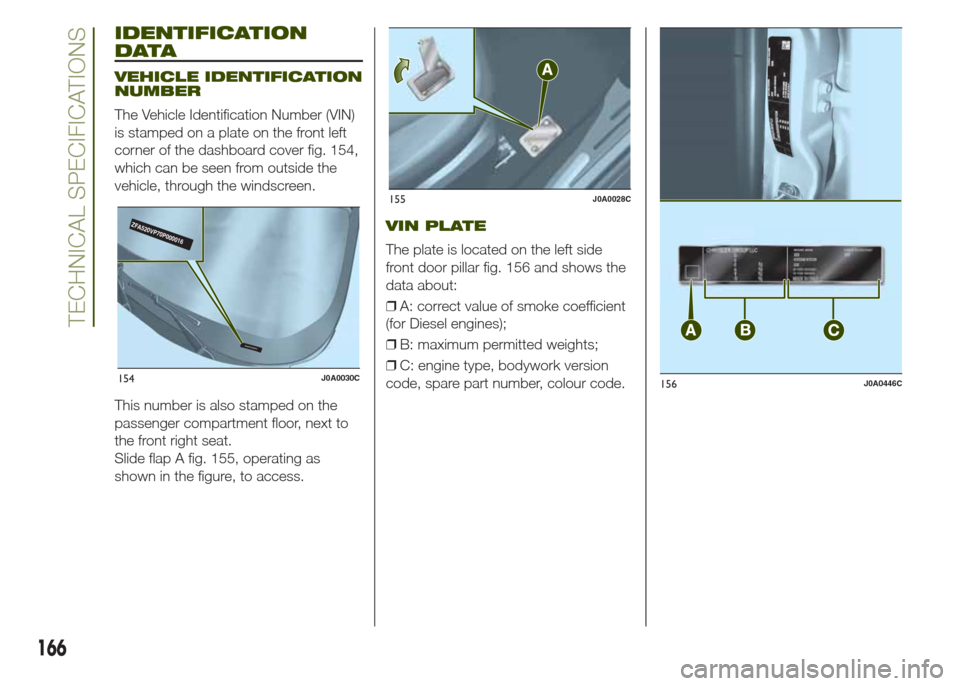
The Vehicle Identification Number (VIN)
is stamped on a plate on the front left
corner of the dashboard cover fig. 154,
which can be seen from outside the
vehicle, through the windscreen.
This number is also stamped on the
passenger compartment floor, next to
the front right seat.
Slide flap A fig. 155, operating as
shown in the figure, to access.
VIN PLATE
The plate is located on the left side
front door pillar fig. 156 and shows the
data about:
❒A: correct value of smoke coefficient
(for Diesel engines);
❒B: maximum permitted weights;
❒C: engine type, bodywork version
code, spare part number, colour code.
Z
FA520VP70P000016
ZFA520VP70P000016
154J0A0030C
155J0A0028C
156J0A0446C
166
TECHNICAL SPECIFICATIONS
Page 204 of 212
WARNING
ROOF RACK/SKI RACK
❒The use of transversal bars on longitudinal ones prevents the use of the sunroof, because the latter, while opening, interferes with the bars.
❒Therefore do not move the sunroof if transversal bars have been fitted.
❒Fully comply with the regulations in force concerning maximum clearance.
INTERIORS
❒Never use alcohol, petrols and derivatives to clean the dashboard and instrument panel lens.