steering JEEP RENEGADE 2014 1.G User Guide
[x] Cancel search | Manufacturer: JEEP, Model Year: 2014, Model line: RENEGADE, Model: JEEP RENEGADE 2014 1.GPages: 212, PDF Size: 17.48 MB
Page 49 of 212
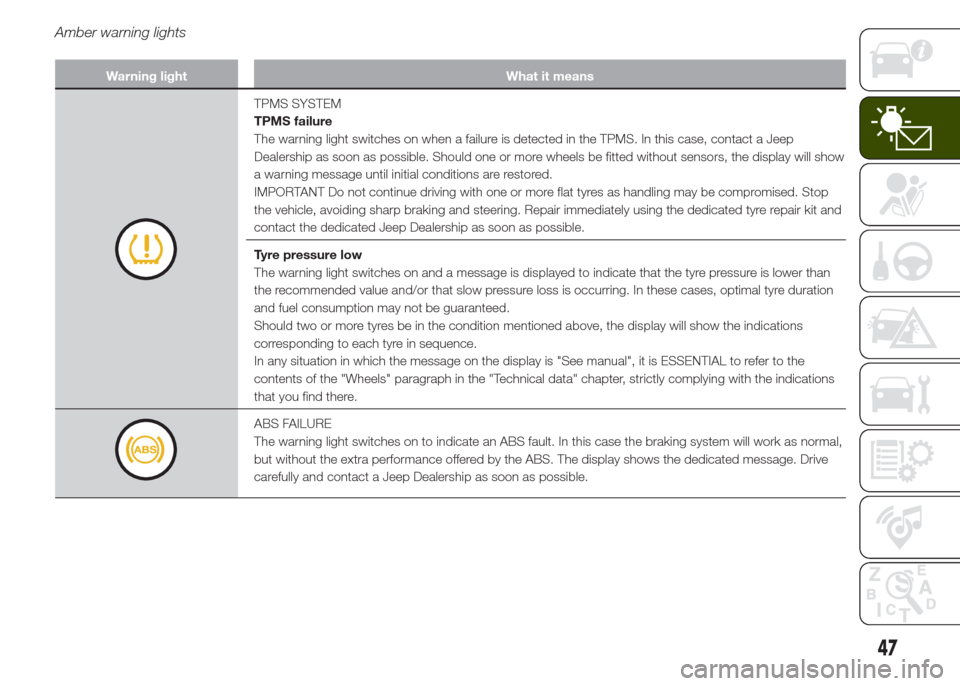
Amber warning lights
Warning light What it means
TPMS SYSTEM
TPMS failure
The warning light switches on when a failure is detected in the TPMS. In this case, contact a Jeep
Dealership as soon as possible. Should one or more wheels be fitted without sensors, the display will show
a warning message until initial conditions are restored.
IMPORTANT Do not continue driving with one or more flat tyres as handling may be compromised. Stop
the vehicle, avoiding sharp braking and steering. Repair immediately using the dedicated tyre repair kit and
contact the dedicated Jeep Dealership as soon as possible.
Tyre pressure low
The warning light switches on and a message is displayed to indicate that the tyre pressure is lower than
the recommended value and/or that slow pressure loss is occurring. In these cases, optimal tyre duration
and fuel consumption may not be guaranteed.
Should two or more tyres be in the condition mentioned above, the display will show the indications
corresponding to each tyre in sequence.
In any situation in which the message on the display is "See manual", it is ESSENTIAL to refer to the
contents of the "Wheels" paragraph in the "Technical data" chapter, strictly complying with the indications
that you find there.
ABS FAILURE
The warning light switches on to indicate an ABS fault. In this case the braking system will work as normal,
but without the extra performance offered by the ABS. The display shows the dedicated message. Drive
carefully and contact a Jeep Dealership as soon as possible.
47
Page 52 of 212
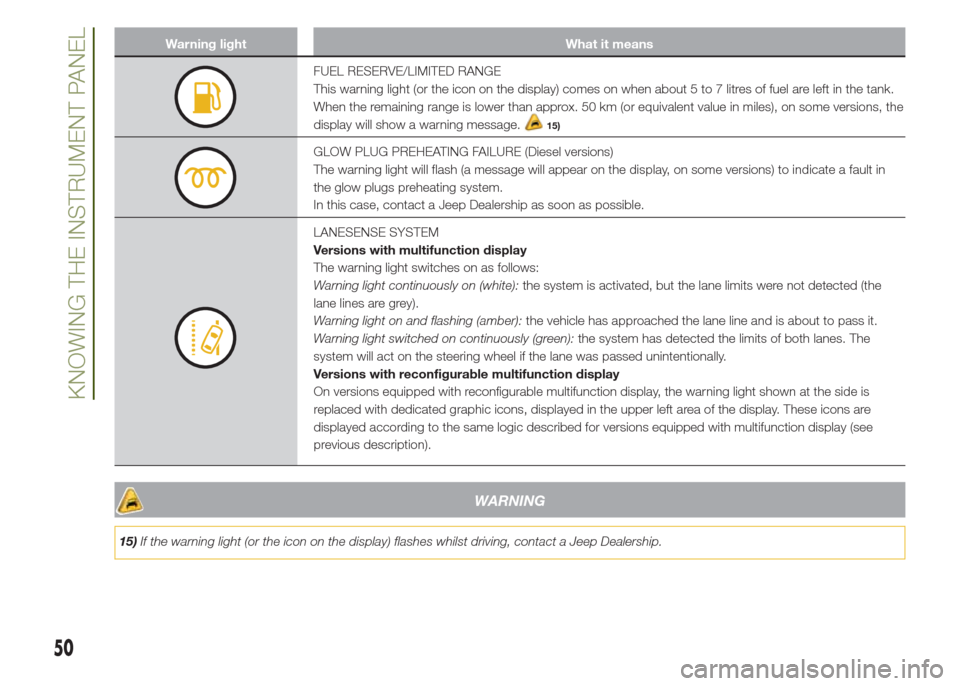
Warning light What it means
FUEL RESERVE/LIMITED RANGE
This warning light (or the icon on the display) comes on when about 5 to 7 litres of fuel are left in the tank.
When the remaining range is lower than approx. 50 km (or equivalent value in miles), on some versions, the
display will show a warning message.
15)
GLOW PLUG PREHEATING FAILURE (Diesel versions)
The warning light will flash (a message will appear on the display, on some versions) to indicate a fault in
the glow plugs preheating system.
In this case, contact a Jeep Dealership as soon as possible.
LANESENSE SYSTEM
Versions with multifunction display
The warning light switches on as follows:
Warning light continuously on (white):the system is activated, but the lane limits were not detected (the
lane lines are grey).
Warning light on and flashing (amber):the vehicle has approached the lane line and is about to pass it.
Warning light switched on continuously (green):the system has detected the limits of both lanes. The
system will act on the steering wheel if the lane was passed unintentionally.
Versions with reconfigurable multifunction display
On versions equipped with reconfigurable multifunction display, the warning light shown at the side is
replaced with dedicated graphic icons, displayed in the upper left area of the display. These icons are
displayed according to the same logic described for versions equipped with multifunction display (see
previous description).
WARNING
15)If the warning light (or the icon on the display) flashes whilst driving, contact a Jeep Dealership.
50
KNOWING THE INSTRUMENT PANEL
Page 67 of 212
DST SYSTEM (Dynamic
Steering Torque)
The DST function uses the integration
of the ESC system with the electric
power steering to increase the safety
level of the whole vehicle.
53)
ERM (Electronic Rollover
Mitigation) SYSTEM
The system monitors the tendency of
the wheels to rise from the ground if the
driver performs extreme manoeuvres
like quick steering to avoid an obstacle,
especially in poor road conditions.
If these conditions occur, the system
intervenes on the brakes and engine
power to reduce the possibility that the
wheels are raised from the ground. It
is not possible to avoid tendency to roll
over if the phenomenon is due to
reasons such as driving on high side
gradients, collision with objects or other
vehicles.
54)
TSC (Trailer Sway
Control) SYSTEM
The system employs a series of
sensors located on the vehicle to
identify excessive swerving of the trailer
and take the necessary precautions
to eliminate it.
System intervention
When the system is active, the
warning light flashes on the
instrument panel, the engine power is
reduced and braking can be felt on the
individual wheels, following the attempt
to eliminate the swerving of the trailer.
The system is active only with ESC
engaged.
When the ESC system is deactivated
(by pressing the button on the central
tunnel), the TSC system is deactivated
as well.
55) 56)
HDC (Hill Descent
Control) SYSTEM
(where provided)
It is an integral part of the ESC system
and is aimed at keeping the vehicle at a
constant speed during a descent,
operating autonomously on the brakes
in various ways at the same time.
In this way the vehicle stability and
completely safe driving are guaranteed,
above all in poor grip conditions and
steep descents.
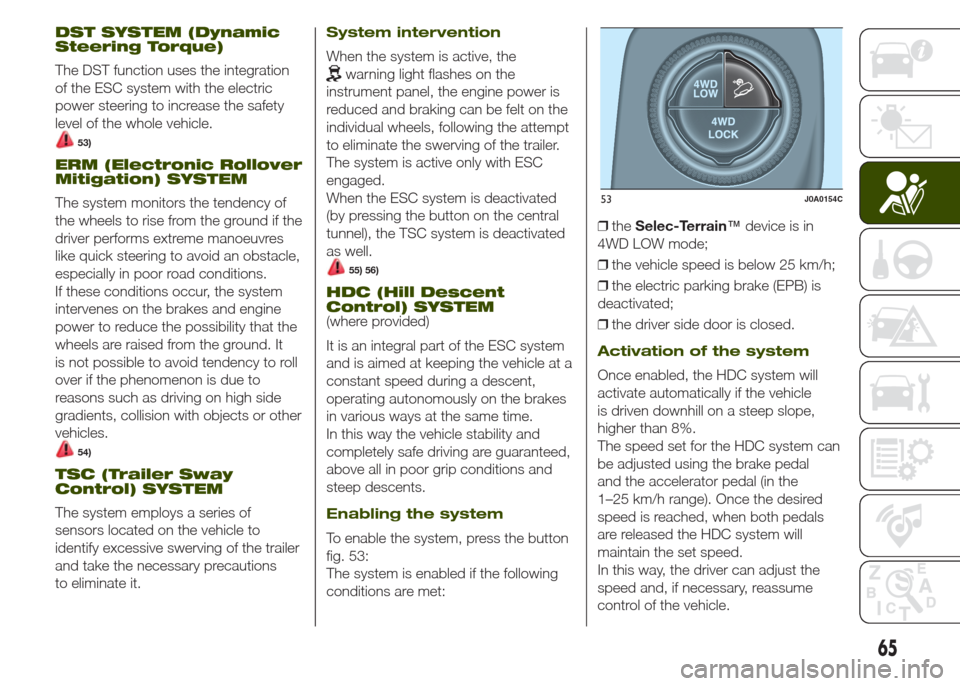
Enabling the system
To enable the system, press the button
fig. 53:
The system is enabled if the following
conditions are met:❒theSelec-Terrain™device is in
4WD LOW mode;
❒the vehicle speed is below 25 km/h;
❒the electric parking brake (EPB) is
deactivated;
❒the driver side door is closed.
Activation of the system
Once enabled, the HDC system will
activate automatically if the vehicle
is driven downhill on a steep slope,
higher than 8%.
The speed set for the HDC system can
be adjusted using the brake pedal
and the accelerator pedal (in the
1–25 km/h range). Once the desired
speed is reached, when both pedals
are released the HDC system will
maintain the set speed.
In this way, the driver can adjust the
speed and, if necessary, reassume
control of the vehicle.
53J0A0154C
65
Page 76 of 212
IMPORTANT The TPMS is designed for
original tyres and wheels. Pressure
and alarms signalled by the TPMS are
defined according to the size of the
tyres fitted on the vehicle. Using spare
wheels of a size, type and/or design
different from the original ones may
cause an irregular operation of the
system and damage the sensors.
Aftermarket fitted wheels may damage
the sensors. Using aftermarket tyre
sealants may damage the Tyre Pressure
Monitoring System sensor. If
aftermarket tyre sealant is used it is
recommended to go to a Jeep
Dealership to have the sensors
checked. After tyre pressure check and
adjustment, always refit the valve plug
to prevent humidity and dirt from
entering, these may damage the Tyre
Pressure Monitoring System sensor.
TPMS check message
If a system failure is present, the
warning light flashes for about 75
seconds and then stays on constantly.
An acoustic signal is also issued.
TPMS deactivation
The TPMS can be deactivated by
replacing the wheels equipped with
TPMS with others that are not (e.g.
upon replacement of the wheel
assemblies in winter). Then drive the
vehicle for at least 20 minutes at a
speed higher than about 25 km/h (15
mph). The TPMS will emit an acoustic
warning, the
warning light will flash
for about 75 seconds, then will stay
on constantly and the instrument panel
will display the "TPMS check" message
with some dashes (– –) instead of the
pressure values.
At the next engine start, the system will
not emit any acoustic signal and the
display will not show the message
"TPMS check", but the dashes (– –) will
be still displayed instead of the pressure
value.
WARNING
63)The system is an aid for vehicle driving,
it DOES NOT warn the driver about
incoming vehicles outside of the detection
areas. The driver must always maintain a
sufficient level of attention to the traffic and
road conditions and for controlling the
trajectory of the vehicle.64)The system is an aid for the driver, who
must always pay full attention while driving.
The responsibility always rests with the
driver, who must take into account the
traffic conditions in order to drive in
complete safety. The driver must always
maintain a safe distance from the vehicle in
front.
65)If the driver depresses the brake pedal
fully or carries out a fast steering during
system operation, the automatic braking
function may stop (e.g. to allow a possible
manoeuvre to avoid the obstacle).
66)The system intervenes on vehicles
travelling in the same lane. People, animals
and things (e.g. pushchairs) are not taken
into consideration.
67)If the vehicle must be placed on a roller
bench for maintenance interventions or if
it is washed in an automatic roller washing
tunnel with an obstacle in the front part
(e.g. another vehicle, a wall or another
obstacle), the system may detect its
presence and activate. In this case the
system must be deactivated through the
settings of theUconnect™system.
68)The presence of the TPMS does not
permit the driver to neglect regular checks
of the tyre pressure, including for the
spare wheel, and correct maintenance: the
system is not used to signal a possible
fault to a tyre.
69)Tyre pressure must be checked with
tyres rested and cold. Should it become
necessary for whatever reason to check
pressure with warm tyres, do not reduce
pressure even though it is higher than
the prescribed value. Repeat the check
when the tyres are cold.
74
SAFETY
Page 77 of 212
70)Should one or more wheels be fitted
without sensors (e.g. if the spare wheel
is fitted), the system will no longer be
available for the replaced wheel and a
warning message will be shown on the
display, until the wheels with sensors are
fitted again.
71)The TPMS cannot indicate sudden tyre
pressure drops (e.g. if a tyre bursts). In
this case, stop the vehicle, braking with
care and avoiding sharp steering actions.
72)Replacing the normal tyres with winter
tyres and vice versa requires an inspection
of the TPMS, which should be carried
out only by a Jeep Dealership.
73)Changes in outside temperature may
cause tyre pressures to vary. The system
may temporarily indicate insufficient
pressure. In this case check the tyre
inflation pressure with the tyres cold and, if
necessary top up the inflation pressure.
74)When a tyre is removed, it is advisable
to replace the rubber gasket for the valve:
go to a Jeep Dealership. The fitting/
removal of the tyres and/or rims require
special care. To avoid damaging or fitting
the sensors incorrectly, tyre and/or rim
fitting/removal operations should only be
carried out by specialised staff. Go to a
Jeep Dealership.
WARNING
23)The system may have limited or absent
operation due to weather conditions such
as: heavy rain, hail, thick fog, heavy snow.
24)The section of the bumper before
the sensor must not be covered with
adhesives, auxiliary headlights or any other
object.
25)System intervention might be
unexpected or delayed when other vehicles
transport loads projecting from the side,
above or from the rear, with respect to the
normal size of the vehicle.
26)Operation can be adversely affected by
any structural change made to the vehicle,
such as a modification to the front
geometry, tyre change, or a heavier load
than the standard load of the vehicle.
27)Incorrect repairs made on the front part
of the vehicle (e.g. bumper, chassis) may
alter the position of the radar sensor,
and adversely affect its operation. Go to a
Jeep Dealership for any operation of this
type.
28)Do not tamper nor carry out any
intervention on the radar sensor or on the
camera on the windscreen. In the event
of a sensor failure, contact a Jeep
Dealership.
29)When towing a trailer (with modules
installed after purchasing the vehicle),
a vehicle or during loading manoeuvres on
a vehicle transporter (or in vehicle for
transport), the system must be deactivated
via theUconnect™system.30)Do not wash with high-pressure jets in
the bumper lower area: in particular do
not operate on the system's electrical
connector.
31)Be careful in the case of repairs and
new paintings in the area around the
sensor (panel covering the sensor on the
left side of the bumper). In the event of
a frontal impact the sensor may
automatically deactivate and display a
warning to indicate that the sensor needs
to be repaired. Even without a malfunction
warning, deactivate the system operation
if you think that the position of the radar
sensor has changed (e.g. due to
low-speed frontal impact as during parking
manoeuvres). In these cases, go to a
Jeep Dealership to have the radar sensor
realigned or replaced.
32)The tyre quick repair kit (TireKit),
provided with the vehicle, is compatible
with the TPMS sensors. Using sealants
different from that in the original kit may
compromise its operation. If sealants not
equivalent with the original one are used, it
is recommended to have the TPMS sensor
operation checked by a qualified repair
centre.
75
Page 82 of 212
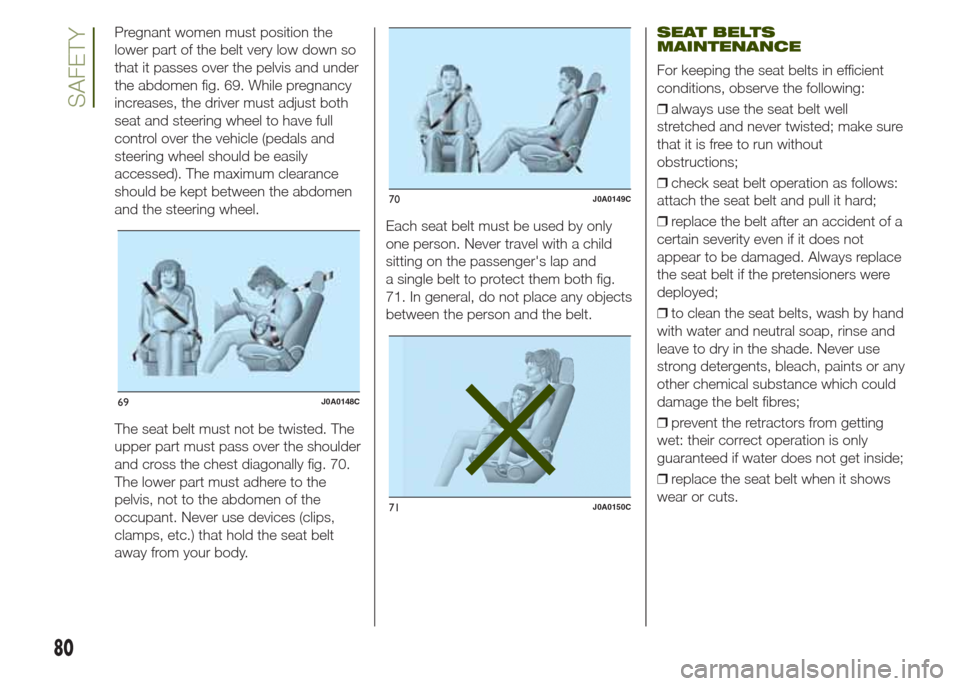
Pregnant women must position the
lower part of the belt very low down so
that it passes over the pelvis and under
the abdomen fig. 69. While pregnancy
increases, the driver must adjust both
seat and steering wheel to have full
control over the vehicle (pedals and
steering wheel should be easily
accessed). The maximum clearance
should be kept between the abdomen
and the steering wheel.
The seat belt must not be twisted. The
upper part must pass over the shoulder
and cross the chest diagonally fig. 70.
The lower part must adhere to the
pelvis, not to the abdomen of the
occupant. Never use devices (clips,
clamps, etc.) that hold the seat belt
away from your body.Each seat belt must be used by only
one person. Never travel with a child
sitting on the passenger's lap and
a single belt to protect them both fig.
71. In general, do not place any objects
between the person and the belt.SEAT BELTS
MAINTENANCE
For keeping the seat belts in efficient
conditions, observe the following:
❒always use the seat belt well
stretched and never twisted; make sure
that it is free to run without
obstructions;
❒check seat belt operation as follows:
attach the seat belt and pull it hard;
❒replace the belt after an accident of a
certain severity even if it does not
appear to be damaged. Always replace
the seat belt if the pretensioners were
deployed;
❒to clean the seat belts, wash by hand
with water and neutral soap, rinse and
leave to dry in the shade. Never use
strong detergents, bleach, paints or any
other chemical substance which could
damage the belt fibres;
❒prevent the retractors from getting
wet: their correct operation is only
guaranteed if water does not get inside;
❒replace the seat belt when it shows
wear or cuts.
69J0A0148C
70J0A0149C
71J0A0150C
80
SAFETY
Page 93 of 212
84)On the sun visor there is a label with
suitable symbols reminding the user that it
is compulsory to deactivate the airbag if
a rearward facing child restraint system is
fitted. Always comply with the instructions
on the passenger's side sun visor (see
the "Supplementary Restraint System
(SRS) - Airbag" paragraph).
85)Should it be necessary to carry a child
on the passenger side front seat in a rear
facing child restraint system, the passenger
side front airbag and side bag must be
deactivated through the display main menu
(see the instructions in the "Display"
paragraph, "Knowing the instrument panel"
chapter), verifying activation by checking
whether the
OFFLED has switched on
in the panel located on the dashboard.
Move the passenger's seat as far back as
possible to avoid contact between the child
restraint system and the dashboard.
86)Do not adjust the front or rear seat if a
child is seated on it or on the dedicated
child restraint system.
87)Incorrect fitting of the child restraint
system may result in an inefficient
protection system. In the event of an
accident the child restraint system may
become loose and the child may be
injured, even fatally. When fitting a restraint
system for newborns or children, strictly
comply with the instructions provided
by the Manufacturer.88)When the child restraint system is not
used, secure it with the seat belt or with
the ISOFIX anchorages, or remove it from
the vehicle. Do not leave it unsecured
inside the passenger compartment. In this
way, in the case of sudden braking or an
accident, it will not cause injuries to the
occupants.
89)After installing a child restraint system,
do not move the seat: always remove
the child restraint system before making
any adjustment.
90)Always make sure that the chest
section of the seat belt does not pass
under the arms or behind the back of the
child. In the event of an accident the seat
belt will not be able to secure the child,
with the risk of injury, including fatal injury.
Therefore the child must always wear
the seat belt correctly.
91)Do not use the same lower anchorage
to install more than one child protection
system.
92)If a Universal ISOFIX child restraint
system is not fixed to all three anchorages,
it will not be able to protect the child
correctly. In a crash, the child could be
seriously or fatally injured.
93)Fit the child restraint system only when
the vehicle is stationary. The child restraint
system is correctly fixed to the brackets
when you hear the click. Follow the
instructions for assembly, disassembly and
positioning that the Manufacturer must
supply with the child restraint system.
SUPPLEMENTARY
RESTRAINT SYSTEM
(SRS) - AIRBAG
The vehicle is equipped with:
❒front driver airbag;
❒front passenger airbag;
❒driver and passenger front side bags
for pelvis, chest and shoulder
protection (Side bags);
❒front and rear side passenger side
bags for head protection (window bag).
FRONT AIRBAGS
The front driver/passenger airbags and
the driver's knee bag (where provided)
protect the front seat occupants in
the event of frontal impacts of
medium/high severity, by placing the
bag between the occupant and the
steering wheel or dashboard.
Therefore non-activation in other types
of collisions (side impacts, rear shunts,
roll-overs, etc.) does not indicate a
system malfunction.
Driver and passenger front airbags are
not a replacement of but
complementary to the seat belts, which
should always be worn, as specified
by law in Europe and most non-
European countries.
91
Page 94 of 212
In the event of impact, those not
wearing a seat belt are projected
forwards and may come into contact
with the bag which is still inflating. The
protection offered by the bag is
compromised in these circumstances.
The front airbags may not activate in
the case of a frontal impact against
highly deformable objects not involving
the front surface of the vehicle (e.g.
wing collision against guard rail) or in
the case of the vehicle wedging under
other vehicles or protective barriers
(e.g. under trucks or guard rails).
Failure to activate in the conditions
described above is due to the fact that
they may not provide any additional
protection compared with seat belts, so
their activation would be inappropriate.
In these cases, non-deployment does
not indicate a system malfunction.
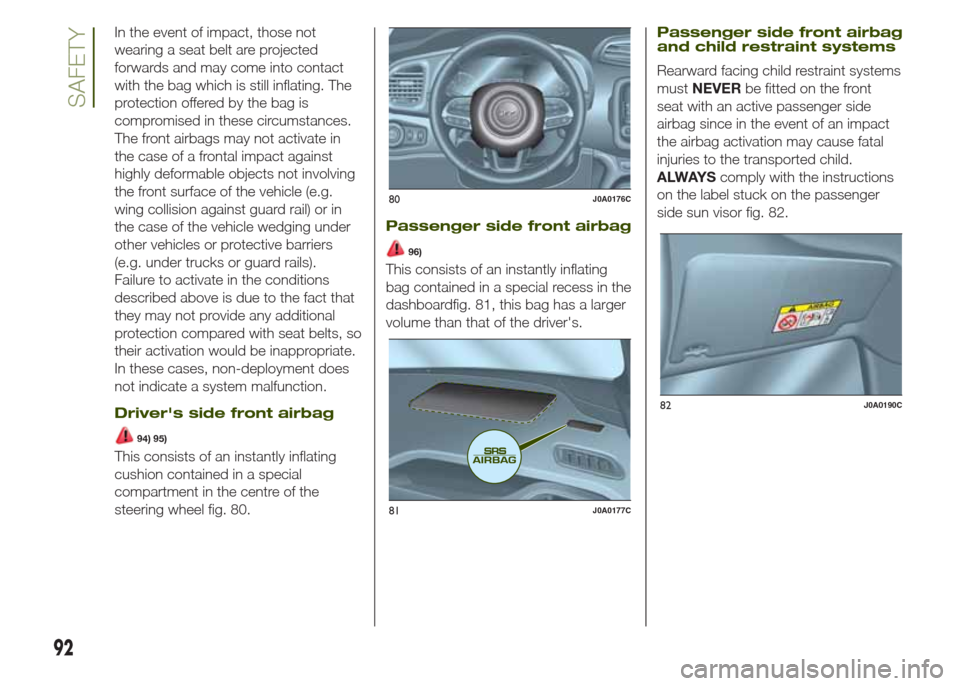
Driver's side front airbag
94) 95)
This consists of an instantly inflating
cushion contained in a special
compartment in the centre of the
steering wheel fig. 80.
Passenger side front airbag
96)
This consists of an instantly inflating
bag contained in a special recess in the
dashboardfig. 81, this bag has a larger
volume than that of the driver's.
Passenger side front airbag
and child restraint systems
Rearward facing child restraint systems
mustNEVERbe fitted on the front
seat with an active passenger side
airbag since in the event of an impact
the airbag activation may cause fatal
injuries to the transported child.
ALWAYScomply with the instructions
on the label stuck on the passenger
side sun visor fig. 82.
80J0A0176C
81J0A0177C
82J0A0190C
92
SAFETY
Page 98 of 212
WARNING
94)Do not apply stickers or other objects
on the steering wheel, on the dashboard in
the passenger side airbag area, on side
upholstery on the roof or on the seats.
Never put objects (e.g. mobile phones) on
the passenger's side dashboard since
they could interfere with correct inflation of
the airbag and also cause serious injury
to the passengers.
95)Always drive keeping your hands on
the steering wheel rim so that the airbag
can inflate freely if necessary. Do not drive
with your body bent forward. Keep your
back straight against the backrest.
96)When an active passenger airbag is
fitted, DO NOT install rearward facing child
restraint systems on the front passenger
seat. Deployment of the airbag in an
accident could cause fatal injuries to the
child regardless of the severity of the
impact. Therefore, always deactivate the
passenger side airbag when a rearward
facing child restraint system is installed on
the front passenger seat. The front
passenger seat must also be positioned
back as far as possible in order to prevent
the child restraint system from coming
into contact with the dashboard.
Immediately reactivate the passenger
airbag as soon as the child restraint system
has been removed.
97)Do not hook rigid objects to the coat
hooks and to the support handles.100)If the
warning light does not
switch on when the ignition device is
moved to MAR or if it stays on when
driving, there might be a fault in the
restraint systems; in this case, the airbags
or pretensioners may not deploy in the
event of an accident or, in a lower number
of cases, they could deploy erroneously.
Before proceeding, contact a Jeep
Dealership immediately to have the system
checked.
101)On some versions, if the
OFFLED
(located on the dashboard panel) is faulty,
warning light
lights up in the instrument
panel.
102)If a side bag is present, do not cover
the front seat backrests with extra covers.
103)Do not travel carrying objects in
your lap, in front of your chest or between
your lips (pipe, pencils, etc.). They could
cause severe injury if the airbag is
deployed.
104)If the has been subject to theft,
attempted theft, vandalism, or flooding,
have the airbag system inspected at a
Jeep Dealership.105)If the ignition device is at MAR, even if
the engine is switched off, airbags may
be deployed when the vehicle is stationary
and hit by another vehicle. Therefore,
even if the vehicle is stationary, when an
active front passenger airbag is fitted, DO
NOT install rearward facing child restraint
systems on the front passenger seat.
Deployment of the airbag following an
impact could cause fatal injuries to the
child. Therefore, always deactivate the
passenger side airbag when a rearward
facing child restraint system is installed on
the front passenger seat. The front
passenger seat must also be positioned
back as far as possible in order to prevent
the child restraint system from coming
into contact with the dashboard.
Immediately reactivate the passenger
airbag as soon as the child restraint system
has been removed. Finally, remember that
if the ignition device is at STOP, no safety
device (airbags or pretensioners) will
activate following an impact; therefore if
these devices do not activate this cannot
be considered as signal of the system
malfunction.
106)If the airbag failure warning light is
faulty this will be signalled by an airbag
failure icon lighting up in the instrument
panel display with a dedicated message.
The pyrotechnic charges are not disabled.
Before proceeding, contact a Jeep
Dealership immediately to have the system
checked.
107)The front airbag deployment threshold
is higher than that of the pretensioners.
When the impact is between the two
deployment thresholds, it is normal that
pretensioners only are engaged.
96
SAFETY
98)Do not rest your head, arms or elbows
on the door, windows or the area in which
the window bag is located to avoid
possible injury during inflation.
99)
elbows out of the windowNever lean head, arms and
Page 109 of 212
122)Before opening the bonnet, make
sure that the vehicle is switched off and
that the ignition device is in the STOP
position. Follow the indications on the plate
underneath the bonnet. We recommend
that you remove the key from the ignition if
other people remain in the vehicle. The
vehicle should always be left after the key
has been removed or turned to the STOP
position. During refuelling, make sure
that the engine is off (ignition device in the
STOP position).
WARNING
39)If climate comfort is to be favoured, the
Stop/Start system can be deactivated,
for a continuous operation of the climate
control system.
SPEED LIMITER
DESCRIPTION
This device allows the speed of the
vehicle to be limited to values which
can be set by the driver.
The maximum speed can be set both
with vehicle stationary and in motion.
The minimum speed that can be set is
30 km/h.
When the device is active, the vehicle
speed depends on the pressure at
the accelerator pedal, until the set
speed limit is reached.
ACTIVATING THE DEVICE
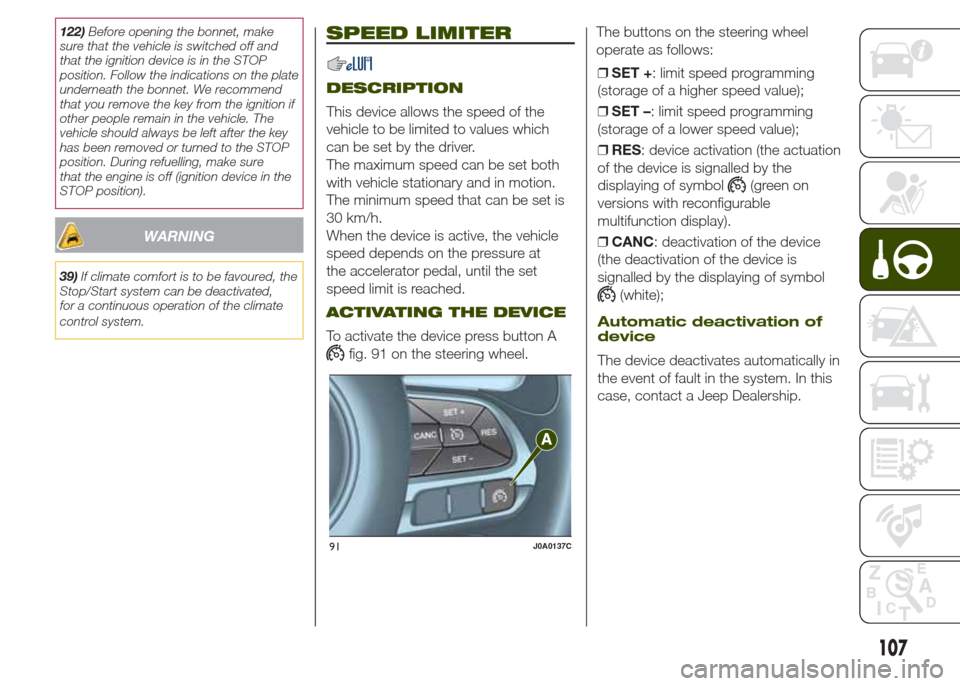
To activate the device press button A
fig. 91 on the steering wheel.The buttons on the steering wheel
operate as follows:
❒SET +: limit speed programming
(storage of a higher speed value);
❒SET –: limit speed programming
(storage of a lower speed value);
❒RES: device activation (the actuation
of the device is signalled by the
displaying of symbol
(green on
versions with reconfigurable
multifunction display).
❒CANC: deactivation of the device
(the deactivation of the device is
signalled by the displaying of symbol
(white);
Automatic deactivation of
device
The device deactivates automatically in
the event of fault in the system. In this
case, contact a Jeep Dealership.
91J0A0137C
107