warning JEEP RENEGADE 2014 1.G Owners Manual
[x] Cancel search | Manufacturer: JEEP, Model Year: 2014, Model line: RENEGADE, Model: JEEP RENEGADE 2014 1.GPages: 212, PDF Size: 17.48 MB
Page 3 of 212
Dear Customer,
We would like to congratulate and thank you for choosing a Jeep.
We have written this handbook to help you get to know all the features of your vehicle and use it in the best possible way. This vehicle
is intended for daily use as well as for specific uses, so even routes and uses not suitable for traditional vehicles on the market can
be tackled. Ride and handling capabilities are different from most other vehicles, both on and off road; we thus recommend you to
spend all the time necessary to know the vehicle dynamics.
Here you will find information, advice and important warnings regarding use of your vehicle and how to achieve the best performance
from the technical features of your Jeep.
You are advised to read it right through before taking to the road for the first time, to become familiar with the controls and above all
with those concerning brakes, steering and gearbox; at the same time, you can understand the vehicle behaviour on different road
surfaces.
This document also provides a description of special features and tips, as well as essential information for the safe driving, care and
maintenance of your Jeep over time.
After reading it, you are advised to keep the handbook inside the vehicle, for an easy reference and for making sure it remains onboard
the vehicle should it be sold.
In the attached Warranty Booklet you will also find a description of the Services that Jeep offers to its customers, the Warranty
Certificate and the detail of the terms and conditions for maintaining its validity.
We are sure that these will help you to get in touch with and appreciate your new vehicle and the service provided by the people at
Jeep.
Enjoy reading. Happy motoring!
WARNING
This Owner Handbook describes all Jeep Renegade versions. Options, equipment dedicated to specific Markets or
versions are not explicitly indicated in the text: as a consequence, you should only consider the information which is
related to the trim level, engine and version that you have purchased. Any content introduced throughout the production
of the model, outside the specific request of options at the time of purchase, will be identified with the wording(where
provided).
All data contained in this publication are intended to help you use your vehicle in the best possible way. Chrysler Group
LLC effort aims at a constant improvement of the vehicles produced. For this reason it reserves the right to make
changes at the model described for technical and/or commercial reasons.
For further information, contact a Jeep Dealership.
Page 4 of 212
READ THIS CAREFULLY
REFUELLING
Petrol engines: only refuel with unleaded petrol with octane rating (RON) not less than 95 in compliance with the European specification
EN228. Do not use petrol containing methanol or ethanol E85. Using these mixtures may cause misfiring and driving issues, as well as
damage fundamental components of the supply system.
Diesel engines: refuel only with diesel fuel conforming to the European specification EN590. The use of other products or mixtures may
damage the engine beyond repair and consequently invalidate the warranty, due to the damage caused.
For further details on the use of the correct fuel see paragraph "Refuelling the vehicle" in the "Starting and driving" chapter.
STARTING THE ENGINE
Versions with manual gearbox (petrol engines): make sure that the parking brake is engaged; set the gear lever to neutral, fully depress
the clutch pedal without pressing the accelerator, then bring the ignition device to AVV or press the ignition device button and release the
key or the button as soon as the engine has started.
Versions with manual gearbox (diesel engines): make sure that the parking brake is engaged; set the gear lever to neutral, fully depress
the clutch pedal without pressing the accelerator, then bring the ignition device to MAR and wait for warning lights
andto switch
off. Bring the ignition device to AVV or press the ignition device button and finally release the key or the button as soon as the engine has
started.
Versions with automatic transmission: make sure that the parking brake is engaged and that the gear lever is in P (Park) or N (Neutral),
fully depress the brake pedal, then bring the ignition device to AVV or press the ignition device button.
PARKING ON FLAMMABLE MATERIAL
The catalytic converter develops high temperatures during operation. Do not park the vehicle on grass, dry leaves, pine needles or other
flammable material: fire hazard.
RESPECTING THE ENVIRONMENT
The vehicle is fitted with a system that carries out a continuous diagnosis of the emission-related components in order to help protect the
environment.
ELECTRICAL ACCESSORIES
If, after buying the vehicle, you decide to add electrical accessories (with the risk of gradually draining the battery), contact a Jeep Dealership.
They can calculate the overall electrical requirement and check that the vehicle's electric system can support the required load.
SCHEDULED SERVICING
Correct maintenance of the vehicle is essential for ensuring that it maintains its performance and its safety features, its environmental
friendliness and low running costs unchanged in time.
Page 5 of 212
SYMBOLS
Some vehicle components have coloured labels whose symbols indicate precautions to be observed when using this
component.
A plate summarising these symbols can also be found under the bonnet.
ROLL OVER WARNING
The risk of rolling over for off-road vehicles is remarkably higher than for any other type of vehicle. This vehicle has a higher
ground clearance and has a higher centre of gravity compared to many other vehicles for transporting passengers, so that it
allows a better performance to be reached in a wide range of off-road applications.
Anyway, a dangerous driving style can increase the risk of losing control of the vehicle.
The vehicle is more subject to the risk of rolling over because of the higher centre of gravity should the driver lose its control.
Therefore, avoid tight curves or other unsafe driving conditions that may lead to losing the vehicle control. Failure to comply
with these precautions may cause accidents, vehicle rolling over and severe or fatal injuries. Drive carefully.
The main cause for severe or fatal injuries is failing to wear driver and passenger seat belts. In the event of rolling over, a
passenger not wearing the seat belt is much more likely to be fatally injured than a passenger wearing it correctly. Always fasten
the seat belts.
VEHICLE CHANGES/ALTERATIONS
IMPORTANT Any change or alteration of the vehicle might seriously affect its safety and road holding, thus causing accidents,
in which the occupants could even be fatally injured.
Page 6 of 212
USE OF THE OWNER HANDBOOK
OPERATING INSTRUCTIONS
Each time direction instructions (left/right or forwards/backwards) about the vehicle are given, these must be intended as
regarding an occupant in the driver's seat. Special cases not complying with this rule will be properly specified in the text.
The figures in the Owner Handbook are provided by way of example only: this might imply that some details of the image do
not correspond to the actual arrangement of your vehicle. In addition, the Handbook has been conceived considering vehicles
with steering wheel on the left side; it is therefore possible that on vehicles with steering wheel on the right side, some controls
position or construction is not exactly mirror-like with respect to the figure.
To identify the chapter with the information needed you can consult the index at the end of this Owner Handbook.
Chapters can be rapidly identified with dedicated graphic tabs, at the side of each odd page. A few pages further there is a key
for getting to know the chapter order and the relevant symbols in the tabs. There is anyway a textual indication of the current
chapter at the side of each even page.
WARNINGS AND PRECAUTIONS
While reading this Owner Handbook you will find a series ofWARNINGSto prevent procedures that could damage your
vehicle.
There are alsoPRECAUTIONSthat must be carefully followed to prevent incorrect use of the components of the vehicle,
which could cause accidents or injuries.
Therefore allWARNINGSandPRECAUTIONSmust always be carefully followed.
WARNINGSandPRECAUTIONSare recalled in the text with the following symbols:
personal safety;
vehicle safety;
environmental protection.
NOTE These symbols, when necessary, are indicated besides the title or at the end of the line and are followed by a number.
That number recalls the corresponding warning at the end of the relevant section.
Page 9 of 212
THE KEYS
KEY WITH REMOTE
CONTROL
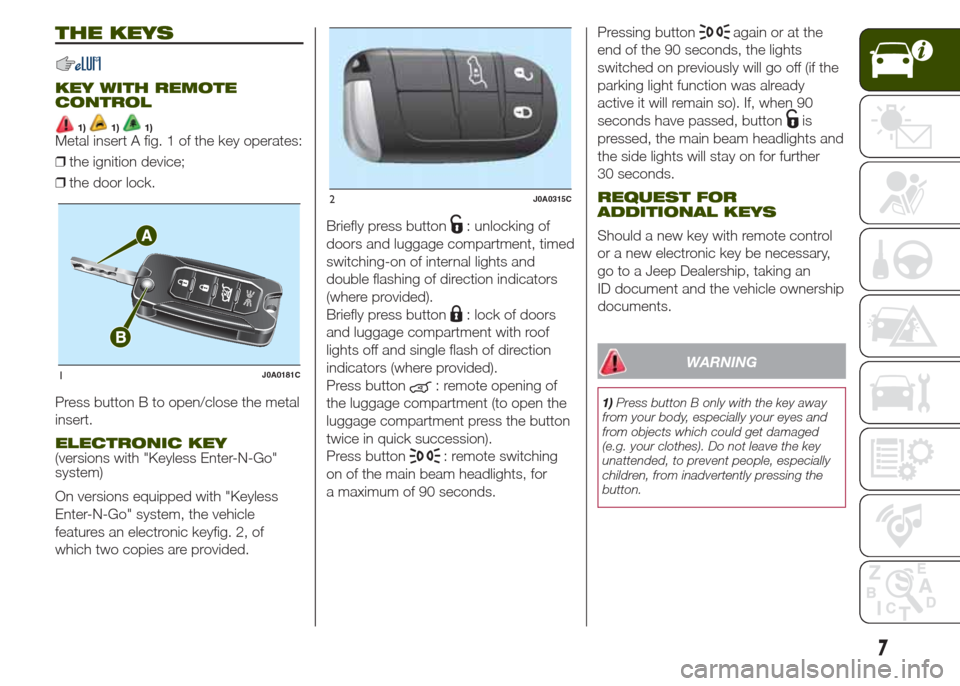
1)1)1)Metal insert A fig. 1 of the key operates:
❒the ignition device;
❒the door lock.
Press button B to open/close the metal
insert.
ELECTRONIC KEY(versions with "Keyless Enter-N-Go"
system)
On versions equipped with "Keyless
Enter-N-Go" system, the vehicle
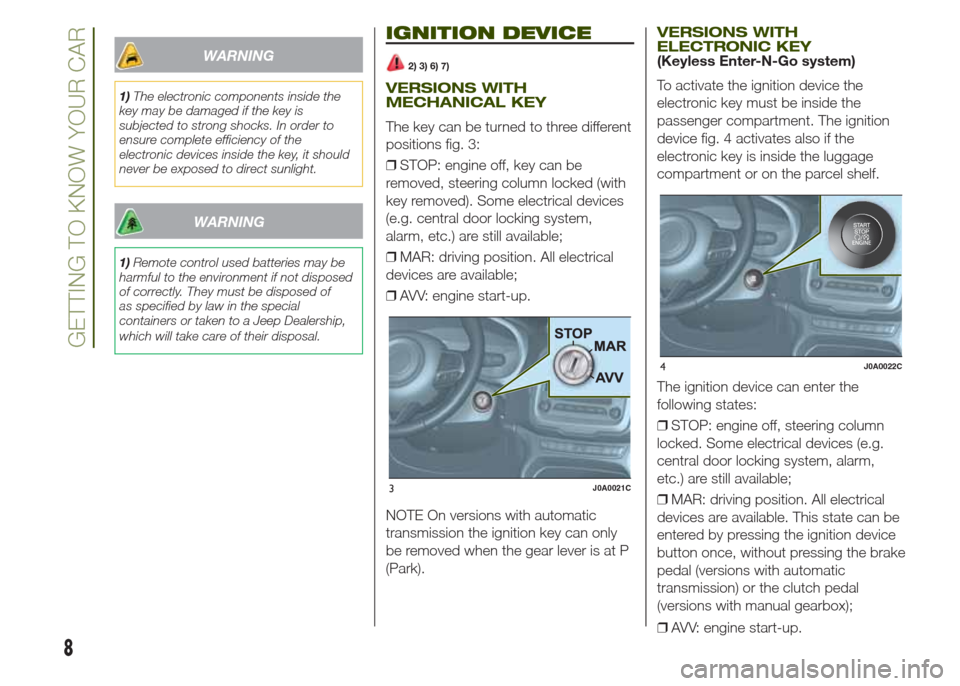
features an electronic keyfig. 2, of
which two copies are provided.Briefly press button
: unlocking of
doors and luggage compartment, timed
switching-on of internal lights and
double flashing of direction indicators
(where provided).
Briefly press button
: lock of doors
and luggage compartment with roof
lights off and single flash of direction
indicators (where provided).
Press button
: remote opening of
the luggage compartment (to open the
luggage compartment press the button
twice in quick succession).
Press button
: remote switching
on of the main beam headlights, for
a maximum of 90 seconds.Pressing button
again or at the
end of the 90 seconds, the lights
switched on previously will go off (if the
parking light function was already
active it will remain so). If, when 90
seconds have passed, button
is
pressed, the main beam headlights and
the side lights will stay on for further
30 seconds.
REQUEST FOR
ADDITIONAL KEYS
Should a new key with remote control
or a new electronic key be necessary,
go to a Jeep Dealership, taking an
ID document and the vehicle ownership
documents.
WARNING
1)Press button B only with the key away
from your body, especially your eyes and
from objects which could get damaged
(e.g. your clothes). Do not leave the key
unattended, to prevent people, especially
children, from inadvertently pressing the
button.
1J0A0181C
2J0A0315C
7
Page 10 of 212
WARNING
1)The electronic components inside the
key may be damaged if the key is
subjected to strong shocks. In order to
ensure complete efficiency of the
electronic devices inside the key, it should
never be exposed to direct sunlight.
WARNING
1)Remote control used batteries may be
harmful to the environment if not disposed
of correctly. They must be disposed of
as specified by law in the special
containers or taken to a Jeep Dealership,
which will take care of their disposal.
IGNITION DEVICE
2) 3) 6) 7)
VERSIONS WITH
MECHANICAL KEY
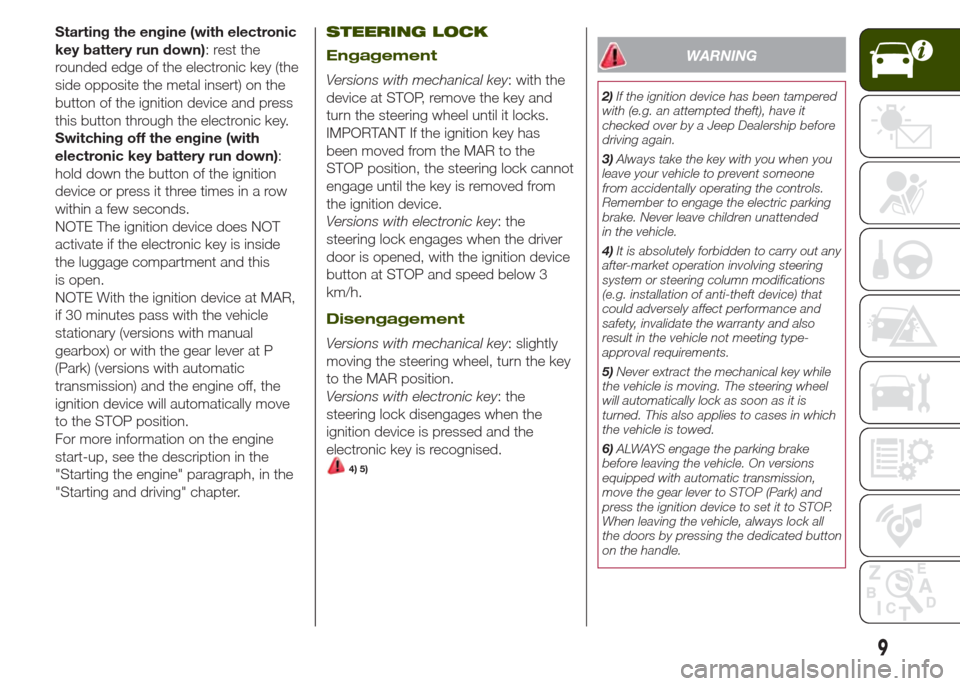
The key can be turned to three different
positions fig. 3:
❒STOP: engine off, key can be
removed, steering column locked (with
key removed). Some electrical devices
(e.g. central door locking system,
alarm, etc.) are still available;
❒MAR: driving position. All electrical
devices are available;
❒AVV: engine start-up.
NOTE On versions with automatic
transmission the ignition key can only
be removed when the gear lever is at P
(Park).
VERSIONS WITH
ELECTRONIC KEY
(Keyless Enter-N-Go system)
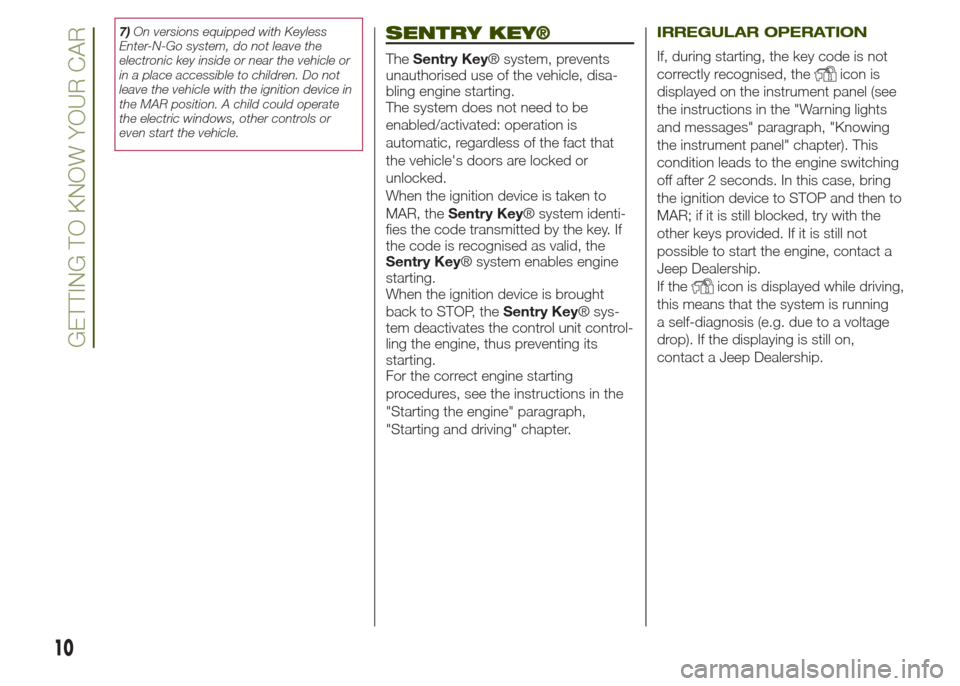
To activate the ignition device the
electronic key must be inside the
passenger compartment. The ignition
device fig. 4 activates also if the
electronic key is inside the luggage
compartment or on the parcel shelf.
The ignition device can enter the
following states:
❒STOP: engine off, steering column
locked. Some electrical devices (e.g.
central door locking system, alarm,
etc.) are still available;
❒MAR: driving position. All electrical
devices are available. This state can be
entered by pressing the ignition device
button once, without pressing the brake
pedal (versions with automatic
transmission) or the clutch pedal
(versions with manual gearbox);
3J0A0021C
4J0A0022C
8
GETTING TO KNOW YOUR CAR
❒AVV: engine start-up.
Page 11 of 212
Starting the engine (with electronic
key battery run down): rest the
rounded edge of the electronic key (the
side opposite the metal insert) on the
button of the ignition device and press
this button through the electronic key.
Switching off the engine (with
electronic key battery run down):
hold down the button of the ignition
device or press it three times in a row
within a few seconds.
NOTE The ignition device does NOT
activate if the electronic key is inside
the luggage compartment and this
is open.
NOTE With the ignition device at MAR,
if 30 minutes pass with the vehicle
stationary (versions with manual
gearbox) or with the gear lever at P
(Park) (versions with automatic
transmission) and the engine off, the
ignition device will automatically move
to the STOP position.
For more information on the engine
start-up, see the description in the
"Starting the engine" paragraph, in the
"Starting and driving" chapter.STEERING LOCK
Engagement
Versions with mechanical key: with the
device at STOP, remove the key and
turn the steering wheel until it locks.
IMPORTANT If the ignition key has
been moved from the MAR to the
STOP position, the steering lock cannot
engage until the key is removed from
the ignition device.
Versions with electronic key: the
steering lock engages when the driver
door is opened, with the ignition device
button at STOP and speed below 3
km/h.
Disengagement
Versions with mechanical key: slightly
moving the steering wheel, turn the key
to the MAR position.
Versions with electronic key: the
steering lock disengages when the
ignition device is pressed and the
electronic key is recognised.
4) 5)
WARNING
2)If the ignition device has been tampered
with (e.g. an attempted theft), have it
checked over by a Jeep Dealership before
driving again.
3)Always take the key with you when you
leave your vehicle to prevent someone
from accidentally operating the controls.
Remember to engage the electric parking
brake. Never leave children unattended
in the vehicle.
4)It is absolutely forbidden to carry out any
after-market operation involving steering
system or steering column modifications
(e.g. installation of anti-theft device) that
could adversely affect performance and
safety, invalidate the warranty and also
result in the vehicle not meeting type-
approval requirements.
5)Never extract the mechanical key while
the vehicle is moving. The steering wheel
will automatically lock as soon as it is
turned. This also applies to cases in which
the vehicle is towed.
6)ALWAYS engage the parking brake
before leaving the vehicle. On versions
equipped with automatic transmission,
move the gear lever to STOP (Park) and
press the ignition device to set it to STOP.
When leaving the vehicle, always lock all
the doors by pressing the dedicated button
on the handle.
9
Page 12 of 212
7)On versions equipped with Keyless
Enter-N-Go system, do not leave the
electronic key inside or near the vehicle or
in a place accessible to children. Do not
leave the vehicle with the ignition device in
the MAR position. A child could operate
the electric windows, other controls or
even start the vehicle.SENTRY KEY®
TheSentry Key® system, prevents
unauthorised use of the vehicle, disa-
bling engine starting.
The system does not need to be
enabled/activated: operation is
automatic, regardless of the fact that
the vehicle's doors are locked or
unlocked.
When the ignition device is taken to
MAR, theSentry Key® system identi-
fies the code transmitted by the key. If
the code is recognised as valid, the
Sentry Key® system enables engine
starting.
When the ignition device is brought
back to STOP, theSentry Key® sys-
tem deactivates the control unit control-
ling the engine, thus preventing its
starting.
For the correct engine starting
procedures, see the instructions in the
"Starting the engine" paragraph,
"Starting and driving" chapter.
IRREGULAR OPERATION
If, during starting, the key code is not
correctly recognised, the
icon is
displayed on the instrument panel (see
the instructions in the "Warning lights
and messages" paragraph, "Knowing
the instrument panel" chapter). This
condition leads to the engine switching
off after 2 seconds. In this case, bring
the ignition device to STOP and then to
MAR; if it is still blocked, try with the
other keys provided. If it is still not
possible to start the engine, contact a
Jeep Dealership.
If the
icon is displayed while driving,
this means that the system is running
a self-diagnosis (e.g. due to a voltage
drop). If the displaying is still on,
contact a Jeep Dealership.
10
GETTING TO KNOW YOUR CAR
Page 13 of 212
ALARM
Activation of the alarm triggers the
acoustic warning and the direction
indicators.
IMPORTANT The alarm is adapted to
meet requirements in various countries.
SWITCHING ON THE
ALARM
With the doors, bonnet and tailgate
closed and the ignition device turned to
STOP, point the key with remote control
(or electronic key) towards the vehicle
and press and release button
.
Except for specific markets, the system
emits a visual and acoustic signal and
enables door locking.
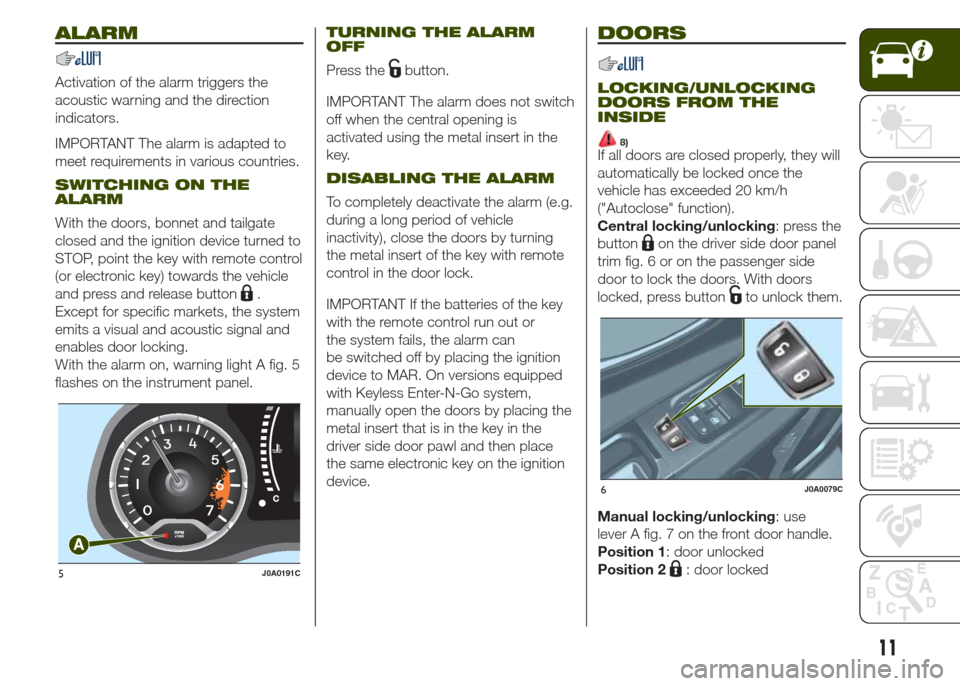
With the alarm on, warning light A fig. 5
flashes on the instrument panel.
TURNING THE ALARM
OFF
Press thebutton.
IMPORTANT The alarm does not switch
off when the central opening is
activated using the metal insert in the
key.
DISABLING THE ALARM
To completely deactivate the alarm (e.g.
during a long period of vehicle
inactivity), close the doors by turning
the metal insert of the key with remote
control in the door lock.
IMPORTANT If the batteries of the key
with the remote control run out or
the system fails, the alarm can
be switched off by placing the ignition
device to MAR. On versions equipped
with Keyless Enter-N-Go system,
manually open the doors by placing the
metal insert that is in the key in the
driver side door pawl and then place
the same electronic key on the ignition
device.
DOORS
LOCKING/UNLOCKING
DOORS FROM THE
INSIDE
8)If all doors are closed properly, they will
automatically be locked once the
vehicle has exceeded 20 km/h
("Autoclose" function).
Central locking/unlocking: press the
button
on the driver side door panel
trim fig. 6 or on the passenger side
door to lock the doors. With doors
locked, press button
to unlock them.
Manual locking/unlocking: use
lever A fig. 7 on the front door handle.
Position 1: door unlocked
Position 2
: door locked5J0A0191C
6J0A0079C
11
Page 16 of 212
WARNING
8)NEVER leave children unattended inside
the vehicle, let alone leave the vehicle
with the doors unlocked in a place that
children can access easily. Children may
seriously, or even fatally, injure themselves.
Also ensure that children do not
inadvertently operate the electric parking
brake, the brake pedal or the automatic
transmission lever.
9)Always use this device when carrying
children. After engaging the device on both
rear doors, check for proper engagement
by trying to open a rear door with the
internal handle.
10)Once the Dead Lock device has been
actuated, doors cannot be opened from
inside; for this reason, make sure there are
no persons left inside the vehicle.
WARNING
2)Make sure to take the key with you once
a door or the tailgate is locked, to prevent
locking the same key inside the vehicle.
Once it has been left inside, the key can be
collected only using the second key
supplied with the vehicle.3)The operation of the recognition system
depends on various factors, such as, for
example, any electromagnetic wave
interference from external sources (e.g.
mobile phones), the charge of the battery
in the electronic key and the presence
of metal objects near the key or the vehicle.
In these cases it is still possible to unlock
the doors by using the metal insert in
the electronic key (see description on the
following pages).
SEATS
FRONT SEATS WITH
MANUAL ADJUSTMENT
11)4)
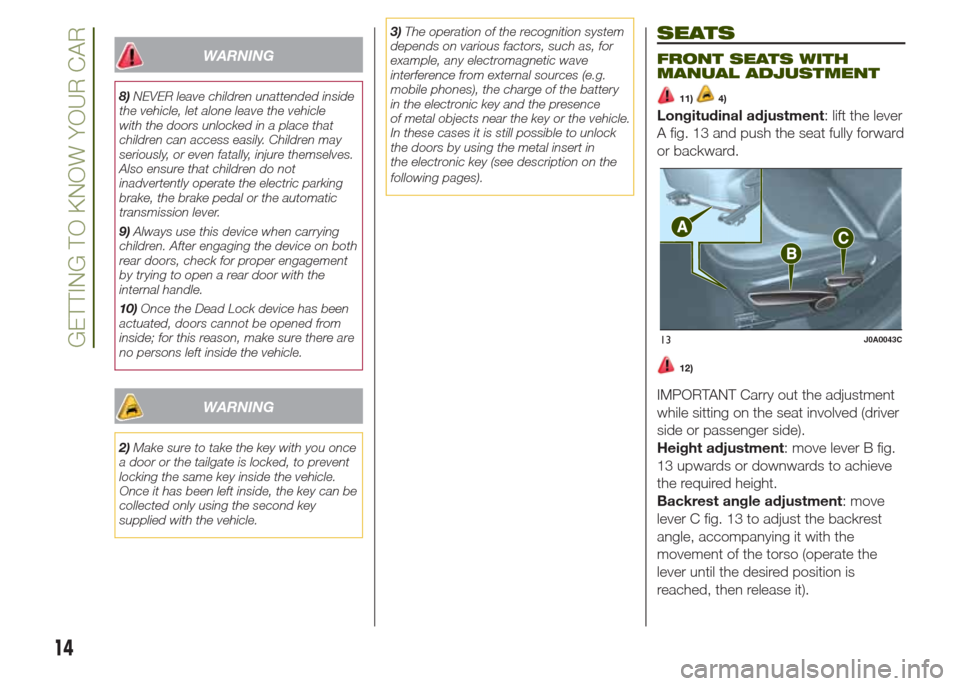
Longitudinal adjustment: lift the lever
A fig. 13 and push the seat fully forward
or backward.
12)
IMPORTANT Carry out the adjustment
while sitting on the seat involved (driver
side or passenger side).
Height adjustment: move lever B fig.
13 upwards or downwards to achieve
the required height.
Backrest angle adjustment: move
lever C fig. 13 to adjust the backrest
angle, accompanying it with the
movement of the torso (operate the
lever until the desired position is
reached, then release it).
13J0A0043C
14
GETTING TO KNOW YOUR CAR