engine coolant JEEP RENEGADE 2015 1.G User Guide
[x] Cancel search | Manufacturer: JEEP, Model Year: 2015, Model line: RENEGADE, Model: JEEP RENEGADE 2015 1.GPages: 678, PDF Size: 29.84 MB
Page 324 of 678
Turbo engine below -20°F (-29°C) and for the 2.4L engine
below -29°F (-34°C) and is recommended for the 2.4L
engine below -20°F (-29°C).
Extended Park Starting
NOTE:An extended park condition occurs when the
vehicle has not been started or driven for at least 35 days.
1. Install a battery charger or jumper cables to the battery
to ensure a full battery charge during the crank cycle.
2. Cycle the ignition in the AVV/START position and
release it when the engine starts.
3. If the engine fails to start within ten seconds, cycle the
ignition to the STOP/OFF position, wait 10-15 seconds
to allow the starter to cool, then repeat the Extended
Park Starting procedure.
4. If the engine fails to start after eight attempts, allow
the starter to cool for at least 10 minutes, then repeat
the procedure.
CAUTION!
To prevent damage to the starter, do not continuously
crank the engine for more than 10 seconds at a time.
Wait 10 to 15 seconds before trying again.
Warming Up The Engine
Proceed as follows:
•Travel slowly, letting the engine run at a reduced RPM,
without accelerating suddenly.
•It is recommended to wait until the engine coolant
temperature gauge starts to rise for maximum perfor-
mance.
322 STARTING AND OPERATING
Page 326 of 678
on the type of driving and the amount of cargo, the pump
will run for up to 10 minutes after the engine has been
shut off to circulate coolant through the turbocharger.
Although the pump is rubber-mounted for quiet opera-
tion, it is normal to hear it running during this time.
ENGINE BREAK-IN RECOMMENDATIONS
A long break-in period is not required for the engine and
drivetrain (transmission and axle) in your vehicle.
Drive moderately during the first 300 miles (500 km).
After the initial 60 miles (100 km), speeds up to 50 or
55 mph (80 or 90 km/h) are desirable.
While cruising, brief full-throttle acceleration within the
limits of local traffic laws contributes to a good break-in.
Wide-open throttle acceleration in low gear can be detri-
mental and should be avoided.
The engine oil installed in the engine at the factory is a
high-quality energy conserving type lubricant. Oil
changes should be consistent with anticipated climate
conditions under which vehicle operations will occur. For
the recommended viscosity and quality grades, refer to
“Maintenance Procedures” in “Maintaining And Caring
For Your Vehicle.”
CAUTION!
Never use Non-Detergent Oil or Straight Mineral Oil
in the engine or damage may result.
NOTE:A new engine may consume some oil during its
first few thousand miles (kilometers) of operation. This
should be considered a normal part of the break-in and
not interpreted as a problem.
324 STARTING AND OPERATING
Page 500 of 678
IF YOUR ENGINE OVERHEATS
In any of the following situations, you can reduce the
potential for overheating your engine by taking the
appropriate action.
•On the highways — slow down.
•In city traffic — while stopped, put transmission in
NEUTRAL, but do not increase engine idle speed.
CAUTION!
Driving with a hot cooling system could damage
your vehicle. If the temperature gauge reads “H,”
pull over and stop the vehicle. Idle the vehicle with
the air conditioner turned off until the pointer drops
back into the normal range. If the pointer remains on
the “H” and you hear continuous chimes, turn the
engine off immediately and call for service.
NOTE:There are steps that you can take to slow down
an impending overheat condition:
•If your air conditioner (A/C) is on, turn it off. The A/C
system adds heat to the engine cooling system and
turning the A/C off can help remove this heat.
•You can also turn the temperature control to maximum
heat, the mode control to floor and the blower control
to high. This allows the heater core to act as a
supplement to the radiator and aids in removing heat
from the engine cooling system.
WARNING!
You or others can be badly burned by hot engine
coolant (antifreeze) or steam from your radiator. If
you see or hear steam coming from under the hood,
do not open the hood until the radiator has had time
to cool. Never try to open a cooling system pressure
cap when the radiator or coolant bottle is hot.
498 IN CASE OF EMERGENCY
Page 519 of 678
Once A Month Or Before A Long Trip:
•Check engine oil level.
•Check windshield washer fluid level.
•Check the tire inflation pressures and look for unusual
wear or damage.
•Check the fluid levels of the coolant reservoir, and
brake master cylinder reservoir, and fill as needed.
•Check function of all interior and exterior lights.
Required Maintenance Intervals.
Refer to the “Maintenance Schedules” on the following
page for the required maintenance intervals.
At Every Oil Change Interval As Indicated By Oil
Change Indicator System:
Change oil and filter.
Inspect battery and clean and tighten terminals as
required.
Inspect brake pads, shoes, rotors, drums, and hoses.
Inspect engine cooling system protection and hoses.
Check and adjust hand brake.
Inspect exhaust system.
Inspect engine air cleaner if using in dusty or off-road
conditions.
9
MAINTAINING AND CARING FOR YOUR VEHICLE 517
Page 526 of 678
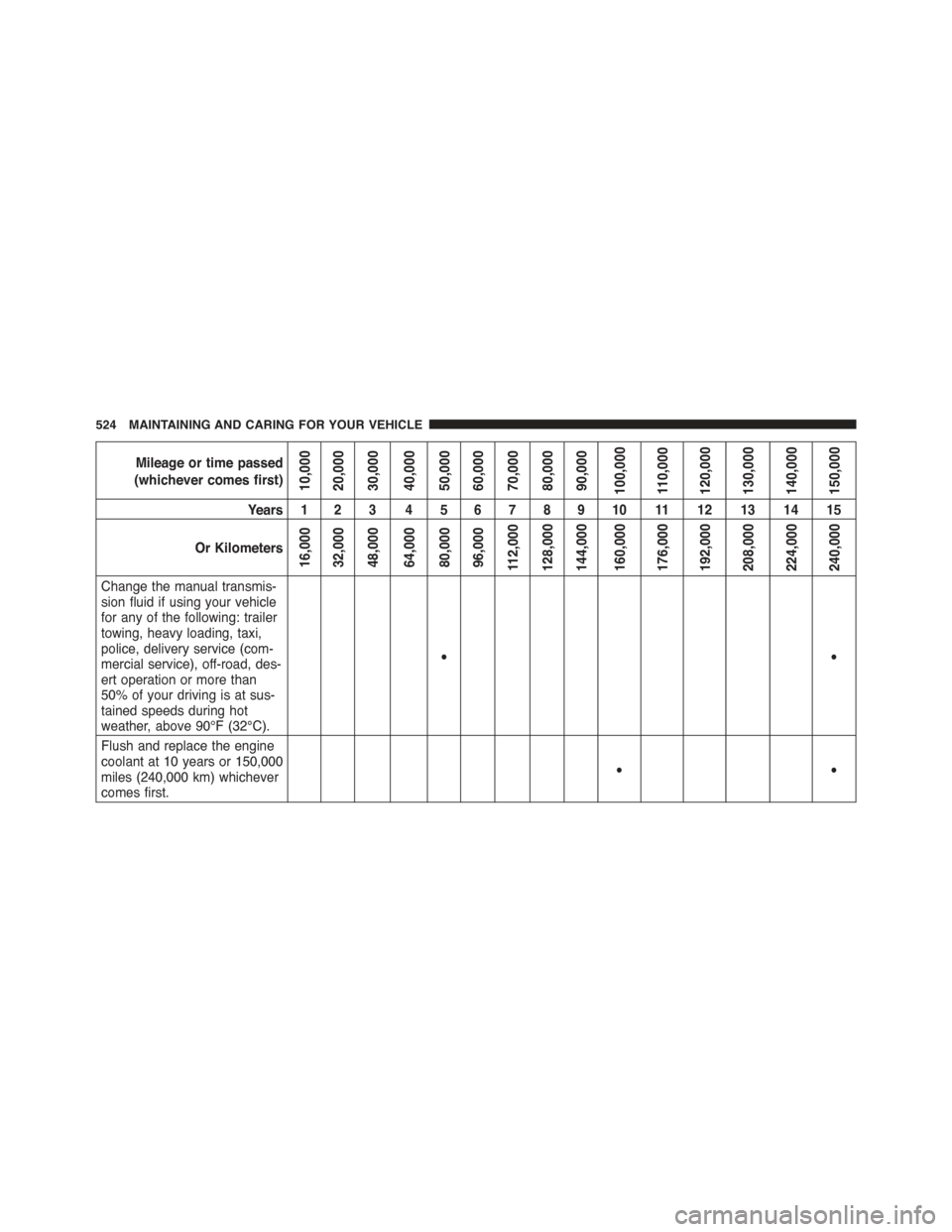
Mileage or time passed
(whichever comes first)10,00020,00030,00040,00050,00060,00070,00080,00090,000100,000110,000120,000130,000140,000150,000
Years 1 2 3 4 5 6 7 8 9 10 11 12 13 14 15
Or Kilometers16,00032,00048,00064,00080,00096,000112,000128,000144,000160,000176,000192,000208,000224,000240,000
Change the manual transmis-sion fluid if using your vehiclefor any of the following: trailertowing, heavy loading, taxi,police, delivery service (com-mercial service), off-road, des-ert operation or more than50% of your driving is at sus-tained speeds during hotweather, above 90°F (32°C).
••
Flush and replace the enginecoolant at 10 years or 150,000miles (240,000 km) whichevercomes first.
••
524 MAINTAINING AND CARING FOR YOUR VEHICLE
Page 529 of 678
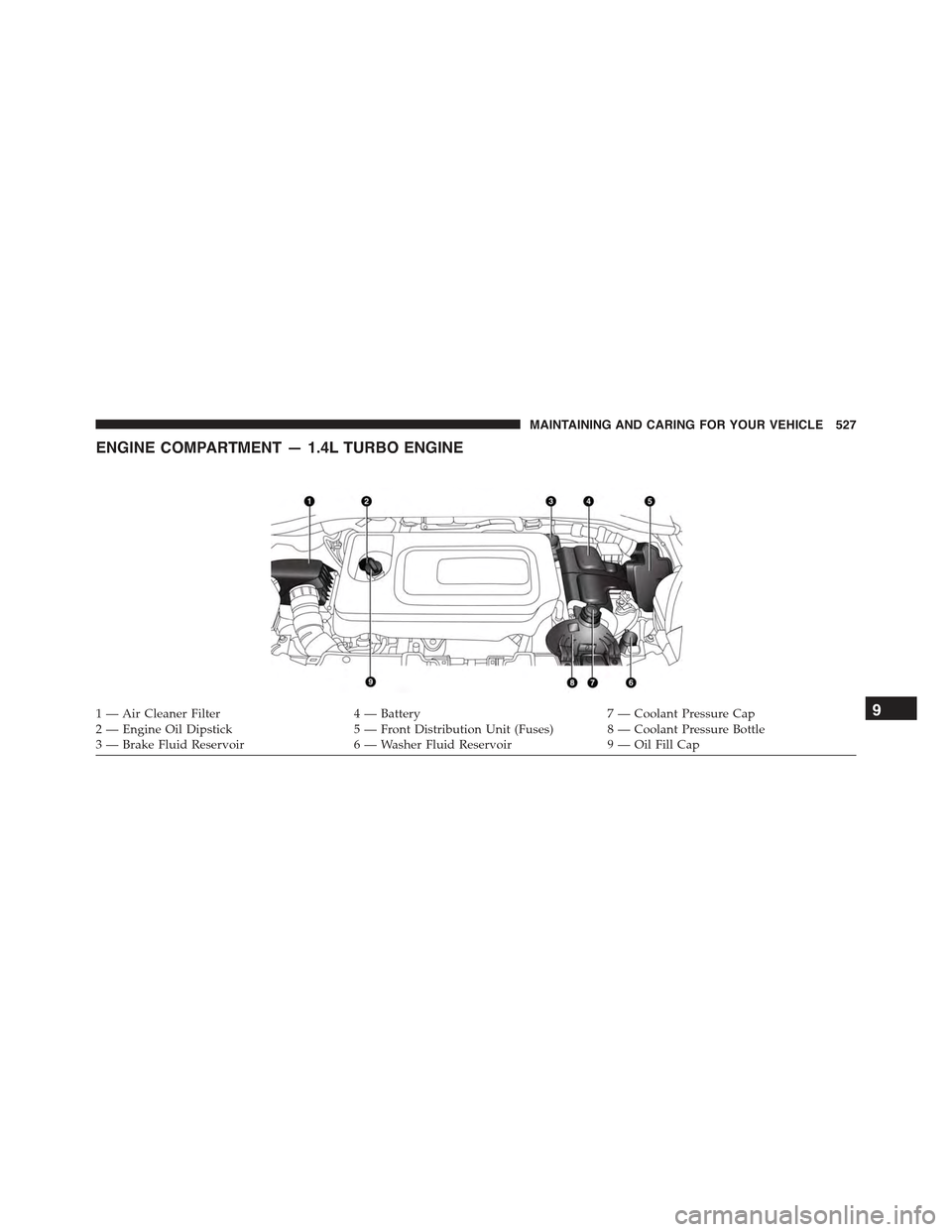
ENGINE COMPARTMENT — 1.4L TURBO ENGINE
1 — Air Cleaner Filter4 — Battery7 — Coolant Pressure Cap2 — Engine Oil Dipstick5 — Front Distribution Unit (Fuses) 8 — Coolant Pressure Bottle3 — Brake Fluid Reservoir6 — Washer Fluid Reservoir9 — Oil Fill Cap
9
MAINTAINING AND CARING FOR YOUR VEHICLE 527
Page 530 of 678
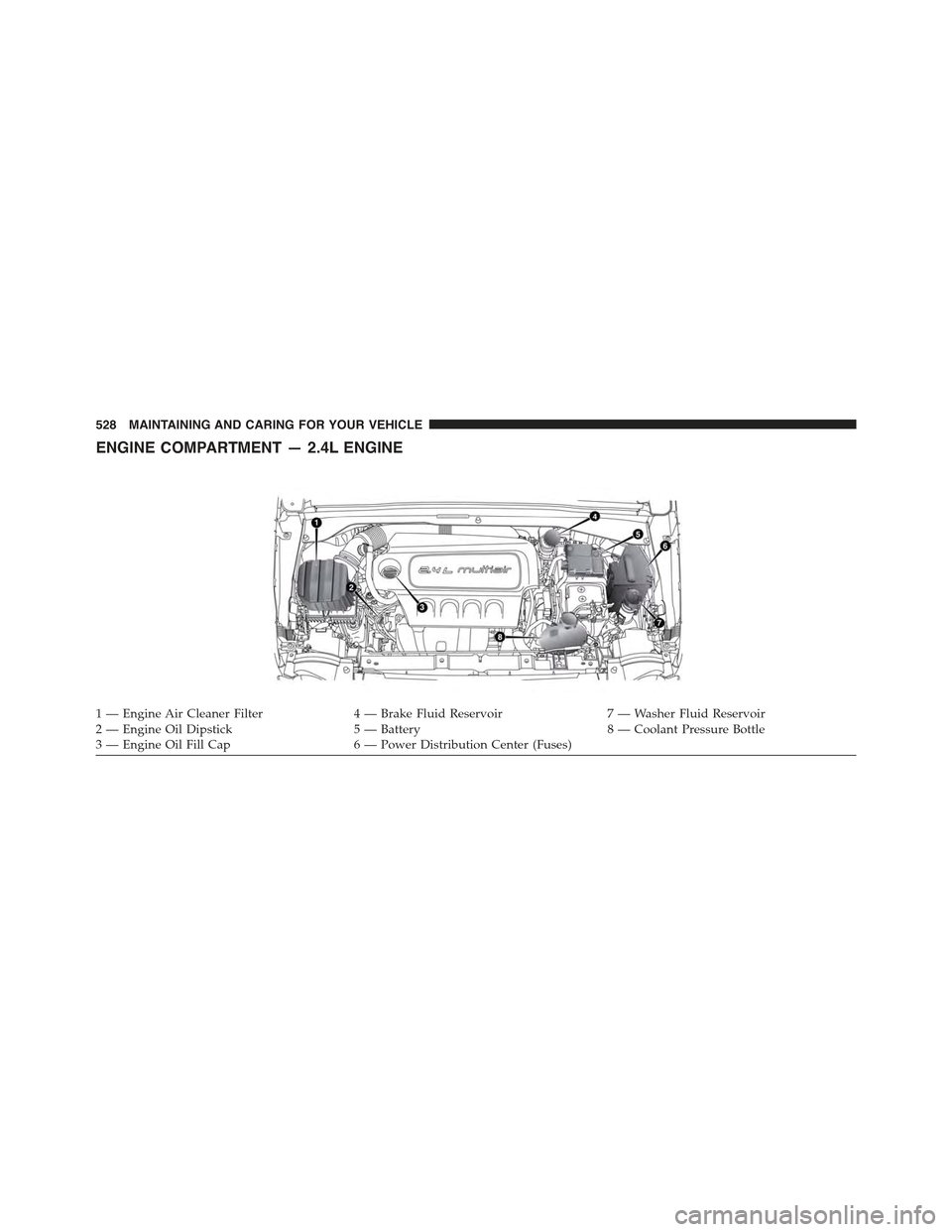
ENGINE COMPARTMENT — 2.4L ENGINE
1 — Engine Air Cleaner Filter4 — Brake Fluid Reservoir7 — Washer Fluid Reservoir2 — Engine Oil Dipstick5 — Battery8 — Coolant Pressure Bottle3 — Engine Oil Fill Cap6 — Power Distribution Center (Fuses)
528 MAINTAINING AND CARING FOR YOUR VEHICLE
Page 541 of 678
Rear Wiper Blade Removal/Installation
1. Carefully lift the rear wiper arm upward to raise the
wiper blade off of the liftgate glass.
2. Grab and hold the wiper arm closest to the wiper
blade end while pushing the wiper blade towards the
liftgate glass to unsnap the blade pivot pin from the
wiper blade holder on the wiper arm.
3. Install the wiper blade pivot pin into the wiper blade
holder at the end of the wiper arm, and firmly push
the wiper blade until it snaps into place.
Adding Washer Fluid
The windshield washer fluid reservoir is located in the
engine compartment, and the fluid level should be
checked at regular intervals. Fill the reservoir with wind-
shield washer solvent (not engine coolant/ antifreeze).
Refer to “Engine Compartment” in this section for fur-
ther information.
WARNING!
Commercially available windshield washer solvents
are flammable. They could ignite and burn you. Care
must be exercised when filling or working around
the washer solution.
Exhaust System
The best protection against carbon monoxide entry into
the vehicle body is a properly maintained engine exhaust
system.
If you notice a change in the sound of the exhaust system;
or if the exhaust fumes can be detected inside the vehicle;
or when the underside or rear of the vehicle is damaged;
9
MAINTAINING AND CARING FOR YOUR VEHICLE 539
Page 544 of 678
•Do not idle the engine with any spark plug wires
disconnected or removed, such as when diagnostic
testing, or for prolonged periods during very rough
idle or malfunctioning operating conditions.
Cooling System
WARNING!
•When working near the radiator cooling fan, dis-
connect the fan motor lead or turn the ignition
switch to the OFF position. The fan is temperature
controlled and can start at any time the ignition
switch is in the ON position.
•You or others can be badly burned by hot engine
coolant (antifreeze) or steam from your radiator. If
you see or hear steam coming from under the hood,
do not open the hood until the radiator has had
time to cool. Never try to open a cooling system
pressure cap when the radiator is hot.
Coolant Checks
Check engine coolant (antifreeze) protection every 12
months (before the onset of freezing weather, where
applicable). If the engine coolant (antifreeze) is dirty or
rusty in appearance, the system should be drained,
flushed and refilled with fresh engine coolant (anti-
freeze). Check the front of the A/C condenser for any
accumulation of bugs, leaves, etc. If dirty, clean by gently
spraying water from a garden hose vertically down the
face of the condenser.
Cooling System — Drain, Flush And Refill
NOTE:Some vehicles require special tools to add coolant
properly. Failure to fill these systems properly could lead
to severe internal engine damage. If any coolant is
needed to be added to the system please contact your
local authorized dealer.
542 MAINTAINING AND CARING FOR YOUR VEHICLE
Page 545 of 678
If the engine coolant (antifreeze) is dirty or contains
visible sediment, have an authorized dealer clean and
flush with OAT coolant (antifreeze) (conforming to
MS.90032).
Refer to the “Maintenance Schedule” for the proper
maintenance intervals.
Selection Of Coolant
Refer to “Fluids, Lubricants, and Genuine Parts” in the
“Technical Data” section for further information.
CAUTION!
•Mixing of engine coolant (antifreeze) other than
specified Organic Additive Technology (OAT) en-
gine coolant (antifreeze), may result in engine
damage and may decrease corrosion protection.
Organic Additive Technology (OAT) engine cool-
ant is different and should not be mixed with
Hybrid Organic Additive Technology (HOAT) en-
gine coolant (antifreeze) or any “globally compat-
ible” coolant (antifreeze). If a non-OAT engine
coolant (antifreeze) is introduced into the cooling
system in an emergency, the cooling system will
need to be drained, flushed, and refilled with fresh
OAT coolant (conforming to MS.90032), by an au-
thorized dealer as soon as possible.
(Continued)
9
MAINTAINING AND CARING FOR YOUR VEHICLE 543