warning light JEEP RENEGADE 2015 1.G Owner's Manual
[x] Cancel search | Manufacturer: JEEP, Model Year: 2015, Model line: RENEGADE, Model: JEEP RENEGADE 2015 1.GPages: 678, PDF Size: 29.84 MB
Page 198 of 678
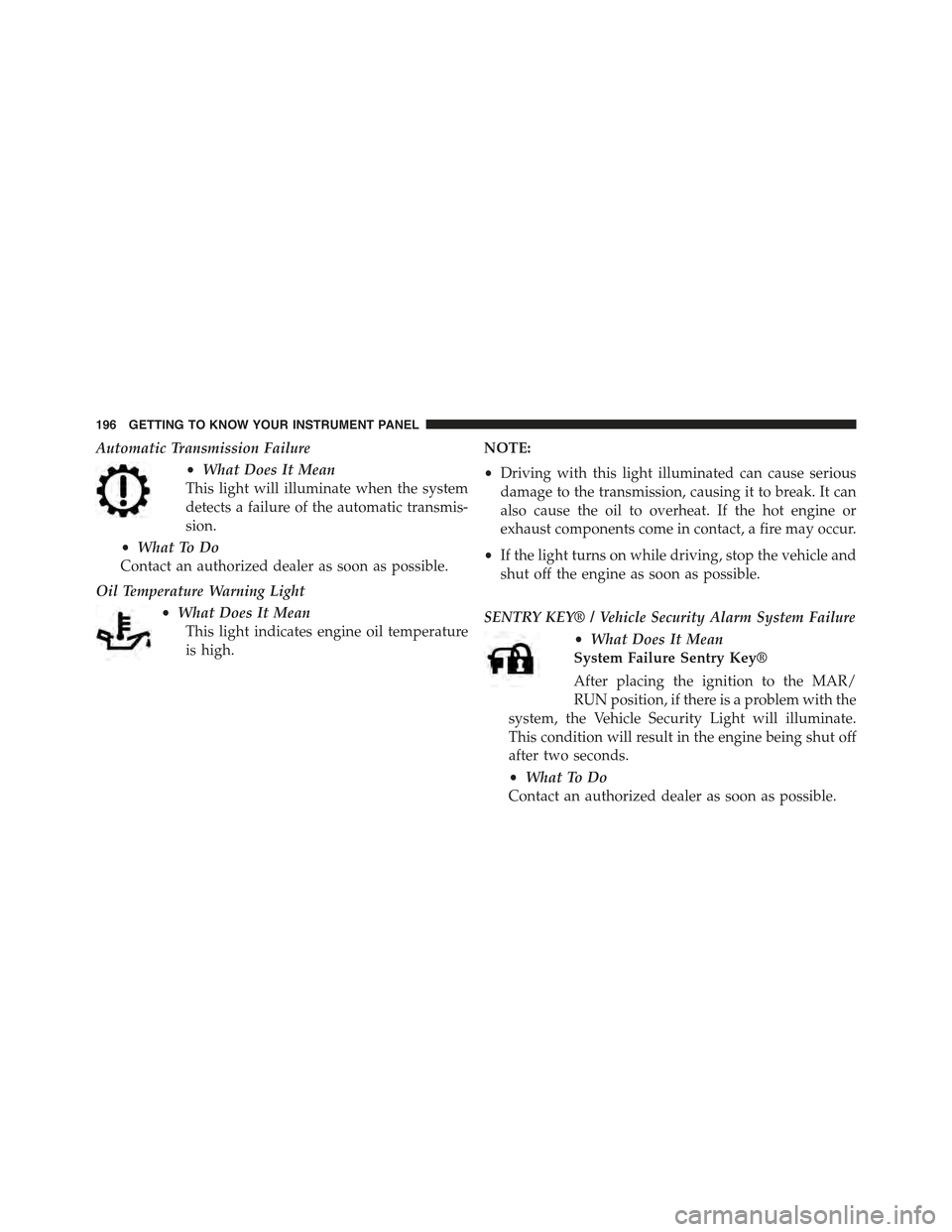
Automatic Transmission Failure
•What Does It Mean
This light will illuminate when the system
detects a failure of the automatic transmis-
sion.
•What To Do
Contact an authorized dealer as soon as possible.
Oil Temperature Warning Light
•What Does It Mean
This light indicates engine oil temperature
is high.
NOTE:
•Driving with this light illuminated can cause serious
damage to the transmission, causing it to break. It can
also cause the oil to overheat. If the hot engine or
exhaust components come in contact, a fire may occur.
•If the light turns on while driving, stop the vehicle and
shut off the engine as soon as possible.
SENTRY KEY® / Vehicle Security Alarm System Failure
•What Does It Mean
System Failure Sentry Key®
After placing the ignition to the MAR/
RUN position, if there is a problem with the
system, the Vehicle Security Light will illuminate.
This condition will result in the engine being shut off
after two seconds.
•What To Do
Contact an authorized dealer as soon as possible.
196 GETTING TO KNOW YOUR INSTRUMENT PANEL
Page 202 of 678
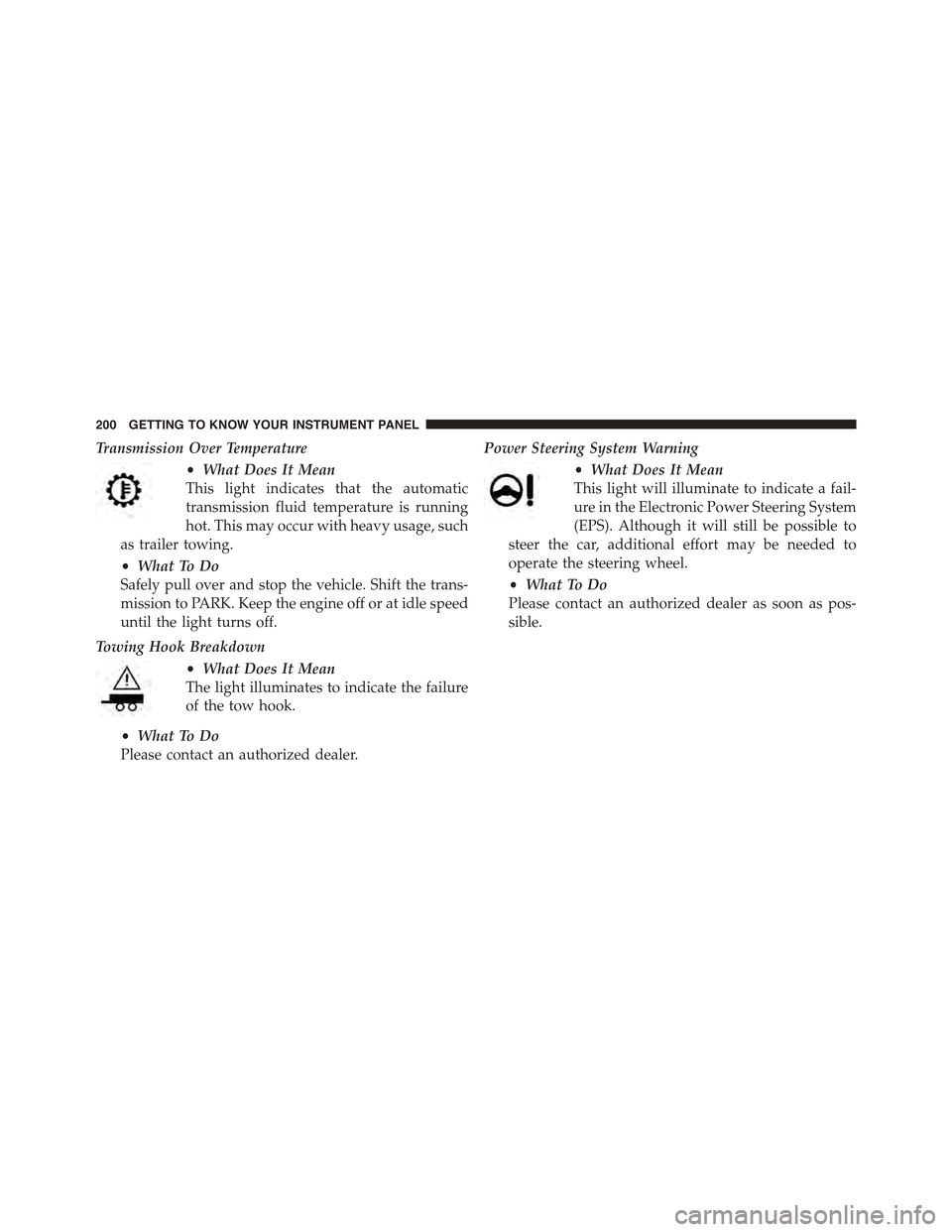
Transmission Over Temperature
•What Does It Mean
This light indicates that the automatic
transmission fluid temperature is running
hot. This may occur with heavy usage, such
as trailer towing.
•What To Do
Safely pull over and stop the vehicle. Shift the trans-
mission to PARK. Keep the engine off or at idle speed
until the light turns off.
Towing Hook Breakdown
•What Does It Mean
The light illuminates to indicate the failure
of the tow hook.
•What To Do
Please contact an authorized dealer.
Power Steering System Warning
•What Does It Mean
This light will illuminate to indicate a fail-
ure in the Electronic Power Steering System
(EPS). Although it will still be possible to
steer the car, additional effort may be needed to
operate the steering wheel.
•What To Do
Please contact an authorized dealer as soon as pos-
sible.
200 GETTING TO KNOW YOUR INSTRUMENT PANEL
Page 215 of 678
Restore Default Settings
Selecting this item, and you can reset and restore the
default settings.
Vehicle Setup
This menu item allows you to change the settings for the
following:
•Display
•Units of measure
•Clock and Data
•Safety
•Safety and Assistance
•Lights
•Doors and Locks
•Compass (If Equipped)
Vehicles Equipped With Multifunctional Display
Reconfigurable:Menu items#Display#(you can select
only the items#See Phone#and#See Navigation,##Secu-
rity,#and#Safety & Assistance#(only#Volume Alerts#is
selectable) are present.
All other entries are displayed and selected on the
display of the Uconnect® system.
“Display”
By selecting the#Display,#you can access the following
settings:
•Language: allows you to select the language in which
to display the information/warnings.
•See Phone:allows you to view, on the instrument
cluster display, the information relating to Phone
mode displayed on the display of the Uconnect®
system.
5
GETTING TO KNOW YOUR INSTRUMENT PANEL 213
Page 223 of 678
SAFETY
CONTENTS
!BRAKE SYSTEM.......................223
!ELECTRONIC BRAKE CONTROL SYSTEM . . . .224
▫Anti-Lock Brake System (ABS)............225
▫Traction Control System (TCS)............227
▫Brake Assist System (BAS)...............227
▫Electronic Roll Mitigation (ERM)..........228
▫Hill Start Assist (HSA).................229
▫Hill Descent Control (HDC) — If Equipped . . .231
▫Electronic Stability Control (ESC)..........233
▫ESC Activation/Malfunction Indicator Light And
ESC OFF Indicator Light................238
▫Trailer Sway Control (TSC)..............239
▫Ready Alert Braking (RAB)...............240
▫Dynamic Steering Torque (DST)...........240
▫Selec Speed Control (SSC) — If Equipped . . . .241
!FORWARD COLLISION WARNING (FCW) WITH
MITIGATION — IF EQUIPPED.............244
▫Forward Collision Warning (FCW) With
Mitigation Operation...................244
▫Turning FCW ON Or OFF...............247
6
Page 225 of 678
BRAKE SYSTEM
Your vehicle is equipped with dual hydraulic
brake systems. If either of the two hydraulic
systems loses normal capability, the remaining
system will still function. However, there will
be some loss of overall braking effectiveness. This will be
evident by increased pedal travel during application and
greater pedal force required to slow or stop the vehicle. In
addition, if the malfunction is caused by a leak in the
hydraulic system, the “Brake Warning Light” will turn on
as the brake fluid level drops in the master cylinder.
In the event power assist is lost for any reason (i.e.,
repeated brake applications with the engine OFF) the
brakes will still function. However, the effort required to
brake the vehicle will be much greater than that required
with the power system operating.
WARNING!
•Riding the brakes can lead to brake failure and
possibly a collision. Driving with your foot resting
or riding on the brake pedal can result in abnor-
mally high brake temperatures, excessive lining
wear, and possible brake damage. You would not
have your full braking capacity in an emergency.
•Driving a vehicle with the “Brake Warning Light”
on is dangerous. A significant decrease in braking
performance or vehicle stability during braking
may occur. It will take you longer to stop the
vehicle or will make your vehicle harder to control.
You could have a collision. Have the vehicle
checked immediately.
6
SAFETY 223
Page 226 of 678
ELECTRONIC BRAKE CONTROL SYSTEM
This system enhances directional control and stability of
the vehicle under various driving conditions. ESC cor-
rects for oversteering or understeering of the vehicle by
applying the brake of the appropriate wheel to assist in
counteracting the oversteer or understeer condition. En-
gine power may also be reduced to help the vehicle
maintain the desired path.
ESC uses sensors in the vehicle to determine the vehicle
path intended by the driver and compares it to the actual
path of the vehicle. When the actual path does not match
the intended path, ESC applies the brake of the appro-
priate wheel to assist in counteracting the oversteer or
understeer condition.
•Oversteer - when the vehicle is turning more than
appropriate for the steering wheel position.
•Understeer - when the vehicle is turning less than
appropriate for the steering wheel position.
The “ESC Activation/Malfunction Indicator Light” lo-
cated in the instrument cluster will start to flash as soon
as the tires lose traction and the ESC system becomes
active. The “ESC Activation/Malfunction Indicator
Light” also flashes when the TCS is active. If the “ESC
Activation/Malfunction Indicator Light” begins to flash
during acceleration, ease up on the accelerator and apply
as little throttle as possible. Be sure to adapt your speed
and driving to the prevailing road conditions.
WARNING!
The Electronic Stability Control (ESC) cannot pre-
vent the natural laws of physics from acting on the
vehicle, nor can it increase the traction afforded by
prevailing road conditions. ESC cannot prevent col-
lisions, including those resulting from excessive
speed in turns, driving on very slippery surfaces, or
(Continued)
224 SAFETY
Page 227 of 678
WARNING!(Continued)
hydroplaning. ESC also cannot prevent collisions
resulting from loss of vehicle control due to inappro-
priate driver input for the conditions. Only a safe,
attentive, and skillful driver can prevent collisions.
The capabilities of an ESC equipped vehicle must
never be exploited in a reckless or dangerous manner
which could jeopardize the user ’s safety or the safety
of others.
Anti-Lock Brake System (ABS)
The Anti-Lock Brake System (ABS) is designed to aid the
driver in maintaining vehicle control under adverse
braking conditions. The system operates with a separate
computer to modulate hydraulic pressure, to prevent
wheel lock-up and help avoid skidding on slippery
surfaces.
All vehicle wheels and tires must be the same size and
type, and tires must be properly inflated, to produce
accurate signals for the computer.
WARNING!
Significant over or under-inflation of tires or mixing
sizes of tires or wheels on the vehicle can lead to loss
of braking effectiveness.
The ABS conducts a low-speed self-test at approximately
12 mph (20 km/h). If you have your foot lightly on the
brake while this test is occurring, you may feel slight
pedal movement. The movement can be more apparent
on ice and snow. This is normal.
The ABS pump motor runs during the self-test at 12 mph
(20 km/h) and during an ABS stop. The pump motor
makes a low humming noise during operation, which is
normal.
6
SAFETY 225
Page 232 of 678
The following conditions must be met in order for HSA to
activate:
•The vehicle must be stopped.
•The vehicle must be on a 5% (approximate) grade or
greater hill.
•The gear selection must match vehicle uphill direction
(i.e., vehicle facing uphill is in forward gear; vehicle
backing uphill is in REVERSE gear).
•For vehicles equipped with an automatic transmission,
the HSA will work in REVERSE gear and all forward
gears. The system will not activate if the transmission
is in PARK.
WARNING!
There may be situations where the Hill Start Assist
(HSA) will not activate and slight rolling may occur,
such as on minor hills or with a loaded vehicle, or
while pulling a trailer. HSA is not a substitute for
active driving involvement. It is always the driver ’s
responsibility to be attentive to distance to other
vehicles, people, and objects, and most importantly
brake operation to ensure safe operation of the ve-
hicle under all road conditions. Your complete atten-
tion is always required while driving to maintain
safe control of your vehicle. Failure to follow these
warnings can result in a collision or serious personal
injury.
230 SAFETY
Page 236 of 678
ESC uses sensors in the vehicle to determine the vehicle
path intended by the driver and compares it to the actual
path of the vehicle. When the actual path does not match
the intended path, ESC applies the brake of the appro-
priate wheel to assist in counteracting the oversteer or
understeer condition.
•Oversteer - when the vehicle is turning more than
appropriate for the steering wheel position.
•Understeer - when the vehicle is turning less than
appropriate for the steering wheel position.
The “ESC Activation/Malfunction Indicator Light” lo-
cated in the instrument cluster will start to flash as soon
as the tires lose traction and the ESC system becomes
active. The “ESC Activation/Malfunction Indicator
Light” also flashes when the TCS is active. If the “ESC
Activation/Malfunction Indicator Light” begins to flash
during acceleration, ease up on the accelerator and apply
as little throttle as possible. Be sure to adapt your speed
and driving to the prevailing road conditions.
WARNING!
The Electronic Stability Control (ESC) cannot pre-
vent the natural laws of physics from acting on the
vehicle, nor can it increase the traction afforded by
prevailing road conditions. ESC cannot prevent col-
lisions, including those resulting from excessive
speed in turns, driving on very slippery surfaces, or
hydroplaning. ESC also cannot prevent collisions
resulting from loss of vehicle control due to inappro-
priate driver input for the conditions. Only a safe,
attentive, and skillful driver can prevent collisions.
The capabilities of an ESC equipped vehicle must
never be exploited in a reckless or dangerous manner
which could jeopardize the user ’s safety or the safety
of others.
234 SAFETY
Page 238 of 678
WARNING!
•When in “Partial Off” mode, the TCS functionality
of ESC, (except for the limited slip feature de-
scribed in the TCS section), has been disabled and
the “ESC Off Indicator Light” will be illuminated.
When in “Partial Off” mode, the engine power
reduction feature of TCS is disabled, and the
enhanced vehicle stability offered by the ESC sys-
tem is reduced.
•Trailer Sway control (TSC) is disabled when the
ESC system is in the “Partial Off” mode.
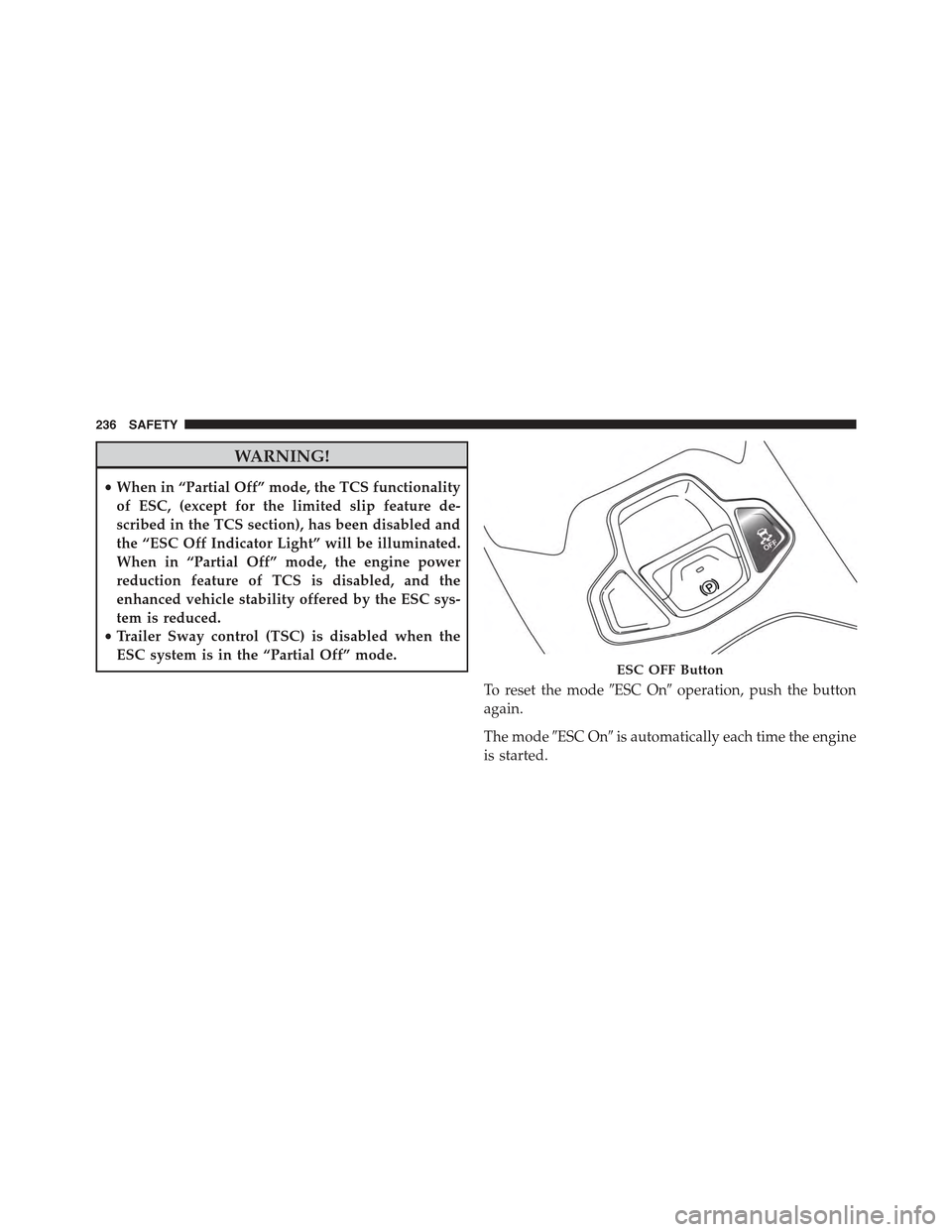
To reset the mode#ESC On#operation, push the button
again.
The mode#ESC On#is automatically each time the engine
is started.
ESC OFF Button
236 SAFETY