service JEEP RENEGADE 2015 1.G Repair Manual
[x] Cancel search | Manufacturer: JEEP, Model Year: 2015, Model line: RENEGADE, Model: JEEP RENEGADE 2015 1.GPages: 678, PDF Size: 29.84 MB
Page 482 of 678
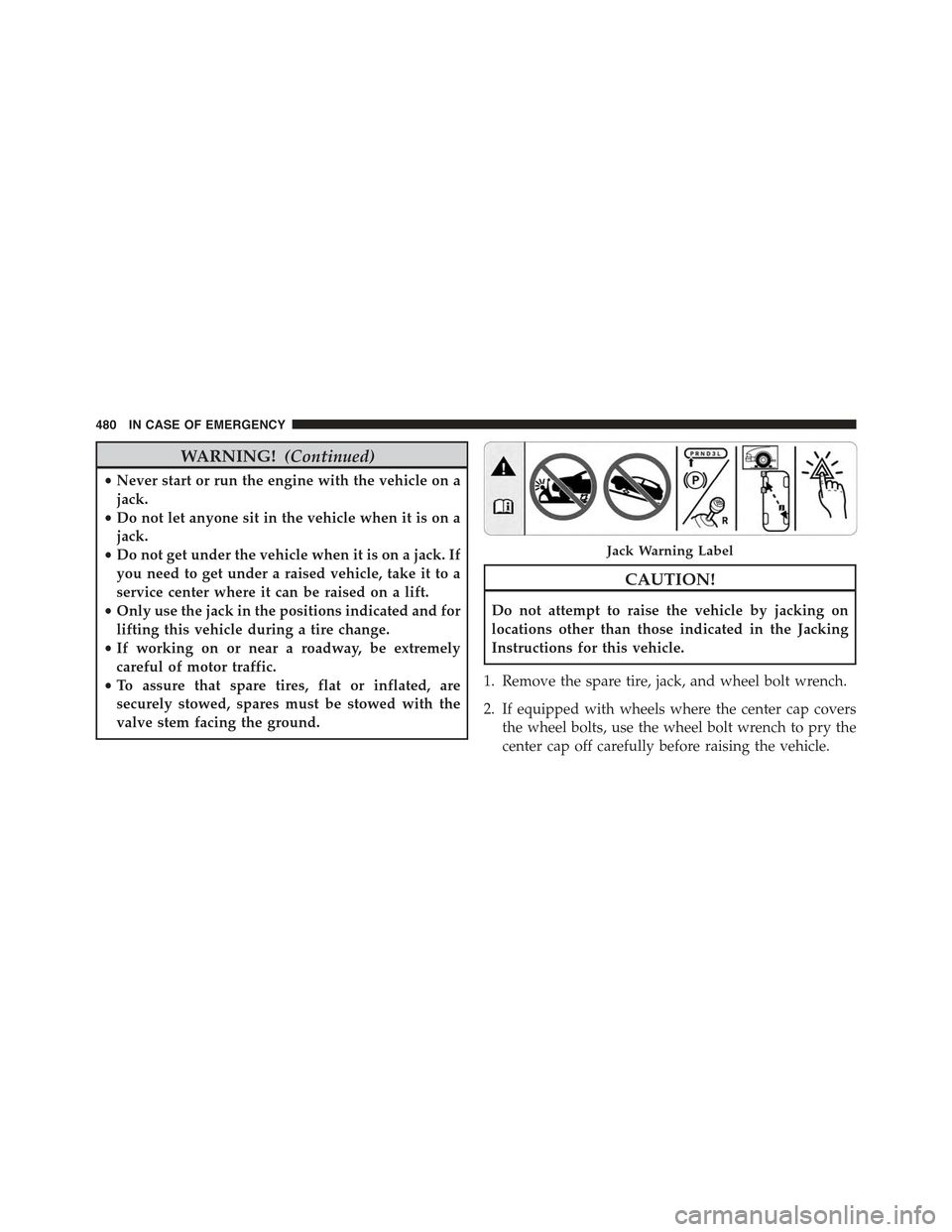
WARNING!(Continued)
•Never start or run the engine with the vehicle on a
jack.
•Do not let anyone sit in the vehicle when it is on a
jack.
•Do not get under the vehicle when it is on a jack. If
you need to get under a raised vehicle, take it to a
service center where it can be raised on a lift.
•Only use the jack in the positions indicated and for
lifting this vehicle during a tire change.
•If working on or near a roadway, be extremely
careful of motor traffic.
•To assure that spare tires, flat or inflated, are
securely stowed, spares must be stowed with the
valve stem facing the ground.
CAUTION!
Do not attempt to raise the vehicle by jacking on
locations other than those indicated in the Jacking
Instructions for this vehicle.
1. Remove the spare tire, jack, and wheel bolt wrench.
2. If equipped with wheels where the center cap covers
the wheel bolts, use the wheel bolt wrench to pry the
center cap off carefully before raising the vehicle.
Jack Warning Label
480 IN CASE OF EMERGENCY
Page 487 of 678
NOTE:
•Your vehicle may be equipped with a compact spare
tire or a limited — use spare tire. For further infor-
mation refer to “Tires — General Information” in
“Maintaining And Caring For Your Vehicle”.
•For vehicles so equipped, do not attempt to install a
center cap or wheel cover on the compact spare.
8. Install the wheel bolts with the threaded end of the
wheel bolt toward the wheel. Lightly tighten the
wheel bolts.
WARNING!
To avoid the risk of forcing the vehicle off the jack,
do not fully tighten the wheel bolts until the vehicle
has been lowered. Failure to follow this warning may
result in personal injury.
9. Lower the vehicle to the ground by turning the jack
handle counterclockwise.
10. Finish tightening the wheel bolts. Push down on the
wrench while at the end of the handle for increased
leverage. Tighten the wheel bolts in a star pattern
until each wheel bolt has been tightened twice. Refer
to “Torque Specifications” in this section for the
proper lug bolt torque. If in doubt about the correct
tightness, have them checked with a torque wrench
by your authorized dealer or at a service station.
8
IN CASE OF EMERGENCY 485
Page 489 of 678
WARNING!
To avoid the risk of forcing the vehicle off the jack,
do not tighten the lug nuts fully until the vehicle has
been lowered. Failure to follow this warning may
result in personal injury.
3. Lower the vehicle to the ground by turning the jack
handle counterclockwise.
4. Finish tightening the wheel bolts. Push down on the
wrench while at the end of the handle for increased
leverage. Tighten the wheel bolts in a star pattern until
each wheel bolt has been tightened twice. Refer to
“Torque Specifications” in this section for the proper
lug bolt torque. If in doubt about the correct tightness,
have them checked with a torque wrench by your
authorized dealer or service station.
5. Lower the jack until it is free. Remove the wheel
chocks. Stow the jack and tools back in the proper
storage location. Release the Electric Park Brake before
driving the vehicle.
6. After 25 miles (40 km) check the wheel bolt torque
with a torque wrench to ensure that all wheel bolts are
properly seated against the wheel.
TIRE SERVICE KIT STORAGE
The Tire Service Kit is located in the rear storage com-
partment inside a storage container. Located inside the
container are a screwdriver and the emergency fuel
funnel. To access the Tire Service Kit open the lift gate
and remove the load floor.
8
IN CASE OF EMERGENCY 487
Page 490 of 678
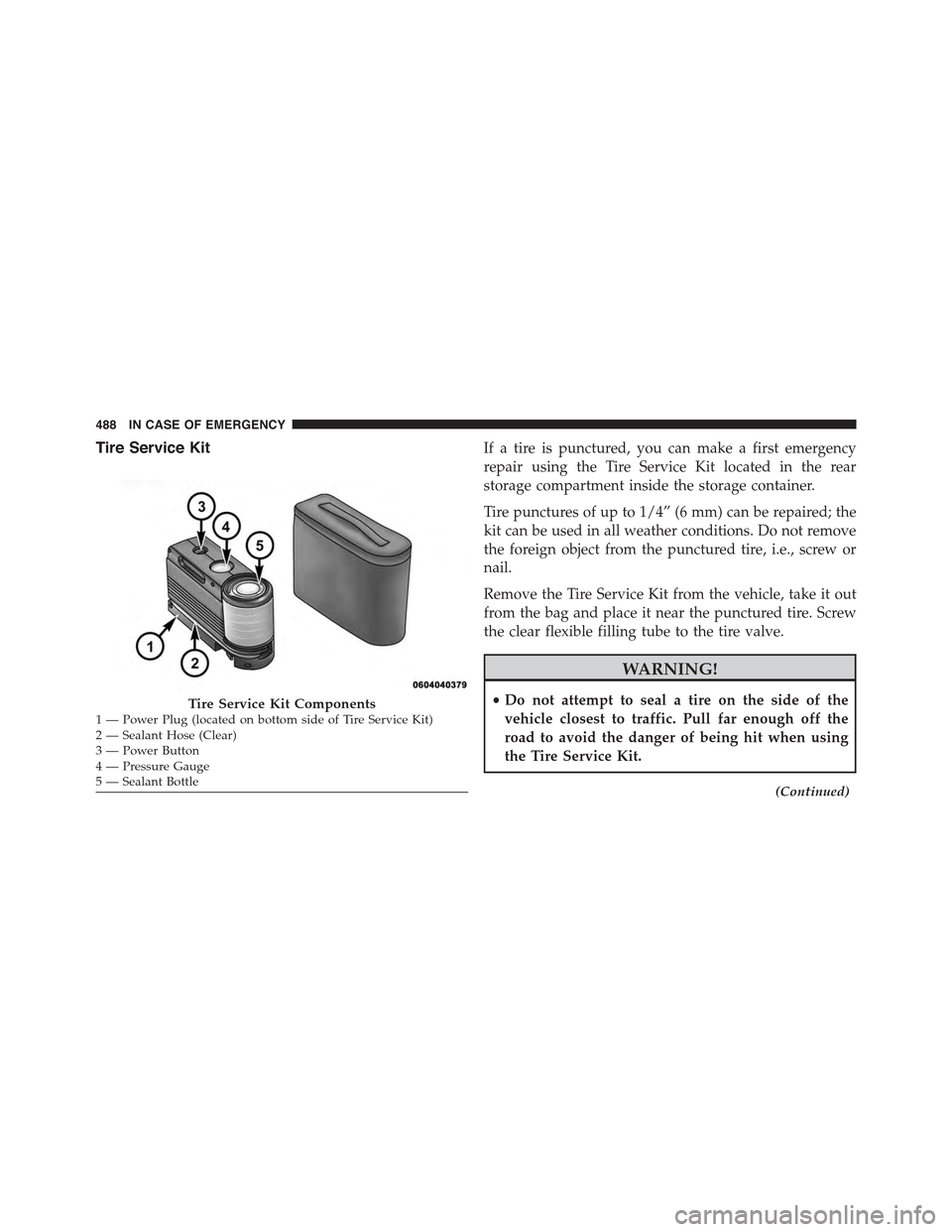
Tire Service KitIf a tire is punctured, you can make a first emergency
repair using the Tire Service Kit located in the rear
storage compartment inside the storage container.
Tire punctures of up to 1/4” (6 mm) can be repaired; the
kit can be used in all weather conditions. Do not remove
the foreign object from the punctured tire, i.e., screw or
nail.
Remove the Tire Service Kit from the vehicle, take it out
from the bag and place it near the punctured tire. Screw
the clear flexible filling tube to the tire valve.
WARNING!
•Do not attempt to seal a tire on the side of the
vehicle closest to traffic. Pull far enough off the
road to avoid the danger of being hit when using
the Tire Service Kit.
(Continued)
Tire Service Kit Components1 — Power Plug (located on bottom side of Tire Service Kit)2—SealantHose(Clear)3—PowerButton4—PressureGauge5 — Sealant Bottle
488 IN CASE OF EMERGENCY
Page 491 of 678
WARNING!(Continued)
•Do not use Tire Service Kit or drive the vehicle
under the following circumstances:
– If the puncture in the tire tread is approximately
1/4” (6 mm) or larger.
– If the tire has any sidewall damage.
– If the tire has any damage from driving with
extremely low tire pressure.
– If the tire has any damage from driving on a flat
tire.
– If the wheel has any damage.
– If you are unsure of the condition of the tire or
the wheel.
•Keep Tire Service Kit away from open flames or
heat source.
(Continued)
WARNING!(Continued)
•A loose Tire Service Kit thrown forward in a
collision or hard stop could endanger the occupants
of the vehicle. Always stow the Tire Service Kit in
the place provided. Failure to follow these warn-
ings can result in injuries that are serious or fatal to
you, your passengers, and others around you.
•Take care not to allow the contents of Tire Service
Kit to come in contact with hair, eyes, or clothing.
Tire Service Kit sealant is harmful if inhaled,
swallowed, or absorbed through the skin. It causes
skin, eye, and respiratory irritation. Flush immedi-
ately with plenty of water if there is any contact
with eyes or skin. Change clothing as soon as
possible, if there is any contact with clothing.
(Continued)
8
IN CASE OF EMERGENCY 489
Page 492 of 678
WARNING!(Continued)
•Tire Service Kit Sealant solution contains latex. In
case of an allergic reaction or rash, consult a phy-
sician immediately. Keep Tire Service Kit out of
reach of children. If swallowed, rinse mouth imme-
diately with plenty of water and drink plenty of
water. Do not induce vomiting! Consult a physician
immediately.
Insert the power plug into the vehicle power outlet
socket. Start the vehicle engine.
Push the Tire Service Kit power button to the “I” position.
The electric compressor will be turned on, sealant and air
will inflate the tire.
Minimum 26 psi (1.8 bar) of pressure should be reached
within 20 minutes. If the pressure has not been reached
turn off and remove the Tire Service Kit, drive the vehicle
30 feet (10 meters) back and forth, to better distribute the
sealant inside the tire.
Attach the clear flexible filling tube of the compressor
directly to the tire valve and repeat the inflation process.
When the correct pressure has been reached, start driving
the vehicle to uniformly distribute the sealant inside the
tire. After 10 minutes, stop and check the tire pressure. If
the pressure is below 19 psi (1.3 bar), do not drive the
vehicle, as the tire is too damaged, contact the nearest
Authorized Dealer.
WARNING!
Tire Service Kit is not a permanent flat tire repair.
Have the tire inspected and repaired or replaced after
using Tire Service Kit. Do not exceed 65 mph
(110 km/h) until the tire is repaired or replaced.
(Continued)
490 IN CASE OF EMERGENCY
Page 493 of 678
WARNING!(Continued)
Failure to follow this warning can result in injuries
that are serious or fatal to you, your passengers, and
others around you. Have the tire checked as soon as
possible at an Authorized Dealer.
If the pressure is at 19 psi (1.3 bar) or above repeat the
inflation process to reach the correct tire pressure and
continue driving.
Peel off the warning label from the bottle and place it on
the dashboard as a reminder to the driver that the tire has
been treated with Tire Service Kit.
WARNING!
The metal end fitting from Power Plug may get hot
after use, so it should be handled carefully.
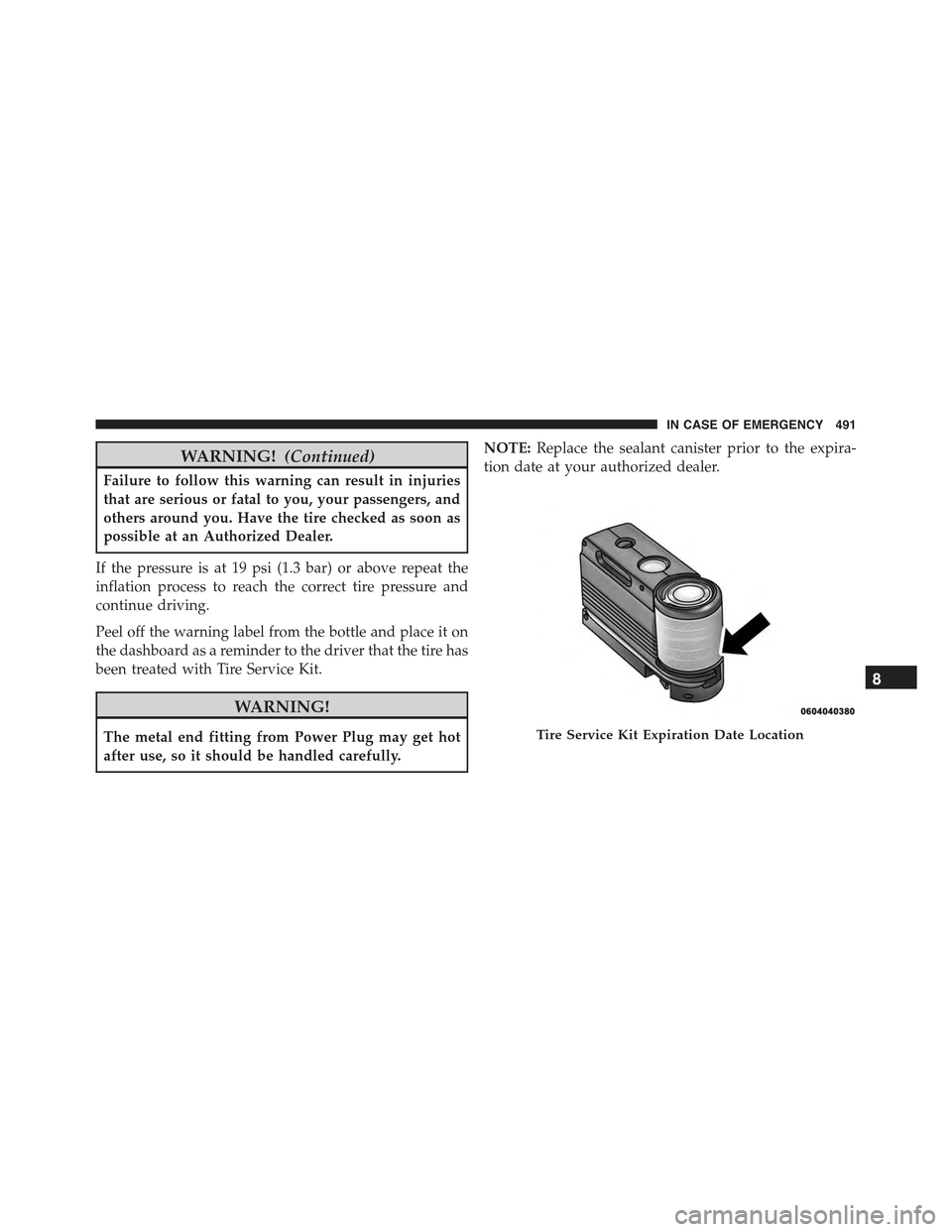
NOTE:Replace the sealant canister prior to the expira-
tion date at your authorized dealer.
Tire Service Kit Expiration Date Location
8
IN CASE OF EMERGENCY 491
Page 500 of 678
IF YOUR ENGINE OVERHEATS
In any of the following situations, you can reduce the
potential for overheating your engine by taking the
appropriate action.
•On the highways — slow down.
•In city traffic — while stopped, put transmission in
NEUTRAL, but do not increase engine idle speed.
CAUTION!
Driving with a hot cooling system could damage
your vehicle. If the temperature gauge reads “H,”
pull over and stop the vehicle. Idle the vehicle with
the air conditioner turned off until the pointer drops
back into the normal range. If the pointer remains on
the “H” and you hear continuous chimes, turn the
engine off immediately and call for service.
NOTE:There are steps that you can take to slow down
an impending overheat condition:
•If your air conditioner (A/C) is on, turn it off. The A/C
system adds heat to the engine cooling system and
turning the A/C off can help remove this heat.
•You can also turn the temperature control to maximum
heat, the mode control to floor and the blower control
to high. This allows the heater core to act as a
supplement to the radiator and aids in removing heat
from the engine cooling system.
WARNING!
You or others can be badly burned by hot engine
coolant (antifreeze) or steam from your radiator. If
you see or hear steam coming from under the hood,
do not open the hood until the radiator has had time
to cool. Never try to open a cooling system pressure
cap when the radiator or coolant bottle is hot.
498 IN CASE OF EMERGENCY
Page 507 of 678
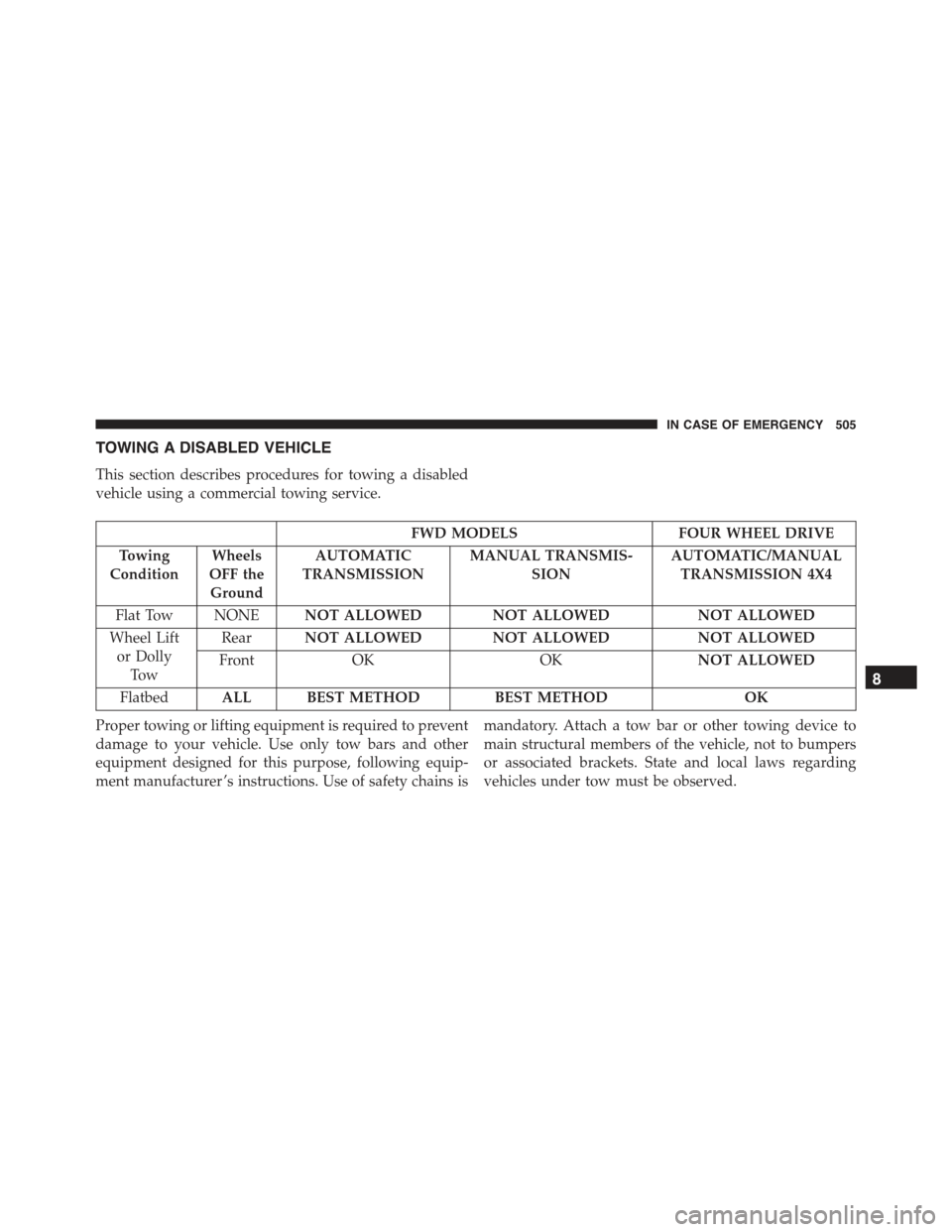
TOWING A DISABLED VEHICLE
This section describes procedures for towing a disabled
vehicle using a commercial towing service.
FWD MODELSFOUR WHEEL DRIVE
Towing
Condition
Wheels
OFF the
Ground
AUTOMATIC
TRANSMISSION
MANUAL TRANSMIS-
SION
AUTOMATIC/MANUAL
TRANSMISSION 4X4
Flat Tow NONENOT ALLOWED NOT ALLOWEDNOT ALLOWED
Wheel Lift
or Dolly
To w
RearNOT ALLOWED NOT ALLOWEDNOT ALLOWED
FrontOKOKNOT ALLOWED
FlatbedALL BEST METHODBEST METHODOK
Proper towing or lifting equipment is required to prevent
damage to your vehicle. Use only tow bars and other
equipment designed for this purpose, following equip-
ment manufacturer ’s instructions. Use of safety chains is
mandatory. Attach a tow bar or other towing device to
main structural members of the vehicle, not to bumpers
or associated brackets. State and local laws regarding
vehicles under tow must be observed.
8
IN CASE OF EMERGENCY 505
Page 513 of 678
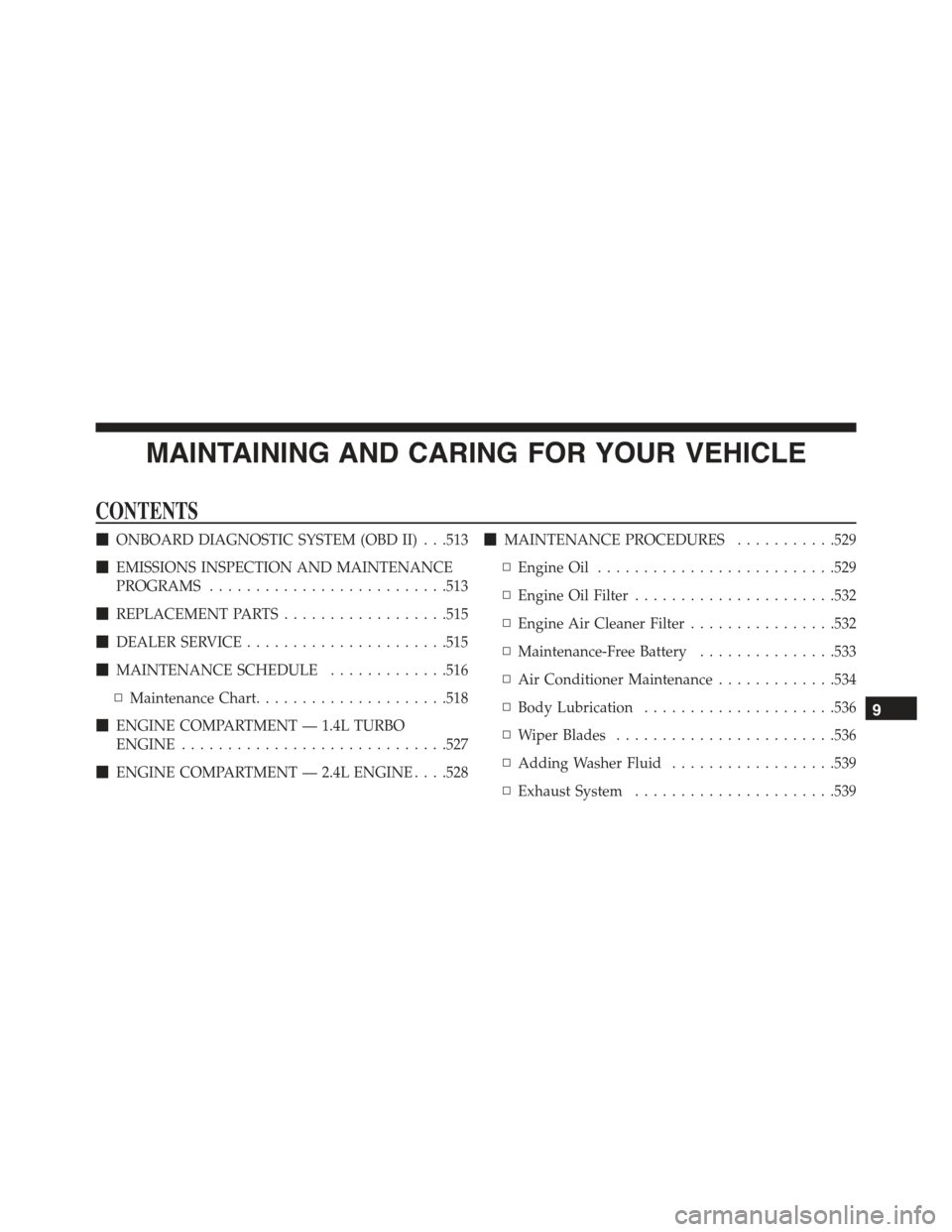
MAINTAINING AND CARING FOR YOUR VEHICLE
CONTENTS
!ONBOARD DIAGNOSTIC SYSTEM (OBD II) . . .513
!EMISSIONS INSPECTION AND MAINTENANCE
PROGRAMS..........................513
!REPLACEMENT PARTS..................515
!DEALER SERVICE......................515
!MAINTENANCE SCHEDULE.............516
▫Maintenance Chart.....................518
!ENGINE COMPARTMENT — 1.4L TURBO
ENGINE.............................527
!ENGINE COMPARTMENT — 2.4L ENGINE . . . .528
!MAINTENANCE PROCEDURES...........529
▫Engine Oil..........................529
▫Engine Oil Filter......................532
▫Engine Air Cleaner Filter................532
▫Maintenance-Free Battery...............533
▫Air Conditioner Maintenance.............534
▫Body Lubrication.....................536
▫Wiper Blades........................536
▫Adding Washer Fluid..................539
▫Exhaust System......................539
9