service JEEP RENEGADE 2015 1.G Service Manual
[x] Cancel search | Manufacturer: JEEP, Model Year: 2015, Model line: RENEGADE, Model: JEEP RENEGADE 2015 1.GPages: 678, PDF Size: 29.84 MB
Page 349 of 678
Transmission Limp Home Mode
Transmission function is monitored for abnormal condi-
tions. If a condition is detected that could result in
transmission damage, Transmission Limp Home Mode is
activated. In this mode, the transmission remains in
fourth gear regardless of which forward gear is selected.
PARK, REVERSE, and NEUTRAL will continue to oper-
ate. The Malfunction Indicator Light (MIL) may be illu-
minated. Limp Home Mode allows the vehicle to be
driven to an authorized dealer for service without dam-
aging the transmission.
In the event of a momentary problem, the transmission
can be reset to regain all forward gears by performing the
following steps:
1. Stop the vehicle.
2. Shift the transmission into PARK.
3. Turn the ignition switch to the STOP/OFF position.
4. Wait approximately 10 seconds.
5. Restart the engine.
6. Shift into the desired gear range. If the problem is no
longer detected, the transmission will return to normal
operation.
NOTE:Even if the transmission can be reset, we recom-
mend that you visit your authorized dealer at your
earliest possible convenience. Your authorized dealer has
diagnostic equipment to determine if the problem could
recur. If the transmission cannot be reset, authorized
dealer service is required.
Key Ignition Park Interlock
Vehicles Equipped With Keyless Enter-N-Go™:
This vehicle is equipped with a Key Ignition Park Inter-
lock which requires the transmission to be in PARK
before the ignition can be turned to the STOP/OFF
7
STARTING AND OPERATING 347
Page 374 of 678
shift lever is moved to REVERSE and the system is
disabled, the EVIC/DID will display the “PARKSENSE
OFF” message for as long as the vehicle is in REVERSE.
The ParkSense® switch LED will be ON when
ParkSense® is disabled or requires service. The
ParkSense® switch LED will be OFF when the system is
enabled. If the ParkSense® switch is pushed, and re-
quires service, the ParkSense® switch LED will blink
momentarily, and then the LED will be ON.
ParkSense will remember the previous state when the
vehicle is switch off.
CAUTION!
After turning off the ignition, the ParkSense® re-
mains in this setting until the next key cycle, even in
the case of changing the setting of starting MAR/
RUN to STOP/OFF and then again in MAR/RUN.
Service The ParkSense® Rear Park Assist
System
During vehicle start up, when the ParkSense® Rear Park
Assist System has detected a faulted condition, the
instrument cluster will actuate a single chime, once per
ignition cycle, and it will display the “PARKSENSE
UNAVAILABLE WIPE REAR SENSORS” or the
“PARKSENSE UNAVAILABLE SERVICE REQUIRED”
message. Refer to “Electronic Vehicle Information Center
(EVIC) or Driver Information Display (DID)” for further
information. When the shift lever is moved to REVERSE
and the system has detected a faulted condition, the
EVIC/DID will display the#PARKSENSE UNAVAIL-
ABLE WIPE REAR SENSORS#or#PARKSENSE UN-
AVAILABLE SERVICE REQUIRED#message for as long
as the vehicle is in REVERSE. Under this condition,
ParkSense® will not operate.
If “PARKSENSE UNAVAILABLE WIPE REAR SEN-
SORS” appears in the Electronic Vehicle Information
372 STARTING AND OPERATING
Page 375 of 678
Center (EVIC) or Driver Information Display (DID) make
sure the outer surface and the underside of the rear
fascia/bumper is clean and clear of snow, ice, mud, dirt
or other obstructions and then cycle the ignition. If the
message continues to appear, see an authorized dealer.
If “PARKSENSE UNAVAILABLE SERVICE REQUIRED”
appears in the EVIC/DID, see an authorized dealer.
Park Assist System Usage Precautions
NOTE:
•Ensure that the outer surface and the underside of the
rear bumper is clean and clear of snow, ice, mud, dirt
or other obstruction to keep the Rear Park Assist
system operating properly.
•Jackhammers, large trucks, and other vibrations could
affect the performance of Rear Park Assist.
•Clean the Rear Park Assist sensors regularly, taking
care not to scratch or damage them. The sensors must
not be covered with ice, snow, slush, mud, dirt or
debris. Failure to do so can result in the system not
working properly. The Rear Park Assist system might
not detect an obstacle behind the fascia/bumper, or it
could provide a false indication that an obstacle is
behind the fascia/bumper.
•Objects such as bicycle carriers, etc., must not be
placed within 12 inches (30 cm) from the rear fascia/
bumper while driving the vehicle. Failure to do so can
result in the system misinterpreting a close object as a
sensor problem, causing a failure indication to be
displayed in the instrument cluster.
7
STARTING AND OPERATING 373
Page 384 of 678
a chime will sound when tire pressure is low in one or
more of the four active road tires. Should this occur, you
should stop as soon as possible, check the inflation
pressure of each tire on your vehicle, and inflate each tire
to the vehicle’s recommended cold placard pressure
value as shown in the#Inflate to XX#message. Once the
system receives the updated tire pressures, the system
will automatically update and the “Tire Pressure Moni-
toring Telltale Light” will turn off.
NOTE:When filling warm tires, the tire pressure may
need to be increased up to an additional 4 psi (30 kPa)
above the recommended cold placard pressure in order
to turn the Tire Pressure Monitoring Telltale Light off.
The vehicle may need to be driven for up to 20 minutes
above 15 mph (24 km/h) in order for the TPMS to receive
this information.
Service TPMS Warning
When a system fault is detected, the “Tire Pressure
Monitoring Telltale Light” will flash on and off for 75
seconds and then remain on solid. The system fault will
also sound a chime. If the ignition is cycled, this sequence
will repeat, providing the system fault still exists. The
“Tire Pressure Monitoring Telltale Light” will turn off
when the fault condition no longer exists. A system fault
can occur due to any of the following:
1. Jamming due to electronic devices or driving next to
facilities emitting the same radio frequencies as the
TPMS sensors.
2. Installing some form of aftermarket window tinting
that affects radio wave signals.
3. Lots of snow or ice around the wheels or wheel
housings.
382 STARTING AND OPERATING
Page 387 of 678
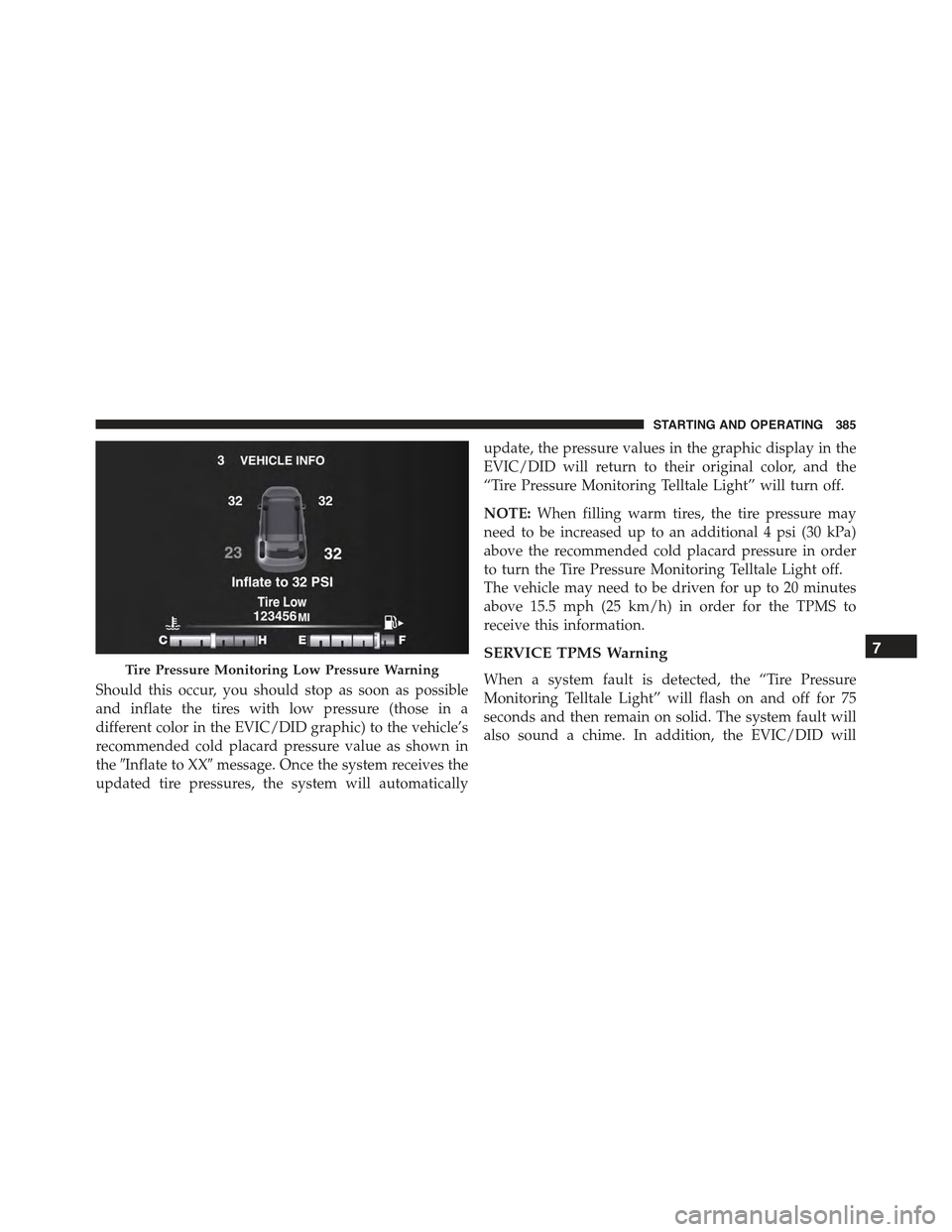
Should this occur, you should stop as soon as possible
and inflate the tires with low pressure (those in a
different color in the EVIC/DID graphic) to the vehicle’s
recommended cold placard pressure value as shown in
the#Inflate to XX#message. Once the system receives the
updated tire pressures, the system will automatically
update, the pressure values in the graphic display in the
EVIC/DID will return to their original color, and the
“Tire Pressure Monitoring Telltale Light” will turn off.
NOTE:When filling warm tires, the tire pressure may
need to be increased up to an additional 4 psi (30 kPa)
above the recommended cold placard pressure in order
to turn the Tire Pressure Monitoring Telltale Light off.
The vehicle may need to be driven for up to 20 minutes
above 15.5 mph (25 km/h) in order for the TPMS to
receive this information.
SERVICE TPMS Warning
When a system fault is detected, the “Tire Pressure
Monitoring Telltale Light” will flash on and off for 75
seconds and then remain on solid. The system fault will
also sound a chime. In addition, the EVIC/DID will
Tire Pressure Monitoring Low Pressure Warning
7
STARTING AND OPERATING 385
Page 388 of 678
display a#SERVICE TPM SYSTEM#message for a mini-
mum of five seconds and then display dashes (- -) in
place of the pressure value to indicate which sensor is not
being received.
If the ignition key is cycled, this sequence will repeat,
providing the system fault still exists. If the system fault
no longer exists, the “Tire Pressure Monitoring Telltale
Light” will no longer flash, and the “SERVICE TPM
SYSTEM” message will no longer display, and a pressure
value will display in place of the dashes. A system fault
can occur due to any of the following:
1. Jamming due to electronic devices or driving next to
facilities emitting the same radio frequencies as the
TPMS sensors.
2. Installing some form of aftermarket window tinting
that affects radio wave signals.
3. Lots of snow or ice around the wheels or wheel
housings.
4. Using tire chains on the vehicle.
5. Using wheels/tires not equipped with TPMS sensors.
Vehicles With Matching Full-Size Spare
1. The matching full size spare wheel and tire assembly
has a tire pressure monitoring sensor that can be
monitored by the TPMS.
2. If you install the full size spare in place of a road tire
that has a pressure below the low-pressure warning
limit, a chime will sound and the “TPMS Telltale
Light” will turn on upon the next ignition key cycle. In
addition, the EVIC/DID will display a Tire Low
message, an#Inflate to XX#message and a graphic
showing the low tire pressure value in a different
color.
386 STARTING AND OPERATING
Page 389 of 678
3. After driving the vehicle for up to 20 minutes above
15.5 mph (25 km/h) the “TPMS Telltale Light” will
turn OFF, as long as no tire pressure is below the
low-pressure warning limit in any of the four active
road tires.
4. The EVIC/DID will display a graphic showing the tire
pressure value in the same color as the other pressure
values in place of the different color low tire pressure
value. The EVIC/DID will also display a “SPARE
LOW PRESSURE” message to remind you to service
the flat tire.
Vehicles With Compact Spare or Non-Matching Full
Size Spare
1. The compact spare tire or non-matching full size does
not have a tire pressure monitoring sensor. Therefore,
the TPMS will not monitor the pressure in the compact
spare tire.
2. If you install the compact or non-matching full size
spare tire in place of a road tire that has a pressure
below the low-pressure warning limit, upon the next
ignition key cycle, the “TPMS Telltale Light” will
remain on and a chime will sound. In addition, the
graphic in the EVIC/DID will still display a different
color pressure value and an#Inflate to XX#message.
3. After driving the vehicle for up to 20 minutes above
15.5 mph (25 km/h), the “TPMS Telltale Light” will
flash on and off for 75 seconds and then remain on
solid. In addition, the EVIC/DID will display a “SER-
VICE TPM SYSTEM” message for five seconds and
then display dashes (- -) in place of the pressure value.
4. For each subsequent ignition key cycle, a chime will
sound, the “TPMS Telltale Light” will flash on and off
for 75 seconds and then remain on solid, and the
7
STARTING AND OPERATING 387
Page 390 of 678
EVIC/DID will display a “SERVICE TPM SYSTEM”
message for five seconds and then display dashes (- -)
in place of the pressure value.
5. Once you repair or replace the original road tire and
reinstall it on the vehicle in place of the compact spare
or non-matching full size, the TPMS will update
automatically. In addition, the “TPMS Telltale Light”
will turn off and the graphic in the EVIC/DID will
display a new pressure value instead of dashes (- -), as
long as no tire pressure is below the low-pressure
warning limit in any of the four active road tires. The
vehicle may need to be driven for up to 20 minutes
above 15.5 mph (25 km/h) in order for the TPMS to
receive this information.
General Information
This device complies with Part 15 of the FCC rules and
RSS 210 of Industry Canada. Operation is subject to the
following conditions:
•This device may not cause harmful interference.
•This device must accept any interference received,
including interference that may cause undesired op-
eration.
The TPM sensors are regulated under one of the follow-
ing licenses:
United StatesKR55WY9012
Canada7812D-5WY9012
FUEL REQUIREMENTS
1.4L Turbo Engine
This engine is designed to meet all emis-
sion regulations and provide satisfactory
388 STARTING AND OPERATING
Page 391 of 678
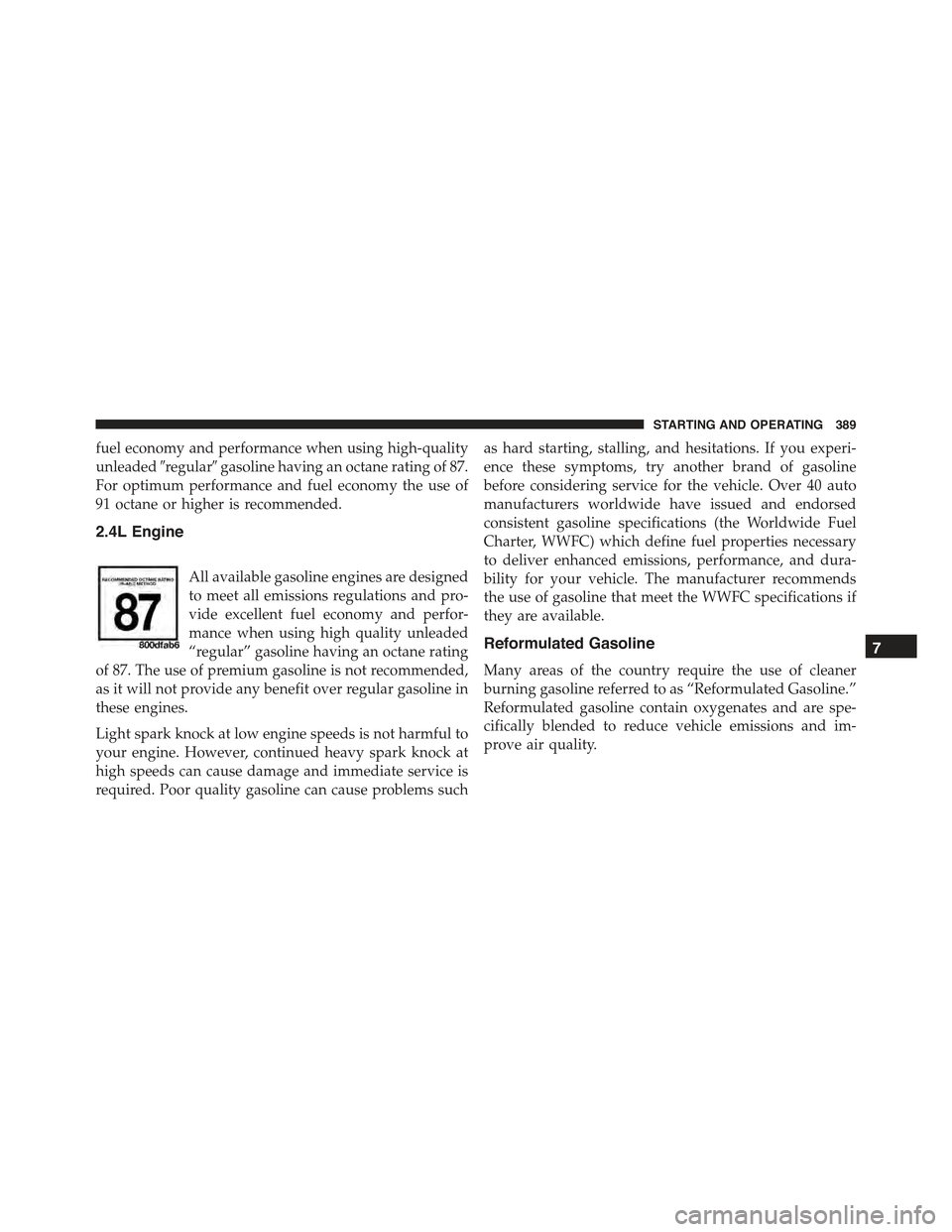
fuel economy and performance when using high-quality
unleaded#regular#gasoline having an octane rating of 87.
For optimum performance and fuel economy the use of
91 octane or higher is recommended.
2.4L Engine
All available gasoline engines are designed
to meet all emissions regulations and pro-
vide excellent fuel economy and perfor-
mance when using high quality unleaded
“regular” gasoline having an octane rating
of 87. The use of premium gasoline is not recommended,
as it will not provide any benefit over regular gasoline in
these engines.
Light spark knock at low engine speeds is not harmful to
your engine. However, continued heavy spark knock at
high speeds can cause damage and immediate service is
required. Poor quality gasoline can cause problems such
as hard starting, stalling, and hesitations. If you experi-
ence these symptoms, try another brand of gasoline
before considering service for the vehicle. Over 40 auto
manufacturers worldwide have issued and endorsed
consistent gasoline specifications (the Worldwide Fuel
Charter, WWFC) which define fuel properties necessary
to deliver enhanced emissions, performance, and dura-
bility for your vehicle. The manufacturer recommends
the use of gasoline that meet the WWFC specifications if
they are available.
Reformulated Gasoline
Many areas of the country require the use of cleaner
burning gasoline referred to as “Reformulated Gasoline.”
Reformulated gasoline contain oxygenates and are spe-
cifically blended to reduce vehicle emissions and im-
prove air quality.
7
STARTING AND OPERATING 389
Page 394 of 678
Fuel System Cautions
CAUTION!
Follow these guidelines to maintain your vehicle’s
performance:
•The use of leaded gasoline is prohibited by Federal
law. Using leaded gasoline can impair engine per-
formance and damage the emissions control sys-
tem.
•An out-of-tune engine or certain fuel or ignition
malfunctions can cause the catalytic converter to
overheat. If you notice a pungent burning odor or
some light smoke, your engine may be out of tune
or malfunctioning and may require immediate ser-
vice. Contact your authorized dealer for service
assistance.
(Continued)
CAUTION!(Continued)
•The use of fuel additives, which are now being
sold as octane enhancers, is not recommended.
Most of these products contain high concentrations
of methanol. Fuel system damage or vehicle perfor-
mance problems resulting from the use of such
fuels or additives is not the responsibility of the
manufacturer and may void or not be covered
under the New Vehicle Limited Warranty.
NOTE:Intentional tampering with the emissions control
system can result in civil penalties being assessed against
you.
392 STARTING AND OPERATING