ECU JEEP RENEGADE 2016 1.G Service Manual
[x] Cancel search | Manufacturer: JEEP, Model Year: 2016, Model line: RENEGADE, Model: JEEP RENEGADE 2016 1.GPages: 688, PDF Size: 7.09 MB
Page 346 of 688
WARNING!(Continued)
•Unintended movement of a vehicle could injure
those in or near the vehicle. As with all vehicles,
you should never exit a vehicle while the engine is
running. Before exiting a vehicle, always apply the
EPB, shift the transmission into PARK, turn the
engine OFF, and remove the Key Fob. When the
ignition is in the STOP/OFF (key removal) posi-
tion, the transmission is locked in PARK, securing
the vehicle against unwanted movement.
•When leaving the vehicle, always make sure the
ignition is in the STOP/OFF position, remove the
Key Fob from the vehicle, and lock the vehicle.
•Never leave children alone in a vehicle, or with
access to an unlocked vehicle. Allowing children to
be in a vehicle unattended is dangerous for a
number of reasons. A child or others could be
(Continued)
WARNING!(Continued)
seriously or fatally injured. Children should be
warned not to touch the parking brake, brake pedal
or the shift lever.
•Do not leave the Key Fob in or near the vehicle (or
in a location accessible to children), and do not
leave the ignition (of a vehicle equipped with
Keyless Enter-N-Go) in the MAR/RUN position. A
child could operate power windows, other controls,
or move the vehicle.
CAUTION!
•Before moving the shift lever out of PARK, you
must turn the ignition switch from the STOP/OFF
position to the MAR/RUN position, and also press
the brake pedal. Otherwise, damage to the shift
lever could result.
(Continued)
344 STARTING AND OPERATING
Page 351 of 688
Transmission Limp Home Mode
Transmission function is electronically monitored for
abnormal conditions. If a condition is detected that could
result in transmission damage, Transmission Limp Home
Mode is activated. In this mode, the transmission remains
in fourth gear regardless of which forward gear is
selected. PARK, REVERSE, and NEUTRAL will continue
to operate. The Malfunction Indicator Light (MIL) may be
illuminated. Limp Home Mode allows the vehicle to be
driven to an authorized dealer for service without dam-
aging the transmission.
In the event of a momentary problem, the transmission
can be reset to regain all forward gears by performing the
following steps:
1. Stop the vehicle.
2. Shift the transmission into PARK.3. Turn the ignition switch to the STOP/OFF position.
4. Wait approximately 10 seconds.
5. Restart the engine.
6. Shift into the desired gear range. If the problem is no
longer detected, the transmission will return to normal
operation.
NOTE:Even if the transmission can be reset, we recom-
mend that you visit your authorized dealer at your
earliest possible convenience. Your authorized dealer has
diagnostic equipment to determine if the problem could
recur. If the transmission cannot be reset, authorized
dealer service is required.
7
STARTING AND OPERATING 349
Page 413 of 688
items down low and be sure that the weight is distributed
equally. Stow all loose items securely before driving.
Improper weight distributions can have an adverse effect
on the way your vehicle steers and handles and the way
the brakes operate.
CAUTION!
Do not load your vehicle any heavier than the GVWR
or the maximum front and rear GAWR. If you do,
parts on your vehicle can break, or it can change the
way your vehicle handles. This could cause you to
lose control. Also overloading can shorten the life of
your vehicle.
ON-ROAD DRIVING TIPS
Utility vehicles have higher ground clearance and a
narrower track to make them capable of performing in a
wide variety of off-road applications. Specific design
characteristics give them a higher center of gravity than
ordinary cars.
An advantage of the higher ground clearance is a better
view of the road, allowing you to anticipate problems.
They are not designed for cornering at the same speeds as
conventional two-wheel drive vehicles any more than
low-slung sports cars are designed to perform satisfacto-
rily in off-road conditions. If at all possible, avoid sharp
turns or abrupt maneuvers. As with other vehicles of this
type, failure to operate this vehicle correctly may result in
loss of control or vehicle rollover.
7
STARTING AND OPERATING 411
Page 425 of 688
NOTE:Remember that everything put into or on the
trailer adds to the load on your vehicle. Also, additional
factory-installed options or dealer-installed options must
be considered as part of the total load on your vehicle.
Refer to the “Tire And Loading Information” placard for
the maximum combined weight of occupants and cargo
for your vehicle.
Towing Requirements
To promote proper break-in of your new vehicle drive-
train components, the following guidelines are recom-
mended:
WARNING!
Improper towing can lead to a collision. Follow these
guidelines to make your trailer towing as safe as
possible:
(Continued)
WARNING!(Continued)
•Make certain that the load is secured in the trailer
and that it will not shift during travel. When
trailering cargo that is not fully secured, dynamic
load shifts can occur that may be difficult for the
driver to control. You could lose control of your
vehicle and have a collision.
•When hauling cargo, or towing a trailer, do not
overload your vehicle or trailer. Overloading can
cause a loss of control, poor performance, or dam-
age to brakes, axle, engine, transmission, steering,
suspension, chassis structure, or tires.
•Safety chains must always be used between your
vehicle and trailer. Always connect the chains to
the frame or hook retainers of the vehicle hitch.
Cross the chains under the trailer tongue and allow
enough slack for turning corners.
(Continued)
7
STARTING AND OPERATING 423
Page 433 of 688
Recreational Towing
Models With Front-Wheel Drive (FWD)
Recreational towing is allowed ONLY if the front wheels
are OFF the ground. This may be accomplished using a
tow dolly (front wheels off the ground) or vehicle trailer
(all four wheels off the ground). If using a tow dolly,
follow this procedure:
•Properly secure the dolly to the tow vehicle, following
the dolly manufacturer’s instructions.
•Drive the front wheels onto the tow dolly.
•Apply the Electronic Parking Brake (EPB). Place the
transmission in PARK. Turn the engine OFF.
•Properly secure the front wheels to the dolly, following
the dolly manufacturer’s instructions.
•Turn the ignition to the MAR/RUN position, but do
not start the engine.•Press and hold the brake pedal.
•Release the Electric Park Brake (EPB).
•Turn the ignition OFF, remove the key, and release the
brake pedal.
CAUTION!
•DO NOT flat tow this vehicle. Damage to the
drivetrain will result. If this vehicle requires tow-
ing, make sure the drive wheels are OFF the
ground.
•Ensure that the Electric Park Brake is released, and
remains released, while being towed.
•Towing this vehicle in violation of the above re-
quirements can cause severe transmission damage.
Damage from improper towing is not covered un-
der the New Vehicle Limited Warranty.
7
STARTING AND OPERATING 431
Page 463 of 688
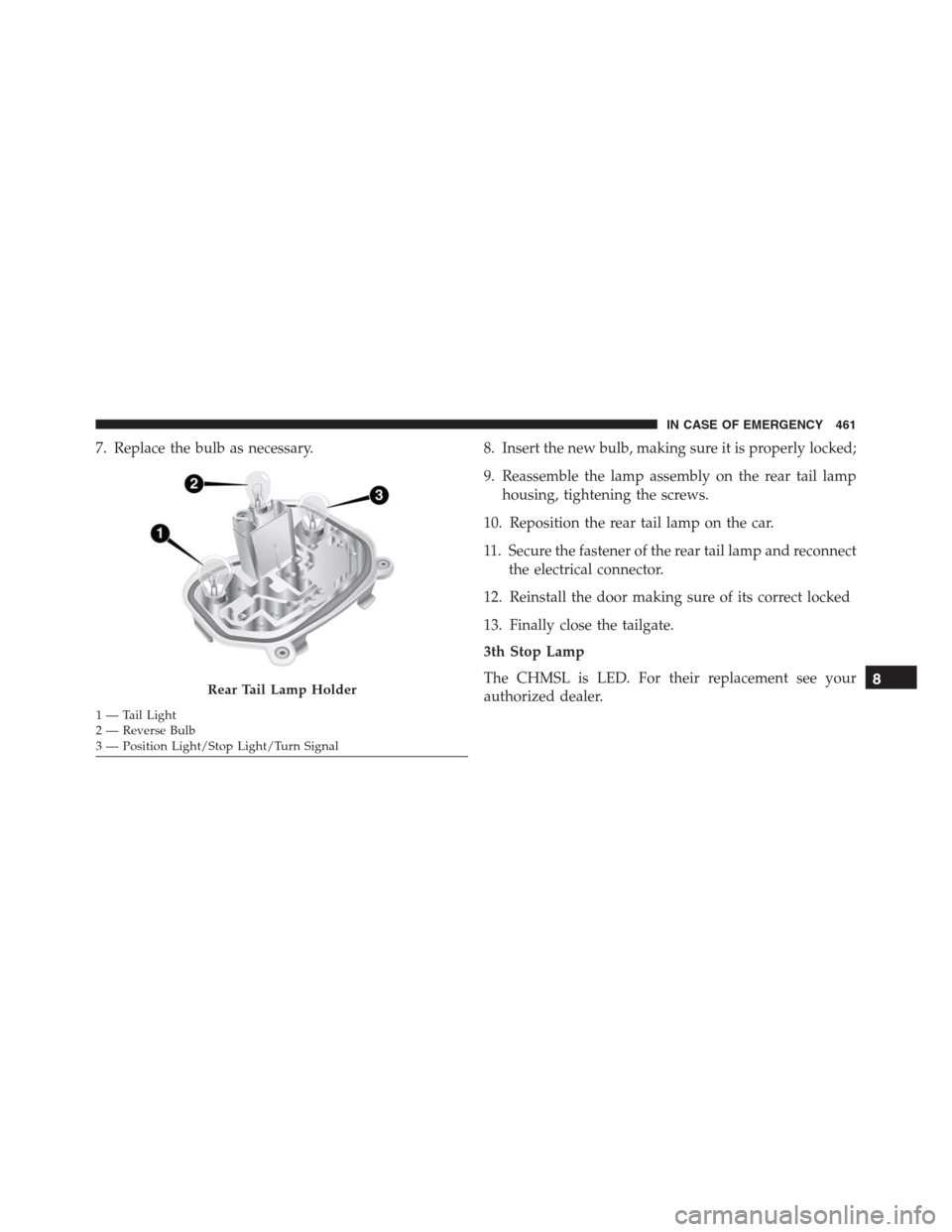
7. Replace the bulb as necessary. 8. Insert the new bulb, making sure it is properly locked;
9. Reassemble the lamp assembly on the rear tail lamp
housing, tightening the screws.
10. Reposition the rear tail lamp on the car.
11. Secure the fastener of the rear tail lamp and reconnect
the electrical connector.
12. Reinstall the door making sure of its correct locked
13. Finally close the tailgate.
3th Stop Lamp
The CHMSL is LED. For their replacement see your
authorized dealer.
Rear Tail Lamp Holder
1 — Tail Light
2 — Reverse Bulb
3 — Position Light/Stop Light/Turn Signal
8
IN CASE OF EMERGENCY 461
Page 475 of 688
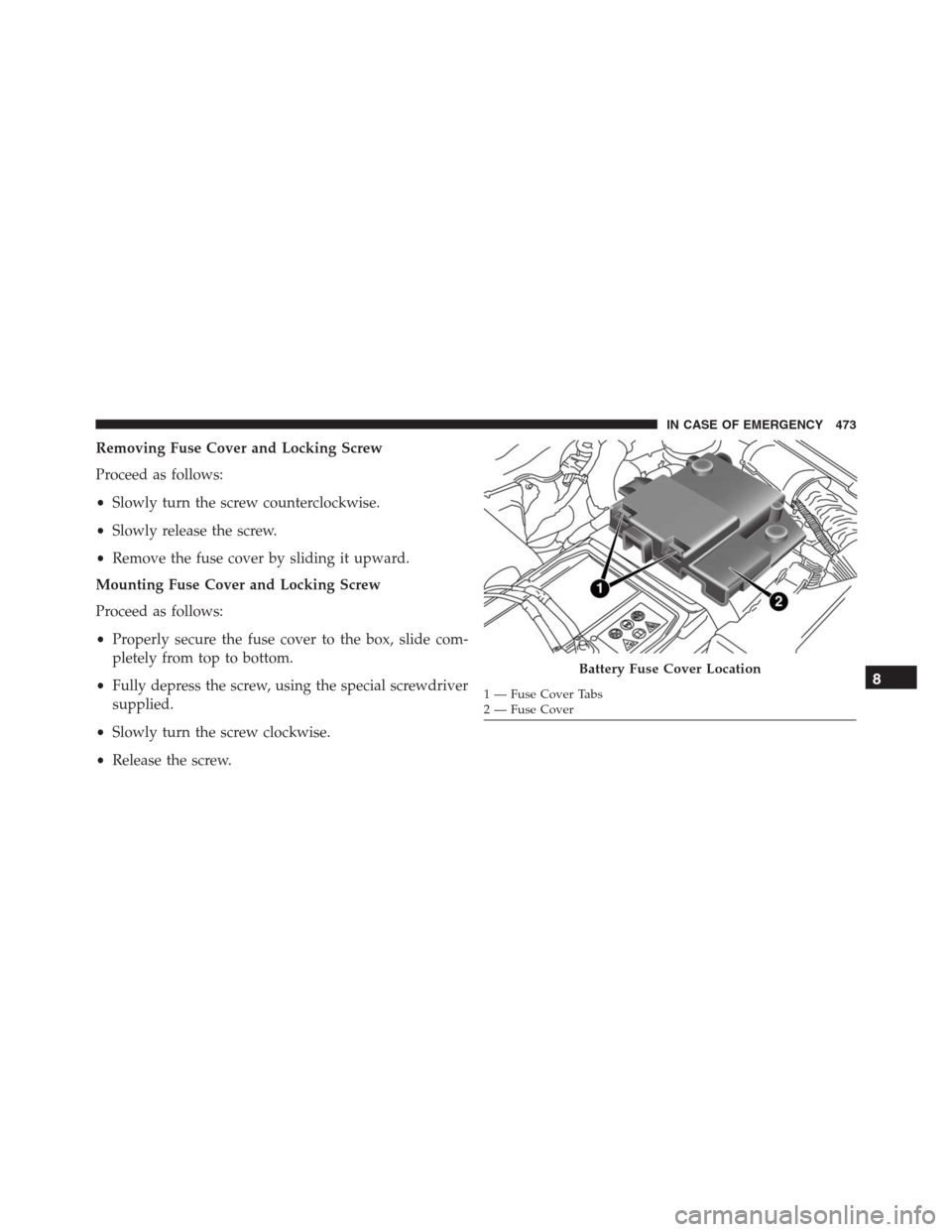
Removing Fuse Cover and Locking Screw
Proceed as follows:
•Slowly turn the screw counterclockwise.
•Slowly release the screw.
•Remove the fuse cover by sliding it upward.
Mounting Fuse Cover and Locking Screw
Proceed as follows:
•Properly secure the fuse cover to the box, slide com-
pletely from top to bottom.
•Fully depress the screw, using the special screwdriver
supplied.
•Slowly turn the screw clockwise.
•Release the screw.
Battery Fuse Cover Location
1 — Fuse Cover Tabs
2 — Fuse Cover8
IN CASE OF EMERGENCY 473
Page 487 of 688
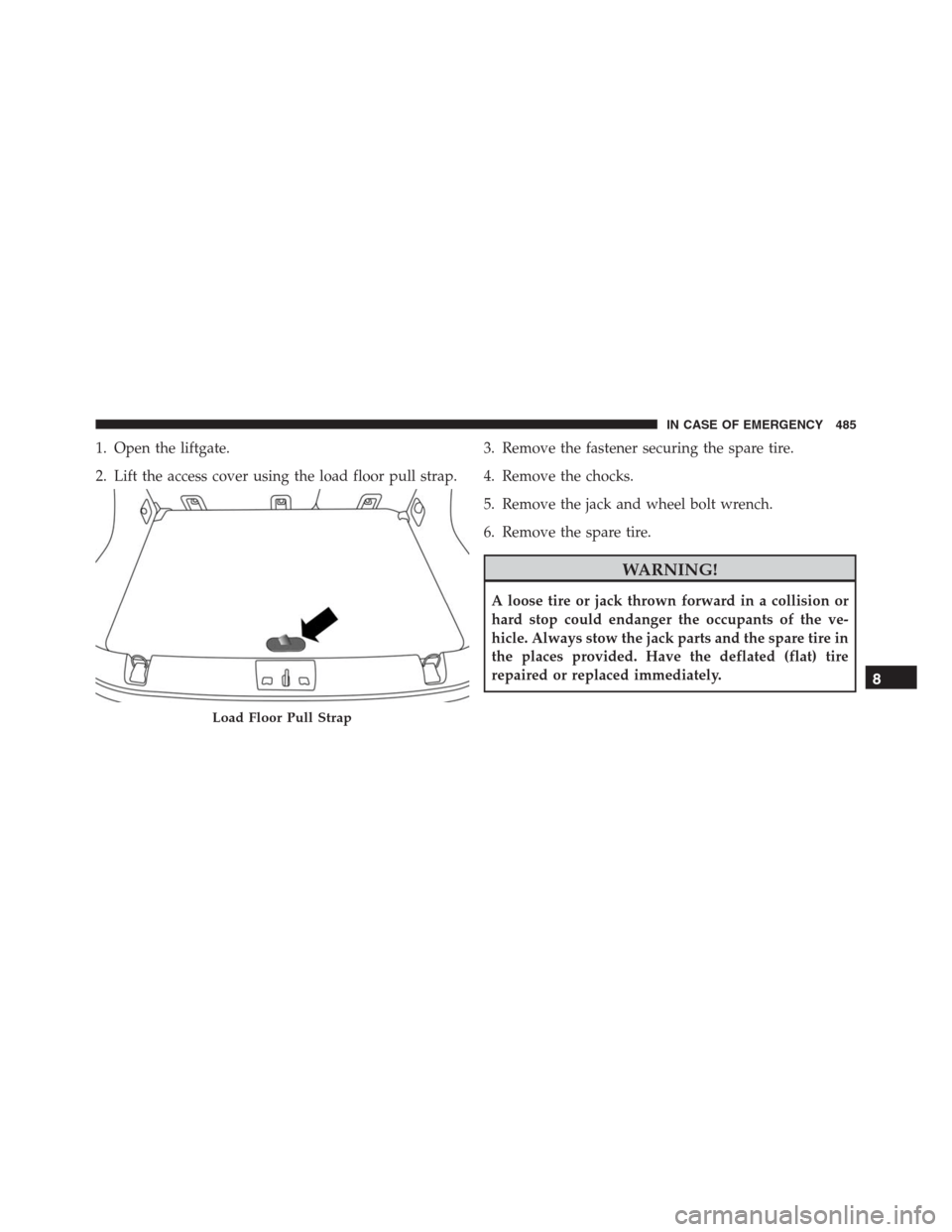
1. Open the liftgate.
2. Lift the access cover using the load floor pull strap.3. Remove the fastener securing the spare tire.
4. Remove the chocks.
5. Remove the jack and wheel bolt wrench.
6. Remove the spare tire.
WARNING!
A loose tire or jack thrown forward in a collision or
hard stop could endanger the occupants of the ve-
hicle. Always stow the jack parts and the spare tire in
the places provided. Have the deflated (flat) tire
repaired or replaced immediately.
Load Floor Pull Strap
8
IN CASE OF EMERGENCY 485
Page 489 of 688
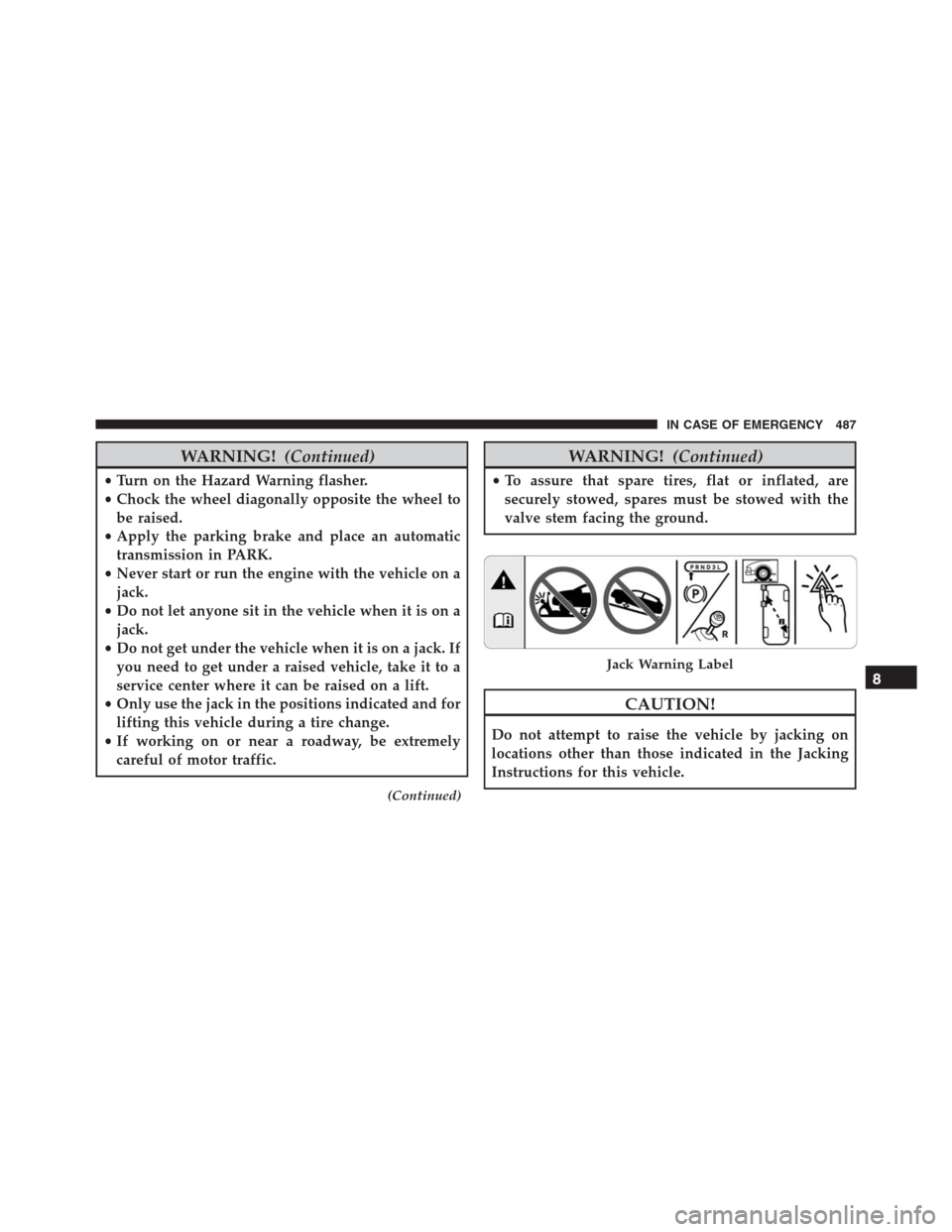
WARNING!(Continued)
•Turn on the Hazard Warning flasher.
•Chock the wheel diagonally opposite the wheel to
be raised.
•Apply the parking brake and place an automatic
transmission in PARK.
•Never start or run the engine with the vehicle on a
jack.
•Do not let anyone sit in the vehicle when it is on a
jack.
•Do not get under the vehicle when it is on a jack. If
you need to get under a raised vehicle, take it to a
service center where it can be raised on a lift.
•Only use the jack in the positions indicated and for
lifting this vehicle during a tire change.
•If working on or near a roadway, be extremely
careful of motor traffic.
(Continued)
WARNING!(Continued)
•To assure that spare tires, flat or inflated, are
securely stowed, spares must be stowed with the
valve stem facing the ground.
CAUTION!
Do not attempt to raise the vehicle by jacking on
locations other than those indicated in the Jacking
Instructions for this vehicle.
Jack Warning Label8
IN CASE OF EMERGENCY 487
Page 495 of 688
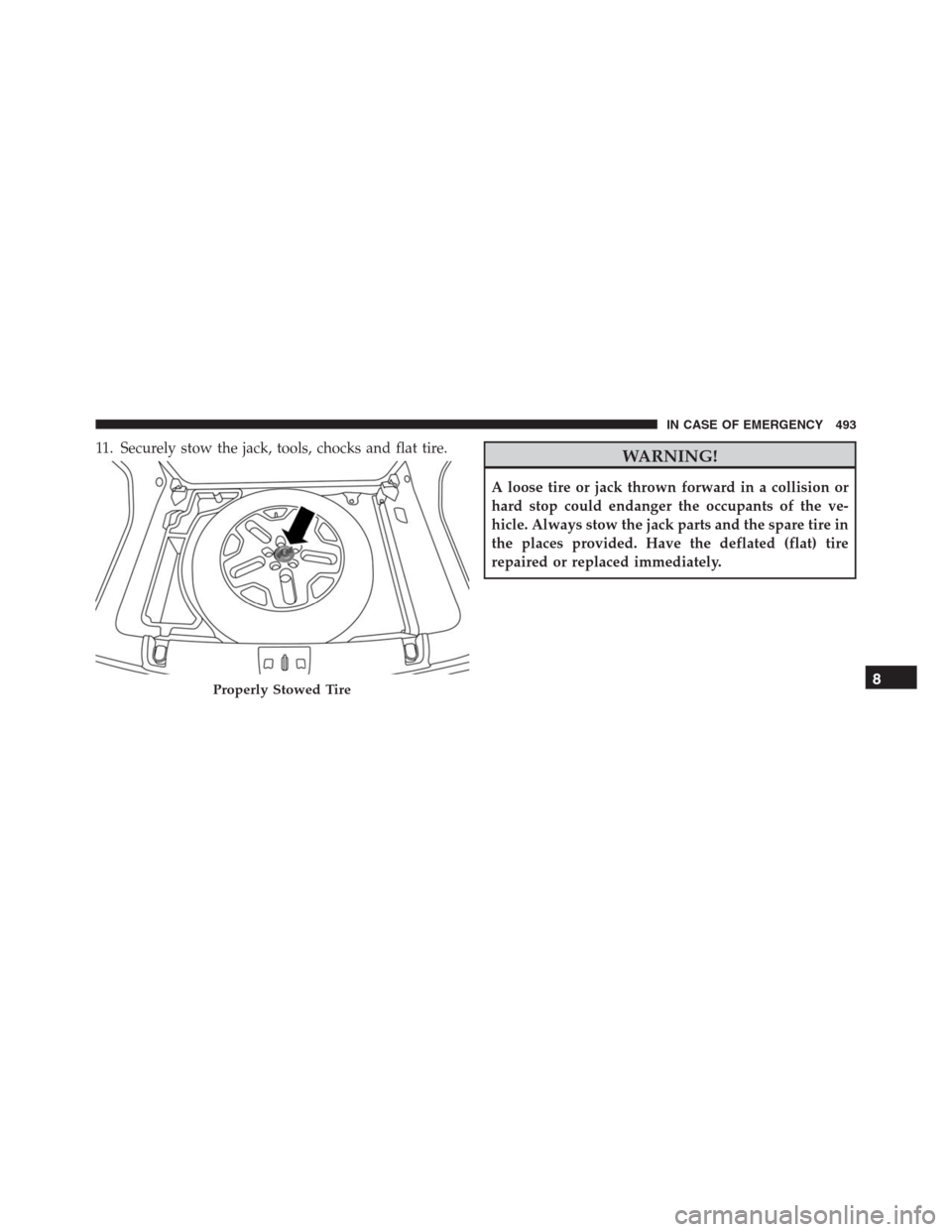
11. Securely stow the jack, tools, chocks and flat tire.WARNING!
A loose tire or jack thrown forward in a collision or
hard stop could endanger the occupants of the ve-
hicle. Always stow the jack parts and the spare tire in
the places provided. Have the deflated (flat) tire
repaired or replaced immediately.
Properly Stowed Tire8
IN CASE OF EMERGENCY 493