ignition JEEP RENEGADE 2016 1.G Workshop Manual
[x] Cancel search | Manufacturer: JEEP, Model Year: 2016, Model line: RENEGADE, Model: JEEP RENEGADE 2016 1.GPages: 688, PDF Size: 7.09 MB
Page 325 of 688
floor and hold it there. Crank the engine for no more than
15 seconds. This should clear any excess fuel in case the
engine is flooded. Leave the ignition key in the MAR/
RUN position, release the accelerator pedal and repeat
the “Normal Starting” procedure.
CAUTION!
To prevent damage to the starter, do not continuously
crank the engine for more than 25 seconds at a time.
Wait 60 seconds before trying again.
WARNING!
•Never pour fuel or other flammable liquid into the
throttle body air inlet opening in an attempt to start
the vehicle. This could result in flash fire causing
serious personal injury.
(Continued)
WARNING!(Continued)
•Do not attempt to push or tow your vehicle to get it
started. Vehicles equipped with an automatic trans-
mission cannot be started this way. Unburned fuel
could enter the catalytic converter and once the
engine has started, ignite and damage the converter
and vehicle.
•If the vehicle has a discharged battery, booster
cables may be used to obtain a start from a booster
battery or the battery in another vehicle. This type
of start can be dangerous if done improperly. Refer
to “Jump-Starting” in “In Case Of Emergency” for
further information.
Cold Weather Operation
To ensure reliable starting under extreme cold conditions
an externally powered electric block heater (available
from your authorized dealer) is required for the 1.4L
7
STARTING AND OPERATING 323
Page 326 of 688
Turbo engine below -20°F (-29°C) and for the 2.4L engine
below -29°F (-34°C) and is recommended for the 2.4L
engine below -20°F (-29°C).
To prevent possible engine damage while starting at low
temperatures, this vehicle will inhibit engine cranking
when the ambient temperature is less than -34°F (-35°C)
and the oil temperature sensor reading indicates an
engine block heater has not been used. The message
“plug in engine heater” will be displayed in the instru-
ment cluster when the ambient temperature is below -4°F
(-20°C) at the time the engine is shut off as a reminder to
avoid possible crank delays at the next cold start.
Extended Park Starting
NOTE:Extended Park condition occurs when the vehicle
has not been started or driven for at least 30 days.
1. Install a battery charger or jumper cables to the battery
to ensure a full battery charge during the crank cycle.2. Cycle the ignition in the START position and release it
when the engine starts.
3. If the engine fails to start within ten seconds, cycle the
ignition to the STOP (OFF/LOCK) position, wait five
seconds to allow the starter to cool, then repeat the
Extended Park Starting procedure.
4. If the engine fails to start after eight attempts, allow
the starter to cool for at least 10 minutes, then repeat
the procedure.
CAUTION!
To prevent damage to the starter, do not crank con-
tinuously for more than 10 seconds at a time. Wait 10
to 15 seconds before trying again.
324 STARTING AND OPERATING
Page 327 of 688
After Starting — Warming Up The Engine
Proceed as follows:
•Travel slowly, letting the engine run at a reduced RPM,
without accelerating suddenly.
•It is recommended to wait until the engine coolant
temperature gauge starts to rise for maximum perfor-
mance.
Stopping The Engine
Vehicles Equipped With A Mechanical Key Fob:
To turn off the engine with, proceed as follows:
1. Park the car in a position that does not cause a traffic
hazard.
2. Place the transmission in gear (models with a manual
transmission) or place the transmission in PARK (P)
(models with automatic transmission).3. With the engine idling, place the ignition in the
STOP/OFF position.
4. Remove the key from the ignition when the engine is
shut off.
Vehicles Equipped With Electronic Key (Keyless Enter-
N-Go):
To shut off the engine with vehicle speed greater than
5 mph (8 km/h) you must push and hold the ignition or
push the START/STOP button three times consecutively
within a few seconds. The engine will shut down and the
ignition will be placed in the RUN position.
Turning Off the car (placing the ignition from the RUN
position to the STOP position), the power supply to the
accessories are maintained for a period of three minutes.
Opening the driver side door with the ignition RUN will
sound a short chime, to remind the driver to place the
ignition to STOP.7
STARTING AND OPERATING 325
Page 328 of 688
When the ignition is in the STOP/OFF position, the
window switches remains active for three minutes.
Opening a front door will cancel this function.
After severe driving, idle the engine to allow the tem-
perature inside the engine compartment to cool before
shutting off the engine.
Turbocharger “Cool Down” — If Equipped
This vehicle is equipped with an after-run pump to cool
the turbocharger after the engine is shut off. Depending
on the type of driving and the amount of cargo, the pump
will run for up to 10 minutes after the engine has been
shut off to circulate coolant through the turbocharger.
Although the pump is rubber-mounted for quiet opera-
tion, it is normal to hear it running during this time.
ENGINE BREAK-IN RECOMMENDATIONS
A long break-in period is not required for the engine and
drivetrain (transmission and axle) in your vehicle.
Drive moderately during the first 300 miles (500 km).
After the initial 60 miles (100 km), speeds up to 50 or
55 mph (80 or 90 km/h) are desirable.
While cruising, brief full-throttle acceleration within the
limits of local traffic laws contributes to a good break-in.
Wide-open throttle acceleration in low gear can be detri-
mental and should be avoided.
The engine oil installed in the engine at the factory is a
high-quality energy conserving type lubricant. Oil
changes should be consistent with anticipated climate
conditions under which vehicle operations will occur. For
the recommended viscosity and quality grades, refer to
“Maintenance Procedures” in “Maintaining And Caring
For Your Vehicle.”
326 STARTING AND OPERATING
Page 330 of 688
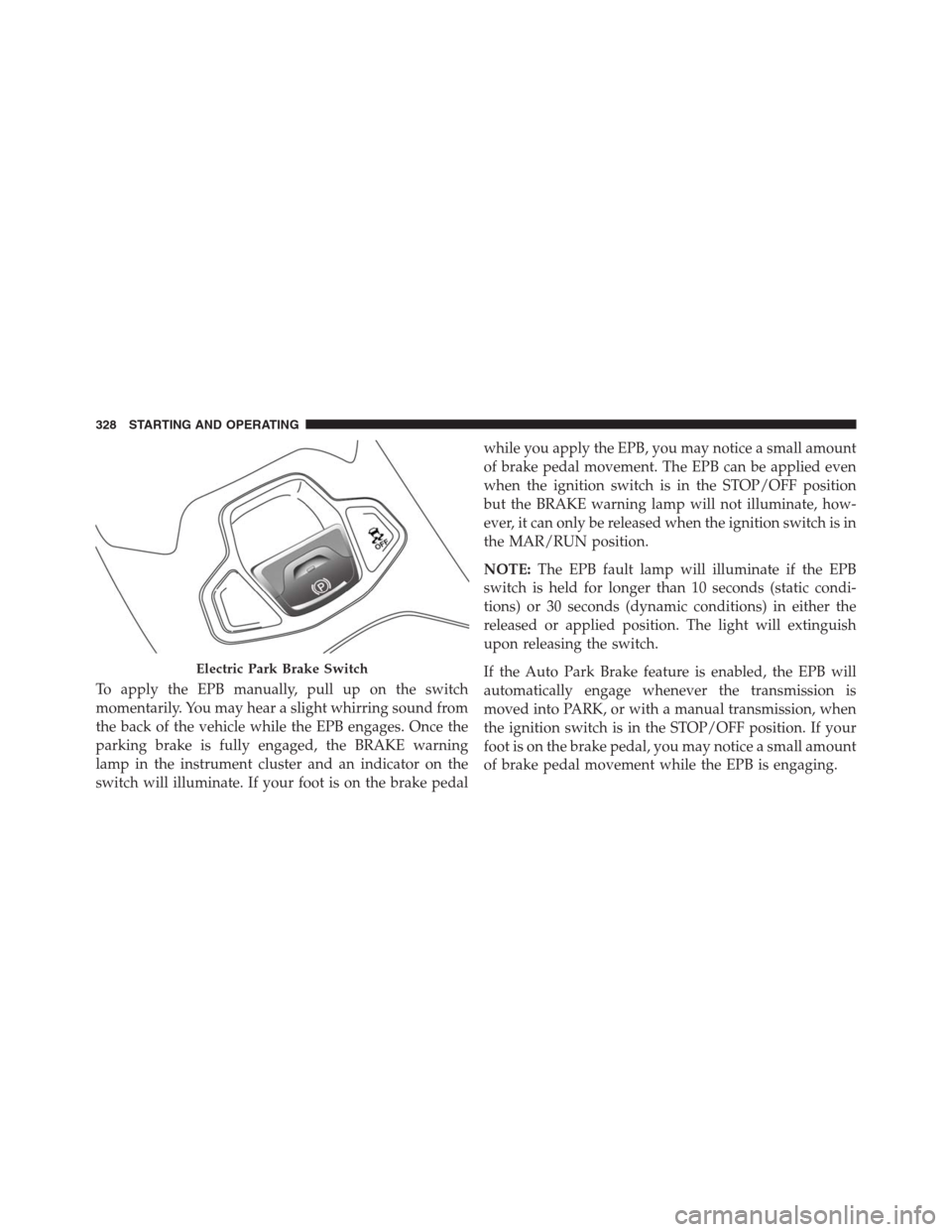
To apply the EPB manually, pull up on the switch
momentarily. You may hear a slight whirring sound from
the back of the vehicle while the EPB engages. Once the
parking brake is fully engaged, the BRAKE warning
lamp in the instrument cluster and an indicator on the
switch will illuminate. If your foot is on the brake pedalwhile you apply the EPB, you may notice a small amount
of brake pedal movement. The EPB can be applied even
when the ignition switch is in the STOP/OFF position
but the BRAKE warning lamp will not illuminate, how-
ever, it can only be released when the ignition switch is in
the MAR/RUN position.
NOTE:The EPB fault lamp will illuminate if the EPB
switch is held for longer than 10 seconds (static condi-
tions) or 30 seconds (dynamic conditions) in either the
released or applied position. The light will extinguish
upon releasing the switch.
If the Auto Park Brake feature is enabled, the EPB will
automatically engage whenever the transmission is
moved into PARK, or with a manual transmission, when
the ignition switch is in the STOP/OFF position. If your
foot is on the brake pedal, you may notice a small amount
of brake pedal movement while the EPB is engaging.
Electric Park Brake Switch
328 STARTING AND OPERATING
Page 331 of 688
The electric park brake will be automatically released if
the driver ’s seat belt is buckled and driver’s intention to
start (in forward or reverse direction) is recognized by the
system
To release the EPB manually, the ignition switch must be
in the MAR/RUN position. Put your foot on the brake
pedal, then push the EPB switch down momentarily. You
may hear a slight whirring sound from the back of the car
while the parking brake disengages. You may also notice
a small amount of movement in the brake pedal. Once
the EPB is fully disengaged, The BRAKE warning lamp
in the instrument cluster and the LED indicator on the
switch will extinguish.NOTE:
•When parking on a hill, it is important to turn the front
wheels toward the curb on a downhill grade and away
from the curb on an uphill grade. Apply the EPB
before placing the shift lever in PARK, otherwise the
load on the transmission locking mechanism may
make it difficult to move the shift lever out of PARK.
The EPB should always be applied whenever the
driver is not in the vehicle.
•If the clutch pedal is released at the same time the gas
pedal is pressed, the EPB will be automatically re-
leased (manual transmissions only).
7
STARTING AND OPERATING 329
Page 332 of 688
WARNING!
•Never use the PARK position as a substitute for the
parking brake. Always apply the parking brake
fully when parked to guard against vehicle move-
ment and possible injury or damage.
•
When leaving the vehicle, always remove the key fob
from the ignition and lock your vehicle. If equipped
with Keyless Enter-N-Go, always make sure the
keyless ignition node is in “OFF” mode, remove the
Key Fob from the vehicle and lock the vehicle
•Never leave children alone in a vehicle, or with
access to an unlocked vehicle. Allowing children to
be in a vehicle unattended is dangerous for a
number of reasons. A child or others could be
seriously or fatally injured. Children should be
warned not to touch the parking brake, brake pedal
or the transmission gear selector.
(Continued)
WARNING!(Continued)
•Do not leave the Key Fob in or near the vehicle (or
in a location accessible to children), and do not
leave the ignition of a vehicle equipped with
Keyless Enter-N-Go in the ON/RUN mode. A child
could operate power windows, other controls, or
move the vehicle.
•Be sure the parking brake is fully disengaged
before driving; failure to do so can lead to brake
failure and a collision.
•Always fully apply the parking brake when leav-
ing your vehicle, or it may roll and cause damage or
injury. Also be certain to leave the transmission in
PARK. Failure to do so may allow the vehicle to roll
and cause damage or injury.
330 STARTING AND OPERATING
Page 334 of 688
Auto Park Brake
The EPB can be programmed to be applied automatically
whenever the vehicle speed is below 1.9 mph (3 km/h)
and the automatic transmission is placed in PARK, or
with a manual transmission, whenever the ignition
switch is in the STOP/OFF position. Auto Park Brake is
enabled and disabled by customer selection through the
Customer Programmable Features section of the
Uconnect Settings.
Any single Auto Park Brake application can be bypassed
by pushing the EPB switch to the release position while
the transmission is placed in PARK (automatic transmis-
sion) and the ignition is in the MAR/RUN position.
SafeHold
SafeHold is a safety feature of the EPB system that will
engage the park brake automatically if the vehicle is left
unsecured while the ignition switch is in MAR/RUN.For automatic transmissions, the EPB will automatically
engage if all of the following conditions are met:
•Vehicle speed is below 1.9 mph (3 km/h).
•There is no attempt to depress the brake pedal or
accelerator pedal.
•The seat belt is unbuckled.
•The driver door is open.
•The vehicle is not in the PARK position.
For manual transmissions, the EPB will automatically
engage if all of the following conditions are met:
•Vehicle speed is below 1.9 mph (3 km/h).
•There is no attempt to depress the brake pedal or
accelerator pedal.
•The clutch pedal is not pressed.
332 STARTING AND OPERATING
Page 335 of 688
•The seat belt is unbuckled.
•The driver door is open.
SafeHold can be temporarily bypassed by pushing the
EPB Switch while the driver door is open and the brake
pedal is pressed. Once manually bypassed, SafeHold will
be enabled again once the vehicle reaches 12 mph
(20 km/h) or the ignition is turned to the STOP/OFF
position and back to MAR/RUN again.
Brake Service Mode
We recommend having your brakes serviced by your
authorized dealer. You should only make repairs for
which you have the knowledge and the right equipment.
You should only enter Brake Service Mode during brake
service.
When servicing your rear brakes, it may be necessary for
you or your technician to push the rear piston into the
rear caliper bore. With the electric park brake system, thiscan only be done after retracting the EPB actuator. The
actuator retraction can be done easily by entering the
Brake Service Mode through the Uconnect Settings in
your vehicle. This menu based system will guide you
through the steps necessary to retract the EPB actuator in
order to perform rear brake service.
Service Mode has requirements that must be met in order
to be activated:
•The vehicle must be at a standstill.
•The parking brake must be disabled.
•The transmission must be in park or neutral.
•The EPB switch not activated.
•The vehicle in ignition MAR/ON position.
•The brake pedal not pressed.
While in service mode, the EPB fault lamp will flash
continuously while the ignition switch is MAR/ON.7
STARTING AND OPERATING 333
Page 342 of 688
WARNING!(Continued)
vehicle could accelerate quickly forward or in RE-
VERSE. You could lose control of the vehicle and
hit someone or something. Only shift into gear
when the engine is idling normally and your foot is
firmly pressing the brake pedal.
•Unintended movement of a vehicle could injure
those in or near the vehicle. As with all vehicles,
you should never exit a vehicle while the engine is
running. Before exiting a vehicle, always apply the
parking brake, shift the transmission into PARK,
turn the engine STOP/OFF, and remove the Key
Fob. When the ignition is in the STOP/OFF (key
removal) position, the transmission is locked in
PARK, securing the vehicle against unwanted
movement.
(Continued)
WARNING!(Continued)
•When leaving the vehicle, always make sure the
ignition is in the STOP/OFF position, remove the
Key Fob from the vehicle, and lock the vehicle.
•Never leave children alone in a vehicle, or with
access to an unlocked vehicle. Allowing children to
be in a vehicle unattended is dangerous for a
number of reasons. A child or others could be
seriously or fatally injured. Children should be
warned not to touch the parking brake, brake pedal
or the transmission shift lever.
•Do not leave the Key Fob in or near the vehicle (or
in a location accessible to children), and do not
leave the ignition (of a vehicle equipped with
Keyless Enter-N-Go) in the MAR/RUN position. A
child could operate power windows, other controls,
or move the vehicle.
340 STARTING AND OPERATING