battery JEEP RENEGADE 2017 1.G Owner's Manual
[x] Cancel search | Manufacturer: JEEP, Model Year: 2017, Model line: RENEGADE, Model: JEEP RENEGADE 2017 1.GPages: 516, PDF Size: 5.73 MB
Page 315 of 516
HAZARD WARNING FLASHERS
The Hazard Warning flasher switch is located on the switch
bank below the radio.Push the switch to turn on the Hazard Warning
Flasher. When the switch is activated, all directional
turn signals will flash on and off to warn oncoming traffic
of an emergency. Push the switch a second time to turn off
the Hazard Warning flashers.
This is an emergency warning system and it should not be
used when the vehicle is in motion. Use it when your
vehicle is disabled and it is creating a safety hazard for
other motorists.
When you must leave the vehicle to seek assistance, the
Hazard Warning flashers will continue to operate even
though the ignition is placed in OFF mode.
NOTE: With extended use the Hazard Warning flashers
may wear down your battery.
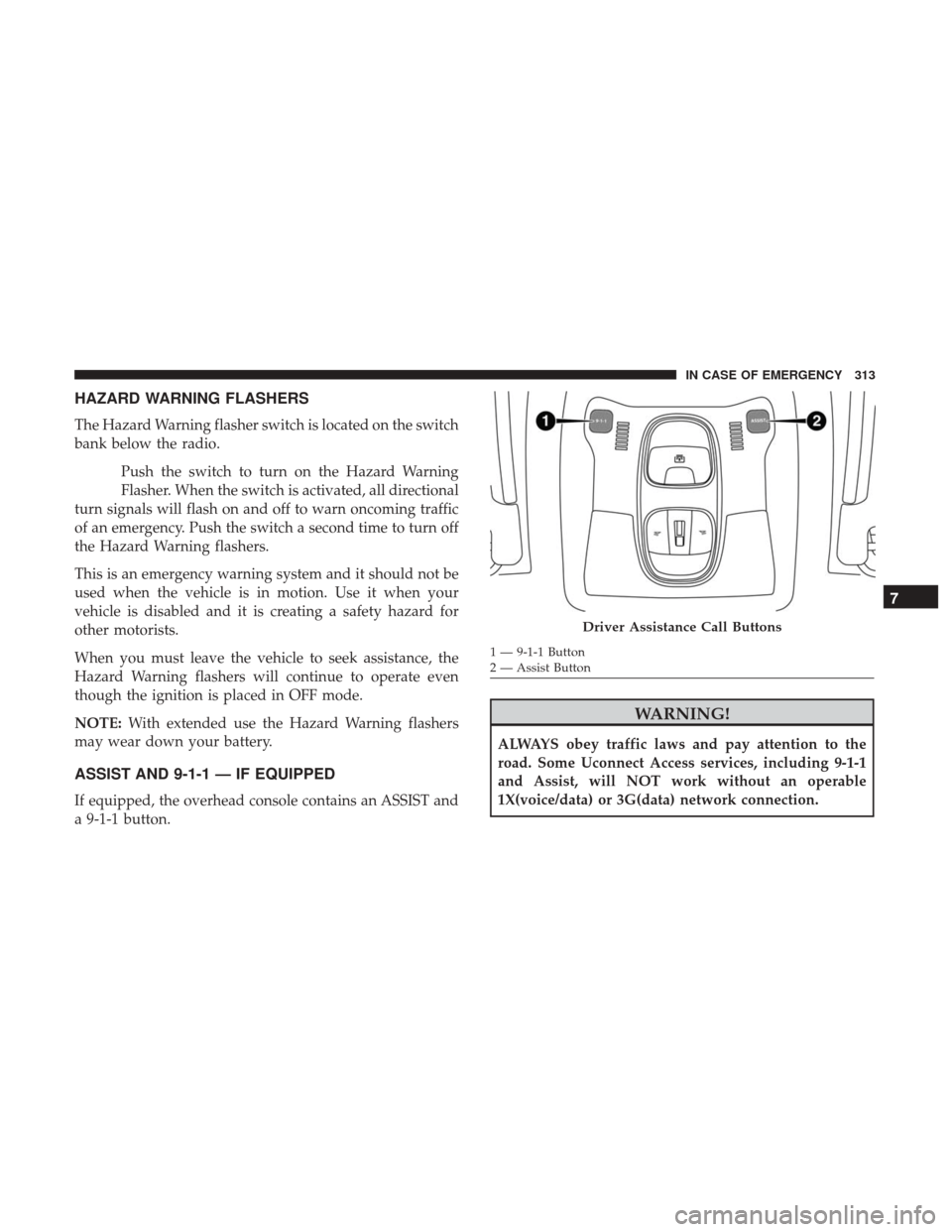
ASSIST AND 9-1-1 — IF EQUIPPED
If equipped, the overhead console contains an ASSIST and
a 9-1-1 button.
WARNING!
ALWAYS obey traffic laws and pay attention to the
road. Some Uconnect Access services, including 9-1-1
and Assist, will NOT work without an operable
1X(voice/data) or 3G(data) network connection.
Driver Assistance Call Buttons
1 — 9-1-1 Button
2 — Assist Button
7
IN CASE OF EMERGENCY 313
Page 317 of 516
4. You should be able to speak with the 9-1-1 operatorthrough the vehicle audio system to determine if addi-
tional help is needed.
WARNING!
ALWAYS obey traffic laws and pay attention to the
road. Some Uconnect Access services, including 9-1-1
and Assist, will NOT work without an operable
1X(voice/data) or 3G(data) network connection.
NOTE: •Your vehicle may be transmitting data as authorized
by the subscriber.
• Once a connection is made between the vehicle’s 9-1-1
Call system and the 9-1-1 operator, the 9-1-1 operator
may be able to open a voice connection with the
vehicle to determine if additional help is needed. Once
the 9-1-1 operator opens a voice connection with the
vehicle’s 9-1-1 Call system, the operator should be able
to speak with you or other vehicle occupants and hear
sounds occurring in the vehicle. The vehicle’s 9-1-1
Call system will attempt to remain connected with the
9-1-1 operator until the 9-1-1 operator terminates the
connection. 5. The 9-1-1 operator may attempt to contact appropriate
emergency responders and provide them with impor-
tant vehicle information and GPS coordinates.
WARNING!
•If anyone in the vehicle could be in danger (e.g., fire
or smoke is visible, dangerous road conditions or
location), do not wait for voice contact from a 9-1-1
operator. All occupants should exit the vehicle im-
mediately and move to a safe location.
•
The 9-1-1 Call system is embedded into the vehicle’s
electrical system. Do not add aftermarket electrical
equipment to the vehicle’s electrical system. This may
prevent your vehicle from sending a signal to initiate an
emergency call. To avoid interference that can cause the
9-1-1 Call system to fail, never add aftermarket equip-
ment (e.g., two-way mobile radio, CB radio, data re-
corder, etc.) to your vehicle’s electrical system or modify
the antennas on your vehicle. IF YOUR VEHICLE
LOSES BATTERY POWER FOR ANY REASON (IN-
CLUDING DURING OR AFTER AN ACCIDENT), THE
UCONNECT FEATURES, APPS AND SERVICES,
AMONG OTHERS, WILL NOT OPERATE.
(Continued)
7
IN CASE OF EMERGENCY 315
Page 319 of 516
•The vehicle battery loses power or becomes discon-
nected during a vehicle crash.
• Operable 1X(voice/data) or 3G(data) network and/or
Global Positioning Satellite signals are unavailable or
obstructed.
• Equipment malfunction at the 9-1-1 operator facility.
• Operator error by the 9-1-1 operator.
• Operable 1X(voice/data) or 3G(data) network conges-
tion.
• Weather.
• Buildings, structures, geographic terrain, or tunnels.
WARNING!
ALWAYS obey traffic laws and pay attention to the
road. Some Uconnect Access services, including 9-1-1
and Assist, will NOT work without an operable
1X(voice/data) or 3G(data) network connection. NOTE:
•
Your vehicle may be transmitting data as authorized by
the subscriber
• Never place anything on or near the vehicle’s operable
1X(voice/data) or 3G(data) network and GPS antennas.
You could prevent operable 1X(voice/data) or 3G(data)
network and GPS signal reception, which can prevent
your vehicle from placing an emergency call. Operable
1X(voice/data) or 3G(data) network and GPS signal
reception is required for the 9-1-1 Call system to function
properly.
General Information
This device complies with Part 15 of the FCC Rules.
Operation is subject to the following two conditions: (1)
This device may not cause harmful interference, and (2)
this device must accept any interference received, includ-
ing interference that may cause undesired operation.
BULB REPLACEMENT
General Information
• Before you replace a bulb, check the contacts to be sure
they are not oxidized.
• Replace the bulbs with the same type and wattage.
7
IN CASE OF EMERGENCY 317
Page 340 of 516
WARNING!(Continued)
•Halogen lamps contain gas under pressure, in the
event of breakage be careful of the projection of
fragments of glass.
• Halogen lamps must be handled by touching only
the metallic part. If the transparent bulb is in contact
with the fingers, reduces the intensity of the emitted
light and you can also affect the life of the lamp. In
case of accidental contact, rub the bulb with a cloth
dampened with alcohol and allow to dry.
FUSES
WARNING!
• When replacing a blown fuse, always use an appro-
priate replacement fuse with the same amp rating as
the original fuse. Never replace a fuse with another
fuse of higher amp rating. Never replace a blown
fuse with metal wires or any other material. Failure
to use proper fuses may result in serious personal
injury, fire and/or property damage.
(Continued)
WARNING! (Continued)
•Before replacing a fuse, make sure that the ignition is
off and that all the other services are switched off
and/or disengaged.
• If the replaced fuse blows again, contact an autho-
rized dealer.
• If a general protection fuse for safety systems (air
bag system, braking system), power unit systems
(engine system, gearbox system) or steering system
blows, contact an authorized dealer.
General Information
The fuses protect electrical systems against excessive cur-
rent.
When a device does not work, you must check the electri-
cal circuit inside the fuse for a break/melt.
Also please be aware that when using power outlets for
extended periods of time with the engine off may result in
vehicle battery discharge.
338 IN CASE OF EMERGENCY
Page 343 of 516
Mounting Fuse Cover and Locking Screw
Proceed as follows:
•Properly secure the fuse cover to the box, slide com-
pletely from top to bottom.
• Fully depress the screw, using the special screwdriver
supplied.
• Slowly turn the screw clockwise.
• Release the screw.
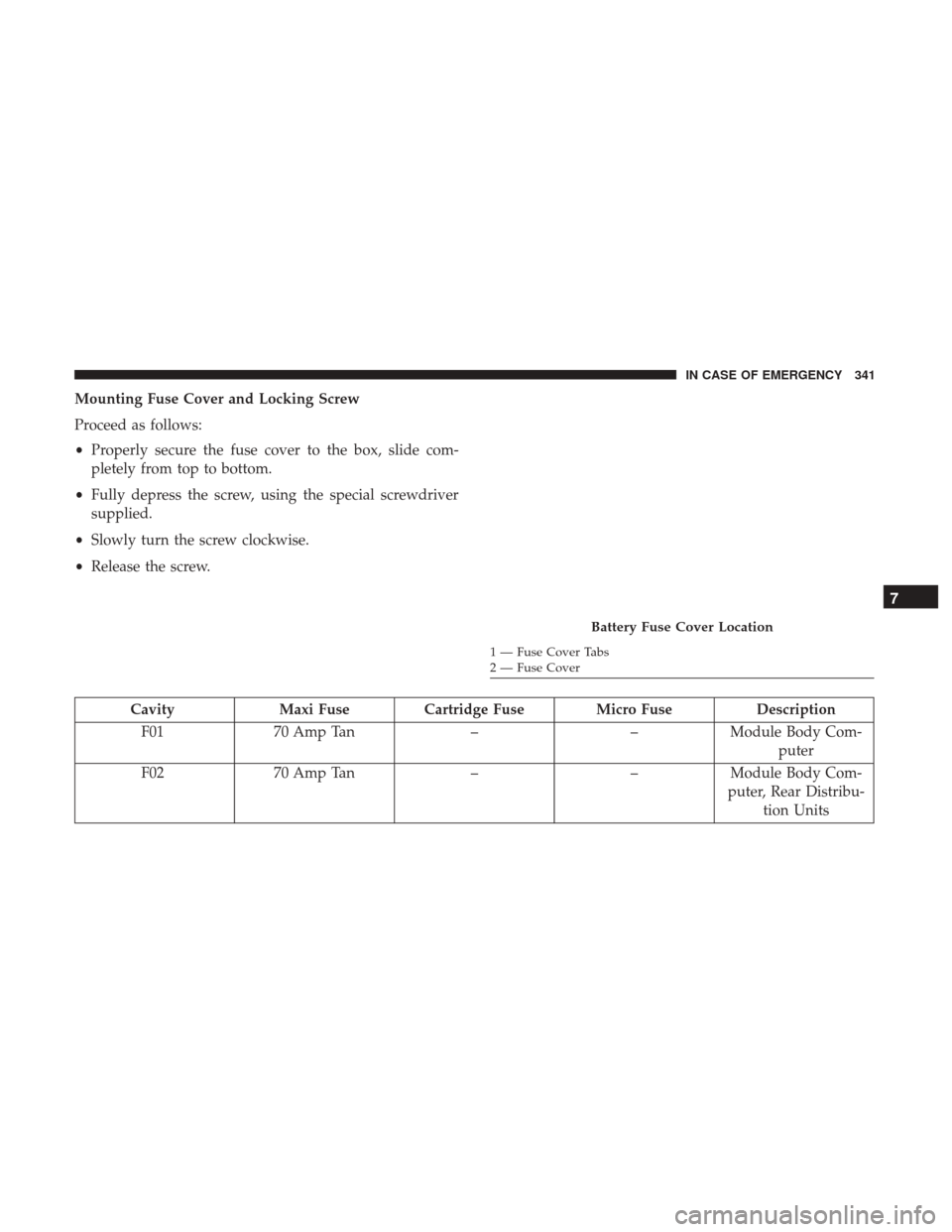
Cavity Maxi FuseCartridge Fuse Micro Fuse Description
F01 70 Amp Tan ––Module Body Com-
puter
F02 70 Amp Tan ––Module Body Com-
puter, Rear Distribu- tion Units
Battery Fuse Cover Location
1 — Fuse Cover Tabs
2 — Fuse Cover
7
IN CASE OF EMERGENCY 341
Page 346 of 516
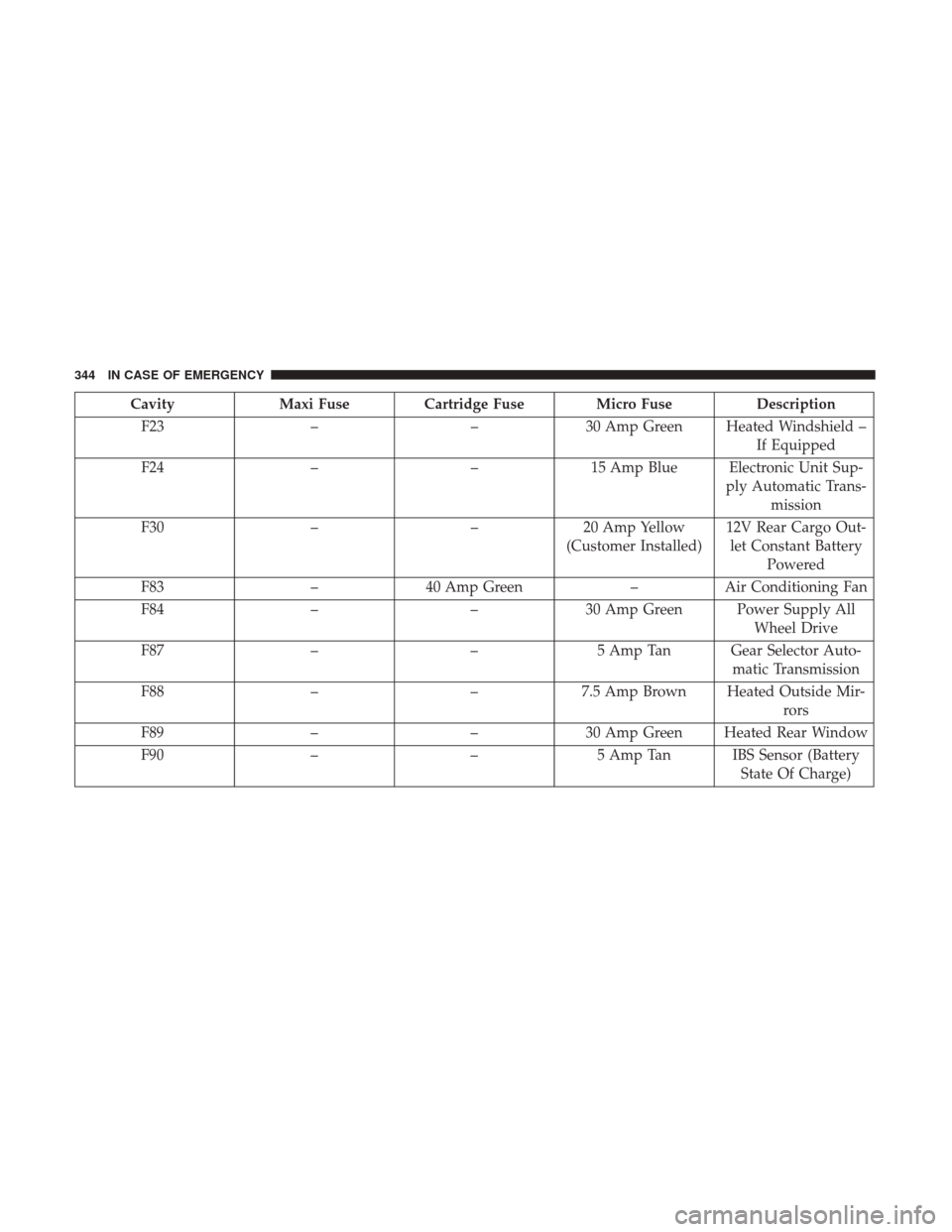
CavityMaxi FuseCartridge Fuse Micro Fuse Description
F23 ––30 Amp Green Heated Windshield –
If Equipped
F24 ––15 Amp Blue Electronic Unit Sup-
ply Automatic Trans-mission
F30 ––20 Amp Yellow
(Customer Installed) 12V Rear Cargo Out-
let Constant Battery Powered
F83 –40 Amp Green –Air Conditioning Fan
F84 ––30 Amp Green Power Supply All
Wheel Drive
F87 ––5 Amp Tan Gear Selector Auto-
matic Transmission
F88 ––7.5 Amp Brown Heated Outside Mir-
rors
F89 ––30 Amp Green Heated Rear Window
F90 ––5 Amp Tan IBS Sensor (Battery
State Of Charge)
344 IN CASE OF EMERGENCY
Page 348 of 516
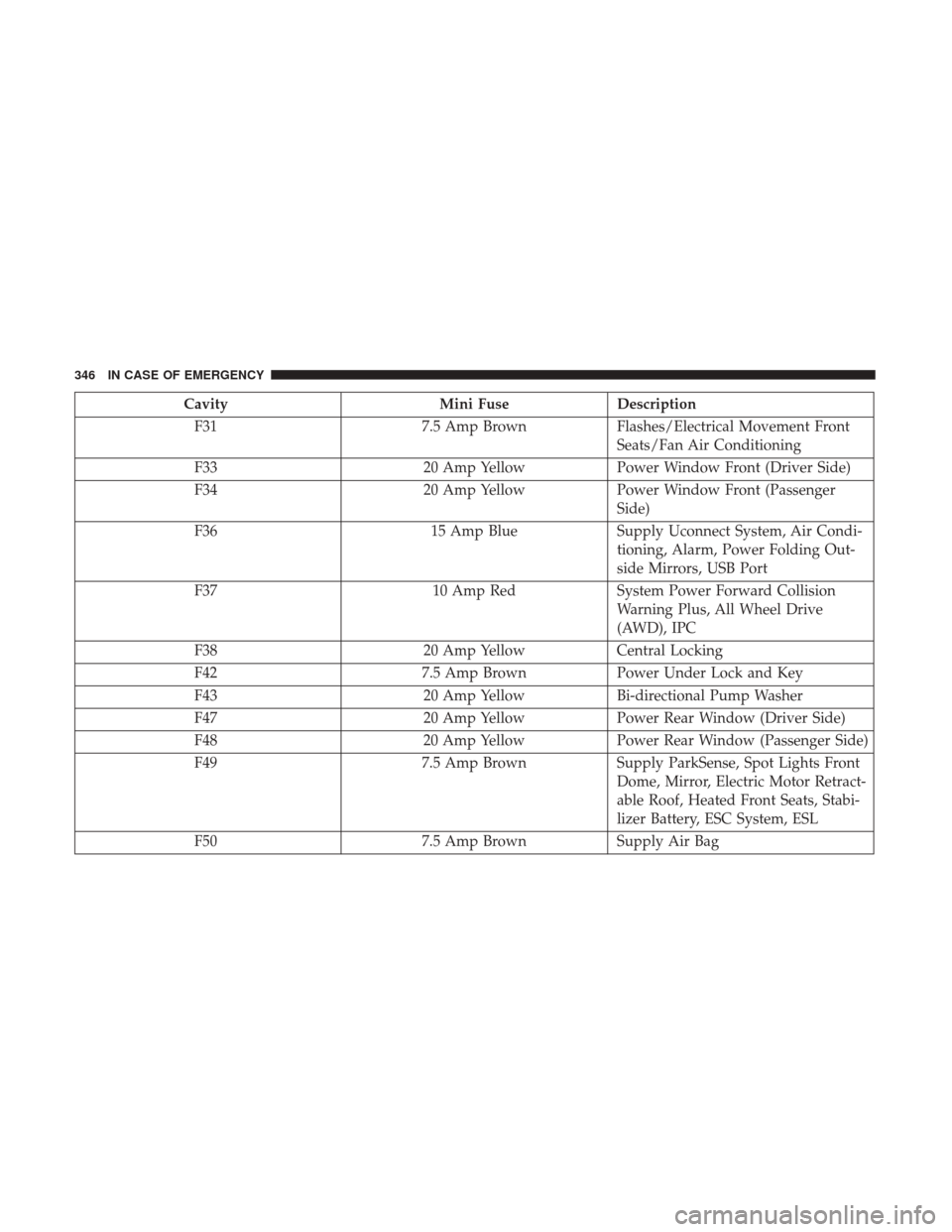
CavityMini FuseDescription
F31 7.5 Amp BrownFlashes/Electrical Movement Front
Seats/Fan Air Conditioning
F33 20 Amp YellowPower Window Front (Driver Side)
F34 20 Amp YellowPower Window Front (Passenger
Side)
F36 15 Amp BlueSupply Uconnect System, Air Condi-
tioning, Alarm, Power Folding Out-
side Mirrors, USB Port
F37 10 Amp RedSystem Power Forward Collision
Warning Plus, All Wheel Drive
(AWD), IPC
F38 20 Amp YellowCentral Locking
F42 7.5 Amp BrownPower Under Lock and Key
F43 20 Amp YellowBi-directional Pump Washer
F47 20 Amp YellowPower Rear Window (Driver Side)
F48 20 Amp YellowPower Rear Window (Passenger Side)
F49 7.5 Amp BrownSupply ParkSense, Spot Lights Front
Dome, Mirror, Electric Motor Retract-
able Roof, Heated Front Seats, Stabi-
lizer Battery, ESC System, ESL
F50 7.5 Amp BrownSupply Air Bag
346 IN CASE OF EMERGENCY
Page 363 of 516
WARNING!
Store the sealant canister in its special compartment,
away from sources of heat. Failure to follow this
WARNING may result in sealant canister rupture and
serious injury or death.
JUMP STARTING
If your vehicle has a discharged battery it can be jump-
started using a set of jumper cables and a battery in another
vehicle or by using a portable battery booster pack. Jump
starting can be dangerous if done improperly so please
follow the procedures in this section carefully.
NOTE:When using a portable battery booster pack follow
the manufacturer ’s operating instructions and precautions.
WARNING!
Do not attempt jump-starting if the battery is frozen. It
could rupture or explode and cause personal injury.
CAUTION!
Do not use a portable battery booster pack or any other
booster source with a system voltage greater than
12 Volts or damage to the battery, starter motor, alter-
nator or electrical system may occur.
Tire Service Kit Expiration Date Location
7
IN CASE OF EMERGENCY 361
Page 364 of 516
Preparations For Jump Start
The battery in your vehicle is located in the front of the
engine compartment, behind the left headlight assembly.
NOTE:The positive battery post is covered with a protec-
tive cap. Lift up on the cap to gain access to the positive
battery post.
WARNING!
• Take care to avoid the radiator cooling fan whenever
the hood is raised. It can start anytime the ignition
switch is ON. You can be injured by moving fan
blades.
• Remove any metal jewelry such as rings, watch
bands and bracelets that could make an inadvertent
electrical contact. You could be seriously injured.
• Batteries contain sulfuric acid that can burn your
skin or eyes and generate hydrogen gas which is
flammable and explosive. Keep open flames or
sparks away from the battery.
Proceed as follows:
1. Set the Electric Park Brake, shift the automatic transmis- sion into PARK (manual transmission in NEUTRAL)
and place the ignition OFF.
2. Turn off the heater, radio, and all unnecessary electrical accessories.
3. If using another vehicle to jump start the battery, park the vehicle within the jumper cables reach, set the
parking brake and make sure the ignition is OFF.
Battery Posts
1 — Positive Battery Post
2 — Negative Battery Post 362 IN CASE OF EMERGENCY
Page 365 of 516
WARNING!
Do not allow vehicles to touch each other as this could
establish a ground connection and personal injury
could result.
Jump Starting Procedure
WARNING!
Failure to follow this jump-starting procedure could
result in personal injury or property damage due to
battery explosion.
CAUTION!
Failure to follow these procedures could result in
damage to the charging system of the booster vehicle
or the discharged vehicle.
Connecting The Jumper Cables
1. Connect the positive (+)end of the jumper cable to the
positive (+)post of the discharged vehicle.
2. Connect the opposite end of the positive (+)jumper
cable to the positive (+)post of the booster battery. 3. Connect the negative
(-)end of the jumper cable to the
negative (-)post of the booster battery.
4. Connect the opposite end of the negative (-)jumper
cable to a good engine ground (exposed metal part of
the discharged vehicle’s engine) away from the battery
and the fuel injection system.
WARNING!
Do not connect the jumper cable to the negative (-) post
of the discharged battery. The resulting electrical spark
could cause the battery to explode and could result in
personal injury. Only use the specific ground point, do
not use any other exposed metal parts.
5. Start the engine in the vehicle that has the booster battery, let the engine idle a few minutes, and then start
the engine in the vehicle with the discharged battery.
6. Once the engine is started, remove the jumper cables in the reverse sequence:
7
IN CASE OF EMERGENCY 363