cooling JEEP RENEGADE 2017 1.G Owner's Manual
[x] Cancel search | Manufacturer: JEEP, Model Year: 2017, Model line: RENEGADE, Model: JEEP RENEGADE 2017 1.GPages: 516, PDF Size: 5.73 MB
Page 398 of 516
•Use only high purity water such as distilled or deionized
water when mixing the water/engine coolant (anti-
freeze) solution. The use of lower quality water will
reduce the amount of corrosion protection in the engine
cooling system.
NOTE:
• It is the owner’s responsibility to maintain the proper
level of protection against freezing according to the
temperatures occurring in the area where the vehicle is
operated.
• Some vehicles require special tools to add coolant prop-
erly. Failure to fill these systems properly could lead to
severe internal engine damage. If any coolant is needed
to be added to the system, please contact your local
authorized dealer.
• Mixing engine coolant (antifreeze) types is not recom-
mended and can result in cooling system damage. If
HOAT and OAT coolant are mixed in an emergency,
have a authorized dealer drain, flush, and refill with
OAT coolant (conforming to MS.90032) as soon as pos-
sible.Cooling System Pressure Cap
The cap must be fully tightened to prevent loss of engine
coolant (antifreeze), and to ensure that engine coolant
(antifreeze) will return to the radiator from the coolant
recovery tank.
The cap should be inspected and cleaned if there is any
accumulation of foreign material on the sealing surfaces.
WARNING!
• Do not open hot engine cooling system. Never add
engine coolant (antifreeze) when the engine is over-
heated. Do not loosen or remove the cap to cool an
overheated engine. Heat causes pressure to build up
in the cooling system. To prevent scalding or injury,
do not remove the pressure cap while the system is
hot or under pressure.
• Do not use a pressure cap other than the one speci-
fied for your vehicle. Personal injury or engine
damage may result.
396 SERVICING AND MAINTENANCE
Page 399 of 516
Disposal Of Used Coolant
Used ethylene glycol-based coolant (antifreeze) is a regu-
lated substance requiring proper disposal. Check with your
local authorities to determine the disposal rules for your
community. To prevent ingestion by animals or children,
do not store ethylene glycol-based coolant in open contain-
ers or allow it to remain in puddles on the ground. If
ingested by a child or pet, seek emergency assistance
immediately. Clean up any ground spills immediately.
Coolant Level
The coolant expansion bottle provides a quick visual
method for determining that the coolant level is adequate.
With the engine off and cold, the level of the coolant
(antifreeze) in the bottle should be between the “MAX” and
“MIN” lines marked on the bottle.
As long as the engine operating temperature is satisfactory,
the coolant bottle need only be checked once a month.
When additional coolant (antifreeze) is needed to maintain
the proper level, it should be added to the coolant bottle.
Do not overfill.
See your authorized dealer for service
Points To Remember
NOTE:When the vehicle is stopped after a few miles/
kilometers of operation, you may observe vapor coming
from the front of the engine compartment. This is normally
a result of moisture from rain, snow, or high humidity
accumulating on the radiator and being vaporized when
the thermostat opens, allowing hot engine coolant (anti-
freeze) to enter the radiator.
If an examination of your engine compartment shows no
evidence of radiator or hose leaks, the vehicle may be
safely driven. The vapor will soon dissipate.
• Do not overfill the coolant expansion bottle.
• Check the coolant freeze point in the radiator and in the
coolant expansion bottle. If engine coolant (antifreeze)
needs to be added, the contents of the coolant expansion
bottle must also be protected against freezing.
• If frequent engine coolant (antifreeze) additions are
required, the cooling system should be pressure tested
for leaks.
• Maintain engine coolant (antifreeze) concentration at a
minimum of 50% OAT coolant (conforming to
8
SERVICING AND MAINTENANCE 397
Page 427 of 516
represent higher levels of performance on the laboratory
test wheel, than the minimum required by law.
WARNING!
The temperature grade for this tire is established for
a tire that is properly inflated and not overloaded.
Excessive speed, under-inflation, or excessive load-
ing, either separately or in combination, can cause
heat buildup and possible tire failure.
STORING THE VEHICLE
If the vehicle should remain stationary for more than a
month, observe the following precautions:
• Park your vehicle in a covered, dry and possibly airy
location the windows open slightly.
• Check that the Electric Park Brake is not engaged.
• Disconnect the negative (-) terminal from the battery
post and be sure that the battery is fully charged. During
storage check battery charge quarterly.
• If you do not disconnect the battery from the electrical
system, check the battery charge every thirty days. •
Clean and protect the painted parts by applying protec-
tive waxes.
• Clean and protect polished metal parts by applying
protective waxes.
• Apply talcum powder to the front and rear wiper blades
and leave raised from the glass.
• Cover the vehicle with an appropriate cover taking care
not to damage the painted surface by dragging across
dirty surfaces. Do not use plastic sheeting which will not
allow the evaporation of moisture present on the surface
of the vehicle.
• Inflate the tires at a pressure of +7.25 psi (+0.5 bar)
higher than recommended on the tire placard and check
it periodically.
• Do not drain the engine cooling system.
• Whenever you leave the vehicle is stationary for two
weeks or more, idle the engine for approximately five
minutes with the air conditioning system on and high
fan speed. This will ensure a proper lubrication of the
system, thus minimizing the possibility of damage to the
compressor when the vehicle is put back into operation.8
SERVICING AND MAINTENANCE 425
Page 440 of 516
Carbon Monoxide Warnings
WARNING!
Carbon monoxide (CO) in exhaust gases is deadly.
Follow the precautions below to prevent carbon mon-
oxide poisoning:
•
Do not inhale exhaust gases. They contain carbon mon-
oxide, a colorless and odorless gas, which can kill. Never
run the engine in a closed area, such as a garage, and
never sit in a parked vehicle with the engine running for
(Continued)
WARNING! (Continued)
an extended period. If the vehicle is stopped in an open
area with the engine running for more than a short
period, adjust the ventilation system to force fresh,
outside air into the vehicle.
•Guard against carbon monoxide with proper mainte-
nance. Have the exhaust system inspected every time the
vehicle is raised. Have any abnormal conditions repaired
promptly. Until repaired, drive with all side windows
fully open.
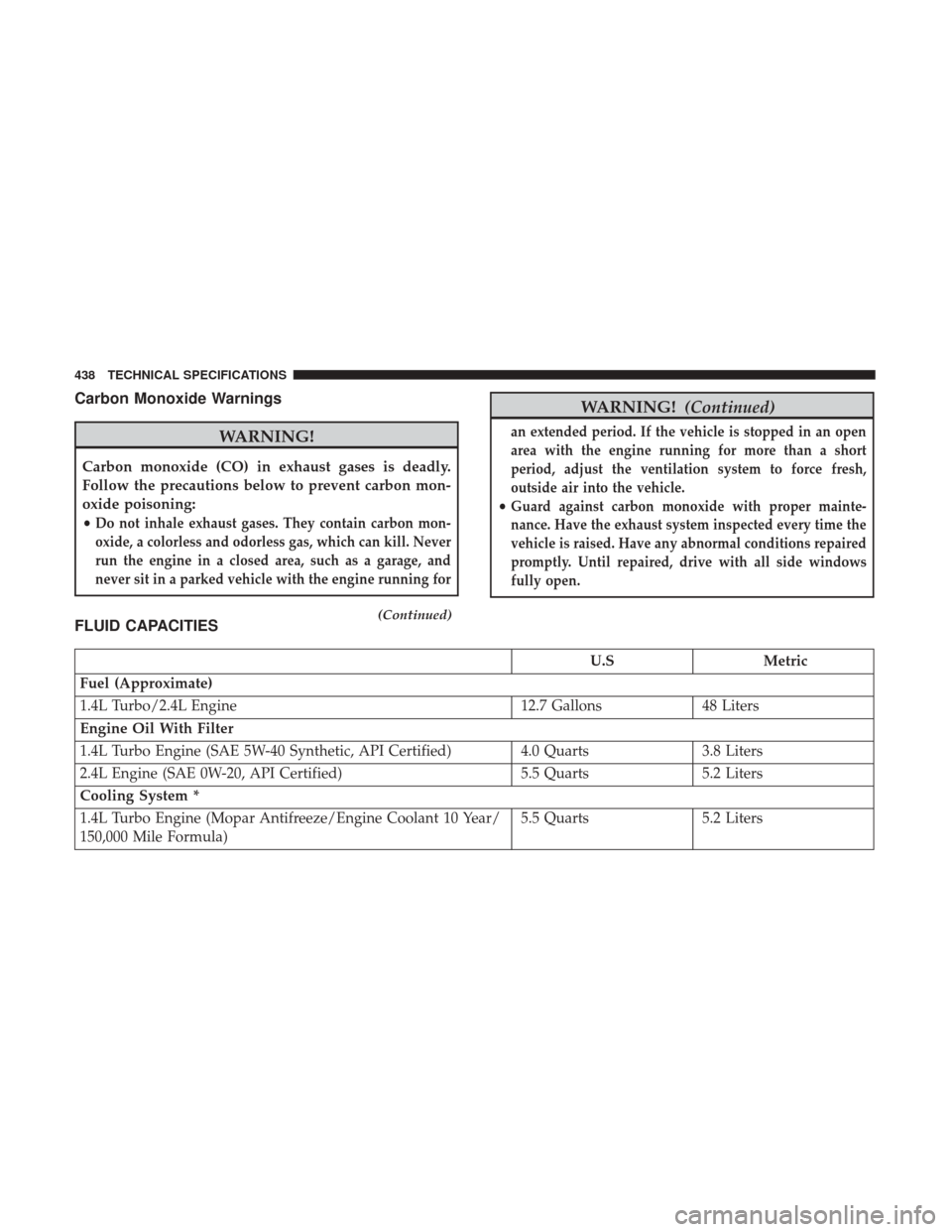
FLUID CAPACITIES
U.S Metric
Fuel (Approximate)
1.4L Turbo/2.4L Engine 12.7 Gallons48 Liters
Engine Oil With Filter
1.4L Turbo Engine (SAE 5W-40 Synthetic, API Certified) 4.0 Quarts 3.8 Liters
2.4L Engine (SAE 0W-20, API Certified) 5.5 Quarts5.2 Liters
Cooling System *
1.4L Turbo Engine (Mopar Antifreeze/Engine Coolant 10 Year/
150,000 Mile Formula) 5.5 Quarts
5.2 Liters
438 TECHNICAL SPECIFICATIONS
Page 504 of 516
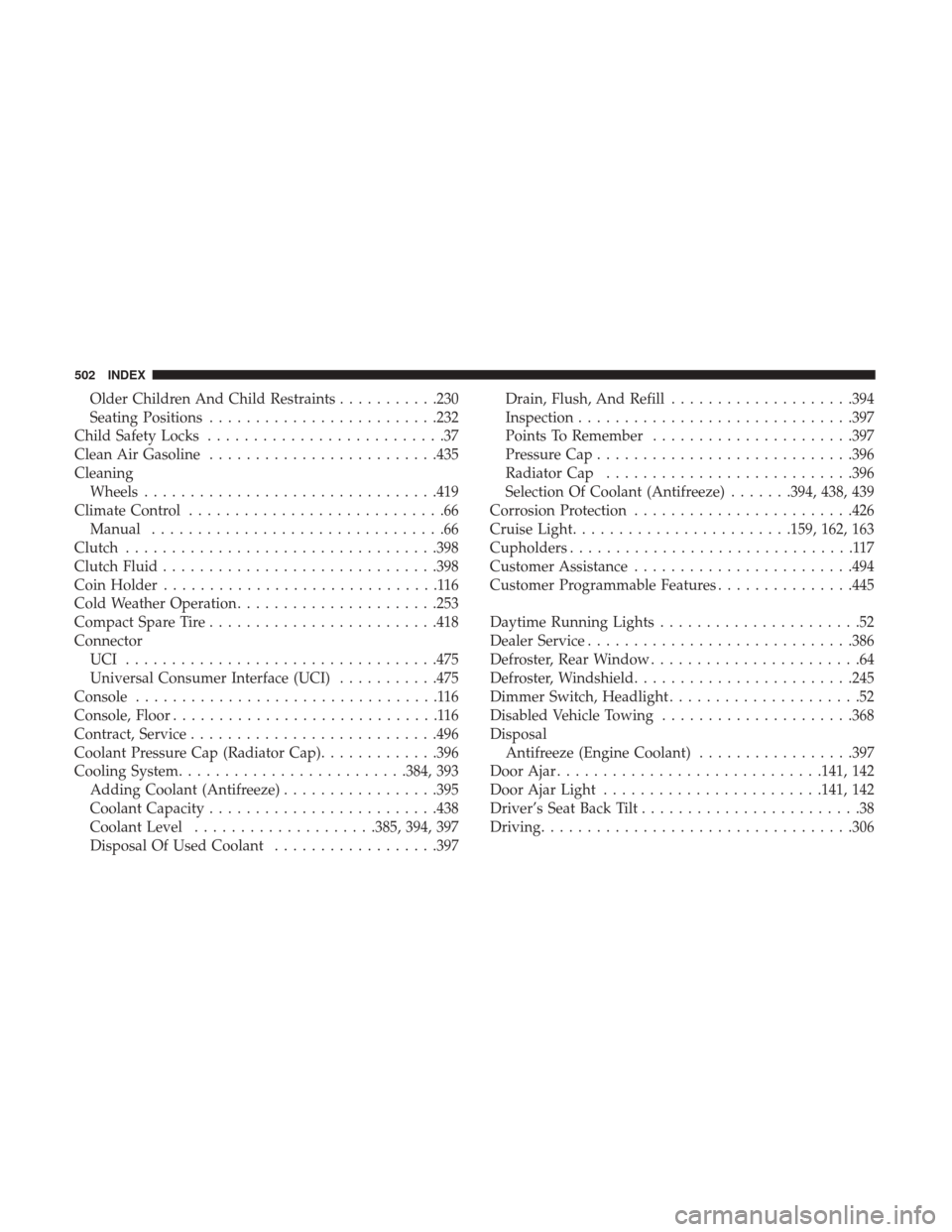
Older Children And Child Restraints...........230
Seating Positions ........................ .232
Child Safety Locks ..........................37
Clean Air Gasoline ........................ .435
Cleaning Wheels ............................... .419
Climate Control ............................66
Manual ................................66
Clutch ................................. .398
Clutch Fluid ............................. .398
Coin Holder ..............................116
Cold Weather Operation ..................... .253
Compact Spare Tire ........................ .418
Connector UCI ................................. .475
Universal Consumer Interface (UCI) ...........475
Console .................................116
Console, Floor .............................116
Contract, Service .......................... .496
Coolant Pressure Cap (Radiator Cap) .............396
Cooling System ........................ .384, 393
Adding Coolant (Antifreeze) .................395
Coolant Capacity ........................ .438
Coolant Level ....................385, 394, 397
Disposal Of Used Coolant ..................397 Drain, Flush, And Refill
....................394
Inspection ............................. .397
Points To Remember ..................... .397
Pressure Cap ........................... .396
Radiator Cap .......................... .396
Selection Of Coolant (Antifreeze) .......394, 438, 439
Corrosion Protection ....................... .426
Cruise Light ....................... .159, 162, 163
Cupholders ...............................117
Customer Assistance ....................... .494
Customer Programmable Features ...............445
Daytime Running Lights ......................52
Dealer Service ............................ .386
Defroster, Rear Window .......................
64
Defroster, Windshield ....................... .245
Dimmer Switch, Headlight .....................52
Disabled Vehicle Towing .....................368
Disposal Antifreeze (Engine Coolant) .................397
Door Ajar ............................ .141, 142
Door Ajar Light ....................... .141, 142
Driver’s Seat Back Tilt ........................38
Driving ................................. .306
502 INDEX
Page 505 of 516
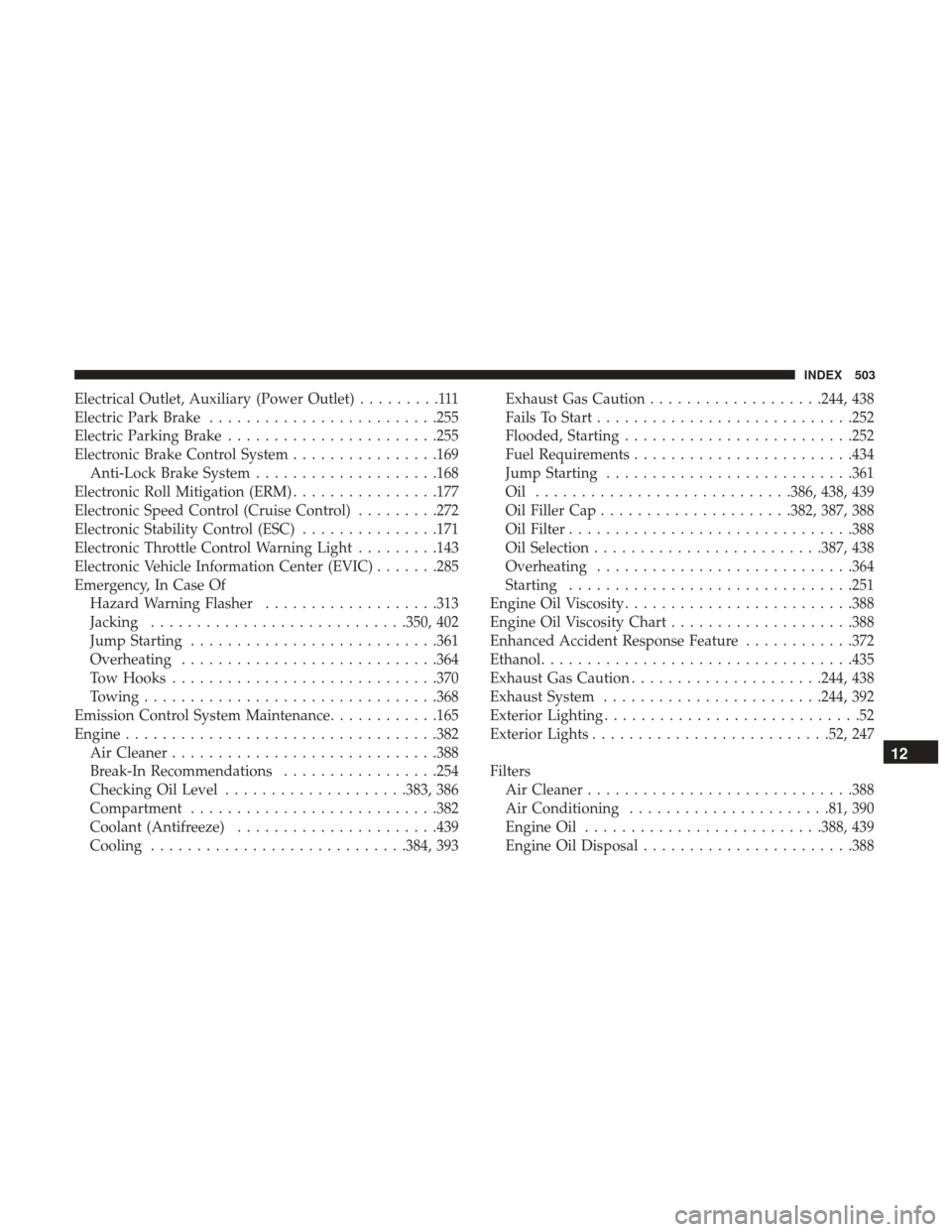
Electrical Outlet, Auxiliary (Power Outlet).........111
Electric Park Brake ........................ .255
Electric Parking Brake ...................... .255
Electronic Brake Control System ................169
Anti-Lock Brake System ....................168
Electronic Roll Mitigation (ERM) ................177
Electronic Speed Control (Cruise Control) .........272
Electronic Stability Control (ESC) ...............171
Electronic Throttle Control Warning Light .........143
Electronic Vehicle Information Center (EVIC) .......285
Emergency, In Case Of Hazard Warning Flasher ...................313
Jacking ........................... .350, 402
Jump Starting .......................... .361
Overheating ........................... .364
Tow Hooks ............................ .370
Towing ............................... .368
Emission Control System Maintenance ............165
Engine ................................. .382
Air Cleaner ............................ .388
Break-In Recommendations .................254
Checking Oil Level ....................383, 386
Compartment .......................... .382
Coolant (Antifreeze) ..................... .439
Cooling ........................... .384, 393Exhaust Gas Caution
...................244, 438
Fails To Start ........................... .252
Flooded, Starting ........................ .252
Fuel Requirements ....................... .434
Jump Starting .......................... .361
Oil ........................... .386, 438, 439
Oil Filler Cap .....................382, 387, 388
Oil Filter .............................. .388
Oil Selection ........................ .387, 438
Overheating ........................... .364
Starting .............................. .251
Engine
Oil Viscosity ........................ .388
Engine Oil Viscosity Chart ....................388
Enhanced Accident Response Feature ............372
Ethanol ................................. .435
Exhaust Gas Caution .....................244, 438
Exhaust System ....................... .244, 392
Exterior Lighting ............................52
Exterior Lights ......................... .52, 247
Filters Air Cleaner ............................ .388
Air Conditioning ..................... .81, 390
Engine Oil ......................... .388, 439
Engine Oil Disposal ...................... .388
12
INDEX 503
Page 513 of 516
Tire Markings............................ .403
Tires......................... .247, 410, 418, 424
Aging (Life Of Tires) ..................... .415
Air Pressure ........................... .410
Chains ............................... .421
Changing .......................... .350, 402
Compact Spare ......................... .418
General Information ...................410, 418
High Speed ............................ .412
Inflation Pressures ....................... .412
Jacking ........................... .350, 402
Life Of Tires ........................... .415
Load Capacity ...................... .407, 408
Pressure Monitor System (TPMS) .............195
Pressure Warning Light ....................153
Quality Grading ........................ .424
Radial ............................... .413
Replacement ........................... .415
Rotation .............................. .422
Safety ............................ .403, 410
Snow Tires ............................ .417
Spare Tire ......................... .418, 419
Spinning .............................. .414
Trailer Towing .......................... .301
Tread Wear Indicators .....................414 Tire Safety Information
...................... .403
Tire Service Kit ........................... .358
Tongue Weight/Trailer Weight .................299
Tow Hooks, Emergency ..................... .370
Towing ................................. .296
Disabled Vehicle ........................ .368
Guide ................................ .299
Recreational ........................... .305
Weight ............................... .299
Trailer Sway Control (TSC) ....................171
T
railer Towing ............................ .296
Cooling System Tips ..................... .304
Hitches ............................... .298
Minimum Requirements ....................300
Trailer And Tongue Weight ..................299
Wiring ............................... .302
Trailer Towing Guide ....................... .299
Trailer Weight ............................ .299
Transfer Case Fluid ................................ .440
Transmission Automatic ......................... .263, 400
Fluid ................................ .440
Manual ............................... .260
Transporting Pets ......................... .243
12
INDEX 511