light JEEP WAGONEER 2023 Owners Manual
[x] Cancel search | Manufacturer: JEEP, Model Year: 2023, Model line: WAGONEER, Model: JEEP WAGONEER 2023Pages: 396, PDF Size: 15.17 MB
Page 318 of 396
316SERVICING AND MAINTENANCE
CHECKING OIL LEVEL — 3.0L ENGINES
The 3.0L engine does not have a traditional “dipstick” and
there is no need to manually check the oil level. If it is
desired to check engine oil level, it can be seen on the
instrument cluster display by navigating to the appropriate
screen under “Vehicle Information”. Use the up or
down arrow buttons within the steering wheel controls
to find the “Vehicle Information” menu. Then use the
right or left arrow buttons until you reach the “Oil
Level” sub-menu.
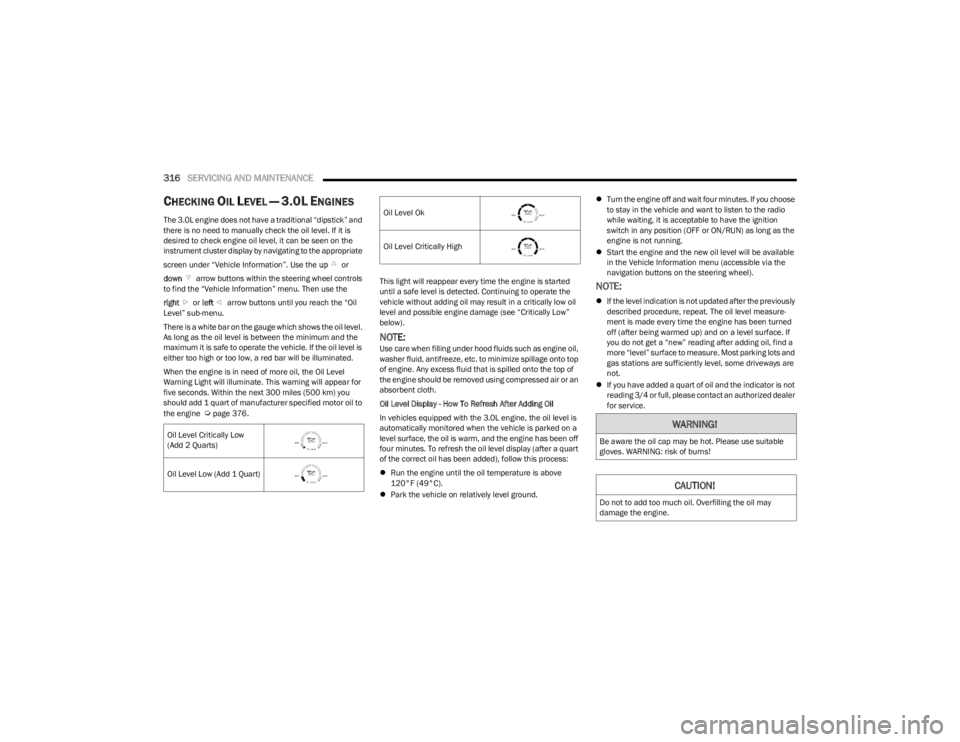
There is a white bar on the gauge which shows the oil level.
As long as the oil level is between the minimum and the
maximum it is safe to operate the vehicle. If the oil level is
either too high or too low, a red bar will be illuminated.
When the engine is in need of more oil, the Oil Level
Warning Light will illuminate. This warning will appear for
five seconds. Within the next 300 miles (500 km) you
should add 1 quart of manufacturer specified motor oil to
the engine
Úpage 376. This light will reappear every time the engine is started
until a safe level is detected. Continuing to operate the
vehicle without adding oil may result in a critically low oil
level and possible engine damage (see “Critically Low”
below).
NOTE:Use care when filling under hood fluids such as engine oil,
washer fluid, antifreeze, etc. to minimize spillage onto top
of engine. Any excess fluid that is spilled onto the top of
the engine should be removed using compressed air or an
absorbent cloth.
Oil Level Display - How To Refresh After Adding Oil
In vehicles equipped with the 3.0L engine, the oil level is
automatically monitored when the vehicle is parked on a
level surface, the oil is warm, and the engine has been off
four minutes. To refresh the oil level display (after a quart
of the correct oil has been added), follow this process:
Run the engine until the oil temperature is above
120°F (49°C).
Park the vehicle on relatively level ground.
Turn the engine off and wait four minutes. If you choose
to stay in the vehicle and want to listen to the radio
while waiting, it is acceptable to have the ignition
switch in any position (OFF or ON/RUN) as long as the
engine is not running.
Start the engine and the new oil level will be available
in the Vehicle Information menu (accessible via the
navigation buttons on the steering wheel).
NOTE:
If the level indication is not updated after the previously
described procedure, repeat. The oil level measure -
ment is made every time the engine has been turned
off (after being warmed up) and on a level surface. If
you do not get a “new” reading after adding oil, find a
more “level” surface to measure. Most parking lots and
gas stations are sufficiently level, some driveways are
not.
If you have added a quart of oil and the indicator is not
reading 3/4 or full, please contact an authorized dealer
for service.
Oil Level Critically Low
(Add 2 Quarts)
Oil Level Low (Add 1 Quart)
Oil Level Ok
Oil Level Critically High
WARNING!
Be aware the oil cap may be hot. Please use suitable
gloves. WARNING: risk of burns!
CAUTION!
Do not to add too much oil. Overfilling the oil may
damage the engine.
23_WS_OM_EN_USC_t.book Page 316
Page 319 of 396

SERVICING AND MAINTENANCE317
NOTE:
After adding oil to the engine, always reinstall the oil
cap securely by rotating clockwise until it stops. Never
run the engine without the oil fill cap as this could
cause an oil leak.
Because the oil level is automatically detected only
when the engine has been off and restarted (after four
minutes), the system cannot immediately detect a
sudden drop in oil level while driving (for example, if the
oil pan starts to leak due to damage during an off-road
event).
CHECKING OIL LEVEL — 5.7L & 6.4L
E
NGINES
To ensure proper engine lubrication, the engine oil must
be maintained at the correct level. Check the oil level at
regular intervals, such as every fuel stop. The best time to
check the engine oil level is about five minutes after a fully
warmed up engine is shut off.
Checking the oil while the vehicle is on level ground will
improve the accuracy of the oil level readings.
There are four possible dipstick types:
Crosshatched zone.
Crosshatched zone marked SAFE.
Crosshatched zone marked with MIN at the low end of
the range and MAX at the high end of the range.
Crosshatched zone marked with dimples at the MIN
and the MAX ends of the range.
NOTE:Always maintain the oil level within the crosshatch
markings on the dipstick.
Adding 1 qt (1 L) of oil when the reading is at the low end
of the dipstick range will raise the oil level to the high end
of the range marking.
ADDING WASHER FLUID
The instrument cluster display will indicate when the
washer fluid level is low. When the sensor detects a low
fluid level, the Low Washer Fluid Warning Light will turn on
and the "Washer Fluid Low" message will be displayed.
The fluid reservoir for the windshield washers and the rear
window washer is shared. The fluid reservoir is located in
the engine compartment, be sure to check the fluid level
at regular intervals. Fill the reservoir with windshield
washer solvent only (not radiator antifreeze). When
refilling the washer fluid reservoir, take some washer fluid
and apply it to a cloth or towel and wipe clean the wiper
blades, this will help blade performance. To prevent
freeze-up of your windshield washer system in cold
weather, select a solution or mixture that meets or
exceeds the temperature range of your climate. This rating
information can be found on most washer fluid containers.
NOTE:Use care when filling under hood fluids such as engine oil,
washer fluid, antifreeze, etc. to minimize spillage onto top
of engine. Any excess fluid that is spilled onto the top of
the engine should be removed using compressed air or an
absorbent cloth.
CAUTION!
If the “Critically Low or Critically High” Oil Level Warning
Light is illuminated, the following steps should be
taken:
Critically Low: add two quarts of manufacturer speci -
fied oil as soon as possible
Úpage 376. Continuing
to operate the vehicle with “Critically Low” oil level
may damage the engine.
Critically High: contact an authorized dealer for
service. Continuing to operate the vehicle with “Criti -
cally High” oil level may damage the engine.
Do not use any oils that are not manufacturer specified
and API approved.
Used engine oil and oil filters contain substances which
are harmful to the environment. When oil and filters are
changed contact an authorized dealer and dispose of in
a safe and responsible manner.
WARNING!
Commercially available windshield washer solvents are
flammable. They could ignite and burn you. Care must
be exercised when filling or working around the washer
solution.
8
23_WS_OM_EN_USC_t.book Page 317
Page 321 of 396

SERVICING AND MAINTENANCE319
ENGINE OIL
Engine Oil Selection
Use only the manufacturer's recommended fluids Úpage 376.
NOTE:Hemi engines at times can tick right after startup and then
quiet down after approximately 30 seconds. This is normal
and will not harm the engine. This characteristic can be
caused by short drive cycles. For example, if the vehicle is
started then shut off after driving a short distance. Upon
restarting, you may experience a ticking sound. Other
causes could be if the vehicle is unused for an extended
period of time, incorrect oil, extended oil changes or
extended idling. If the engine continues to tick or if the
Malfunction Indicator Light (MIL) comes on, see the
nearest authorized dealer.
American Petroleum Institute (API)
Approved Engine Oil
These symbols mean that the oil has been certified by the
API. The manufacturer only recommends API trademark
oils.
The API Starburst trademark certifies 0W-20,
0W-30 and 5W-30 engine oils.
The API Donut trademark certifies 0W-40 and
5W-40 engine oil.
Synthetic Engine Oils
Your engine was designed for synthetic engine oils, only
use synthetic API approved engine oils.
Synthetic engine oils which do not have both the correct
API trademark and the correct SAE viscosity grade
numbers should not be used.
Materials Added To Engine Oil
The manufacturer strongly recommends against the
addition of any additives (other than leak detection dyes)
to the engine oil. Engine oil is an engineered product and
its performance may be impaired by supplemental
additives.
Disposing Of Used Engine Oil And Oil
Filters
Care should be taken in disposing of used engine oil and
oil filters from your vehicle. Used oil and oil filters,
indiscriminately discarded, can present a problem to the
environment. Contact an authorized dealer, service
station or governmental agency for advice on how and
where used oil and oil filters can be safely discarded in
your area.
ENGINE OIL FILTER
The engine oil filter should be replaced with a new filter at
every engine oil change.
Engine Oil Filter Selection
A full-flow type disposable oil filter should be used for
replacement. The quality of replacement filters varies
considerably. We recommend using a Mopar® Engine Oil
Filter. If a Mopar® Engine Oil Filter is unavailable only use
filters that meet or exceed SAE/USCAR-36 Filter
Performance Requirements.
ENGINE AIR CLEANER FILTER
For the proper maintenance intervals Úpage 310.
Engine Air Cleaner Filter Selection
The quality of replacement engine air cleaner filters varies
considerably. Only high quality Mopar® filters should be
used.
CAUTION!
Do not use chemical flushes in your engine oil as the
chemicals can damage your engine. Such damage is
not covered by the New Vehicle Limited Warranty.
WARNING!
The air induction system (air cleaner, hoses, etc.) can
provide a measure of protection in the case of engine
backfire. Do not remove the air induction system (air
cleaner, hoses, etc.) unless such removal is necessary
for repair or maintenance. Make sure that no one is
near the engine compartment before starting the
vehicle with the air induction system (air cleaner, hoses,
etc.) removed. Failure to do so can result in serious
personal injury.
8
23_WS_OM_EN_USC_t.book Page 319
Page 330 of 396

328SERVICING AND MAINTENANCE
(Continued)
Coolant Level
The coolant bottle provides a quick visual method for
determining that the coolant level is adequate. With the
engine off and cold, the level of the engine coolant
(antifreeze) in the bottle should be between the ranges
indicated on the bottle.
The radiator normally remains completely full, so there is
no need to remove the radiator/coolant pressure cap
unless checking for engine coolant freeze point or
replacing coolant. Advise your service attendant of this. As
long as the engine operating temperature is satisfactory,
the coolant bottle need only be checked once a month.
When additional engine coolant is needed to maintain the
proper level, only OAT coolant that meets the
requirements of the manufacturer Material Standard
MS.90032 should be added to the coolant bottle. Do not
overfill.
Cooling System Notes
NOTE:When the vehicle is stopped after a few miles/kilometers
of operation, you may observe vapor coming from the front
of the engine compartment. This is normally a result of
moisture from rain, snow, or high humidity accumulating
on the radiator and being vaporized when the thermostat
opens, allowing hot engine coolant (antifreeze) to enter
the radiator. If an examination of your engine compartment shows no
evidence of radiator or hose leaks, the vehicle may be
safely driven. The vapor will soon dissipate.
Do not overfill the coolant expansion bottle.
Check the coolant freeze point in the radiator and in
the coolant expansion bottle. If engine coolant needs
to be added, the contents of the coolant expansion
bottle must also be protected against freezing.
If frequent engine coolant additions are required, the
cooling system should be pressure tested for leaks.
Maintain engine coolant concentration at a minimum
of 50% OAT coolant (conforming to MS.90032) and
distilled water for proper corrosion protection of your
engine which contains aluminum components.
Make sure that the coolant expansion bottle overflow
hoses are not kinked or obstructed.
Keep the front of the radiator clean. If your vehicle is
equipped with air conditioning, keep the front of the
condenser clean.
Do not change the thermostat for Summer or Winter
operation. If replacement is ever necessary, install
ONLY the correct type thermostat. Other designs may
result in unsatisfactory engine cooling performance,
poor gas mileage, and increased emissions.
BRAKE SYSTEM
In order to ensure brake system performance, all brake
system components should be inspected periodically. For
the proper maintenance intervals
Úpage 310.
Fluid Level Check — Brake Master Cylinder
The fluid level of the master cylinder should be checked
whenever the vehicle is serviced, or immediately if the
Brake System Warning Light is on. If necessary, add fluid
to bring level within the designated marks on the side of
the reservoir of the brake master cylinder. Be sure to clean
the top of the master cylinder area before removing cap.
With disc brakes, fluid level can be expected to fall as the
brake pads wear. Brake fluid level should be checked
when pads are replaced. If the brake fluid is abnormally
low, check the system for leaks.
WARNING!
Riding the brakes can lead to brake failure and possibly
a collision. Driving with your foot resting or riding on the
brake pedal can result in abnormally high brake
temperatures, excessive lining wear, and possible brake
damage. You would not have your full braking capacity
in an emergency.
WARNING!
Use only manufacturer's recommended brake fluid Úpage 377. Using the wrong type of brake fluid can
severely damage your brake system and/or impair its
performance. The proper type of brake fluid for your
vehicle is also identified on the original factory
installed hydraulic master cylinder reservoir.
23_WS_OM_EN_USC_t.book Page 328
Page 340 of 396
338SERVICING AND MAINTENANCE
Interior Power Distribution Center
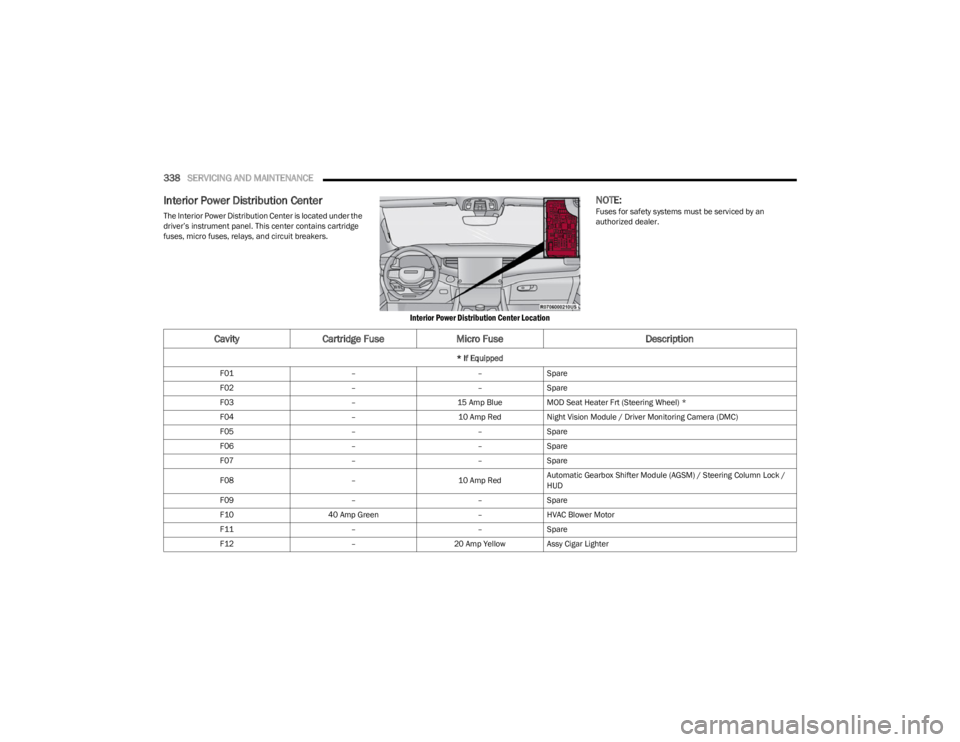
The Interior Power Distribution Center is located under the
driver’s instrument panel. This center contains cartridge
fuses, micro fuses, relays, and circuit breakers.
Interior Power Distribution Center Location
NOTE:Fuses for safety systems must be serviced by an
authorized dealer.
CavityCartridge Fuse Micro Fuse Description
* If Equipped
F01 ––Spare
F02 ––Spare
F03 –15 Amp BlueMOD Seat Heater Frt (Steering Wheel) *
F04 –10 Amp RedNight Vision Module / Driver Monitoring Camera (DMC)
F05 ––Spare
F06 ––Spare
F07 ––Spare
F08 –10 Amp RedAutomatic Gearbox Shifter Module (AGSM) / Steering Column Lock /
HUD
F09 ––Spare
F10 40 Amp Green –HVAC Blower Motor
F11 ––Spare
F12 –20 Amp Yellow Assy Cigar Lighter
23_WS_OM_EN_USC_t.book Page 338
Page 342 of 396

340SERVICING AND MAINTENANCE
F32 –10 Amp RedMOD ICS Switch Bank / SW Bank Upper / SW EPB / Aux Switch Bank
Module (ASBM) / Mod HVAC Cntrl Frt / Humidity Rain Light Sensor
(HRLS)
F33 –15 Amp BlueTransfer case SW / SW Bank Lower / Mod ICS Switch Bank Rear /
Climate Control Display / Suspension SW *
F34 ––Spare
F35 –10 Amp RedIRCAM Heater
F36 ––Spare
F37 ––Spare
F38 ––Spare
F39 ––Spare
F40 ––Spare
F41A ––Spare
F41B ––Spare
F42A ––Spare
F42B –10 Amp RedMOD HVAC Control Frt
F43A ––Spare
F43B ––Spare
F44 –15 Amp BlueMOD Cluster CCN / MOD SGW (Cybersecurity)
F45 30 Amp Pink –MOD Inverter 150W
F46 ––Spare
F47A ––Spare
F47B ––Spare
Cavity Cartridge Fuse Micro Fuse Description
* If Equipped
23_WS_OM_EN_USC_t.book Page 340
Page 346 of 396

344SERVICING AND MAINTENANCE
The Rear Power Distribution Center is located behind a trim cover of the rear driver’s side quarter panel. This center contains cartridge fuses, micro fuses, relays, and circuit breakers.
The following chart corresponds to the fuses inside.
CavityCartridge Fuse Micro Fuse Description
* If Equipped
F05 150 Amp Gray –Underhood Power Distribution Center Battery Feed
F06 ––Spare
F07 ––Spare
F08 ––Spare
F09 ––Spare
F10 ––Spare
F11 ––Spare
F12 ––Spare
F13 30 Amp Pink –Air Compressor (Tire Inflator)
F14 25 Amp Clear –MTR Sunshade Sunroof
F15A ––Spare
F15B –10 Amp RedHands Free Liftgate / Rear Window Switches / MOD HVAC Cntrl Rr
F16 ––Spare
F17 ––Spare
F18 25 Amp Clear –Power Liftgate Module
F19A –10 Amp RedL2+ Driver Alert Lighting Module
F19B –10 Amp RedAnimation Lighting RR-LT
F20A –15 Amp BlueCentral ASAS Decision Module (CADM) - LO
F20B ––Spare
F21A ––Spare
23_WS_OM_EN_USC_t.book Page 344
Page 347 of 396

SERVICING AND MAINTENANCE345
F21B –10 Amp RedSunroof - Dual Pane 2nd & 3rd Row Seat SW-Illumination
F22 ––Spare
F23 –10 Amp RedRear Seat Entertainment (Driver / Passenger)
F24 ––Spare
F25 30 Amp Pink –Mod Door MUX Passenger
F26 ––Spare
F27 ––Spare
F28 30 Amp Pink –MOD Memory / Power Seat (Passenger Frt)
F29A –10 Amp RedAnimation Lighting RR-RT
F29B –10 Amp RedAnimation Lighting RR-LT
F30 30 Amp Pink –MOD Memory / Power Seat (Driver Frt)
F31 ––Spare
F32 ––Spare
F33 ––Spare
F34 30 Amp Pink –MOD Door MUX Driver
F35 25 Amp Clear –Integrated Trailer Tow Module #2
F36A –10 Amp RedIntelligent Event Base Lighting Module
F36B ––Spare
F37 25 Amp Clear –Integrated Trailer Tow Module #1
F38 ––Spare
F39 ––Spare
F40 –30 Amp Green Mod Audio Amplifier #1A
CavityCartridge Fuse Micro Fuse Description
* If Equipped
8
23_WS_OM_EN_USC_t.book Page 345
Page 350 of 396

348SERVICING AND MAINTENANCE
F81 –20 Amp Yellow Module Seat Heater Frt (PASS) *
F82 –10 Amp RedAnimation Lighting RR / Air Compressor (Tire Inflator) / Animation
Lighting Liftgate Taillamp
F83 ––Spare
F84 ––Spare
F85 ––Spare
F86 –15 Amp BlueLumbar Support Driver & Passenger SW *
F87 ––Spare
F88 20 Amp Blue –MOD Door MUX Driver Rear - Smart Motor
CB1 –20 Amp BluePower Outlet RR
CavityCartridge Fuse Micro Fuse Description
* If Equipped
23_WS_OM_EN_USC_t.book Page 348
Page 351 of 396
SERVICING AND MAINTENANCE349
BULB REPLACEMENT
Replacement Bulbs, Names, And Part
Numbers
Your vehicle is equipped with LED lamps. In the event of a
light malfunction, please see an authorized dealer for LED
replacement.
TIRES
TIRE SAFETY INFORMATION
Tire safety information will cover aspects of the following
information: Tire Markings, Tire Identification Numbers,
Tire Terminology and Definitions, Tire Pressures, and Tire
Loading.
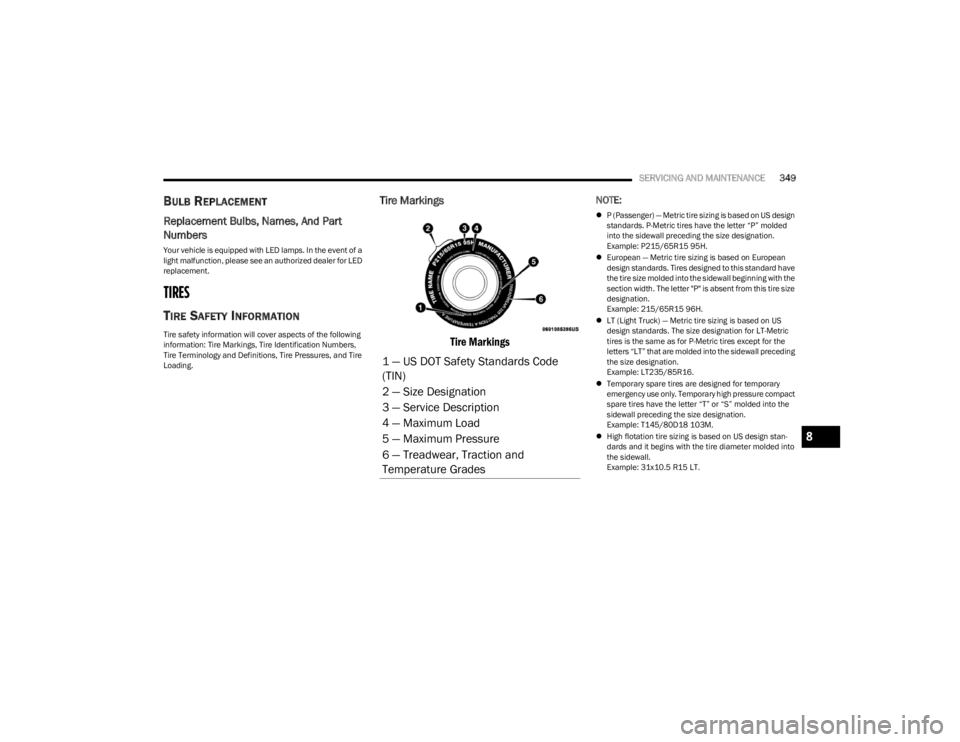
Tire Markings
Tire Markings
NOTE:
P (Passenger) — Metric tire sizing is based on US design
standards. P-Metric tires have the letter “P” molded
into the sidewall preceding the size designation.
Example: P215/65R15 95H.
European — Metric tire sizing is based on European
design standards. Tires designed to this standard have
the tire size molded into the sidewall beginning with the
section width. The letter "P" is absent from this tire size
designation.
Example: 215/65R15 96H.
LT (Light Truck) — Metric tire sizing is based on US
design standards. The size designation for LT-Metric
tires is the same as for P-Metric tires except for the
letters “LT” that are molded into the sidewall preceding
the size designation.
Example: LT235/85R16.
Temporary spare tires are designed for temporary
emergency use only. Temporary high pressure compact
spare tires have the letter “T” or “S” molded into the
sidewall preceding the size designation.
Example: T145/80D18 103M.
High flotation tire sizing is based on US design stan -
dards and it begins with the tire diameter molded into
the sidewall.
Example: 31x10.5 R15 LT.
1 — US DOT Safety Standards Code
(TIN)
2 — Size Designation
3 — Service Description
4 — Maximum Load
5 — Maximum Pressure
6 — Treadwear, Traction and
Temperature Grades
8
23_WS_OM_EN_USC_t.book Page 349