fuel JEEP WAGONEER 2023 Service Manual
[x] Cancel search | Manufacturer: JEEP, Model Year: 2023, Model line: WAGONEER, Model: JEEP WAGONEER 2023Pages: 396, PDF Size: 15.17 MB
Page 337 of 396

SERVICING AND MAINTENANCE335
F46 –5 Amp TanBatt Snsr #2*
F47 –10 Amp RedBPCM
F48 –10 Amp RedCVPAM
F49 –30 Amp PinkAir Suspension Valves
F50 ––Spare
F51 –20 Amp Yellow Fuel Pmp * / FPCM *
F52 ––Spare
F53 ––Spare
F54 –20 Amp Yellow Headlamp LT
F55 ––Spare
F56 ––Spare
F57 ––Spare
F58 ––Spare
F59 50 Amp Red –Air Suspension
F60 ––Spare
F61 ––Spare
F62 ––Spare
F63 –20 Amp Yellow Camera Washer Frt
F64 ––Spare
F65 –15 Amp BlueACT Grille Shutter / ACT Air Dam / Coolant Valve LCVM * / RATVM
F66 –20 Amp Yellow Horns
F67 –10 Amp RedDTCM / Switchable Engine Mount / BSM #2
Cavity Cartridge Fuse Micro Fuse Description
* If Equipped
8
23_WS_OM_EN_USC_t.book Page 335
Page 338 of 396
336SERVICING AND MAINTENANCE
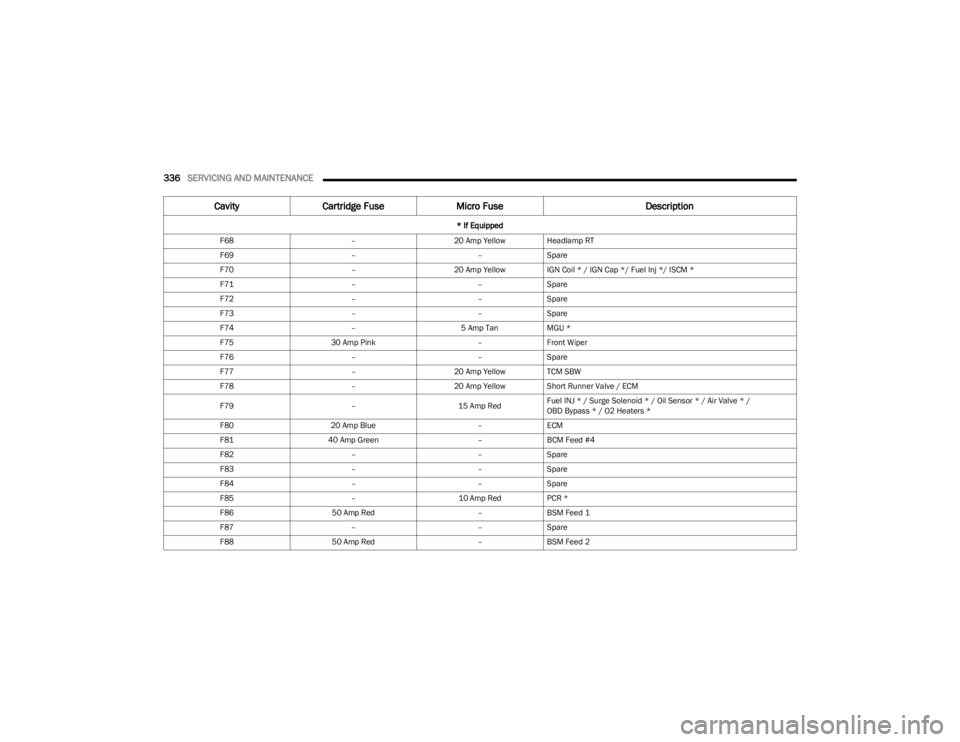
F68 –20 Amp Yellow Headlamp RT
F69 ––Spare
F70 –20 Amp Yellow IGN Coil * / IGN Cap */ Fuel Inj */ ISCM *
F71 ––Spare
F72 ––Spare
F73 ––Spare
F74 –5 Amp TanMGU *
F75 30 Amp Pink –Front Wiper
F76 ––Spare
F77 –20 Amp Yellow TCM SBW
F78 –20 Amp Yellow Short Runner Valve / ECM
F79 –15 Amp RedFuel INJ * / Surge Solenoid * / Oil Sensor * / Air Valve * /
OBD Bypass * / O2 Heaters *
F80 20 Amp Blue –ECM
F81 40 Amp Green –BCM Feed #4
F82 ––Spare
F83 ––Spare
F84 ––Spare
F85 –10 Amp RedPCR *
F86 50 Amp Red –BSM Feed 1
F87 ––Spare
F88 50 Amp Red –BSM Feed 2
Cavity Cartridge Fuse Micro Fuse Description
* If Equipped
23_WS_OM_EN_USC_t.book Page 336
Page 339 of 396

SERVICING AND MAINTENANCE337
F89 ––Spare
F90 ––Spare
F91 ––Spare
F92 20 Amp Blue –Front De-Icer *
F93 25 Amp Clear –Fuel Pmp *
F94 –10 Amp RedA/C Comp Clutch
F95 ––Spare
F96 ––Spare
F97 ––Spare
F98A –15 Amp BlueCooling Fan *
F98B –15 Amp BluePmp Battery Cooling *
F99 ––Spare
F100 ––Spare
F101 ––Spare
F102 25 Amp Clear –Fuel Pmp *
F103 ––Spare
F104 ––Spare
F105A ––Spare
F105B –15 Amp BlueLTR Coolant Pump
CavityCartridge Fuse Micro Fuse Description
* If Equipped
8
23_WS_OM_EN_USC_t.book Page 337
Page 359 of 396
SERVICING AND MAINTENANCE357
(Continued)
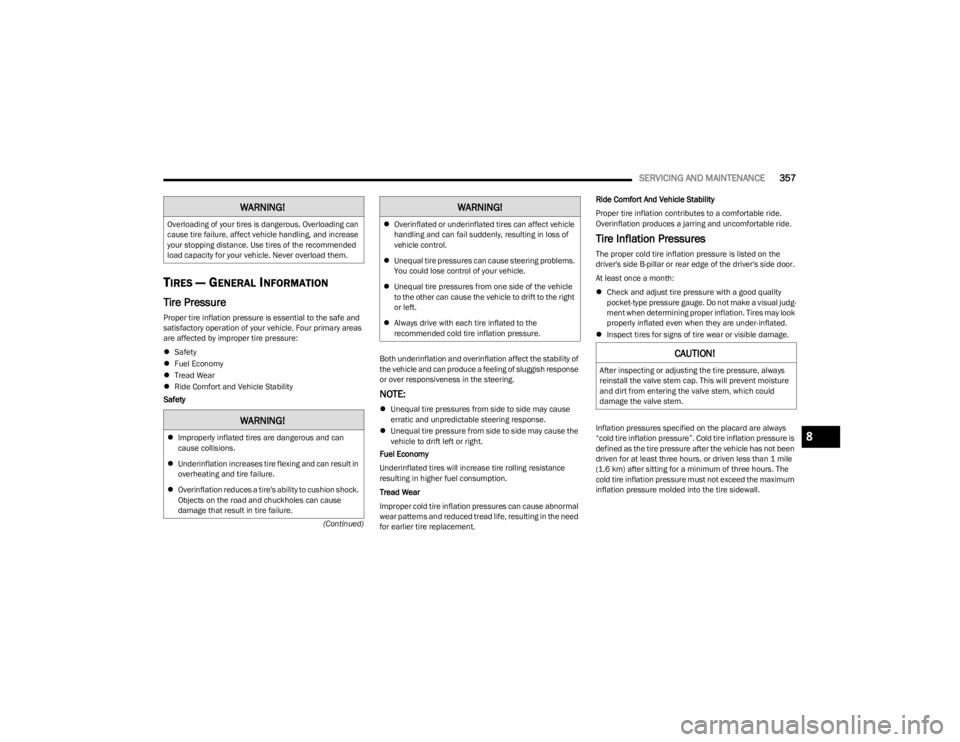
TIRES — GENERAL INFORMATION
Tire Pressure
Proper tire inflation pressure is essential to the safe and
satisfactory operation of your vehicle. Four primary areas
are affected by improper tire pressure:
Safety
Fuel Economy
Tread Wear
Ride Comfort and Vehicle Stability
Safety Both underinflation and overinflation affect the stability of
the vehicle and can produce a feeling of sluggish response
or over responsiveness in the steering.
NOTE:
Unequal tire pressures from side to side may cause
erratic and unpredictable steering response.
Unequal tire pressure from side to side may cause the
vehicle to drift left or right.
Fuel Economy
Underinflated tires will increase tire rolling resistance
resulting in higher fuel consumption.
Tread Wear
Improper cold tire inflation pressures can cause abnormal
wear patterns and reduced tread life, resulting in the need
for earlier tire replacement. Ride Comfort And Vehicle Stability
Proper tire inflation contributes to a comfortable ride.
Overinflation produces a jarring and uncomfortable ride.
Tire Inflation Pressures
The proper cold tire inflation pressure is listed on the
driver's side B-pillar or rear edge of the driver's side door.
At least once a month:
Check and adjust tire pressure with a good quality
pocket-type pressure gauge. Do not make a visual judg -
ment when determining proper inflation. Tires may look
properly inflated even when they are under-inflated.
Inspect tires for signs of tire wear or visible damage.
Inflation pressures specified on the placard are always
“cold tire inflation pressure”. Cold tire inflation pressure is
defined as the tire pressure after the vehicle has not been
driven for at least three hours, or driven less than 1 mile
(1.6 km) after sitting for a minimum of three hours. The
cold tire inflation pressure must not exceed the maximum
inflation pressure molded into the tire sidewall.
WARNING!
Overloading of your tires is dangerous. Overloading can
cause tire failure, affect vehicle handling, and increase
your stopping distance. Use tires of the recommended
load capacity for your vehicle. Never overload them.
WARNING!
Improperly inflated tires are dangerous and can
cause collisions.
Underinflation increases tire flexing and can result in
overheating and tire failure.
Overinflation reduces a tire's ability to cushion shock.
Objects on the road and chuckholes can cause
damage that result in tire failure.
Overinflated or underinflated tires can affect vehicle
handling and can fail suddenly, resulting in loss of
vehicle control.
Unequal tire pressures can cause steering problems.
You could lose control of your vehicle.
Unequal tire pressures from one side of the vehicle
to the other can cause the vehicle to drift to the right
or left.
Always drive with each tire inflated to the
recommended cold tire inflation pressure.
WARNING!
CAUTION!
After inspecting or adjusting the tire pressure, always
reinstall the valve stem cap. This will prevent moisture
and dirt from entering the valve stem, which could
damage the valve stem.
8
23_WS_OM_EN_USC_t.book Page 357
Page 374 of 396
372TECHNICAL SPECIFICATIONS
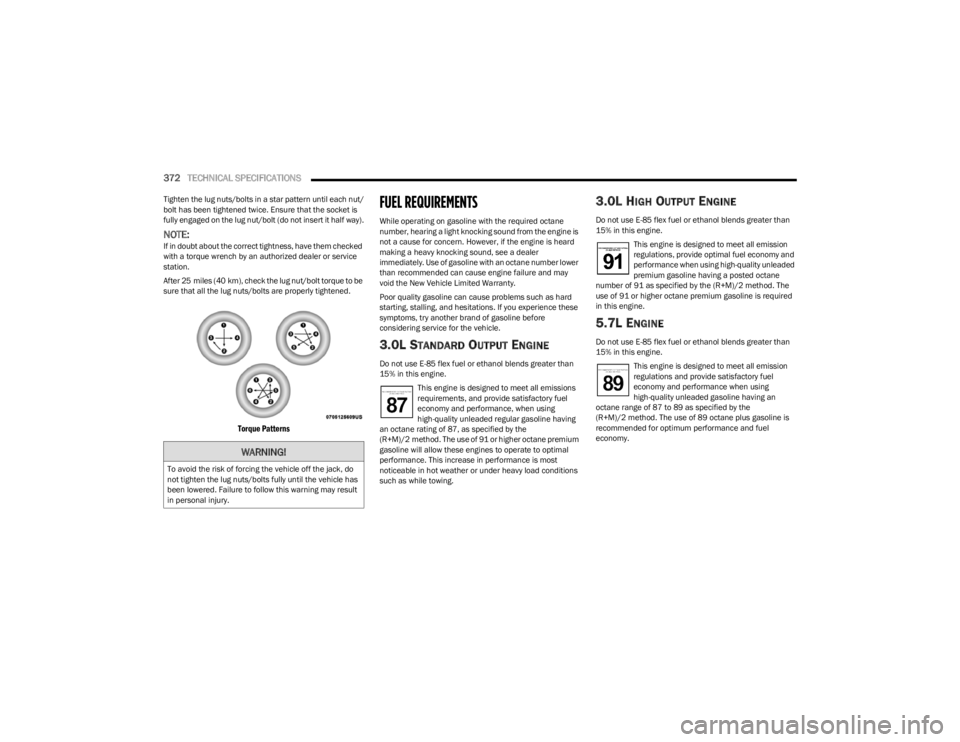
Tighten the lug nuts/bolts in a star pattern until each nut/
bolt has been tightened twice. Ensure that the socket is
fully engaged on the lug nut/bolt (do not insert it half way).
NOTE:If in doubt about the correct tightness, have them checked
with a torque wrench by an authorized dealer or service
station.
After 25 miles (40 km), check the lug nut/bolt torque to be
sure that all the lug nuts/bolts are properly tightened.
Torque Patterns
FUEL REQUIREMENTS
While operating on gasoline with the required octane
number, hearing a light knocking sound from the engine is
not a cause for concern. However, if the engine is heard
making a heavy knocking sound, see a dealer
immediately. Use of gasoline with an octane number lower
than recommended can cause engine failure and may
void the New Vehicle Limited Warranty.
Poor quality gasoline can cause problems such as hard
starting, stalling, and hesitations. If you experience these
symptoms, try another brand of gasoline before
considering service for the vehicle.
3.0L STANDARD OUTPUT ENGINE
Do not use E-85 flex fuel or ethanol blends greater than
15% in this engine.
This engine is designed to meet all emissions
requirements, and provide satisfactory fuel
economy and performance, when using
high-quality unleaded regular gasoline having
an octane rating of 87, as specified by the
(R+M)/2 method. The use of 91 or higher octane premium
gasoline will allow these engines to operate to optimal
performance. This increase in performance is most
noticeable in hot weather or under heavy load conditions
such as while towing.
3.0L HIGH OUTPUT ENGINE
Do not use E-85 flex fuel or ethanol blends greater than
15% in this engine.
This engine is designed to meet all emission
regulations, provide optimal fuel economy and
performance when using high-quality unleaded
premium gasoline having a posted octane
number of 91 as specified by the (R+M)/2 method. The
use of 91 or higher octane premium gasoline is required
in this engine.
5.7L ENGINE
Do not use E-85 flex fuel or ethanol blends greater than
15% in this engine.
This engine is designed to meet all emission
regulations and provide satisfactory fuel
economy and performance when using
high-quality unleaded gasoline having an
octane range of 87 to 89 as specified by the
(R+M)/2 method. The use of 89 octane plus gasoline is
recommended for optimum performance and fuel
economy.
WARNING!
To avoid the risk of forcing the vehicle off the jack, do
not tighten the lug nuts/bolts fully until the vehicle has
been lowered. Failure to follow this warning may result
in personal injury.
23_WS_OM_EN_USC_t.book Page 372
Page 375 of 396
TECHNICAL SPECIFICATIONS373
6.4L ENGINE
Do not use E-85 flex fuel or ethanol blends greater than
15% in this engine.
This engine is designed to meet all emission
regulations, provide optimal fuel economy and
performance when using high-quality unleaded
premium gasoline having a posted octane
number of 91 as specified by the (R+M)/2 method. The
use of 91 or higher octane premium gasoline is required
in these engines.
REFORMULATED GASOLINE
Many areas of the country require the use of
cleaner-burning gasoline referred to as “reformulated
gasoline”. Reformulated gasoline contains oxygenates
and are specifically blended to reduce vehicle emissions
and improve air quality.
The use of reformulated gasoline is recommended.
Properly blended reformulated gasoline will provide
improved performance and durability of engine and fuel
system components.
MATERIALS ADDED TO FUEL
Besides using unleaded gasoline with the proper octane
rating, gasolines that contain detergents, corrosion and
stability additives are recommended. Using gasolines that
have these additives will help improve fuel economy,
reduce emissions, and maintain vehicle performance.
Designated TOP TIER Detergent Gasoline
contains a higher level of detergents to further
aide in minimizing engine and fuel system
deposits. When available, the usage of TOP
TIER Detergent Gasoline is recommended. Visit
www.toptiergas.com for a list of TOP TIER Detergent
Gasoline retailers.
Indiscriminate use of fuel system cleaning agents should
be avoided. Many of these materials intended for gum and
varnish removal may contain active solvents or similar
ingredients. These can harm fuel system gasket and
diaphragm materials.
GASOLINE/OXYGENATE BLENDS
Some fuel suppliers blend unleaded gasoline with
oxygenates such as ethanol.
Problems that result from using gasoline containing more
than 15% ethanol (E-15) or gasoline containing methanol
are not the responsibility of the manufacturer and may
void or not be covered under New Vehicle Limited
Warranty.
CAUTION!
DO NOT use E-85, gasoline containing methanol, or
gasoline containing more than 15% ethanol (E-15). Use
of these blends may result in starting and drivability
problems, damage critical fuel system components,
cause emissions to exceed the applicable standard,
and/or cause the Malfunction Indicator Light to
illuminate. Please observe pump labels as they should
clearly communicate if a fuel contains greater than
15% ethanol (E-15).
9
23_WS_OM_EN_USC_t.book Page 373
Page 376 of 396
374TECHNICAL SPECIFICATIONS
DO NOT USE E-85 IN NON-FLEX FUEL
V
EHICLES
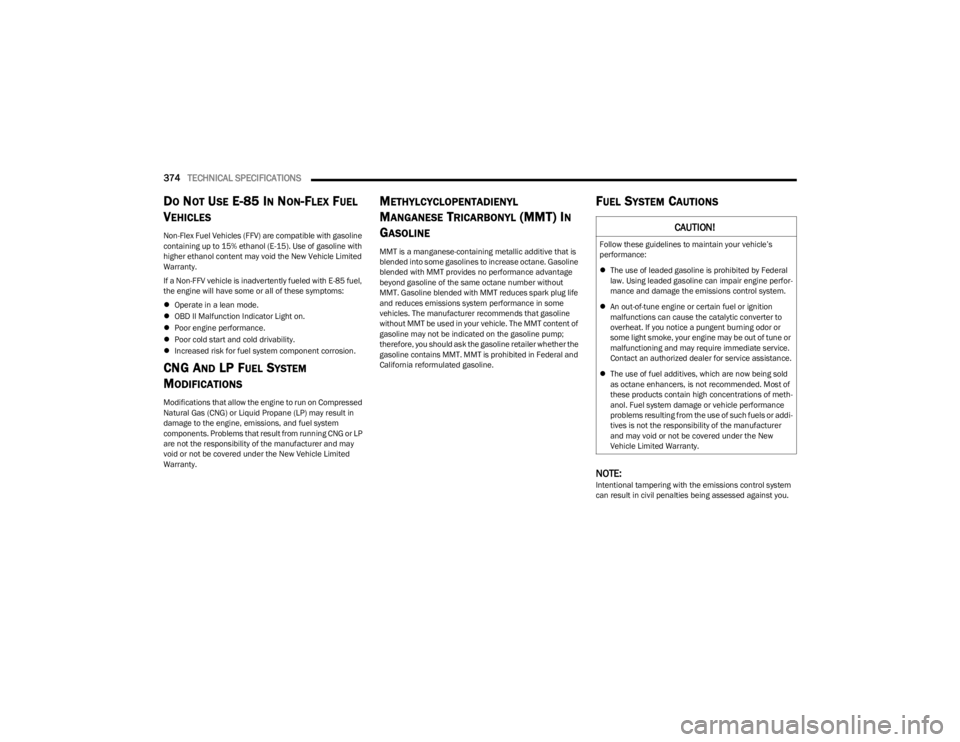
Non-Flex Fuel Vehicles (FFV) are compatible with gasoline
containing up to 15% ethanol (E-15). Use of gasoline with
higher ethanol content may void the New Vehicle Limited
Warranty.
If a Non-FFV vehicle is inadvertently fueled with E-85 fuel,
the engine will have some or all of these symptoms:
Operate in a lean mode.
OBD II Malfunction Indicator Light on.
Poor engine performance.
Poor cold start and cold drivability.
Increased risk for fuel system component corrosion.
CNG AND LP FUEL SYSTEM
M
ODIFICATIONS
Modifications that allow the engine to run on Compressed
Natural Gas (CNG) or Liquid Propane (LP) may result in
damage to the engine, emissions, and fuel system
components. Problems that result from running CNG or LP
are not the responsibility of the manufacturer and may
void or not be covered under the New Vehicle Limited
Warranty.
METHYLCYCLOPENTADIENYL
M
ANGANESE TRICARBONYL (MMT) IN
G
ASOLINE
MMT is a manganese-containing metallic additive that is
blended into some gasolines to increase octane. Gasoline
blended with MMT provides no performance advantage
beyond gasoline of the same octane number without
MMT. Gasoline blended with MMT reduces spark plug life
and reduces emissions system performance in some
vehicles. The manufacturer recommends that gasoline
without MMT be used in your vehicle. The MMT content of
gasoline may not be indicated on the gasoline pump;
therefore, you should ask the gasoline retailer whether the
gasoline contains MMT. MMT is prohibited in Federal and
California reformulated gasoline.
FUEL SYSTEM CAUTIONS
NOTE:Intentional tampering with the emissions control system
can result in civil penalties being assessed against you.
CAUTION!
Follow these guidelines to maintain your vehicle’s
performance:
The use of leaded gasoline is prohibited by Federal
law. Using leaded gasoline can impair engine perfor -
mance and damage the emissions control system.
An out-of-tune engine or certain fuel or ignition
malfunctions can cause the catalytic converter to
overheat. If you notice a pungent burning odor or
some light smoke, your engine may be out of tune or
malfunctioning and may require immediate service.
Contact an authorized dealer for service assistance.
The use of fuel additives, which are now being sold
as octane enhancers, is not recommended. Most of
these products contain high concentrations of meth -
anol. Fuel system damage or vehicle performance
problems resulting from the use of such fuels or addi -
tives is not the responsibility of the manufacturer
and may void or not be covered under the New
Vehicle Limited Warranty.
23_WS_OM_EN_USC_t.book Page 374
Page 377 of 396
TECHNICAL SPECIFICATIONS375
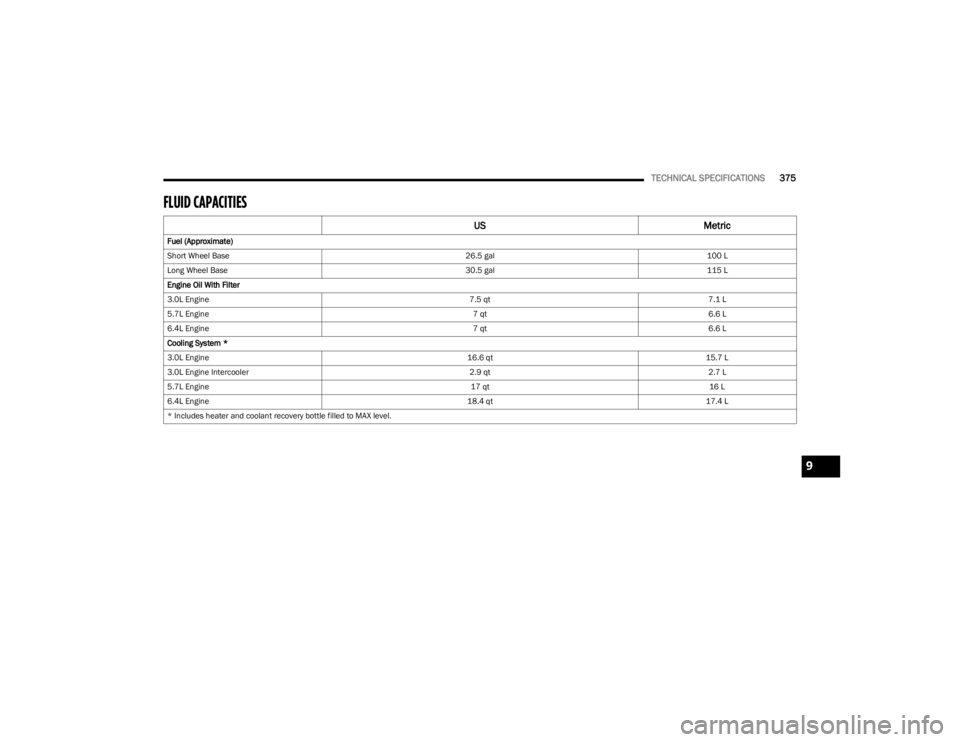
FLUID CAPACITIES
US Metric
Fuel (Approximate)
Short Wheel Base 26.5 gal100 L
Long Wheel Base 30.5 gal115 L
Engine Oil With Filter
3.0L Engine 7.5 qt7.1 L
5.7L Engine 7 qt6.6 L
6.4L Engine 7 qt6.6 L
Cooling System *
3.0L Engine 16.6 qt15.7 L
3.0L Engine Intercooler 2.9 qt2.7 L
5.7L Engine 17 qt16 L
6.4L Engine 18.4 qt17.4 L
* Includes heater and coolant recovery bottle filled to MAX level.
9
23_WS_OM_EN_USC_t.book Page 375
Page 379 of 396
TECHNICAL SPECIFICATIONS377
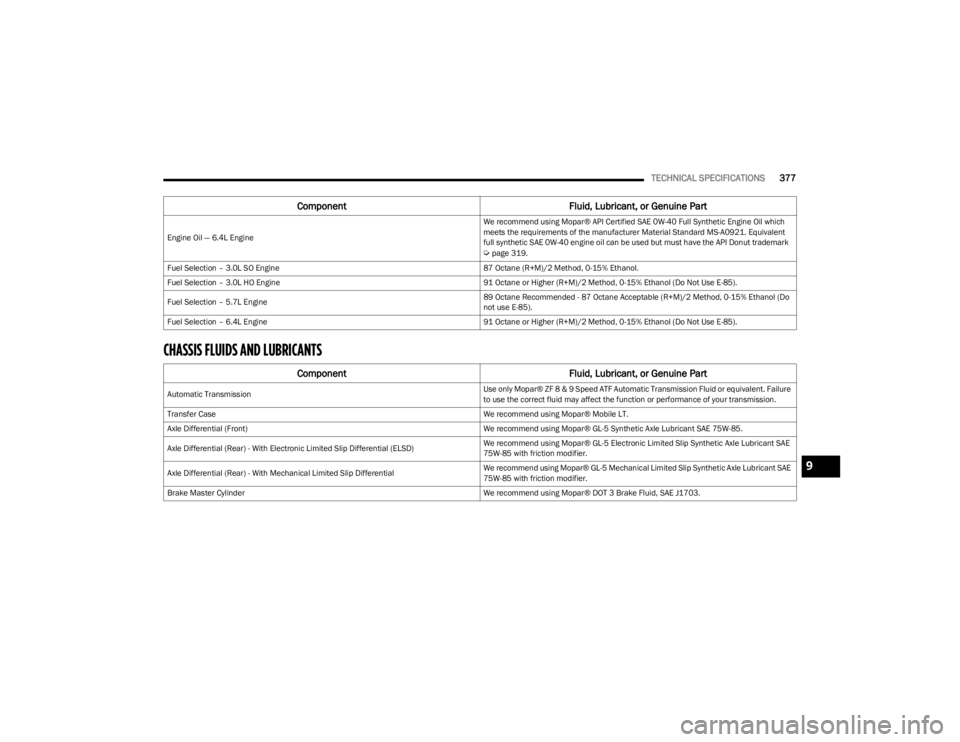
CHASSIS FLUIDS AND LUBRICANTS
Engine Oil — 6.4L Engine We recommend using Mopar® API Certified SAE 0W-40 Full Synthetic Engine Oil which
meets the requirements of the manufacturer Material Standard MS-A0921. Equivalent
full synthetic SAE 0W-40 engine oil can be used but must have the API Donut trademark
Úpage 319.
Fuel Selection – 3.0L SO Engine 87 Octane (R+M)/2 Method, 0-15% Ethanol.
Fuel Selection – 3.0L HO Engine 91 Octane or Higher (R+M)/2 Method, 0-15% Ethanol (Do Not Use E-85).
Fuel Selection – 5.7L Engine 89 Octane Recommended - 87 Octane Acceptable (R+M)/2 Method, 0-15% Ethanol (Do
not use E-85).
Fuel Selection – 6.4L Engine 91 Octane or Higher (R+M)/2 Method, 0-15% Ethanol (Do Not Use E-85).
ComponentFluid, Lubricant, or Genuine Part
Automatic Transmission Use only Mopar® ZF 8 & 9 Speed ATF Automatic Transmission Fluid or equivalent. Failure
to use the correct fluid may affect the function or performance of your transmission.
Transfer Case We recommend using Mopar® Mobile LT.
Axle Differential (Front) We recommend using Mopar® GL-5 Synthetic Axle Lubricant SAE 75W-85.
Axle Differential (Rear) - With Electronic Limited Slip Differential (ELSD) We recommend using Mopar® GL-5 Electronic Limited Slip Synthetic Axle Lubricant SAE
75W-85 with friction modifier.
Axle Differential (Rear) - With Mechanical Limited Slip Differential We recommend using Mopar® GL-5 Mechanical Limited Slip Synthetic Axle Lubricant SAE
75W-85 with friction modifier.
Brake Master Cylinder We recommend using Mopar® DOT 3 Brake Fluid, SAE J1703.
ComponentFluid, Lubricant, or Genuine Part
9
23_WS_OM_EN_USC_t.book Page 377
Page 381 of 396

CUSTOMER ASSISTANCE379
What to Do
If your vehicle requires jump start assistance, out of
gas/fuel delivery, tire service, lockout service or towing as
a result of a mechanical breakdown, dial toll-free: USA:
833-667-4825/Canada: 800-363-4869. Provide your
name, Vehicle Identification Number (VIN) required for
covered services, license plate number, and your location,
including the telephone number from which you are
calling. Briefly describe the nature of the problem and
answer a few simple questions. You will be given the name
of the service provider and an estimated time of arrival. If
you feel you are in an unsafe situation, please let us know.
With your consent, we will contact local police or safety
authorities.
If Unable to Contact Roadside Assistance
If you are unable to contact Roadside Assistance or
unable to provide a valid Vehicle Identification Number
(VIN), and you obtain towing services on your own, you may
submit your original receipts from the licensed towing or
service facility, for services rendered within 30 days of the
occurrence. Be sure to include your VIN, odometer
mileage at the time of service, and current mailing
address. We will process the claim based on vehicle and
service eligibility. If eligible, we will reimburse you for the
reasonable amount actually paid, based on the usual and
customary charges for that service in the area where they
were provided. FCA US LLC’s determination relating to reimbursement is
final. Correspondence should be mailed to:
FCA US LLC Customer Assistance
P.O. Box 9145
Medford, MA 02155
Attention Claims Department
FCA US LLC reserves the right to modify the terms or
discontinue the Roadside Assistance Program at any time.
The Roadside Assistance program is subject to restrictions
and conditions of use, which are determined solely by FCA
US LLC.
Flat Tire Service
If you are inconvenienced by a flat tire, we will dispatch a
service provider to use your vehicle’s temporary spare tire
(if equipped) as recommended in your Owner’s Manual.
This is not a permanent flat tire repair.
Out of Gas/Fuel Delivery
Drivers cannot always count on a gas station being
nearby, especially when traveling away from home. We will
dispatch a service provider to deliver a small amount of
fuel (maximum two gallons) to get you to a nearby station.
This service is limited to two occurrences in a 12-month
period.
Battery Jump Assistance
No time is a good time for a depleted battery. With
Roadside Assistance, you do not have to worry about
being stranded. We will dispatch a service provider to
provide you with a battery jump anytime, day or night.Lockout Service
Whether the keys are locked in your vehicle or frozen locks
are keeping you from getting on your way, help is just a
phone call away. This service is limited to providing access
to the vehicle’s seating area. It does not cover the cost of
replacement keys.
Towing Service
Our towing service gives you peace of mind and
confidence. If your vehicle becomes disabled as a result of
a mechanical breakdown, Roadside Assistance will
dispatch a towing service to transport your vehicle to the
closest authorized Chrysler, Dodge, Jeep®, or Ram dealer.
If you choose to go to another dealer, you will be
responsible for the cost if the extra distance exceeds
10 miles.
FCA U S LLC CUSTOMER CENTER
P.O. Box 21–8004
Auburn Hills, MI 48321–8004
Phone: (833) 667-4825
WAGONEER CLIENT SERVICES CANADA
P.O. Box 1621
Windsor, Ontario N9A 4H6
Phone: 1-844-472-6301 (844-GRAND01)
10
23_WS_OM_EN_USC_t.book Page 379