rear JEEP WRANGLER 1997 Owners Manual
[x] Cancel search | Manufacturer: JEEP, Model Year: 1997, Model line: WRANGLER, Model: JEEP WRANGLER 1997Pages: 1056, PDF Size: 12.55 MB
Page 30 of 1056
Do not use volatile solvents for cleaning purposes.
Many are potentially flammable, and if used in
closed areas they may cause respiratory harm.
Glass Surfaces
All glass surfaces should be cleaned on a regular basis
with any commercial household-type glass cleaner.
Never use an abrasive type cleaner. Use caution when
cleaning inside rear windows equipped with electric
defrosters. Do not use scrapers or other sharp instru-
ments which may scratch the elements.
When cleaning the rear view mirror, spray cleaner on the
towel or rag that you are using. Do not spray cleaner
directly on the mirror.
Carpet
Vacuum your carpet regularly to prevent a soil build-up.
Shampoo soiled carpet with a reliable upholstery cleaner,
using a natural sponge or soft bristle brush. After carpet
dries, vacuum it thoroughly.
MAINTAINING YOUR VEHICLE 283
Page 34 of 1056
Cavity Fuse Description
12 10 Amp Red Power Distribution Relays,
Skim (Sentry Key)
13 10 Amp Red Turn Signals
14 10 Amp Red Radio
15 10 Amp Red HBL (Rear Window De-
froster) Switch
16 10 Amp Red Headlamp Aim (Export
Only)
17 25 Amp
NaturalFront Wiper
18 20 Amp Yel-
lowCigar Lighter
19 20 Amp Yel-
lowSpare
20 20 Amp Yel-
lowSpare
MAINTAINING YOUR VEHICLE 287
Page 35 of 1056
Cavity Fuse/Color Description
1 40 Amp Green HEVAC
2 40 Amp Green HBL (Rear Window De-
froster)
3 40 Amp Green Exterior Lighting
4 40 Amp Green Radiator Fan
5 20 Amp Yellow Transmission
6 30 Amp Pink Starter
7 Open
8 40 Amp Green ABS Motor
9 20 Amp Yellow ASD
10 40 Amp Green HD/LP
11 Open IOD Storage
12 30 Amp Pink ABS Valve
Page 36 of 1056
Cavity Fuse/Color Description
29 Relay ASD
30 Relay A/C Clutch
31 Relay Transmission
32 Relay Starter
33 Relay ABS
34 Open
35 Relay Fog Lamp
36 Relay Horn
37 Relay Fuel Pump
38 Relay HBL (Rear Window De-
froster)
39 Relay Front Differential Locker
(Rubicon) or High Speed
Fan (2.4L Engines)
40 Relay Rear Differential Locker
(Rubicon) or Low Speed
Fan (2.4L Engines)
MAINTAINING YOUR VEHICLE 289
Page 64 of 1056
Use care when washing the inside of the rear win-
dow to prevent damage to heating elements. Use a
soft cloth and a mild washing solution, wiping
parallel to the heating elements. Also, keep all
objects a safe distance from the window to prevent
damaging the heating elements.
Rear Defroster Switch
UNDERSTANDING THE FEATURES OF YOUR VEHICLE 137
Page 70 of 1056
An incorrectly anchored tether strap could lead to
increased head motion and possible injury to the
child. Use only the anchor positions directly behind
the child seat to secure a child restraint top tether
strap.
Children Too Large for Booster Seats
Children who are large enough to wear the shoulder belt
comfortably, and whose legs are long enough to bend
over the front of the seat when their back is against the
seat back should use the lap/shoulder belt in a rear seat.
•Make sure that the child is seated upright in the seat.
•The lap belt portion should be low on the hips and as
snug as possible.
•Check belt fit periodically. A child’s squirming or
slouching can move the belt out of position.
•If the shoulder belt contacts the child’s face or neck,
move the child closer to the center of the vehicle.
Never allow a child to put the shoulder belt under an
arm or behind their back.
Transporting Pets
Airbags deploying in the front seat could harm your pet.
An unrestrained pet will be thrown about and possibly
injured, or injure a passenger during panic braking or in
a collision.
Pets should be restrained in the rear seat in pet harnesses
or pet carriers that are secured by seat belts.
THINGS TO KNOW BEFORE STARTING YOUR VEHICLE 43
Page 89 of 1056
You or others could be injured if you leave the
vehicle unattended with the transfer case in the N
(Neutral) position without first fully engaging the
parking brake. The transfer case N (Neutral) position
disengages both the front and rear driveshafts from
the powertrain and will allow the vehicle to move
regardless of the transmission position. The parking
brake should always be applied when the driver is
not in the vehicle.
Page 91 of 1056
Failure to engage a position completely can cause
transfer case damage or loss of power and vehicle
control. You could have an injury accident. Do not
drive the vehicle unless the transfer case is fully
engaged.
On vehicles equipped with a limited-slip differen-
tial, never run the engine with one rear wheel off the
ground. The vehicle may drive through the rear
wheel remaining on the ground and cause you to
lose control of your vehicle.
Page 96 of 1056
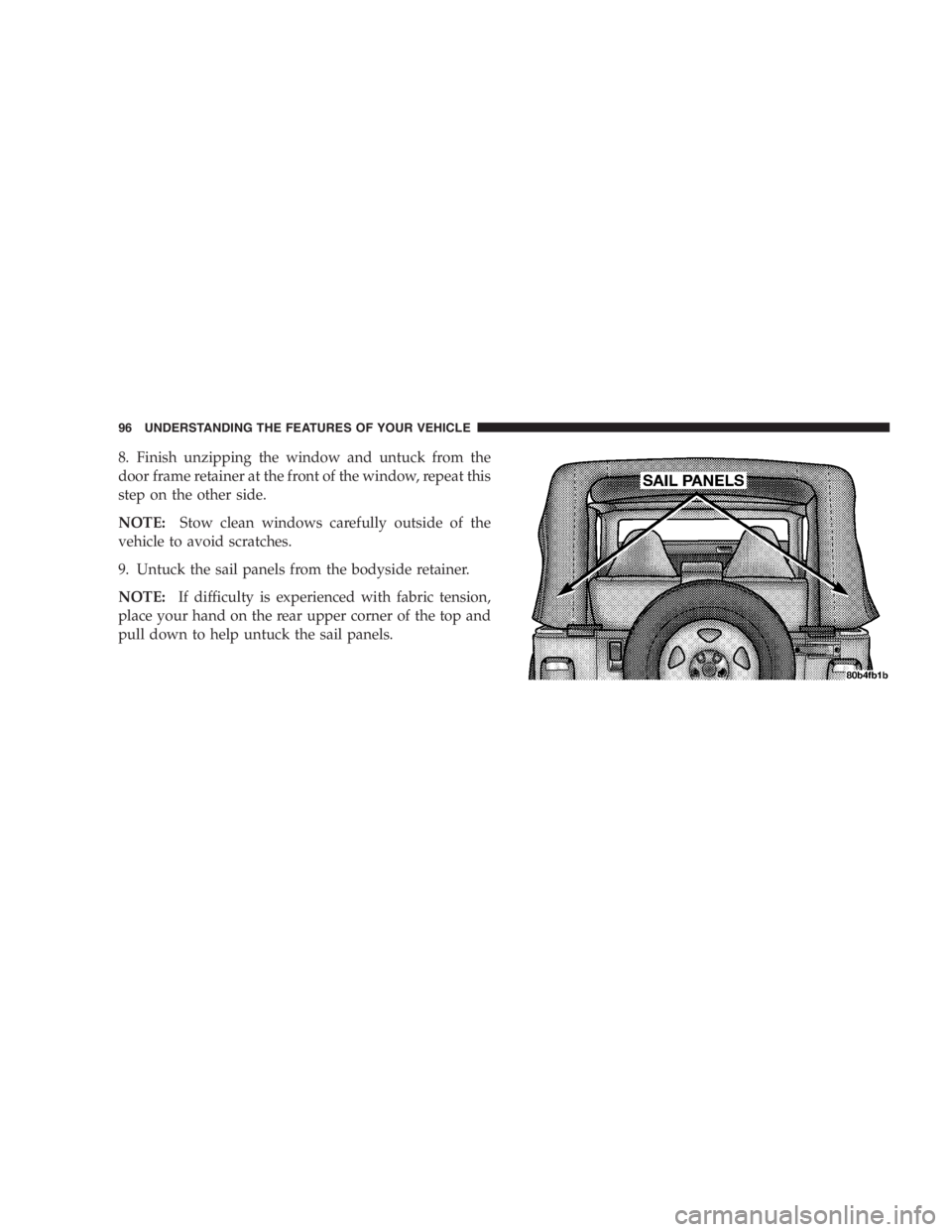
To use your brakes and decelerate more safely, follow these tips:
•Do not “ride” the brakes by resting your foot on the pedal. This
could overheat the brakes and result in unpredictable braking
action, longer stopping distances, or brake damage.
•When descending mountains or hills, repeated braking can cause
brake fade with loss of braking control. Avoid repeated heavy
braking by downshifting the transmission whenever possible.
•Do not downshift on icy or slippery roads, because engine braking
may cause skidding and loss of control.
•Engines may idle at higher speeds during warm-up, which could
cause rear wheels to spin and result in loss of vehicle control. Be
especially careful while driving on slippery roads, in close-quarter
maneuvering, parking or stopping. Remember, always engage
4-wheel drive when driving on slippery roads.
•Do not drive too fast for road conditions, especially when roads are wet
or slushy. A wedge of water can build up between the tire tread and the
road. This hydroplaning action can cause loss of traction, braking
ability, and control. Under such conditions, engage 4-wheel drive.
•After going through deep water or a car wash, brakes may become
wet, resulting in poor performance and unpredictable braking
action. Dry the brakes by gentle, intermittent pedal action while
driving at very slow speeds.
WARNING!
The weight and position of cargo and passengers can change
the vehicle center of gravity and vehicle handling. To avoid
loss of control resulting in personal injury, follow these
guidelines:
•Always place cargo evenly on the cargo floor, and locate
heavier objects as low and as far forward as possible.
•Place as much cargo as possible in front of the rear axle. Too
much weight or improperly placed weight over or behind
the rear axle can cause the rear of the vehicle to sway.
•Do not pile luggage or cargo higher than the top of the
seatback. This could impair visibility or become a danger-
ous projectile in a sudden stop or collision.
•The rear cargo space is intended for load carrying purposes
only, not for passengers, who should sit in seats and use
seat belts.
•On hardtop models, do not drive with the lift glass up. On
fabric top models, do not drive with the rear window
curtain up unless the side curtains are also open. This will
prevent dangerous exhaust fumes from entering the ve-
hicle.
Page 149 of 1056
Internal damage to the transfer case will occur if a
front or rear wheel lift is used when recreational
towing.
NOTE:The transfer case must be shifted into N (Neu-
tral) for recreational towing.
Shifting Into Neutral (N)
Use the following procedure to prepare your vehicle for
recreational towing.
CAUTION!
It is necessary to follow these steps to be certain that
the transfer case is fully in N (Neutral) before
recreational towing to prevent damage to internal
parts.