belt JEEP WRANGLER 2004 TJ / 2.G Owner's Guide
[x] Cancel search | Manufacturer: JEEP, Model Year: 2004, Model line: WRANGLER, Model: JEEP WRANGLER 2004 TJ / 2.GPages: 299, PDF Size: 6.82 MB
Page 160 of 299

STARTING PROCEDURES
Before starting your vehicle, adjust your seat, adjust both
inside and outside mirrors, and fasten your seat belts.
WARNING!
Do not leave children or animals inside parked
vehicles in hot weather. Interior heat build up may
cause serious injury or death.
Manual Transmission
Apply the parking brake, place the gearshift control lever
in N (Neutral) and depress the clutch pedal before
starting vehicle. This vehicle is equipped with a clutch
interlocking ignition system. It will not start unless the
clutch pedal is pressed to the floor.
WARNING!
You or others around you could be injured if you
attempt to start the engine with a manual transmis-
sion in gear Ð your vehicle will move. Remember,
always push the clutch pedal in fully and shift into
N (Neutral) before attempting to start the engine.
Automatic Transmission
Start the engine with the selector lever in the N (Neutral)
or P (Park) position. Apply the brake before shifting to
any driving range.
Normal Starting
Normal starting of either a cold or a warm engine is
obtained without pumping or depressing the accelerator
pedal. Turn the key to the START position and release
when the engine starts. If the engine fails to start within
10 seconds, turn the key to the OFF position, wait 5
seconds, then repeat the normal starting procedure.
160 STARTING AND OPERATING
Page 178 of 299

WARNING!
To use your brakes and decelerate more safely, follow these
tips:
²Do not ªrideº the brakes by resting your foot on the pedal.
This could overheat the brakes and result in unpredictable
braking action, longer stopping distances, or brake damage.
²When descending mountains or hills, repeated braking can
cause brake fade with loss of braking control. Avoid
repeated heavy braking by downshifting the transmission
whenever possible.
²Do not downshift on icy or slippery roads, because engine
braking may cause skidding and loss of control.
²Engines may idle at higher speeds during warm-up, which
could cause rear wheels to spin and result in loss of vehicle
control. Be especially careful while driving on slippery
roads, in close-quarter maneuvering, parking or stopping.
Remember, always engage 4-wheel drive when driving on
slippery roads.
²Do not drive too fast for road conditions, especially when
roads are wet or slushy. A wedge of water can build up
between the tire tread and the road. This hydroplaning
action can cause loss of traction, braking ability, and
control. Under such conditions, engage 4-wheel drive.
²After going through deep water or a car wash, brakes may
become wet, resulting in poor performance and unpredict-
able braking action. Dry the brakes by gentle, intermittent
pedal action while driving at very slow speeds.
WARNING!
The weight and position of cargo and passengers can
change the vehicle center of gravity and vehicle han-
dling. To avoid loss of control resulting in personal
injury, follow these guidelines:
²Always place cargo evenly on the cargo floor, and
locate heavier objects as low and as far forward as
possible.
²Place as much cargo as possible in front of the rear
axle. Too much weight or improperly placed weight
over or behind the rear axle can cause the rear of the
vehicle to sway.
²Do not pile luggage or cargo higher than the top of
the seatback. This could impair visibility or become
a dangerous projectile in a sudden stop or collision.
²The rear cargo space is intended for load carrying
purposes only, not for passengers, who should sit in
seats and use seat belts.
²On hardtop models, do not drive with the lift glass
up. On fabric top models, do not drive with the rear
window curtain up unless the side curtains are also
open. This will prevent dangerous exhaust fumes
from entering the vehicle.
178 STARTING AND OPERATING
Page 221 of 299

MAINTAINING YOUR VEHICLE
CONTENTS
m2.4L Engine..........................223
m4.0L Engine..........................224
mOnboard Diagnostic System Ð OBD II......225
mEmissions Inspection And
Maintenance Programs
..................226
mReplacement Parts.....................227
mDealer Service........................227
mMaintenance Procedures.................228
NEngine Oil..........................228
NDrive Belts Ð Check Condition And Tension . . 231
NSpark Plugs.........................232
NCatalytic Converter....................232NEngine Timing Belt Ð 2.4L Engine.........233
NIgnition Wiring System Ð 2.4L Engine......233
NCrankcase Emission Control System........234
NFuel Filter..........................234
NEngine Air Cleaner Filter................234
NMaintenance-Free Battery................234
NAir Conditioner Maintenance.............235
NPower Steering Fluid Check..............236
NDriveline And Steering Component
Lubrication..........................237
NBody Lubrication.....................237
NWindshield Wiper Blades................237
7
Page 231 of 299

Materials Added To Engine Oils
The manufacturerstrongly recommendsagainst the ad-
dition of any additives (other than leak detection dyes) to
engine oil. Engine oil is an engineered product and it's
performance may be impaired by supplemental addi-
tives.
Disposing of Used Engine Oil
Care should be taken in disposing of used engine oil from
your vehicle. Used oil, indiscriminately discarded, can
present a problem to the environment. Contact your
authorized dealer, service station, or governmental
agency for advice on how and where used oil can be
safely discarded in your area.
Engine Oil Filter
The engine oil filter should be replaced at every engine
oil change.
Engine Oil Filter Selection
All of the manufacturer's engines have a full-flow type
disposable oil filter. Use a filter of this type for replace-
ment. The quality of replacement filters varies consider-
ably. Only high quality filters should be used to assure
most efficient service. Mopartengine oil filters are high
quality oil filters and are recommended.
Drive Belts Ð Check Condition and Tension
At the mileage shown in the appropriate ªMaintenance
Schedule,º check all drive belts for condition and proper
tension. Improper belt tension can cause belt slippage
and failure.
4.0L Engines
MAINTAINING YOUR VEHICLE 231
7
Page 232 of 299

Inspect the drive belt for evidence of cuts, cracks, or
glazing and replace them if there is any sign of damage
which could result in belt failure. If adjustment is re-
quired, adjust the belts according to the specifications
and procedures shown in the Service Manual.
Special tools are required to properly measure tension
and to restore belt tension to factory specifications. Also,
check belt routing to make sure there is no interference
between the belts and other engine components.
Spark Plugs
Spark plugs must fire properly to assure engine perfor-
mance and emission control. New plugs should be in-
stalled at the mileage specified in the appropriate main-
tenance chart. The entire set should be replaced if there is
any malfunction due to a faulty spark plug.
Refer to the ªVehicle Emission Control Informationº label
in the engine compartment for spark plug information.
Catalytic Converter
The catalytic converter requires the use of unleaded fuel
only. Leaded gasoline will destroy the effectiveness of the
converter as an emission control device.
Under normal operating conditions, the catalytic con-
verter will not require maintenance. However, it is im-
portant to keep the engine properly tuned to assure
proper catalyst operation and prevent possible catalyst
damage.
CAUTION!
Damage to the catalytic converter can result if your
vehicle is not kept in proper operating condition. In
the event of engine malfunction, particularly involv-
ing engine misfire or other apparent loss of perfor-
mance, have your vehicle serviced promptly. Contin-
ued operation of your vehicle with a severe
malfunction could cause the converter to overheat,
resulting in possible damage to the converter and
vehicle.
232 MAINTAINING YOUR VEHICLE
Page 233 of 299

WARNING!
A hot exhaust system can start a fire if you park over
materials that can burn. Such materials might be
grass or leaves coming into contact with your ex-
haust system. Do not park or operate your vehicle in
areas where your exhaust system can contact any-
thing that can burn.
In unusual situations involving grossly malfunctioning
engine operation, a scorching odor may suggest severe
and abnormal catalyst overheating. If this occurs, stop
the vehicle, turn off the engine and allow it to cool.
Service, including a tune up to manufacturer's specifica-
tions, should be obtained immediately.
To minimize the possibility of catalytic converter dam-
age:
²Do not shut off the engine or interrupt the ignition
when the transmission is in gear and the vehicle is in
motion.
²Do not try to start the engine by pushing or towing the
vehicle.
²Do not idle the engine with any spark plug wires
disconnected or removed, such as when diagnostic
testing.
²Do not idle the engine for prolonged periods during
very rough idle or malfunctioning operating condi-
tions.
²Do not allow vehicle to run out of fuel.
NOTE:Intentional tampering with emissions control
systems can result in civil penalties being assessed
against you.
Engine Timing Belt Ð 2.4L Engine
Replace the engine timing belt at the intervals described
in the appropriate maintenance schedule.
Ignition Wiring System Ð 2.4L Engine
Replace the ignition cables at the intervals described in
the appropriate maintenance schedule.
MAINTAINING YOUR VEHICLE 233
7
Page 235 of 299

To determine the battery charge, check the battery test
indicator (if equipped) on top of the battery. Refer to the
illustration.
CAUTION!
It is essential when replacing the cables on the
battery that the positive cable is attached to the
positive post and the negative cable is attached to the
negative post. Battery posts are marked (+) positive
and negative (-) and identified on the battery case.
Also, if a ªfast chargerº is used while battery is in the
vehicle, disconnect both vehicle battery cables be-
fore connecting the charger to battery. Do not use a
ªfast chargerº to provide starting voltage.
Air Conditioner Maintenance
For best possible performance, your air conditioner
should be checked and serviced by an Authorized Dealer
at the start of each warm season. This service should
include cleaning of the condenser fins and a performance
test. Drive belt tension should also be checked at this
time.
MAINTAINING YOUR VEHICLE 235
7
Page 253 of 299

WARNING!
Only remove the carpet for cleaning purposes. It
provides insulation against high floor pan tempera-
tures. You or your passengers could be burned if the
carpet is not properly in place. Always put the carpet
back into the vehicle before driving.
Follow These Steps To Remove The Carpet:
1. Unsnap the front and rear floor carpets. A snap is
located on the outboard side of each front seat.
2. Remove the attachment cap from the front footwell
area on both the driver and passenger side. The cap is
removed by pulling it straight out.
3. Remove the front and rear floor carpets.
4. Remove the cargo floor and wheelhouse carpets.
NOTE:If your vehicle is equipped with an Add-A-
TrunkŸ it must be removed to be able to remove the cargo
floor and wheelhouse carpets. For Add-A-TrunkŸ removal
procedure, refer to ªStorageº in Section 3 of this manual.
Follow These Steps To Replace The Carpet:
1. Place the front floor carpets in the vehicle.
2. Attach the carpet to the studs in the footwell and press
on the attachment caps to secure the carpet.
3. Place rear floor carpet in vehicle and snap rear carpet
to front floor carpet.
4. Install wheelhouse carpet followed by the cargo floor
carpet.
5. Reinstall Add-A-TrunkŸ if so equipped.
Seat Belt Maintenance
Do not bleach, dye or clean the belts with chemical
solvents or abrasive cleaners. This will weaken the fabric.
Sun damage will also weaken the fabric.
If the belts need cleaning, use a mild soap solution or
lukewarm water. Do not remove the belts from the
vehicle to wash them.
Replace the belts if they appear frayed or worn or if the
buckles do not work properly.
MAINTAINING YOUR VEHICLE 253
7
Page 267 of 299
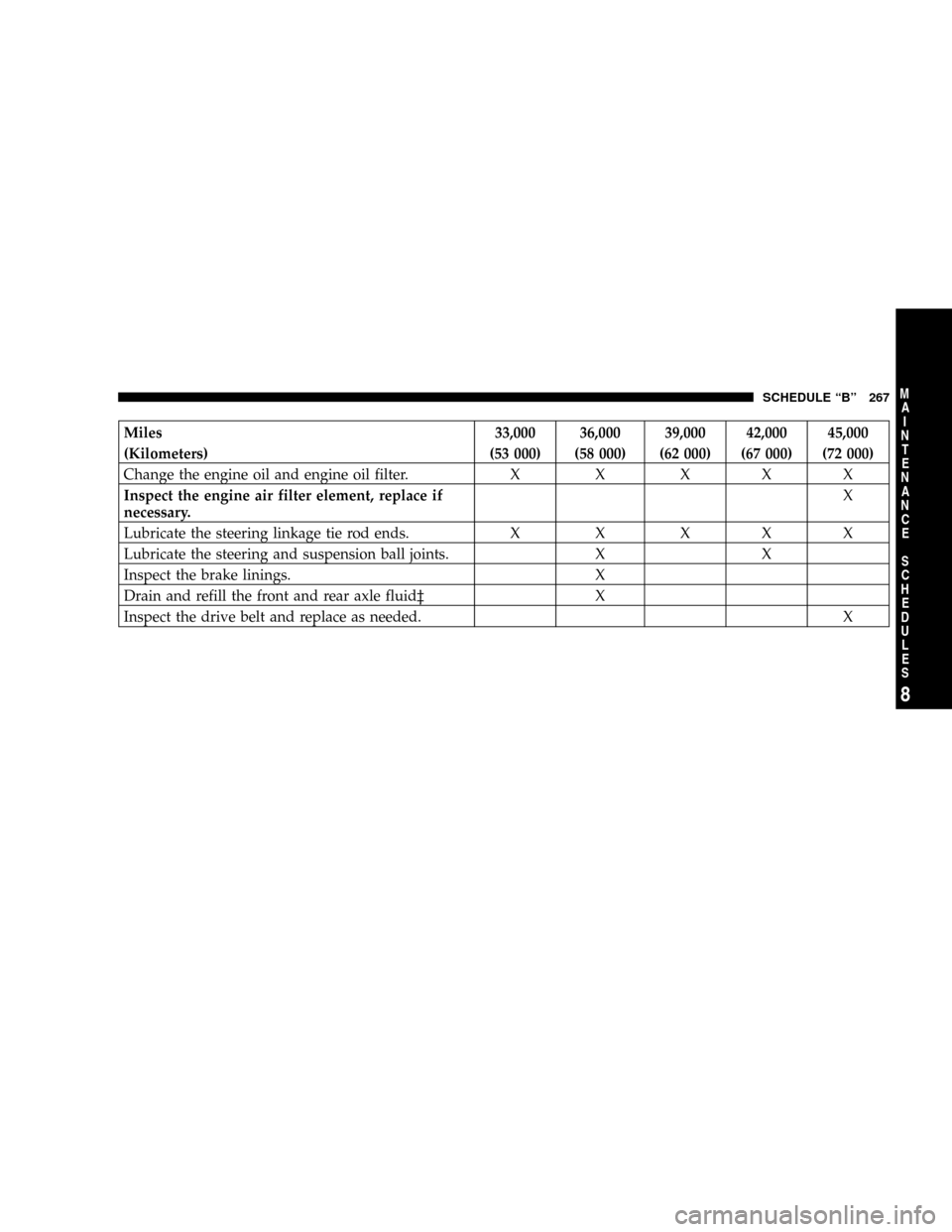
Miles 33,000 36,000 39,000 42,000 45,000
(Kilometers) (53 000) (58 000) (62 000) (67 000) (72 000)
Change the engine oil and engine oil filter. X X X X X
Inspect the engine air filter element, replace if
necessary.X
Lubricate the steering linkage tie rod ends. X X X X X
Lubricate the steering and suspension ball joints. X X
Inspect the brake linings. X
Drain and refill the front and rear axle fluid³ X
Inspect the drive belt and replace as needed. X
SCHEDULE ªBº 267
8
M
A
I
N
T
E
N
A
N
C
E
S
C
H
E
D
U
L
E
S
Page 268 of 299
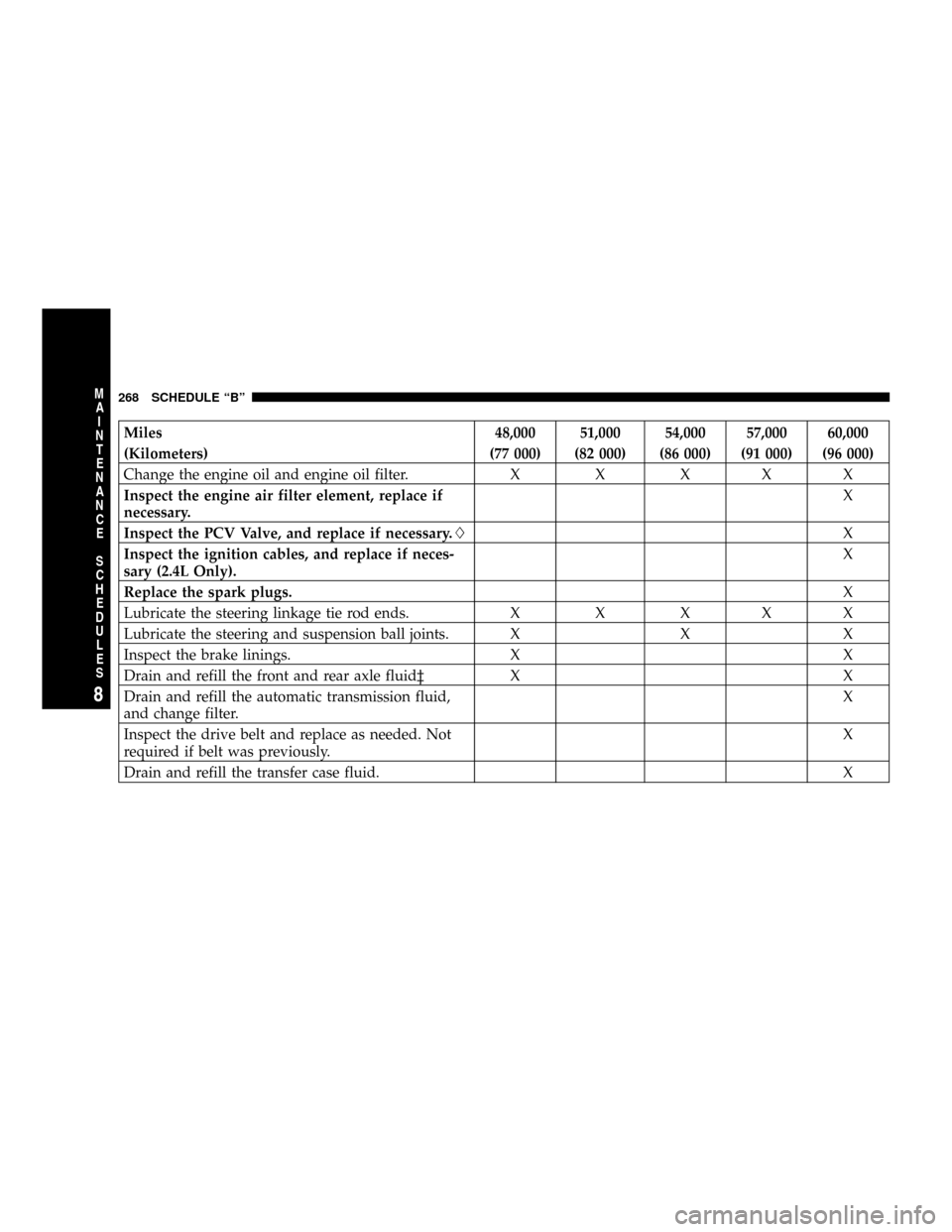
Miles 48,000 51,000 54,000 57,000 60,000
(Kilometers) (77 000) (82 000) (86 000) (91 000) (96 000)
Change the engine oil and engine oil filter. X X X X X
Inspect the engine air filter element, replace if
necessary.X
Inspect the PCV Valve, and replace if necessary.LX
Inspect the ignition cables, and replace if neces-
sary (2.4L Only).X
Replace the spark plugs.X
Lubricate the steering linkage tie rod ends. X X X X X
Lubricate the steering and suspension ball joints. X X X
Inspect the brake linings. X X
Drain and refill the front and rear axle fluid³ X X
Drain and refill the automatic transmission fluid,
and change filter.X
Inspect the drive belt and replace as needed. Not
required if belt was previously.X
Drain and refill the transfer case fluid. X
268 SCHEDULE ªBº
8
M
A
I
N
T
E
N
A
N
C
E
S
C
H
E
D
U
L
E
S